
Mini-cluster Guided Long-tailed Deep Clustering
Abstract
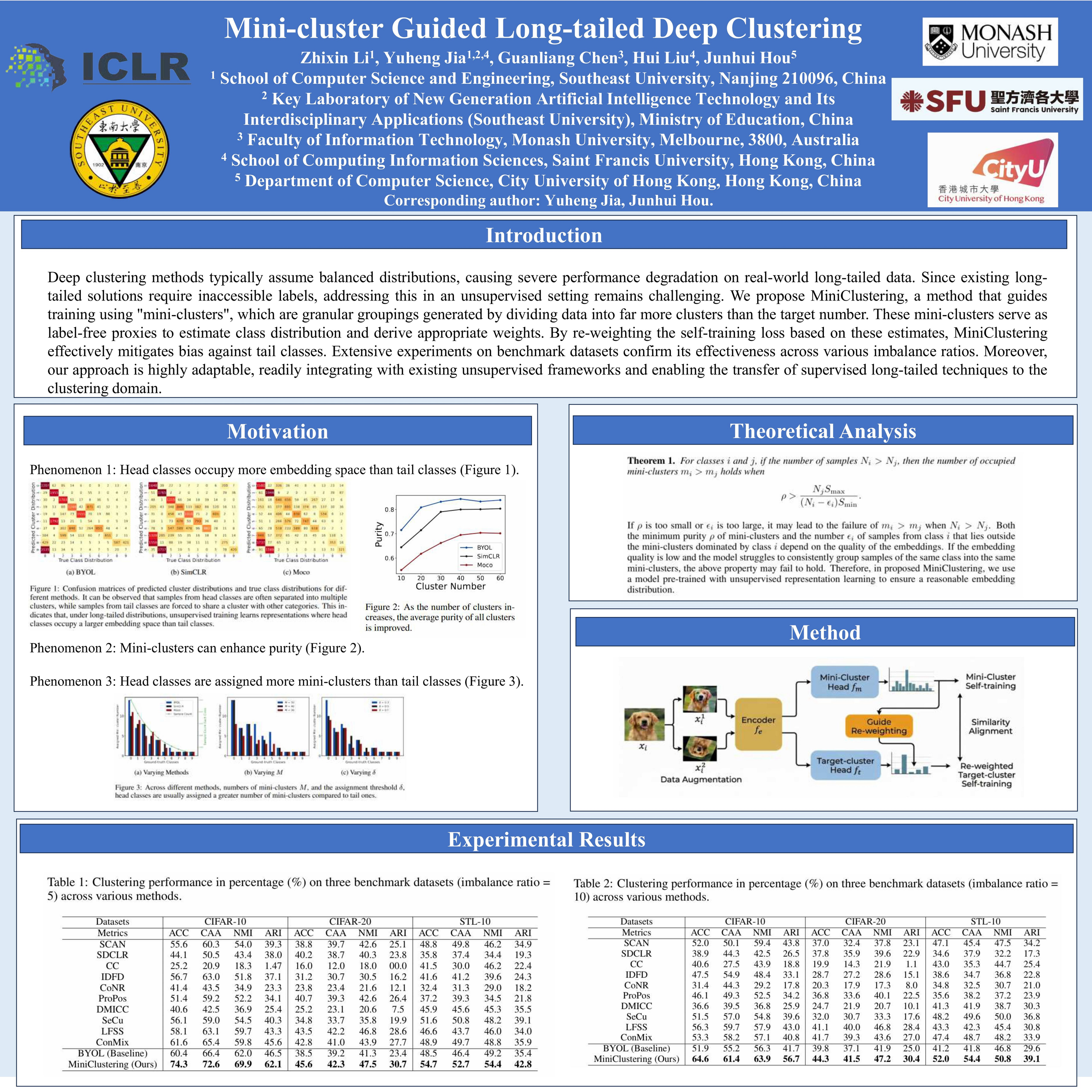
As an important branch of unsupervised learning, deep clustering has seen substantial progress in recent years. However, the majority of current deep clustering methods operate under the assumption of balanced or near-balanced cluster distributions. This assumption contradicts the common long-tailed class distributions in real-world data, leading to severe performance degradation in deep clustering. Although many long-tailed learning methods have been proposed, these approaches typically rely on label information to differentiate treatment across different classes, which renders them inapplicable to deep clustering scenarios. How to re-weight the training of deep clustering models in an unsupervised setting remains an open challenge. To address this, we propose a mini-cluster guided long-tailed deep clustering method, termed MiniClustering. We introduce a specialized clustering head that divide data into much more clusters than the target number of clusters. These predicted clusters are referred to as mini-clusters. The mini-cluster-level predictions serve as the guide for estimating the appropriate weights for classes with varying degrees of long-tailedness. The weights are then incorporated to re-weight the self-training loss in model training. In this way, we can mitigate model bias by re-weighting gradients from different classes. We evaluate our method on multiple benchmark datasets with different imbalance ratios to demonstrate its effectiveness. Further, our method can be readily applied to the downstream of existing unsupervised representation learning frameworks for long-tailed deep clustering. It can also adapt label-dependent long-tailed learning methods to unsupervised clustering tasks by leveraging the estimated weights. The code is available at https://github.com/LZX-001/MiniClustering.