
ProReGen: Progressive Residual Generation under Attribute Correlations
Ruby Shrestha ⋅ Ajay Gopi ⋅ Casey Meisenzahl ⋅ Bipin Lekhak ⋅ Linwei Wang
Abstract
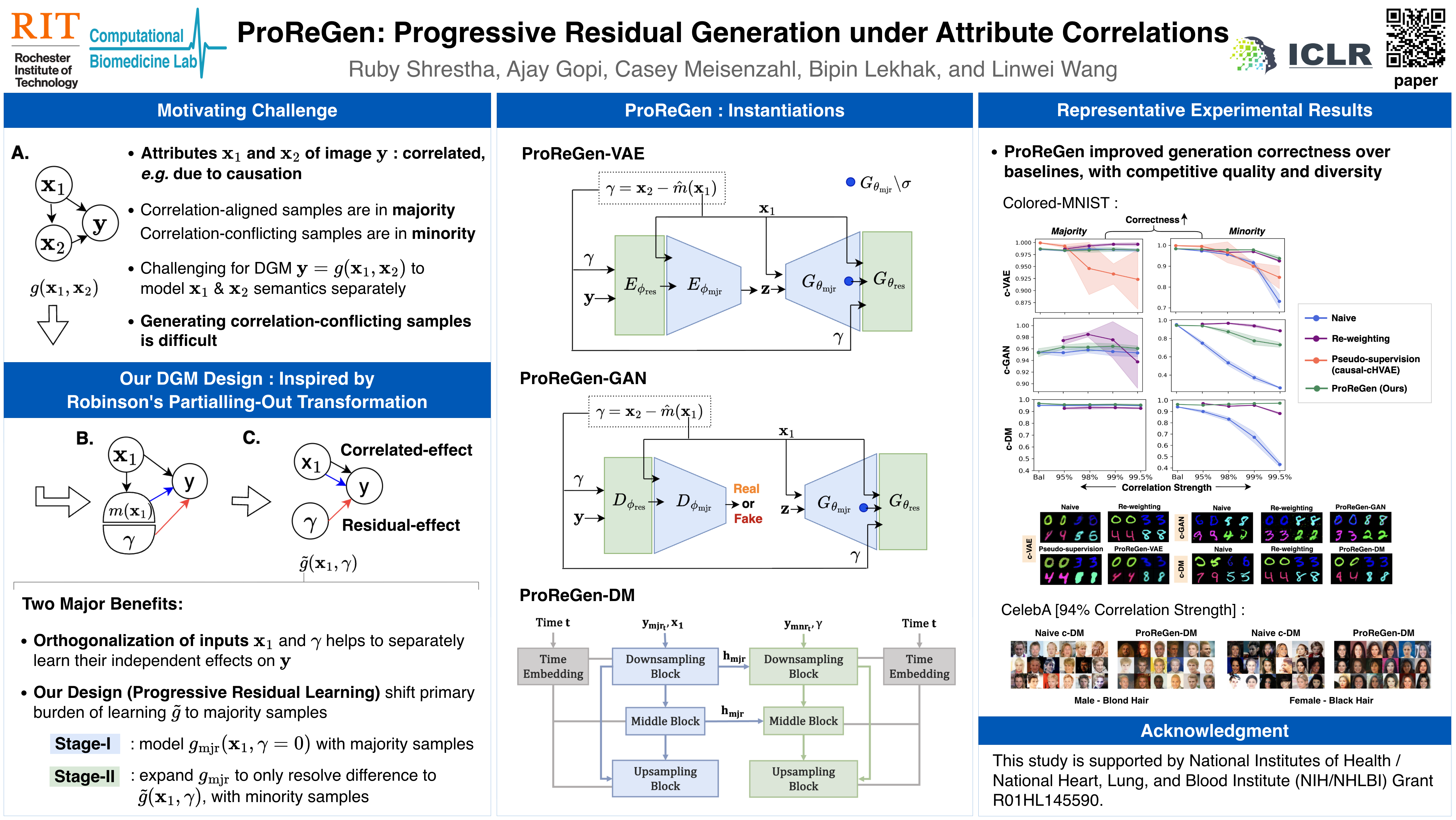
Attribute correlations in the training data will compromise the ability of a deep generative model (DGM) to synthesize images with under-represented attribute combinations ($\textit{i.e.,}$ minority samples). Existing approaches mitigate this by data re-sampling to remove attribute correlations seen by the DGM, using a classifier to provide $\textit{pseudo-supervision}$ on generated counterfactual samples, or incorporating inductive bias to explicitly decompose the generation into independent sub-mechanisms. We present ProReGen, a $\textit{progressive residual generation}$ approach inspired by the classical Robinson's transformation, to partial out from an image attribute $\mathbf{x}_2$ its component $m(\mathbf{x}_1)$ that is predictable by other image attributes $\mathbf{x}_1$, and the residual $\gamma = \mathbf{x}_2 - m(\mathbf{x}_1)$ that is not. This simplifies the problem of learning a DGM $g(\mathbf{x}_1, \mathbf{x}_2)$ conditioned on correlated inputs, to learning $\tilde{g}(\mathbf{x}_1, \gamma)$ conditioned on orthogonal inputs. It further allows us to progressively learn $\tilde{g}$ by first shifting the burden to abundant majority samples to learn $\tilde{g}(\mathbf{x}_1, \gamma = 0)$, and then expanding it with additional layers $g\_{\text{res}}$ to resolve its difference to $\tilde{g}(\mathbf{x}_1, \gamma)$ using residual attribute $\gamma$ on limited minority samples. On three benchmark datasets with curated varying strengths of attribute correlation and one dataset with natural attribute correlation, we demonstrate that ProReGen---with input orthogonalization and progressive residual learning---improved the correctness of minority generations compared to existing strategies.
Video
Chat is not available.
Successful Page Load