
Random-projection ensemble dimension reduction
Abstract
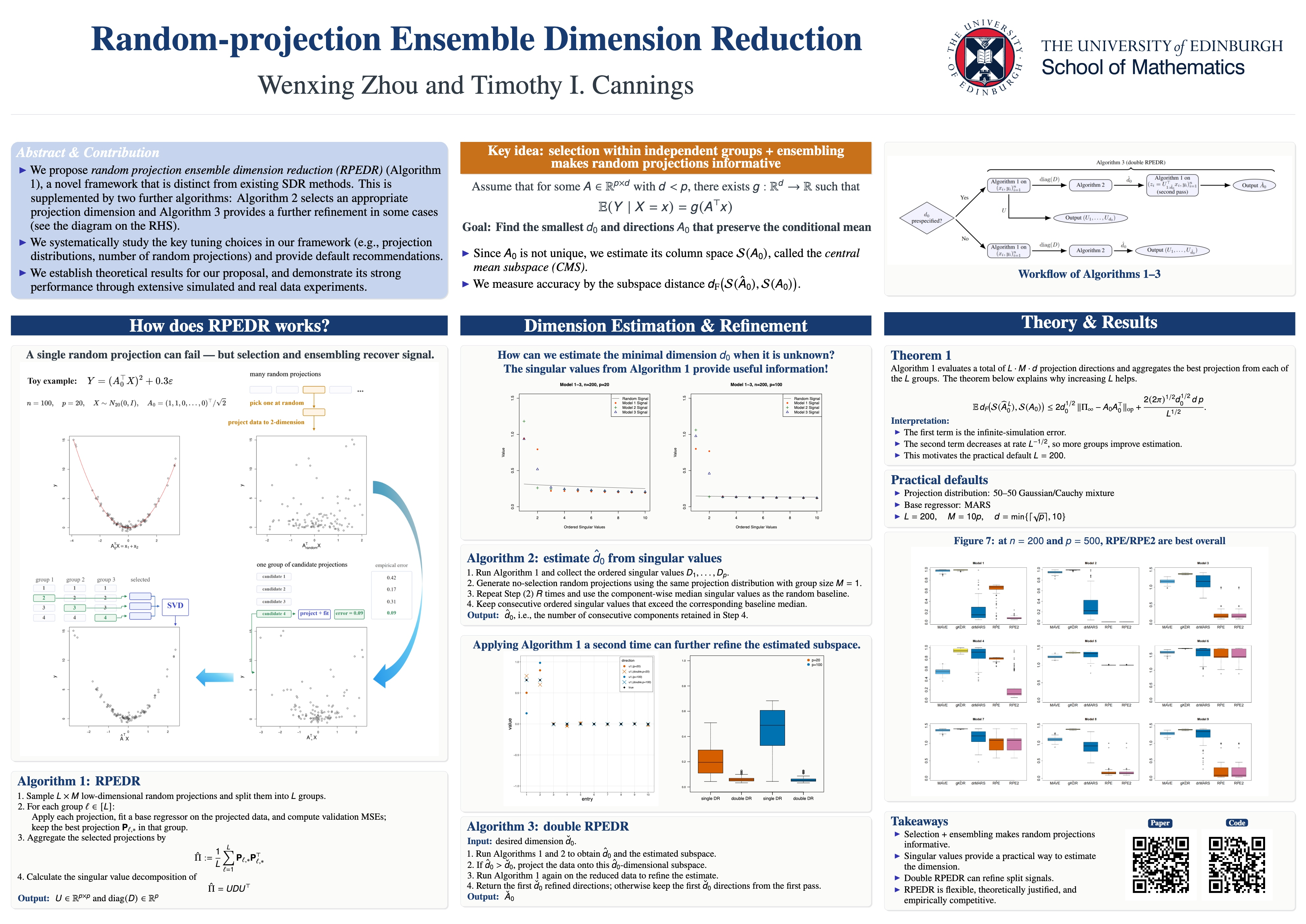
We introduce a new, flexible, and theoretically justified framework for dimension reduction in high-dimensional regression, based on an ensemble of random projections. Specifically, we consider disjoint groups of independent random projections, retain the best projection in each group according to the empirical regression performance on the projected covariates, and then aggregate the selected projections via singular value decomposition. The singular values quantify the relative importance of corresponding projection directions and guide the dimension selection process. We investigate various aspects of our framework, including the choice of projection distribution and the number of projections used. Our theoretical results show that the expected estimation error decreases as the number of groups of projections increases. Finally, we demonstrate that our proposal consistently matches or outperforms state-of-the-art methods through extensive numerical studies on simulated and real data.