
LoC-Decomp: LLM Autoformalization via Logical Concept Decomposition and Iterative Feedback Correction
Abstract
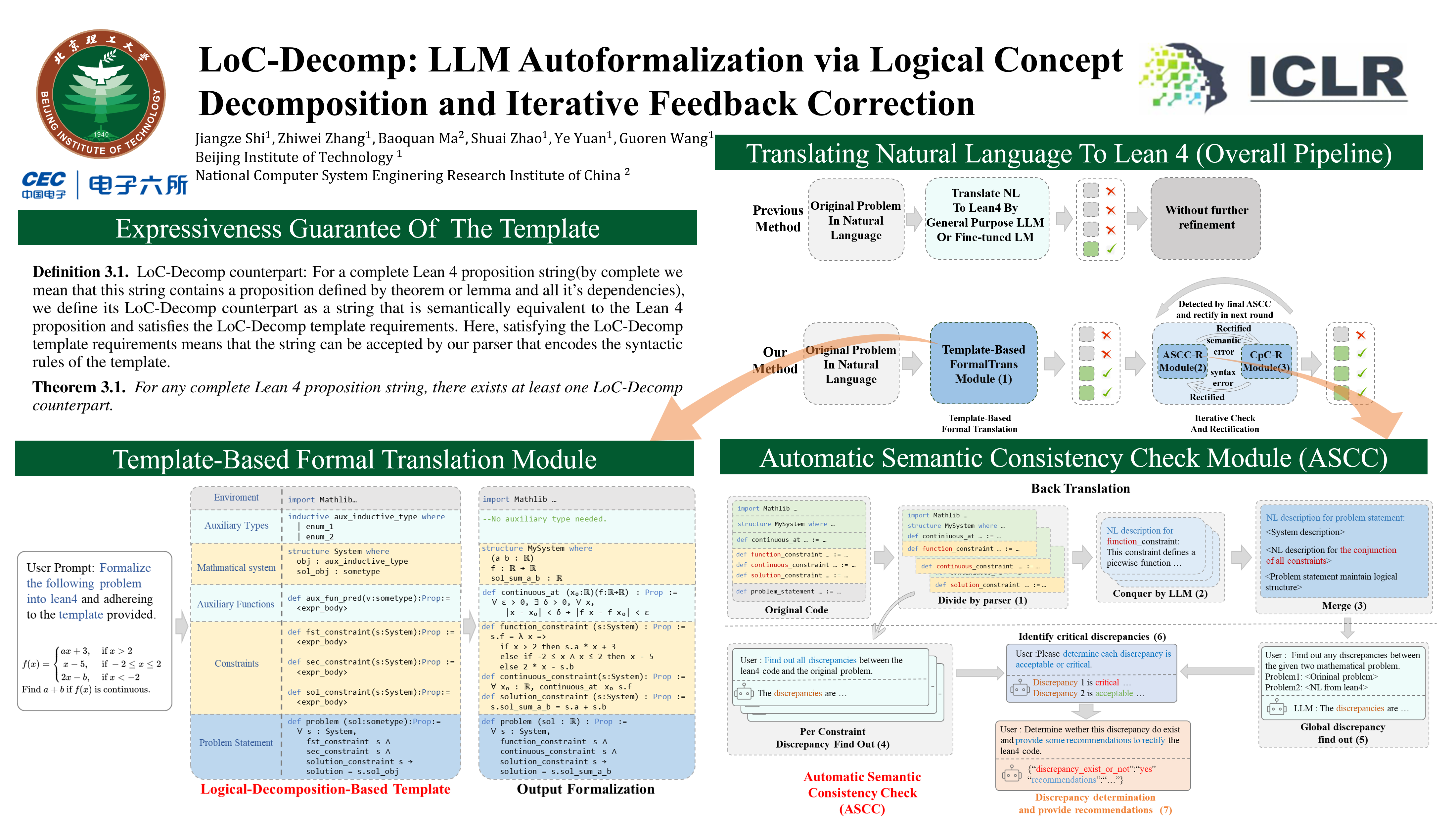
Autoformalization—the process of converting natural language mathematical statements into machine-verifiable formal code—plays a critical role in ensuring the reliability of mathematical reasoning generated by large language models (LLMs). Recent studies show that LLMs exhibit strong potential in automating this process, producing formal code for systems such as Lean 4, Coq, and Isabelle. Despite prominent advances, existing LLM-based autoformalization methods remain limited: they lack the ability to provide reliable semantic consistency checks to ensure that the formal code accurately preserves the meaning of the original statement. Furthermore, such methods are unable to support iterative improvement through corrective feedback. To address these limitations, we propose Loc-Decomp, a novel framework that integrates an automatic semantic consistency checker and the Lean 4 compiler to iteratively refine LLM-generated formalizations, ensuring both semantic consistency and syntactic correctness. Our approach introduces three key innovations: (1) A structured and COT-like formalization template that decomposes complex formalization tasks into modular, foundational components, and systematically assembles them—like building blocks—into a complete formal expression. (2) A semantic self-checking mechanism based on a divide-conquer-merge strategy to detect subtle inconsistencies between the formalization and the original statement. (3) An iterative feedback-driven refinement loop that leverages both semantic and syntactic error signals to guide the LLM in progressively improving the formal output. By integrating these innovations, Loc-Decomp significantly enhances the accuracy of LLM-driven formalization, reduces reliance on human intervention, and moves closer to truly reliable automated reasoning. Extensive experiments on high-school-level and undergraduate-level datasets demonstrate that our approach achieves a significantly higher formalization success rate compared to baseline methods and state-of-the-art (SOTA) models. On the PutnamBench dataset, for instance, our method attains a success rate of 93.09\%, representing an improvement of 18 percentage points over the previous SOTA SFT-based model.