
DR-Submodular Maximization with Stochastic Biased Gradients: Classical and Quantum Gradient Algorithms
Shengminjie Chen ⋅ Xiaoming Sun ⋅ Wenguo Yang ⋅ Jialin Zhang ⋅ Zihan Zhao
Abstract
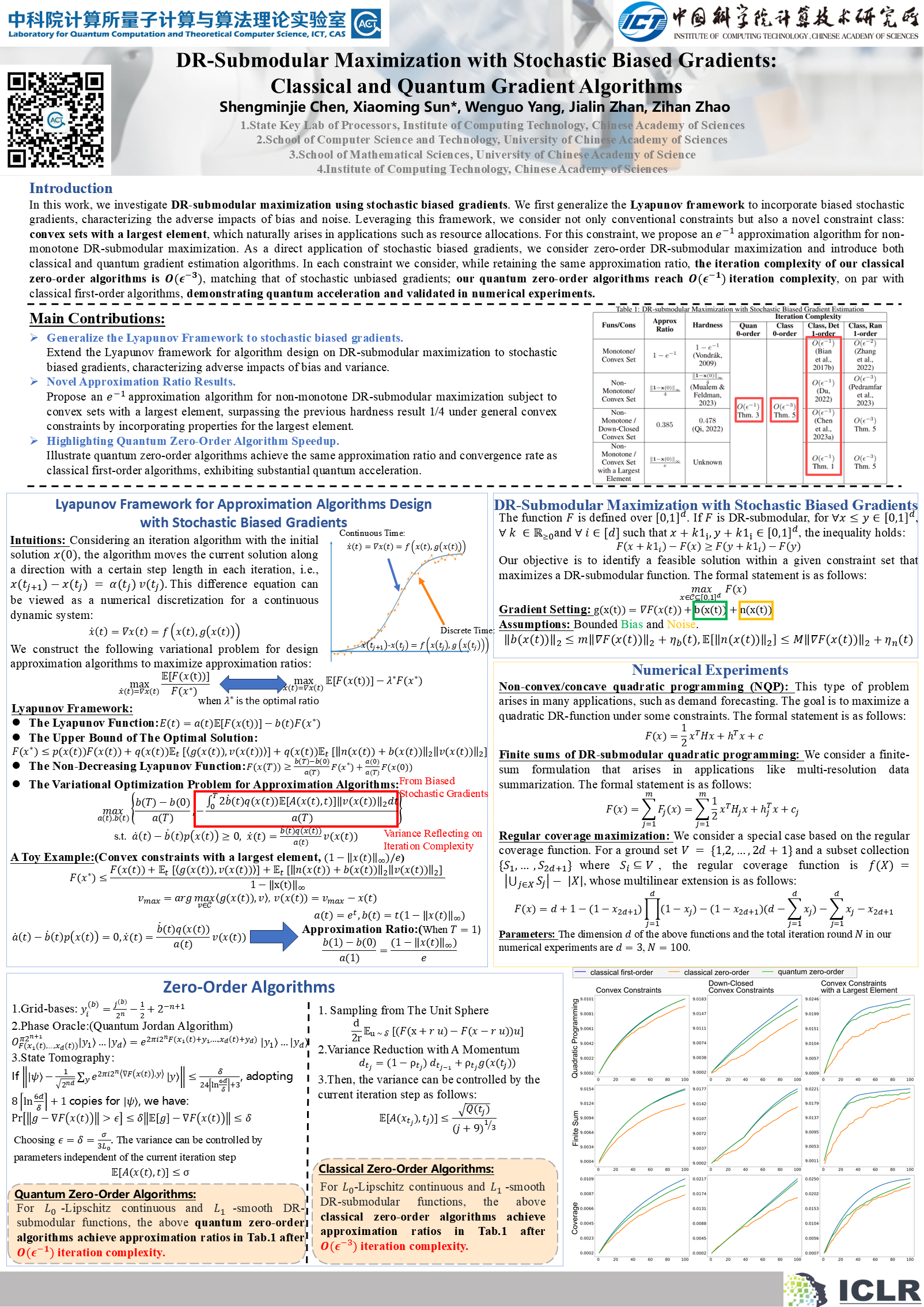
In this work, we investigate DR-submodular maximization using stochastic biased gradients, which is a more realistic but challenging setting than stochastic unbiased gradients. We first generalize the Lyapunov framework to incorporate biased stochastic gradients, characterizing the adverse impacts of bias and noise. Leveraging this framework, we consider not only conventional constraints but also a novel constraint class: convex sets with a largest element, which naturally arises in applications such as resource allocations. For this constraint, we propose an $1/e$ approximation algorithm for non-monotone DR-submodular maximization, surpassing the hardness result $1/4$ for general convex constraints. As a direct application of stochastic biased gradients, we consider zero-order DR-submodular maximization and introduce both classical and quantum gradient estimation algorithms. In each constraint we consider, while retaining the same approximation ratio, the iteration complexity of our classical zero-order algorithms is $O(\epsilon^{-3})$, matching that of stochastic unbiased gradients; our quantum zero-order algorithms reach $O(\epsilon^{-1})$ iteration complexity, on par with classical first-order algorithms, demonstrating quantum acceleration and validated in numerical experiments.
Video
Chat is not available.
Successful Page Load