
Orbital Transformers for Predicting Wavefunctions in Time-Dependent Density Functional Theory
Abstract
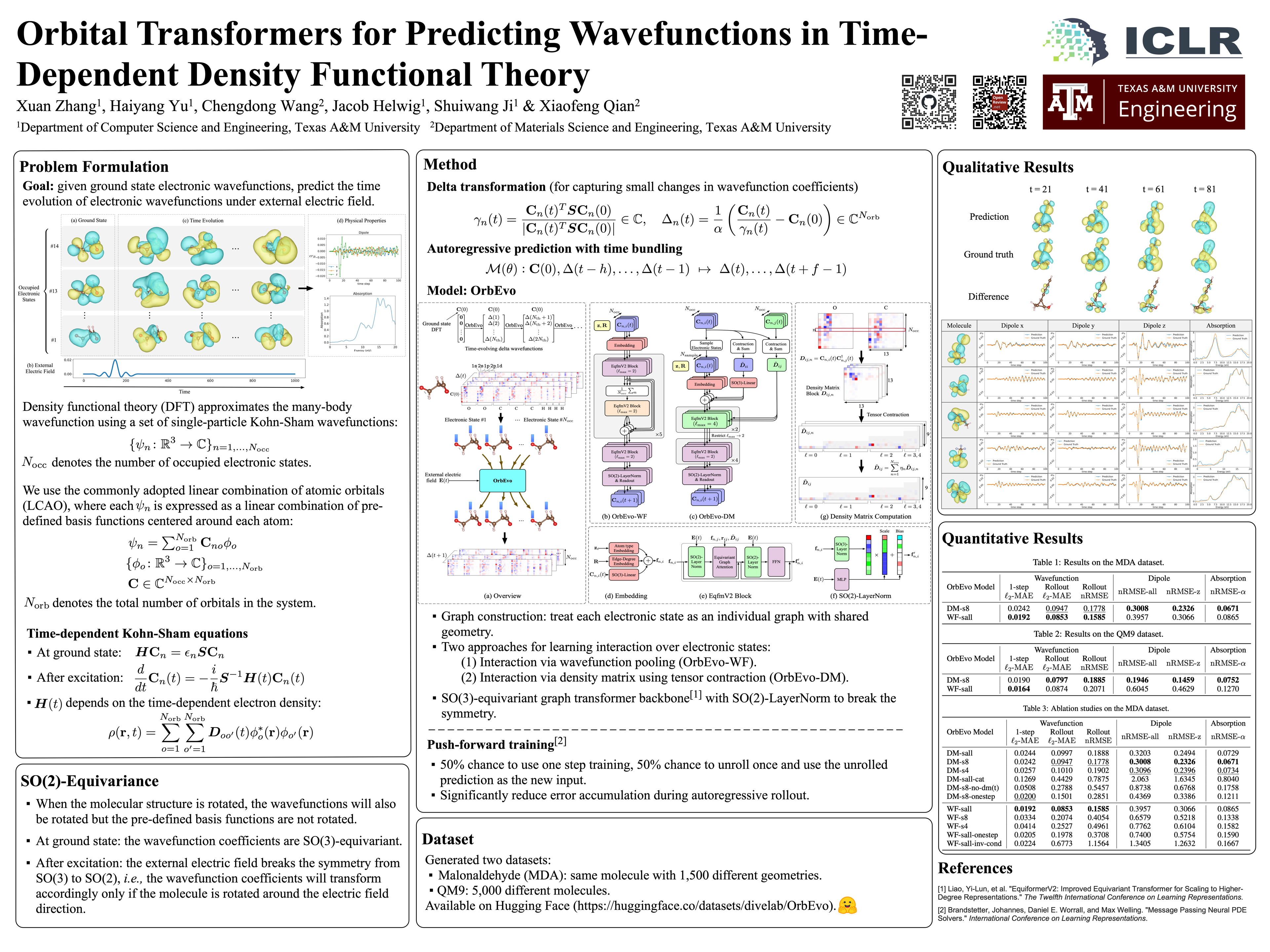
We aim to learn wavefunctions simulated by time-dependent density functional theory (TDDFT), which can be efficiently represented as linear combination coefficients of atomic orbitals. In real-time TDDFT, the electronic wavefunctions of a molecule evolve over time in response to an external excitation, enabling first-principles predictions of physical properties such as optical absorption, electron dynamics, and high-order response. However, conventional real-time TDDFT relies on time-consuming propagation of all occupied states with fine time steps. In this work, we propose OrbEvo, which is based on an equivariant graph transformer architecture and learns to evolve the full electronic wavefunction coefficients across time steps. First, to account for external field, we design an equivariant conditioning to encode both strength and direction of external electric field and break the symmetry from SO(3) to SO(2). Furthermore, we design two OrbEvo models, OrbEvo-WF and OrbEvo-DM, using wavefunction pooling and density matrix as interaction method, respectively. Motivated by the central role of the density functional in TDDFT, OrbEvo-DM encodes the density matrix aggregated from all occupied electronic states into feature vectors via tensor contraction, providing a more intuitive approach to learn the time evolution operator. We adopt a training strategy specifically tailored to limit the error accumulation of time-dependent wavefunctions over autoregressive rollout. To evaluate our approach, we generate TDDFT datasets consisting of 5,000 different molecules in the QM9 dataset and 1,500 molecular configurations of the malonaldehyde molecule in the MD17 dataset. Results show that our OrbEvo model accurately captures quantum dynamics of excited states under external field, including time-dependent wavefunctions, time-dependent dipole moment, and optical absorption spectra characterized by dipole oscillator strength. It also shows strong generalization capability on the diverse molecules in the QM9 dataset. Our dataset is available at https://huggingface.co/divelab, and our code is available as part of the AIRS library https://github.com/divelab/AIRS/.