
Activity-Based Recommendations for the Reduction of CO2 Emissions in Private Households
Alona Zharova ⋅ Laura Löschmann
Keywords:
Power and energy systems
Classification, regression, and supervised learning
Buildings
recommender systems
Abstract
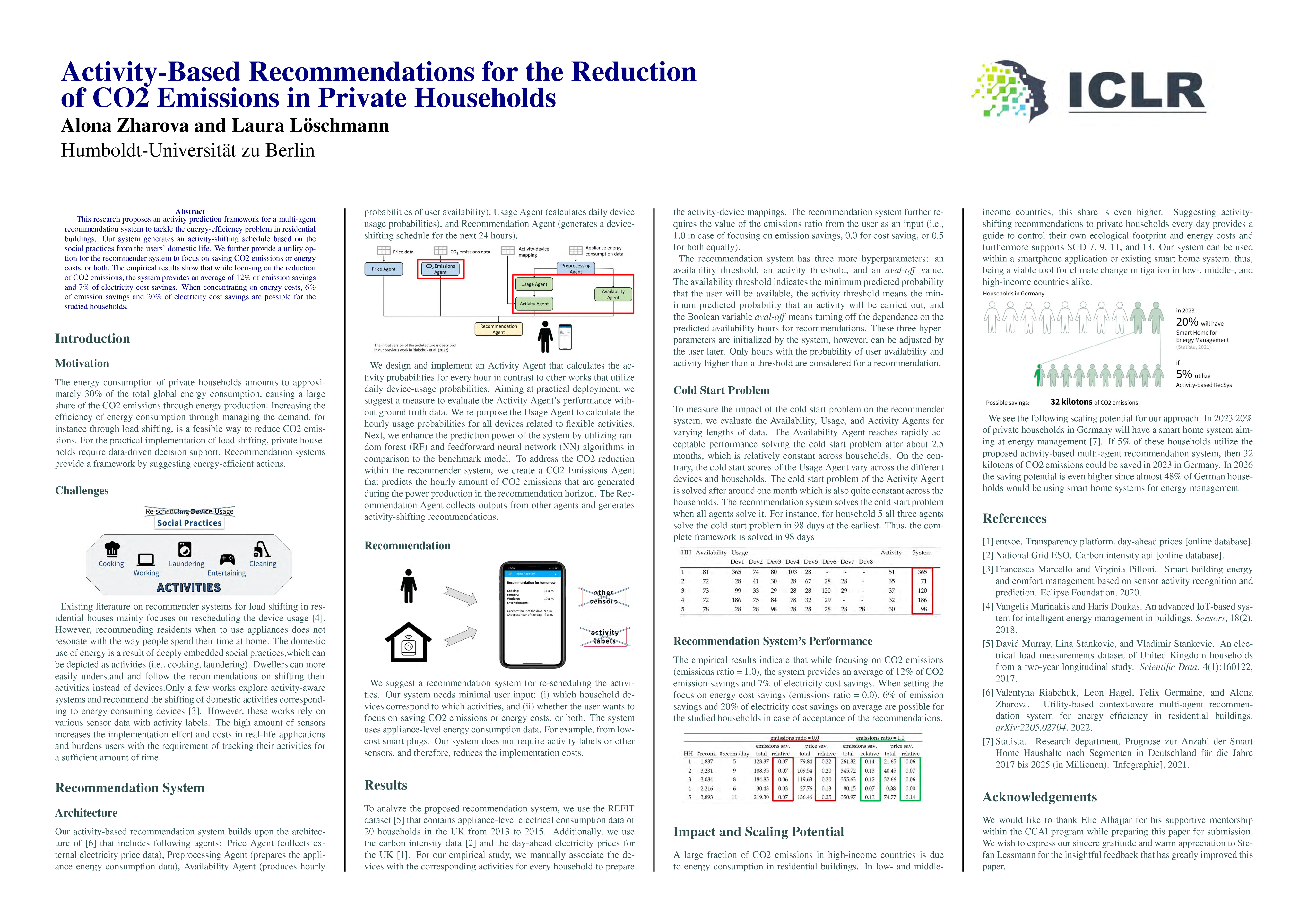
This paper proposes an activity prediction framework for a multi-agent recommendation system to tackle the energy-efficiency problem in residential buildings. Our system generates an activity-shifting schedule based on the social practices from the users’ domestic life. We further provide a utility option for the recommender system to focus on saving CO2 emissions or energy costs, or both. The empirical results show that while focusing on the reduction of CO2 emissions, the system provides an average of 12% of emission savings and 7% of electricity cost savings. When concentrating on energy costs, 6% of emission savings and 20% of electricity cost savings are possible for the studied households.
Video
Chat is not available.
Successful Page Load