
Explainability of predictive uncertainty models under drift in the telecom domain
Abstract
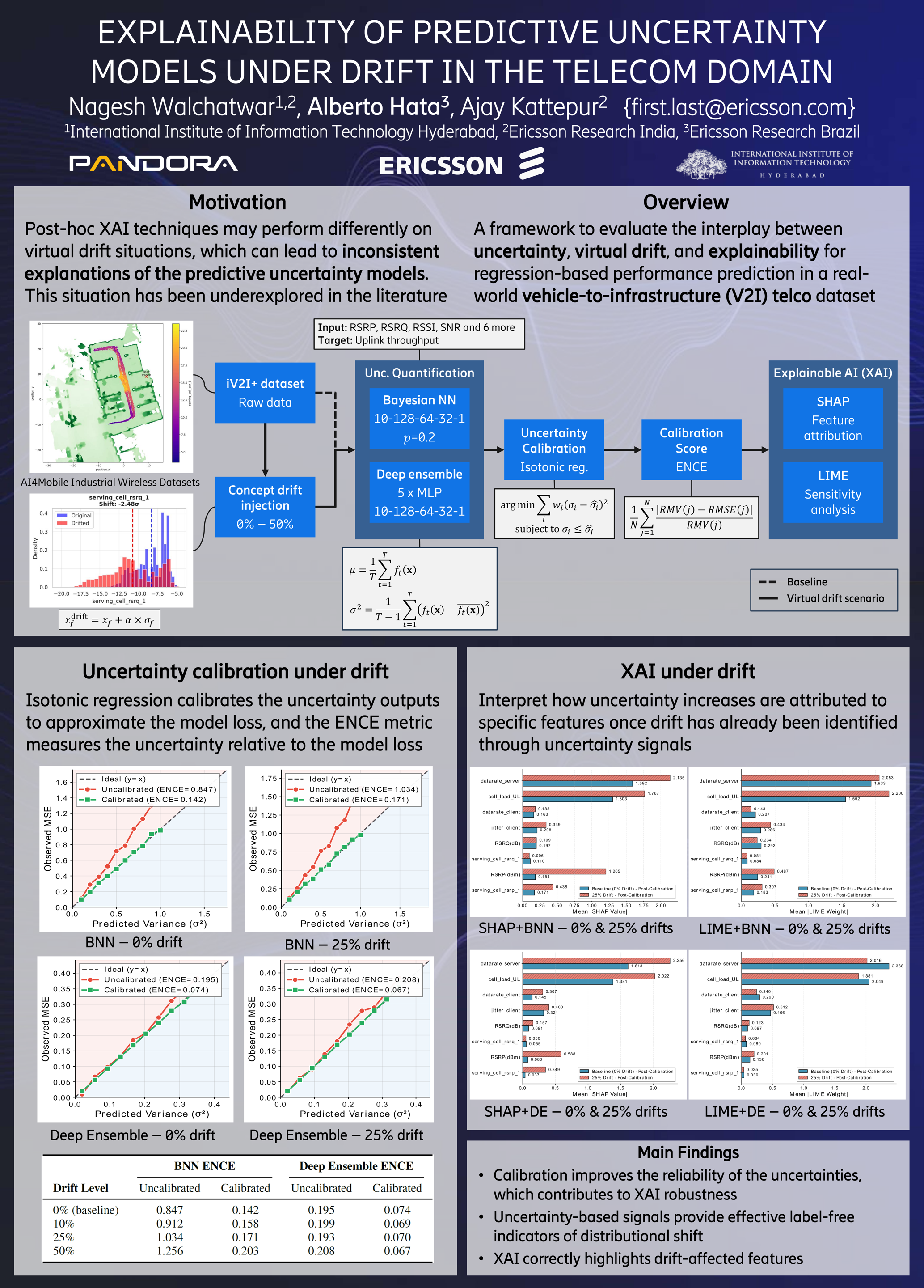
Machine learning models deployed in dynamic environments are prone to distributional shifts that degrade predictive reliability. While uncertainty quantification and drift detection are widely studied, their interaction with explainability remains insufficiently understood, particularly for regression tasks under covariate shift. This paper presents a unified experimental framework that integrates uncertainty quantification, calibration, drift analysis, and explainable AI (XAI) for regression models in a real-world telecommunications setting. We evaluate Bayesian neural networks (BNNs) with Monte Carlo Dropout and deep ensembles, quantifying predictive uncertainty using variance and assessing calibration quality via Expected Normalized Calibration Error. Through controlled covariate drift experiments on a real-world vehicle-to-infrastructure (V2I) communication dataset, we analyze how uncertainty degradation and calibration breakdown are reflected in explanation behavior using SHAP. The results show that BNNs exhibit higher sensitivity to drift through pronounced increases in predictive uncertainty, while ensemble models provide more stable but less adaptive estimates. Importantly, explanation patterns consistently track uncertainty degradation. A finding that has not previously been demonstrated for regression tasks under covariate drift in telecom settings, which highlights XAI as a principled diagnostic tool for drift-aware model monitoring and lifecycle management in non-stationary environments.