
DamoFD: Digging into Backbone Design on Face Detection
Abstract
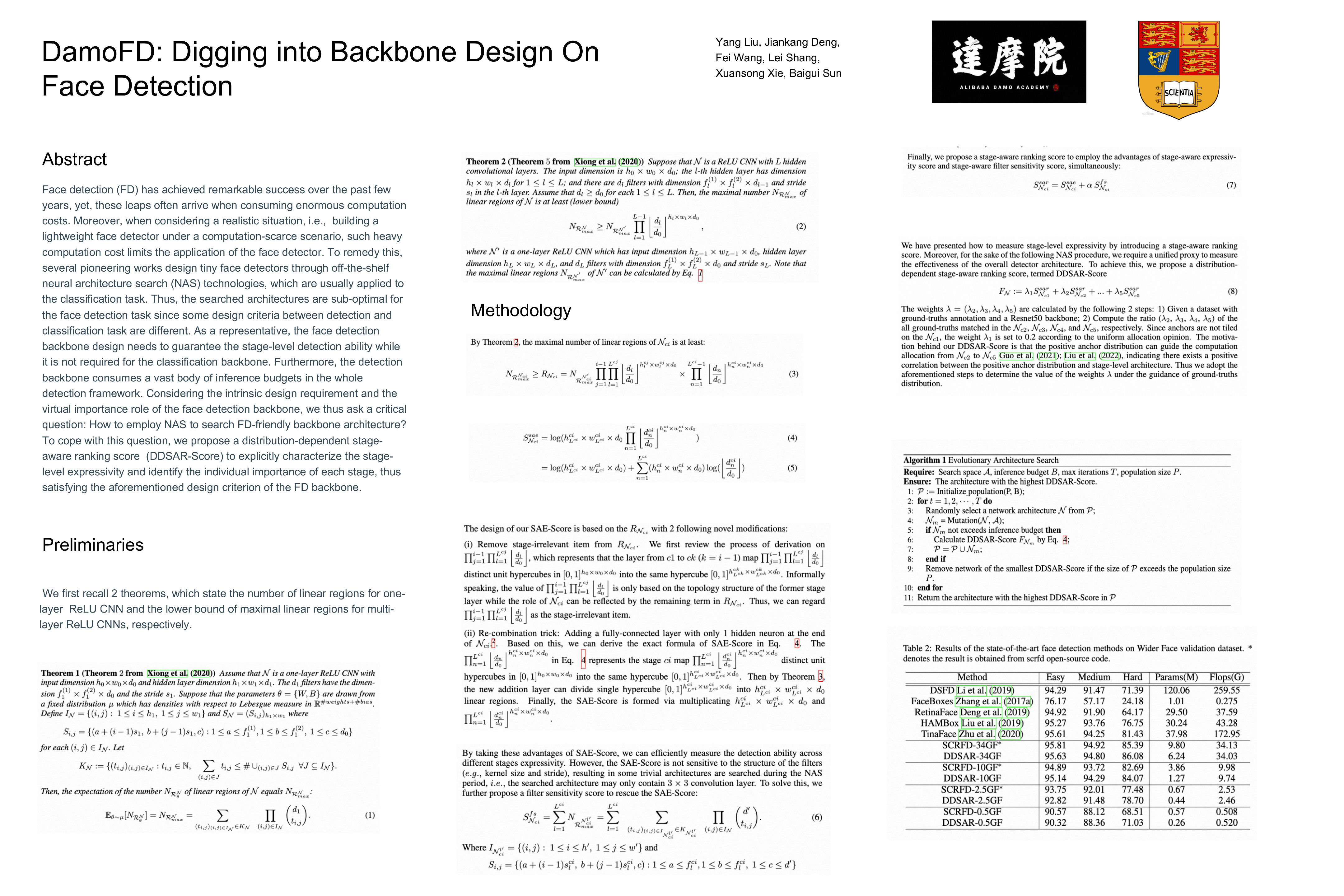
Face detection (FD) has achieved remarkable success over the past few years, yet,these leaps often arrive when consuming enormous computation costs. Moreover,when considering a realistic situation, i.e., building a lightweight face detectorunder a computation-scarce scenario, such heavy computation cost limits the applicationof the face detector. To remedy this, several pioneering works designtiny face detectors through off-the-shelf neural architecture search (NAS) technologies,which are usually applied to the classification task. Thus, the searchedarchitectures are sub-optimal for the face detection task since some design criteriabetween detection and classification task are different. As a representative, theface detection backbone design needs to guarantee the stage-level detection abilitywhile it is not required for the classification backbone. Furthermore, the detectionbackbone consumes a vast body of inference budgets in the whole detection framework.Considering the intrinsic design requirement and the virtual importance roleof the face detection backbone, we thus ask a critical question: How to employNAS to search FD-friendly backbone architecture? To cope with this question,we propose a distribution-dependent stage-aware ranking score (DDSAR-Score)to explicitly characterize the stage-level expressivity and identify the individualimportance of each stage, thus satisfying the aforementioned design criterion ofthe FD backbone. Based on our proposed DDSAR-Score, we conduct comprehensiveexperiments on the challenging Wider Face benchmark dataset and achievedominant performance across a wide range of compute regimes. In particular,compared to the tiniest face detector SCRFD-0.5GF, our method is +2.5 % betterin Average Precision (AP) score when using the same amount of FLOPs. Thecode is avaliable at https://github.com/ly19965/FaceMaas/tree/master/faceproject/facedetection/DamoFD.