
Poster Session
Poster Session 6 Pavilion 3
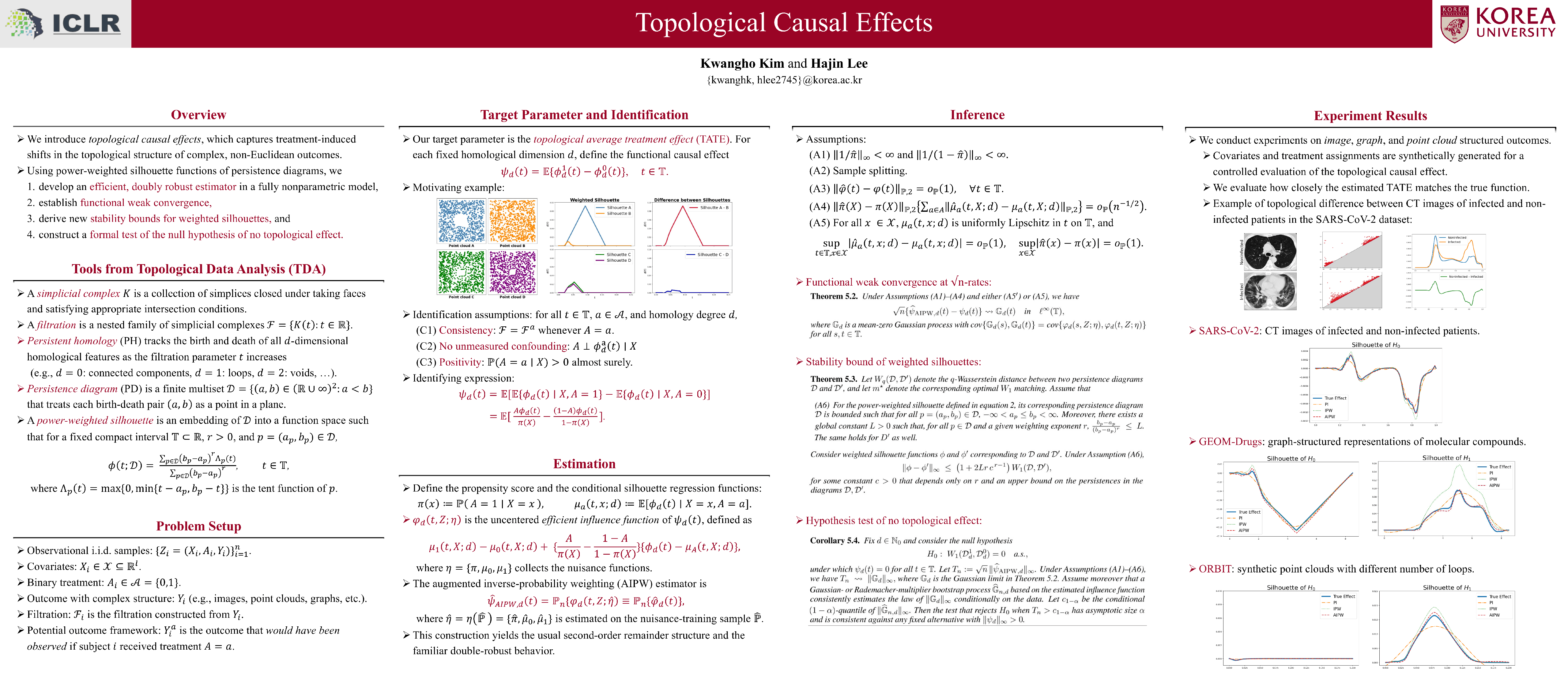
Estimating causal effects is particularly challenging when outcomes arise in complex, non-Euclidean spaces, where conventional methods often fail to capture meaningful structural variation. We develop a framework for topological causal inference that defines treatment effects through differences in the topological structure of potential outcomes, summarized by power-weighted silhouette functions of persistence diagrams. We develop an efficient, doubly robust estimator in a fully nonparametric model, establish functional weak convergence, and construct a formal test of the null hypothesis of no topological effect. Empirical studies illustrate that the proposed method reliably quantifies topological treatment effects across diverse complex outcome types.
Foundation Models for Causal Inference via Prior-Data Fitted Networks
Yuchen Ma ⋅ Dennis Frauen ⋅ Emil Javurek ⋅ Stefan Feuerriegel
Prior-data fitted networks (PFNs) have recently been proposed as a promising way to train tabular foundation models. PFNs are transformers that are pre-trained on synthetic data generated from a prespecified prior distribution and that enable Bayesian inference through in-context learning. In this paper, we introduce CausalFM, a comprehensive framework for training PFN-based foundation models in various causal inference settings. First, we formalize the construction of Bayesian priors for causal inference based on structural causal models (SCMs) in a principled way and derive necessary criteria for the validity of such priors. Building on this, we propose a novel family of prior distributions using causality-inspired Bayesian neural networks that enable CausalFM to perform Bayesian causal inference in various settings, including for back-door, front-door, and instrumental variable adjustment. Finally, we instantiate CausalFM and explicitly train models to perform in-context learning in these settings. We show that CausalFM achieves competitive in-context learning performance even when compared to baselines that are specifically trained for the task at hand. In sum, our framework can be used as a general recipe to train foundation models for various causal inference settings. In contrast to the current state-of-the-art in causal inference, CausalFM offers a novel paradigm with the potential to fundamentally change how practitioners perform causal inference in medicine, economics, and other disciplines.
Efficient Ensemble Conditional Independence Test Framework for Causal Discovery
Zhengkang Guan ⋅ Kun Kuang
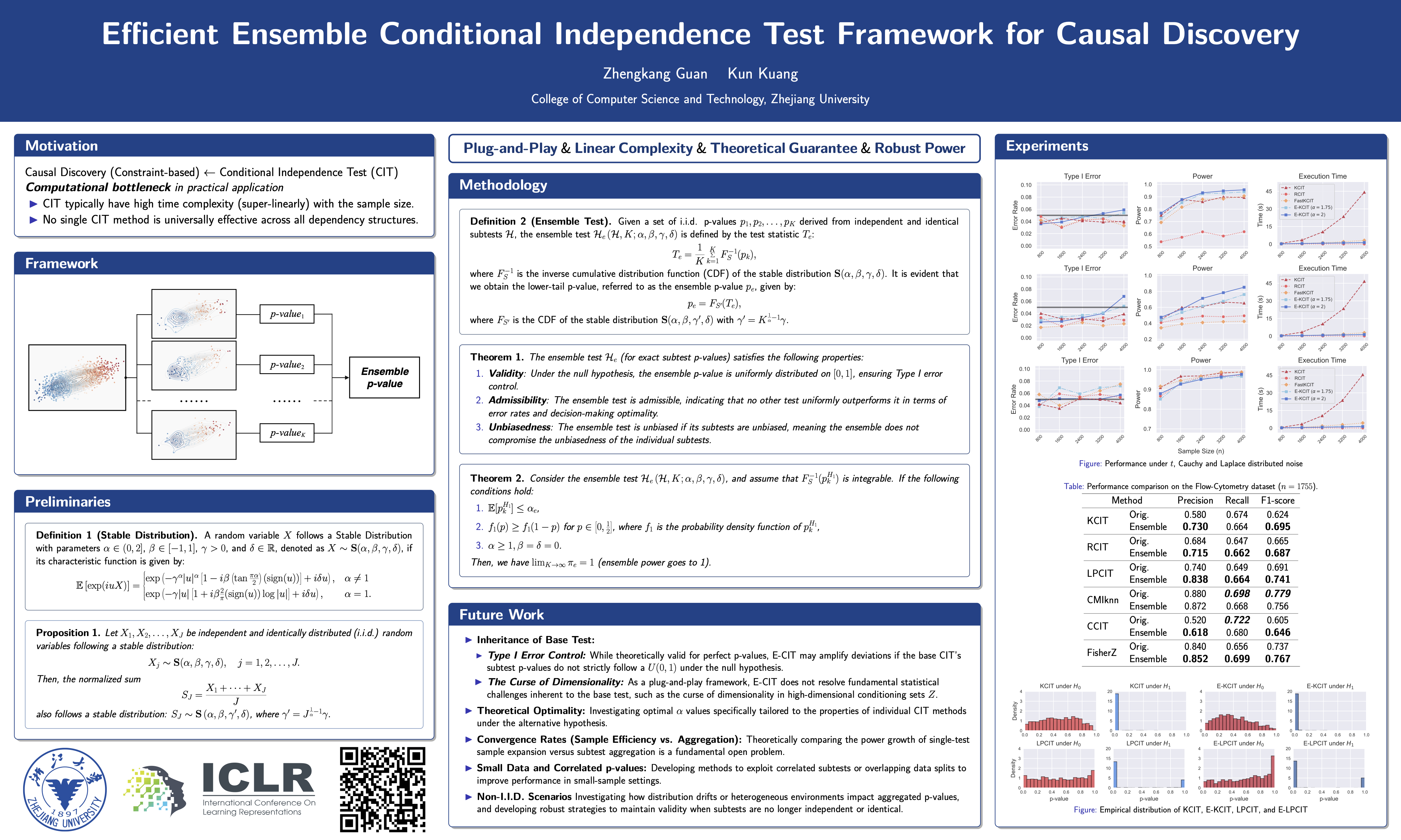
Constraint-based causal discovery relies on numerous conditional independence tests (CITs), but its practical applicability is severely constrained by the prohibitive computational cost, especially as CITs themselves have high time complexity with respect to the sample size. To address this key bottleneck, we introduce the Ensemble Conditional Independence Test (E-CIT), a general-purpose and plug-and-play framework. E-CIT operates on an intuitive divide-and-aggregate strategy: it partitions the data into subsets, applies a given base CIT independently to each subset, and aggregates the resulting p-values using a novel method grounded in the properties of stable distributions. This framework reduces the computational complexity of a base CIT to linear in the sample size when the subset size is fixed. Moreover, our tailored p-value combination method offers theoretical consistency guarantees under mild conditions on the subtests. Experimental results demonstrate that E-CIT not only significantly reduces the computational burden of CITs and causal discovery but also achieves competitive performance. Notably, it exhibits an improvement in complex testing scenarios, particularly on real-world datasets.
Executable Counterfactuals: Improving LLMs' Causal Reasoning Through Code
Aniket Vashishtha ⋅ Qirun Dai ⋅ Hongyuan Mei ⋅ Amit Sharma ⋅ Chenhao Tan ⋅ Hao Peng
Counterfactual reasoning, a hallmark of intelligence, consists of three steps: inferring latent variables from observations (abduction), constructing alternative situations (interventions), and predicting the outcomes of the alternatives (prediction). This skill is essential for advancing LLMs' causal understanding and expanding their applications in high-stakes domains such as scientific research and healthcare. However, existing efforts in assessing LLM's counterfactual reasoning capabilities tend to skip the abduction step, effectively reducing to interventional reasoning and leading to over-estimated LLM performance. To address this, we introduce executable counterfactuals, a novel framework that operationalizes causal reasoning through code and math problems. Our framework explicitly requires all three steps of counterfactual reasoning and enables scalable synthetic data creation with varying difficulty, creating a new frontier for evaluating and improving LLM's reasoning. Our results reveal substantial drop in accuracy (25-40%) from interventional to counterfactual reasoning for state-of-the-art models such as o4-mini and Claude-4-Sonnet. To address this gap, we construct a training set comprising counterfactual code problems having if-condition and test on out-of-distribution code structures (e.g., having while-loop); we also test whether a model trained on code would generalize to counterfactual math word problems. While Supervised Finetuning (SFT) on stronger models' reasoning traces improves in-distribution performance of Qwen models, it leads to a decrease in accuracy on out-of-distribution tasks such as counterfactual math problems. In contrast, reinforcement learning (RL) induces the core cognitive behaviors and generalizes to new distributions, yielding substantial accuracy gains over the base model on both code (improvement of 1.5x-2x) and counterfactual math problems. Analysis of the reasoning traces further reinforces these findings and highlights the promise of RL with scalable data generation for improving LLMs' counterfactual reasoning.
Modeling Interference for Treatment Effect Estimation in Network Dynamic Environment
Qiang Huang ⋅ Jin Tian
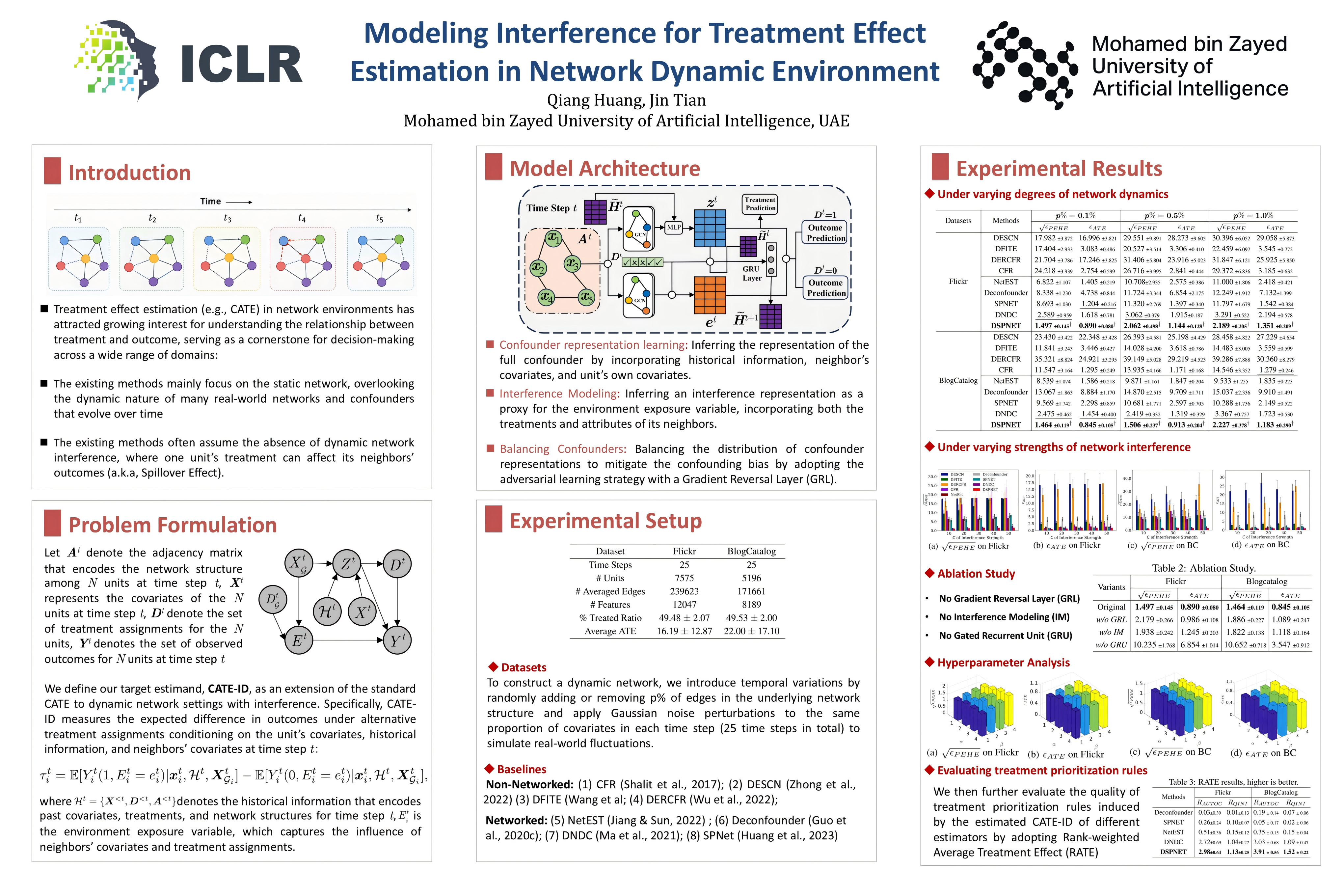
In recent years, estimating causal effects of treatment on the outcome variable in network environments has attracted growing interest. The intrinsic interconnectedness of network and the attendant violation of the SUTVA assumption have prompted a wave of treatment effect estimation methods tailored to network settings, yielding considerable progress such as capturing hidden confounders by leveraging auxiliary network structure. Nevertheless, despite these advances, the existing methods: (i) mainly focus on the static network, overlooking the dynamic nature of many real-world networks and confounders that evolve over time; (ii) assume the absence of dynamic network interference where one unit’s treatment can affect its neighbors’ outcomes. To address these two limitations, we first define a new estimand of treatment effects accounting for interference in a dynamic network environment, i.e., CATE-ID, and establish its identifiability under such an environment. Then we accordingly propose DSPNET, a framework tailored specifically for treatment effect estimation in dynamic network environment, that leverages historical information and network structure to capture time-varying confounders and model dynamic interference. Extensive experiments demonstrate the superiority of our proposed method compared to state-of-the-art approaches.
Generalization of RLVR Using Causal Reasoning as a Testbed
Zhichu Lu ⋅ Hongyu Zhao ⋅ Shuo Sun ⋅ Hao Peng ⋅ Rui Ding ⋅ Hongyuan Mei
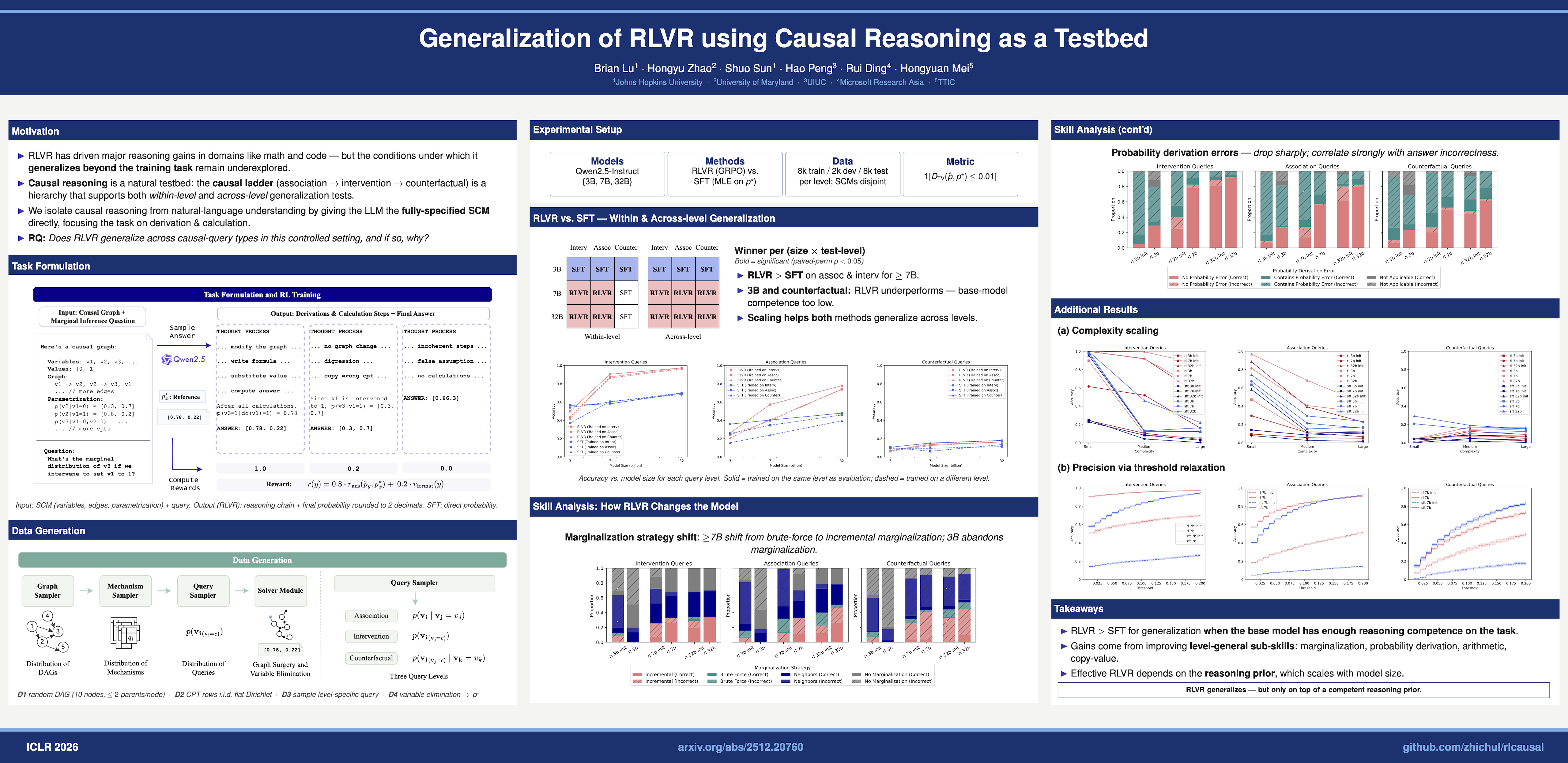
Reinforcement learning with verifiable rewards (RLVR) has emerged as a promising paradigm for post-training large language models (LLMs) on complex reasoning tasks. Yet, the conditions under which RLVR yields robust generalization remain underexplored. This paper provides an empirical study of RLVR generalization in the setting of probabilistic inference over causal graphical models. This setting offers two natural axes along which to examine generalization: (i) the level of the probabilistic query---associational, interventional, or counterfactual---and (ii) the structural complexity of the query, measured by the size of its relevant subgraph. We construct a dataset of causal graphs and queries spanning these difficulty axes and fine-tune Qwen-2.5-Instruct models using RLVR or supervised fine-tuning (SFT). We vary both the model scale (3B-32B) and the query level included in training. We find that RLVR yields stronger within-level and across-level generalization than SFT, but only for specific combinations of model size and training query level. Further analysis shows that RLVR's effectiveness depends on the model's initial reasoning competence. With sufficient initial competence, RLVR improves an LLM's marginalization strategy and reduces errors in intermediate probability calculations, producing substantial accuracy gains, particularly on more complex queries. These results show that RLVR can improve specific causal reasoning subskills, with its benefits emerging only when the model has sufficient initial competence. Our code and data is available at https://github.com/zhichul/rlcausal.
Identifiability Challenges in Sparse Linear Ordinary Differential Equations
Cecilia Casolo ⋅ Sören Becker ⋅ Niki Kilbertus
Dynamical systems modeling is a core pillar of scientific inquiry across natural and life sciences. Increasingly, dynamical system models are learned from data, rendering identifiability a paramount concept. For systems that are not identifiable from data, no guarantees can be given about their behavior under new conditions and inputs, or about possible control mechanisms to steer the system. It is known in the community that "linear ordinary differential equations (ODE) are almost surely identifiable from a single trajectory." However, this only holds for dense matrices. The sparse regime remains underexplored, despite its practical relevance with sparsity arising naturally in many biological, social, and physical systems. In this work, we address this gap by characterizing the identifiability of sparse linear ODEs. Contrary to the dense case, we show that sparse systems are unidentifiable with a positive probability in practically relevant sparsity regimes and provide lower bounds for this probability. We further study empirically how this theoretical unidentifiability manifests in state-of-the-art methods to estimate linear ODEs from data. Our results corroborate that sparse systems are also practically unidentifiable. Theoretical limitations are not resolved through inductive biases or optimization dynamics. Our findings call for rethinking what can be expected from data-driven dynamical system modeling and allows for quantitative assessments of how much to trust a learned linear ODE.
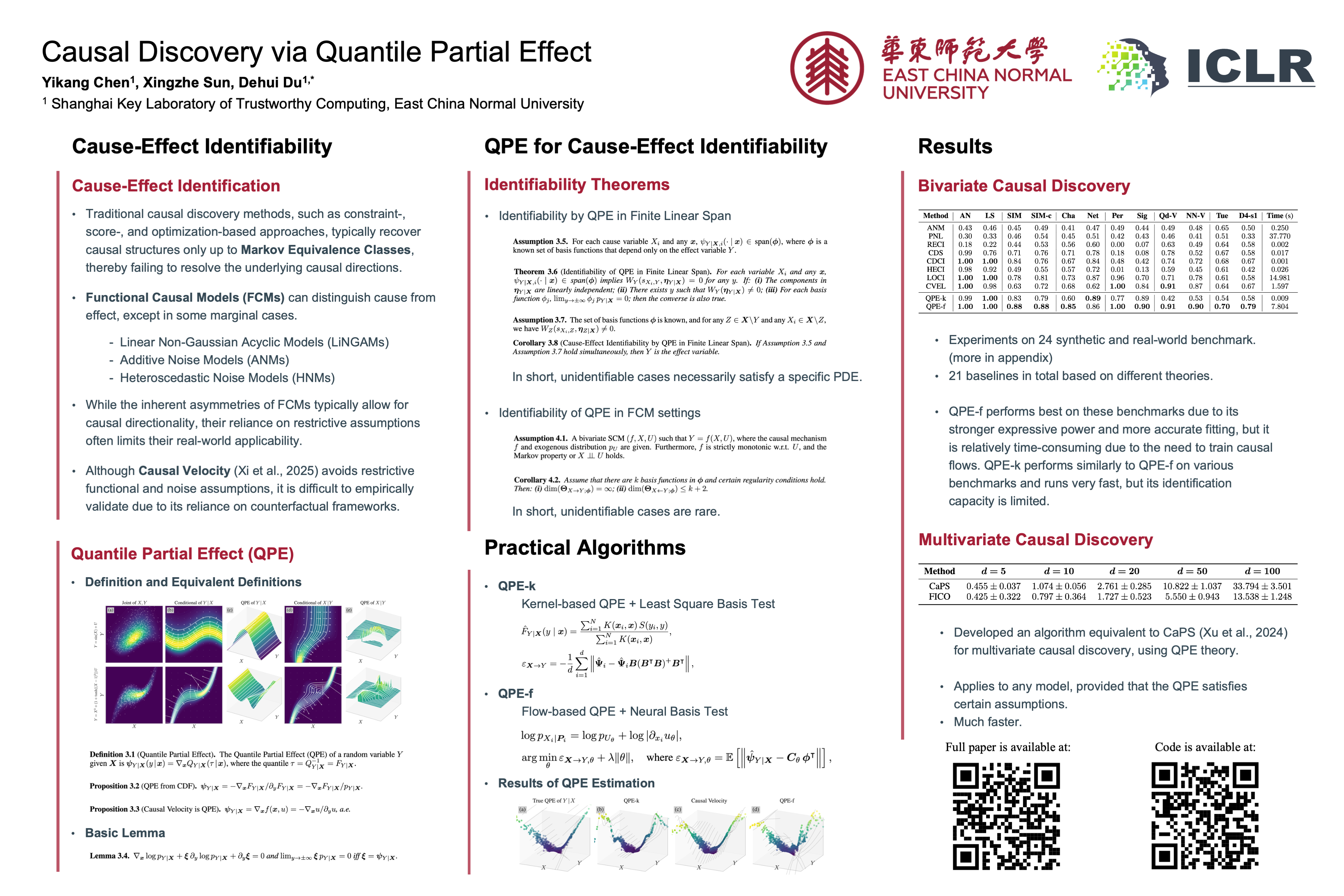
Quantile Partial Effect (QPE) is a statistic associated with conditional quantile regression, measuring the effect of covariates at different levels. Our theory demonstrates that when the QPE of cause on effect is assumed to lie in a finite linear span, cause and effect are identifiable from their observational distribution. This generalizes previous identifiability results based on Functional Causal Models (FCMs) with additive, heteroscedastic noise, etc. Meanwhile, since QPE resides entirely at the observational level, this parametric assumption does not require considering mechanisms, noise, or even the Markov assumption, but rather directly utilizes the asymmetry of shape characteristics in the observational distribution. By performing basis function tests on the estimated QPE, causal directions can be distinguished, which is empirically shown to be effective in experiments on a large number of bivariate causal discovery datasets. For multivariate causal discovery, leveraging the close connection between QPE and score functions, we find that Fisher Information is sufficient as a statistical measure to determine causal order when assumptions are made about the second moment of QPE. We validate the feasibility of using Fisher Information to identify causal order on multiple synthetic and real-world multivariate causal discovery datasets.
I Predict Therefore I Am: Is Next Token Prediction Enough to Learn Human-Interpretable Concepts from Data?
Yuhang Liu ⋅ Dong Gong ⋅ Yichao Cai ⋅ Erdun Gao ⋅ Zhen Zhang ⋅ Biwei Huang ⋅ Mingming Gong ⋅ Anton Hengel ⋅ Javen Qinfeng Shi
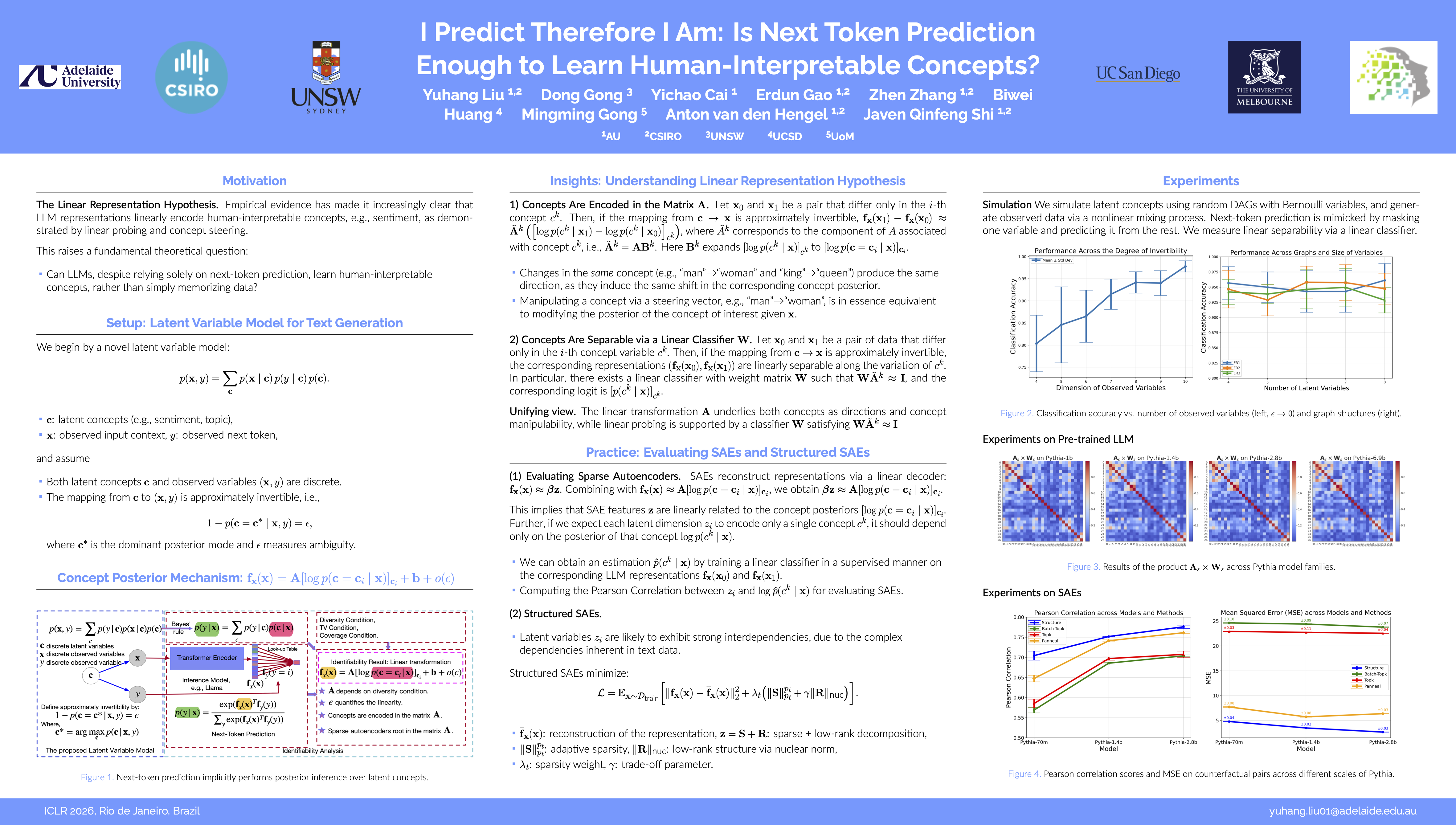
Recent empirical evidence shows that LLM representations encode human-interpretable concepts. Nevertheless, the mechanisms by which these representations emerge remain largely unexplored. To shed further light on this, we introduce a novel generative model that generates tokens on the basis of such concepts formulated as latent discrete variables. Under mild conditions, even when the mapping from the latent space to the observed space is non-invertible, we establish rigorous identifiability result: the representations learned by LLMs through next-token prediction can be approximately modeled as the logarithm of the posterior probabilities of these latent discrete concepts given input context, up to an invertible linear transformation. This theoretical finding: 1) provides evidence that LLMs capture essential underlying generative factors, 2) offers a unified and principled perspective for understanding the linear representation hypothesis, and 3) motivates a theoretically grounded approach for evaluating sparse autoencoders. Empirically, we validate our theoretical results through evaluations on both simulation data and the Pythia, Llama, and DeepSeek model families.
The Hot Mess of AI: How Does Misalignment Scale With Model Intelligence and Task Complexity?
Alexander Hägele ⋅ Aryo Pradipta Gema ⋅ Henry Sleight ⋅ Ethan Perez ⋅ Jascha Sohl-Dickstein
As AI becomes more capable, we entrust it with more general and consequential tasks. The risks from failure grow more severe with increasing task scope. It is therefore important to understand the ways extremely capable AI models will fail: Will they fail by systematically pursuing goals we do not intend? Or will they fail by being a hot mess, and taking nonsensical actions that do not further any goal? We operationalize this question using a bias-variance decomposition of the errors made by AI models: An AI's error incoherence on a task is measured over test-time randomness as the fraction of its error that stems from variance rather than bias in task outcome. Across all tasks and frontier models we measure, we find that the longer models spend reasoning and taking actions, the more incoherent their failures become. We observe that error incoherence changes with model scale in a way that is task and experiment dependent. However, in several settings larger, more capable models are more incoherent than smaller models. Consequently, scale alone seems unlikely to eliminate incoherence. Instead, as more capable AIs pursue harder tasks, requiring more sequential action and thought, our results predict failures to be accompanied by more incoherent behavior. This suggests a future where AIs sometimes cause industrial accidents (due to unpredictable misbehavior), but are less likely to exhibit consistent pursuit of a misaligned goal. This increases the relative importance of alignment research targeting reward hacking or goal misspecification.
Axis-aligned decision trees are fast and stable but struggle on datasets with rotated or interaction-dependent decision boundaries, where informative splits require linear combinations of features rather than single-feature thresholds. Oblique forests address this with per-node hyperplane splits, but at added computational cost. We propose a simple alternative: JARF, Jacobian-Aligned Random Forests. Concretely, we fit a random forest to estimate class probabilities or regression outputs, compute finite-difference gradients with respect to each feature, form an expected Jacobian outer product/expected gradient outer product, and use it as a single global linear preconditioner for all inputs. This preserves the simplicity of axisaligned trees while applying a single global rotation to capture oblique boundaries and feature interactions that would otherwise require many axis-aligned splits to approximate. On tabular benchmarks, our preconditioned forest matches or surpasses oblique baselines while training faster. Our results suggest that supervised preconditioning can deliver the accuracy of oblique forests while keeping the simplicity of axis-aligned trees.
Explainable $ K $-means Neural Networks for Multi-view Clustering
Yalan Qin ⋅ Xinpeng Zhang ⋅ Guorui Feng
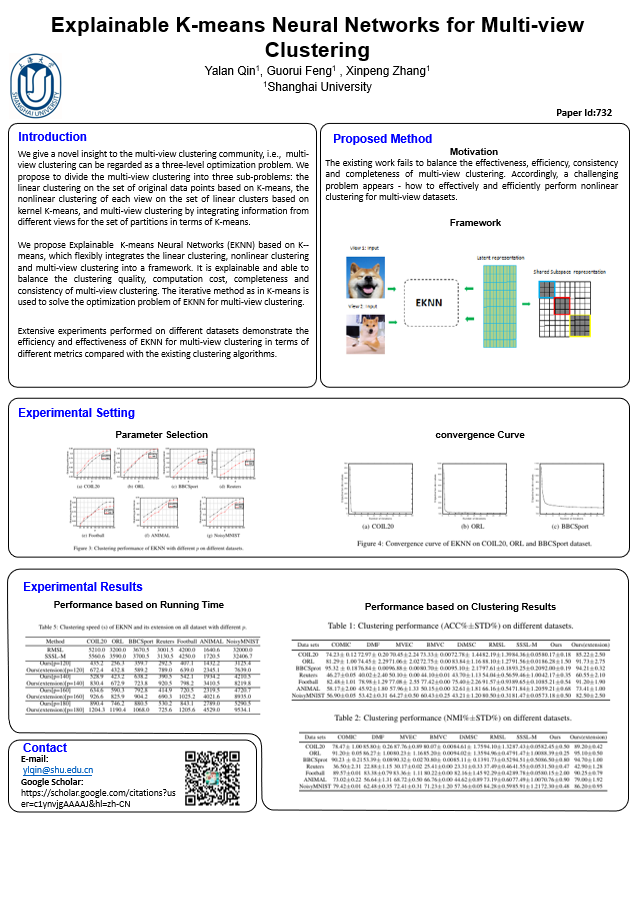
Despite multi-view clustering has achieved great progress in past decades, it is still a challenge to balance the effectiveness, efficiency, completeness and consistency of nonlinearly separable clustering for the data from different views. To address this challenge, we show that multi-view clustering can be regarded as a three-level optimization problem. To be specific, we divide the multi-view clustering into three sub-problems based on $ K $-means or kernel $ K $-means, i.e., linear clustering on the original multi-view dataset, nonlinear clustering on the set of obtained linear clusters and multi-view clustering by integrating partition matrices from different views obtained by linear and nonlinear clustering based on reconstruction. We propose Explainable $ K $-means Neural Networks (EKNN) and present how to unify these three sub-problems into a framework based on EKNN. It is able to simultaneously consider the effectiveness, efficiency, completeness and consistency for the nonlinearly multi-view clustering and can be optimized by an iterative algorithm. EKNN is explainable since the effect of each layer is known. To the best of our knowledge, this is the first attempt to balance the effectiveness, efficiency, completeness and consistency by dividing the multi-view clustering into three different sub-problems. Extensive experimental results demonstrate the effectiveness and efficiency of EKNN compared with other methods for multi-view clustering on different datasets in terms of different metrics.
KLAS: Using Similarity to Stitch Neural Networks for Improved Accuracy-Efficiency Tradeoffs
Debopam Sanyal ⋅ Anantharaman Iyer ⋅ Alind Khare ⋅ Trisha Jain ⋅ Akshay Jajoo ⋅ Myungjin Lee ⋅ James Kerce ⋅ Alexey Tumanov
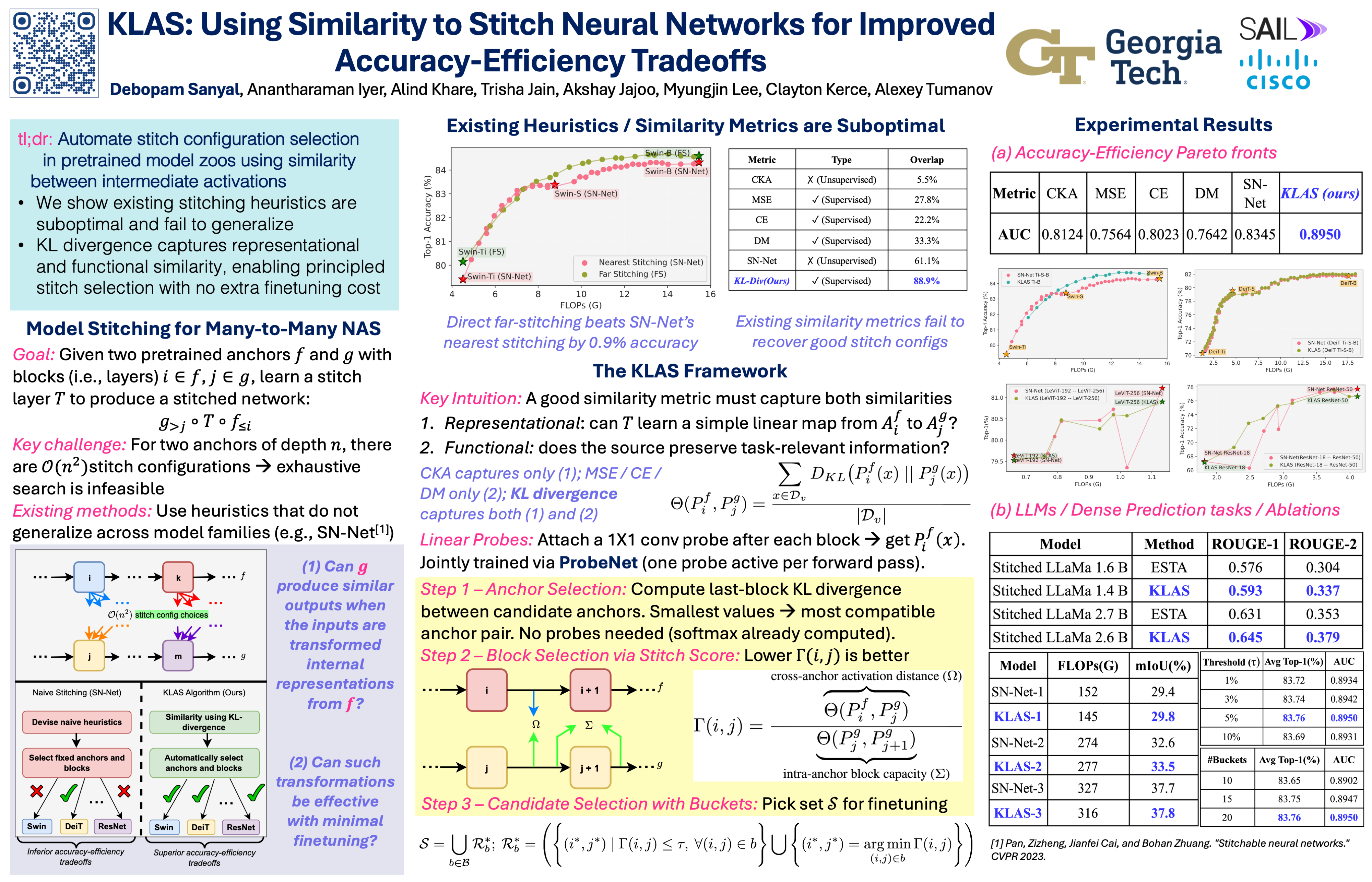
Given the wide range of deployment targets, flexible model selection is essential for optimizing performance within a given compute budget. Recent work demonstrates that stitching pretrained models within a model family enables cost-effective interpolation of the accuracy-efficiency tradeoff space. Stitching transforms intermediate activations from one pretrained model into another, producing a new interpolated stitched network. Such networks provide a pool of deployment options along the accuracy-efficiency spectrum. However, existing stitching approaches often yield suboptimal tradeoffs and lack generalizability, as they primarily rely on heuristics to select stitch configurations. We argue that constructing improved accuracy-efficiency tradeoffs requires explicitly capturing and leveraging the similarity between pretrained models being stitched. To this end, we introduce KLAS, a novel stitch selection framework that automates and generalizes stitch selection across model families by leveraging KL divergence between intermediate representations. KLAS identifies the most promising binary stitches from the $\mathcal{O}(k^2n^2)$ possibilities for $k$ pretrained models of depth $n$. Through comprehensive experiments, we demonstrate that KLAS improves the accuracy-efficiency curve of stitched models at the same finetuning cost as baselines. KLAS achieves up to $1.21\%$ higher ImageNet-1K top-1 accuracy at the same computational cost, or maintains accuracy with a $1.33\times$ reduction in FLOPs.
SeeDNorm: Self-Rescaled Dynamic Normalization
Wenrui Cai ⋅ Defa Zhu ⋅ Siyuan Qiao ⋅ Qingjie Liu ⋅ Qiyang Min
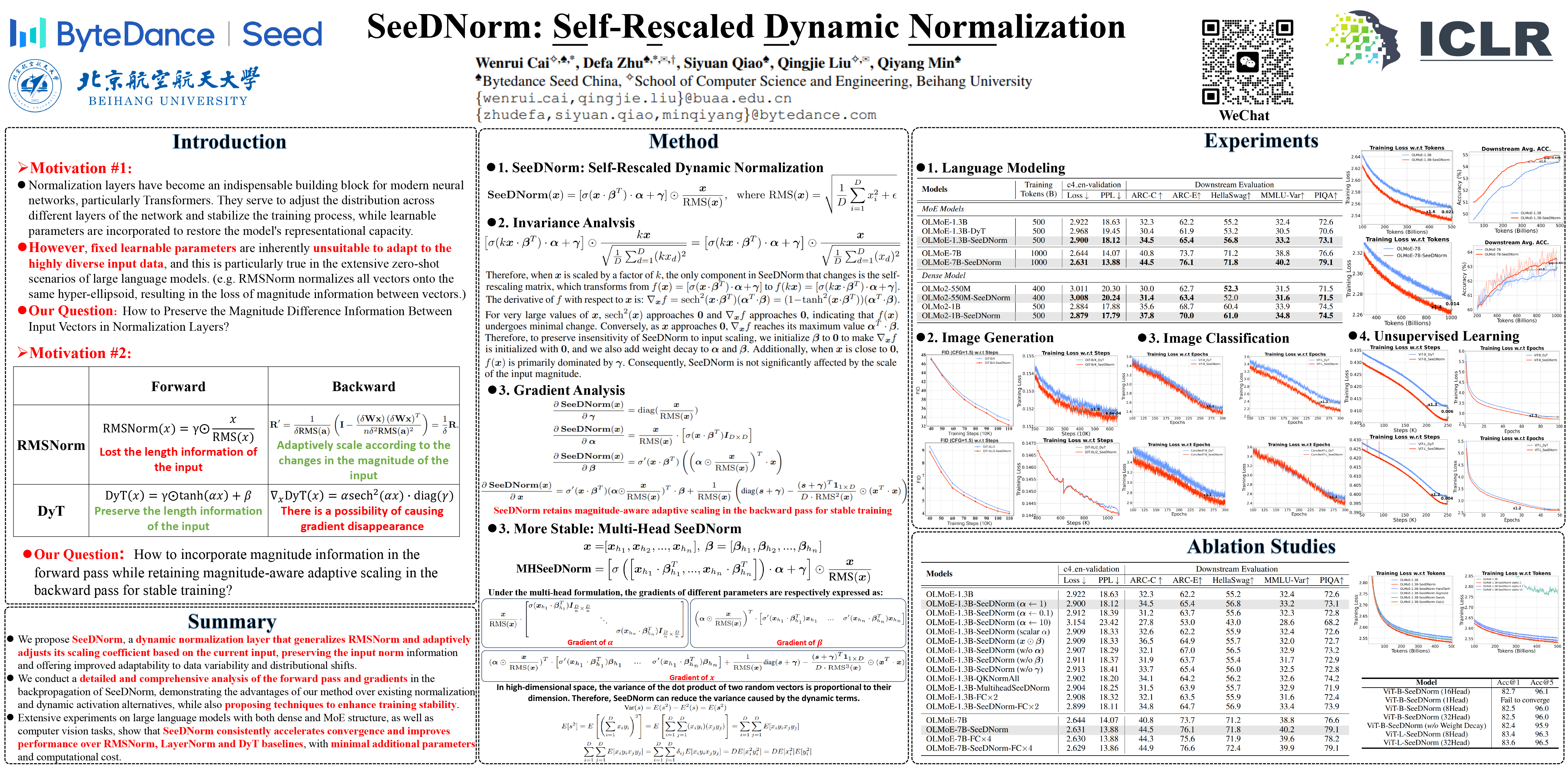
Normalization layer constitutes an essential component in neural networks. In transformers, the predominantly used RMSNorm constrains vectors to a unit hypersphere, followed by dimension-wise rescaling through a learnable scaling coefficient $\gamma$ to maintain the representational capacity of the model. However, RMSNorm discards the input norm information in forward pass and a static scaling factor $\gamma$ may be insufficient to accommodate the wide variability of input data and distributional shifts, thereby limiting further performance improvements, particularly in zero-shot scenarios that large language models routinely encounter. To address this limitation, we propose SeeDNorm, which enhances the representational capability of the model by dynamically adjusting the scaling coefficient based on the current input, thereby preserving the input norm information and enabling data-dependent, self-rescaled dynamic normalization. During backpropagation, SeeDNorm retains the ability of RMSNorm to dynamically adjust gradient according to the input norm. We provide a detailed analysis of the training optimization for SeedNorm and proposed corresponding solutions to address potential instability issues that may arise when applying SeeDNorm. We validate the effectiveness of SeeDNorm across models of varying sizes in large language model pre-training as well as supervised and unsupervised computer vision tasks. By introducing a minimal number of parameters and with negligible impact on model efficiency, SeeDNorm achieves consistently superior performance compared to previously commonly used normalization layers such as RMSNorm and LayerNorm, as well as element-wise activation alternatives to normalization layers like DyT.
Beyond DAGs: A Latent Partial Causal Model for Multimodal Learning
Yuhang Liu ⋅ Zhen Zhang ⋅ Dong Gong ⋅ Erdun Gao ⋅ Biwei Huang ⋅ Mingming Gong ⋅ Anton Hengel ⋅ Kun Zhang ⋅ Javen Qinfeng Shi
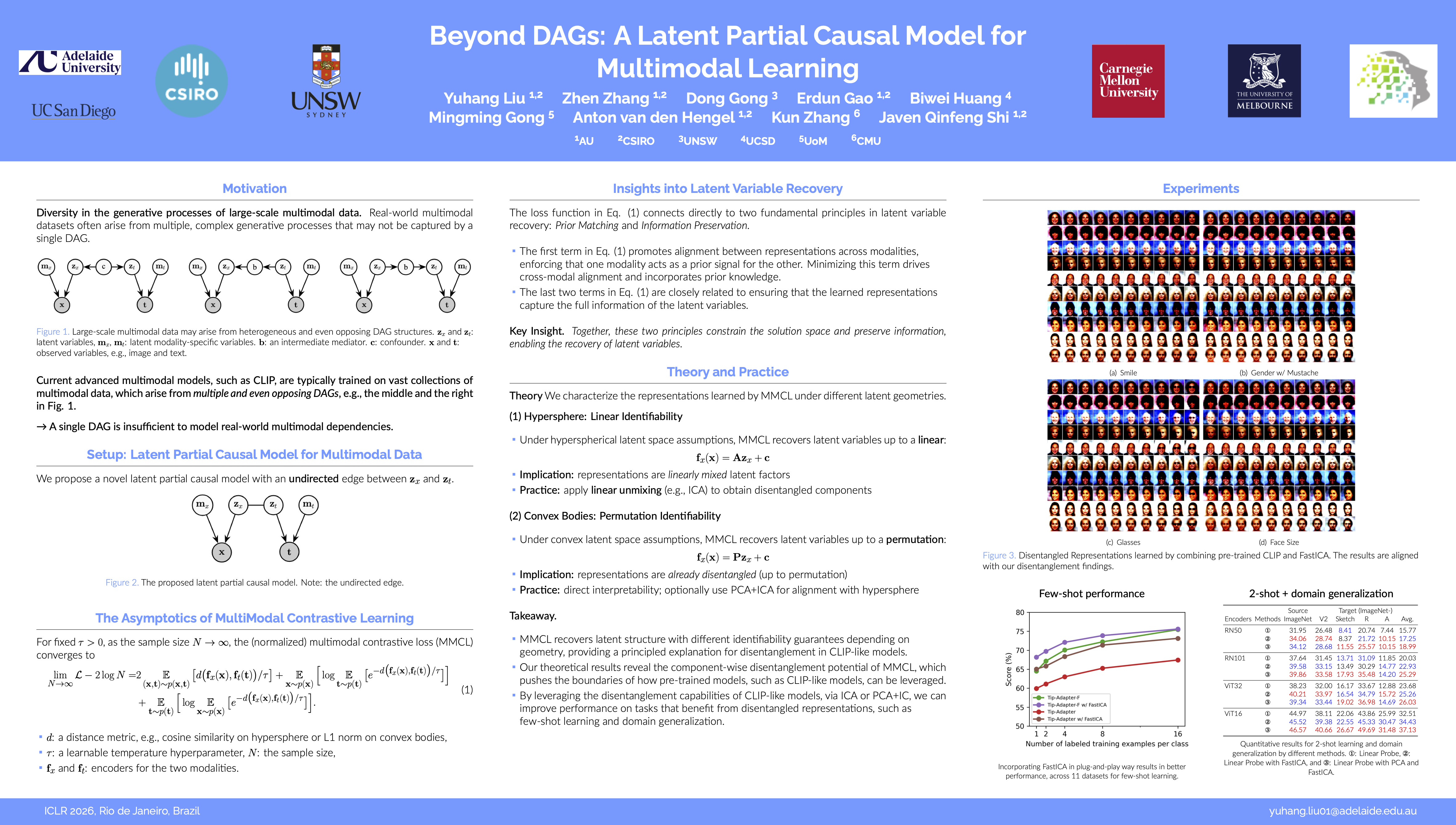
Directed Acyclic Graphs (DAGs) are a standard tool in causal modeling, but their suitability for capturing the complexity of large-scale multimodal data is questionable. In practice, real-world multimodal datasets are often collected from heterogeneous generative processes that do not conform to a single DAG. Instead, they may involve multiple, and even opposing, DAG structures with inverse causal directions. To address this gap, in this work, we first propose a novel latent partial causal model tailored for multimodal data representation learning, featuring two latent coupled variables parts connected by an undirected edge, to represent the transfer of knowledge across modalities. Under specific statistical assumptions, we establish an identifiability result, demonstrating that representations learned by MultiModal Contrastive Learning (MMCL) correspond to the latent coupled variables up to a trivial transformation. This result deepens our understanding of the why MMCL works, highlights its potential for representation disentanglement, and expands the utility of pre-trained models like CLIP. Synthetic experiments confirm the robustness of our findings, even when the assumptions are partially violated. Most importantly, experiments on a pre-trained CLIP model embodies disentangled representations, enabling few-shot learning and improving domain generalization across diverse real-world datasets. Together, these contributions push the boundaries of MMCL, both in theory and in practical applications.
Aligning Collaborative View Recovery and Tensorial Subspace Learning via Latent Representation for Incomplete Multi-View Clustering
Youqing Wang ⋅ Yu Cao ⋅ Jinlu Wang ⋅ Xiang Xu ⋅ Jiapu Wang ⋅ Tengfei Liu ⋅ Junbin Gao ⋅ Jipeng Guo
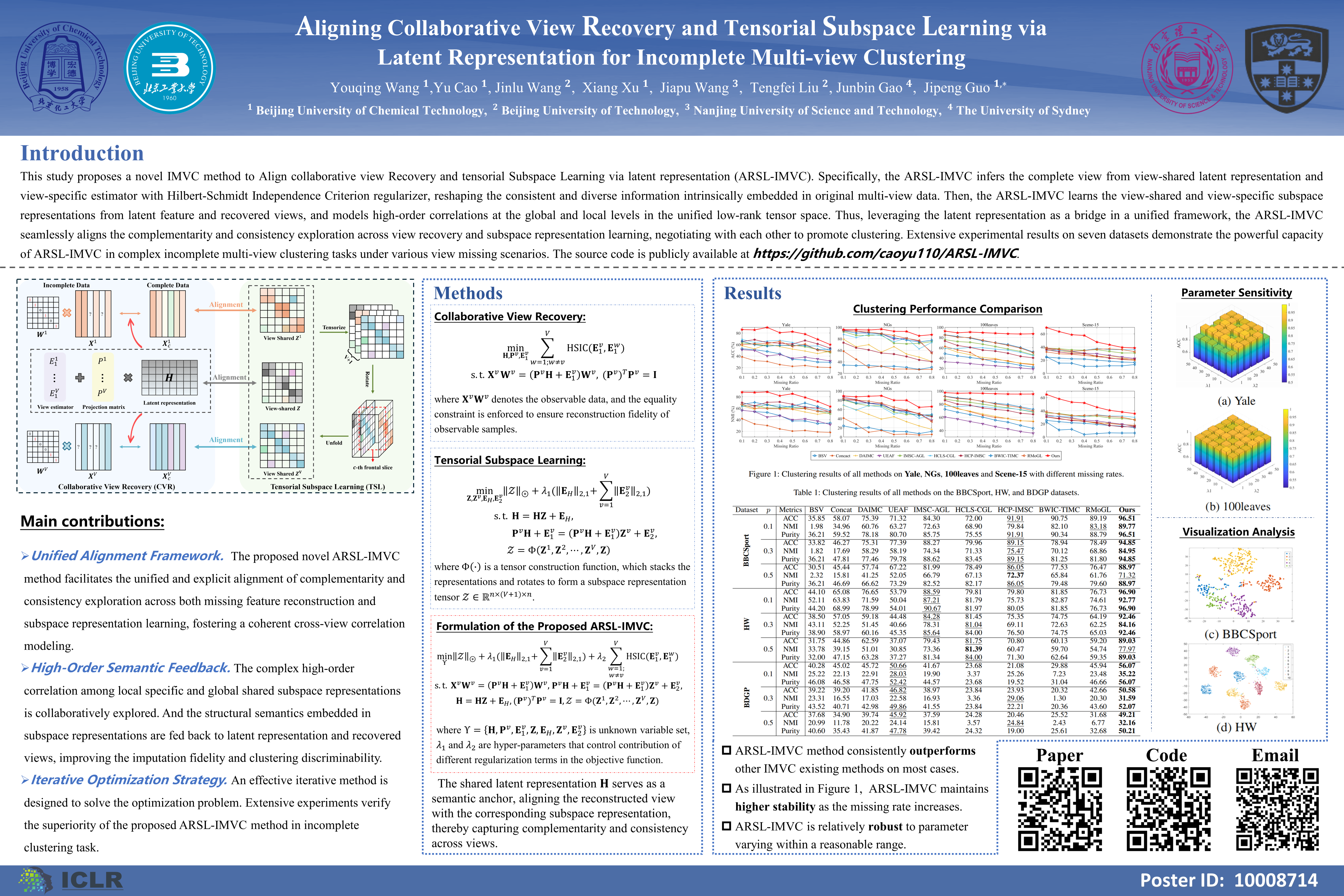
Multi-view data usually suffer from partially missing views in open scenarios, which inevitably degrades clustering performance. The incomplete multi-view clustering (IMVC) has attracted increasing attention and achieved significant success. Although existing imputation-based IMVC methods perform well, they still face one crucial limitation, i.e., view recovery and subspace representation lack explicit alignment and collaborative interaction in exploring complementarity and consistency across multiple views. To this end, this study proposes a novel IMVC method to Align collaborative view Recovery and tensorial Subspace Learning via latent representation (ARSL-IMVC). Specifically, the ARSL-IMVC infers the complete view from view-shared latent representation and view-specific estimator with Hilbert-Schmidt Independence Criterion regularizer, reshaping the consistent and diverse information intrinsically embedded in original multi-view data. Then, the ARSL-IMVC learns the view-shared and view-specific subspace representations from latent feature and recovered views, and models high-order correlations at the global and local levels in the unified low-rank tensor space. Thus, leveraging the latent representation as a bridge in a unified framework, the ARSL-IMVC seamlessly aligns the complementarity and consistency exploration across view recovery and subspace representation learning, negotiating with each other to promote clustering. Extensive experimental results on seven datasets demonstrate the powerful capacity of ARSL-IMVC in complex incomplete multi-view clustering tasks under various view missing scenarios. The source code is publicly available at https://github.com/caoyu110/ARSL-IMVC.
MRMR: A Realistic and Expert-Level Multidisciplinary Benchmark for Reasoning-Intensive Multimodal Retrieval
Siyue Zhang ⋅ Yuan Gao ⋅ Xiao Zhou ⋅ Yilun Zhao ⋅ Tingyu Song ⋅ Arman Cohan ⋅ Anh Tuan Luu ⋅ Chen Zhao
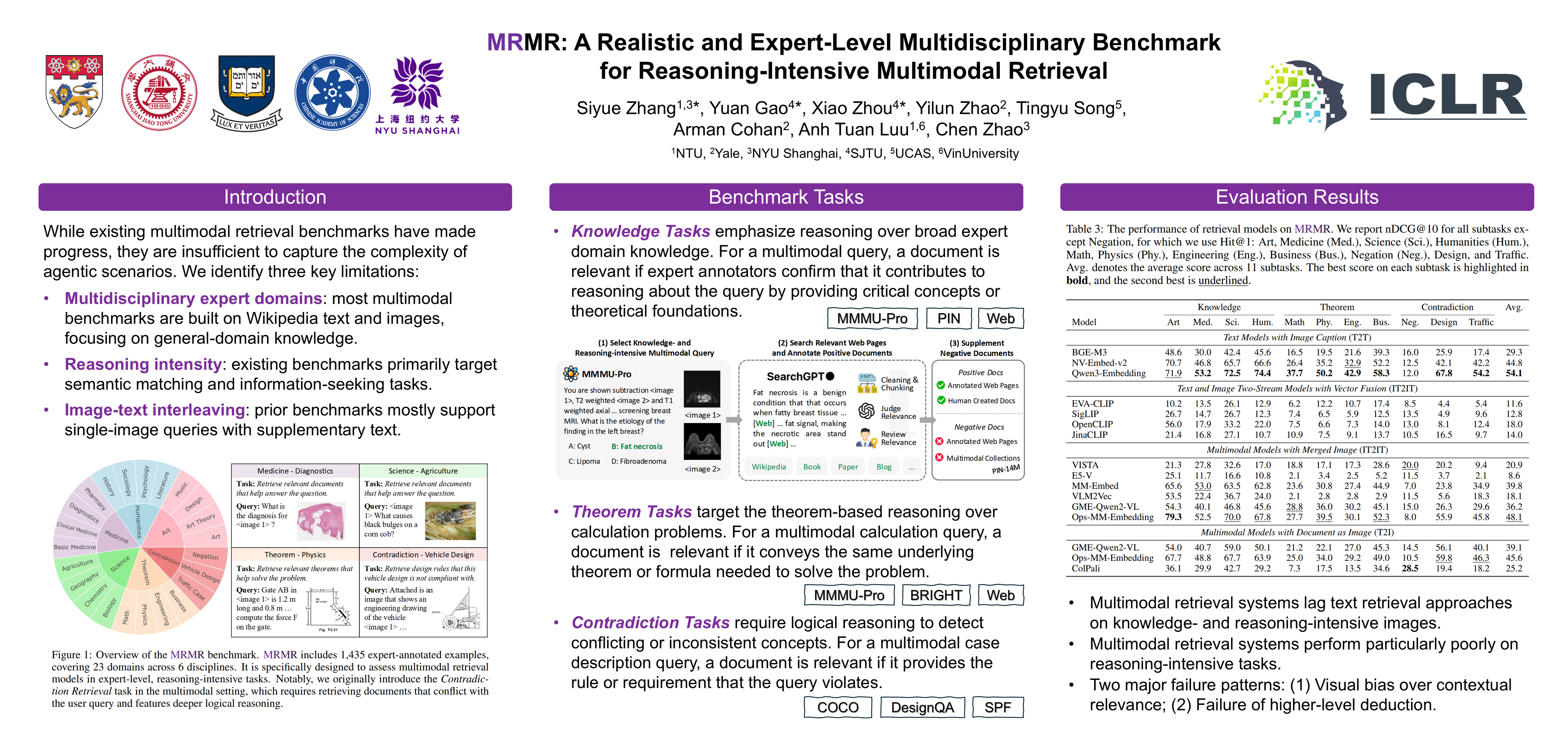
We introduce MRMR, the first expert-level multidisciplinary multimodal retrieval benchmark requiring intensive reasoning. MRMR contains 1,435 queries spanning 23 domains, with positive documents carefully verified by human experts. Compared to prior benchmarks, MRMR introduces three key advancements. First, it challenges retrieval systems across diverse areas of expertise, enabling fine-grained model comparison across domains. Second, queries are reasoning-intensive, with images requiring deeper interpretation such as diagnosing microscopic slides. We further introduce Contradiction Retrieval, a novel task requiring models to identify conflicting concepts. Finally, queries and documents are constructed as image–text interleaved sequences. Unlike earlier benchmarks restricted to single images or unimodal documents, MRMR offers a realistic setting with multi-image queries and mixed-modality corpus documents. We conduct an extensive evaluation of 4 categories of multimodal retrieval systems and 14 frontier models on MRMR. The text embedding model Qwen3-Embedding with LLM-generated image captions achieves the highest performance, highlighting substantial room for improving multimodal retrieval models. Although latest multimodal models such as Ops-MM-Embedding perform competitively on expert-domain queries, they fall short on reasoning-intensive tasks. We believe that MRMR paves the way for advancing multimodal retrieval in more realistic and challenging scenarios.
NeuCLIP: Efficient Large-Scale CLIP Training with Neural Normalizer Optimization
Xiyuan Wei ⋅ Chih-Jen Lin ⋅ Tianbao Yang
Accurately estimating the normalization term (also known as the partition function) in the contrastive loss is a central challenge for training Contrastive Language-Image Pre-training (CLIP) models. Conventional methods rely on large batches for approximation, demanding substantial computational resources. To mitigate this issue, prior works introduced per-sample normalizer estimators, which are updated at each epoch in a blockwise coordinate manner to keep track of updated encoders. However, this scheme incurs optimization error that scales with the ratio of dataset size to batch size, limiting effectiveness for large datasets or small batches. To overcome this limitation, we propose NeuCLIP, a novel and elegant optimization framework based on two key ideas: (i) **reformulating** the contrastive loss for each sample **via convex analysis** into a minimization problem with an auxiliary variable representing its log-normalizer; and (ii) **transforming** the resulting minimization over $n$ auxiliary variables (where $n$ is the dataset size) via **variational analysis** into the minimization over a compact neural network that predicts the log-normalizers. We design an alternating optimization algorithm that jointly trains the CLIP model and the auxiliary network. By employing a tailored architecture and acceleration techniques for the auxiliary network, NeuCLIP achieves more accurate normalizer estimation, leading to improved performance compared with previous methods. Extensive experiments on large-scale CLIP training, spanning datasets from millions to billions of samples, demonstrate that NeuCLIP outperforms previous methods. Code is available at https://github.com/Optimization-AI/NeuCLIP.
NerVE: Nonlinear Eigenspectrum Dynamics in LLM Feed-Forward Networks
Nandan Kumar Jha ⋅ Brandon Reagen
We introduce NerVE, a unified eigenspectral framework for understanding how feed-forward networks (FFNs) in large language models (LLMs) organize and regulate information flow in high-dimensional latent space. Despite FFNs dominating the parameter budget, their high-dimensional dynamics remain poorly understood. NerVE addresses this gap through lightweight, memory-efficient tracking of eigenspectrum dynamics via four complementary metrics: Spectral Entropy (dispersion), Participation Ratio (effective dimensionality), Eigenvalue Early Enrichment (top-heaviness), and Jensen-Shannon divergence (distributional shifts). Our key insight is that FFN nonlinearities reinject variance across eigenmodes, fundamentally governing latent dimension utilization, and that optimizer geometry strongly modulates the extent of this variance reinjection. We validate NerVE across model scales, and diverse architectural and optimizer configurations, each uniquely shaping FFN dynamics: normalization schemes controlling variance flow; FFN weight geometries constraining latent space; positional encoding and activation functions regulating information flow; and optimizer choices redistributing effective capacity across depth. Across these settings, NerVE consistently recovers stable spectral signatures that correlate with model's generalization ability and respond predictably to design choices, generalizing beyond transformer to MLP-Mixer architectures, providing actionable insights for architectural and optimizer choices beyond trial-and-error.
Compositional Generalization through Gradient Search in Nonparametric Latent Space
Haruki Shirakami ⋅ James Henderson
Many state-of-the-art methods in deep learning fail at systematic reasoning in settings which require compositional generalization. To address this, we propose a novel architecture which uses a nonparametric latent space, information-theoretic regularization of this space, and test-time gradient-based search to achieve strong performance on compositional meta-learning tasks such as program induction, Raven's progressive matrices, and linguistic systematicity tasks. Our proposed architecture, Abduction Transformer, uses nonparametric mixture distributions to represent inferred hidden causes of few-shot meta-learning instances. These representations are refined at test-time via gradient descent to better account for the observed few-shot examples, a form of variational posterior inference which allows Abduction Transformer to solve meta-learning tasks that require novel recombinations of knowledge acquired during training. Our method outperforms standard transformer architectures and a contemporary test-time adaptive variational approach, indicating a promising new direction for neural networks capable of systematic generalization.
DTO-KD: Dynamic Trade-off Optimization for Effective Knowledge Distillation
Zeeshan Hayder ⋅ Ali Cheraghian ⋅ Lars Petersson ⋅ Mehrtash Harandi ⋅ Richard Hartley
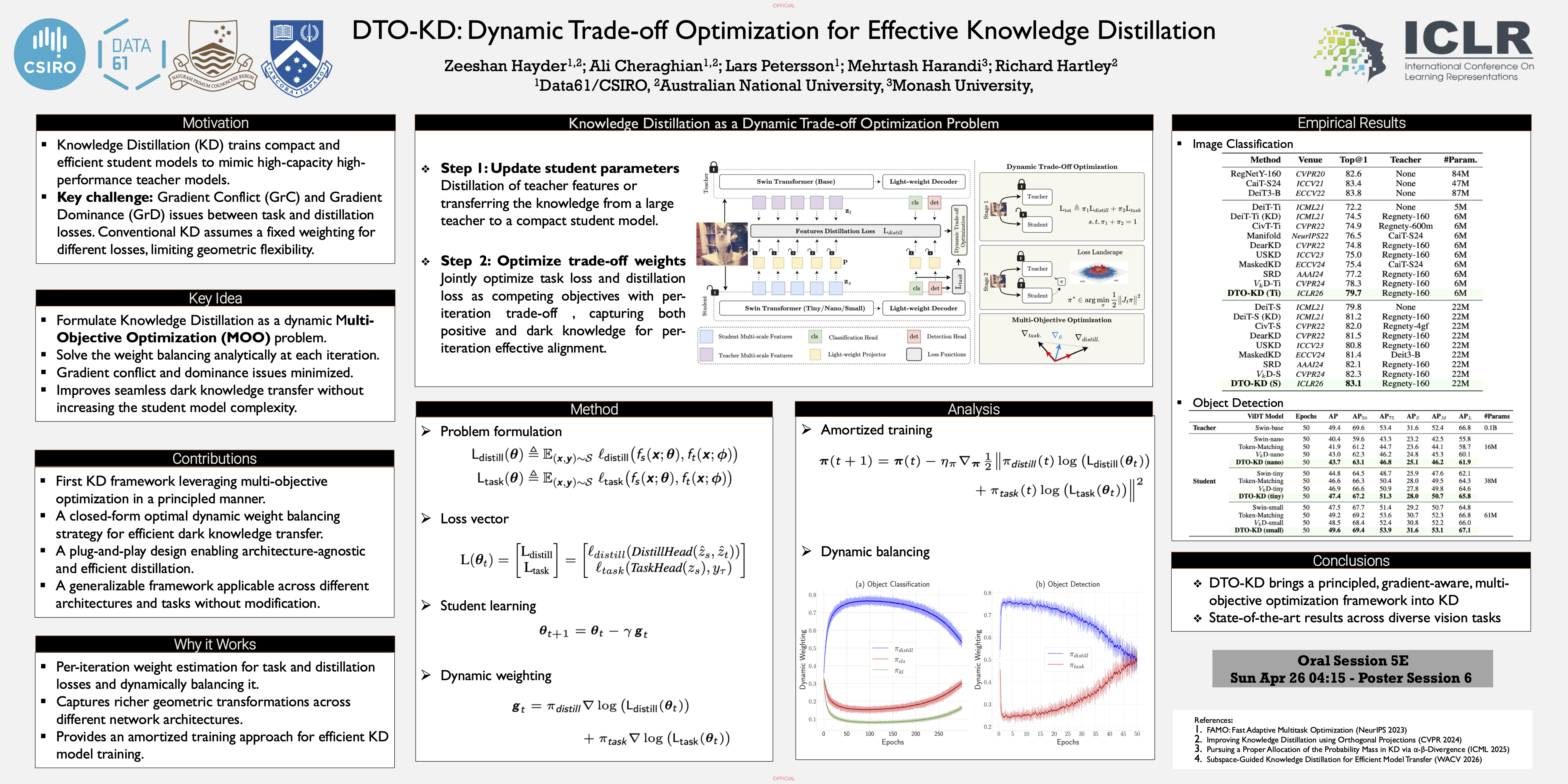
Knowledge Distillation (KD) is a widely adopted framework for compressing large models into compact student models by transferring knowledge from a high-capacity teacher. Despite its success, KD presents two persistent challenges: (1) the trade-off between optimizing for the primary task loss and mimicking the teacher's outputs, and (2) the gradient disparity arising from architectural and representational mismatches between teacher and student models. In this work, we propose Dynamic Trade-off Optimization for Knowledge Distillation (DTO-KD), a principled multi-objective optimization formulation of KD that dynamically balances task and distillation losses at the gradient level. Specifically, DTO-KD resolves two critical issues in gradient-based KD optimization: (i) gradient conflict, where task and distillation gradients are directionally misaligned, and (ii) gradient dominance, where one objective suppresses learning progress on the other. Our method adapts per-iteration trade-offs by leveraging gradient projection techniques to ensure balanced and constructive updates. We evaluate DTO-KD on large-scale benchmarks including ImageNet-1K for classification and COCO for object detection. Across both tasks, DTO-KD consistently outperforms prior KD methods, yielding state-of-the-art accuracy and improved convergence behavior. Furthermore, student models trained with DTO-KD exceed the performance of their non-distilled counterparts, demonstrating the efficacy of our multi-objective formulation for KD.
Stochastic Optimal Control for Continuous-Time fMRI Representation Learning
Joonhyeong Park ⋅ Byoungwoo Park ⋅ Chang-Bae Bang ⋅ Jungwon Choi ⋅ Hyungjin Chung ⋅ Byung-Hoon Kim ⋅ Juho Lee
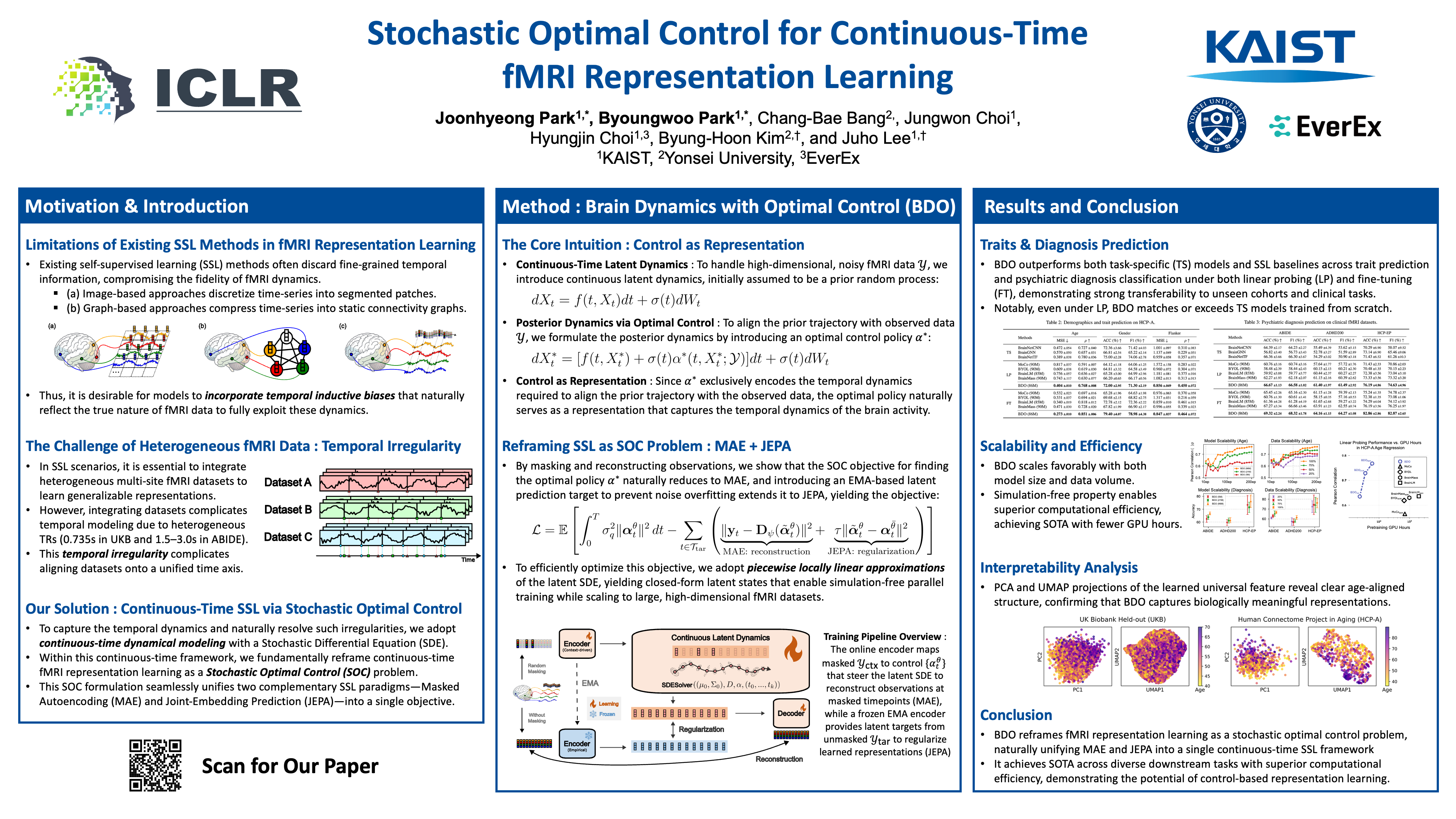
Learning robust representations from functional magnetic resonance imaging (fMRI) is fundamentally challenged by the temporal irregularity and noise inherent in data from heterogeneous sources. Existing self-supervised learning (SSL) methods often discard critical temporal information by discretizing or averaging fMRI signals. To address this, we introduce a novel framework that reframes SSL as a Stochastic Optimal Control (SOC) problem. Our approach models brain activity as continuous-time latent dynamics, learning a robust representation of brain dynamics by optimizing a control policy that is agnostic to the temporal irregularity. This SOC framework naturally unifies masked autoencoding (MAE) and joint-embedding prediction (JEPA) to extract compact, control-derived representations. Furthermore, a simulation-free inference strategy ensures computational efficiency and scalability for large-scale fMRI datasets. Our model demonstrates state-of-the-art performance across diverse downstream applications, highlighting the potential of the SOC-based continuous-time representation learning framework.
DiVeQ: Differentiable Vector Quantization Using the Reparameterization Trick
Mohammad Vali ⋅ Tom Bäckström ⋅ Arno Solin
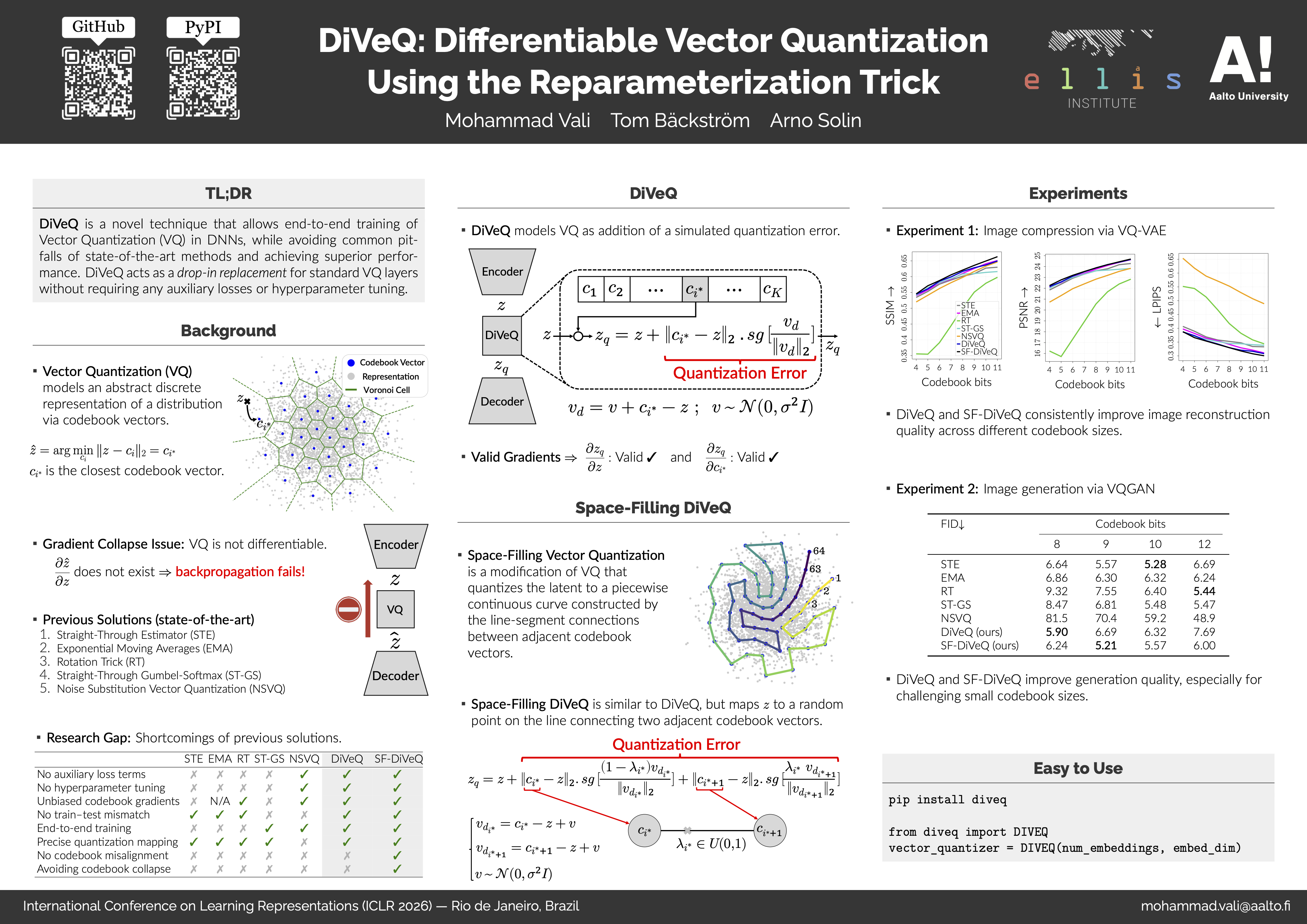
Vector quantization is common in deep models, yet its hard assignments block gradients and hinder end-to-end training. We propose DiVeQ, which treats quantization as adding an error vector that mimics the quantization distortion, keeping the forward pass hard while letting gradients flow. We also present a space-filling variant (SF-DiVeQ) that assigns to a curve constructed by the lines connecting codewords, resulting in less quantization error and full codebook usage. Both methods train end-to-end without requiring auxiliary losses or temperature schedules. In VQ-VAE image compression, VQGAN image generation, and DAC speech coding tasks across various data sets, our proposed methods improve reconstruction and sample quality over alternative quantization approaches.
Improving Set Function Approximation with Quasi-Arithmetic Neural Networks
Tomas Tokar ⋅ Scott Sanner
Sets represent a fundamental abstraction across many types of data. To handle the unordered nature of set-structured data, models such as DeepSets and PointNet rely on fixed, non-learnable pooling operations (e.g., sum or max) -- a design choice that can hinder the transferability of learned embeddings and limits model expressivity. More recently, learnable aggregation functions have been proposed as more expressive alternatives. In this work, we advance this line of research by introducing the Neuralized Kolmogorov Mean (NKM) -- a novel, trainable framework for learning a generalized measure of central tendency through an invertible neural function. We further propose quasi-arithmetic neural networks (QUANNs), which incorporate the NKM as a learnable aggregation function. We provide a theoretical analysis showing that, QUANNs are universal approximators for a broad class of common set-function decompositions and, thanks to their invertible neural components, learn more structured latent representations. Empirically, QUANNs outperform state-of-the-art baselines across diverse benchmarks, while learning embeddings that transfer effectively even to tasks that do not involve sets.
MoRA: Mobility as the Backbone for Geospatial Representation Learning at Scale
Ya Wen ⋅ Jixuan Cai ⋅ Qiyao Ma ⋅ Linyan Li ⋅ Xinhuan Chen ⋅ Chris Webster ⋅ Yulun Zhou
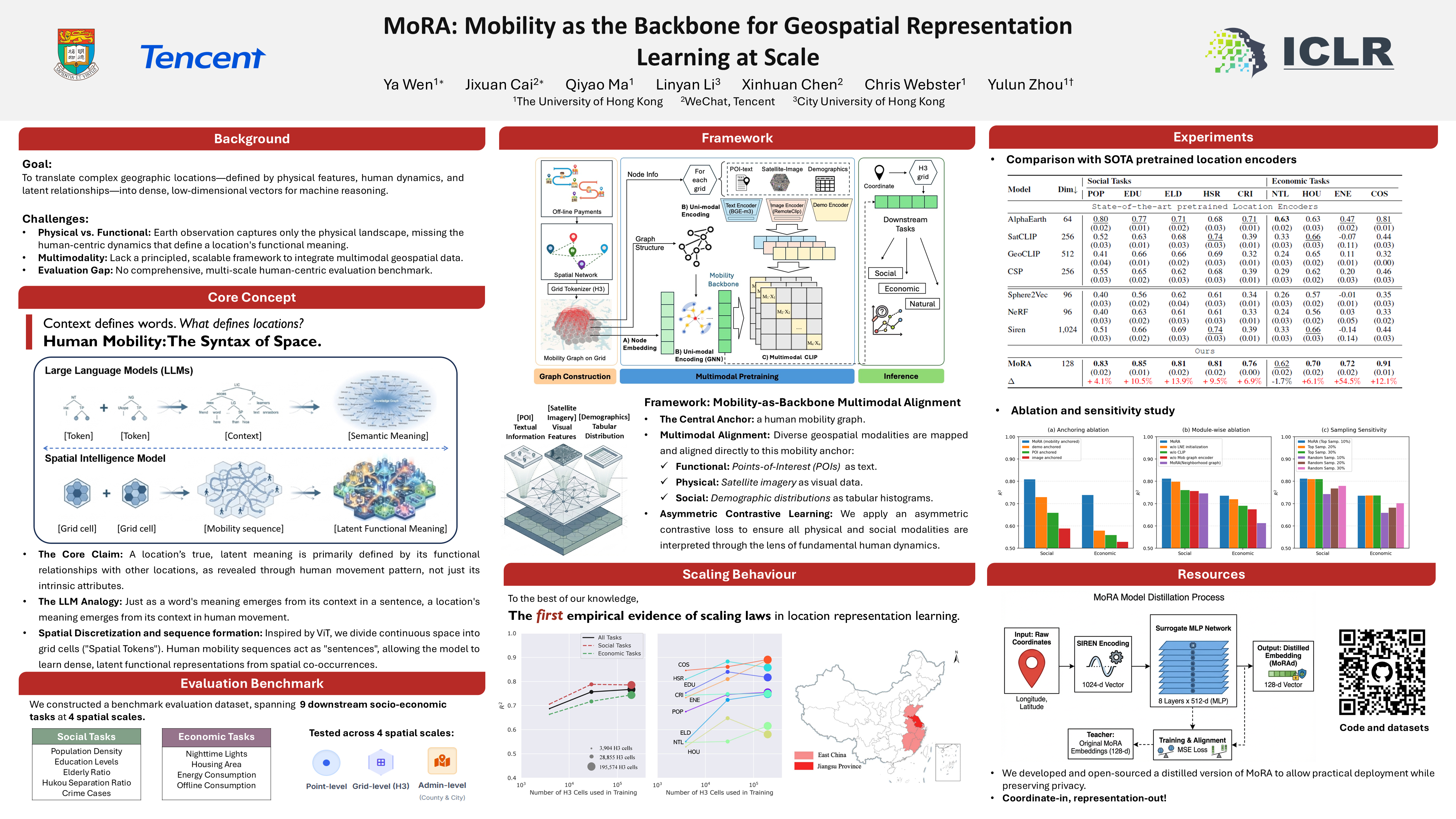
Representation learning of geospatial locations remains a core challenge in achieving general geospatial intelligence, with increasingly diverging philosophies and techniques. While Earth observation paradigms excel at depicting locations in their physical states, we propose that a location’s full characterization requires grounding in both its physical attributes and its internal human activity pattern, the latter being particularly crucial for understanding its human-centric functions. We present MoRA, a human-centric geospatial framework that leverages a mobility graph as its core backbone to fuse various data modalities, aiming to learn embeddings that represent the socio-economic context and functional role of a location. MoRA achieves this through the integration of spatial tokenization, GNNs, and asymmetric contrastive learning to align 100M+ POIs, massive remote sensing imagery, and structured demographic statistics with a billion-edge mobility graph, ensuring the three auxiliary modalities are interpreted through the lens of fundamental human dynamics. To rigorously evaluate the effectiveness of MoRA, we construct a benchmark dataset composed of 9 downstream prediction tasks across social and economic domains. Experiments show that MoRA, with four input modalities and a compact 128-dimensional representation space, achieves superior predictive performances than state-of-the-art models by an average of 12.9\%. Echoing LLM scaling laws, we further demonstrate the scaling behavior in geospatial representation learning. We open-source code and pretrained models at: https://github.com/ylzhouchris/MoRA.
OrthoRF: Exploring Orthogonality in Object-Centric Representations
Despoina Touska ⋅ Bastiaan Auer ⋅ Alexandru Onose ⋅ Tejaswi Kasarla ⋅ Luis Armando Pérez Rey ⋅ Maximilian Lipp ⋅ Lyubov Amitonova ⋅ Martin R. Oswald ⋅ Pascal Cerfontaine
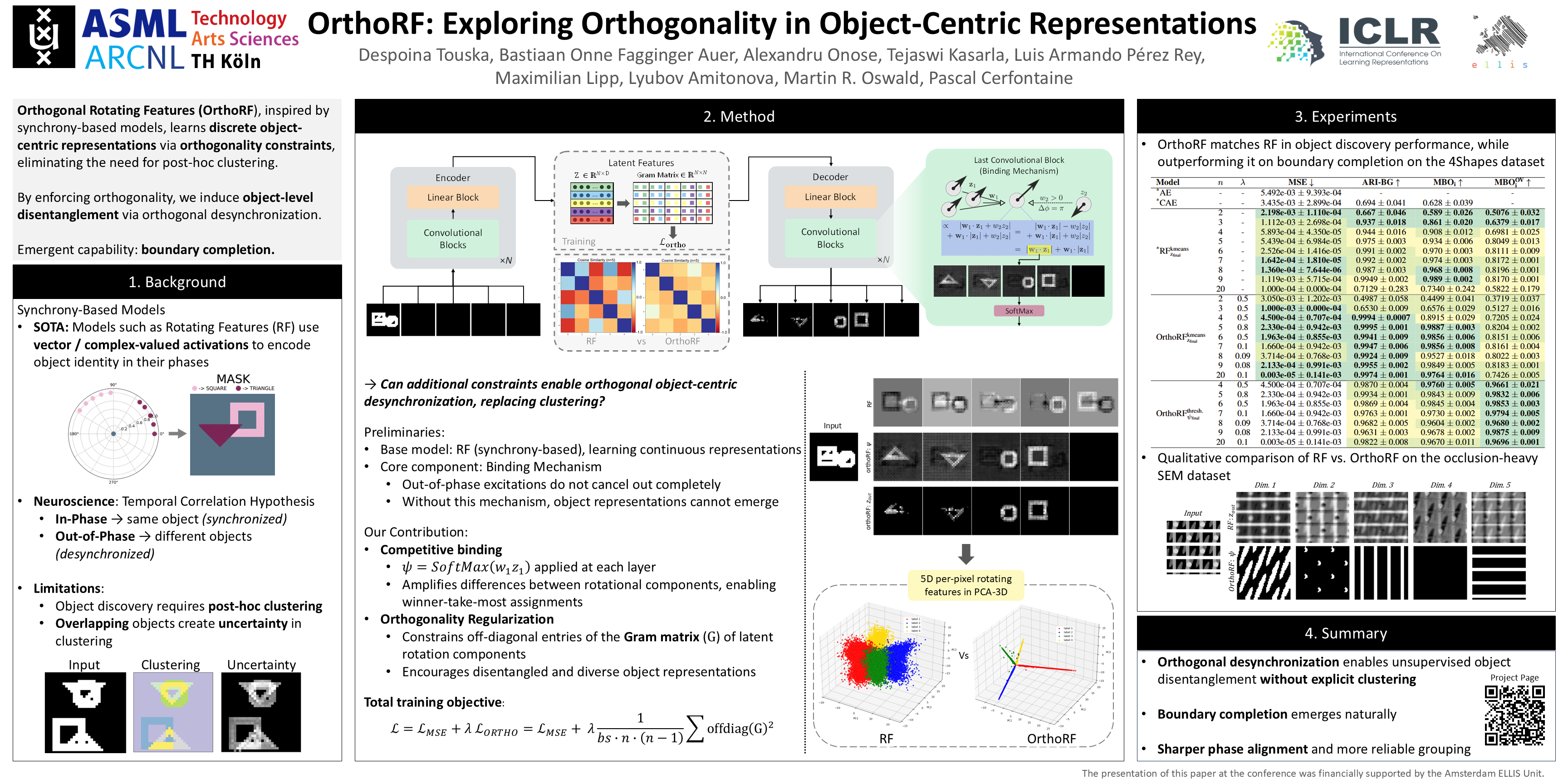
Neural synchrony is hypothesized to help the brain organize visual scenes into structured multi-object representations. In machine learning, synchrony-based models analogously learn object-centric representations by storing binding in the phase of complex-valued features. Rotating Features (RF) instantiate this idea with vector-valued activations, encoding object presence in magnitudes and affiliation in orientations. We propose Orthogonal Rotating Features (OrthoRF), which enforces orthogonality in RF’s orientation space via an inner-product loss and architectural modifications. This yields sharper phase alignment and more reliable grouping. In evaluations of unsupervised object discovery, including settings with overlapping objects, noise, and out-of-distribution tests, OrthoRF matches or outperforms current models while producing more interpretable representations, and it eliminates the post-hoc clustering required by many synchrony-based approaches. Unlike current models, OrthoRF also recovers occluded object parts, indicating stronger grouping under occlusion. Overall, orthogonality emerges as a simple, effective inductive bias for synchrony-based object-centric learning.
DiffSparse: Accelerating Diffusion Transformers with Learned Token Sparsity
Haowei Zhu ⋅ Ji Liu ⋅ Ziqiong Liu ⋅ Dong Li ⋅ Jun-Hai Yong ⋅ Bin Wang ⋅ Emad Barsoum
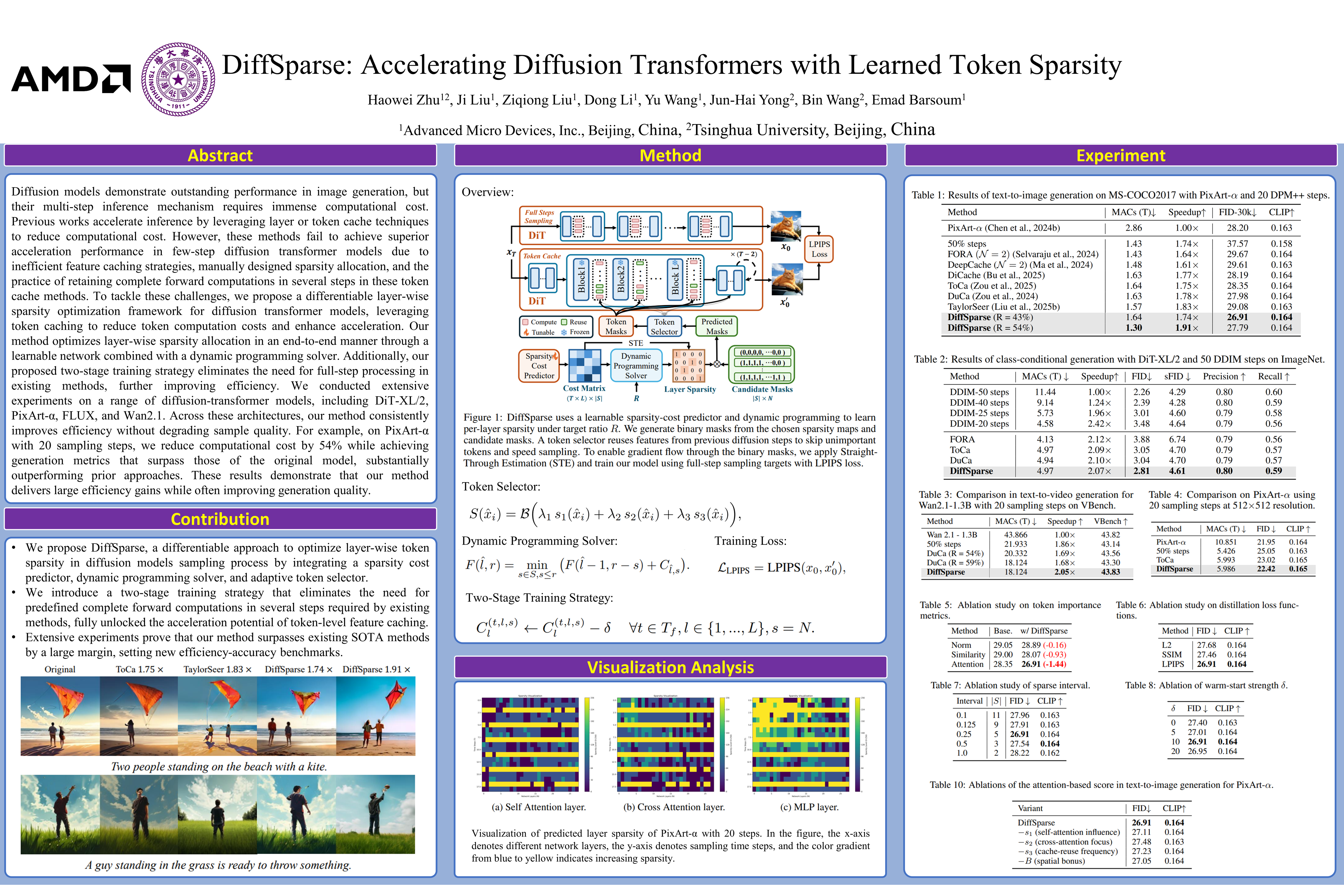
Diffusion models demonstrate outstanding performance in image generation, but their multi-step inference mechanism requires immense computational cost. Previous works accelerate inference by leveraging layer or token cache techniques to reduce computational cost. However, these methods fail to achieve superior acceleration performance in few-step diffusion transformer models due to inefficient feature caching strategies, manually designed sparsity allocation, and the practice of retaining complete forward computations in several steps in these token cache methods. To tackle these challenges, we propose a differentiable layer-wise sparsity optimization framework for diffusion transformer models, leveraging token caching to reduce token computation costs and enhance acceleration. Our method optimizes layer-wise sparsity allocation in an end-to-end manner through a learnable network combined with a dynamic programming solver. Additionally, our proposed two-stage training strategy eliminates the need for full-step processing in existing methods, further improving efficiency. We conducted extensive experiments on a range of diffusion-transformer models, including DiT-XL/2, PixArt-$\alpha$, FLUX, and Wan2.1. Across these architectures, our method consistently improves efficiency without degrading sample quality. For example, on PixArt-$\alpha$ with 20 sampling steps, we reduce computational cost by 54% while achieving generation metrics that surpass those of the original model, substantially outperforming prior approaches. These results demonstrate that our method delivers large efficiency gains while often improving generation quality. .
RAEE: A Robust Retrieval-Augmented Early Exit Framework for Efficient Inference
LIANMING HUANG ⋅ Shangyu Wu ⋅ Yufei CUI ⋅ Ying Xiong ⋅ Haibo Hu ⋅ Xue Liu ⋅ Tei-Wei Kuo ⋅ Nan Guan ⋅ Chun Jason Xue
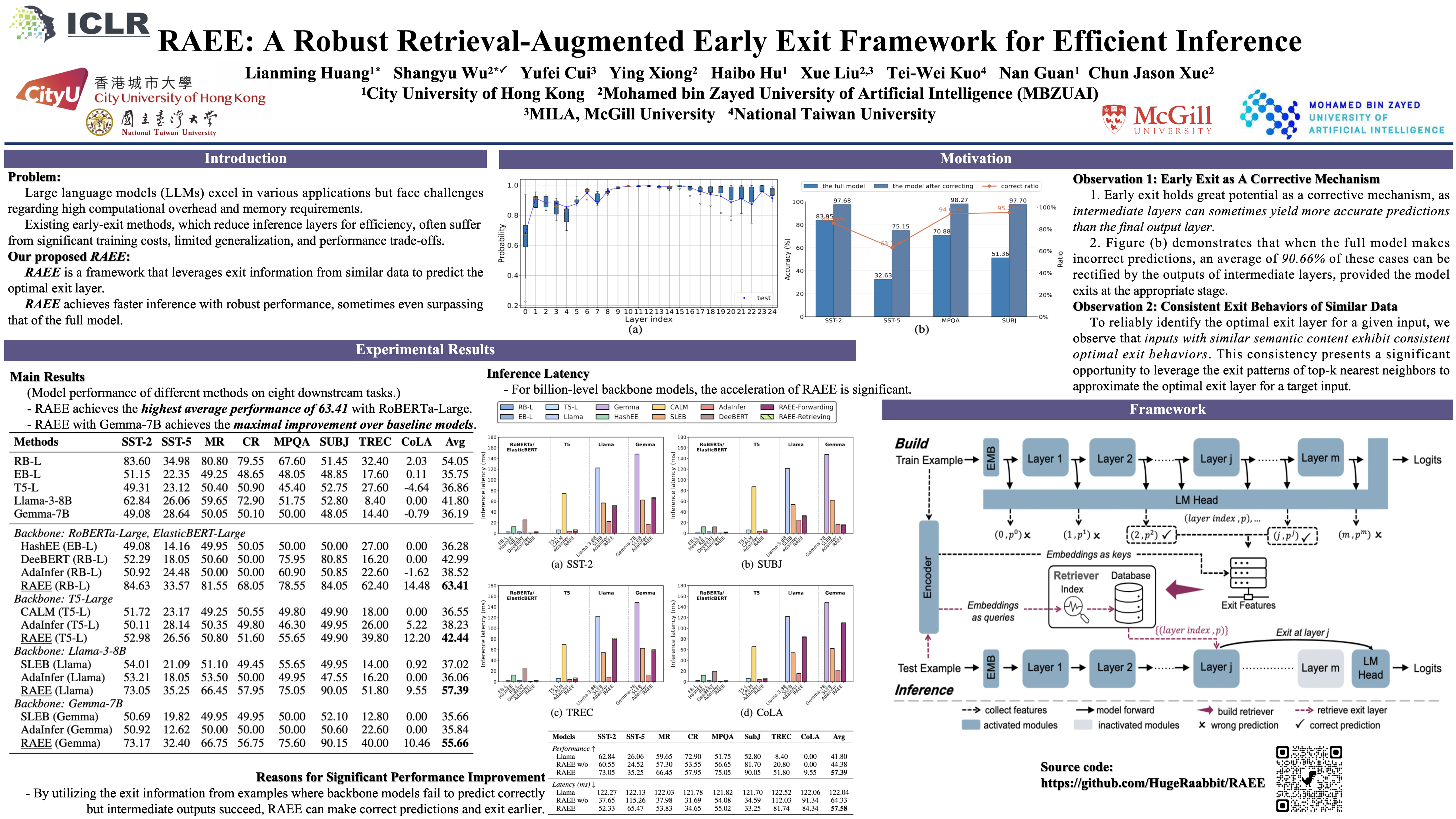
Deploying large language model inference remains challenging due to their high computational overhead. Early exit optimizes model inference by adaptively reducing the number of inference layers. Current methods typically train internal classifiers or use heuristic methods to determine the exit layer. However, those methods either introduce significant training overheads or lead to performance degradation. To address these limitations, this paper proposes RAEE, a robust Retrieval-Augmented Early Exit framework that not only enables early exit but also enhances model performance through corrective exit information at intermediate layers. This paper first demonstrates that the early exit problem can be effectively modeled as a distribution prediction problem, in which the distribution can be further approximated through the exit information of similar data. Subsequently, this paper introduces the process of collecting exit information of correct predictions and the steps to construct the retrieval database. Finally, leveraging the pre-constructed retrieval database, RAEE utilizes the exit information from retrieved similar data to guide the backbone model's exit. Experimental results demonstrate that RAEE can not only accelerate inference while achieving robust zero-shot performance across eight downstream tasks.
Modality Alignment across Trees on Heterogeneous Hyperbolic Manifolds
Wei Wu ⋅ Xiaomeng Fan ⋅ Yuwei Wu ⋅ Zhi Gao ⋅ Pengxiang Li ⋅ Yunde Jia ⋅ Mehrtash Harandi
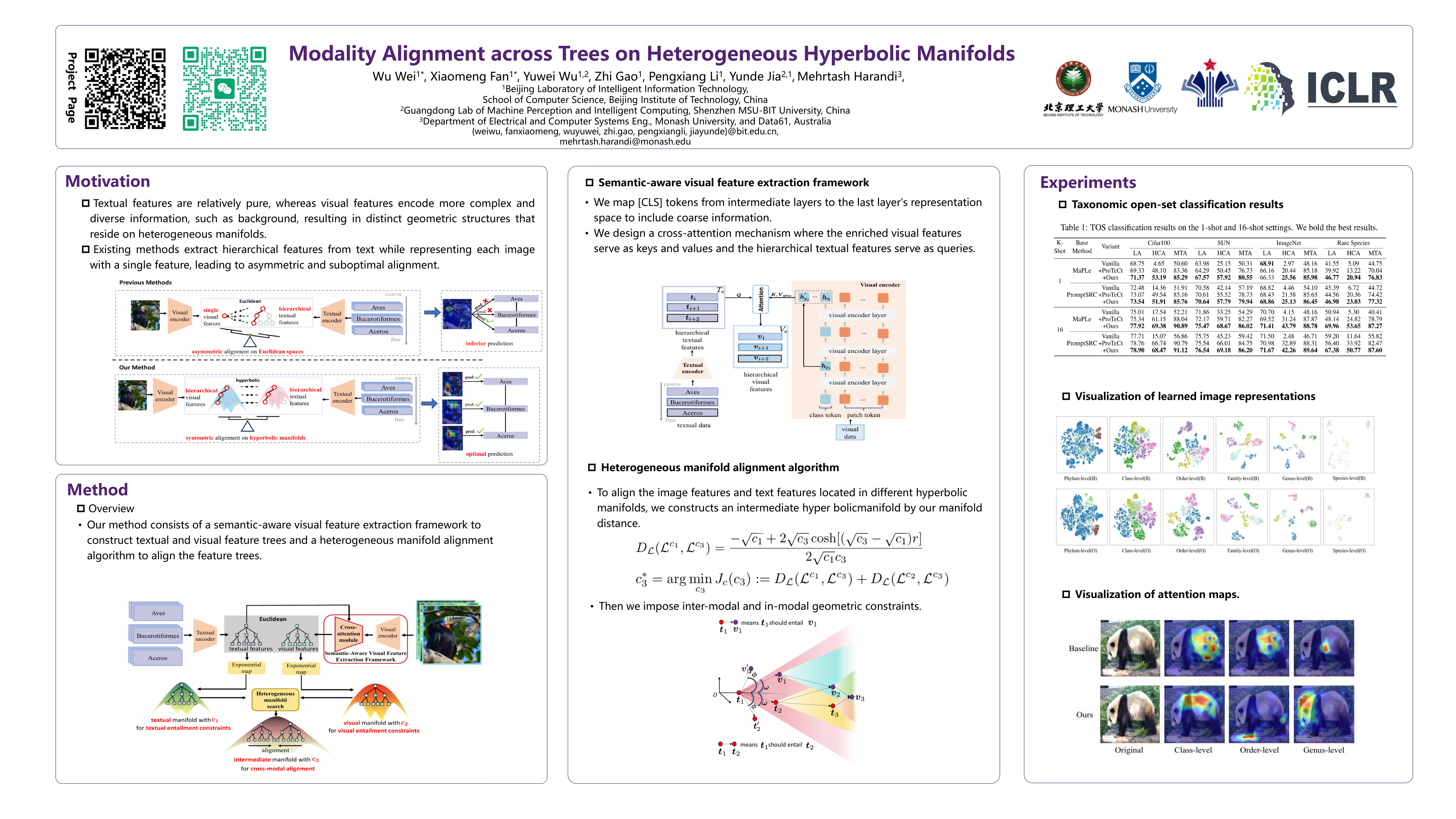
Modality alignment is critical for vision-language models (VLMs) to effectively integrate information across modalities. However, existing methods extract hierarchical features from text while representing each image with a single feature, leading to asymmetric and suboptimal alignment. To address this, we propose Alignment across Trees, a method that constructs and aligns tree-like hierarchical features for both image and text modalities. Specifically, we introduce a semantic-aware visual feature extraction framework that applies a cross-attention mechanism to visual class tokens from intermediate Transformer layers, guided by textual cues to extract visual features with coarse-to-fine semantics. We then embed the feature trees of the two modalities into hyperbolic manifolds with distinct curvatures to effectively model their hierarchical structures. To align across the heterogeneous hyperbolic manifolds with different curvatures, we formulate a KL distance measure between distributions on heterogeneous manifolds, and learn an intermediate manifold for manifold alignment by minimizing the distance. We prove the existence and uniqueness of the optimal intermediate manifold. Experiments on taxonomic open-set classification tasks across multiple image datasets demonstrate that our method consistently outperforms strong baselines under few-shot and cross-domain settings.
Let OOD Feature Exploring Vast Predefined Classifiers
Kewen Xia ⋅ Xiaodong Yue ⋅ WeiZhipeng ⋅ Yaxin Peng ⋅ Zihao Li ⋅ Jianxiang Zhu ⋅ Jie Shi ⋅ PeilinXu
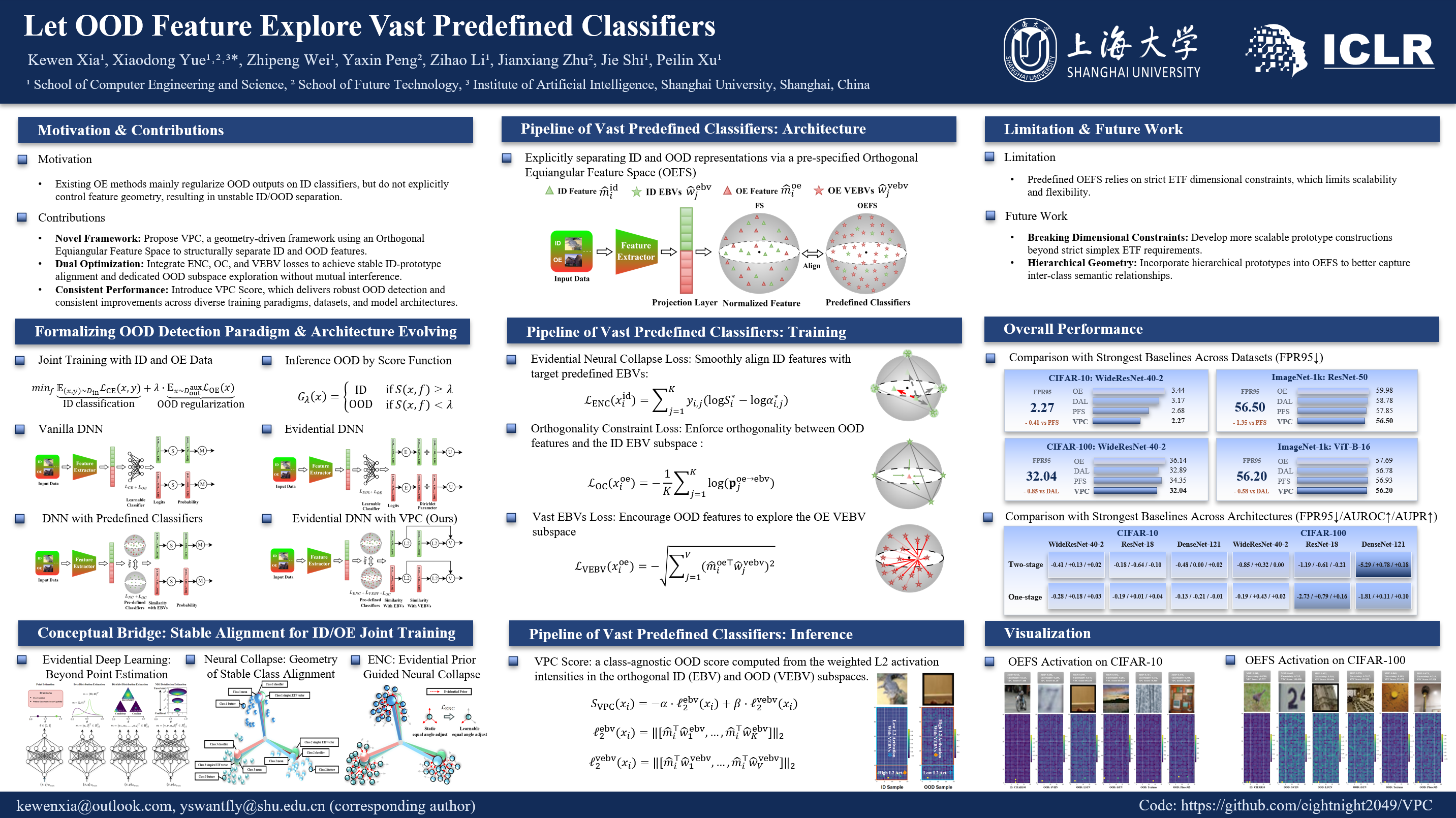
Real-world out-of-distribution (OOD) data exhibit broad, continually evolving distributions, rendering reliance solely on in-distribution (ID) data insufficient for robust detection. Consequently, methods leveraging auxiliary Outlier Exposure (OE) data have emerged, substantially enhancing generalization by jointly fine-tuning models on ID and large-scale OE data. However, many existing approaches primarily enforce orthogonality between ID and OE features while pushing OE predictions toward near-uniform, low-confidence scores, thus overlooking the controllability of representation geometry. We propose Vast Predefined Classifiers (VPC), which constructs a pre-specified Orthogonal Equiangular Feature Space (OEFS) to explicitly separate ID and OOD representations while capturing the rich variability of OOD features. We employ evidential priors to align ID features with their class-specific Equiangular Basic Vectors (EBVs), thereby preserving ID performance. In parallel, a new VEBV loss encourages OE features to explore the subspace spanned by Vast EBVs (VEBVs), enabling a rich characterization of diverse OOD patterns. This dual optimization, coupled with the prescribed geometric representation space, promotes optimal orthogonality between ID and OOD representations. Furthermore, we introduce the VPC Score, a discriminative metric based on the L2 activation intensity of features over the predefined classifiers. Extensive experiments across diverse OOD settings and training paradigms on benchmarks including CIFAR-10/100 and the ImageNet-1k, demonstrate strong and robust performance, validating VPC's effectiveness. Code is available at https://github.com/eightnight2049/VPC.
Disentanglement of Variations with Multimodal Generative Modeling
Yijie Zhang ⋅ Yiyang Shen ⋅ Weiran Wang
Multimodal data are prevalent across various domains, and learning robust representations of such data is paramount to enhancing generation quality and downstream task performance. To handle heterogeneity and interconnections among different modalities, recent multimodal generative models extract shared and private (modality-specific) information with two separate variables. Despite attempts to enforce disentanglement between these two variables, these methods struggle with challenging datasets where the likelihood model is insufficient. In this paper, we propose Information-Disentangled Multimodal VAE (IDMVAE) to explicitly address this issue, with rigorous mutual information-based regularizations, including cross-view mutual information maximization for extracting shared variables, and a cycle-consistency style loss for redundancy removal using generative augmentations. We further introduce diffusion models to improve the capacity of latent priors. These newly proposed components are complementary to each other. Compared to existing approaches, IDMVAE shows a clean separation between shared and private information, demonstrating superior generation quality and semantic coherence on challenging datasets.
TIGaussian: Disentangle Gaussians for Spatial-Awared Text-Image-3D Alignment
Jiarun Liu ⋅ Qifeng Chen ⋅ Yiru Zhao ⋅ Minghua Liu ⋅ Baorui Ma ⋅ Sheng Yang
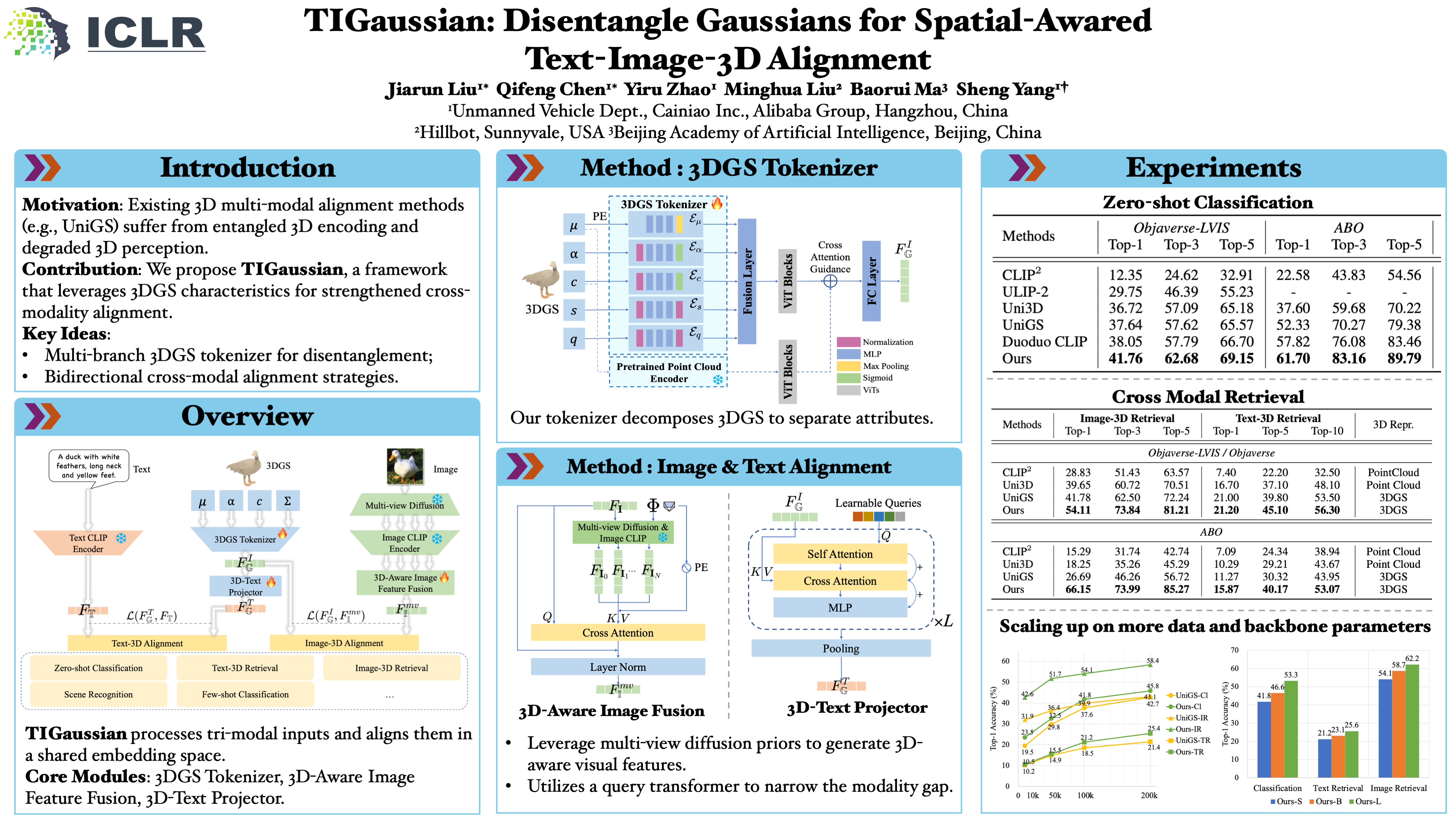
While visual-language models have profoundly linked features between texts and images, the incorporation of 3D modality data, such as point clouds and 3D Gaussians, further enables pretraining for 3D-related tasks, e.g., cross-modal retrieval, zero-shot classification, and scene recognition. As challenges remain in extracting 3D modal features and bridging the gap between different modalities, we propose TIGaussian, a framework that harnesses 3D Gaussian Splatting (3DGS) characteristics to strengthen cross-modality alignment through multi-branch 3DGS tokenizer and modality-specific 3D feature alignment strategies. Specifically, our multi-branch 3DGS tokenizer decouples the intrinsic properties of 3DGS structures into compact latent representations, enabling more generalizable feature extraction. To further bridge the modality gap, we develop a bidirectional cross-modal alignment strategies: a multi-view feature fusion mechanism that leverages diffusion priors to resolve perspective ambiguity in image-3D alignment, while a text-3D projection module adaptively maps 3D features to text embedding space for better text-3D alignment. Extensive experiments on various datasets demonstrate the state-of-the-art performance of TIGaussian in multiple tasks. Code repository: https://github.com/RUiN-jiarun/TIGaussian.
Beyond Static Vision: Scene Dynamic Field Unlocks Intuitive Physics Understanding in Multi-modal Large Language Models
Nanxi Li ⋅ Xiang Wang ⋅ Yuanjie Chen ⋅ Haode Zhang ⋅ HONG LI ⋅ Yong-Lu Li
While Multimodal Large Language Models (MLLMs) have demonstrated impressive capabilities in image and video understanding, their ability to comprehend the physical world has become an increasingly important research focus. Despite their improvements, current MLLMs struggle significantly with high-level physics reasoning. In this work, we investigate the first step of physical reasoning, i.e., **intuitive physics understanding**, revealing substantial limitations in understanding the dynamics of continuum objects. To isolate and evaluate this specific capability, we introduce two fundamental benchmark tasks: Next Frame Selection (NFS) and Temporal Coherence Verification (TCV). Our experiments demonstrate that even state-of-the-art MLLMs perform poorly on these foundational tasks. To address this limitation, we propose Scene Dynamic Field (SDF), a concise approach that leverages physics simulators within a multi-task fine-tuning framework. SDF substantially improves performance, achieving up to $20.7\%$ gains on fluid tasks while showing strong generalization to unseen physical domains. This work not only highlights a critical gap in current MLLMs but also presents a promising cost-efficient approach for developing more physically grounded MLLMs. Our code and data are available at https://github.com/andylinx/Scene-Dynamic-Field.
One-Shot Exemplars for Class Grounding in Self-Supervised Learning
Haowen Cui ⋅ Shuo Chen ⋅ Jun Li ⋅ Jian Yang
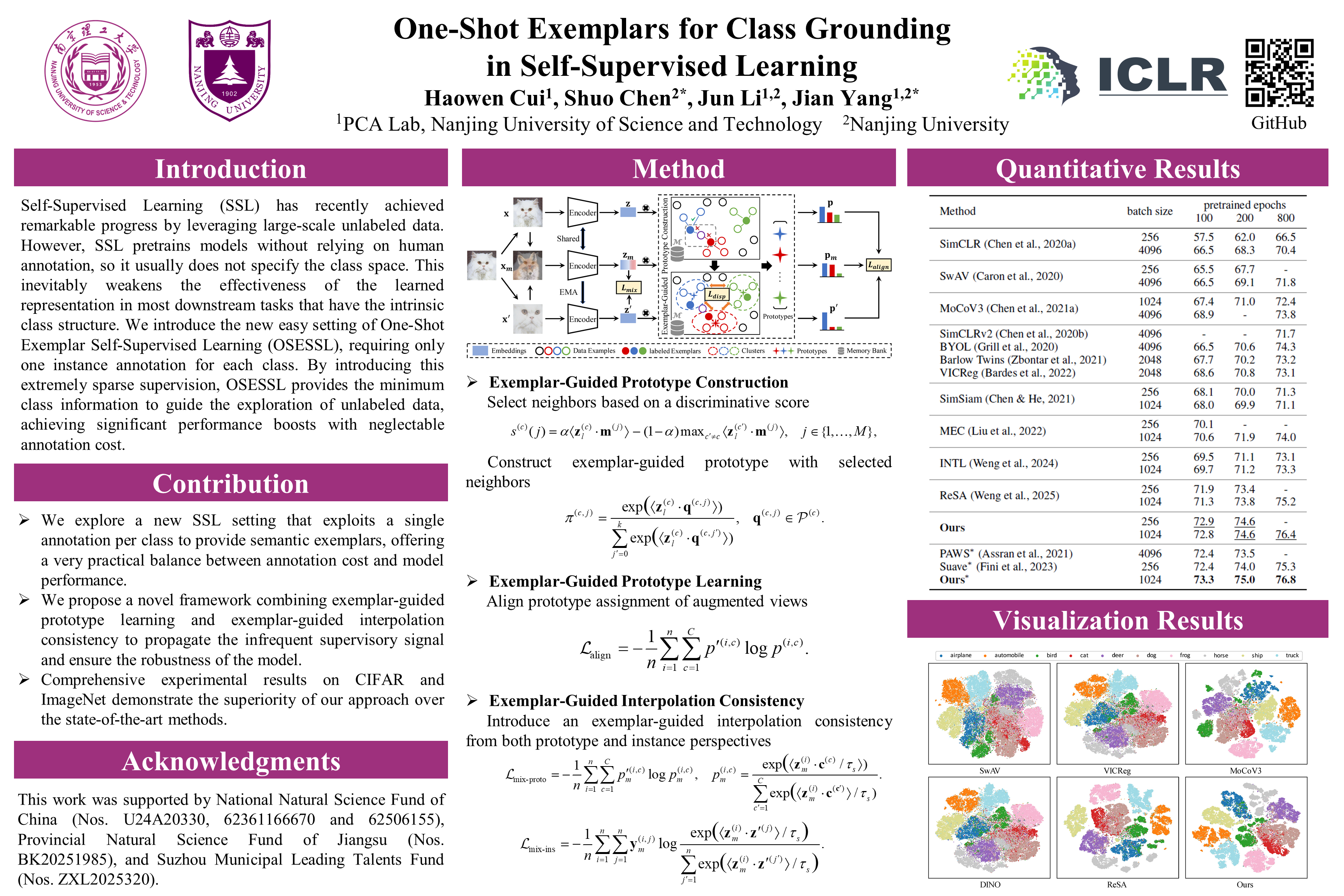
Self-Supervised Learning (SSL) has recently achieved remarkable progress by leveraging large-scale unlabeled data. However, SSL pretrains models without relying on human annotation, so it usually does not specify the class space. This inevitably weakens the effectiveness of the learned representation in most downstream tasks that have the intrinsic class structure. In this work, we introduce the new easy setting of One-Shot Exemplar Self-Supervised Learning (OSESSL), requiring only one instance annotation for each class. By introducing this extremely sparse supervision, OSESSL provides the minimum class information to guide the exploration of unlabeled data, achieving significant performance boosts with neglectable annotation cost (i.e., a complexity of $\mathcal{O}(1)$ w.r.t. the sample size). In this OSESSL setting, we propose a simple yet effective framework that leverages the single-labeled exemplar to build the class-specific prototype for learning reliable representations from the huge unlabeled data. To this end, we also build a novel consistency regularization, which extends the sparse exemplar supervision into the decision boundaries, thus improving the robustness of the learned representation. Extensive experiments on real-world datasets clearly validate the reliability of this simple and practical setting. The proposed approach successfully outperforms the state-of-the-art methods, achieving gains of approximately 3\% and 6\% $k$-NN accuracy on CIFAR-100 and ImageNet-100, respectively.
ShieldedCode: Learning Robust Representations for Virtual Machine Protected Code
Mingqiao Mo ⋅ Yunlong Tan ⋅ Hao Zhang ⋅ Heng Zhang ⋅ Yangfan He
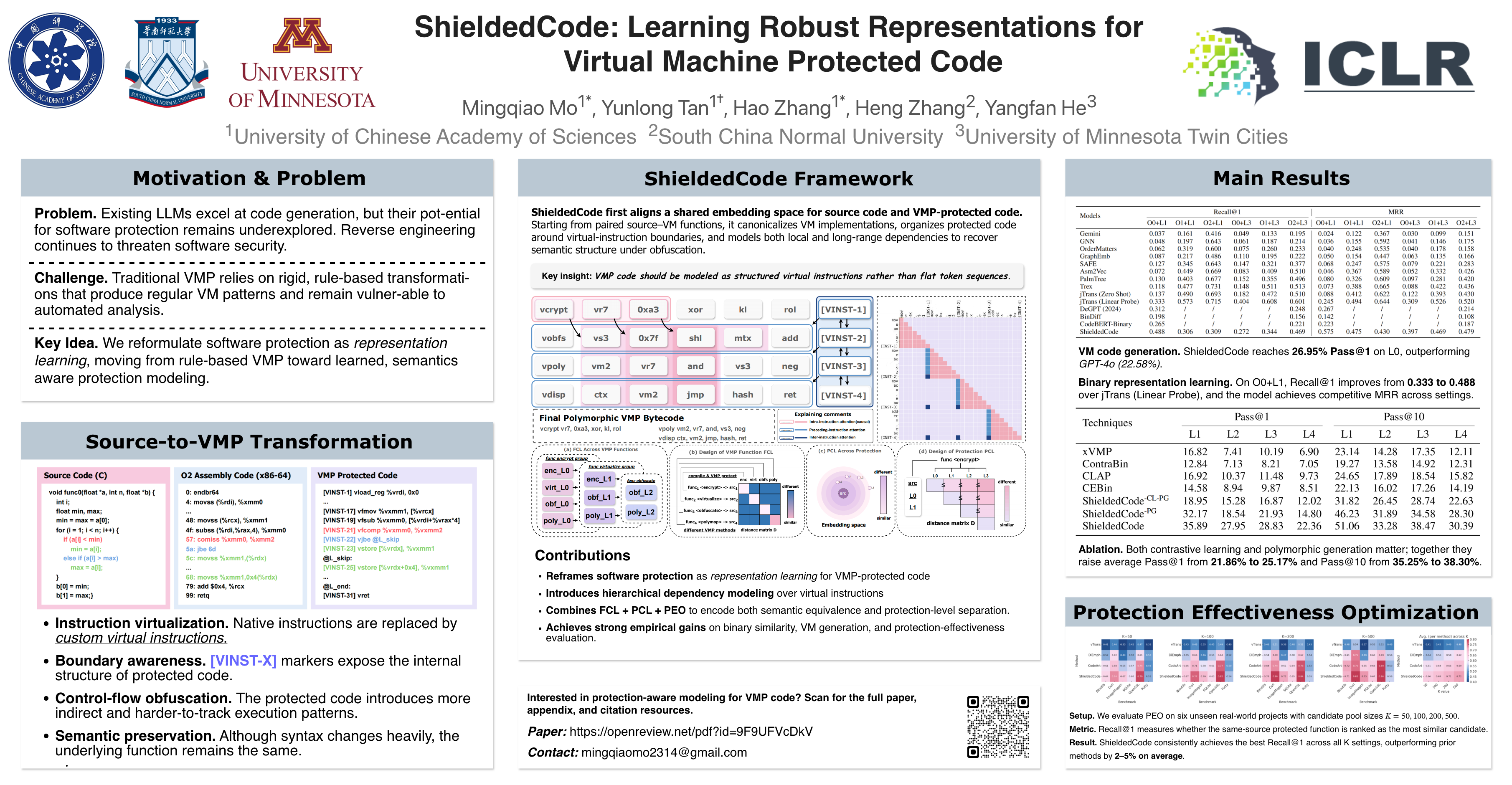
Large language models (LLMs) have achieved remarkable progress in code generation, yet their potential for software protection remains largely untapped. Reverse engineering continues to threaten software security, while traditional virtual machine protection (VMP) relies on rigid, rule-based transformations that are costly to design and vulnerable to automated analysis. In this work, we present the first protection-aware framework that learns robust representations of VMP-protected code. Our approach builds large-scale paired datasets of source code and normalized VM implementations, and introduces hierarchical dependency modeling at intra-, preceding-, and inter-instruction levels. We jointly optimize language modeling with functionality-aware and protection-aware contrastive objectives to capture both semantic equivalence and protection strength. To further assess resilience, we propose a protection effectiveness optimization task that quantifies and ranks different VM variants derived from the same source. Coupled with a two-stage continual pre-training and fine-tuning pipeline, our method enables models to generate, compare, and reason over protected code. Extensive experiments show that our framework significantly improves robustness across diverse protection levels, opening a new research direction for learning-based software defense. In this work, we present ShieldedCode, the first protection-aware framework that learns robust representations of VMP-protected code. Our method achieves 26.95\% Pass@1 on L0 VM code generation compared to 22.58\% for GPT-4o, and improves binary similarity detection Recall@1 by 10\% over state of art methods like jTrans.
Optimizer Choice Matters For The Emergence of Neural Collapse
Jim Zhao ⋅ Tin Sum Cheng ⋅ Wojciech Masarczyk ⋅ Aurelien Lucchi
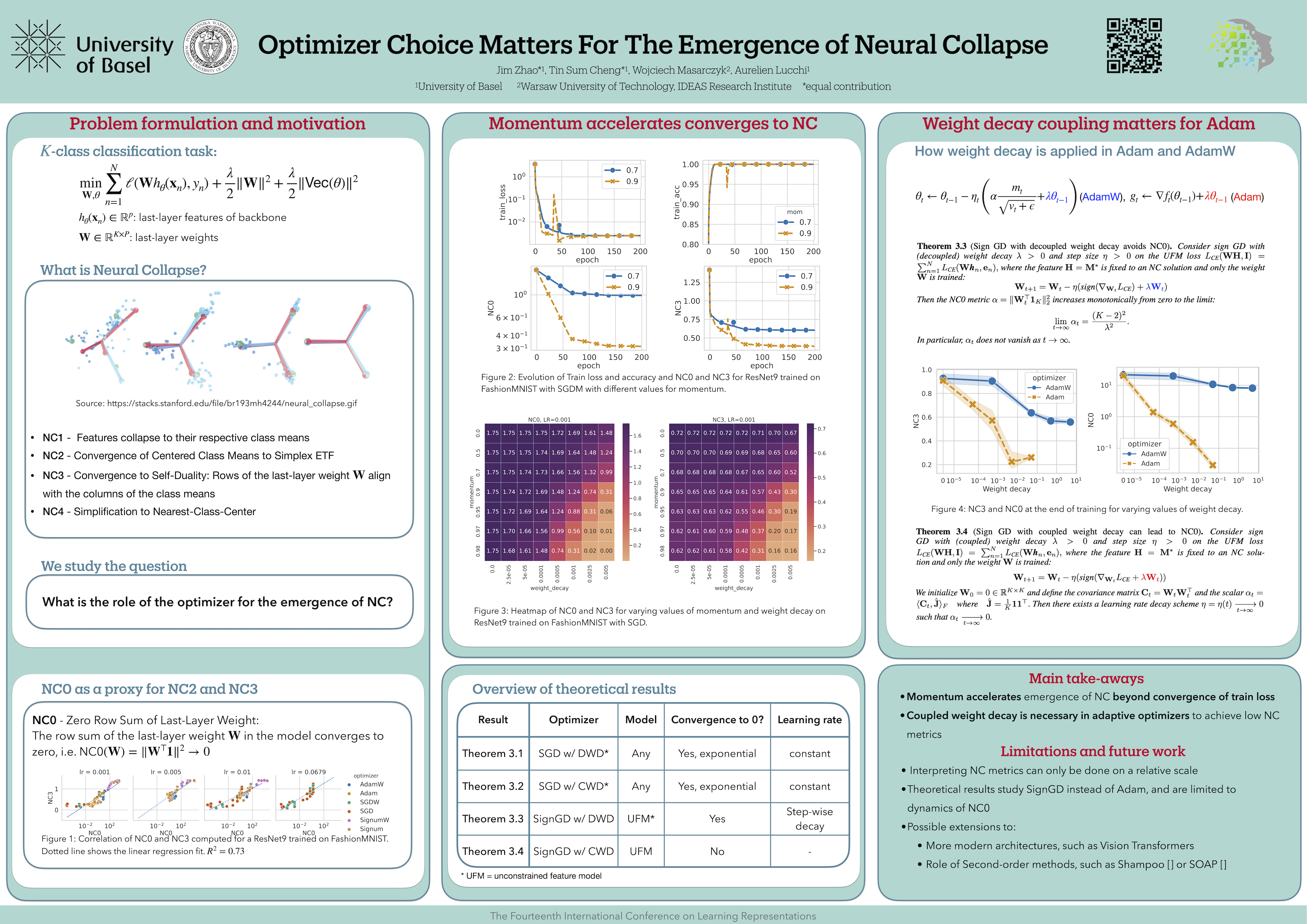
Neural Collapse (NC) refers to the emergence of highly symmetric geometric structures in the representations of deep neural networks during the terminal phase of training. Despite its prevalence, the theoretical understanding of NC remains limited. Existing analyses largely ignore the role of the optimizer, thereby suggesting that NC is universal across optimization methods. In this work, we challenge this assumption and demonstrate that the choice of optimizer plays a critical role in the emergence of NC. The phenomenon is typically quantified through NC metrics, which, however, are difficult to track and analyze theoretically. To overcome this limitation, we introduce a novel diagnostic metric, NC0, whose convergence to zero is a necessary condition for NC. Using NC0, we provide theoretical evidence that NC cannot emerge under decoupled weight decay in adaptive optimizers, as implemented in AdamW. Concretely, we prove that SGD, SignGD with coupled weight decay (a special case of Adam), and SignGD with decoupled weight decay (a special case of AdamW) exhibit qualitatively different NC0 dynamics. Also, we show the accelerating effect of momentum on NC (beyond convergence of train loss) when trained with SGD, being the first result concerning momentum in the context of NC. Finally, we conduct extensive empirical experiments consisting of 3,900 training runs across various datasets, architectures, optimizers, and hyperparameters, confirming our theoretical results. This work provides the first theoretical explanation for optimizer-dependent emergence of NC and highlights the overlooked role of weight decay coupling in implicit biases of optimizers.
Difficult Examples Hurt Unsupervised Contrastive Learning: A Theoretical Perspective
Yi-Ge Zhang ⋅ Jingyi Cui ⋅ Qiran Li ⋅ Yisen Wang
Unsupervised contrastive learning has shown significant performance improvements in recent years, often approaching or even rivaling supervised learning in various tasks. However, its learning mechanism is fundamentally different from supervised learning. Previous works have shown that difficult examples (well-recognized in supervised learning as examples around the decision boundary), which are essential in supervised learning, contribute minimally in unsupervised settings. In this paper, perhaps surprisingly, we find that the direct removal of difficult examples, although reduces the sample size, can boost the downstream classification performance of contrastive learning. To uncover the reasons behind this, we develop a theoretical framework modeling the similarity between different pairs of samples. Guided by this framework, we conduct a thorough theoretical analysis revealing that the presence of difficult examples negatively affects the generalization of contrastive learning. Furthermore, we demonstrate that the removal of these examples, and techniques such as margin tuning and temperature scaling can enhance its generalization bounds, thereby improving performance. Empirically, we propose a simple and efficient mechanism for selecting difficult examples and validate the effectiveness of the aforementioned methods, which substantiates the reliability of our proposed theoretical framework.
NeMo-map: Neural Implicit Flow Fields for Spatio-Temporal Motion Mapping
Yufei Zhu ⋅ Shih-Min Yang ⋅ Andrey Rudenko ⋅ Tomasz Kucner ⋅ Achim Lilienthal ⋅ Martin Magnusson
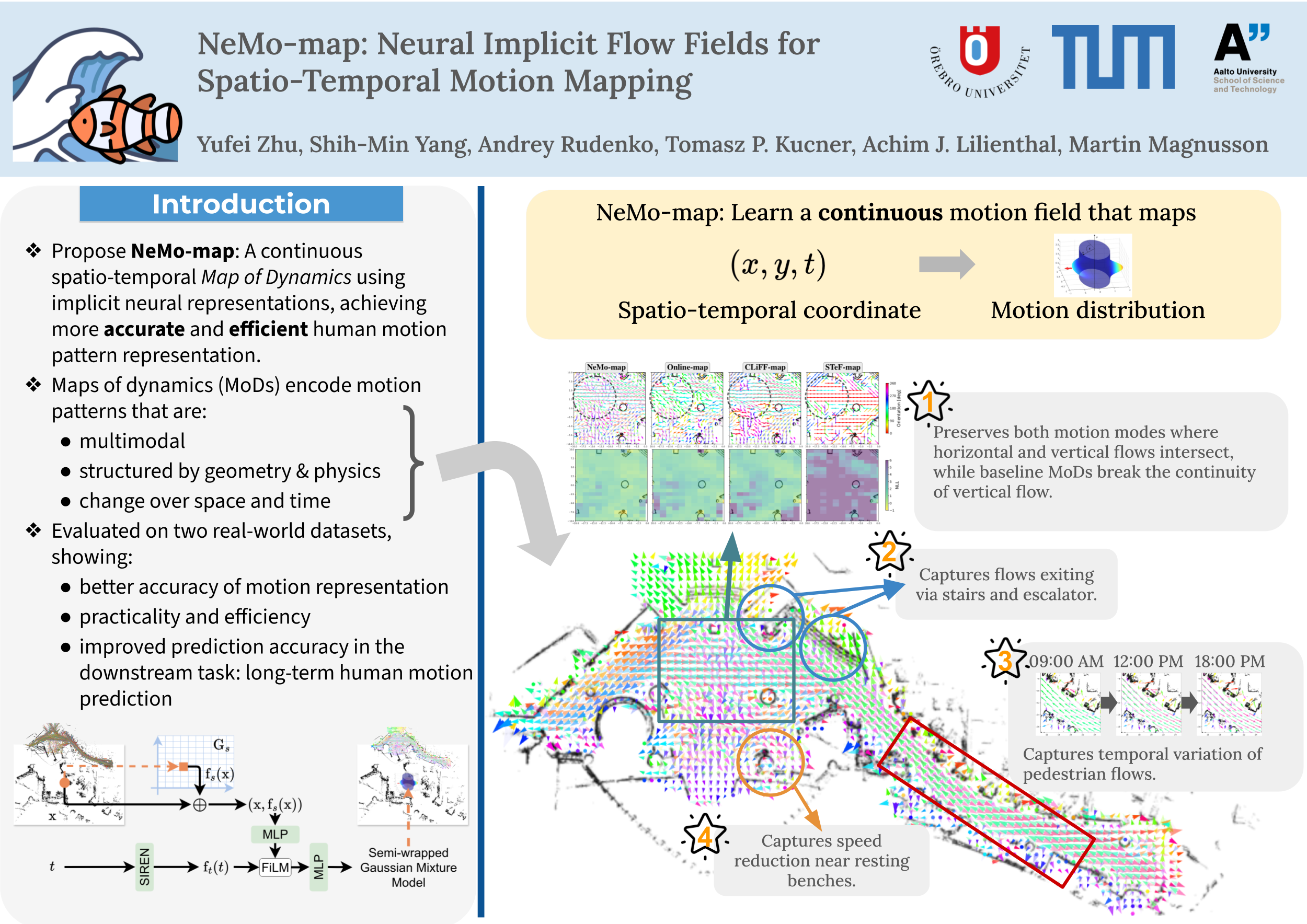
Safe and efficient robot operation in complex human environments can benefit from good models of site-specific motion patterns. Maps of Dynamics (MoDs) provide such models by encoding statistical motion patterns in a map, but existing representations use discrete spatial sampling and typically require costly offline construction. We propose a continuous spatio-temporal MoD representation based on implicit neural functions that directly map coordinates to the parameters of a Semi-Wrapped Gaussian Mixture Model. This removes the need for discretization and imputation for unevenly sampled regions, enabling smooth generalization across both space and time. Evaluated on two public datasets with real-world people tracking data, our method achieves better accuracy of motion representation and smoother velocity distributions in sparse regions while still being computationally efficient, compared to available baselines. The proposed approach demonstrates a powerful and efficient way of modeling complex human motion patterns and high performance in the trajectory prediction downstream task. The code is publicly available at https://github.com/test-bai-cpu/nemo-map.
Rethinking JEPA: Compute‑Efficient Video Self-Supervised Learning with Frozen Teachers
Xianhang Li ⋅ Chen Huang ⋅ Chun-Liang Li ⋅ Eran Malach ⋅ Joshua Susskind ⋅ Vimal Thilak ⋅ Etai Littwin
Video Joint Embedding Predictive Architectures (V‑JEPA) learn generalizable off-the-shelf video representations by predicting masked regions in latent space with an exponential moving average (EMA)‑updated teacher. While EMA prevents representation collapse, it complicates scalable model selection and couples teacher and student architectures. We revisit masked‑latent prediction and show that a frozen teacher suffices. Concretely, we (i) train a target encoder with a simple pixel‑reconstruction objective under V‑JEPA masking, then (ii) freeze it and train a student to predict the teacher’s latents on masked regions. This leads to a two‑stage, unregularized scheme, that we refer to as SALT (Static-teacher Asymmetric Latent Training). SALT decouples optimization into pixel reconstruction (teacher) and masked latent prediction (student), increasing transparency, efficiency, and scalability while preserving the ability of representations to generalize under frozen evaluation. Empirically, our student models outperform recently proposed V-JEPA 2 encoders under frozen backbone evaluation across diverse benchmarks. They are also more compute‑optimal: at matched pretraining FLOPs, our method achieves higher probing accuracy, and its scaling curves dominate V‑JEPA’s accuracy–FLOPs Pareto frontier. Finally, we find that student quality is remarkably robust to teacher quality: high-performing students emerge even with small, sub-optimal teachers. This points to a compute budget allocation that should overwhelmingly favor the student. These results position SALT as a simple, scalable, and compute‑efficient alternative to EMA‑based self‑distillation for video representation learning.
Adversarial Encoding Perturbation and Synthesis for Set Representation Auxiliary Learning
Yankai Chen ⋅ Xinni Zhang ⋅ Henry Peng Zou ⋅ Bowei He ⋅ Yangning Li ⋅ Philip Yu ⋅ Irwin King ⋅ Xue Liu
Sets are a fundamental data structure, and learning their vectorized representations is crucial for many computational problems. Existing methods typically focus on intra-set properties such as permutation invariance and cardinality independence. While effective at preserving basic intra-set semantics, these approaches may be insufficient in explicitly modeling inter-set correlations, which are critical for tasks requiring fine-grained comparisons between sets. In this work, we propose SRAL, a Set Representation Auxiliary Learning framework for capturing inter-set correlations that is compatible with various downstream tasks. SRAL conceptualizes sets as high-dimensional distributions and leverages the 2-Sliced-Wasserstein distance to derive their distributional discrepancies into set representation encoding. More importantly, we introduce a novel adversarial auxiliary learning scheme. Instead of manipulating the input data, our method perturbs the set encoding process itself and compels the model to be robust against worst-case perturbations through a min-max optimization. Our theoretical analysis shows that this objective, in expectation, directly optimizes for the set-wise Wasserstein distances, forcing the model to learn highly discriminative representations. Comprehensive evaluations across four downstream tasks examine SRAL’s performance relative to baseline methods, showing consistent effectiveness in both inter-set relation-sensitive retrieval and intra-set information-oriented processing tasks.
Noise-Aware Generalization: Robustness to In-Domain Noise and Out-of-Domain Generalization
Siqi Wang ⋅ Aoming Liu ⋅ Bryan Plummer
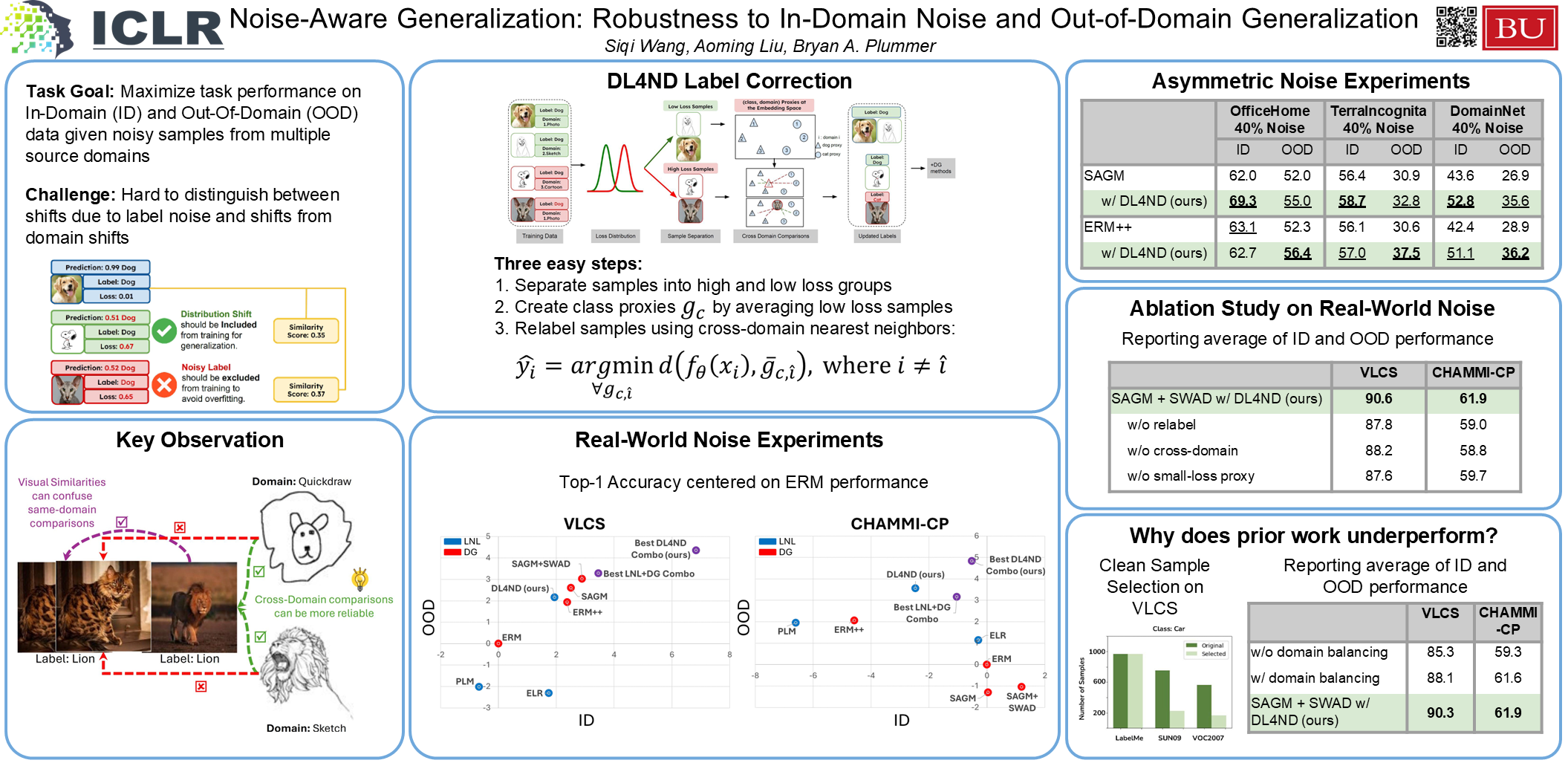
Methods addressing Learning with Noisy Labels (LNL) and multi-source Domain Generalization (DG) use training techniques to improve downstream task performance in the presence of label noise or domain shifts, respectively. Prior work often explores these tasks in isolation, and the limited work that does investigate their intersection, which we refer to as Noise-Aware Generalization (NAG), only benchmarks existing methods without also proposing an approach to reduce its effect. We find that this is likely due, in part, to the new challenges that arise when exploring NAG, which does not appear in LNL or DG alone. For example, we show that the effectiveness of DG methods is compromised in the presence of label noise, making them largely ineffective. Similarly, LNL methods often overfit to easy-to-learn domains as they confuse domain shifts for label noise. Instead, we propose Domain Labels for Noise Detection (DL4ND), the first direct method developed for NAG which uses our observation that noisy samples that may appear indistinguishable within a single domain often show greater variation when compared across domains. We find DL4ND outperforms DG and LNL methods, including their combinations, even when simplifying the NAG challenge by using domain labels to isolate domain shifts from noise. Performance gains up to 12.5% over seven diverse datasets with three noise types demonstrates DL4ND’s ability to generalize to a wide variety of settings.
Binomial Gradient-Based Meta-Learning for Enhanced Meta-Gradient Estimation
Yilang Zhang ⋅ Abraham Jaeger Mountain ⋅ Bingcong Li ⋅ Georgios B Giannakis
Meta-learning offers a principled framework leveraging task-invariant priors from related tasks, with which task-specific models can be fine-tuned on downstream tasks, even with limited data records. Gradient-based meta-learning (GBML) relies on gradient descent (GD) to adapt the prior to a new task. Albeit effective, these methods incur high computational overhead that scales linearly with the number of GD steps. To enhance efficiency and scalability, existing methods approximate the gradient of prior parameters (meta-gradient) via truncated backpropagation, yet suffer large approximation errors. Targeting accurate approximation, this work puts forth binomial GBML (BinomGBML), which relies on a truncated binomial expansion for meta-gradient estimation. This novel expansion endows more information in the meta-gradient estimation via efficient parallel computation. As a running paradigm applied to model-agnostic meta-learning (MAML), the resultant BinomMAML provably enjoys error bounds that not only improve upon existing approaches, but also decay super-exponentially under mild conditions. Numerical tests corroborate the theoretical analysis and showcase boosted performance with slightly increased computational overhead.
Learning Pseudorandom Numbers with Transformers: Permuted Congruential Generators, Curricula, and Interpretability
Tao Tao ⋅ Maissam Barkeshli
We study the ability of Transformer models to learn sequences generated by Permuted Congruential Generators (PCGs), a widely used family of pseudo-random number generators (PRNGs). PCGs introduce substantial additional difficulty over linear congruential generators (LCGs) by applying a series of bit-wise shifts, XORs, rotations and truncations to the hidden state. We show that Transformers can nevertheless successfully perform in-context prediction on unseen sequences from diverse PCG variants, in tasks that are beyond published classical attacks. In our experiments we scale moduli up to $2^{22}$ using up to $50$ million model parameters and datasets with up to $5$ billion tokens. Surprisingly, we find even when the output is truncated to a single bit, it can be reliably predicted by the model. When multiple distinct PRNGs are presented together during training, the model can jointly learn them, identifying structures from different permutations. We demonstrate a scaling law with modulus $m$: the number of in-context sequence elements required for near-perfect prediction grows as $\sqrt{m}$. For larger moduli, optimization enters extended stagnation phases; in our experiments, learning moduli $m \geq 2^{20}$ requires incorporating training data from smaller moduli, demonstrating a critical necessity for curriculum learning. Finally, we analyze embedding layers and uncover a novel clustering phenomenon: the top principal components spontaneously group the integers into bitwise rotationally-invariant clusters, revealing how representations can transfer from smaller to larger moduli.
Constraint-guided Hardware-aware NAS through Gradient Modification
Gregory De Ruyter ⋅ Mathias Verbeke ⋅ Hans Hallez
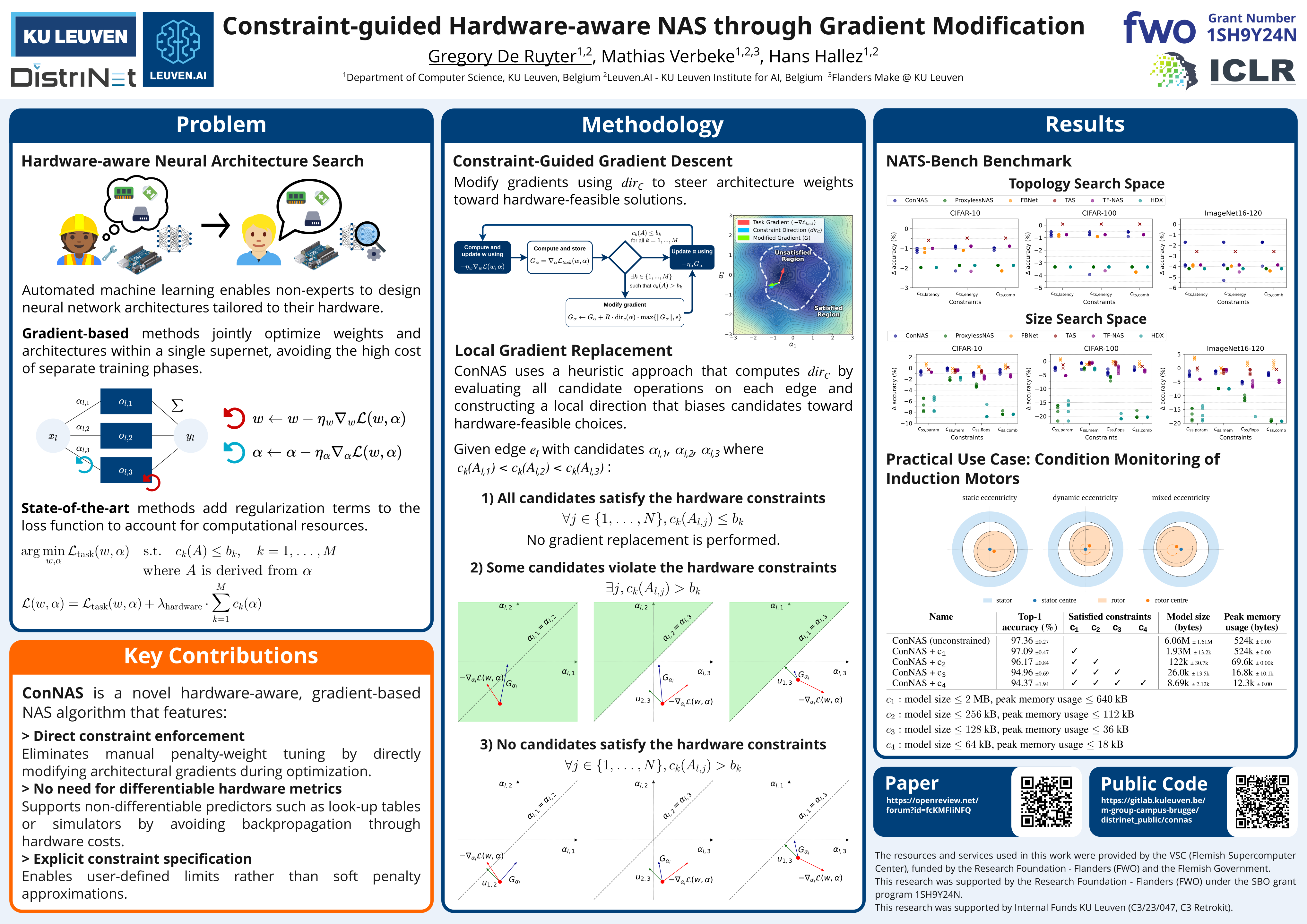
Neural Architecture Search (NAS), particularly gradient-based techniques, has proven highly effective in automating the design of neural networks. Recent work has extended NAS to hardware-aware settings, aiming to discover architectures that are both accurate and computationally efficient. Many existing methods integrate hardware metrics into the optimization objective as regularization terms, which introduces differentiability requirements and hyperparameter tuning challenges. This can either result in overly penalizing resource-intensive architectures or architectures failing to meet the hardware constraints of the target device. To address these challenges, we propose ConNAS, a novel gradient-based NAS framework that enforces hardware constraints directly through gradient modification. This approach eliminates the need for differentiable hardware metrics and regularization weights. The novelty in ConNAS lies in modifying gradients with respect to architectural choices, steering the search away from infeasible architectures while ensuring constraint satisfaction. Evaluations on the NATS-Bench benchmark demonstrate that ConNAS consistently discovers architectures that meet the imposed hardware constraints while achieving performance within just 0.14% of the optimal feasible architecture. Additionally, in a practical deployment scenario, ConNAS outperforms handcrafted architectures by up to 1.55% in accuracy under tight hardware budgets. Our code is publicly available at https://gitlab.kuleuven.be/m-group-campus-brugge/distrinet_public/connas.
PCLR: Progressively Compressed LoRA for Multimodal Continual Instruction Tuning
weicheng meng ⋅ Jingyang Qiao ⋅ Zhizhong Zhang ⋅ Shaohui Liu ⋅ Yuan Xie
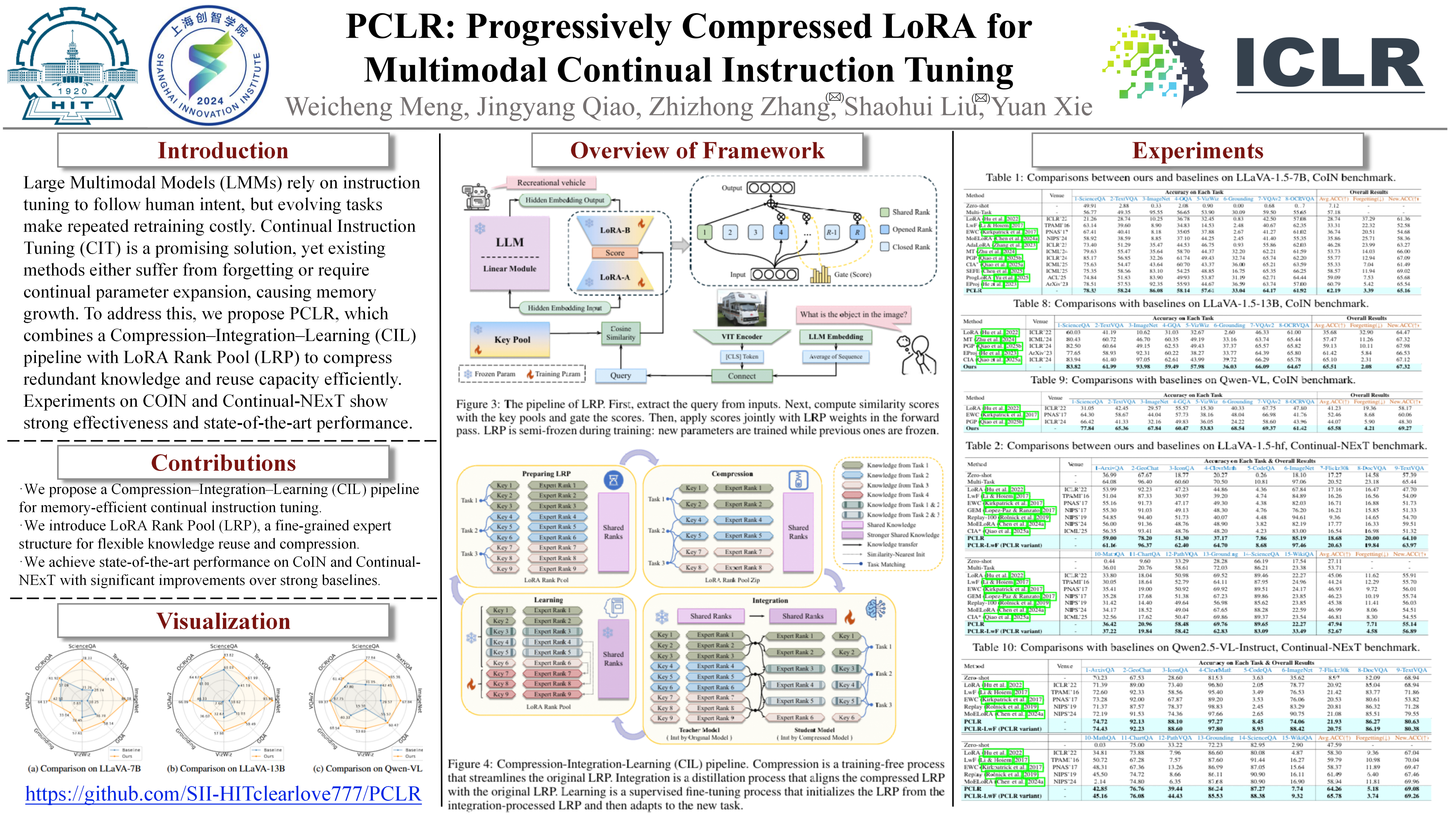
Continual Instruction Tuning (CIT) enables Large Multimodal Models (LMMs) to rapidly adapt to new tasks without retraining, but it suffers from the catastrophic forgetting problem. By adding new branches, model extension provides a great idea to accommodate novel knowledge while causing huge memory consumption. To jointly address forgetting and memory explosion, we propose the Compression–Integration–Learning (CIL) pipeline, which draws on the memory consolidation processes during human sleep. Compression streamlines old parameters to release capacity. Integration merges knowledge from similar tasks to restore the performance loss due to compression. For example, based on LLaVA-7B, the forgetting is reduced from 11.29 to 5.09. Learning reallocates released capacity for new task-relevant parameters. Next, based on the characteristics of LMMs at different learning stages, we establish the progressive learning process, further reducing forgetting from 5.09 to 3.39. Moreover, to adapt this process, we decompose LoRA into a set of rank vectors and introduce an extremely fine-grained architecture, LoRA Rank Pool (LRP), with the goal of flexible knowledge employment and editing. Finally, we combine all components, and yield Progressively Compressed LoRA (PCLR). Extensive experiments demonstrate that PCLR owns a memory budget close to non-extension methods while outperforming extension methods in performance. The implementation code is available at https://github.com/SII-HITclearlove777/PCLR.
Function Induction and Task Generalization: An Interpretability Study with Off-by-One Addition
Qinyuan Ye ⋅ Robin Jia ⋅ Xiang Ren
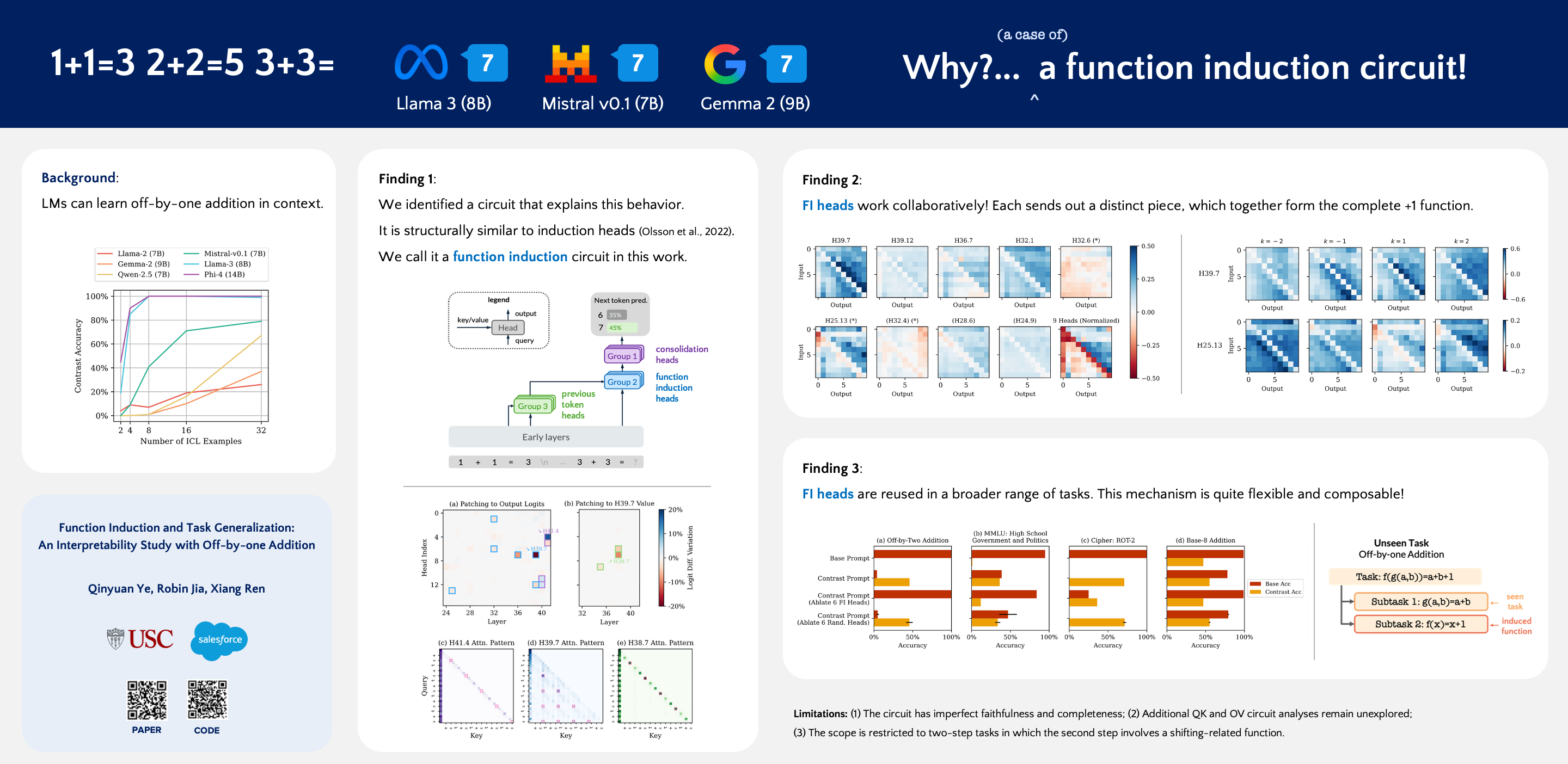
Large language models demonstrate the intriguing ability to perform unseen tasks via in-context learning. However, it remains unclear what mechanisms inside the model drive such task-level generalization. In this work, we approach this question through the lens of off-by-one addition (i.e., 1+1=3, 2+2=5, 3+3=?), a two-step, counterfactual task with an unexpected +1 function as a second step. Leveraging circuit-style interpretability techniques such as path patching, we analyze the models' internal computations behind their performance and present three key findings. First, we identify a mechanism that explains the model's generalization from standard addition to off-by-one addition. It resembles the induction head mechanism described in prior work, yet operates at a higher level of abstraction; we therefore term it "function induction" in this work. Second, we show that the induction of the +1 function is governed by multiple attention heads in parallel, each of which emits a distinct piece of the +1 function. Finally, we find that this function induction mechanism is reused in a broader range of tasks, including synthetic tasks such as shifted multiple-choice QA and algorithmic tasks such as base-8 addition. Overall, our findings offer deeper insights into how reusable and composable structures within language models enable task-level generalization.
Revisit Visual Prompt Tuning: The Expressiveness of Prompt Experts
Minh Le ⋅ Anh Nguyen ⋅ Huy Nguyen ⋅ Chau Nguyen ⋅ Anh T Tran ⋅ Nhat Ho
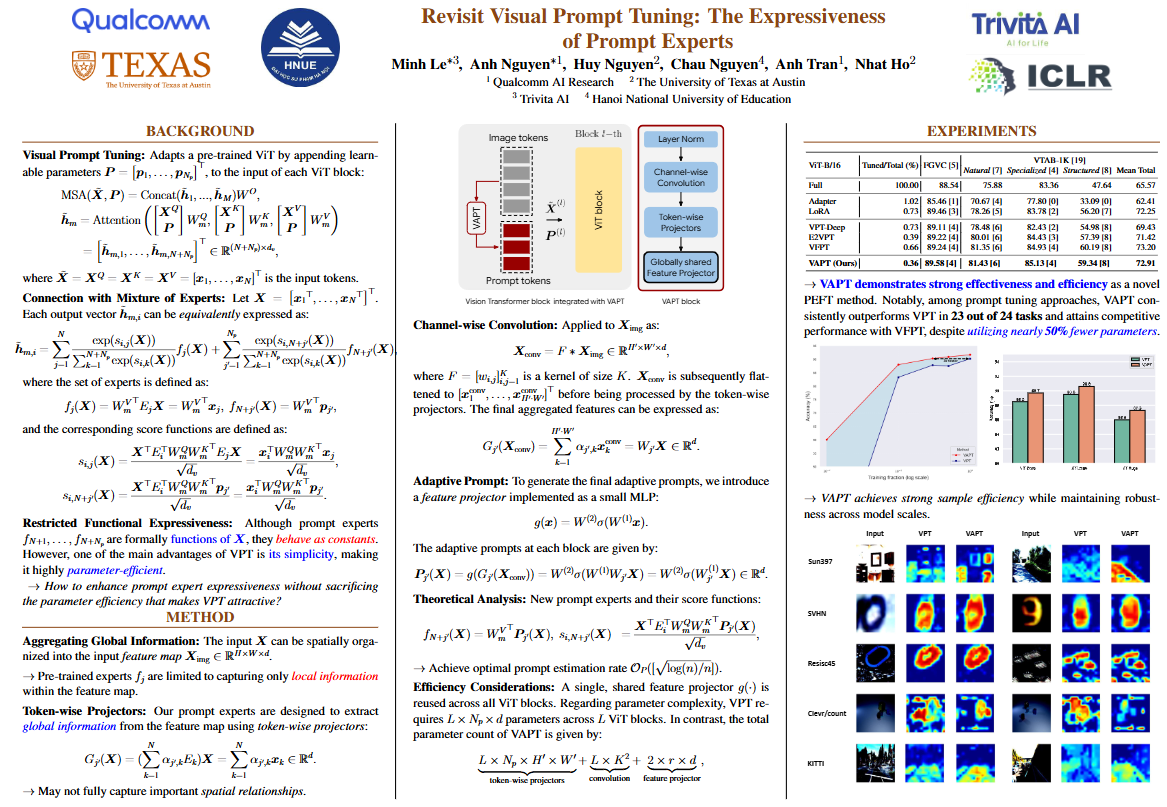
Visual Prompt Tuning (VPT) has proven effective for parameter-efficient adaptation of pre-trained vision models to downstream tasks by inserting task-specific learnable prompt tokens. Despite its empirical success, a comprehensive theoretical understanding of VPT remains an active area of research. Building on the recently established connection between Mixture of Experts (MoE) and prompt-based methods, wherein each attention head can be conceptualized as a composition of multiple MoE models, we reinterpret VPT as the introduction of new prompt experts into these MoE structures. We identify a key limitation in existing VPT frameworks: the restricted functional expressiveness of prompt experts, which remain static and thus limited in their adaptability. To address this, we propose Visual Adaptive Prompt Tuning (VAPT), a novel method that endows prompt experts with enhanced expressiveness while preserving parameter efficiency. Empirical evaluations on VTAB-1K and FGVC demonstrate that VAPT achieves substantial performance improvements, surpassing fully fine-tuned baselines by 7.34% and 1.04%, respectively. Moreover, VAPT consistently outperforms VPT while requiring fewer additional parameters. Furthermore, our theoretical analysis indicates that VAPT achieves optimal sample efficiency. Collectively, these results underscore the theoretical grounding and empirical advantages of our approach.
FIRE: Frobenius-Isometry Reinitialization for Balancing the Stability–Plasticity Tradeoff
Isaac Han ⋅ Sangyeon Park ⋅ Seungwon Oh ⋅ Donghu Kim ⋅ Hojoon Lee ⋅ KyungJoong Kim
Deep neural networks trained on nonstationary data must balance stability (i.e., retaining prior knowledge) and plasticity (i.e., adapting to new tasks). Standard reinitialization methods, which reinitialize weights toward their original values, are widely used but difficult to tune: conservative reinitializations fail to restore plasticity, while aggressive ones erase useful knowledge. We propose FIRE, a principled reinitialization method that explicitly balances the stability–plasticity tradeoff. FIRE quantifies stability through Squared Frobenius Error (SFE), measuring proximity to past weights, and plasticity through Deviation from Isometry (DfI), reflecting weight isotropy. The reinitialization point is obtained by solving a constrained optimization problem, minimizing SFE subject to DfI being zero, which is efficiently approximated by Newton–Schulz iteration. FIRE is evaluated on continual visual learning (CIFAR-10 with ResNet-18), language modeling (OpenWebText with GPT-0.1B), and reinforcement learning (HumanoidBench with SAC and Atari games with DQN). Across all domains, FIRE consistently outperforms both naive training without intervention and standard reinitialization methods, demonstrating effective balancing of the stability–plasticity tradeoff.
MergOPT: A Merge-Aware Optimizer for Robust Model Merging
Enneng Yang ⋅ Qun Yang ⋅ Peng Wang ⋅ Anke Tang ⋅ Guibing Guo ⋅ Xiaochun Cao ⋅ Li Shen
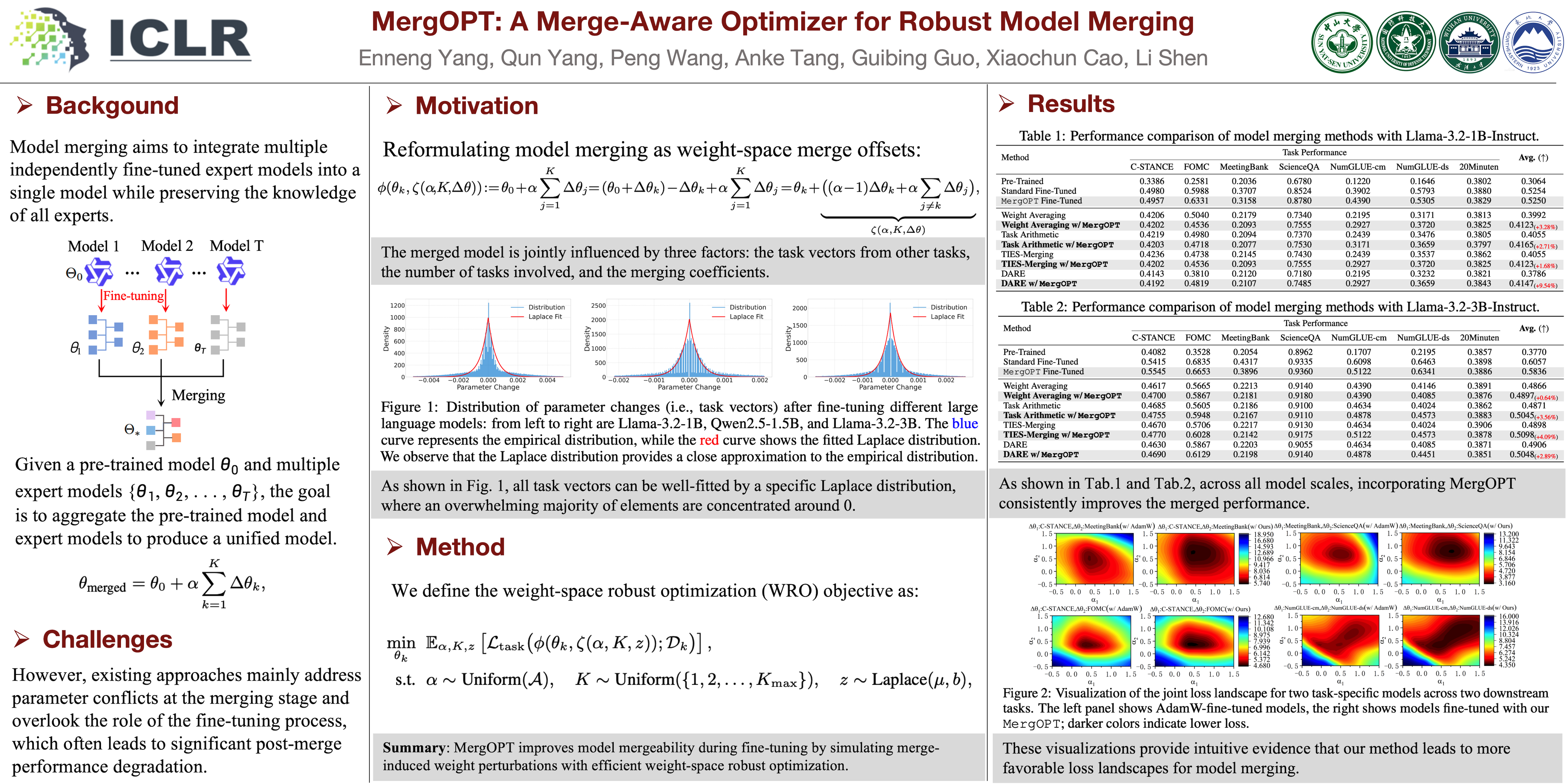
Model merging aims to integrate multiple independently fine-tuned expert models into a single model while preserving the knowledge of all experts. However, existing approaches mainly address parameter conflicts at the merging stage and overlook the role of the fine-tuning process, which often leads to significant post-merge performance degradation. To address this limitation, we propose a novel merging-aware optimizer (abbreviated as MergOPT) that injects principled merge-induced parameter shifts into the weight update steps so that the fine-tuned model exhibits a more stable loss landscape under subsequent merging operations. Specifically, we first formulate model merging as a distributionally robust optimization problem in the weight space: the parameters of other experts to be merged are viewed as adversarial merge-offsets, and fine-tuning adapts to the worst-case merging scenario. Building on this formulation, we analyze the distribution of parameter updates and the effects of merging hyperparameters, from which we derive a merging-guided feasible region for weight shifts. Finally, extensive experiments across four large language models (LLMs) and one vision model show that our approach consistently outperforms standard fine-tuning, yielding an average relative gain of 3.5\% and a maximum gain of 9.5\% across four merging strategies when merging seven experts.
FlyPrompt: Brain-Inspired Random-Expanded Routing with Temporal-Ensemble Experts for General Continual Learning
Hongwei Yan ⋅ Guanglong Sun ⋅ Kanglei Zhou ⋅ Qian Li ⋅ Liyuan Wang ⋅ Yi Zhong
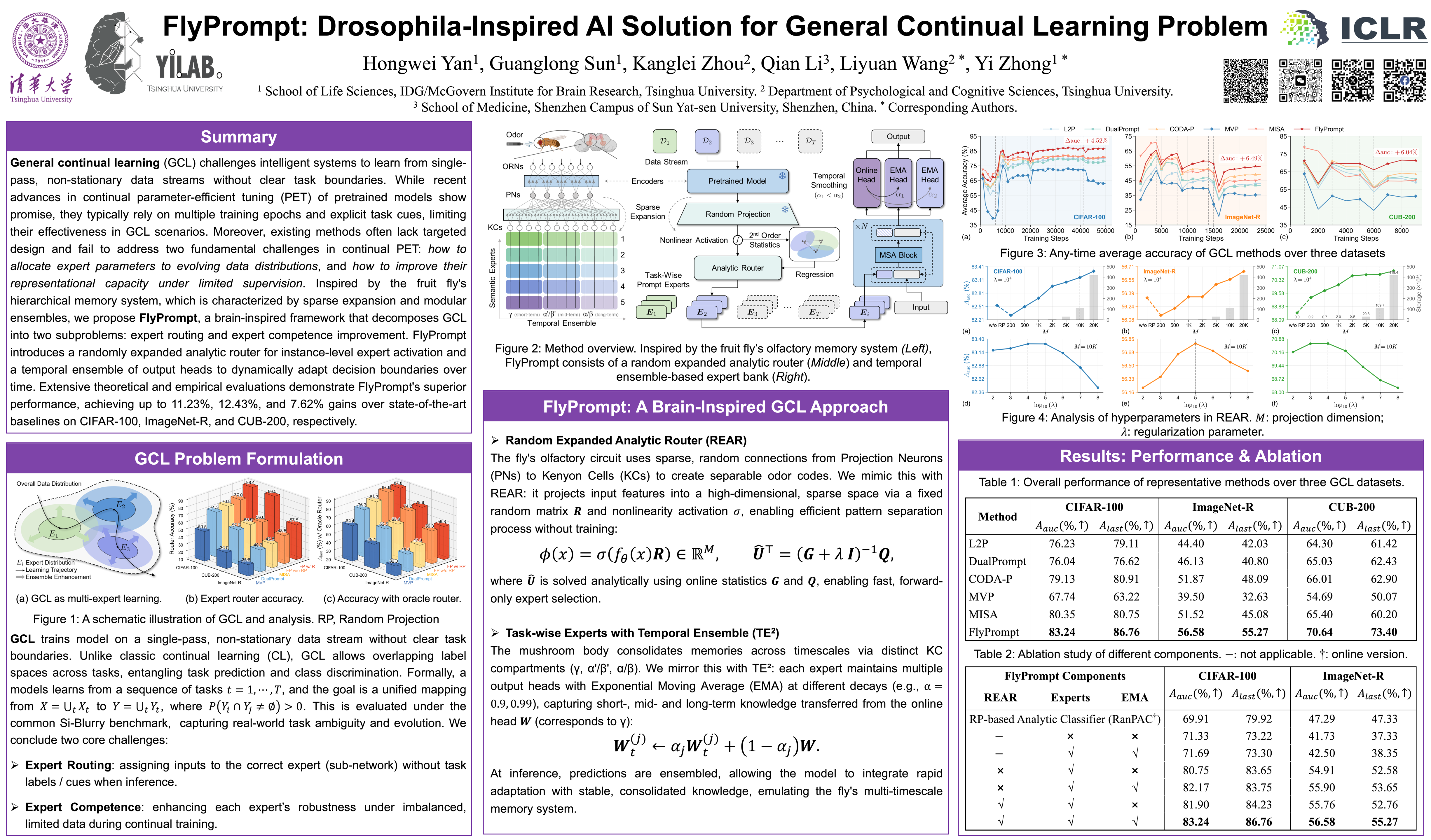
General continual learning (GCL) challenges intelligent systems to learn from single-pass, non-stationary data streams without clear task boundaries. While recent advances in continual parameter-efficient tuning (PET) of pretrained models show promise, they typically rely on multiple training epochs and explicit task cues, limiting their effectiveness in GCL scenarios. Moreover, existing methods often lack targeted design and fail to address two fundamental challenges in continual PET: how to allocate expert parameters to evolving data distributions, and how to improve their representational capacity under limited supervision. Inspired by the fruit fly's hierarchical memory system characterized by sparse expansion and modular ensembles, we propose FlyPrompt, a brain-inspired framework that decomposes GCL into two subproblems: expert routing and expert competence improvement. FlyPrompt introduces a randomly expanded analytic router for instance-level expert activation and a temporal ensemble of output heads to dynamically adapt decision boundaries over time. Extensive theoretical and empirical evaluations demonstrate FlyPrompt's superior performance, achieving up to 11.23%, 12.43%, and 7.62% gains over state-of-the-art baselines on CIFAR-100, ImageNet-R, and CUB-200, respectively. Our source code is available at https://github.com/AnAppleCore/FlyGCL.
An evolutionary perspective on modes of learning in Transformers
Alexander Ku ⋅ Thomas L. Griffiths ⋅ Stephanie Chan
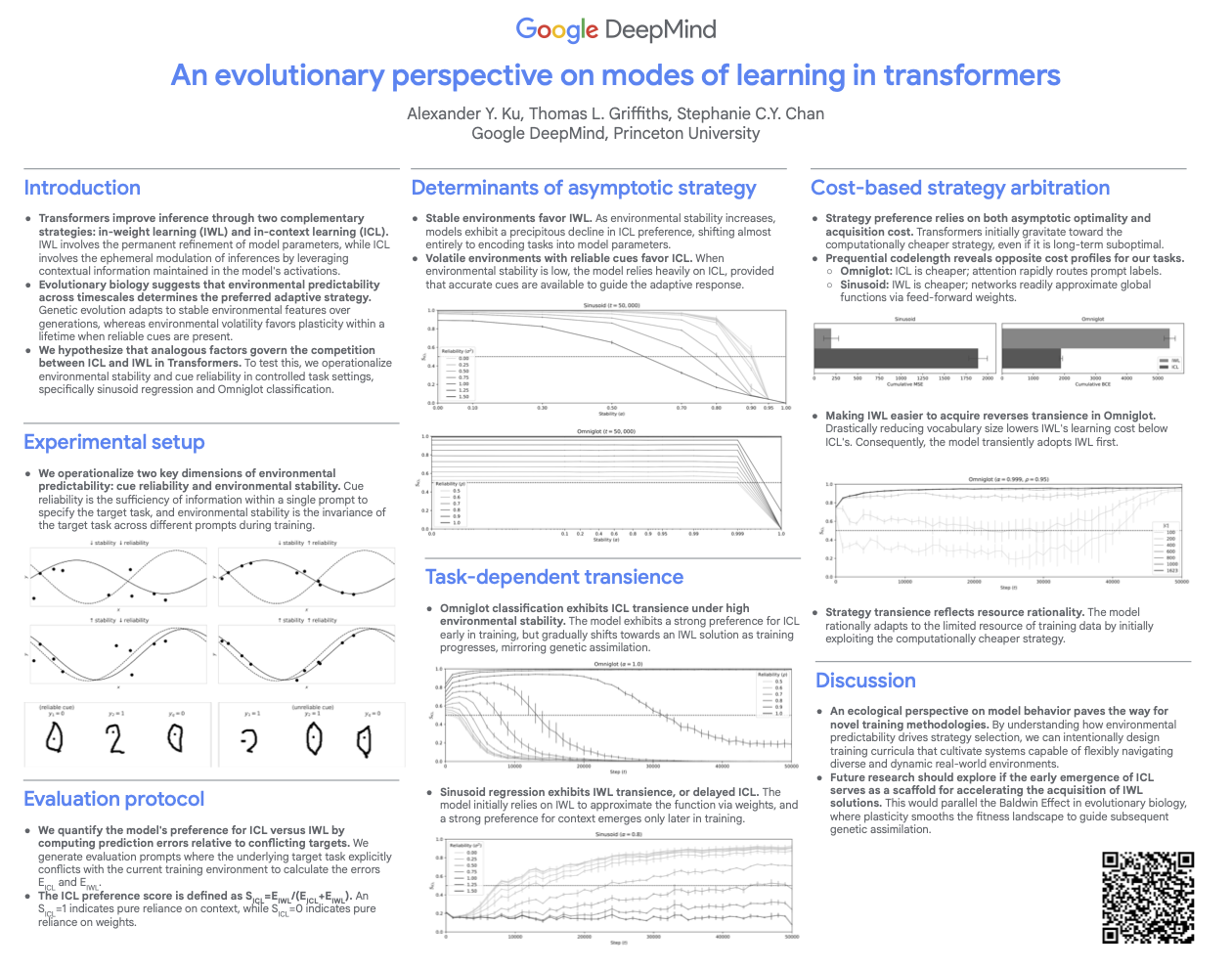
The success of Transformers lies in their ability to improve inference through two complementary strategies: the permanent refinement of model parameters via _in-weight learning_ (IWL), and the ephemeral modulation of inferences via _in-context learning_ (ICL), which leverages contextual information maintained in the model's activations. Evolutionary biology tells us that the predictability of the environment across timescales predicts the extent to which analogous strategies should be preferred. Genetic _evolution_ adapts to stable environmental features by gradually modifying the genotype over generations. Conversely, environmental volatility favors _plasticity_, which enables a single genotype to express different traits within a lifetime, provided there are reliable cues to guide the adaptation. We operationalize these dimensions (environmental stability and cue reliability) in controlled task settings (sinusoid regression and Omniglot classification) to characterize their influence on learning in Transformers. We find that stable environments favor IWL, often exhibiting a sharp transition when conditions are static. Conversely, reliable cues favor ICL, particularly when the environment is volatile. Furthermore, an analysis of learning dynamics reveals task-dependent transitions between strategies (ICL $\to$ IWL and vice versa). We demonstrate that these transitions are governed by (1) the asymptotic optimality of the strategy with respect to the environment, and (2) the optimization cost of acquiring that strategy, which depends on the task structure and the learner's inductive bias.
Retain and Adapt: Auto-Balanced Model Editing for Open-Vocabulary Object Detection under Domain Shifts
Zixuan Duan ⋅ Fengyuan Lu ⋅ Xunzhi Xiang ⋅ Wenbin Li ⋅ Yang Gao ⋅ Qi Fan
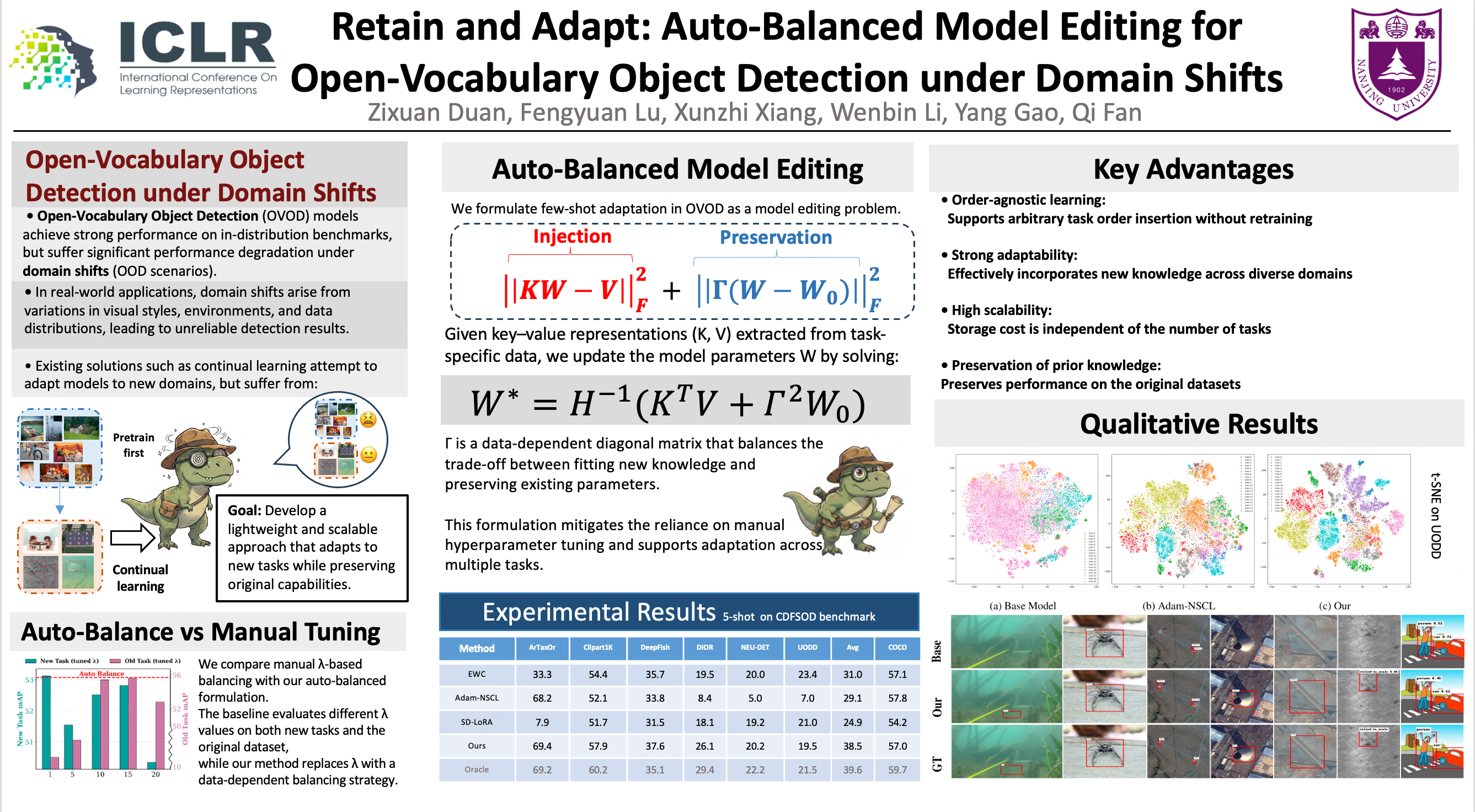
Recent advances in Open Vocabulary Object Detection (OVOD) have shown strong performance on standard benchmarks, but performance drops sharply under out-of-distribution (OOD) shifts. Continual learning offers a potential remedy by sequentially integrating new tasks, yet existing methods often struggle to balance retaining the pre-trained model capabilities with adapting to new tasks, and usually require retraining under specific task orders. To address these limitations, we observe that model editing naturally lends itself to this setting, as it enables efficient knowledge injection while retaining prior capabilities. Building on this insight, we introduce $\textbf{A}$utomatically $\textbf{B}$alanced $\textbf{M}$odel $\textbf{E}$diting ($\textbf{ABME}$), which injects new task knowledge into the powerful OVOD models while preserving the model’s original abilities. We first stores compact key–value representations with storage cost independent of task volume. Then we leverage the stored KV matrices to automatically balance the new and old knowledge for varying learning scenarios, supporting order-agnostic task insertion or removal without additional retraining. Experiments show that ABME consistently achieves a better trade-off between maintaining pre-trained performance and adapting to diverse OOD tasks compared to existing continual learning approaches for open-vocabulary object detection, and generalizes seamlessly across different models and task scales.
Plug-and-Play Compositionality for Boosting Continual Learning with Foundation Models
Weiduo Liao ⋅ Fei Han ⋅ Hisao Ishibuchi ⋅ Qingfu Zhang ⋅ Ying Wei
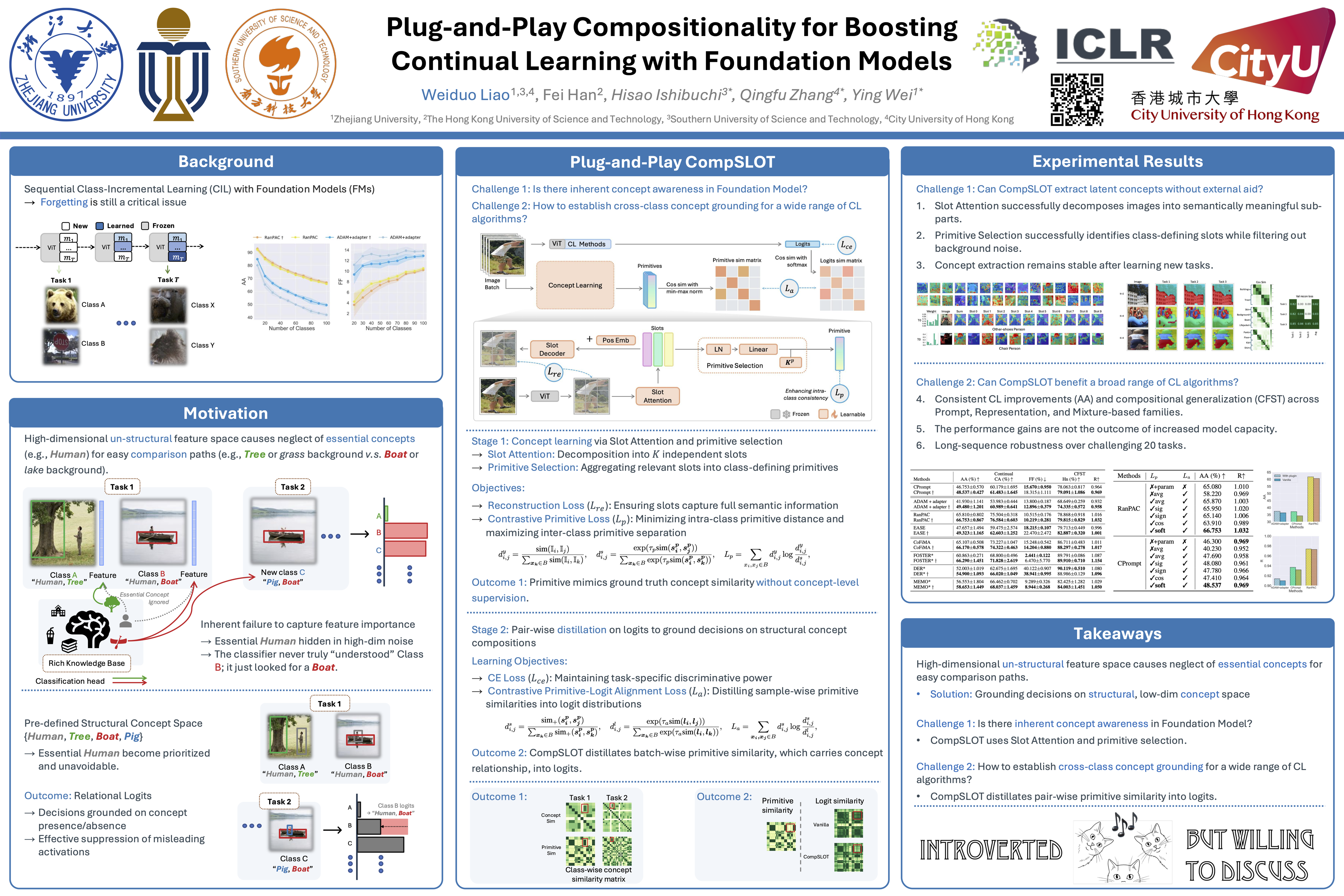
Vision learners often struggle with catastrophic forgetting due to their reliance on class recognition by comparison, rather than understanding classes as compositions of representative concepts. This limitation is prevalent even in state-of-the-art continual learners with foundation models and worsens when current tasks contain few classes. Inspired by the recent success of concept-level understanding in mitigating forgetting, we design a universal framework CompSLOT to guide concept learning across diverse continual learners. Leveraging the progress of object-centric learning in parsing semantically meaningful slots from images, we tackle the challenge of learning slot extraction from ImageNet-pretrained vision transformers by analyzing meaningful concept properties. We further introduce a primitive selection and aggregation mechanism to harness concept-level image understanding. Additionally, we propose a method-agnostic self-supervision approach to distill sample-wise concept-based similarity information into the classifier, reducing reliance on incorrect or partial concepts for classification. Experiments show CompSLOT significantly enhances various continual learners and provides a universal concept-level module for the community.
Context and Diversity Matter: The Emergence of In-Context Learning in World Models
Fan Wang ⋅ ZHIYUAN CHEN ⋅ YUXUAN ZHONG ⋅ Sunjian Zheng ⋅ Pengtao Shao ⋅ Bo Yu ⋅ Shaoshan Liu ⋅ Jianan Wang ⋅ Ning Ding ⋅ Yang Cao ⋅ Yu Kang
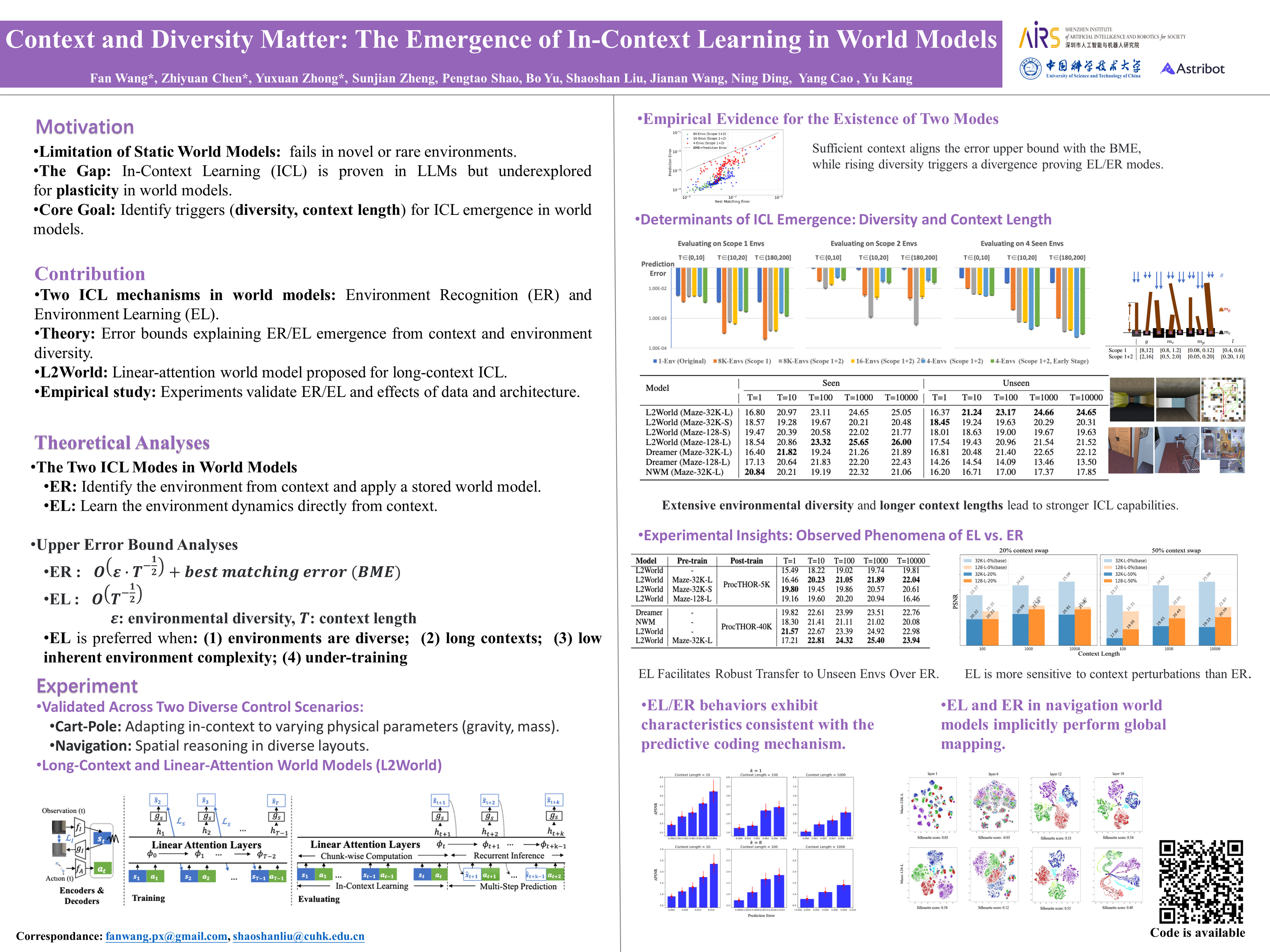
The capability of predicting environmental dynamics underpins both biological neural systems and general embodied AI in adapting to their surroundings. Yet prevailing approaches rest on static world models that falter when confronted with novel or rare configurations. We investigate in-context learning (ICL) of world models, shifting attention from zero-shot performance to the growth and asymptotic limits of the world model. Our contributions are three-fold: (1) we formalize ICL of a world model and identify two core mechanisms: environment recognition (ER) and environment learning (EL); (2) we derive error upper-bounds for both mechanisms that expose how the mechanisms emerge; and (3) we empirically confirm that distinct ICL mechanisms exist in the world model, and we further investigate how data distribution and model architecture affect ICL in a manner consistent with theory. These findings demonstrate the potential of self-adapting world models and highlight the key factors behind the emergence of EL/ER, most notably the necessity of long context and diverse environments. The codes are available at https://github.com/airs-cuhk/airsoul/tree/main/projects/MazeWorld.
CONSIGN: Conformal Segmentation Informed by Spatial Groupings via Decomposition
Bruno Viti ⋅ Elias Karabelas ⋅ Martin Holler
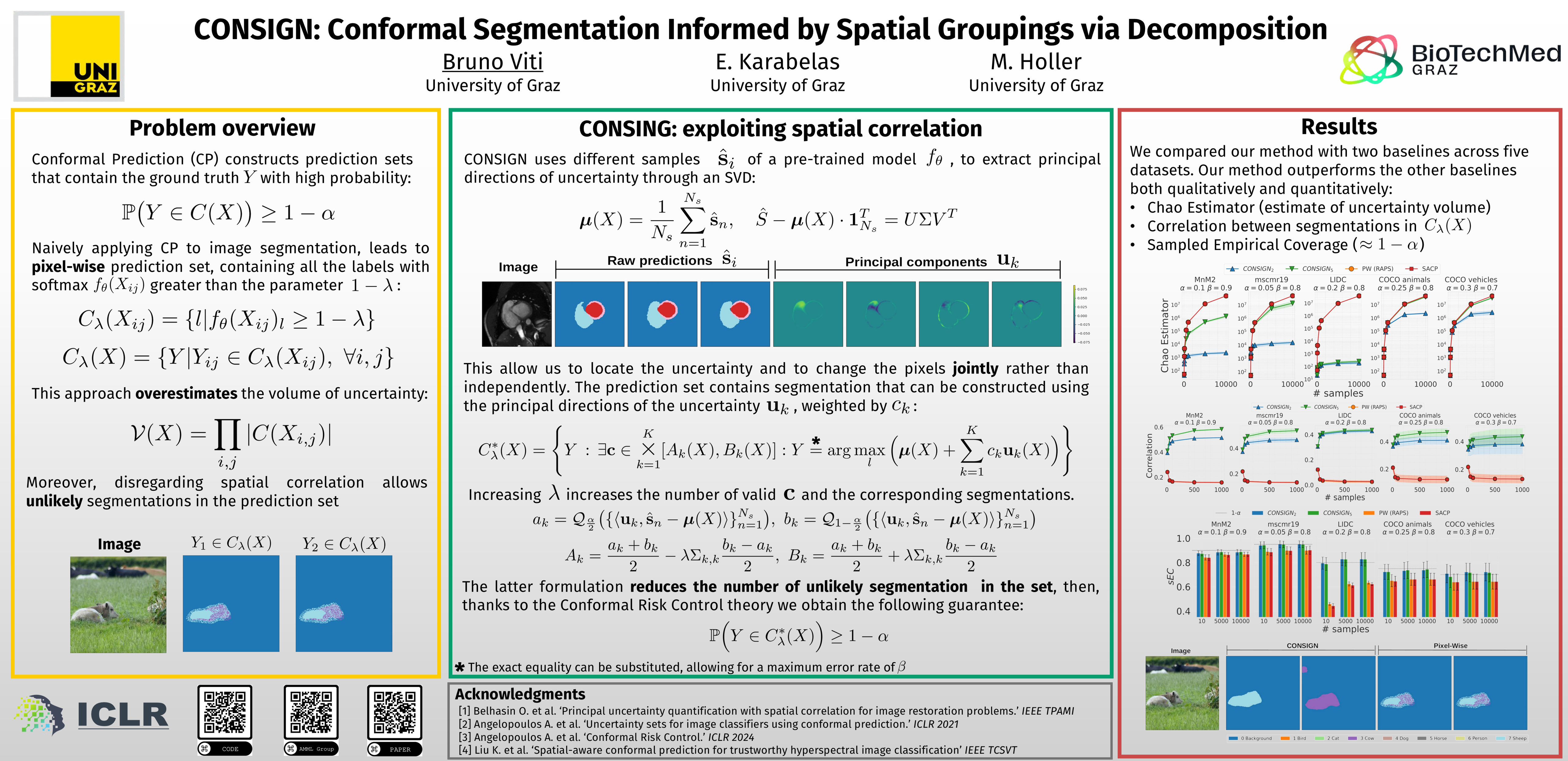
Most machine learning-based image segmentation models produce pixel-wise confidence scores that represent the model’s predicted probability for each class label at every pixel. While this information can be particularly valuable in high-stakes domains such as medical imaging, these scores are heuristic in nature and do not constitute rigorous quantitative uncertainty estimates. Conformal prediction (CP) provides a principled framework for transforming heuristic confidence scores into statistically valid uncertainty estimates. However, applying CP directly to image segmentation ignores the spatial correlations between pixels, a fundamental characteristic of image data. This can result in overly conservative and less interpretable uncertainty estimates. To address this, we propose CONSIGN (Conformal Segmentation Informed by Spatial Groupings via Decomposition), a CP-based method that incorporates spatial correlations to improve uncertainty quantification in image segmentation. Our method generates meaningful prediction sets that come with user-specified, high-probability error guarantees. It is compatible with any pre-trained segmentation model capable of generating multiple sample outputs. We evaluate CONSIGN against two CP baselines across three medical imaging datasets and two COCO dataset subsets, using three different pre-trained segmentation models. Results demonstrate that accounting for spatial structure significantly improves performance across multiple metrics and enhances the quality of uncertainty estimates.
How to Square Tensor Networks and Circuits Without Squaring Them
Lorenzo Loconte ⋅ Adrián Javaloy ⋅ Antonio Vergari
Squared tensor networks (TNs) and their extension as computational graphs---squared circuits---have been used as expressive distribution estimators, yet supporting closed-form marginalization. However, the squaring operation introduces additional complexity when computing the partition function or marginalizing variables, which hinders their applicability in ML. To solve this issue, canonical forms of TNs are parameterized via unitary matrices to simplify the computation of marginals. However, these canonical forms do not apply to circuits, as they can represent factorizations that do not directly map to a known TN. Inspired by the ideas of orthogonality in canonical forms and determinism in circuits enabling tractable maximization, we show how to parameterize squared circuits to overcome their marginalization overhead. Our parameterizations unlock efficient marginalization even in factorizations different from TNs, but encoded as circuits, whose structure would otherwise make marginalization computationally hard. Finally, our experiments on distribution estimation show how our proposed conditions in squared circuits come with no expressiveness loss, while enabling more efficient learning.
Multifidelity Simulation-based Inference for Computationally Expensive Simulators
Anastasia Nastya Krouglova ⋅ Hayden Johnson ⋅ Basile Confavreux ⋅ Michael Deistler ⋅ Pedro J Goncalves
Across many domains of science, stochastic models are an essential tool to understand the mechanisms underlying empirically observed data. Models can be of different levels of detail and accuracy, with models of high-fidelity (i.e., high accuracy) to the phenomena under study being often preferable. However, inferring parameters of high-fidelity models via simulation-based inference is challenging, especially when the simulator is computationally expensive. We introduce a multifidelity approach to neural posterior estimation that uses transfer learning to leverage inexpensive low-fidelity simulations to efficiently infer parameters of high-fidelity simulators. Our method applies the multifidelity scheme to both amortized and non-amortized neural posterior estimation. We further improve simulation efficiency by introducing a sequential variant that uses an acquisition function targeting the predictive uncertainty of the density estimator to adaptively select high-fidelity parameters. On established benchmark and neuroscience tasks, our approaches require up to two orders of magnitude fewer high-fidelity simulations than current methods, while showing comparable performance. Overall, our approaches open new opportunities to perform efficient Bayesian inference on computationally expensive simulators.
Harnessing Temporal Databases for Systematic Evaluation of Factual Time-Sensitive Question-Answering in LLMs
Soyeon Kim ⋅ Jindong Wang ⋅ Xing Xie ⋅ Steven Whang
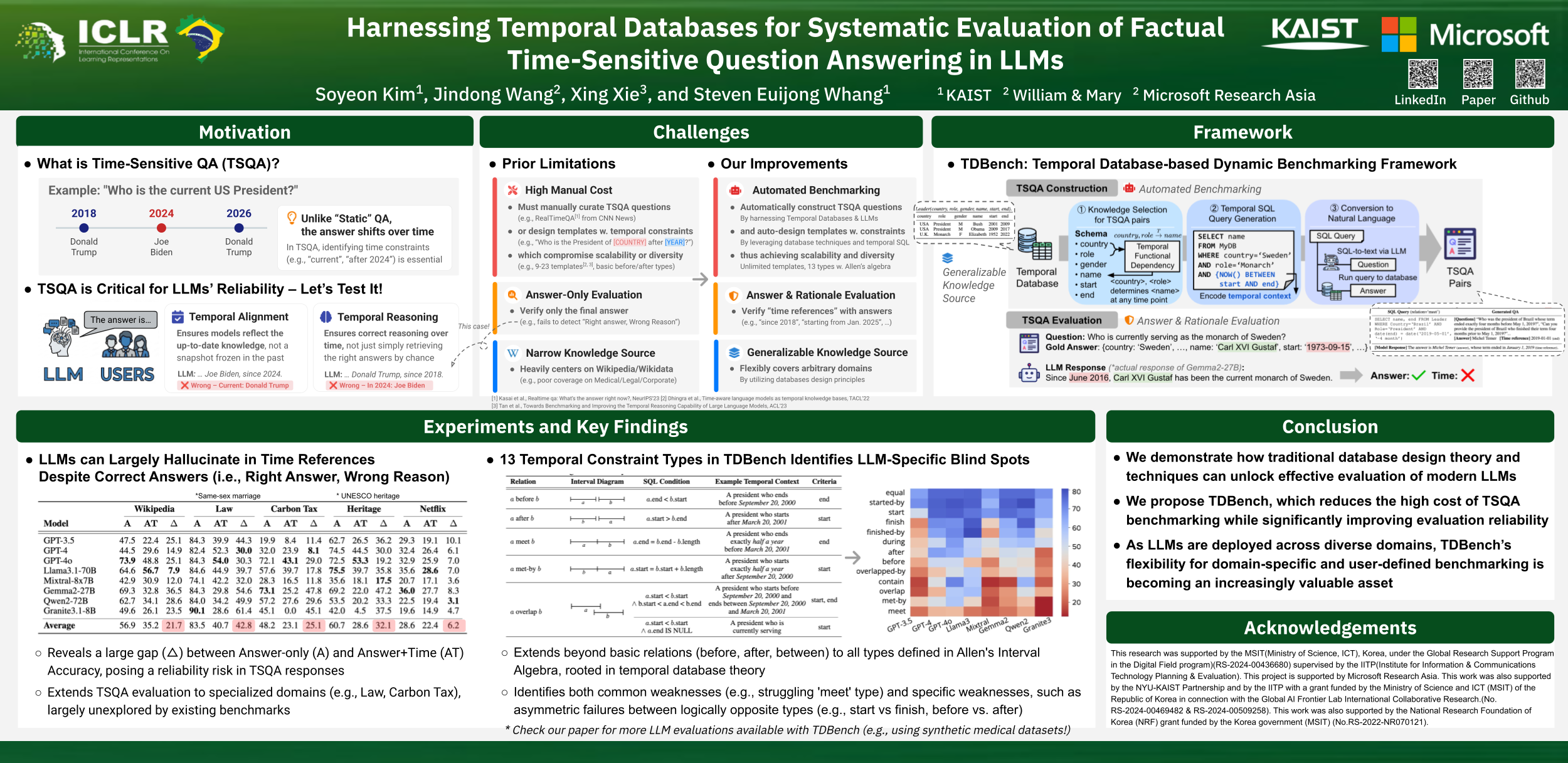
Facts change over time, making it essential for Large Language Models (LLMs) to handle time-sensitive factual knowledge accurately and reliably. Although factual Time-Sensitive Question-Answering (TSQA) tasks have been widely developed, existing benchmarks often face manual bottlenecks that limit scalable and comprehensive TSQA evaluation. To address this issue, we propose TDBench, a new benchmark that systematically constructs TSQA pairs by harnessing temporal databases and database techniques, such as temporal functional dependencies, temporal SQL, and temporal joins. We also introduce a new evaluation metric called time accuracy, which assesses the validity of time references in model explanations alongside traditional answer accuracy for a more fine-grained TSQA evaluation. Extensive experiments on contemporary LLMs show how TDBench enables scalable and comprehensive TSQA evaluation while reducing the reliance on human labor, complementing current TSQA evaluation approaches that largely center on Wikipedia/Wikidata by enabling LLM evaluation on application-specific data.
Don’t Pass@k: A Bayesian Framework for Large Language Model Evaluation
Mohsen Hariri ⋅ Amirhossein Samandar ⋅ Michael Hinczewski ⋅ Vipin Chaudhary
Pass@$k$ is widely used to report performance for LLM reasoning, but it often yields unstable, misleading rankings, especially when the number of trials (samples) is limited and compute is constrained. We present a principled Bayesian evaluation framework that replaces Pass@$k$ and average accuracy over $N$ trials (avg@$N$) with posterior estimates of a model's underlying success probability and credible intervals, yielding stable rankings and a transparent decision rule for differences. Evaluation outcomes are modeled as categorical (not just 0/1) with a Dirichlet prior, giving closed-form expressions for the posterior mean and uncertainty of any weighted rubric and enabling the use of prior evidence when appropriate. Theoretically, under a uniform prior, the Bayesian posterior mean is order-equivalent to average accuracy (Pass@$1$), explaining its empirical robustness while adding principled uncertainty. Empirically, in simulations with known ground-truth success rates and on AIME'24/'25, HMMT, and BrUMO, the Bayesian/avg procedure achieves faster convergence and greater rank stability than Pass@$k$ and recent variants, enabling reliable comparisons at far smaller sample counts. The framework clarifies when observed gaps are statistically meaningful (non-overlapping credible intervals) versus noise, and it naturally extends to graded, rubric-based evaluations. Together, these results recommend replacing Pass@$k$ for LLM evaluation and ranking with a posterior-based, compute-efficient protocol that unifies binary and non-binary evaluation while making uncertainty explicit. Source code is available at https://github.com/mohsenhariri/scorio.
$p\textrm{-less}$ Sampling: A Robust Hyperparameter-Free Approach for LLM Decoding
Runyan Tan ⋅ Shuang Wu ⋅ Phillip Howard
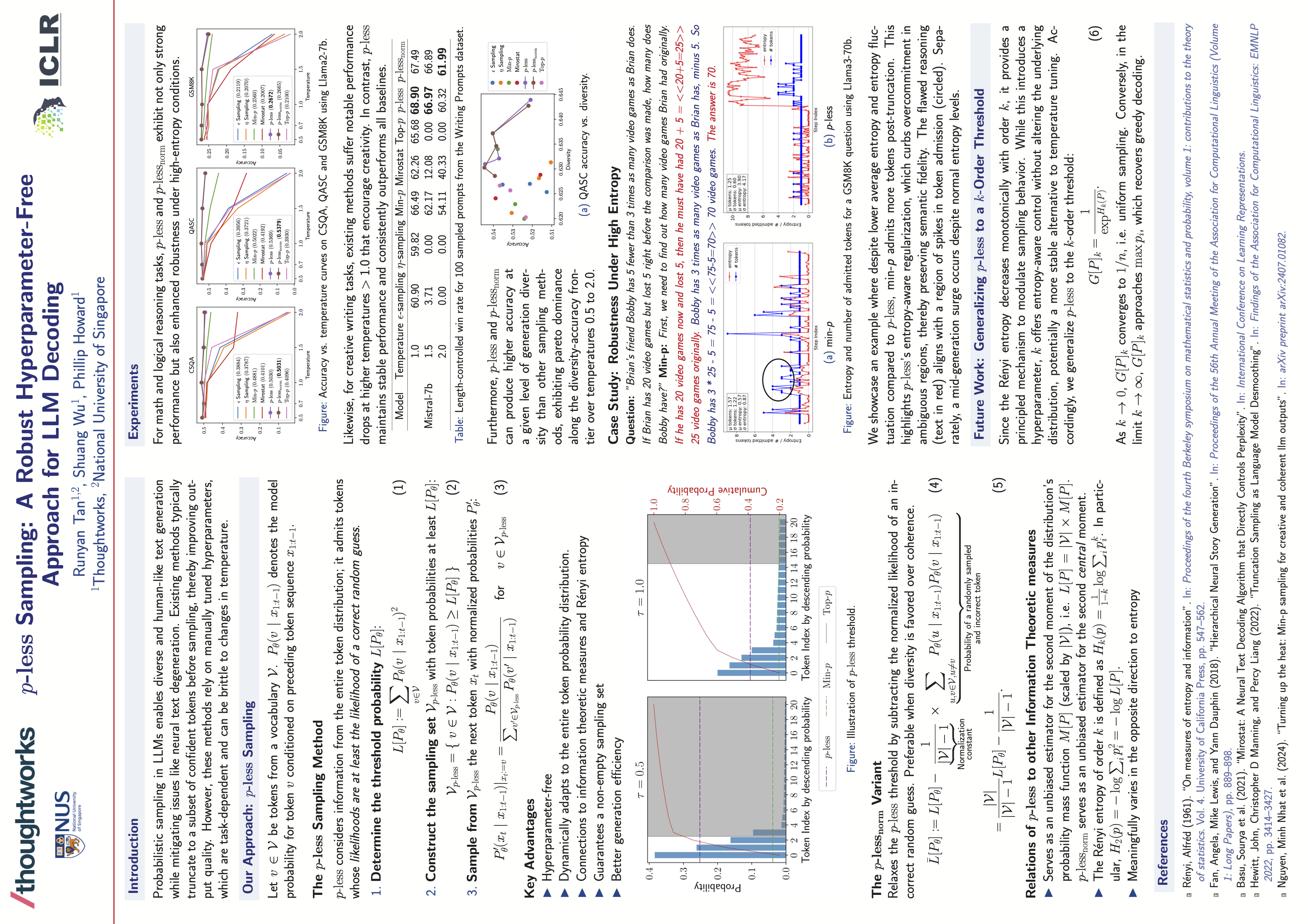
Obtaining high-quality outputs from Large Language Models (LLMs) often depends upon the choice of a sampling-based decoding strategy to probabilistically choose the next token at each generation step. While a variety of such sampling methods have been proposed, their performance can be sensitive to the selection of hyperparameters which may require different settings depending upon the generation task and temperature configuration. In this work, we introduce $p\textrm{-less}$ sampling: an information-theoretic approach to sampling which dynamically sets a truncation threshold at each decoding step based on the entire token probability distribution. Unlike existing methods, $p\textrm{-less}$ sampling has no hyperparameters and consistently produces high-quality outputs as temperature increases. We provide theoretical perspectives on $p$-less sampling to ground our proposed method and conduct experiments to empirically validate its effectiveness across a range of math, logical reasoning, and creative writing tasks. Our results demonstrate how $p\textrm{-less}$ sampling consistently outperforms existing sampling approaches while exhibiting much less degradation in text quality at higher temperature values. We further show how $p$-less achieves greater inference-time efficiency than alternative methods through lower average token sampling times and shorter generation lengths, without sacrificing accuracy. Finally, we provide analyses to highlight the benefits of $p\textrm{-less}$ through qualitative examples, case studies, and diversity assessments.
TESSAR: Geometry-Aware Active Regression via Dynamic Voronoi Tessellation
Seong Jin Cho ⋅ Gwangsu Kim ⋅ Junghyun Lee ⋅ Hee Suk Yoon ⋅ Joshua Tian Jin Tee ⋅ Chang Yoo
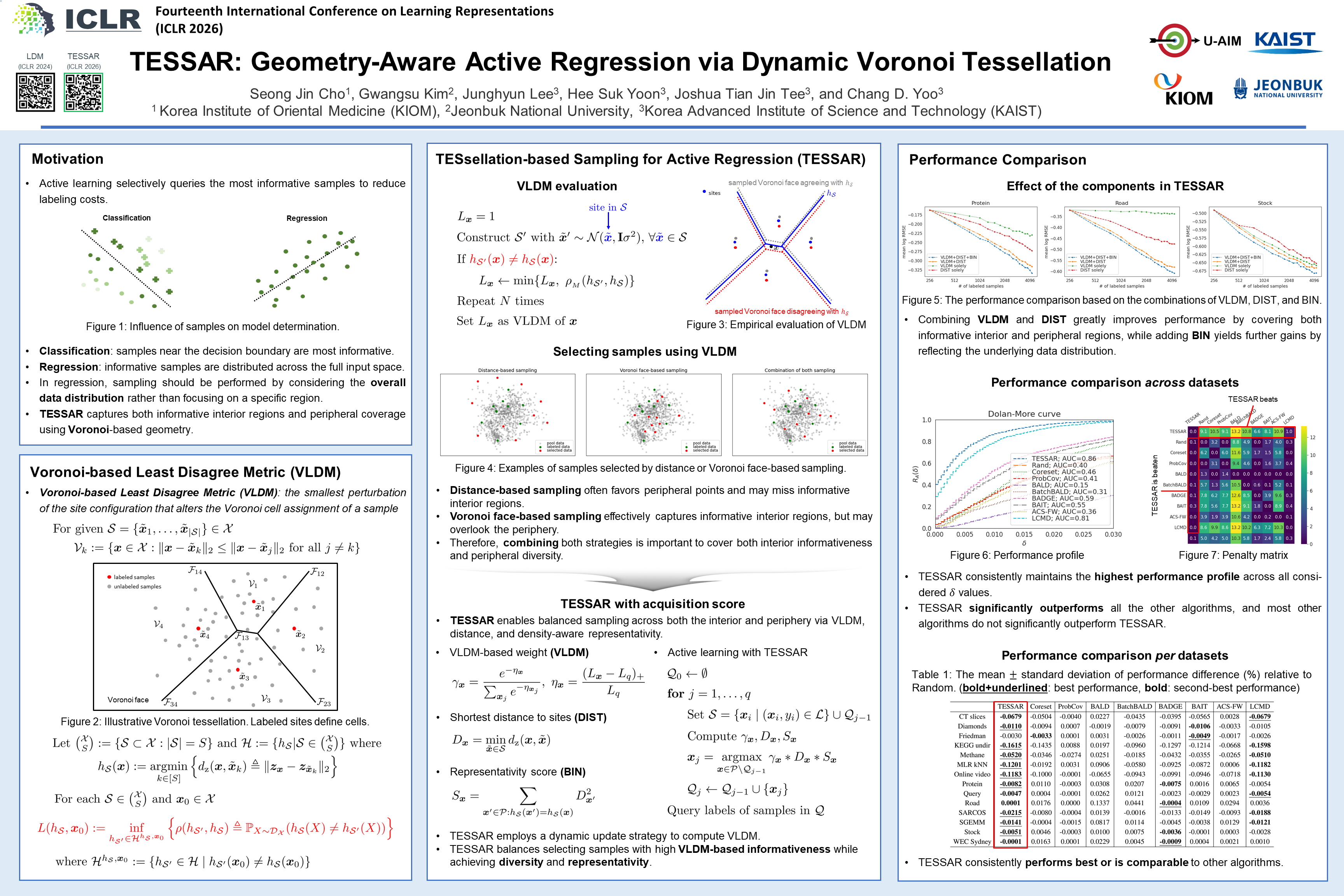
Active learning improves training efficiency by selectively querying the most informative samples for labeling. While it naturally fits classification tasks–where informative samples tend to lie near the decision boundary–its application to regression is less straightforward, as information is distributed across the entire dataset. Distance-based sampling is commonly used to promote diversity but tends to overemphasize peripheral regions while neglecting dense, informative interior regions. To address this, we propose a Voronoi-based active learning framework that leverages geometric structure for sample selection. Central to our method is the Voronoi-based Least Disagree Metric (VLDM), which estimates a sample’s proximity to Voronoi faces by measuring how often its cell assignment changes under perturbations of the labeled sites. We further incorporate a distance-based term to capture the periphery and a Voronoi-derived density score to reflect data representativity. The resulting algorithm, TESSAR (TESsellation-based Sampling for Active Regression), unifies interior coverage, peripheral exploration, and representativity into a single acquisition score. Experiments on various benchmarks demonstrate that TESSAR consistently achieves competitive or superior performance compared to prior state-of-the-art baselines.
BeyondBench: Contamination-Resistant Evaluation of Reasoning in Language Models
Gaurav Srivastava ⋅ Aafiya Hussain ⋅ Zhenyu Bi ⋅ Swastik Roy ⋅ Priya Pitre ⋅ Meng Lu ⋅ Morteza Ziyadi ⋅ Xuan Wang
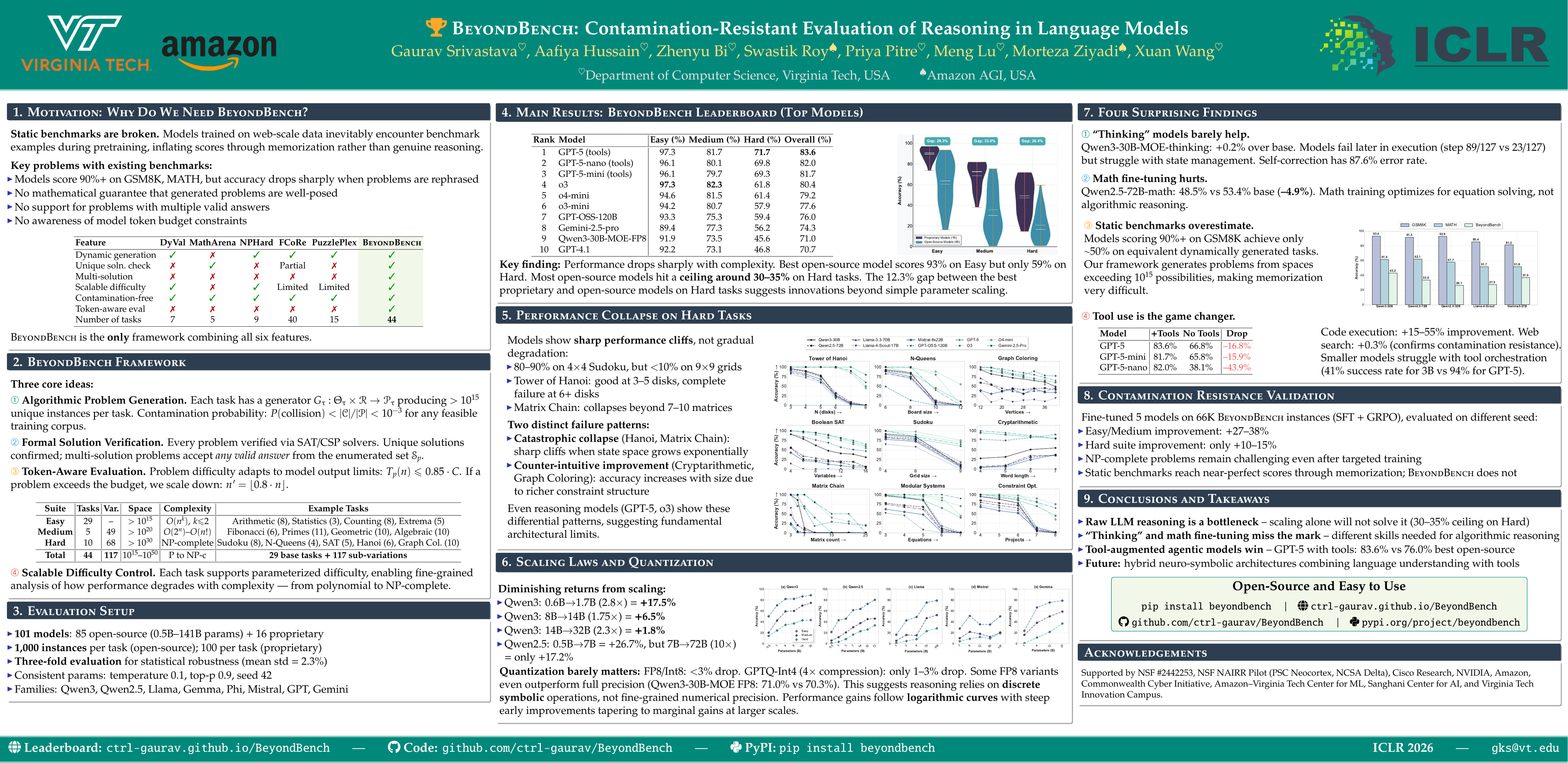
Evaluating language models fairly is becoming harder as static benchmarks risk contamination by training data, making it unclear whether models are truly reasoning or just recalling answers. We introduce **BeyondBench**, an evaluation framework that avoids this problem by using **algorithmic problem generation**. Unlike traditional benchmarks that risk contamination from internet-scale training data, BeyondBench creates mathematically grounded problems on the fly, ensuring each test remains fresh and uncontaminated. Our framework covers **44 algorithmic tasks** with a total of **117 variations**, grouped into three difficulty levels: the *Easy Suite* (29 tasks) for basic arithmetic and statistics, the *Medium Suite* (5 tasks, 49 variations) for sequence patterns and reasoning, and the *Hard Suite* (10 tasks, 68 variations) tackling NP-complete and constraint satisfaction problems. Each task generates problems from a combinatorial space larger than $10^{15}$ unique instances, with solutions verified deterministically by mathematical proofs. We evaluated **101 language models**, including 85 open-source and 16 closed-source models, spanning sizes from 0.5B to 141B parameters and multiple quantization schemes. All evaluations use three-fold evaluation to ensure statistical robustness. Our results show consistent reasoning deficiencies across model families, with performance degrading sharply as problem complexity increases from polynomial to exponential. In our Hard Suite evaluations, models such as Gemini-2.5-pro, Llama-3.3-70B, and Qwen2.5-72B achieved average accuracies of **56.21%, 27.16%, and 33.37%,** respectively. Moreover, we observe that performance drops drastically without tool usage, with GPT-5, GPT-5-mini, and GPT-5-nano showing a **decline** of **16.81%, 15.86%, and 43.95%** in overall accuracy without tool access. The contamination resistance of BeyondBench rests on three guarantees: (i) the problem space is vastly larger than any static dataset, (ii) every instance has a deterministically verifiable solution (unique or fully enumerated), and (iii) isomorphic transformations generate semantically equivalent but syntactically new problems. BeyondBench redefines reasoning evaluation through genuine algorithmic problem-solving, ensuring fair and meaningful evaluation. Our public leaderboard is available at https://ctrl-gaurav.github.io/BeyondBench/. Our open-source Python package is available at https://pypi.org/project/beyondbench/, and the codebase can be found at https://github.com/ctrl-gaurav/BeyondBench for easy and reproducible evaluation.
Graph-based Nearest Neighbors with Dynamic Updates via Random Walks
Nina Mishra ⋅ Yonatan Naamad ⋅ Tal Wagner ⋅ Lichen Zhang
Approximate nearest neighbor search (ANN) is a common way to retrieve relevant search results, especially now in the context of large language models and retrieval augmented generation. One of the most widely used algorithms for ANN is based on constructing a multi-layer graph over the dataset, called the Hierarchical Navigable Small World (HNSW). While this algorithm supports insertion of new data, it does not support deletion of existing data. Moreover, deletion algorithms described by prior work come at the cost of increased query latency, decreased recall, or prolonged deletion time. In this paper, we propose a new theoretical framework for graph-based ANN based on random walks. We then utilize this framework to analyze a randomized deletion approach that preserves hitting time statistics compared to the graph before deleting the point. We then turn this theoretical framework into a \emph{deterministic} deletion algorithm, and show that it provides better tradeoff between query latency, recall, deletion time, and memory usage through an extensive collection of experiments.
Multiple-Prediction-Powered Inference
Charlie Cowen-Breen ⋅ Alekh Agarwal ⋅ Stephen Bates ⋅ William W. Cohen ⋅ Jacob Eisenstein ⋅ Amir Globerson ⋅ Adam Fisch
Statistical estimation often involves tradeoffs between expensive, high-quality measurements and a variety of lower-quality proxies. We introduce Multiple-Prediction-Powered Inference (MultiPPI): a general framework for constructing statistically efficient estimates by optimally allocating resources across these diverse data sources. This work provides theoretical guarantees about the minimax optimality, finite-sample performance, and asymptotic normality of the MultiPPI estimator, and through experiments across three diverse large language model (LLM) evaluation scenarios, we show that MultiPPI consistently achieves lower estimation error than existing baselines. This advantage stems from its budget-adaptive allocation strategy, which strategically combines subsets of models by learning their complex cost and correlation structures.
Addressing divergent representations from causal interventions on neural networks
Satchel Grant ⋅ Simon Jerome Han ⋅ Alexa Tartaglini ⋅ Christopher Potts
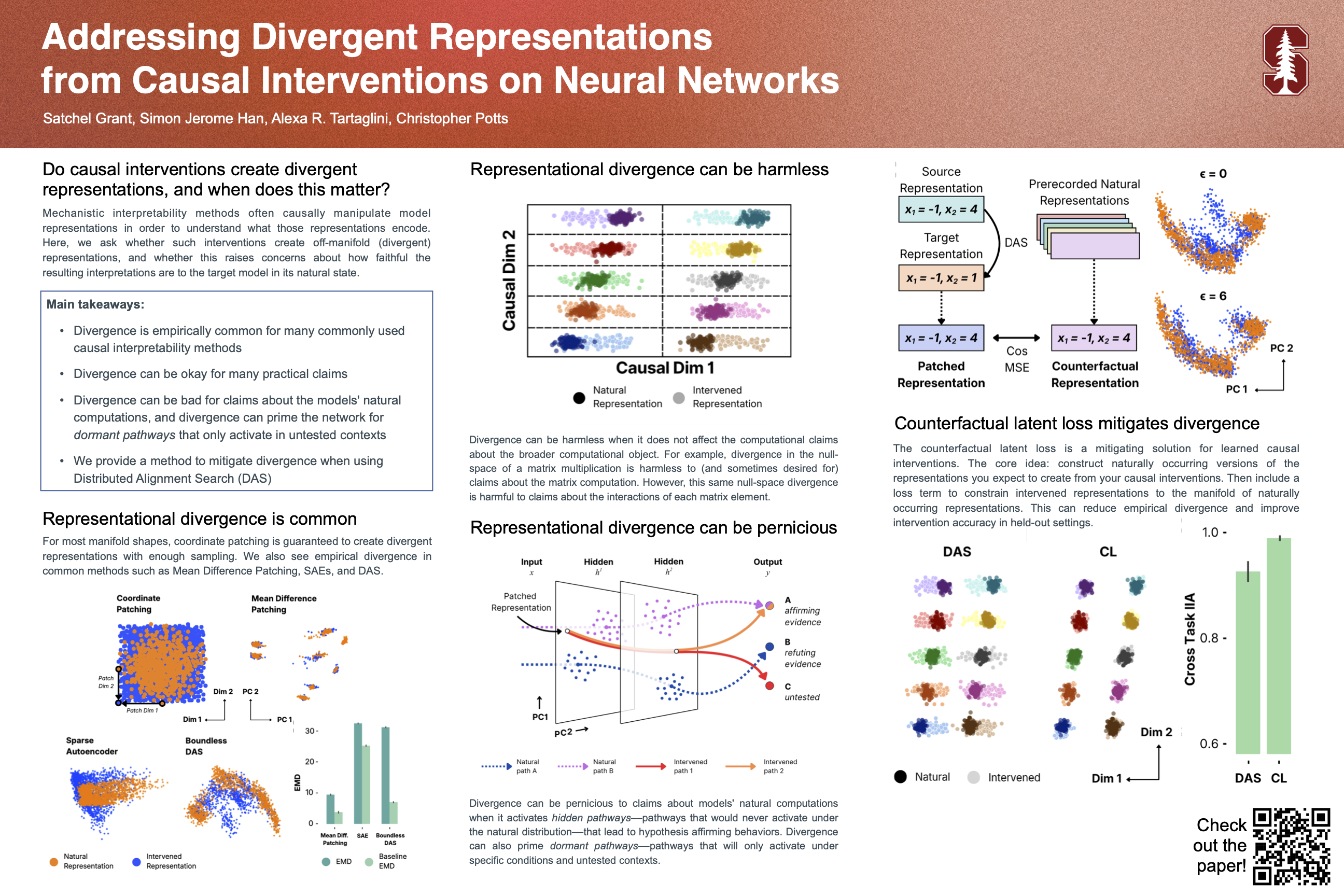
A common approach to mechanistic interpretability is to causally manipulate model representations via targeted interventions in order to understand what those representations encode. Here we ask whether such interventions create out-of-distribution (divergent) representations, and whether this raises concerns about how faithful their resulting explanations are to the target model in its natural state. First, we demonstrate theoretically and empirically that common causal intervention techniques often do shift internal representations away from the natural distribution of the target model. Then, we provide a theoretical analysis of two cases of such divergences: "harmless" divergences that occur in the behavioral null-space of the layer(s) of interest, and "pernicious" divergences that activate hidden network pathways and cause dormant behavioral changes. Finally, in an effort to mitigate the pernicious cases, we apply and modify the Counterfactual Latent (CL) loss from Grant (2025) allowing representations from causal interventions to remain closer to the natural distribution, reducing the likelihood of harmful divergences while preserving the interpretive power of the interventions. Together, these results highlight a path towards more reliable interpretability methods.
Ambig-SWE: Interactive Agents to Overcome Underspecificity in Software Engineering
Sanidhya Vijayvargiya ⋅ Xuhui Zhou ⋅ Akhila Yerukola ⋅ Maarten Sap ⋅ Graham Neubig
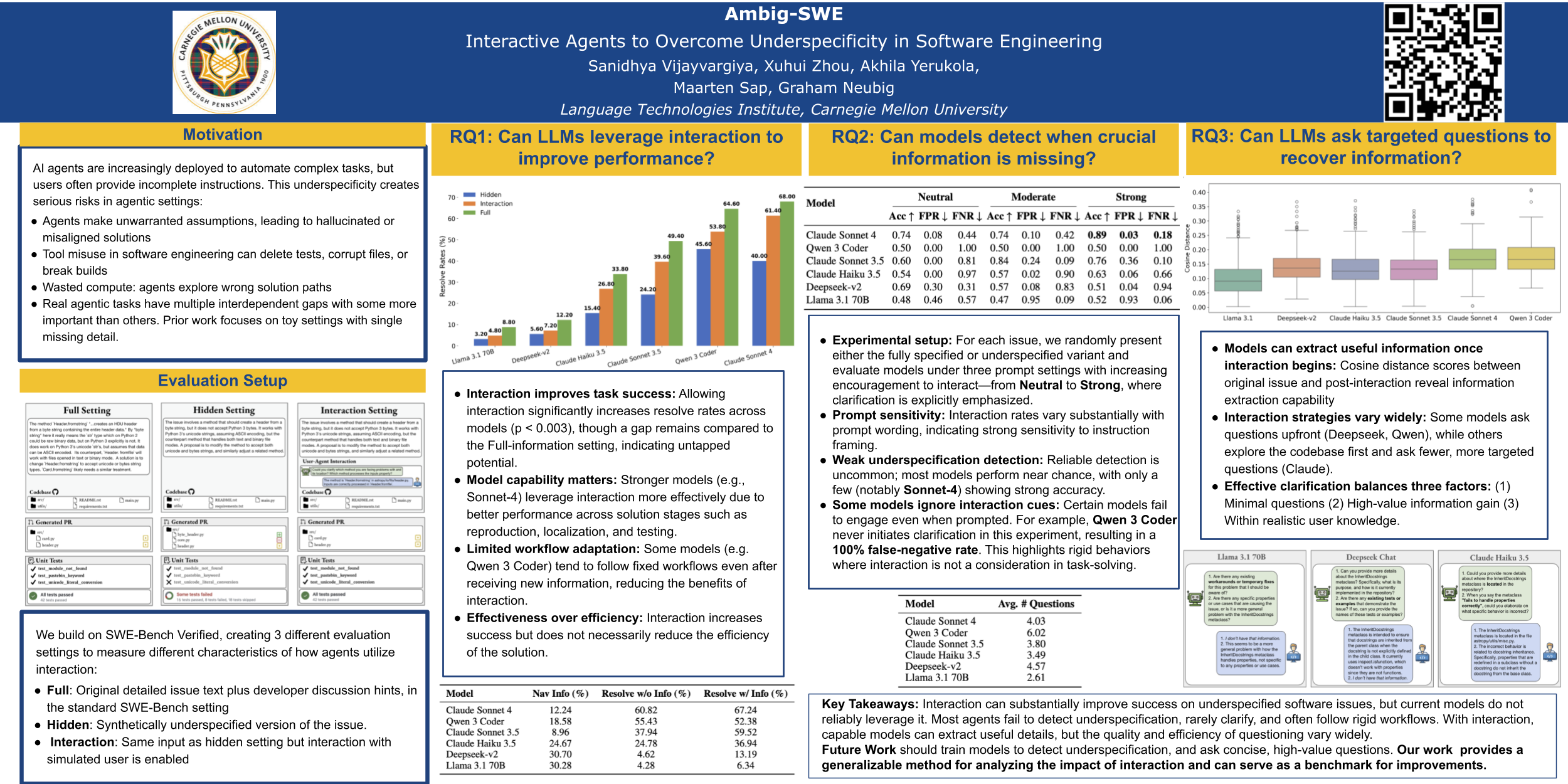
AI agents are increasingly being deployed to automate tasks, often based on underspecified user instructions. Making unwarranted assumptions to compensate for the missing information and failing to ask clarifying questions can lead to suboptimal outcomes, safety risks due to tool misuse, and wasted computational resources. In this work, we study the ability of LLM agents to handle underspecified instructions in interactive code generation settings by evaluating proprietary and open-weight models on their performance across three key steps: (a) detecting underspecificity, (b) asking targeted clarification questions, and (c) leveraging the interaction to improve performance in underspecified scenarios. Our findings reveal that models struggle to distinguish between well-specified and underspecified instructions. However, when models interact for underspecified inputs, they effectively obtain vital information from the user leading to significant improvements in performance, up to 74\% over the non-interactive settings, underscoring the value of effective interaction. Our study highlights critical gaps in how current state-of-the-art models handle missing information in complex software engineering tasks and structures the evaluation into distinct steps to enable targeted improvements.
Epistemic Uncertainty Quantification To Improve Decisions From Black-Box Models
Sébastien Melo ⋅ Gael Varoquaux ⋅ Marine Le Morvan
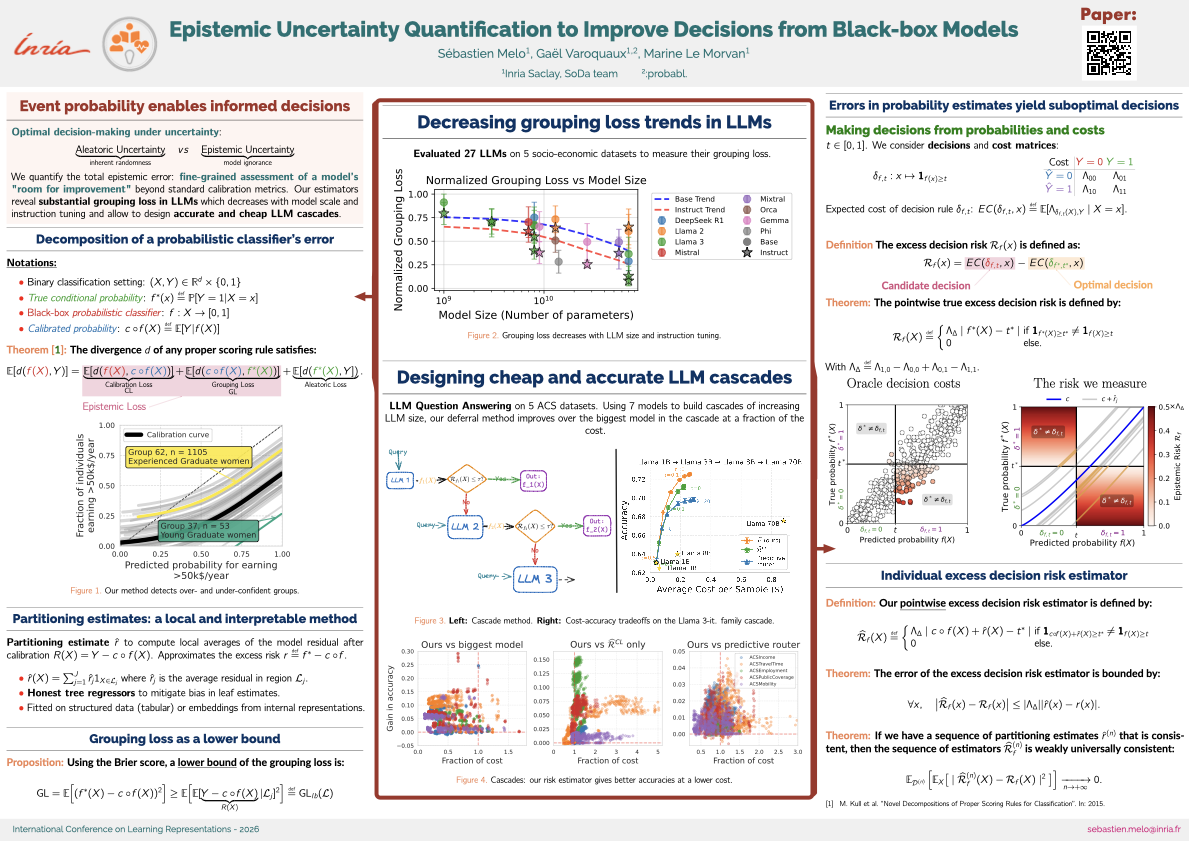
Distinguishing epistemic uncertainty (model ignorance) from aleatoric uncertainty (task randomness) is critical for reliable AI systems, yet standard confidence evaluation metrics capture different and incomplete aspects of uncertainty. While AUC and accuracy measure predictive signal, proper scoring rules assess overall uncertainty, and calibration metrics isolate part of the epistemic uncertainty but ignore within-bin heterogeneity of errors, known as grouping loss. We bridge this evaluation gap by introducing asymptotically consistent and sample-efficient estimators of the grouping loss and excess decision risk, providing a fine-grained assessment of epistemic uncertainty that complements existing calibration metrics. Applied to LLM question-answering with inherent aleatoric noise, our estimators reveal substantial grouping loss which decreases with model scale and instruction tuning. Their local nature enables automatic identification of subgroups with systematic over- or under-confidence, supporting interpretable confidence audits. Finally, we leverage these estimates to design LLM cascades that defer high excess decision risk predictions to stronger models, achieving higher accuracy at lower cost than competing approaches.
A Federated Generalized Expectation-Maximization Algorithm for Mixture Models with an Unknown Number of Components
Michael Ibrahim ⋅ Nagi Gebraeel ⋅ Weijun Xie
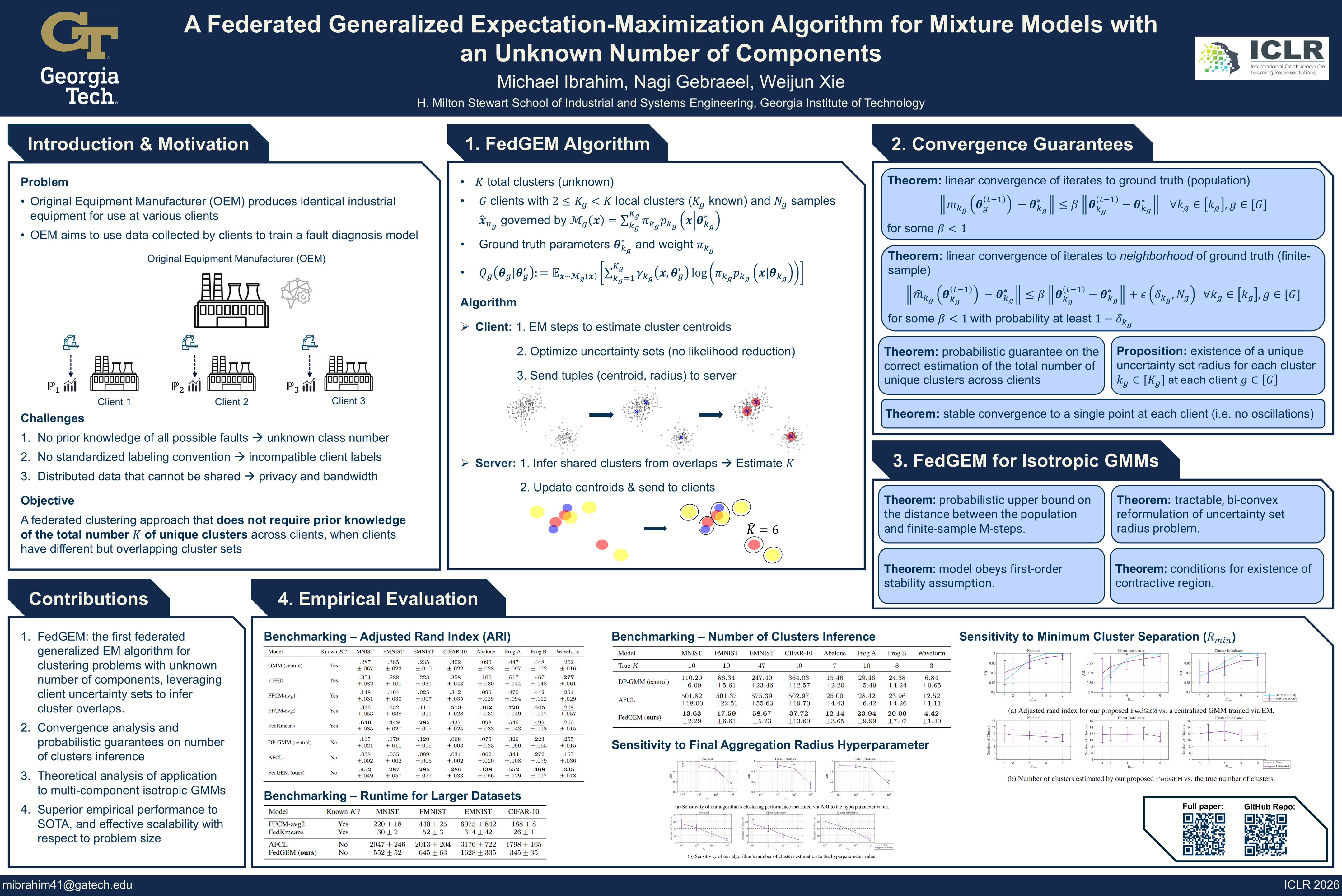
We study the problem of federated clustering when the total number of clusters $K$ across clients is unknown, and the clients have heterogeneous but potentially overlapping cluster sets in their local data. To that end, we develop FedGEM: a federated generalized expectation-maximization algorithm for the training of mixture models with an unknown number of components. Our proposed algorithm relies on each of the clients performing EM steps locally, and constructing an uncertainty set around the maximizer associated with each local component. The central server utilizes the uncertainty sets to learn potential cluster overlaps between clients, and infer the global number of clusters via closed-form computations. We perform a thorough theoretical study of our algorithm, presenting probabilistic convergence guarantees under common assumptions. Subsequently, we study the specific setting of isotropic GMMs, providing tractable, low-complexity computations to be performed by each client during each iteration of the algorithm, as well as rigorously verifying assumptions required for algorithm convergence. We perform various numerical experiments, where we empirically demonstrate that our proposed method achieves comparable performance to centralized EM, and that it outperforms various existing federated clustering methods.
Towards Self-Evolving Agent Benchmarks : Validatable Agent Trajectory via Test-Time Exploration
Dadi Guo ⋅ Tianyi Zhou ⋅ Dongrui Liu ⋅ Chen Qian ⋅ Qihan Ren ⋅ Shuai Shao ⋅ Zhiyuan Fan ⋅ Yi R. Fung ⋅ Kun Wang ⋅ Linfeng Zhang ⋅ Jing Shao
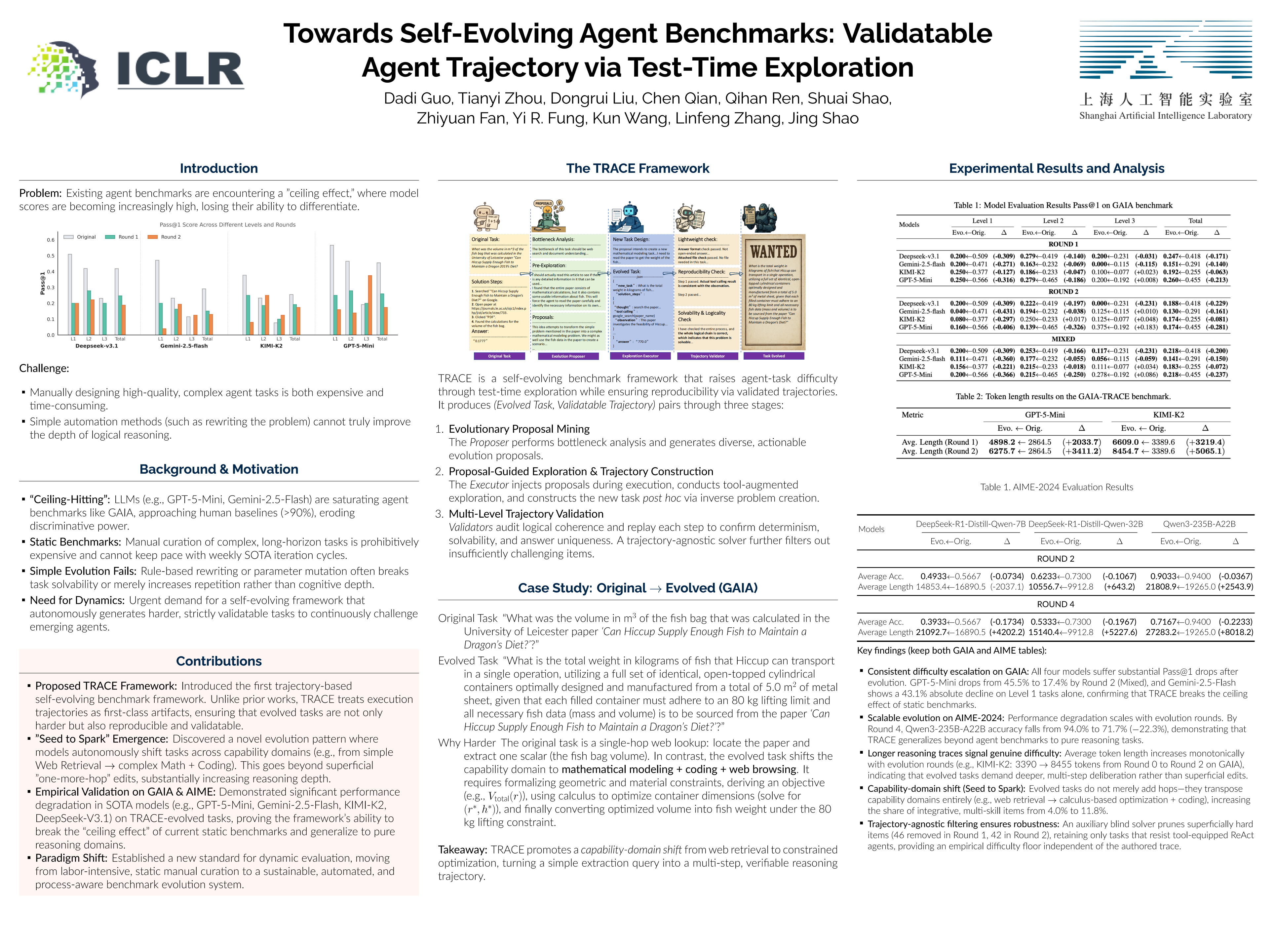
Recent advances in large language models (LLMs) and agent system designs have empowered agents with unprecedented levels of capability. However, existing agent benchmarks are showing a trend of rapid ceiling-hitting by newly developed agents, making it increasingly difficult to meet the demands of evaluating agent abilities. To address this problem, we propose the Trajectory-based Validated-by-Reproducing Agent-benchmark Complexity Evolution (TRACE) framework. This framework takes an original task from an existing benchmark and encourages agents to freely explore and evolve it into a new task with higher difficulty while recording the corresponding execution trajectories. The framework proceeds in three stages: (1) evolutionary proposal mining, which generates task evolution proposals through preliminary exploration and divergent thinking; (2) problem construction via free exploration, where proposals are instantiated into concrete problem instances through agent exploration, with execution trajectories recorded along the process; and (3) multi-level validation, which ensures that the evolved tasks are accompanied by reproducible and logically coherent trajectories. Experiments on the GAIA benchmark demonstrate that the TRACE framework consistently enhances task complexity while improving correctness reliability through trajectory-level validation. In addition, our framework can successfully adapt to and improve reasoning benchmarks such as AIME-2024. This work marks a paradigm shift from static, manually curated benchmarks to dynamic, self-evolving evaluation systems, providing a sustainable and challenging foundation for agent development. Code and data can be found at https://github.com/titanwings/trace-benchmark-evolving.
AQER: A Scalable and Efficient Data Loader for Digital Quantum Computers
Kaining Zhang ⋅ Xinbiao Wang ⋅ Yuxuan Du ⋅ Min-Hsiu Hsieh ⋅ Dacheng Tao
Digital quantum computing promises to offer computational capabilities beyond the reach of classical systems, yet its capabilities are often challenged by scarce quantum resources. A critical bottleneck in this context is how to load classical or quantum data into quantum circuits efficiently. Approximate quantum loaders (AQLs) provide a viable solution to this problem by balancing fidelity and circuit complexity. However, most existing AQL methods are either heuristic or provide guarantees only for specific input types, and a general theoretical framework is still lacking. To address this gap, here we reformulate most AQL methods into a unified framework and establish information-theoretic bounds on their approximation error. Our analysis reveals that the achievable infidelity between the prepared state and target state scales linearly with the total entanglement entropy across subsystems when the loading circuit is applied to the target state. In light of this, we develop AQER, a scalable AQL method that constructs the loading circuit by systematically reducing entanglement in target states. We conduct systematic experiments to evaluate the effectiveness of AQER, using synthetic datasets, classical image and language datasets, and a quantum many-body state datasets with up to 50 qubits. The results show that AQER consistently outperforms existing methods in both accuracy and gate efficiency. Our work paves the way for scalable quantum data processing and real-world quantum computing applications.
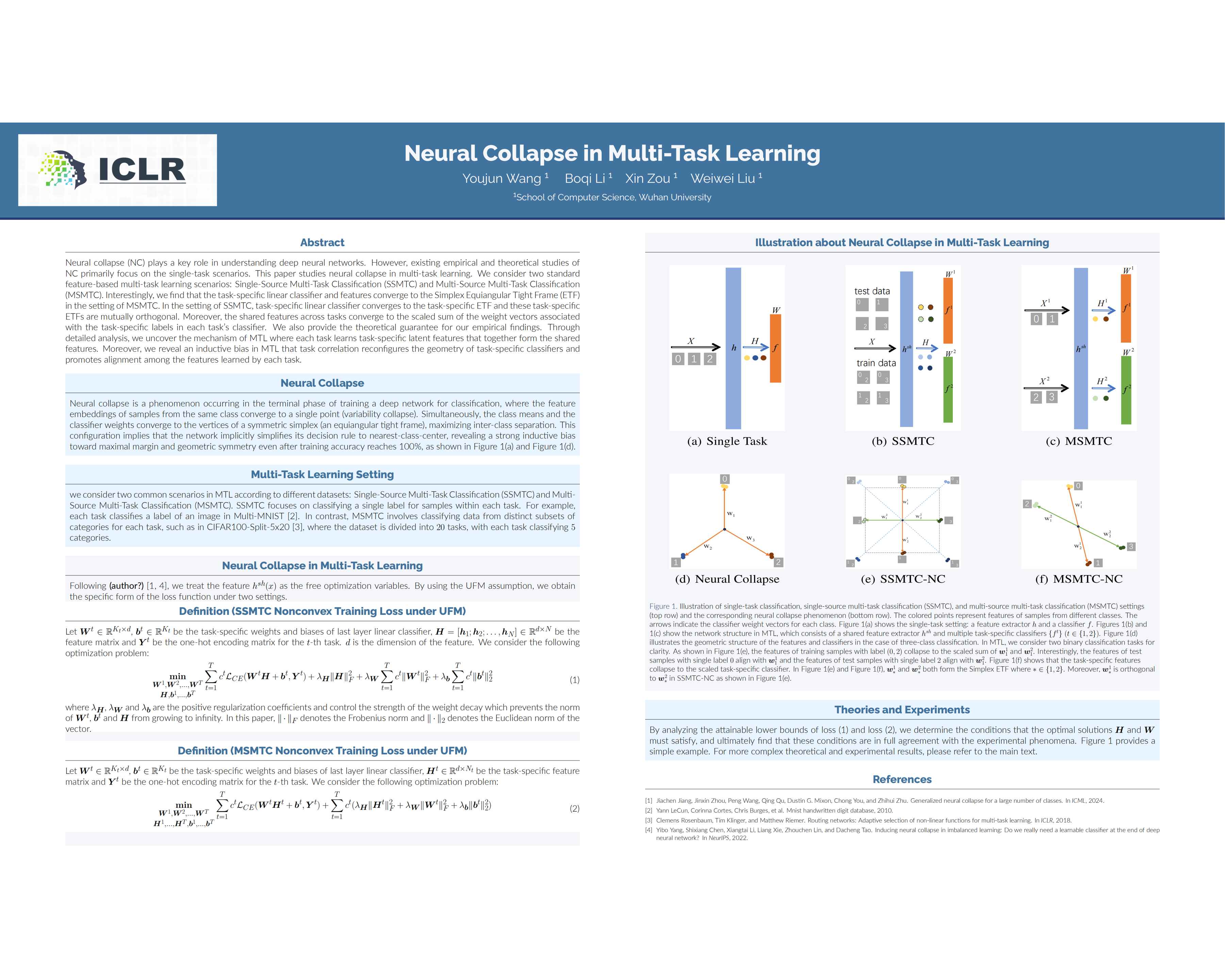
Neural collapse (NC) plays a key role in understanding deep neural networks. However, existing empirical and theoretical studies of NC focus on one single task. This paper studies neural collapse in multi-task learning. We consider two standard feature-based multi-task learning scenarios: Single-Source Multi-Task Classification (SSMTC) and Multi-Source Multi-Task Classification (MSMTC). Interestingly, we find that the task-specific linear classifier and features converge to the Simplex Equiangular Tight Frame (ETF) in the setting of MSMTC. In the setting of SSMTC, task-specific linear classifier converges to the task-specific ETF and these task-specific ETFs are mutually orthogonal. Moreover, the shared features across tasks converge to the scaled sum of the weight vectors associated with the task-specific labels in each task's classifier. We also provide the theoretical guarantee for our empirical findings. Through detailed analysis, we uncover the mechanism of MTL where each task learns task-specific latent features that together form the shared features. Moreover, we reveal an inductive bias in MTL that task correlation reconfigures the geometry of task-specific classifiers and promotes alignment among the features learned by each task.
Lightweight Transformer for EEG Classification via Balanced Signed Graph Algorithm Unrolling
Junyi Yao ⋅ Parham Eftekhar ⋅ Gene Cheung ⋅ Xujin Liu ⋅ Yao Wang ⋅ Wei Hu
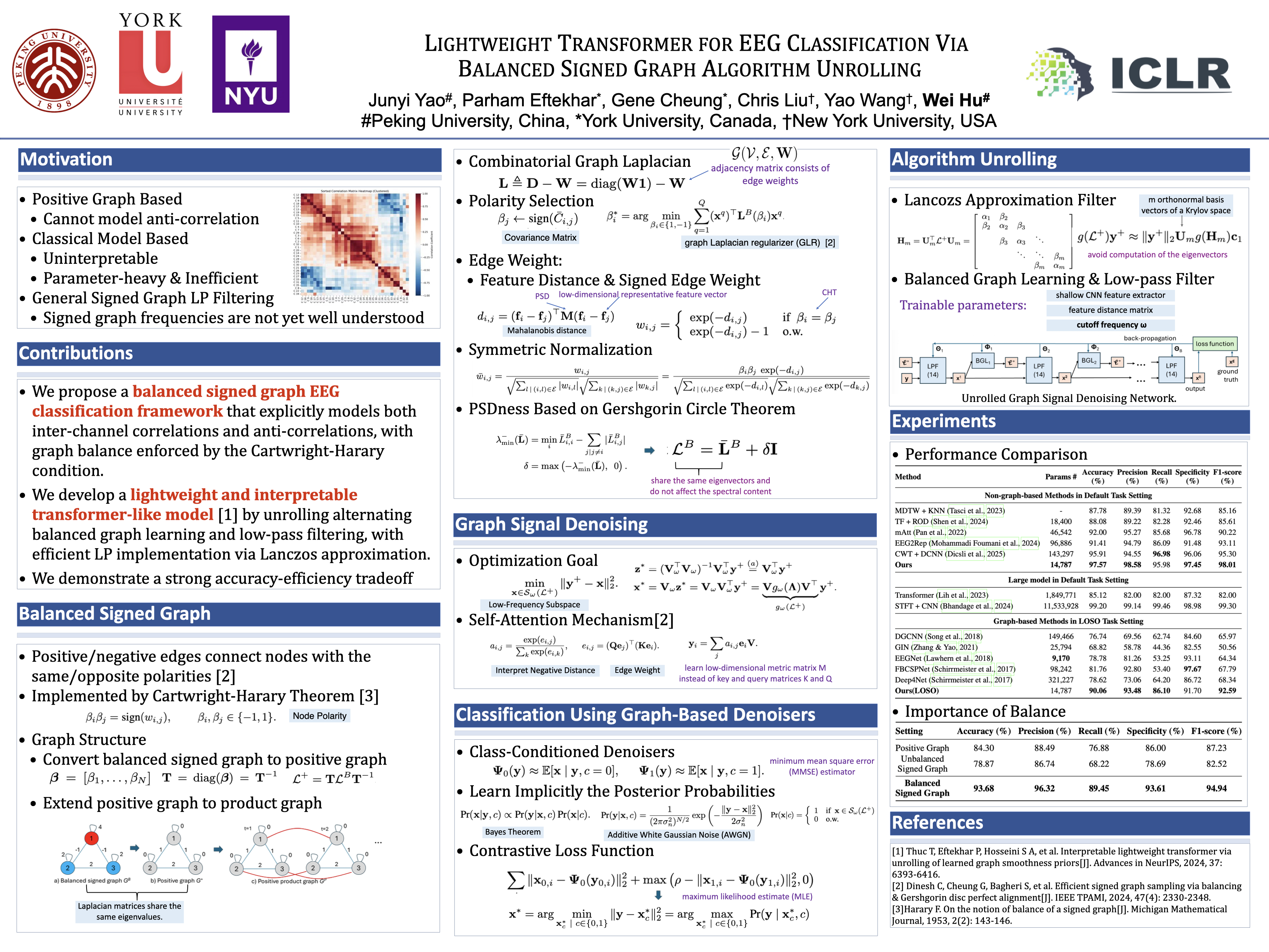
Samples of brain signals collected by EEG sensors have inherent anti-correlations that are well modeled by negative edges in a finite graph. To differentiate epilepsy patients from healthy subjects using collected EEG signals, we build lightweight and interpretable transformer-like neural nets by unrolling a spectral denoising algorithm for signals on a balanced signed graph---graph with no cycles of odd number of negative edges. A balanced signed graph has well-defined frequencies that map to a corresponding positive graph via similarity transform of the graph Laplacian matrices. We implement an ideal low-pass filter efficiently on the mapped positive graph via Lanczos approximation, where the optimal cutoff frequency is learned from data. Given that two balanced signed graph denoisers learn posterior probabilities of two different signal classes during training, we evaluate their reconstruction errors for binary classification of EEG signals. Experiments show that our method achieves classification performance comparable to representative deep learning schemes, while employing dramatically fewer parameters.
RESCHED: Rethinking Flexible Job Shop Scheduling from a Transformer-based Architecture with Simplified States
Xiangjie Xiao ⋅ Cong Zhang ⋅ Wen Song ⋅ Zhiguang Cao
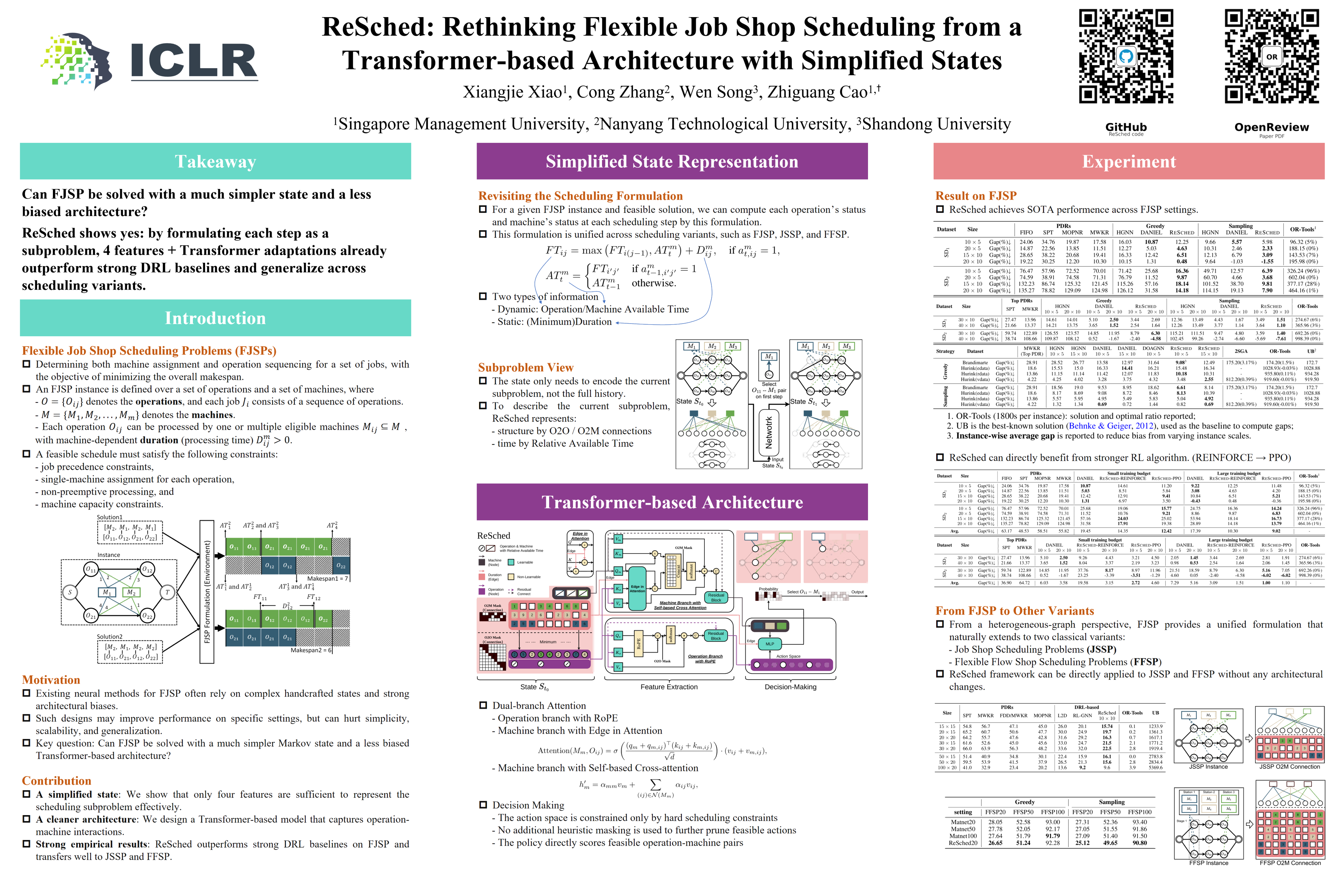
Neural approaches to the Flexible Job Shop Scheduling Problem (FJSP), particularly those based on deep reinforcement learning (DRL), have gained growing attention in recent years. However, existing methods rely on complex feature-engineered state representations (i.e., often requiring more than 20 handcrafted features) and graph-biased neural architectures. To reduce modeling complexity and advance a more generalizable framework for FJSP, we introduce \textsc{ReSched}, a minimalist DRL framework that rethinks both the scheduling formulation and model design. First, by revisiting the Markov Decision Process (MDP) formulation of FJSP, we condense the state space to just four essential features, eliminating historical dependencies through a subproblem-based perspective. Second, we employ Transformer blocks with dot-product attention, augmented by three lightweight but effective architectural modifications tailored to scheduling tasks. Extensive experiments show that \textsc{ReSched} outperforms classical dispatching rules and state-of-the-art DRL methods on FJSP. Moreover, \textsc{ReSched} also generalizes well to the Job Shop Scheduling Problem (JSSP) and the Flexible Flow Shop Scheduling Problem (FFSP), achieving competitive performance against neural baselines specifically designed for these variants.
Beyond the Heatmap: A Rigorous Evaluation of Component Impact in MCTS-Based TSP Solvers
Xuanhao Pan ⋅ Chenguang Wang ⋅ Chaolong Ying ⋅ Ye XUE ⋅ Tianshu Yu

The ``Heatmap + Monte Carlo Tree Search (MCTS)'' paradigm has recently emerged as a prominent framework for solving the Travelling Salesman Problem (TSP). While considerable effort has been devoted to enhancing heatmap sophistication through advanced learning models, this paper rigorously examines whether this emphasis is justified, critically assessing the relative impact of heatmap complexity versus MCTS configuration. Our extensive empirical analysis across diverse TSP scales, distributions, and benchmarks reveals two pivotal insights: \textbf{1}) The configuration of MCTS strategies significantly influences solution quality, underscoring the importance of meticulous tuning to achieve optimal results and enabling valid comparisons among different heatmap methodologies. \textbf{2}) A rudimentary, parameter-free heatmap based on the intrinsic $k$-nearest neighbor structure of TSP instances, when coupled with an optimally tuned MCTS, can match or surpass the performance of more sophisticated, learned heatmaps, demonstrating robust generalizability on problem scale and distribution shift. To facilitate rigorous and fair evaluations in future research, we introduce a streamlined pipeline for standardized MCTS hyperparameter tuning. Collectively, these findings challenge the prevalent assumption that heatmap complexity is the primary determinant of performance, advocating instead for a balanced integration and comprehensive evaluation of both learning and search components within this paradigm.
ViTSP: A Vision Language Models Guided Framework for Solving Large-Scale Traveling Salesman Problems
Zhuoli Yin ⋅ Yi Ding ⋅ Reem Khir ⋅ Hua Cai
Solving the Traveling Salesman Problem (TSP) is NP-hard yet fundamental for a wide range of real-world applications. Classical exact methods face challenges in scaling, and heuristic methods often require domain-specific parameter calibration. While learning-based approaches have shown promise, they suffer from poor generalization and limited scalability due to fixed training data. This work proposes ViTSP, a novel framework that leverages pre-trained vision language models (VLMs) to visually guide the solution process for large-scale TSPs. The VLMs function to identify promising small-scale subproblems from a visualized TSP instance, which are then efficiently optimized using an off-the-shelf solver to improve the global solution. ViTSP bypasses the dedicated model training at the user end while maintaining effectiveness across diverse instances. Experiments on real-world TSP instances ranging from 1k to 88k nodes demonstrate that ViTSP consistently achieves solutions with average optimality gaps of 0.24\%, outperforming existing learning-based methods. Under the same runtime budget, it surpasses the best-performing heuristic solver, LKH-3, by reducing its gaps by 3.57\% to 100\%, particularly on very-large-scale instances with more than 10k nodes. Our framework offers a new perspective in hybridizing pre-trained generative models and operations research solvers in solving combinatorial optimization problems. The framework holds potential for integration into more complex real-world logistics systems. The code is available at https://github.itap.purdue.edu/uSMART/ViTSP_ICLR2026.
Constraint Matters: Multi-Modal Representation for Reducing Mixed-Integer Linear programming
jiajun li ⋅ Yixuan Li ⋅ Ran Hou ⋅ Yu Ding ⋅ Shisi Guan ⋅ Jiahui Duan ⋅ Xiongwei Han ⋅ Tao Zhong ⋅ Vincent Chau ⋅ Weiwei Wu ⋅ Zhiyuan Liu ⋅ Wanyuan Wang
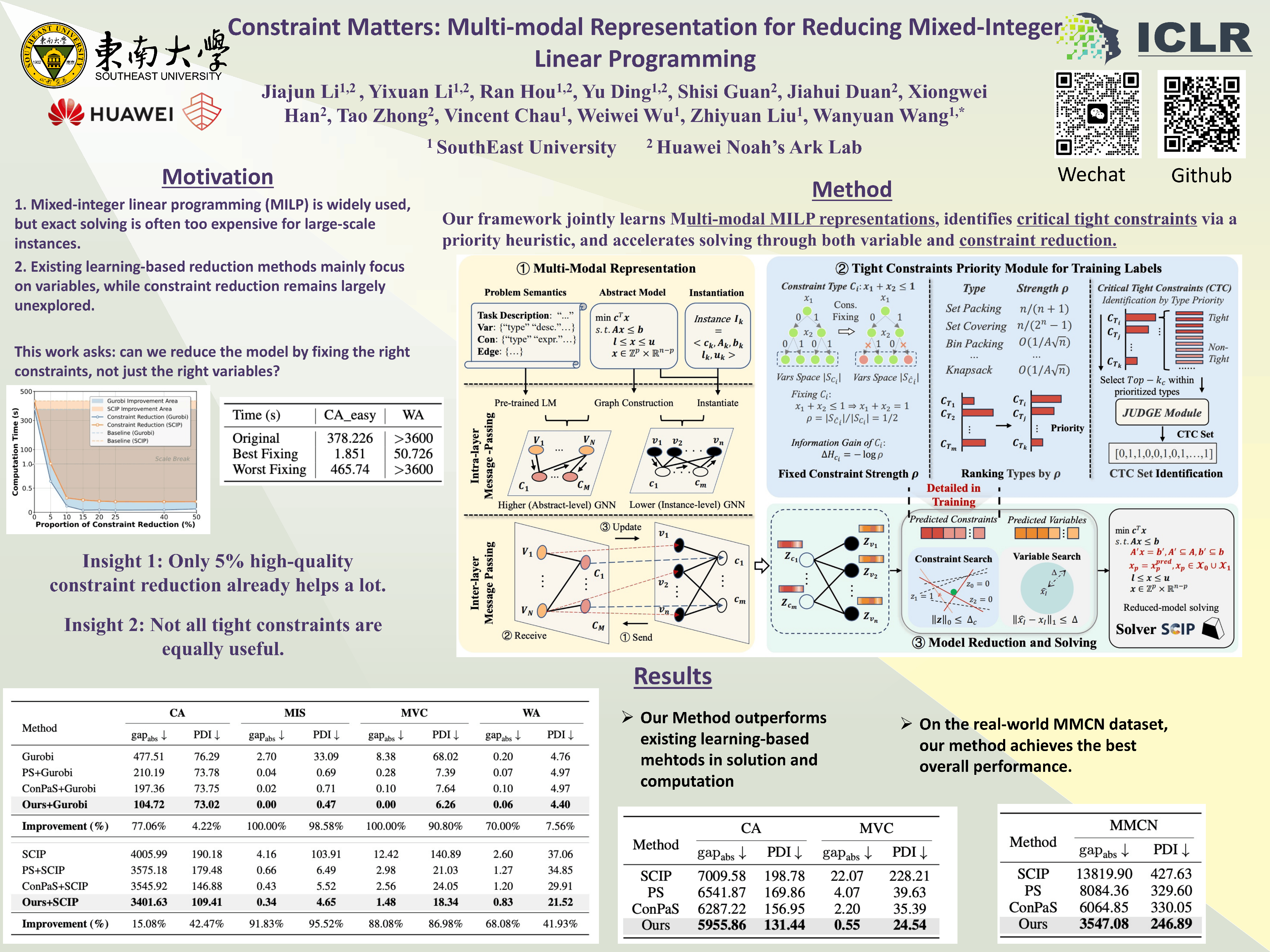
Model reduction, which aims to learn a simpler model of the original mixed integer linear programming (MILP), can solve large-scale MILP problems much faster. Most existing model reduction methods are based on variable reduction, which predicts a solution value for a subset of variables. From a dual perspective, constraint reduction that transforms a subset of inequality constraints into equalities can also reduce the complexity of MILP, but has been largely ignored. Therefore, this paper proposes a novel constraint-based model reduction approach for MILPs. Constraint-based MILP reduction has two challenges: 1) which inequality constraints are critical such that reducing them can accelerate MILP solving while preserving feasibility, and 2) how to predict these critical constraints efficiently. To identify critical constraints, we label the tight-constraints at the optimal solution as potential critical constraints and design an information theory-guided heuristic rule to select a subset of critical tight-constraints. Theoretical analyses indicate that our heuristic mechanism effectively identify the constraints most instrumental in reducing the solution space and uncertainty. To learn the critical tight-constraints, we propose a multi-modal representation that integrates information from both instance-level and abstract-level MILP formulations. The experimental results show that, compared to the state-of-the-art MILP solvers, our method improves the quality of the solution by over 50\% and reduces the computation time by 17.47\%.
Improving Online-to-Nonconvex Conversion for Smooth Optimization via Double Optimism
Francisco Patitucci ⋅ Ruichen Jiang ⋅ Aryan Mokhtari
A recent breakthrough in nonconvex optimization is the online-to-nonconvex conversion framework of Cutkosky et al. (2023), which reformulates the task of finding an $\varepsilon$-first-order stationary point as an online learning problem. When both the gradient and the Hessian are Lipschitz continuous, instantiating this framework with two different online learners achieves a complexity of $ \mathcal{O}(\varepsilon^{-1.75}\log(1/\varepsilon)) $ in the deterministic case and a complexity of $ \mathcal{O}(\varepsilon^{-3.5}) $ in the stochastic case. However, this approach suffers from several limitations: (i) the deterministic method relies on a complex double-loop scheme that solves a fixed-point equation to construct hint vectors for an optimistic online learner, introducing an extra logarithmic factor; (ii) the stochastic method assumes a bounded second-order moment of the stochastic gradient, which is stronger than standard variance bounds; and (iii) different online learning algorithms are used in the two settings. In this paper, we address these issues by introducing an online optimistic gradient method based on a novel **doubly optimistic hint function**. Specifically, we use the gradient at an extrapolated point as the hint, motivated by two optimistic assumptions: that the difference between the hint and the target gradient remains near constant, and that consecutive update directions change slowly due to smoothness. Our method eliminates the need for a double loop and removes the logarithmic factor. Furthermore, by simply replacing full gradients with stochastic gradients and under the standard assumption that their variance is bounded by $\sigma^2$, we obtain a unified algorithm with complexity $\mathcal{O}(\varepsilon^{-1.75} + \sigma^2 \varepsilon^{-3.5})$, smoothly interpolating between the best-known deterministic rate and the optimal stochastic rate.
ATLAS: Alibaba Dataset and Benchmark for Learning-Augmented Scheduling
Zhiyun Jiang ⋅ Tianming Zhao ⋅ Chunqiu xia ⋅ Albert Zomaya
Learning-augmented scheduling uses ML predictions to improve decision-making under uncertainty. Many algorithms in this class have been proposed with better theoretical guarantees than the classic methods. Translating these theoretical results into practice, however, requires an understanding of real workloads. Such an understanding is hard to develop because existing production traces either lack the ground-truth processing times or are not publicly available, while synthetic benchmarks fail to represent real-world complexity. We fill this gap by introducing Alibaba Trace for Learning-Augmented Scheduling (ATLAS), a research-ready dataset derived from Alibaba's Platform of Artificial Intelligence (PAI) cluster trace—a production system that processes hundreds of thousands of ML jobs per day. The ATLAS dataset has been cleaned and features engineered to represent the inputs and constraints of non-clairvoyant scheduling, including user tags, resource requests (CPU/GPU/memory), and job structures with ground-truth processing times. We develop a prediction benchmark reporting prediction error metrics, along with feature importance analysis, and introduce a novel multiple-stage ML model. We also provide a scheduling benchmark for minimizing the total completion time, max-stretch, and makespan. ATLAS is a reproducible foundation for researchers to study learning-augmented scheduling on real workloads, available at https://github.com/zhiyunjiang0810/non-clairvoyant-with-predictions.
Efficient Submodular Maximization for Sums of Concave over Modular Functions
Yang Lv ⋅ Guihao Wang ⋅ Dachuan Xu ⋅ Ruiqi Yang
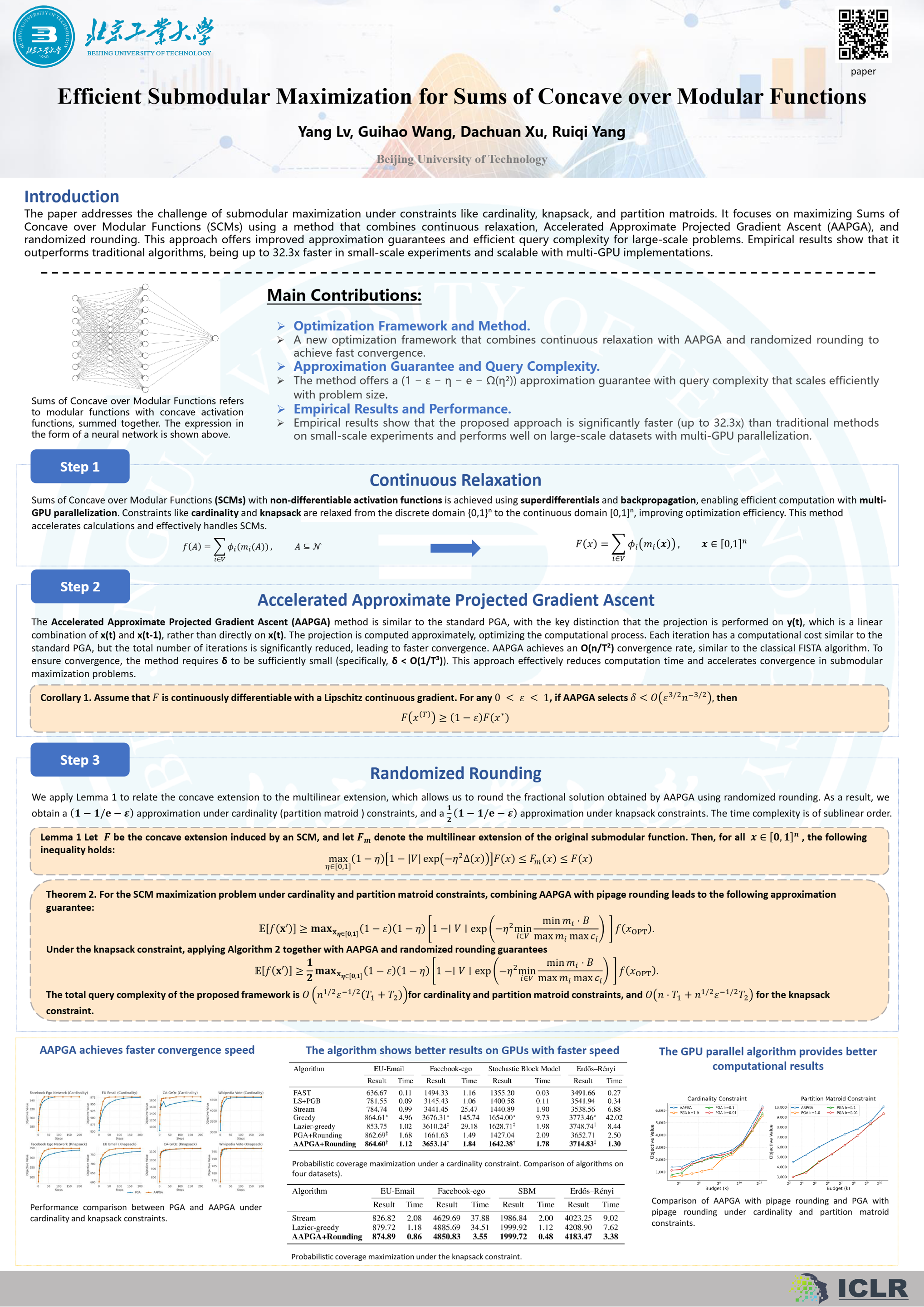
Submodular maximization has broad applications in machine learning, network design, and data mining. However, classical algorithms often suffer from prohibitively high computational costs, which severely limit their scalability in practice. In this work, we focus on maximizing Sums of Concave over Modular functions (SCMs), an important subclass of submodular functions, under three fundamental constraints: cardinality, knapsack, and partition matroids. Our method integrates three components: continuous relaxation, Accelerated Approximate Projected Gradient Ascent (AAPGA), and randomized rounding, to efficiently compute near-optimal solutions. We establish a $(1 - \varepsilon - \eta - e^{-\Omega(\eta^2)})$ approximation guarantee for both cardinality and partition matroid constraints, with query complexity $O\left(n^{1/2}\varepsilon^{-1/2} (T_1 + T_2)\right)$. For the knapsack constraint, the approximation ratio degrades by a factor of $1/2$, with query complexity $O\left(n T_1 + n^{1/2}\varepsilon^{-1/2} T_2\right)$, where $T_1$ denotes the computational cost of evaluating the concave extension, and $T_2$ denotes the computational cost of backpropagation. By leveraging efficient convex optimization techniques, our approach substantially accelerates convergence toward high-quality solutions. In empirical evaluations, we demonstrate that AAPGA consistently outperforms standard PGA. On small-scale experiments, AAPGA achieves superior results in significantly less time, being up to $32.3\times$ faster than traditional methods. On large-scale experiments, our parallel multi-GPU implementation further enhances performance, demonstrating the scalability of our approach.
Sampling from trained predictors is fundamental for interpretability and as a compute-light alternative to diffusion models, but local samplers struggle on the rugged, high-frequency functions such models learn. We observe that standard neural‑network training implicitly produces a coarse‑to‑fine sequence of models. Early checkpoints suppress high‑degree/ high‑frequency components (Boolean monomials; spherical harmonics under NTK), while later checkpoints restore detail. We exploit this by running a simple annealed sampler across the training trajectory, using early checkpoints for high‑mobility proposals and later ones for refinement. In the Boolean domain, this can turn the exponential bottleneck arising from rugged landscapes or needle gadgets into a near-linear one. In the continuous domain, under the NTK regime, this corresponds to smoothing under the NTK kernel. Requiring no additional compute, our method shows strong empirical gains across a variety of synthetic and real-world tasks, including constrained sampling tasks that diffusion models are unable to handle.
Efficient Approximate Posterior Sampling with Annealed Langevin Monte Carlo
Advait Parulekar ⋅ Litu Rout ⋅ Karthikeyan Shanmugam ⋅ Sanjay Shakkottai
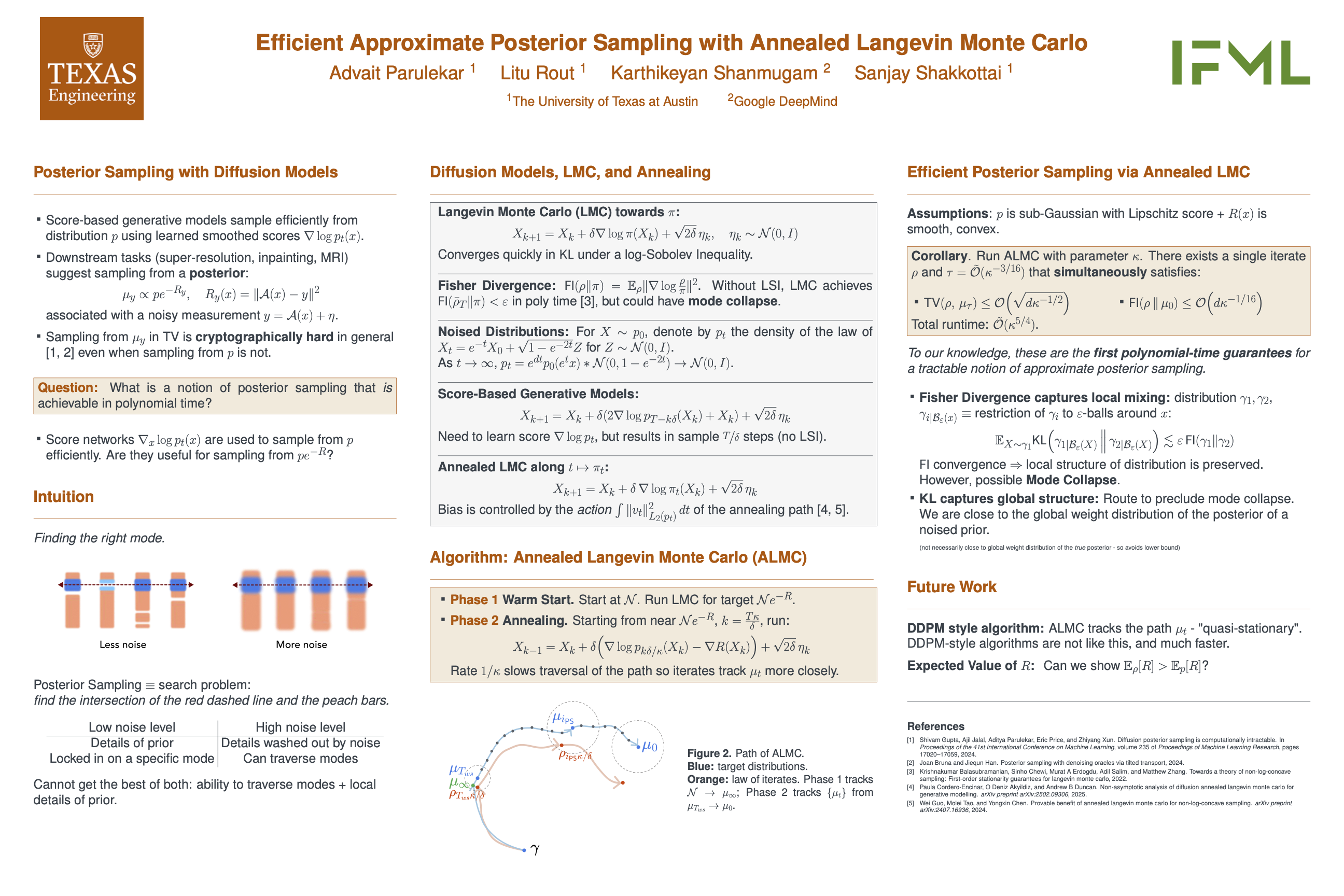
We study the problem of posterior sampling in the context of score based generative models. We have a trained score network for a prior $p(x)$, a measurement model $p(y|x)$, and are tasked with sampling from the posterior $p(x|y)$. Prior work has shown this to be intractable in KL (in the worst case) under well-accepted computational hardness assumptions. Despite this, popular algorithms for tasks such as image super-resolution, stylization, and reconstruction enjoy empirical success. Rather than establishing distributional assumptions or restricted settings under which exact posterior sampling is tractable, we view this as a more general "tilting" problem of biasing a distribution towards a measurement. Under minimal assumptions, we show that one can tractably sample from a distribution that is simultaneously close to the posterior of a noised prior in KL divergence and the true posterior in Fisher divergence. Intuitively, this combination ensures that the resulting sample is consistent with both the measurement and the prior. To the best of our knowledge these are the first formal results for (approximate) posterior sampling in polynomial time.
Efficient Sliced Wasserstein Distance Computation via Adaptive Bayesian Optimization
Manish Acharya ⋅ David Hyde
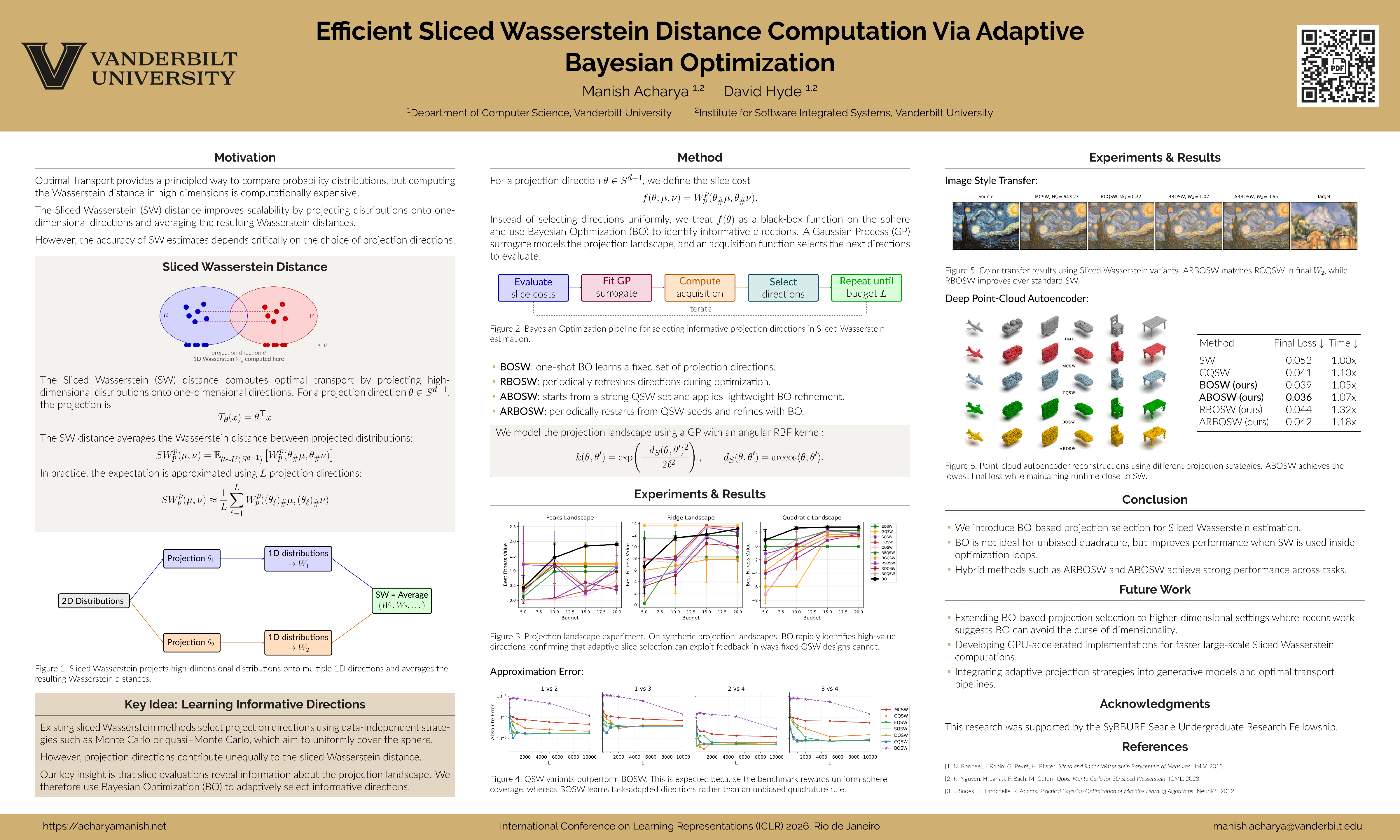
The sliced Wasserstein distance (SW) reduces optimal transport on $\mathbb{R}^d$ to a sum of one-dimensional projections, and thanks to this efficiency, it is widely used in geometry, generative modeling, and registration tasks. Recent work shows that quasi-Monte Carlo constructions for computing SW (QSW) yield direction sets with excellent approximation error. This paper presents an alternate, novel approach: learning directions with Bayesian optimization (BO), particularly in settings where SW appears inside an optimization loop (e.g., gradient flows). We introduce a family of drop-in selectors for projection directions: **BOSW**, a one-shot BO scheme on the unit sphere; **RBOSW**, a periodic-refresh variant; **ABOSW**, an adaptive hybrid that seeds from competitive QSW sets and performs a few lightweight BO refinements; and **ARBOSW**, a restarted hybrid that periodically relearns directions during optimization. Our BO approaches can be composed with QSW and its variants (demonstrated by ABOSW/ARBOSW) and require no changes to downstream losses or gradients. We provide numerical experiments where our methods achieve state-of-the-art performance, and on the experimental suite of the original QSW paper, we find that ABOSW and ARBOSW can achieve convergence comparable to the best QSW variants with modest runtime overhead. We release code with fixed seeds and configurations to support faithful replication (see supplementary material).
Adaptive Acquisition Selection for Bayesian Optimization with Large Language Models
Giang Ngo ⋅ Dat Phan Trong ⋅ Dang Nguyen ⋅ Sunil Gupta ⋅ Svetha Venkatesh

Bayesian Optimization critically depends on the choice of acquisition function, but no single strategy is universally optimal; the best choice is non-stationary and problem-dependent. Existing adaptive portfolio methods often base their decisions on past function values while ignoring richer information like remaining budget or surrogate model characteristics. To address this, we introduce LMABO, a novel framework that casts a pre-trained Large Language Model (LLM) as a zero-shot, online strategist for the BO process. At each iteration, LMABO uses a structured state representation to prompt the LLM to select the most suitable acquisition function from a diverse portfolio. In an evaluation across 50 benchmark problems, LMABO demonstrates a significant performance improvement over strong static, adaptive portfolio, and other LLM-based baselines. We show that the LLM's behavior is a comprehensive strategy that adapts to real-time progress, proving its advantage stems from its ability to process and synthesize the complete optimization state into an effective, adaptive policy.
Trinity: An Evolved LLM Coordinator
Jinglue Xu ⋅ Qi Sun ⋅ Peter Schwendeman ⋅ Stefan Nielsen ⋅ Edoardo Cetin ⋅ Yujin Tang
Combining diverse foundation models is promising, but weight-merging is limited by mismatched architectures and closed APIs. **Trinity** addresses this with a lightweight coordinator that orchestrates collaboration among large language models (LLMs). The coordinator, comprising a compact language model ($\approx 0.6$B parameters) and a lightweight head ($\approx 10$K parameters), is optimized with an evolutionary strategy for efficient and adaptive delegation. **Trinity** processes queries over multiple turns, where at each turn the coordinator assigns one of three roles (*Thinker*, *Worker*, or *Verifier*) to a selected LLM, effectively offloading complex skill acquisition from the coordinator itself. Extensive experiments demonstrate that **Trinity** consistently outperforms individual models and existing methods in various tasks, including coding, math, reasoning, and domain knowledge, while robustly generalizing to out-of-distribution tasks. On established benchmarks, **Trinity** achieves state-of-the-art performance, including a new record of $86.2\%$ on LiveCodeBench. Theoretical and empirical analyses highlight two key factors driving this success: (1) the coordinator’s hidden-state representations provide rich contextualization of inputs, and (2) under high dimensionality and strict budget constraints, the separable Covariance Matrix Adaptation Evolution Strategy algorithm provides substantial advantages over RL, imitation learning, and random search, leveraging potential block-$\varepsilon$-separability.
DR-Submodular Maximization with Stochastic Biased Gradients: Classical and Quantum Gradient Algorithms
Shengminjie Chen ⋅ Xiaoming Sun ⋅ Wenguo Yang ⋅ Jialin Zhang ⋅ Zihan Zhao
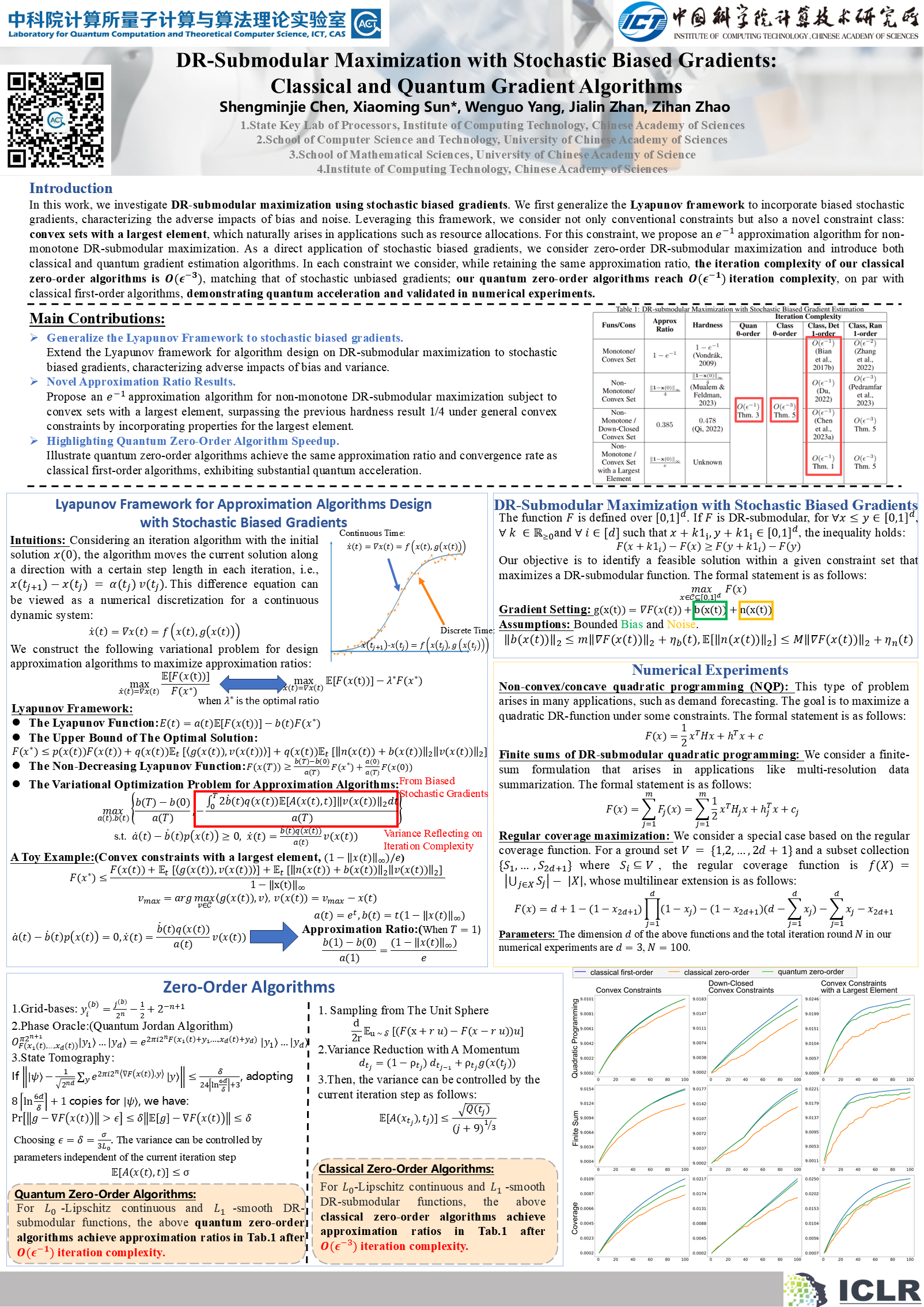
In this work, we investigate DR-submodular maximization using stochastic biased gradients, which is a more realistic but challenging setting than stochastic unbiased gradients. We first generalize the Lyapunov framework to incorporate biased stochastic gradients, characterizing the adverse impacts of bias and noise. Leveraging this framework, we consider not only conventional constraints but also a novel constraint class: convex sets with a largest element, which naturally arises in applications such as resource allocations. For this constraint, we propose an $1/e$ approximation algorithm for non-monotone DR-submodular maximization, surpassing the hardness result $1/4$ for general convex constraints. As a direct application of stochastic biased gradients, we consider zero-order DR-submodular maximization and introduce both classical and quantum gradient estimation algorithms. In each constraint we consider, while retaining the same approximation ratio, the iteration complexity of our classical zero-order algorithms is $O(\epsilon^{-3})$, matching that of stochastic unbiased gradients; our quantum zero-order algorithms reach $O(\epsilon^{-1})$ iteration complexity, on par with classical first-order algorithms, demonstrating quantum acceleration and validated in numerical experiments.
FlexLoRA: Entropy-Guided Flexible Low-Rank Adaptation
Muqing Liu ⋅ Chongjie Si ⋅ Yuheng Jia
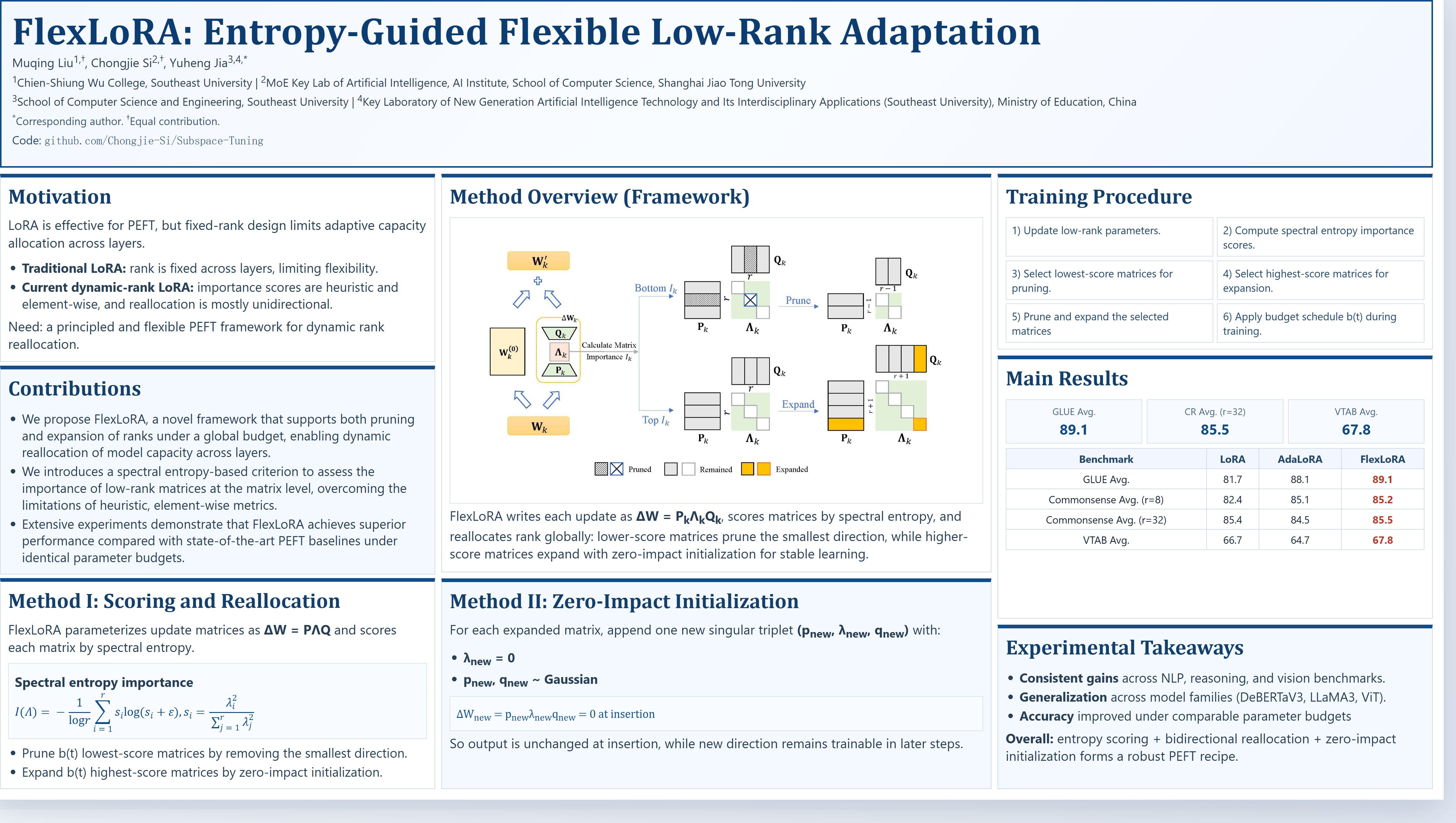
Large pre-trained models achieve remarkable success across diverse domains, yet fully fine-tuning incurs prohibitive computational and memory costs. Parameter-efficient fine-tuning (PEFT) has thus become a mainstream paradigm. Among them, Low-Rank Adaptation (LoRA) introduces trainable low-rank matrices and shows strong performance, nevertheless, its fixed-rank design limits flexibility. Dynamic rank allocation methods mitigate this issue by pruning redundant directions; however, they often rely on heuristic, element-level metrics that globally sort rank directions without matrix-wise distinction, and they lack mechanisms to expand capacity in layers requiring additional adaptation. To overcome these limitations, we propose FlexLoRA, an entropy-guided flexible low-rank adaptation framework that (i) evaluates matrix importance via spectral energy entropy, (ii) supports rank pruning and expansion under a global budget, and (iii) employs zero-impact initialization for newly added singular directions to ensure stability. By addressing granularity, flexibility, and stability limitations, FlexLoRA provides a more principled solution for PEFT. Extensive experiments show that FlexLoRA consistently outperforms state-of-the-art baselines across benchmarks.
Unlocking Full Efficiency of Token Filtering in Large Language Model Training
Di Chai ⋅ LI Pengbo ⋅ Feiyuan Zhang ⋅ Yilun Jin ⋅ Han Tian ⋅ Kaiqiang Xu ⋅ Binhang Yuan ⋅ Dian Shen ⋅ Junxue Zhang ⋅ Kai Chen
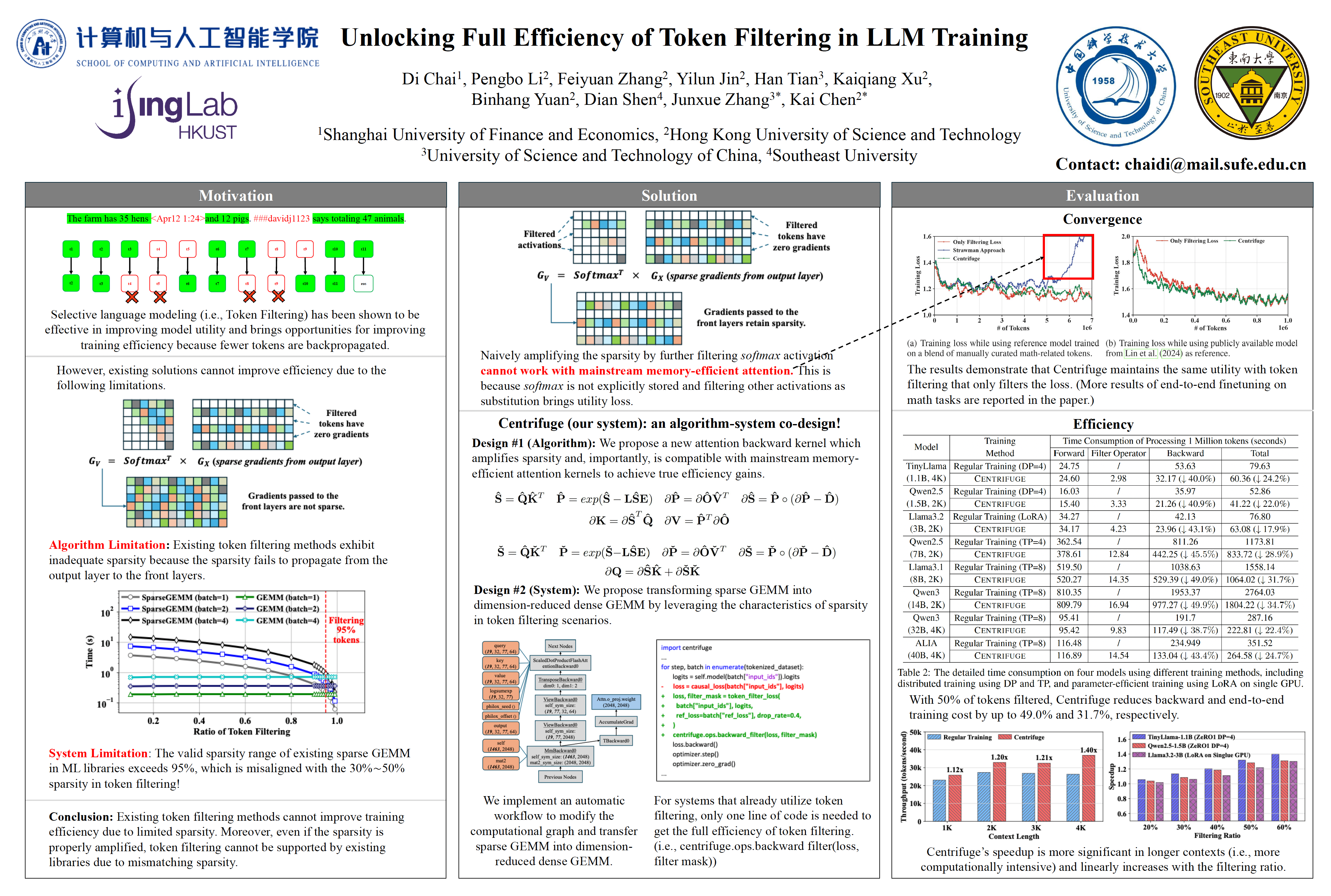
Token filtering has been proposed to enhance the utility of large language models (LLMs) by eliminating inconsequential tokens during training. While using fewer tokens is expected to reduce computational workloads, existing methods have not yet achieved a real-world efficiency boost. This is primarily due to two factors: (1) existing work has inadequate sparsity for speedup, and (2) token filtering operates within a sparsity range that is non-standard in existing machine learning (ML) libraries and thus cannot be efficiently supported. This paper presents Centrifuge, a system that leverages algorithm and system co-design to unleash the full efficiency of token filtering in LLM training. At the algorithm level, Centrifuge filters activations of inconsequential tokens in the attention backward kernel to amplify the sparsity in backward computation. At the system level, Centrifuge proposes an automatic workflow that transforms sparse GEMM into dimension-reduced dense GEMM for optimized efficiency using standard ML libraries. Evaluations on models with various scales—from 1.1B to 40B—demonstrate that Centrifuge reduces backpropagation time by up to 49.9\% and end-to-end training time by up to 34.7\% when filtering 50\% of tokens. Utility assessments indicate that Centrifuge preserves the utility benefits of token filtering and significantly enhances model performance by up to 26.6\% compared to standard training. Centrifuge is designed for seamless integration into existing LLM training frameworks, enabling systems already utilizing token filtering to accelerate training with just one line of code.
From Sequential to Parallel: Reformulating Dynamic Programming as GPU Kernels for Large-Scale Stochastic Combinatorial Optimization
Jingyi Zhao ⋅ Linxin Yang ⋅ Haohua Zhang ⋅ Qile He ⋅ Tian Ding
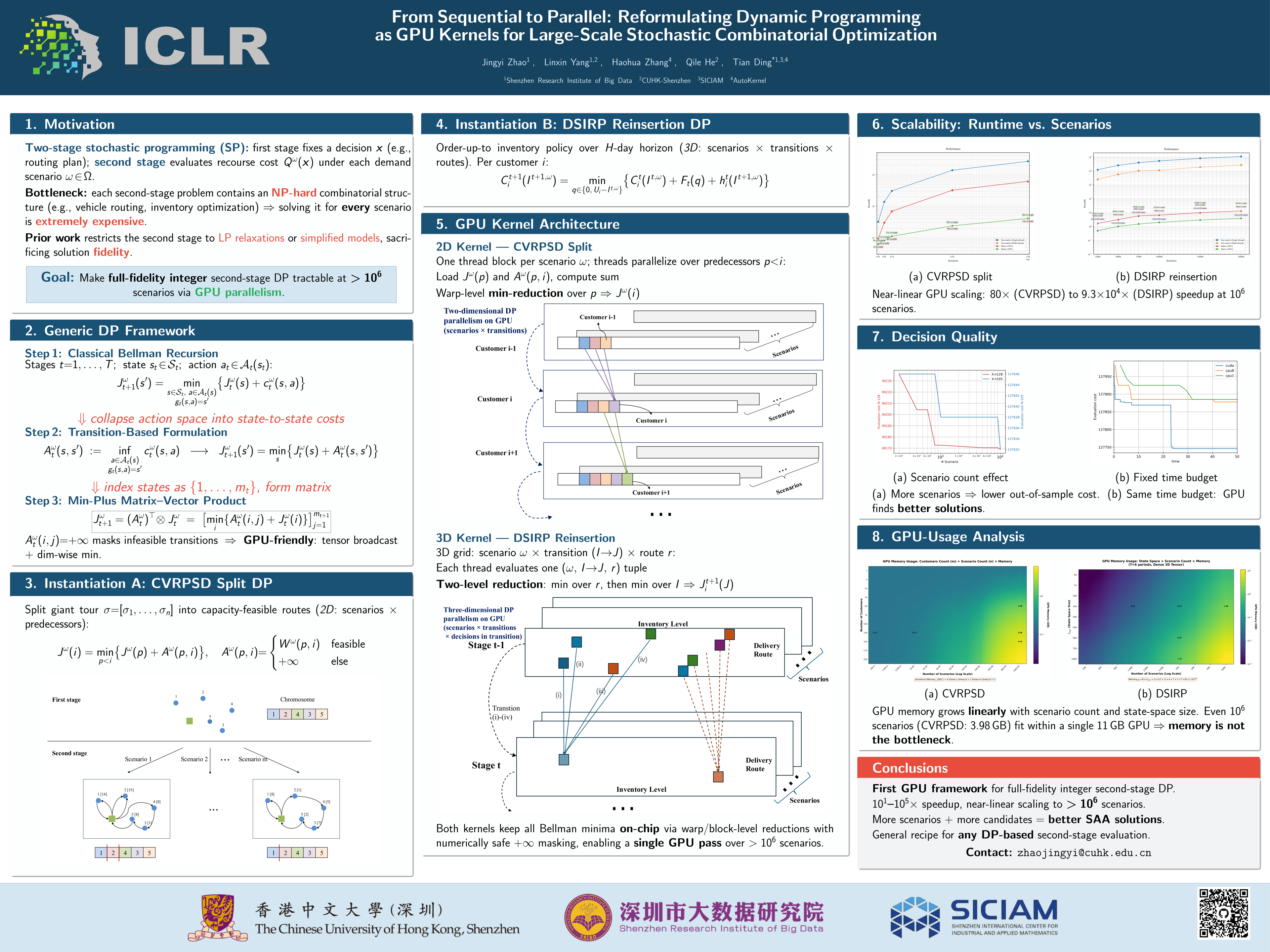
Dynamic programming (DP) is central to combinatorial optimization, optimal control, and reinforcement learning, yet its perceived sequentiality has long hindered scalability. We introduce a general-purpose GPU framework that reformulates broad classes of forward DP recursions as batched min--plus matrix--vector products over layered DAGs, collapsing actions into masked state-to-state transitions that map directly to GPU kernels. This approach removes a major bottleneck in scenario-based stochastic programming (SP), where the use of DP has traditionally restricted the number of scenarios due to excessive computational cost. Our framework exposes massive parallelism across scenarios, transition layers, and, when applicable, route or action options, via self-designed GPU kernels that implement Bellman updates with warp-/block-level reductions and numerically safe masking. In a single GPU pass, these kernels can process over $10^6$ uncertainty realizations, far beyond the capacity of prior scenario-based methods. We demonstrate the approach in two canonical SP applications: (i) a vectorized split operator for the capacitated vehicle routing problem with stochastic demand, exploiting **2D** parallelism (scenarios $\times$ transitions); and (ii) a forward inventory reinsertion DP under an order-up-to policy, exploiting **3D** parallelism (scenarios $\times$ inventory transitions $\times$ route options). Across benchmarks, the implementation scales nearly linearly in the number of scenarios and achieves one to three orders of magnitude speedups over multithreaded CPU baselines, yielding tighter SAA estimates and consistently stronger first-stage decisions under identical wall-clock budgets. Viewed as hardware-aware software primitives, our min--plus DP kernels offer a drop-in path to scalable, GPU-accelerated stochastic discrete optimization.
LEGACY: A Lightweight Dynamic Gradient Compression Strategy for Distributed Deep Learning
Mostapha Essoullami ⋅ El Houcine Bergou ⋅ Aritra Dutta
Distributed learning has achieved remarkable success in training deep neural networks (DNNs) on large datasets, but the communication bottleneck limits its scalability. Various compression techniques have been proposed to alleviate this limitation; however, they either use fixed parameters throughout training or rely on complex and computationally intensive methods to adapt compression parameters. Instead of the hard-to-tune hyperparameters required by adaptive compressors, this paper investigates the impact of two fundamental factors in DNN training—the layer size of the networks and their training phases—to design a simple yet efficient dynamic scheduler for any compressor, guiding the selection of compression parameters. We present a Lightweight Efficient GrAdient Compression strategyY or LEGACY, which, in theory, can work with any compression technique to produce a simple dynamic counterpart. We benchmark LEGACY on distributed and federated training, involving seven different DNN architectures, ranging from ResNet, Transformer-XL, to GPT-2, across large and challenging datasets, including ImageNet, WikiText-103, and OpenWebText. On ImageNet-1K, with an equivalent average data volume, LEGACY's dynamic compression strategies improve the Top-1 accuracy of ResNet-50 by 7-11% compared to uniform Top-0.1% compression, while on WikiText-103, the layer-based dynamic strategy reduces the perplexity of Transformer-XL by ~26% relative to the same baseline. In addition, we evaluate LEGACY under constrained and federated settings, and demonstrate that it scales effectively to a 100-worker configuration while maintaining strong accuracy under aggressive compression. We publish anonymized code at: https://github.com/LEGACY-compression/LEGACY.
FedMuon: Federated Learning with Bias-corrected LMO-based Optimization
Yuki Takezawa ⋅ Anastasia Koloskova ⋅ Xiaowen Jiang ⋅ Sebastian Stich
Recently, a new optimization method based on the linear minimization oracle (LMO), called Muon, has been attracting increasing attention since it can train neural networks faster than the existing adaptive optimization methods, such as Adam. In this paper, we study how Muon can be utilized in federated learning. We first show that straightforwardly using Muon as the local optimizer of FedAvg does not work since the LMO is a biased operator. We then propose FedMuon, which can mitigate this issue and can converge to the stationary point. We also analyze how solving the LMO approximately affects the convergence rate and find that, surprisingly, FedMuon can converge for any number of Newton-Schulz iterations, while it can converge faster as we solve the LMO more accurately. Through experiments, we demonstrated that FedMuon can outperform the state-of-the-art federated learning methods.
A Scalable Distributed Framework for Multimodal GigaVoxel Image Registration
Rohit Jena ⋅ Vedant Zope ⋅ Pratik A Chaudhari ⋅ James Gee
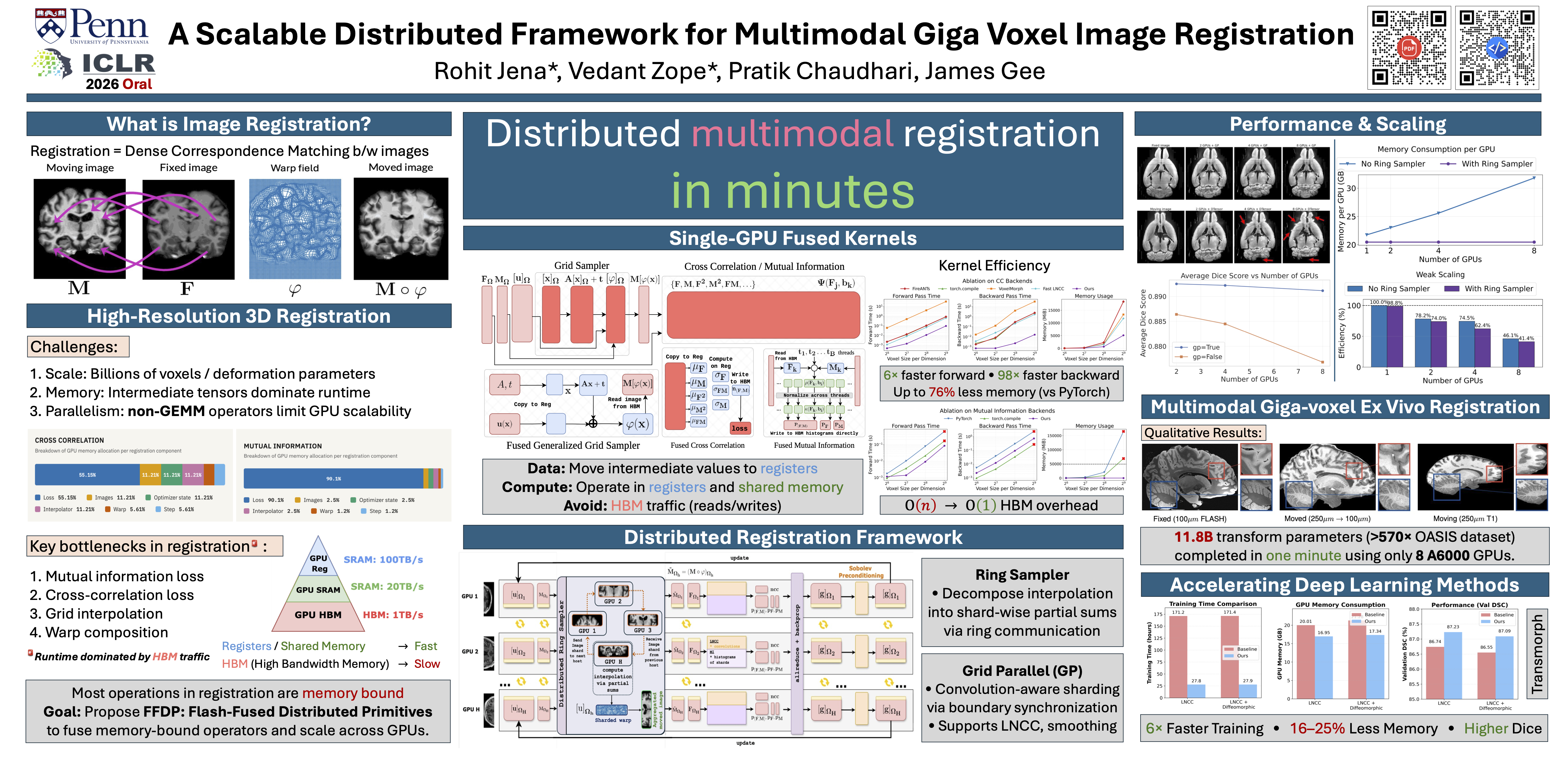
In this work, we propose FFDP, a set of IO-aware non-GEMM fused kernels supplemented with a distributed framework for image registration at unprecedented scales. Image registration is an inverse problem fundamental to biomedical and life sciences, but algorithms have not scaled in tandem with image acquisition capabilities. Our framework complements existing model parallelism techniques proposed for large-scale transformer training by optimizing non-GEMM bottlenecks and enabling convolution-aware tensor sharding. We demonstrate unprecedented capabilities by performing multimodal registration of a 100μm ex-vivo human brain MRI volume at native resolution – an inverse problem more than 570× larger than a standard clinical datum in about a minute using only 8 A6000 GPUs. FFDP accelerates existing state-of-the-art optimization and deep learning registration pipelines by upto 6 − 7× while reducing peak memory consumption by 20 − 59%. Comparative analysis on a 250μm dataset shows that FFDP can fit upto 64× larger problems than existing SOTA on a single GPU, and highlights both the performance and efficiency gains of FFDP compared to SOTA image registration methods.
DES-LOC: Desynced Low Communication Adaptive Optimizers for Foundation Models
Alex Iacob ⋅ Lorenzo Sani ⋅ Mher Safaryan ⋅ Paris Giampouras ⋅ Samuel Horváth ⋅ Andrej Jovanovic ⋅ Meghdad Kurmanji ⋅ Preslav Aleksandrov ⋅ William Shen ⋅ Xinchi Qiu ⋅ Nic Lane
Scaling foundation model training with Distributed Data Parallel~(DDP) methods is bandwidth-limited. Existing infrequent communication methods like Local SGD were designed to synchronize model parameters only and cannot be trivially applied to adaptive optimizers due to additional optimizer states. Heuristic approaches that keep states local or reset them lack guarantees and can be unstable in compute‑efficient batch regimes; conversely, Local Adam synchronizes all states uniformly and is provably convergent but triples communication costs. We propose Desynced Low Communication Adaptive Optimizers (DES-LOC), a family of optimizers assigning independent synchronization periods to parameters and momenta, enabling lower communication costs while preserving convergence. Our theoretical analysis shows that while parameter synchronization dominates the asymptotic rate in-expectation, high-probability convergence guarantees require at least infrequent synchronization of the second momentum. Furthermore, we prove that more frequent momentum sync permits larger stable step sizes. Experiments on language models of up to 1.7B show that DES-LOC can communicate 170x less than DDP and 2x less than the previous state-of-the-art Local Adam, enabling 1.3x–2.1x wall‑clock speedups over DDP for 1-13B models on 100Gb/s links. Furthermore, unlike previous heuristic methods, DES-LOC is robust to worker failures offering a scalable, efficient, and fault-tolerant solution for foundation model training.
MT-DAO: Multi-Timescale Distributed Adaptive Optimizers with Local Updates
Alex Iacob ⋅ Andrej Jovanovic ⋅ Mher Safaryan ⋅ Meghdad Kurmanji ⋅ Lorenzo Sani ⋅ Samuel Horváth ⋅ William Shen ⋅ Xinchi Qiu ⋅ Nic Lane
Training large models with distributed data parallelism (DDP) requires frequent communication of gradients across workers, which can saturate bandwidth. Infrequent communication strategies (e.g., Local SGD) reduce this overhead but, when applied to adaptive optimizers, often suffer a performance gap relative to fully synchronous DDP. We trace this gap to a time-scale mismatch: the optimizer's fast-moving momentum, tuned for frequent updates, decays too quickly to smooth gradients over long intervals, leading to noise-dominated optimization. To address this, we propose MT-DAO, a family of optimizers that employs multiple slow- and fast-moving first momenta or the gradient to track update dynamics across different time scales, for which we provide the first convergence guarantees. Empirically, for language-model pre-training, this eliminates the performance gap with DDP, outperforming infrequent-communication baselines in perplexity and reducing iso-token wall-clock time by 6-27% on Ethernet interconnects. At the 720M scale, MT-DAO reaches a target perplexity in 24% fewer steps and 35% less time than the single-momentum DDP baseline. MT-DAO enables effective cross-datacenter training and training over wide geographic areas.
Exploring Diverse Generation Paths via Inference-time Stiefel Activation Steering
Dongxuan Zhu ⋅ Ly Khanh ⋅ Andy Yat-Ming Cheung ⋅ Man-Chung Yue ⋅ Viet Anh Nguyen
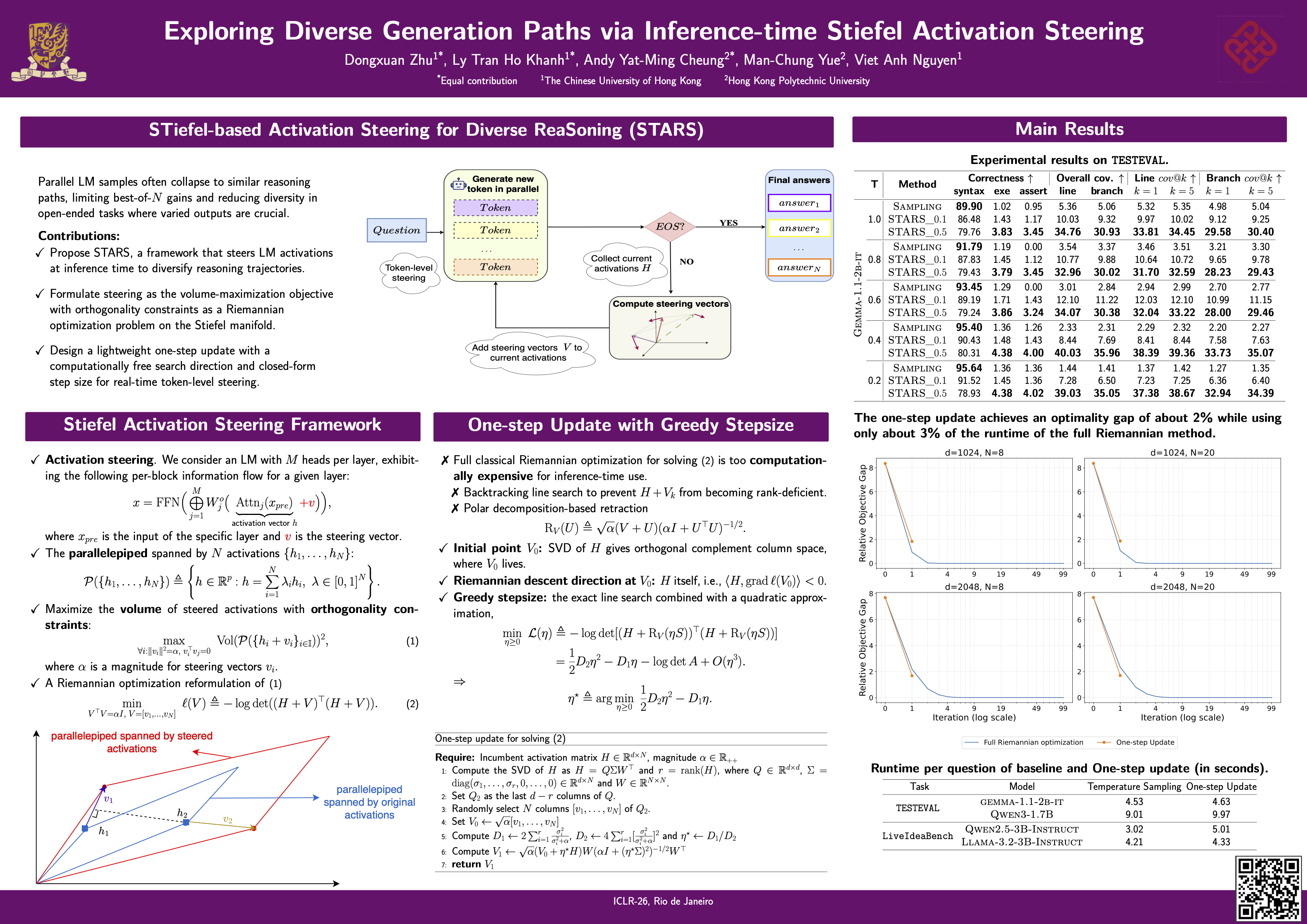
Language models often default to a narrow set of high-probability outputs, leaving their generation paths homogeneous and prone to mode collapse. Sampling-based strategies inject randomness but still struggle to guarantee diversity across multiple concurrent generation runs. We address this limitation by introducing STARS (STiefel-based Activation Steering for Diverse ReaSoning), a training-free, inference-time intervention method that transforms activation steering into an exploration engine. At each token, STARS collects the hidden activations of concurrent generation runs and optimizes multiple additive steering directions jointly on the Stiefel manifold. STARS maximizes the geometric volume of the steered activations, while the Stiefel manifold induces orthogonality of the steering interventions. This formulation explicitly promotes divergent activation vectors of concurrent generation runs, and implicitly promotes divergent generation trajectories. This manifold optimization formulation can be solved using a Riemannian gradient descent algorithm with convergence guarantees, but this algorithm is too time-consuming for real-time inference. To guarantee low latency, we further design a lightweight one-step update with an aggressive, closed-form stepsize. For test case generation and scientific discovery benchmarks, STARS consistently outperforms standard sampling methods, achieving greater diversity without sacrificing qualitative performance.
Understanding and improving Shampoo and SOAP via Kullback-Leibler Minimization
Wu Lin ⋅ Scott C. Lowe ⋅ Felix Dangel ⋅ Runa Eschenhagen ⋅ Zikun Xu ⋅ Roger Grosse
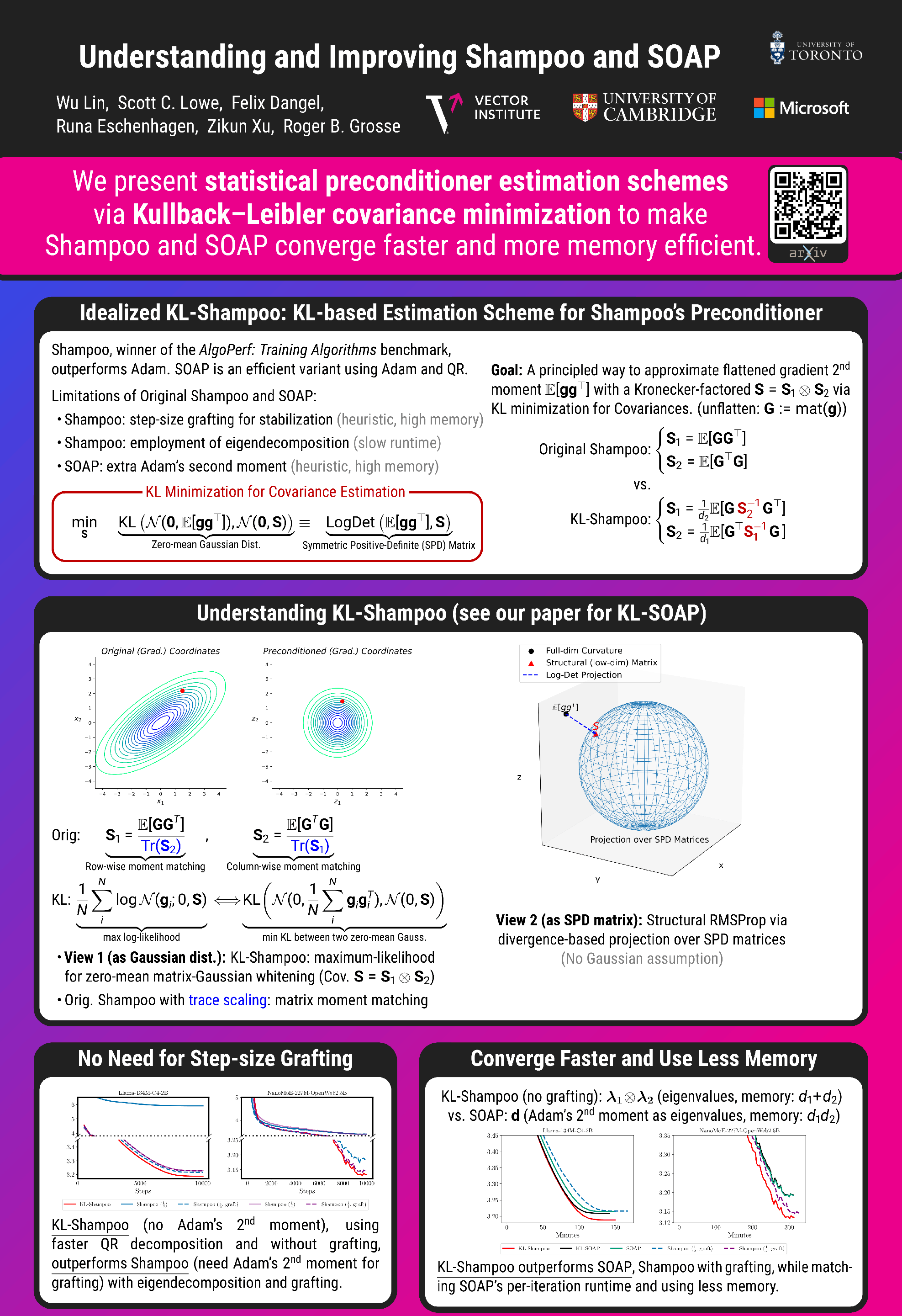
Shampoo and its efficient variant, SOAP, employ structured second-moment estimations and have shown strong performance for training neural networks (NNs). In practice, however, Shampoo typically requires step-size grafting with Adam to be competitive, and SOAP mitigates this by applying Adam in Shampoo’s eigenbasis---at the cost of additional memory overhead from Adam in both methods. Prior analyses have largely relied on the Frobenius norm to motivate these estimation schemes. We instead recast their estimation procedures as covariance estimation under Kullback-Leibler (KL) divergence minimization, revealing a previously overlooked theoretical limitation and motivating principled redesigns. Building on this perspective, we develop \textbf{KL-Shampoo} and \textbf{KL-SOAP}, practical schemes that match or exceed the performance of Shampoo and SOAP in NN pre-training while achieving SOAP-level per-iteration runtime. Notably, KL-Shampoo does not rely on Adam to attain competitive performance, eliminating the memory overhead introduced by Adam. Across our experiments, KL-Shampoo consistently outperforms SOAP, Shampoo, and even KL-SOAP, establishing the KL-based approach as a promising foundation for designing structured methods in NN optimization.
Semi-Supervised Preference Optimization with Limited Feedback
Seonggyun Lee ⋅ Sungjun Lim ⋅ Seojin Park ⋅ Soeun Cheon ⋅ Kyungwoo Song
The field of preference optimization has made outstanding contributions to the alignment of language models with human preferences. Despite these advancements, recent methods still rely heavily on substantial paired (labeled) feedback data, leading to substantial resource expenditures. To address these challenges, we study the problem of Semi-Supervised Preference Optimization in which the idea is to learn from both a small number of pairwise preference labels and a large pool of unpaired samples simultaneously. Our key theoretical contribution proves the existence of an optimal reward threshold capable of separating winning and losing responses with high probability, which enables a principled pseudo-labeling of unpaired data. By leveraging these pseudo-labels, SSPO effectively distills latent preferences from large-scale unpaired data, thus maintaining human alignment while drastically reducing acquisition costs. Extensive experiments across datasets validate this remarkable data efficiency; for instance, SSPO trained with Mistral-7B-Instruct on just 1% of UltraFeedback consistently surpasses strong baselines trained on 10% of UltraFeedback.
Beyond Sequential Reranking: Reranker-Guided Search Improves Reasoning Intensive Retrieval
Haike Xu ⋅ Tong Chen
The widely used retrieve-and-rerank pipeline faces two critical limitations: they are constrained by the initial retrieval quality of the top-k documents, and the growing computational demands of LLM-based rerankers restrict the number of documents that can be effectively processed. We introduce Reranker-Guided-Search (RGS), a novel approach that bypasses these limitations by directly retrieving documents according to reranker preferences rather than following the traditional sequential reranking method. Our method uses a greedy search on proximity graphs generated by approximate nearest neighbor algorithms, strategically prioritizing promising documents for reranking based on document similarity. Experimental results demonstrate substantial performance improvements across multiple benchmarks: 3.5 points on BRIGHT, 2.9 on FollowIR, and 5.1 on M-BEIR, all within a constrained reranker budget of 100 documents. Our analysis suggests that, given a fixed pair of embedding and reranker models, strategically selecting documents to rerank can significantly improve retrieval accuracy under limited reranker budget.
On the Convergence Direction of Gradient Descent
Shuo Chen ⋅ Xiaolong Li ⋅ Jiaying Peng ⋅ Yao Zhao
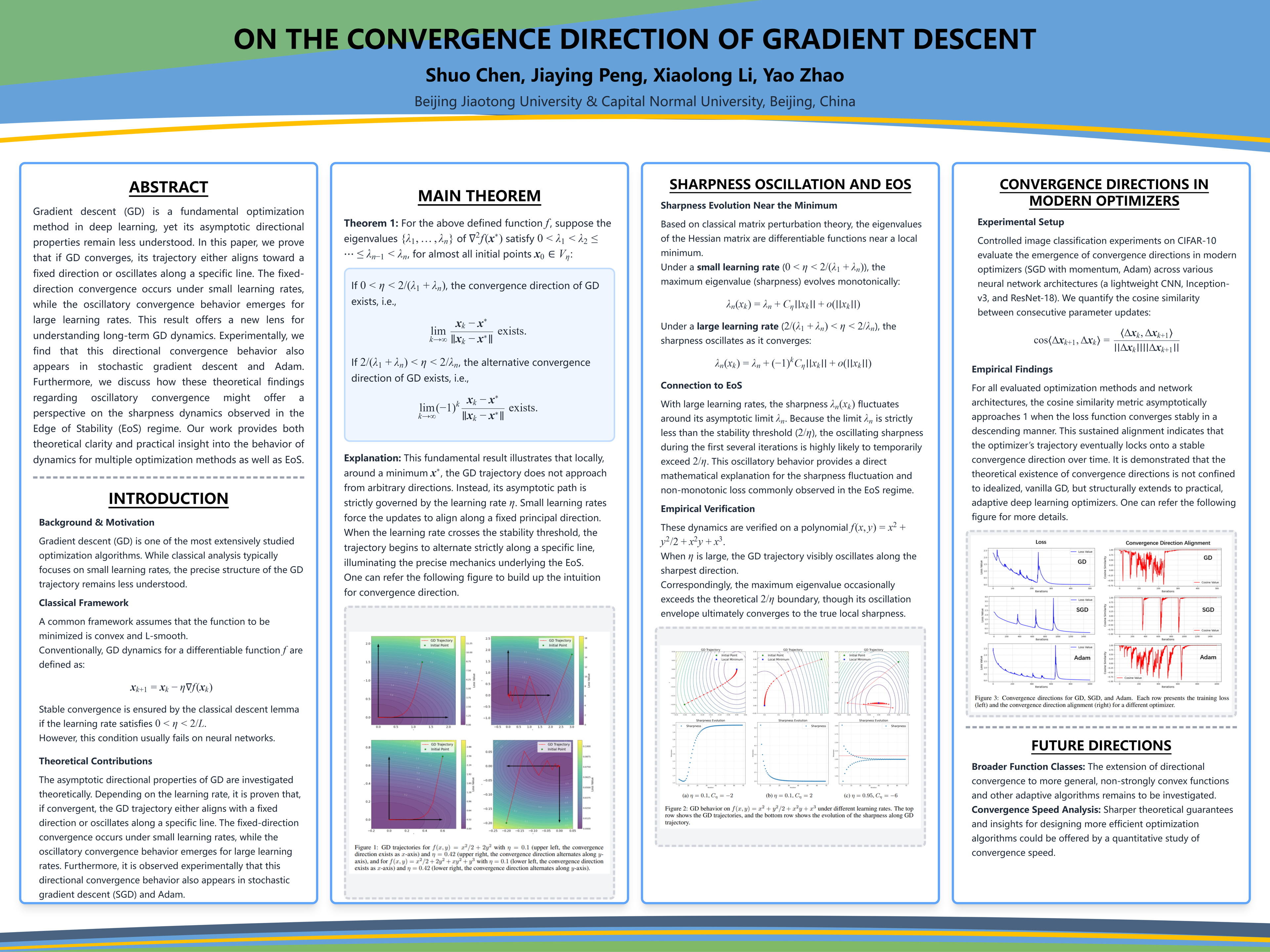
Gradient descent (GD) is a fundamental optimization method in deep learning, yet its asymptotic directional properties remain less understood. In this paper, we prove that if GD converges, its trajectory either aligns toward a fixed direction or oscillates along a specific line. The fixed-direction convergence occurs under small learning rates, while the oscillatory convergence behavior emerges for large learning rates. This result offers a new lens for understanding long-term GD dynamics. Experimentally, we find that this directional convergence behavior also appears in stochastic gradient descent (SGD) and Adam. Furthermore, we discuss how these theoretical findings regarding oscillatory convergence might offer a perspective on the sharpness dynamics observed in the Edge of Stability (EoS) regime. Our work provides both theoretical clarity and practical insight into the behavior of dynamics for multiple optimization methods.
ADEPT: Continual Pretraining via Adaptive Expansion and Dynamic Decoupled Tuning
Jinyang Zhang ⋅ Yue Fang ⋅ Hongxin Ding ⋅ Weibin Liao ⋅ Muyang Ye ⋅ Junfeng Zhao ⋅ Yasha Wang ⋅ Xu Chu

Conventional continual pretraining (CPT) for large language model (LLM) domain adaptation often suffers from catastrophic forgetting and limited domain capacity. Existing strategies adopt layer expansion, introducing additional trainable parameters to accommodate new knowledge. However, the uniform expansion and updates still entangle general and domain learning, undermining its effectiveness. Our pilot studies reveal that LLMs exhibit functional specialization, where layers and units differentially encode general-critical capabilities, suggesting that parameter expansion and optimization should be function-aware. We then propose ADEPT, Adaptive Expansion and Dynamic Decoupled Tuning for continual pretraining, a two-stage framework for domain-adaptive CPT. ADEPT first performs General-Competence Guided Selective Layer Expansion, duplicating layers least critical for the general domain to increase representational capacity while minimizing interference with general knowledge. It then applies Adaptive Unit-Wise Decoupled Tuning, disentangling parameter units within expanded layers according to their general-domain importance and assigning asymmetric learning rates to balance knowledge injection and retention. Experiments on mathematical and medical domains show that ADEPT outperforms full-parameter CPT by up to 5.76% on the general benchmarks and 5.58% on the target domain benchmarks with only 15% of parameters tuned and less than 50% training time. Ablation studies, theoretical analysis, and extended investigations further demonstrate the necessity of targeted expansion and decoupled optimization, providing new principles for efficient and robust domain-adaptive CPT. Our code is open-sourced at https://github.com/PuppyKnightUniversity/ADEPT
FutureFill: Fast Generation from Convolutional Sequence Models
Naman Agarwal ⋅ Xinyi Chen ⋅ Evan Dogariu ⋅ Devan Shah ⋅ Hubert Strauss ⋅ Vladimir Feinberg ⋅ Daniel Suo ⋅ Peter Bartlett ⋅ Elad Hazan
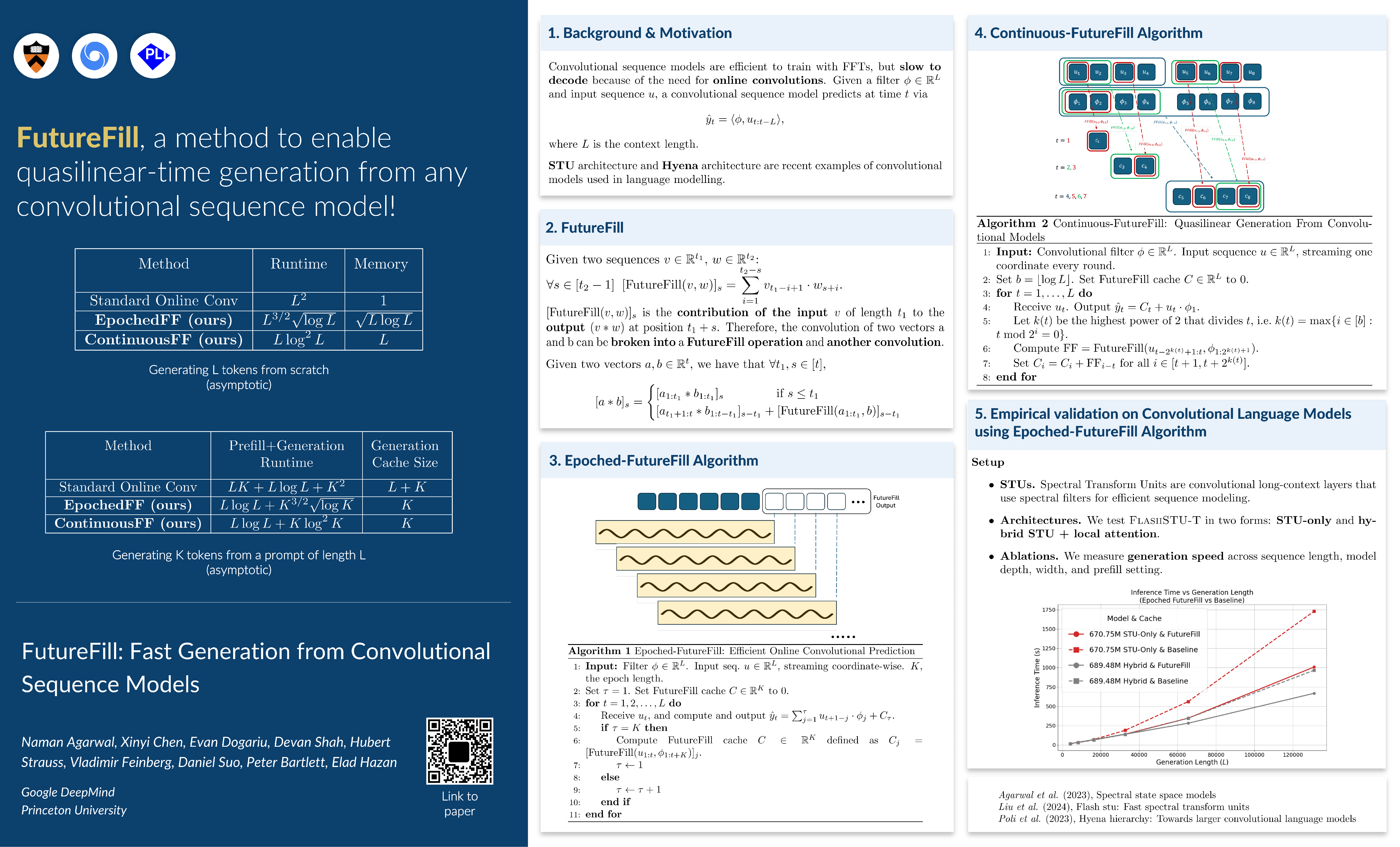
We address the challenge of efficient auto-regressive generation in sequence prediction models by introducing FutureFill—a general-purpose fast generation method for any sequence prediction algorithm based on convolutional operators. FutureFill reduces generation time from quadratic to quasilinear in the context length. Moreover, when generating from a prompt, it requires a prefill cache whose size grows only with the number of tokens to be generated—often much smaller than the caches required by standard convolutional or attention‐based models. We validate our theoretical claims with language modeling experiments and demonstrate substantial efficiency gains when generating from a deep convolutional sequence prediction model.
Displacement-Resistant Extensions of DPO with Nonconvex $f$-Divergences
Idan Pipano ⋅ Shoham Sabach ⋅ Kavosh Asadi ⋅ Mohammad Ghavamzadeh
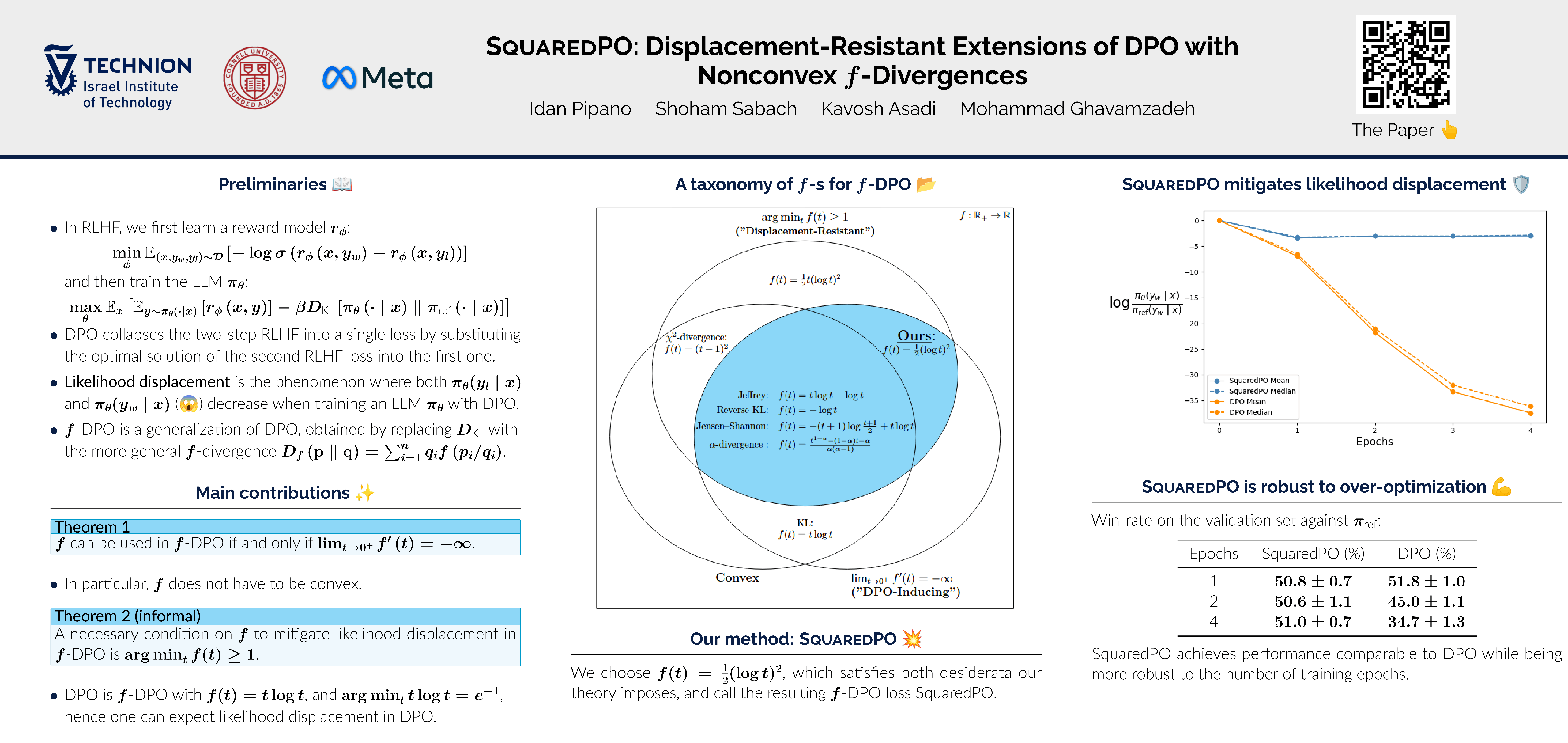
DPO and related algorithms align language models by directly optimizing the RLHF objective: find a policy that maximizes the Bradley-Terry reward while staying close to a reference policy through a KL divergence penalty. Previous work showed that this approach could be further generalized: the original problem remains tractable even if the KL divergence is replaced by a family of $f$-divergence with a convex generating function $f$. Our first contribution is to show that convexity of $f$ is not essential. Instead, we identify a more general condition, referred to as DPO-inducing, that precisely characterizes when the RLHF problem remains tractable. Our next contribution is to establish a second condition on $f$ that is necessary to prevent probability displacement, a known empirical phenomenon in which the probabilities of the winner and the loser responses approach zero. We refer to any $f$ that satisfies this condition as displacement-resistant. We finally focus on a specific DPO-inducing and displacement-resistant $f$, leading to our novel SquaredPO loss. Compared to DPO, this new loss offers stronger theoretical guarantees while performing competitively in practice.
R-Horizon: How Far Can Your Large Reasoning Model Really Go in Breadth and Depth?
Yi Lu ⋅ Jianing Wang ⋅ Linsen Guo ⋅ Wei He ⋅ Hongyin Tang ⋅ Tao Gui ⋅ Xuanjing Huang ⋅ Xuezhi Cao ⋅ Wei Wang ⋅ Xunliang Cai
Recent trends in test-time scaling for reasoning models (e.g., OpenAI o1, DeepSeek-R1) have led to remarkable improvements through long Chain-of-Thought (CoT). However, existing benchmarks mainly focus on immediate, single-horizon tasks, failing to adequately evaluate models’ ability to understand and respond to complex, long-horizon scenarios. To address this incomplete evaluation of Large Reasoning Models (LRMs), we propose R-HORIZON, a method designed to stimulate long-horizon reasoning behaviors in LRMs through query composition. Based on R-HORIZON, we construct a long-horizon reasoning benchmark, comprising complex multi-step reasoning tasks with interdependent problems that span long reasoning horizons. Through comprehensive evaluation of LRMs using the R-HORIZON benchmark, we find that even the most advanced LRMs suffer significant performance degradation. Our analysis reveals that LRMs exhibit limited effective reasoning length and struggle to allocate thinking budget across multiple problems appropriately. Recognizing these limitations, we use R-HORIZON to construct long-horizon reasoning data for reinforcement learning with verified rewards (RLVR). Compared to training with single-horizon data, RLVR with R-HORIZON not only substantially improves performance on the multi-horizon reasoning tasks, but also promotes accuracy on standard reasoning tasks (+7.5 on AIME2024). These results position R-HORIZON as a scalable, controllable, and low-cost paradigm for enhancing and evaluating the long-horizon reasoning capabilities of LRMs.
Query-Aware Flow Diffusion for Graph-Based RAG with Retrieval Guarantees
Zhuoping Zhou ⋅ Davoud Ataee Tarzanagh ⋅ Sima Didari ⋅ Wenjun Hu ⋅ Baruch Gutow ⋅ Oxana Verkholyak ⋅ Masoud Faraki ⋅ Heng Hao ⋅ Hankyu Moon ⋅ Seungjai Min
Graph-based Retrieval-Augmented Generation (RAG) systems leverage interconnected knowledge structures to capture complex relationships that flat retrieval struggles with, enabling multi-hop reasoning. Yet most existing graph-based methods suffer from (i) heuristic designs lacking theoretical guarantees for subgraph quality or relevance and/or (ii) the use of static exploration strategies that ignore the query's holistic meaning, retrieving neighborhoods or communities regardless of intent. We propose \textit{Query-Aware Flow Diffusion RAG} (QAFD-RAG), a training-free framework that dynamically adapts graph traversal to each query's holistic semantics. The central innovation is \emph{query-aware traversal}: during graph exploration, edges are dynamically weighted by how well their endpoints align with the query's embedding, guiding flow along semantically relevant paths while avoiding structurally connected but irrelevant regions. These query-specific reasoning subgraphs enable the first statistical guarantees for query-aware graph retrieval, showing that QAFD-RAG recovers relevant subgraphs with high probability under mild signal-to-noise conditions. The algorithm converges exponentially fast, with complexity scaling with the retrieved subgraph size rather than the full graph. Experiments on question answering and text-to-SQL tasks demonstrate consistent improvements over state-of-the-art graph-based RAG methods.
Incentivizing LLM Reasoning via Reinforcement Learning with Functional Monte Carlo Tree Search
Kongcheng Zhang ⋅ QI YAO ⋅ Baisheng Lai ⋅ Jiaxing Huang ⋅ Wenkai Fang ⋅ Dacheng Tao ⋅ Mingli Song ⋅ Shunyu Liu
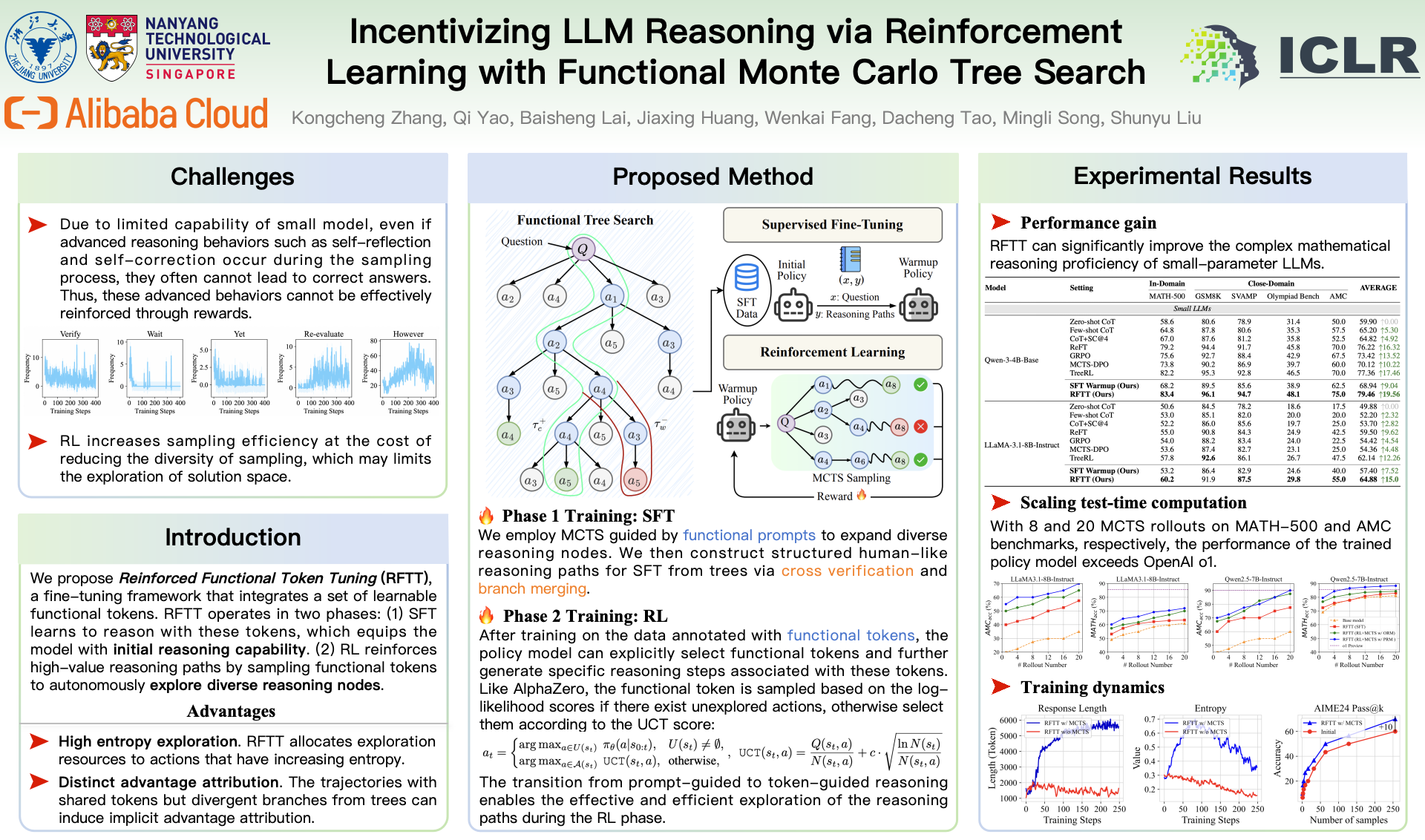
In this work, we propose **Reinforced Functional Token Tuning (RFTT), a novel reinforced fine-tuning framework that empowers Large Language Models (LLMs) with learn-to-reason capabilities. Unlike prior prompt-driven reasoning efforts, RFTT embeds a rich set of learnable functional tokens (e.g., \, \, ) directly into the model vocabulary, enabling chain-of-thought construction with diverse human-like reasoning behaviors. Specifically, RFTT comprises two phases: (1) supervised fine-tuning performs prompt-driven tree search to obtain self-generated training data annotated with functional tokens, which warms up the model to learn these tokens for initial reasoning capability; and (2) online reinforcement learning further allows the model to explore diverse reasoning pathways through functional token sampling without relying on prompts, thereby facilitating effective self-improvement for functional reasoning. Extensive experiments demonstrate the superiority of the proposed RFTT on mathematical benchmarks and highlight its strong generalization capability to other general domains. Moreover, the performance of RFTT exhibits consistent gains with increased test-time computation through additional search rollouts. Our code and dataset are available at https://github.com/sastpg/RFTT.
WINA: Weight Informed Neuron Activation for Accelerating Large Language Model Inference
Sihan Chen ⋅ Dan Zhao ⋅ Jongwoo Ko ⋅ Colby Banbury ⋅ Huiping Zhuang ⋅ Luming Liang ⋅ Pashmina Cameron ⋅ Tianyi Chen
The ever-increasing computational demands of large language models (LLMs) make efficient inference a central challenge. While recent advances leverage specialized architectures or selective activation, they typically require (re)training or architectural modifications, limiting their broad applicability. Training-free sparse activation, in contrast, offers a plug-and-play pathway to efficiency; however, existing methods often rely solely on hidden state magnitudes, leading to significant approximation error and performance degradation. To address this, we introduce WINA (Weight-Informed Neuron Activation): a simple framework for training-free sparse activation that incorporates both hidden state magnitudes and weight matrix structure. By also leveraging the ℓ2-norm of the model’s weight matrices, WINA yields a principled sparsification strategy with provably optimal approximation error bounds, offering better and tighter theoretical guarantees than prior state-of-the-art approaches. Overall, WINA also empirically outperforms many previous training-free methods across diverse LLM architectures and datasets: not only matching or exceeding their accuracy at comparable sparsity levels, but also sustaining performance better at more extreme sparsity levels. Together, these results position WINA as a practical, theoretically grounded, and broadly deployable solution for efficient inference. Our source code is available at https://github.com/microsoft/wina.
ChainGPT: Dual-Reasoning Model with Recurrent Depth and Multi-Rank State Updates
Yunao Zheng ⋅ Xiaojie Wang ⋅ Lei Ren ⋅ Chen Wei
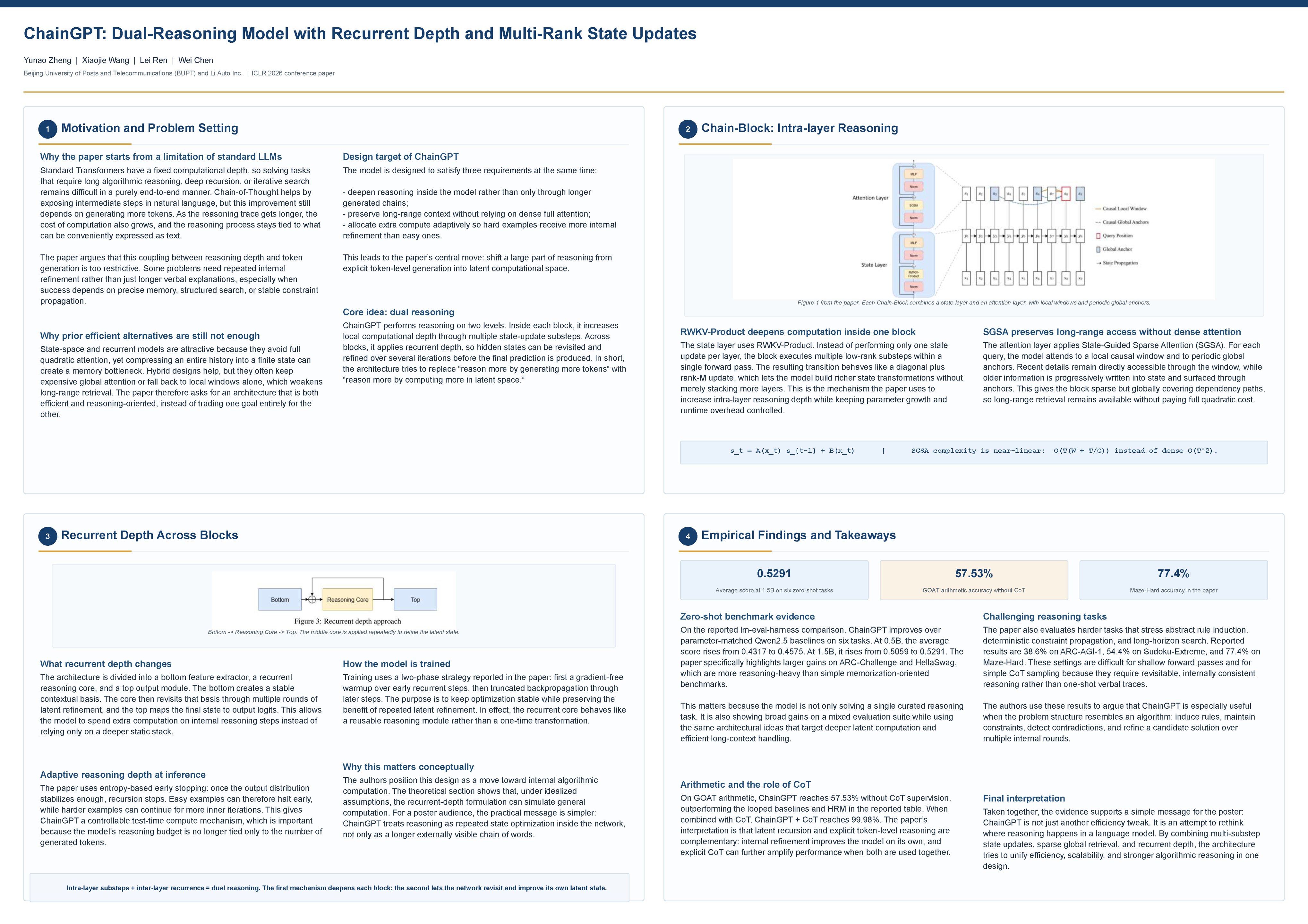
Large language models, constrained by the fixed-depth Transformer architecture, struggle to solve complex reasoning tasks in an end-to-end manner. Existing approaches, such as Chain of Thought, improve reasoning depth to some extent but rely heavily on natural language generation, with computational costs increasing rapidly as the length of the generated sequence grows. To address these limitations, we propose ChainGPT, a dual-reasoning model that shifts reasoning into latent computational space. Within each layer, ChainGPT employs multi-substep state updates combined with state-guided sparse attention, enabling deep local computation and efficient long-range modeling without quadratic costs. Across layers, recurrent depth approach iteratively refine latent states, supported by adaptive training and stopping strategies that balance reasoning depth against computational budget. Theoretically, we show that ChainGPT can, in principle, simulate general computation, and empirically it delivers consistent improvements over comparable models, including on reasoning tasks that remain challenging for existing systems. By unifying efficiency and reasoning ability, ChainGPT provides a principled foundation for next-generation language models.
BEP: A Binary Error Propagation Algorithm for Binary Neural Networks Training
Luca Colombo ⋅ Fabrizio Pittorino ⋅ Daniele Zambon ⋅ Carlo Baldassi ⋅ Manuel Roveri ⋅ Cesare Alippi
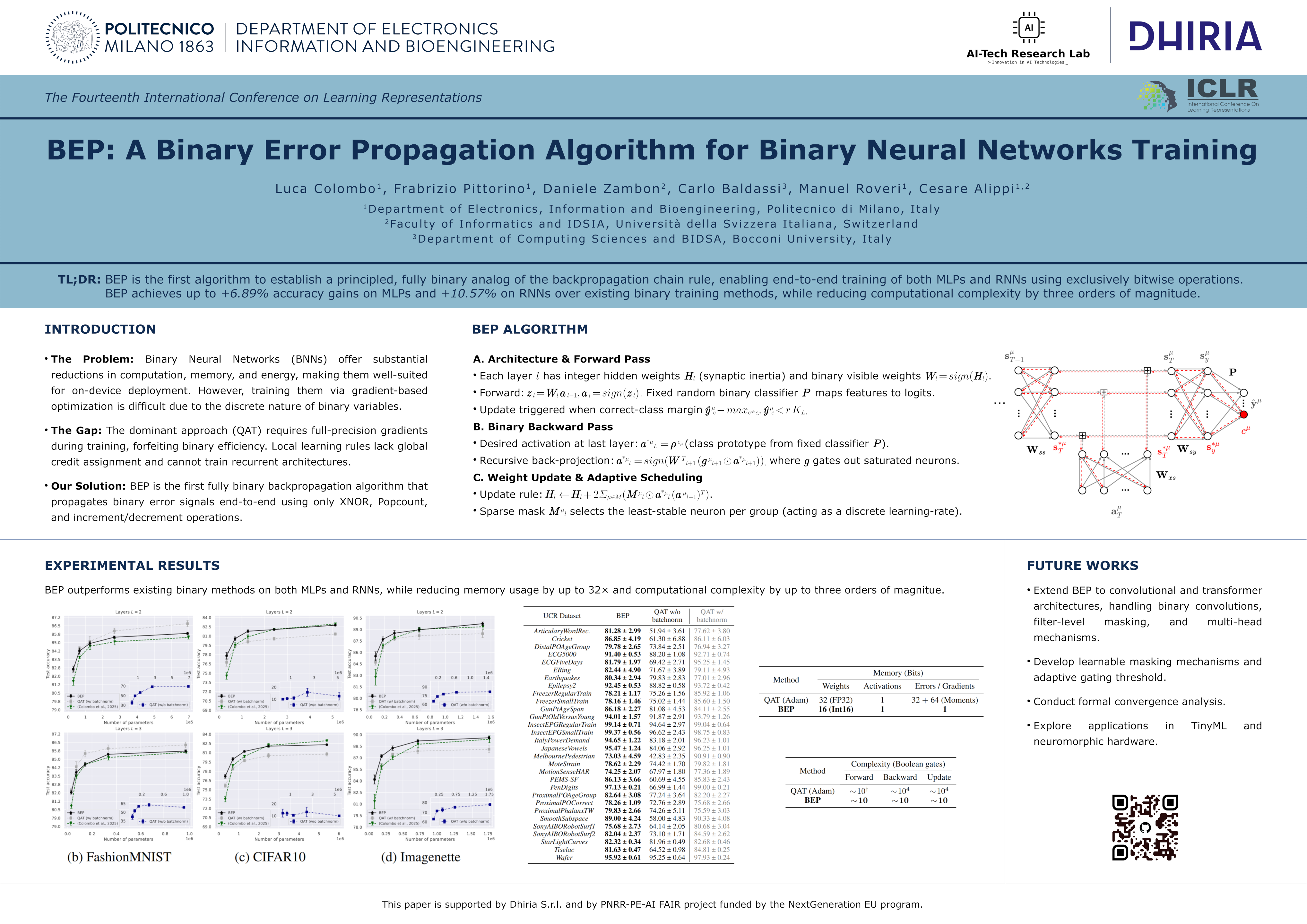
Binary Neural Networks (BNNs), which constrain both weights and activations to binary values, offer substantial reductions in computational complexity, memory footprint, and energy consumption. These advantages make them particularly well suited for deployment on resource-constrained devices. However, training BNNs via gradient-based optimization remains challenging due to the discrete nature of their variables. The dominant approach, quantization-aware training, circumvents this issue by employing surrogate gradients. Yet, this method requires maintaining latent full-precision parameters and performing the backward pass with floating-point arithmetic, thereby forfeiting the efficiency of binary operations during training. While alternative approaches based on local learning rules exist, they are unsuitable for global credit assignment and for back-propagating errors in multi-layer architectures. This paper introduces Binary Error Propagation (BEP), the first learning algorithm to establish a principled, discrete analog of the backpropagation chain rule. This mechanism enables error signals, represented as binary vectors, to be propagated backward through multiple layers of a neural network. BEP operates entirely on binary variables, with all forward and backward computations performed using only bitwise operations. Crucially, this makes BEP the first solution to enable end-to-end binary training for recurrent neural network architectures. We validate the effectiveness of BEP on both multi-layer perceptrons and recurrent neural networks, demonstrating gains of up to $+6.89$% and $+10.57$% in test accuracy, respectively. The proposed algorithm is released as an open-source repository.
Global Resolution: Optimal Multi-Draft Speculative Sampling via Convex Optimization
Rahul Thomas ⋅ Arka Pal
Speculative sampling reduces the latency of autoregressive decoding for target model LLMs without sacrificing inference quality, by using a cheap draft model to suggest a candidate token and a verification criterion to accept or resample this token. To improve acceptance and decoding efficiency, recent work has explored the multi-draft extension, where at each step $n$ draft tokens are generated, and the verification criterion is a distribution conditioned on these. When this criterion maximizes the probability of accepting some draft token, it is called the optimal transport (OT). However, finding the OT is difficult, as it is the solution of a linear program (OTLP) in over $V^n$ variables, with $V$ being the vocabulary size. Two recent theoretical works have reframed the OTLP in terms of importance sampling or subset selection. In this work, we prove that these formulations are equivalent to an exponentially large relaxed OTLP, so it remains infeasible to solve. Then, we reverse engineer subset selection to formulate the OTLP as a max-flow problem. With a novel application of polymatroid theory, we reduce the exponentially large OTLP to a convex optimization problem in at most $V$ variables. This allows us to devise an algorithm for optimal $n$-draft speculative sampling when the $n$ tokens are chosen i.i.d. from a single draft model, which can be tuned to arbitrary accuracy. Finally, we measure acceptance rates and algorithm runtimes for various $n$ and top-$k$ draft sampling settings. Our findings give the first multi-draft algorithm with 90\% acceptance and under 100 ms of overhead per generated token with negligible deviation from the target model distribution.
SCAD: Super-Class-Aware Debiasing for Long-Tailed Semi-Supervised Learning
Sunguk Jang ⋅ Jinwoo Jeon ⋅ Byung-Jun Lee
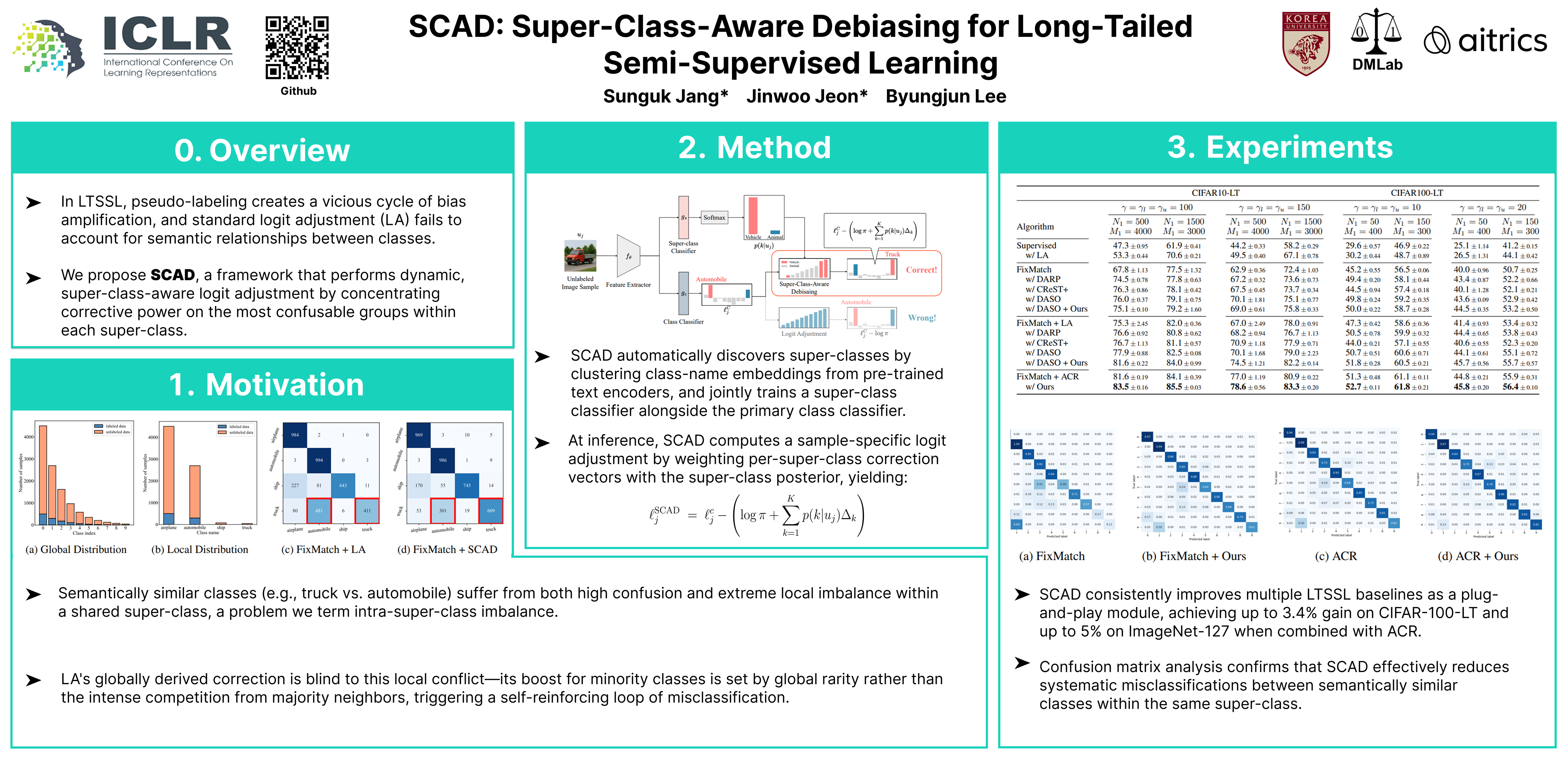
In long-tailed semi-supervised learning (LTSSL), pseudo-labeling often creates a vicious cycle of bias amplification. Recent methods attempt to mitigate this issue via logit adjustment (LA). However, LA-based debiasing remains inherently hierarchy-agnostic and fails to account for semantic relationships between classes. We reveal a critical yet overlooked problem of \textit{intra-super-class imbalance}, where semantically similar classes within a super-class are both highly confusable and locally imbalanced. This combination reinforces early mistakes, causing minority-class representations to be suppressed by their majority neighbors. To break this cycle, we propose Super-Class-Aware Debiasing (SCAD), a framework that performs dynamic, super-class-aware logit adjustment. SCAD leverages latent semantic structure to concentrate its corrective power on the most confusable groups, thereby resolving local imbalances. Extensive experiments demonstrate that SCAD achieves state-of-the-art performance.
d$^2$Cache: Accelerating Diffusion-Based LLMs via Dual Adaptive Caching
Yuchu Jiang ⋅ Yue Cai ⋅ Xiangzhong Luo ⋅ Jiale Fu ⋅ Jiarui Wang ⋅ CHONGHAN LIU ⋅ xu yang
Diffusion-based large language models (dLLMs), despite their promising performance, still suffer from inferior inference efficiency. This is because dLLMs rely on bidirectional attention and cannot directly benefit from the standard key-value (KV) cache as autoregressive models (ARMs) do. To tackle this issue, we introduce \textit{Dual aDaptive Cache} (d$^2$Cache), which is a training-free approximate KV cache framework for accelerating dLLM inference. d$^2$Cache features a two-stage fine-grained selection strategy to identify tokens and adaptively update their KV states at each decoding step, while caching the KV states of the remaining tokens for reuse. Furthermore, d$^2$Cache naturally offers a more reliable decoding alternative, which can enable quasi left-to-right generation and mitigate premature overconfidence in tokens at the end of the sequence. Extensive experimental results on two representative dLLMs (\ie, LLaDA and Dream) demonstrate that d$^2$Cache not only achieves substantial inference speedups, but also yields consistent improvements in generation quality. The anonymous evaluation codes are available at \url{https://anonymous.4open.science/r/d2Cache-5538}.
Overcoming Joint Intractability with Lossless Hierarchical Speculative Decoding
Yuxuan Zhou ⋅ Fei Huang ⋅ Heng Li ⋅ Fengyi Wu ⋅ Tianyu Wang ⋅ jianwei zhang ⋅ Junyang Lin ⋅ Zhi-Qi Cheng
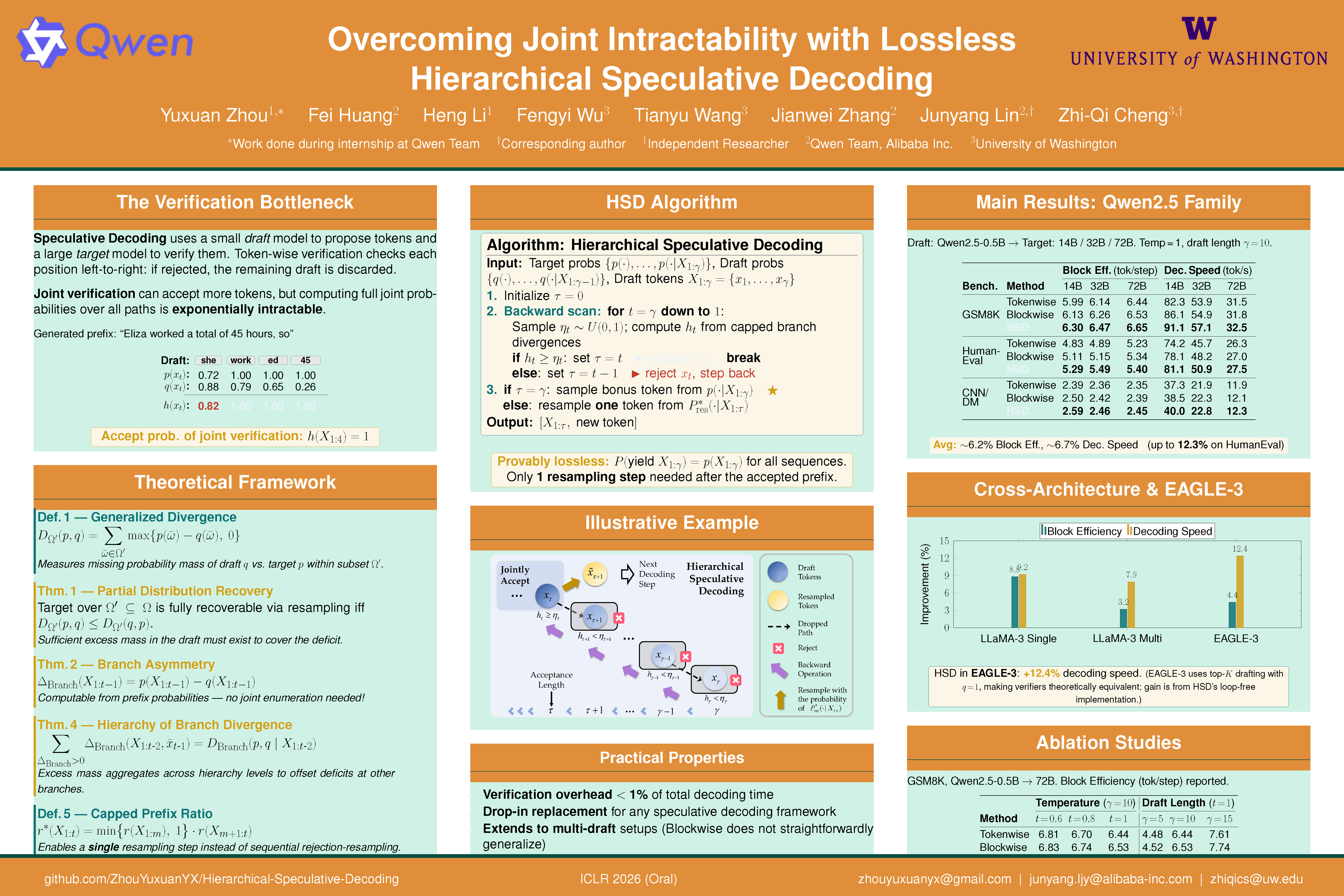
Verification is a key bottleneck in improving inference speed while maintaining distribution fidelity in Speculative Decoding. Recent work has shown that sequence-level verification leads to a higher number of accepted tokens compared to token-wise verification. However, existing solutions often rely on surrogate approximations or are constrained by partial information, struggling with joint intractability. In this work, we propose \emph{Hierarchical Speculative Decoding (HSD)}, a provably lossless verification method that significantly boosts the expected number of accepted tokens and overcomes joint intractability by balancing excess and deficient probability mass across accessible branches. Our extensive large-scale experiments demonstrate that HSD yields consistent improvements in acceptance rates across diverse model families and benchmarks. Moreover, its strong explainability and generality make it readily integrable into a wide range of speculative decoding frameworks. Notably, integrating HSD into EAGLE-3 yields over a 12\% performance gain, establishing state-of-the-art decoding efficiency without compromising distribution fidelity. Code is available at https://github.com/ZhouYuxuanYX/Hierarchical-Speculative-Decoding.
Metis: Training LLMs with FP4 Quantization
Hengjie Cao ⋅ Mengyi Chen ⋅ Yifeng Yang ⋅ Fang Dong ⋅ Ruijun Huang ⋅ Jixian Zhou ⋅ Anrui Chen ⋅ Mingzhi Dong ⋅ Yujiang Wang ⋅ Jinlong Hou ⋅ Yuan Cheng ⋅ FAN WU ⋅ Fan Yang ⋅ Tun Lu ⋅ Ning Gu ⋅ Li Shang
This work identifies anisotropy in the singular value spectra of parameters, activations, and gradients as the fundamental barrier to low-bit training of large language models (LLMs). These spectra are dominated by a small fraction of large singular values, inducing wide numerical ranges that cause quantization bias and severe spectral distortion, ultimately degrading training performance. This work presents \emph{Metis}, a spectral-domain quantization framework that partitions anisotropic spectra into narrower sub-distributions for independent quantization, thereby reducing errors and preserving spectral structure. To minimize overhead, Metis leverages two key properties of the dominant spectral subspace: preservation via sparsely random sampling and preservation via random projection, reducing decomposition cost to a negligible level. On LLaMA-3 8B trained with 100B tokens, Metis enables robust W4A4G4 training with FP4 quantization of weights, activations, and gradients, yielding only a 0.4\% training loss gap and a 0.1\% degradation in downstream accuracy relative to BF16. Beyond matching BF16 fidelity, Metis also surpasses Nvidia’s FP4 recipe, consistently achieving lower loss and higher downstream accuracy while incurring significantly lower computational overhead. The code implementation for Metis is available at: \url{https://github.com/sii-research/Metis}.
Hilbert: Recursively Building Formal Proofs with Informal Reasoning
Sumanth Varambally ⋅ Thomas Voice ⋅ Yanchao Sun ⋅ Zhifeng Chen ⋅ Rose Yu ⋅ Ke Ye
Large Language Models (LLMs) demonstrate impressive mathematical reasoning abilities, but their solutions frequently contain errors that cannot be automatically checked. Formal theorem proving systems such as Lean 4 offer automated verification with complete accuracy, motivating recent efforts to build specialized prover LLMs that generate verifiable proofs in formal languages. However, a significant gap remains: current prover LLMs solve substantially fewer problems than general-purpose LLMs operating in natural language. We introduce Hilbert, an agentic framework that bridges this gap by combining the complementary strengths of informal reasoning and formal verification. Our system orchestrates four components: an informal LLM that excels at mathematical reasoning, a specialized prover LLM optimized for Lean 4 tactics, a formal verifier, and a semantic theorem retriever. Given a problem that the prover is unable to solve, Hilbert employs recursive decomposition to split the problem into subgoals that it solves with the prover or reasoner LLM. It leverages verifier feedback to refine incorrect proofs as necessary. Experimental results demonstrate that Hilbert, substantially outperforms existing approaches on key benchmarks, achieving 99.2\% on miniF2F, 6.6\% points above the best publicly available method. Hilbert achieves the \textbf{strongest known result} from a publicly available model on PutnamBench. It solves 462/660 problems (70.0\%), outperforming proprietary approaches like SeedProver (50.4\%) and achieving a 422\% improvement over the best publicly available baseline. Thus, Hilbert effectively narrows the gap between informal reasoning and formal proof generation. Code is available at ~\url{https://github.com/Rose-STL-Lab/ml-hilbert}.
Holdout-Loss-Based Data Selection for LLM Finetuning via In-Context Learning
Ling Zhang ⋅ Xianliang Yang ⋅ Juwon Yu ⋅ Park Cheonyoung ⋅ Lei Song ⋅ Jiang Bian
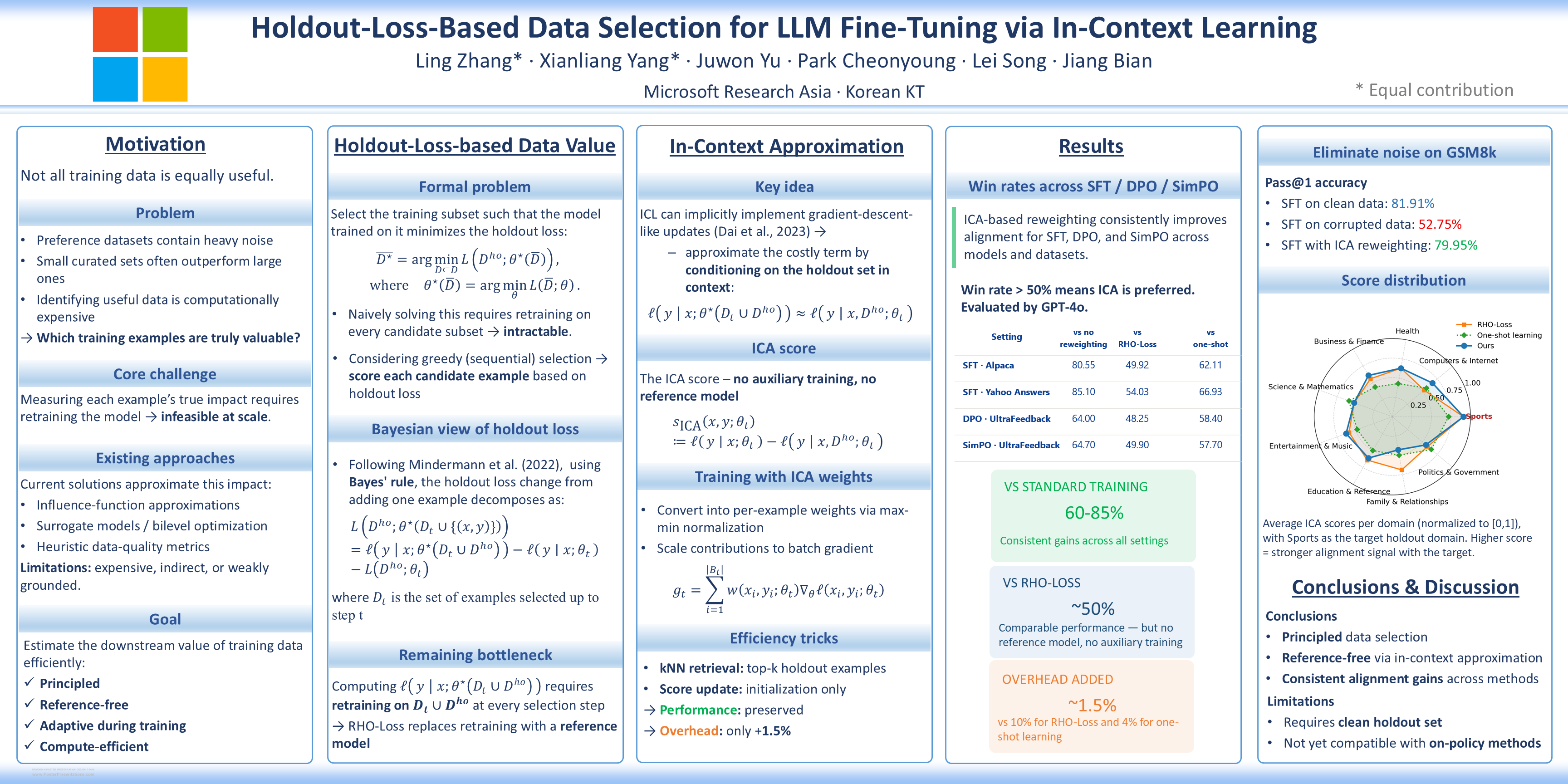
Fine-tuning large pretrained language models is a common approach for aligning them with human preferences, but noisy or off-target examples can dilute supervision. While small, well-chosen datasets often match the performance of much larger ones, systematic and efficient ways to identify high-value training data remain underexplored. Many current methods rely on heuristics or expensive retraining. We present a principled, resource-efficient framework for data selection and reweighting. At its core is an In-Context Approximation (ICA) that estimates the holdout loss a model would incur after training on a candidate example by conditioning on a small, curated holdout set in context. ICA requires no reference model and no additional finetuning. We define the resulting estimate as the ICA score, and derive per-example weights that dynamically reweight gradient updates as model parameters evolve. Across SFT, DPO, and SimPO, and over diverse backbones and datasets, ICA-based reweighting consistently improves model alignment with minimal overhead. We analyze sensitivity to score update frequency and the number of in-context holdout examples. We also discuss limitations in rapidly drifting on-policy settings, highlighting directions for future work.
Towards Quantization-Aware Training for Ultra-Low-Bit Reasoning LLMs
Yasuyuki Okoshi ⋅ Hikari Otsuka ⋅ Daichi Fujiki ⋅ Masato Motomura
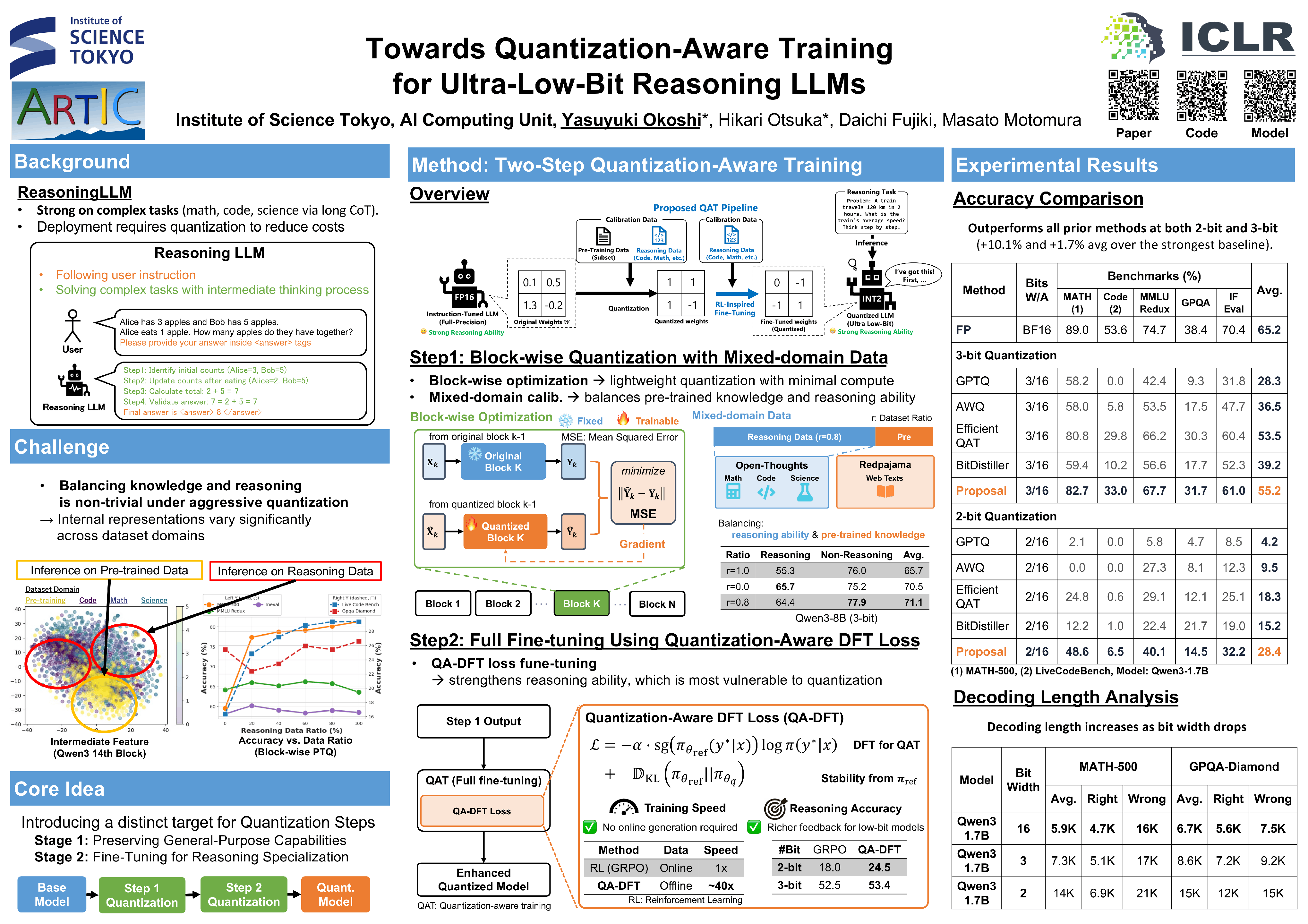
Large language models (LLMs) have achieved remarkable performance across diverse reasoning tasks, yet their deployment is hindered by prohibitive computational and memory costs. Quantization-aware training (QAT) enables ultra-low-bit compression (<4 bits per weight), but existing QAT methods often degrade reasoning capability, partly because complex knowledge structures are introduced during the post-training process in LLMs. In this paper, through a systematic investigation of how quantization affects different data domains, we find that its impact on pre-training and reasoning capabilities differs. Building on this insight, we propose a novel two-stage QAT pipeline specifically designed for reasoning LLMs. In the first stage, we quantize the model using mixed-domain calibration data to preserve essential capabilities across domains; in the second stage, we fine-tune the quantized model with a teacher-guided reward-rectification loss to restore reasoning capability. We first demonstrate that mixed-domain calibration outperforms single-domain calibration by up to 2.74% improvement on average over six tasks, including reasoning and pre-trained tasks. Following experiments on five reasoning benchmarks show that our 2-bit-quantized Qwen3-8B outperforms post-training quantization (PTQ) baselines by 50.45% on average. Moreover, compared to ultra-low-bit-specialized models such as BitNet-2B4T, our pipeline achieves approximately 2\% higher mathematical-reasoning accuracy with fewer than 1B tokens. Code is available: https://github.com/yasu0001/ReasoningQAT
Counterfactual Reasoning for Retrieval-Augmented Generation
Huaiyu Qin ⋅ Chunyu Wei ⋅ Yueguo Chen ⋅ Yunhai Wang
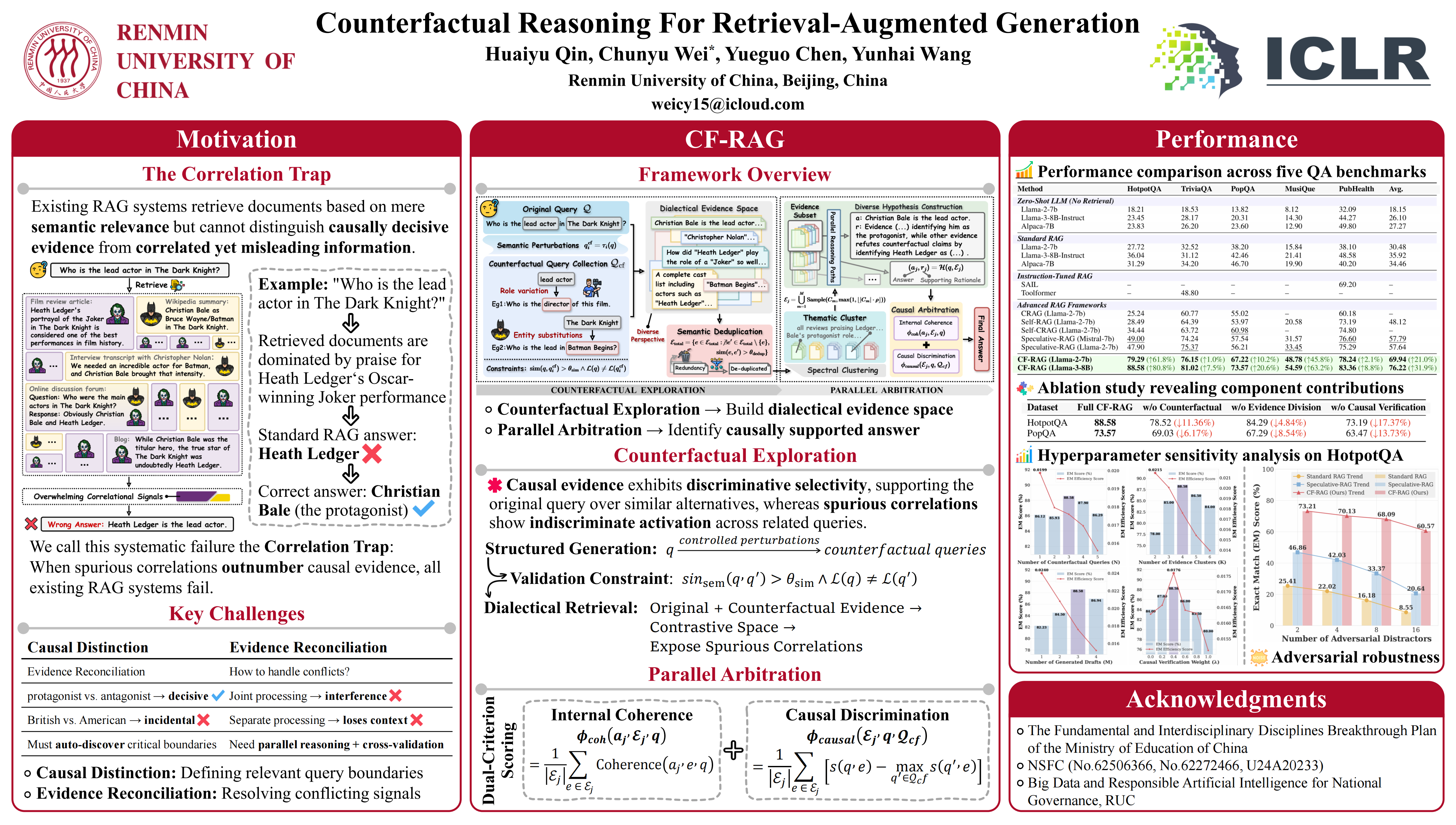
While Retrieval-Augmented Generation (RAG) has advanced knowledge-intensive tasks, we identify a fundamental vulnerability: the Correlation Trap. Existing systems cannot distinguish causally decisive evidence from overwhelmingly correlated yet misleading information, leading to systematic failures. We introduce Counterfactual RAG (CF-RAG), a new framework that operationalizes causal reasoning to overcome this limitation. CF-RAG systematically generates and evaluates counterfactual queries to identify causally relevant distinctions, and employs a parallel arbitration mechanism to reconcile conflicting evidence without interference. On challenging benchmarks, CF-RAG substantially improves robustness against the Correlation Trap, achieving state-of-the-art performance while maintaining comparable efficiency to standard RAG models.
RouterArena: An Open Platform for Comprehensive Comparison of LLM Routers
Yifan (Louie) Lu ⋅ Rixin Liu ⋅ Jiayi Yuan ⋅ Xingqi Cui ⋅ Shenrun Zhang ⋅ Hongyi Liu ⋅ Jiarong Xing
Today's LLM ecosystem comprises a wide spectrum of models that differ in size, capability, and cost. No single model is optimal for all scenarios; hence, LLM routers have become essential for selecting the most appropriate model under varying circumstances. However, the rapid emergence of various routers has led to fragmented evaluation practices and inconsistent metrics, making it difficult to systematically assess progress in this space. To address this problem, we need a comprehensive router comparison and a standardized leaderboard, similar to those available for models. In this work, we introduce RouterArena, the first open platform enabling comprehensive comparison of LLM routers. RouterArena has (1) a principally constructed dataset with broad knowledge domain coverage, (2) distinguishable difficulty levels for each domain, (3) an extensive list of evaluation metrics, and (4) an automated framework for evaluation and leaderboard updates. Leveraging this framework, we have produced the initial leaderboard with detailed metrics comparison. Figure1 provides a preview of the leaderboard. The complete framework and the latest router leaderboard are publicly available at https://routeworks.github.io/
LoFT: Low-Rank Adaptation That Behaves Like Full Fine-Tuning
Nurbek Tastan ⋅ Stefanos Laskaridis ⋅ Martin Takáč ⋅ Karthik Nandakumar ⋅ Samuel Horváth
Large pre-trained models are commonly adapted to downstream tasks using parameter-efficient fine-tuning methods such as Low-Rank Adaptation (LoRA), which injects small trainable low-rank matrices instead of updating all weights. While LoRA dramatically reduces trainable parameters with little overhead, it can still underperform full fine-tuning in accuracy and often converges more slowly. We introduce LoFT, a novel low-rank adaptation method that behaves like full fine-tuning by aligning the optimizer's internal dynamics with those of updating all model weights. LoFT not only learns weight updates in a low-rank subspace (like LoRA) but also properly projects the optimizer's first and second moments (Adam's momentum and variance) into the same subspace, mirroring full-model updates. By aligning the low-rank update itself with the full update, LoFT eliminates the need for tuning extra hyperparameters, e.g., the LoRA scaling factor $\alpha$. Empirically, this approach substantially narrows the performance gap between adapter-based tuning and full fine-tuning and consistently outperforms standard LoRA-style methods, all without increasing inference cost. The code is available at https://github.com/tnurbek/loft.
AtlasKV: Augmenting LLMs with Billion-Scale Knowledge Graphs in 20GB VRAM
Haoyu Huang ⋅ Hong Ting Tsang ⋅ Jiaxin Bai ⋅ Xi Peng ⋅ Gong Zhang ⋅ Yangqiu Song
Retrieval-augmented generation (RAG) has shown some success in augmenting large language models (LLMs) with external knowledge. However, as a non-parametric knowledge integration paradigm for LLMs, RAG methods heavily rely on external retrieval modules and the retrieved textual context prior. Especially for very large scale knowledge augmentation, they would introduce substantial inference latency due to expensive searches and much longer relevant context. In this paper, we propose a parametric knowledge integration method, called $\textbf{AtlasKV}$, a scalable, effective, and general way to augment LLMs with billion-scale knowledge graphs (KGs) (e.g. 1B triples) using very little GPU memory cost (e.g. less than 20GB VRAM). In AtlasKV, we introduce KG2KV and HiKVP to integrate KG triples into LLMs at scale with sub-linear time and memory complexity. It maintains strong knowledge grounding and generalization performance using the LLMs' inherent attention mechanism, and requires no external retrievers, long context priors, or retraining when adapting to new knowledge.
SLM-MUX: Orchestrating Small Language Models for Reasoning
Chenyu Wang ⋅ Zishen Wan ⋅ Hao Kang ⋅ Emma Chen ⋅ Zhiqiang Xie ⋅ Tushar Krishna ⋅ Vijay Janapa Reddi ⋅ Yilun Du
With the rapid development of language models, the number of small language models (SLMs) has grown significantly. Although they do not achieve state-of-the-art accuracy, they are more efficient and often excel at specific tasks. This raises a natural question: can multiple SLMs be orchestrated into a system where each contributes effectively, achieving higher accuracy than any individual model? Existing orchestration methods have primarily targeted frontier models (e.g., GPT-4) and perform suboptimally when applied to SLMs. To address this gap, we propose a three-stage approach for orchestrating SLMs. First, we introduce SLM-MUX, a multi-model architecture that effectively coordinates multiple SLMs. Building on this, we develop two optimization strategies: (i) a model selection search that identifies the most complementary SLMs from a given pool, and (ii) test-time scaling tailored to SLM-MUX. Our approach delivers strong results: Compared to existing orchestration methods, our approach achieves up to 13.4% improvement on MATH, 8.8% on GPQA, and 7.0% on GSM8K. With just two SLMs, SLM-MUX outperforms Qwen 2.5 72B on GPQA and GSM8K, and matches its performance on MATH. We further provide theoretical analyses to substantiate the advantages of our method. Additional experiments show that the core principle of SLM-MUX extends to open-ended generation tasks (e.g., HumanEval) and benefits other model classes, including frontier LLMs and domain-specific fine-tuned SLMs. In summary, we demonstrate that SLMs can be effectively orchestrated into more accurate and efficient systems through the proposed approach.
LeSTD: LLM Compression via Learning-based Sparse Tensor Decomposition
Yi Li ⋅ Zhichun Guo ⋅ Miao Yin ⋅ Bingzhe Li
Large Language Models (LLMs) achieve remarkable success, but their massive parameter counts present significant deployment challenges. Post-training tensor decomposition offers a promising, data-free compression strategy by exploiting structural redundancies within the model weights. However, existing tensor methods face a critical limitation: the dense core tensor bottleneck. While these methods find a shared low-rank basis, the resulting dense core tensor grows polynomially with the chosen ranks, becoming a new storage bottleneck and capping the maximum achievable compression. To overcome this fundamental barrier, we introduce LeSTD (\textbf{Le}arning-based \textbf{S}parse \textbf{T}ensor \textbf{D}ecomposition), a novel two-stage framework for the high-ratio compression of Multi-Head Attention (MHA) blocks. LeSTD first employs an iterative algorithm to identify a high-quality, and shared orthogonal basis that jointly represents all attention heads. Subsequently, it introduces a principled, importance-based pruning algorithm that learns an ultra-sparse core tensor by systematically removing the least salient elements and refitting the remaining ones to preserve model fidelity. By decoupling basis optimization from core sparsification, LeSTD breaks the compression ceiling imposed by the dense core, enabling significantly higher compression ratios than prior methods.
Channel-Aware Mixed-Precision Quantization for Efficient Long-Context Inference
Chengxi Liao ⋅ Zeyi Wen
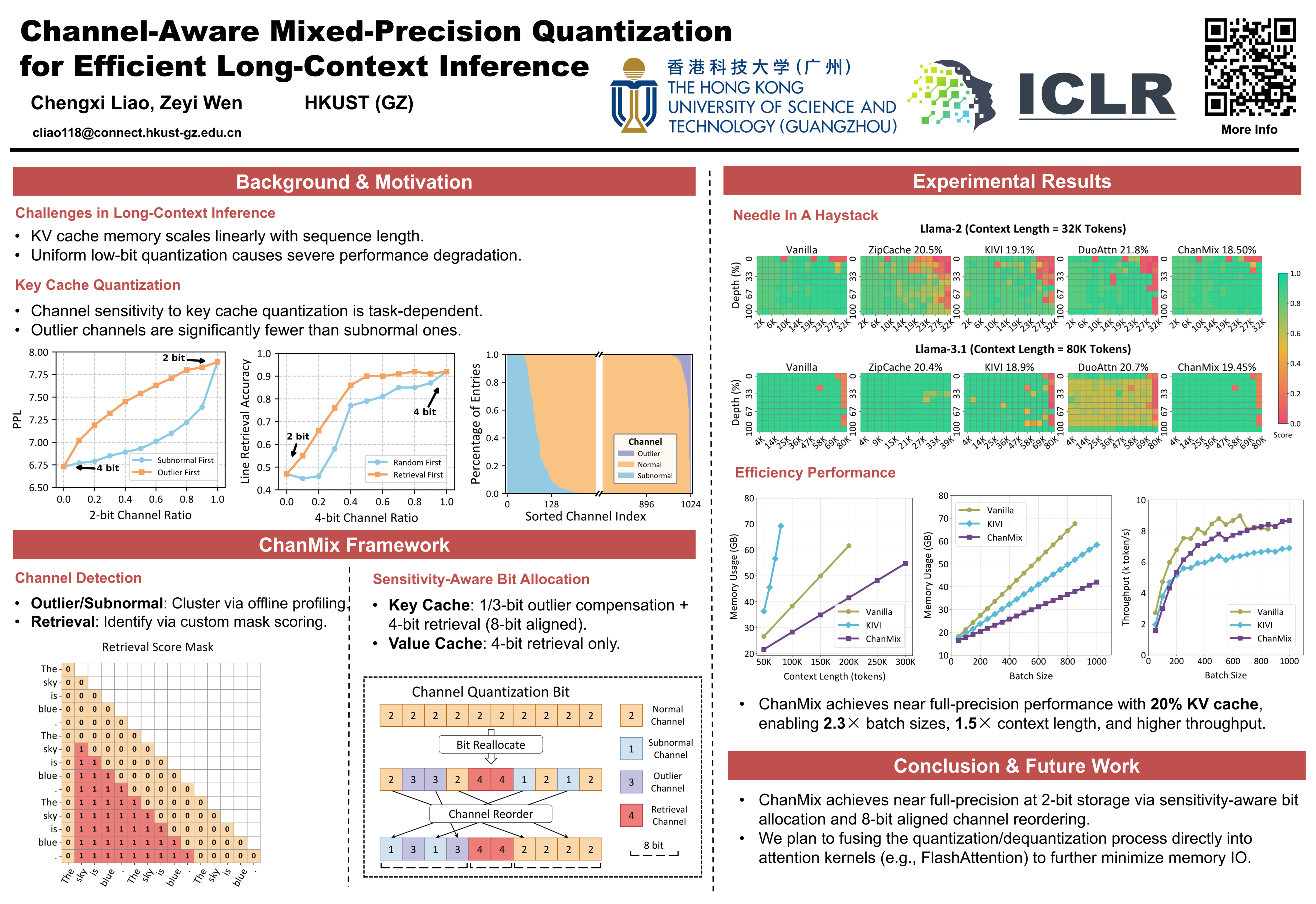
The key-value (KV) cache plays a vital role in accelerating autoregressive inference for large language models (LLMs). However, its linear memory growth with sequence length poses significant memory bottlenecks, especially in long-context scenarios. Quantization offers a promising solution for memory efficiency. While existing methods typically apply channel-wise quantization to the key cache and token-wise quantization to the value cache, they suffer from severe performance degradation under low-bit configurations. Our analysis reveals that quantization sensitivity varies across individual KV channels, presenting an opportunity for non-uniform bit allocation. Following this finding, we propose ChanMix, a mixed-precision quantization framework that supports channel-wise quantization on 2-bit setting with custom Triton kernels implementation. To improve low-bit quantization performance, we introduce a channel-aware bit reallocation strategy, which allocates bits across channel sensitivity. Through extensive evaluation, ChanMix demonstrates superior performance across the NIAH, RULER, and InfiniteBench benchmarks for the Llama, Mistral, and Qwen model families, achieving improvements of at least 5 absolute percentage points on RULER compared to all baseline methods. Additionally, ChanMix enables a 2.3× increase in batch size and supports a 1.5× longer context length during inference. Our code is available at https://github.com/cxiliao/ChanMix.
Expert Heads: Robust Evidence Identification for Large Language Models
Qi Wu ⋅ Jianfeng Qu ⋅ Ximing Li ⋅ Zhixu Li
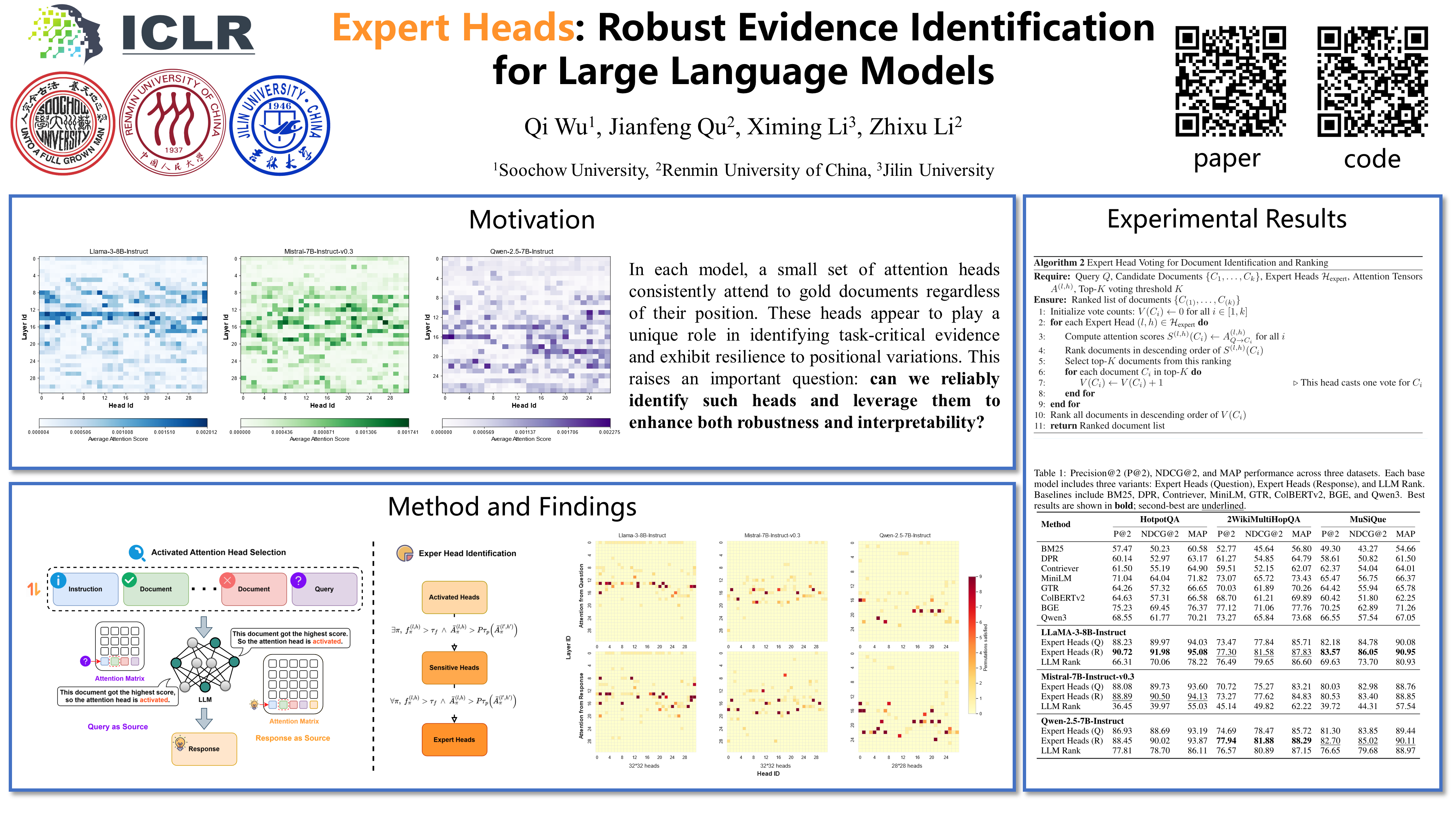
Large language models (LLMs) exhibit strong abilities in multi-document reasoning, yet their evidence identification is highly sensitive to input order. We trace this limitation to attention mechanisms, where many heads overemphasize sequence boundaries and neglect central content. We systematically analyze attention distributions under document permutations and discover a small subset of heads that consistently prioritize task-relevant documents regardless of position. We formalize these as Expert Heads, identified via activation frequency and stability across permutations. Experiments on LLaMA, Mistral, and Qwen reveal architecture-specific patterns: mid-layer heads in LLaMA and Mistral dominate semantic integration, while deeper-layer heads in Qwen specialize in evidence selection. Moreover, Expert Heads exhibit concentrated focus during understanding and more distributed engagement during generation. Their activation strongly correlates with answer correctness, providing diagnostic signals for hallucination detection. Leveraging Expert Heads for document voting significantly improves retrieval and ranking on HotpotQA, 2WikiMultiHopQA, and MuSiQue, outperforming dense retrievers and LLM-based ranking with minimal overhead. Ablations confirm that even a small subset achieves robust gains. Our findings establish Expert Heads as a stable and interpretable mechanism for evidence integration, offering new directions for context pruning, hallucination mitigation, and head-guided training of LLMs.
ProxyAttn: Guided Sparse Attention via Representative Heads
Yixuan Wang ⋅ Huang He ⋅ Siqi Bao ⋅ hua wu ⋅ Haifeng Wang ⋅ Qingfu Zhu ⋅ Wanxiang Che
The quadratic complexity of attention mechanisms limits the efficiency of Large Language Models (LLMs) on long-text tasks. Recently, methods that dynamically estimate block importance have enabled efficient block sparse attention, leading to significant acceleration in long-text pre-filling of LLMs. However, their block-level coarse-grained estimation inevitably leads to performance degradation at high sparsity ratios. In this work, we propose ProxyAttn, a training-free sparse attention algorithm that achieves token-level estimation by compressing the dimension of attention heads. Based on our observation of the similarity among multiple attention heads in long texts, we use the attention scores of pooled representative heads to approximate the scores for all heads. To account for the varying sparsity among heads, we also propose a block-aware dynamic budget estimation method. By combining the scores from a set of representative heads with a multi-head dynamic budget, we can achieve a more fine-grained block attention evaluation at a low computational cost. Experiments on a variety of mainstream models and extensive benchmarks confirm the underlying similarity among attention heads in long texts. Leveraging a token-level fine-grained estimation, the proposed method achieves substantial gains in performance and efficiency compared to existing methods. More precisely, ProxyAttn can achieve up to 10.3x attention acceleration and 2.4x prefilling acceleration without significant performance loss. Our code is available at https://github.com/wyxstriker/ProxyAttn.
RESA: Bringing Back What Sparse Attention Ignores with Residual Estimation
Weihao Yang ⋅ Hao Huang ⋅ Ningke Li ⋅ Shihao Wang ⋅ Darong Yang ⋅ Yanqi Pan ⋅ Wen Xia ⋅ Shiyi Li ⋅ Xiangyu Zou
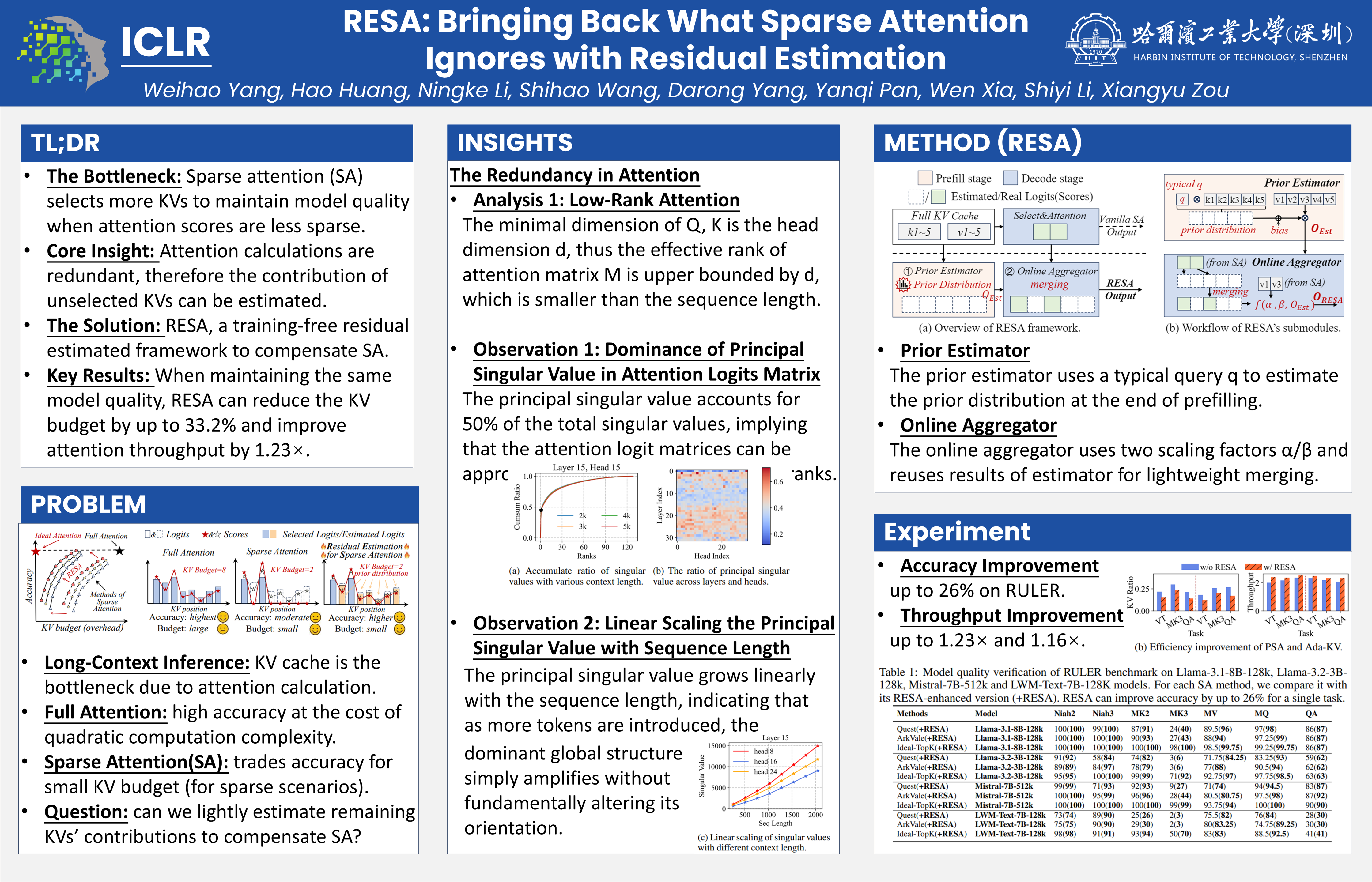
Large Language Models (LLM) have gained significant attention. KV cache, stored to avoid quadratic complexity of attention, becomes a bottleneck due to the demands for long-context. Sparse attention (SA) has been proposed to address this by only selecting critical KVs for attention, which may degrade model quality in less sparse scenarios. To improve quality, rather than selecting more KVs, this paper reveals another perspective by estimating the contributions of remaining KVs, called Residual Estimation. We find that attention logits (before softmax) exhibit substantial redundancy due to its inherent low-rank nature. We perform Singular Value Decomposition (SVD) on logits matrix in prefilling and find the spectral dominance of principal singular value and its linearly scaling property with sequence length. These imply that increasing sequence length leads to replication-like logits growth with significant redundancy. However, it is impossible to perform SVD at each decoding step in practice due to its heavy costs. To this end, we propose RESA, a training-free framework compensating SA's output with an estimated low-rank prior of logits. RESA introduces (i) a Prior Estimator that derives a prior distribution from a typical query as a rank-1 approximation at the end of prefilling, and (ii) an Online Aggregator that fuses the prior with SA at each decoding step via lightweight scaling and merging. Besides, we further show that RESA's effect comes from priors being used as attention bias for knowledge injection. Extensive experiments show that without extra overheads, RESA improves model quality by up to 26\% across various tasks with the same KV budget compared to state-of-the-art. Moreover, RESA maintains the same quality with up to 33.2\% KV budget reduction and 1.23$\times$ attention throughput improvement.
Training-Free Loosely Speculative Decoding: Accepting Semantically Correct Drafts Beyond Exact Match
Jinze Li ⋅ Yixing Xu ⋅ Guanchen Li ⋅ Shuo Yang ⋅ Jinfeng Xu ⋅ Xuanwu Yin ⋅ Dong Li ⋅ Edith Ngai ⋅ Emad Barsoum
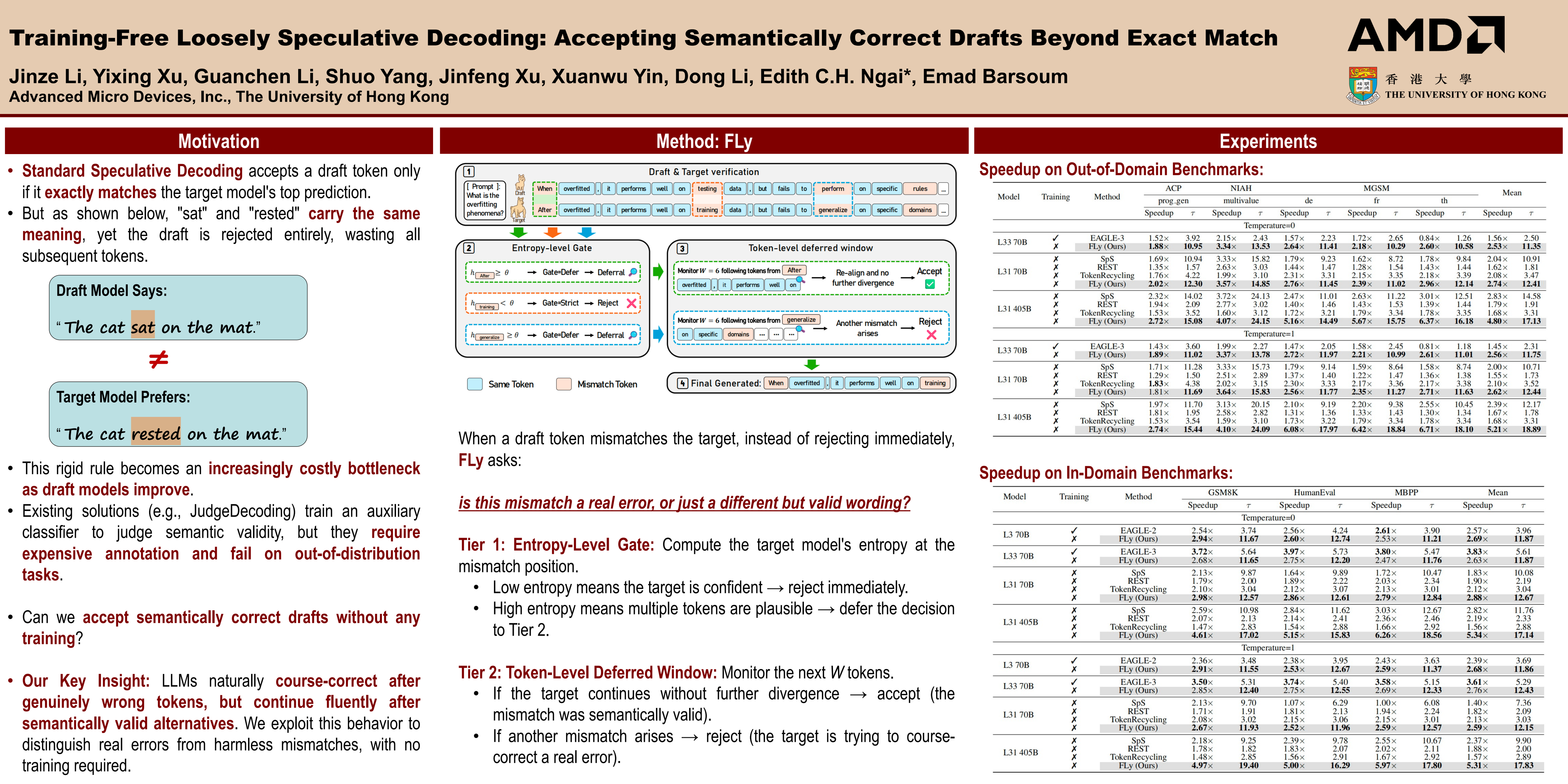
Large language models (LLMs) achieve strong performance across diverse tasks but suffer from high inference latency due to their autoregressive generation. Speculative Decoding (SPD) mitigates this issue by verifying candidate tokens from a smaller draft model in parallel, yet its strict exact-match verification discards many semantically valid continuations. We propose Training-Free Loosely Speculative Decoding (FLy), a novel method that loosens the rigid verification criterion by leveraging the target model’s own corrective behavior to judge whether a draft–target mismatch remains semantically valid. FLy introduces a two-tier mechanism: an entropy-level gate that identifies whether the current token allows multiple plausible alternatives or is nearly deterministic, and a token-level deferred window that distinguishes genuine errors from differently worded yet semantically correct variants. To further reduce latency, we design a multi-level acceleration strategy that accelerates not only the target model but also the drafter itself. Owing to its training-free design, FLy composes seamlessly with arbitrary draft–target pairs and generalizes across models and domains without hyperparameter re-tuning. Experiments show that FLy preserves $\geq$99\% of the target model’s accuracy while achieving an average 2.81$\times$ speedup on Llama-3.1-70B-Instruct and 5.07$\times$ speedup on the 405B variant. Notably, on out-of-domain datasets, our method remains highly effective and outperforms the training-based method EAGLE-3 by 1.62$\times$. Our code is available at https://github.com/AMD-AGI/FLy.
LycheeDecode: Accelerating Long-Context LLM Inference via Hybrid-Head Sparse Decoding
Gang Lin ⋅ dongfang li ⋅ Zhuoen Chen ⋅ Yukun Shi ⋅ Xuhui Chen ⋅ Baotian Hu ⋅ Min Zhang
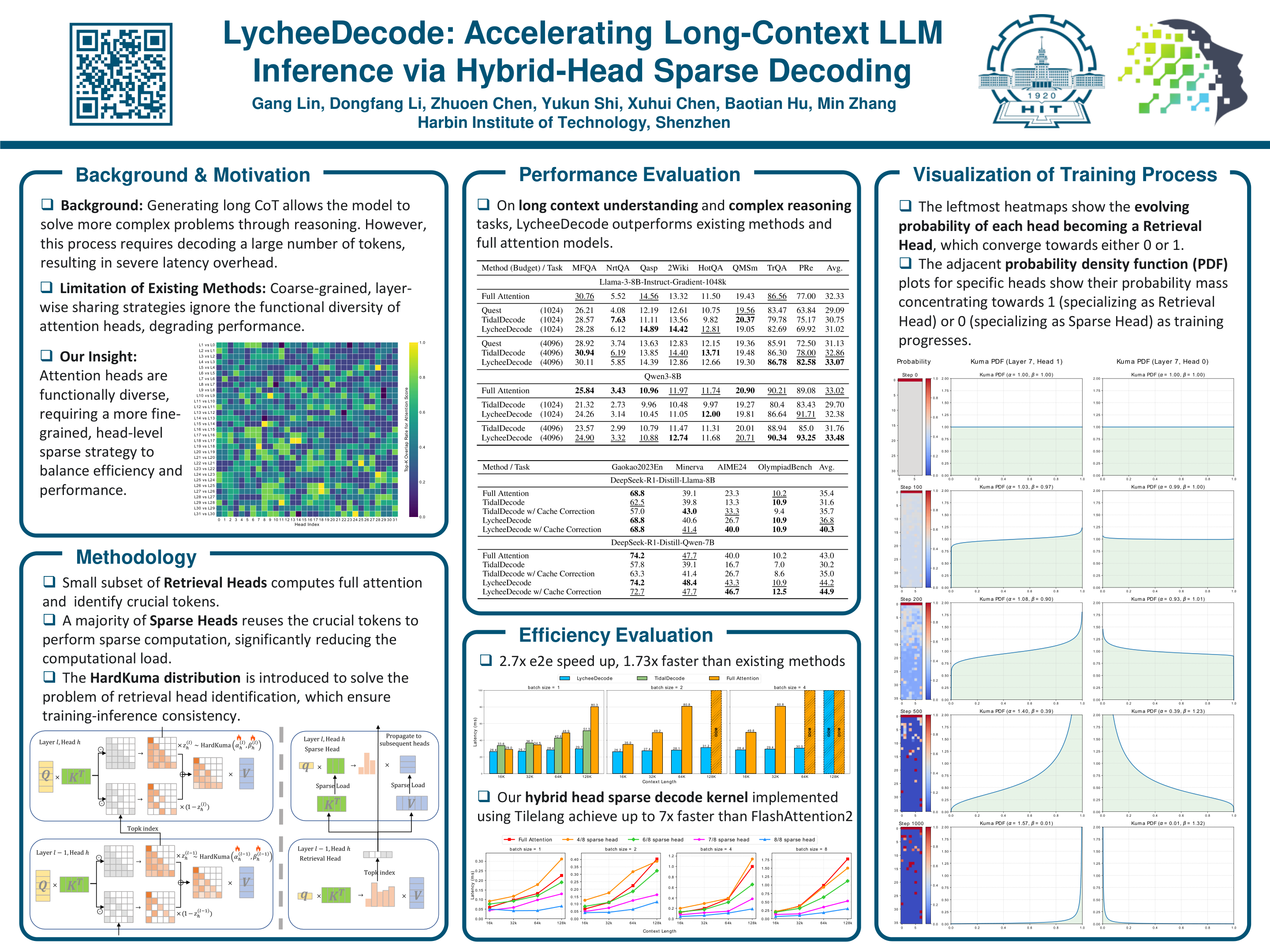
The proliferation of long-context large language models (LLMs) exposes a key bottleneck: the rapidly expanding key-value cache during decoding, which imposes heavy memory and latency costs. While recent approaches attempt to alleviate this by sharing a single set of crucial tokens across layers, such coarse-grained sharing undermines model performance by neglecting the functional diversity of attention heads. To address this, we propose LycheeDecode, an efficient decoding method centered on a fine-grained hybrid-head attention mechanism that employs a hardware-efficient top-$k$ selection strategy. Specifically, the novel HardKuma-based mechanism partitions attention heads into a small subset of retrieval heads that dynamically identify crucial tokens and a majority of sparse heads that reuse them for efficient computation. Through extensive experiments on leading models like Llama3 and Qwen3 across diverse benchmarks for long-context understanding (e.g., LongBench, RULER) and complex reasoning (e.g., AIME24, OlympiadBench), we demonstrate that LycheeDecode achieves generative quality comparable to, and at times surpassing even the full-attention baseline. Crucially, this is accomplished with up to a 2.7x speedup at a 128K context length. By preserving the functional diversity of attention heads, our fine-grained strategy overcomes the performance bottlenecks of existing methods, providing a powerful and validated pathway to both efficient and high-quality long-context LLM inference. The implementation code, kernels, and models will be publicly available.
PrefixMemory-Tuning: Modernizing Prefix-Tuning by Decoupling the Prefix from Attention
Haonan Wang ⋅ Brian Chen ⋅ Siquan Li ⋅ Liang Xinhe ⋅ Hwee Lee ⋅ Kenji Kawaguchi ⋅ Tianyang Hu
Parameter-Efficient Fine-Tuning (PEFT) methods have become crucial for rapidly adapting large language models (LLMs) to downstream tasks. Prefix-Tuning, an early and effective PEFT technique, demonstrated the ability to achieve performance comparable to full fine-tuning with significantly reduced computational and memory overhead. However, despite its earlier success, its effectiveness in training modern state-of-the-art LLMs has been very limited. In this work, we demonstrate empirically that Prefix-Tuning underperforms on LLMs because of an inherent tradeoff between the contribution of input prompt and parameterized prefix within the attention head. This motivates us to introduce PrefixMemory-Tuning, an architecture that generalizes the principles of Prefix-Tuning while addressing its shortcomings by shifting the prefix module out of the attention head itself and improving its expressiveness. Our experiments show that, across diverse benchmarks, PrefixMemory-Tuning consistently outperforms existing Prefix-Tuning methods. Notably, it achieves competitive performance with modern PEFTs on several general benchmarks, highlighting a potential extension of Prefix-Tuning approaches to become state-of-the-art. Our findings suggest that by overcoming its inherent limitations, Prefix-Tuning can remain a competitive and relevant research direction in the landscape of parameter-efficient LLM adaptation.
Attention Is All You Need for KV Cache in Diffusion LLMs
Quan Nguyen-Tri ⋅ Mukul Ranjan ⋅ Zhiqiang Shen
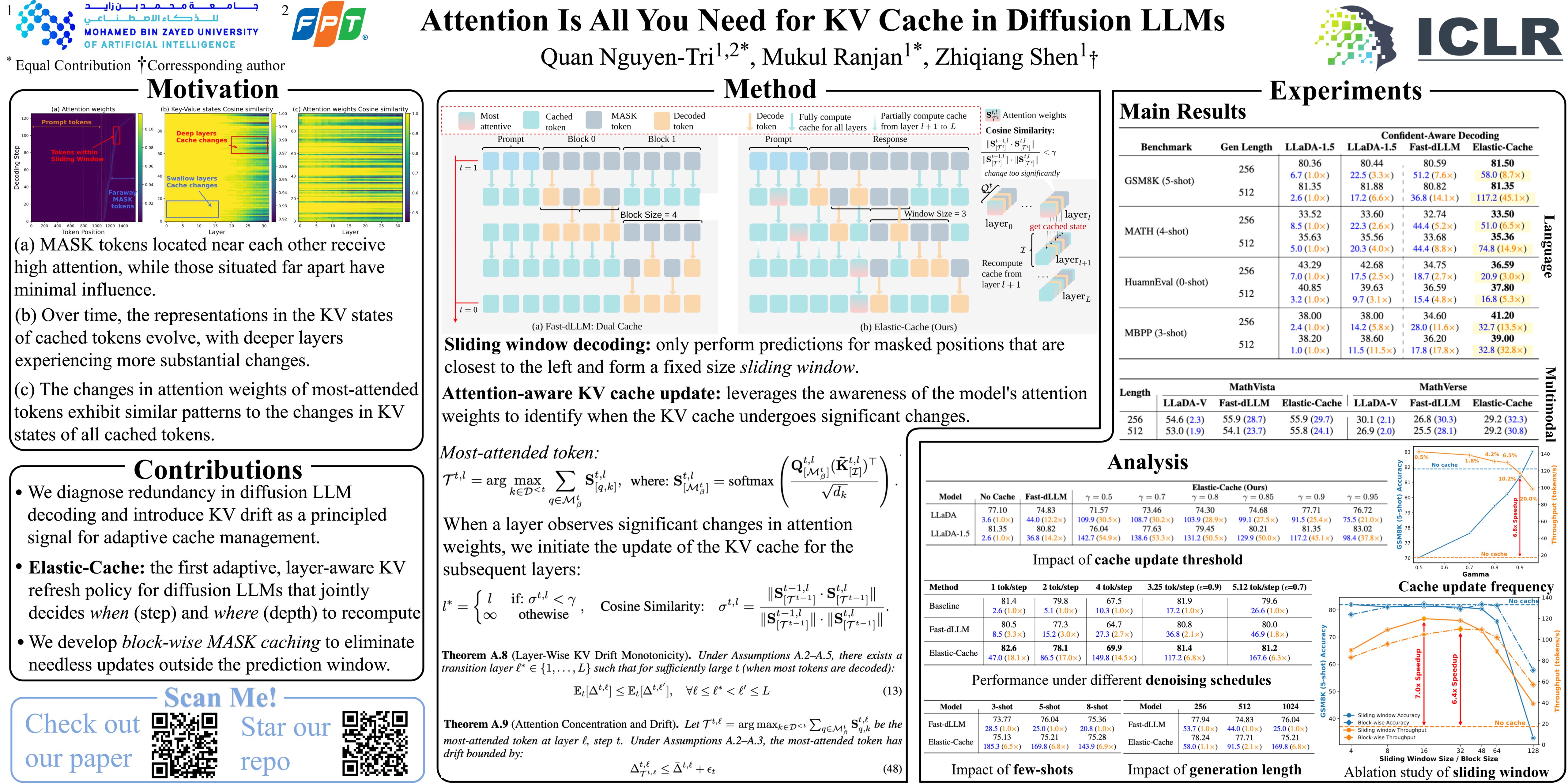
This work studies how to adaptively recompute key–value (KV) caches for diffusion large language models (DLMs) to maximize prediction accuracy while minimizing decoding latency. Prior methods' decoders recompute QKV for all tokens at every denoising step and layer, despite KV states changing little across most steps, especially in shallow layers, leading to substantial redundancy. We make three observations: (1) distant MASK tokens primarily act as a length-bias and can be cached block-wise beyond the active prediction window; (2) KV dynamics increase with depth, suggesting that selective refresh starting from deeper layers is sufficient; and (3) the most-attended token exhibits the smallest KV drift, providing a conservative lower bound on cache change for other tokens. Building on these, we propose Elastic-Cache, a training-free, architecture-agnostic strategy that jointly decides ${when}$ to refresh (via an attention-aware drift test on the most-attended token) and ${where}$ to refresh (via a depth-aware schedule that recomputes from a chosen layer onward while reusing shallow-layer caches and off-window MASK caches). Unlike fixed-period schemes, Elastic-Cache performs adaptive, layer-aware cache updates for diffusion LLMs, reducing redundant computation and accelerating decoding with negligible loss in generation quality. Experiments on LLaDA-Instruct, LLaDA-1.5, and LLaDA-V across mathematical reasoning and code generation tasks demonstrate consistent speedups: $8.7\times$ on GSM8K (256 tokens), $45.1\times$ on longer sequences, and $4.8\times$ on HumanEval, while consistently maintaining higher accuracy than the baseline. Our method achieves significantly higher throughput ($6.8\times$ on GSM8K) than existing confidence-based approaches while preserving generation quality, enabling practical deployment of diffusion LLMs.
Loopholing Discrete Diffusion: Deterministic Bypass of the Sampling Wall
Mingyu Jo ⋅ Jaesik Yoon ⋅ Justin Deschenaux ⋅ Caglar Gulcehre ⋅ Sungjin Ahn
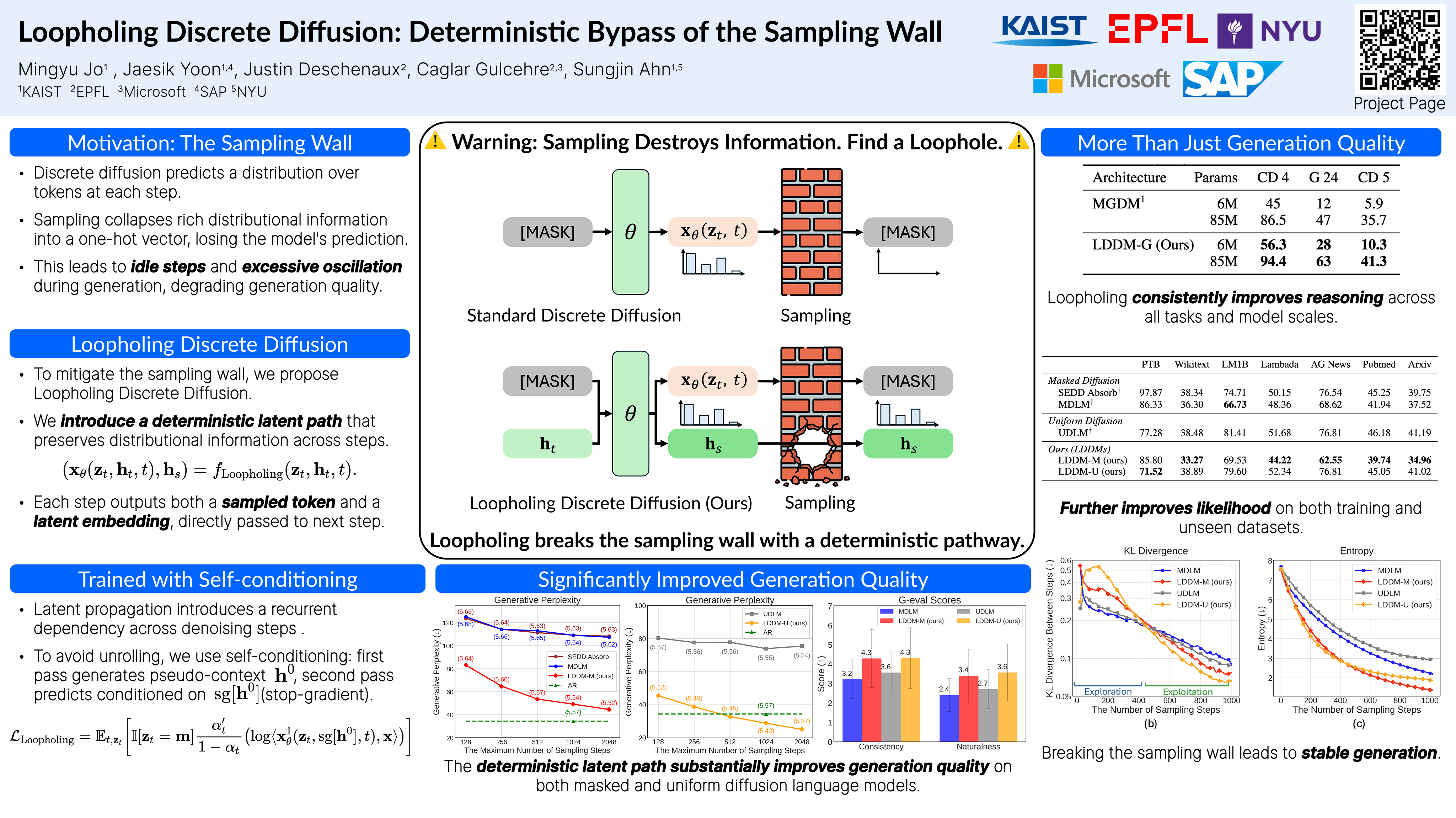
Discrete diffusion models offer a promising alternative to autoregressive generation through parallel decoding, but they suffer from a sampling wall: once categorical sampling occurs, rich distributional information collapses into one-hot vectors and cannot be propagated across steps, forcing subsequent steps to operate with limited information. To mitigate this problem, we introduce Loopholing, a novel and simple mechanism that preserves this information via a deterministic latent pathway, leading to Loopholing Discrete Diffusion Models (LDDMs). Trained efficiently with a self-conditioning strategy that avoids unrolling the full denoising trajectory, LDDMs achieve substantial gains—reducing generative perplexity by up to 61\% over prior baselines, thereby closing (and in some cases surpassing) the gap with autoregressive models, and producing more coherent text. Applied to reasoning tasks, LDDMs also improve performance on arithmetic benchmarks such as Countdown and Game of 24. These results also indicate that loopholing mitigates idle steps and oscillations, providing a general and effective path toward high-quality non-autoregressive text generation.
FS-DFM: Fast and Accurate Long Text Generation with Few-Step Diffusion Language Models
Amin Karimi Monsefi ⋅ Nikhil Bhendawade ⋅ Manuel Ciosici ⋅ Dominic Culver ⋅ Yizhe Zhang ⋅ Irina Belousova
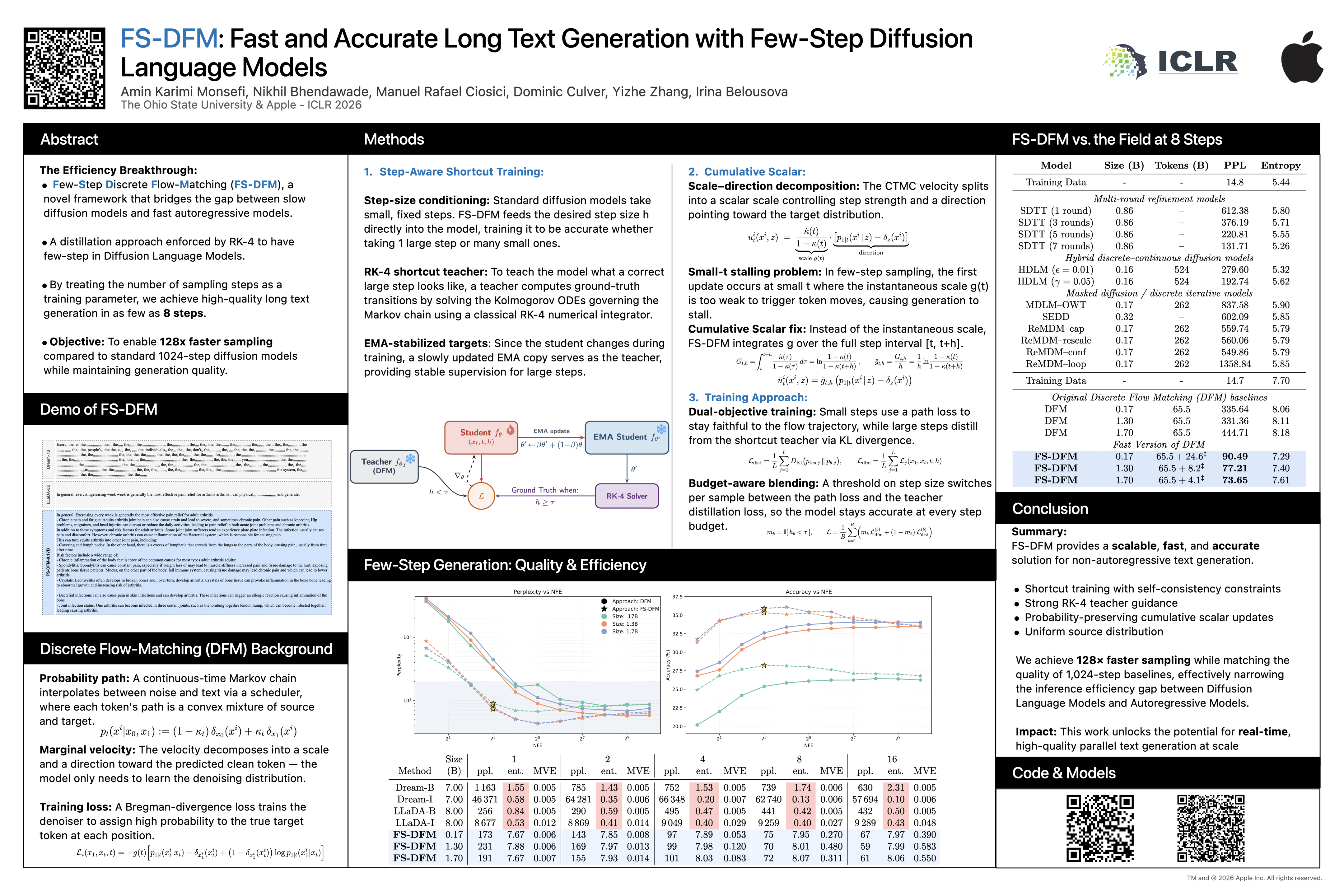
Autoregressive language models (ARMs) deliver strong likelihoods, but are inherently serial: they generate one token per forward pass, which limits throughput and inflates latency for long sequences. Diffusion Language Models (DLMs) parallelize across positions and thus appear promising for language generation, yet standard discrete diffusion typically needs hundreds to thousands of model evaluations to reach high quality, trading serial depth for iterative breadth. We introduce FS-DFM, Few-Step Discrete Flow-Matching. A discrete flow-matching model designed for speed without sacrificing quality. The core idea is simple: make the number of sampling steps an explicit parameter and train the model to be consistent across step budgets, so one big move lands where many small moves would. We pair this with a reliable update rule that moves probability in the right direction without overshooting, and with strong teacher guidance distilled from long-run trajectories. Together, these choices make few-step sampling stable, accurate, and easy to control. On language modeling benchmarks, FS-DFM with 8 sampling steps achieves perplexity parity with a 1\,024-step discrete-flow baseline for generating 1\,024 tokens using a similar-size model, delivering up to 128× faster sampling and corresponding latency/throughput gains.
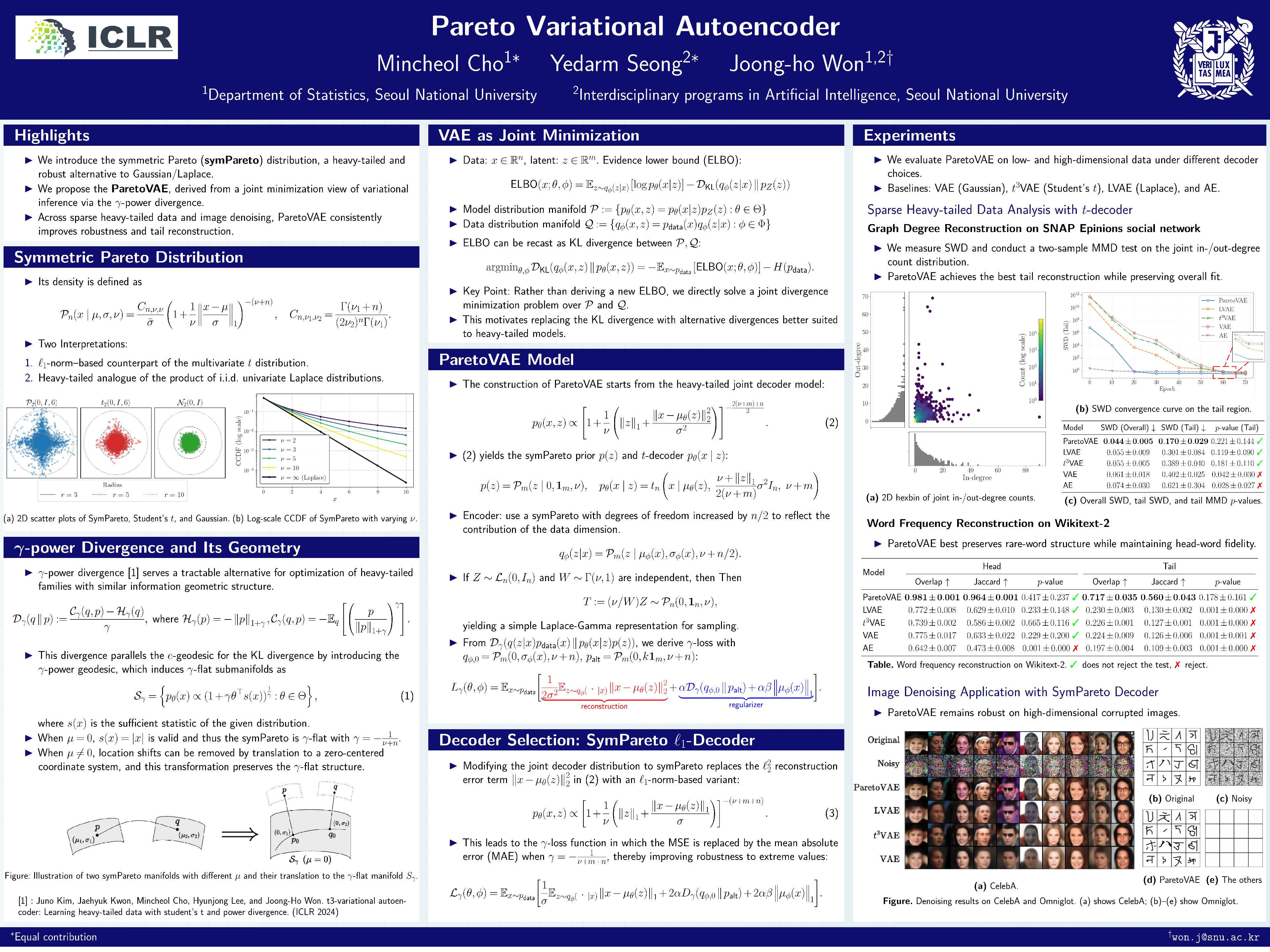
This paper introduces a new class of multivariate power-law distributions---the symmetric Pareto (symPareto) distribution---which can be viewed as an $\ell_1$-norm-based counterpart of the multivariate $t$ distribution, with the motivation of capturing the heavy tail of the target distribution in generative modeling and bringing robustness to noise in downstream tasks such as image denoising. The symPareto distribution possesses many attractive information-geometric properties with respect to the $\gamma$-power divergence that %naturally %\red{characterizes the geometric structures of power-law families.} is a natural alternative to the Kullback-Leibler divergence, the core of the conventional variational autoencoder (VAE) models, for power families. Leveraging on the joint minimization view of variational inference, this paper proposes the ParetoVAE, a probabilistic autoencoder that minimizes the $\gamma$-power divergence between two statistical manifolds. ParetoVAE employs the symPareto distribution for both prior and encoder, with flexible decoder options including multivariate $t$ and symPareto distributions. Empirical evidences demonstrate the effectiveness of ParetoVAE across multiple domains through varying the types of the decoder. The $t$ decoder achieves superior performance in sparse, heavy-tailed data reconstruction and word frequency analysis; the symPareto decoder enables robust high-dimensional denoising.
Self-Speculative Masked Diffusions
Andrew Campbell ⋅ Valentin De Bortoli ⋅ Jiaxin Shi ⋅ Arnaud Doucet
We present self-speculative masked diffusions, a new class of masked diffusion generative models for discrete data that require significantly fewer function evaluations to generate samples. Standard masked diffusion models predict factorized logits over currently masked positions. A number of masked positions are then sampled, however, the factorization approximation means that sampling too many positions in one go leads to poor sample quality. As a result, many simulation steps and therefore neural network function evaluations are required to generate high-quality data. We reduce the computational burden by generating \emph{non-factorized} predictions over masked positions. This is achieved by modifying the final transformer attention mask from non-causal to causal, enabling draft token generation and parallel validation via a novel, model-integrated speculative sampling mechanism. This results in a non-factorized predictive distribution over masked positions in a single forward pass. We apply our method to GPT2 scale text modelling and protein sequence generation, finding that we can achieve a ~2x reduction in the required number of network forward passes relative to standard masked diffusion models.
Information Estimation with Discrete Diffusion
Alberto Foresti ⋅ Giulio Franzese ⋅ Pietro Michiardi
Information-theoretic measures, such as Mutual Information (MI), play a crucial role in understanding non-linear relationships between random variables and are widely used across scientific disciplines. Yet, their use on real-world discrete data remains challenging. Existing methods typically rely on embedding discrete data into a continuous space and apply neural estimators originally designed for continuous distributions. This process requires careful engineering for both the embedding model and estimator architecture, but suffers from issues related to high data dimensionality. In this work, we introduce InfoSEDD, a discrete diffusion–based approach that bridges information-theoretic estimation and generative modeling such that they can be used to compute Kullback–Leibler divergences. Backed by Continuous Time Markov Chains theory principles, the design of InfoSEDD is lightweight and scalable and allows seamless integration with pretrained models. We showcase the versatility of our approach through applications on motif discovery in genetic promoter data, semantic-aware model selection in text summarization, and entropy estimation in Ising models. Finally, we construct consistency tests on real-world textual and genomics data. Our experiments demonstrate that InfoSEDD outperforms alternatives that rely on the ''embedding trick''. Our results position InfoSEDD as a robust and scalable tool for information-theoretic analysis of discrete data.
Planner Aware Path Learning in Diffusion Language Models Training
Zhangzhi Peng ⋅ Zachary Bezemek ⋅ Jarrid Rector-Brooks ⋅ Shuibai Zhang ⋅ Michael Bronstein ⋅ Anru Zhang ⋅ Joey Bose ⋅ Alexander Tong
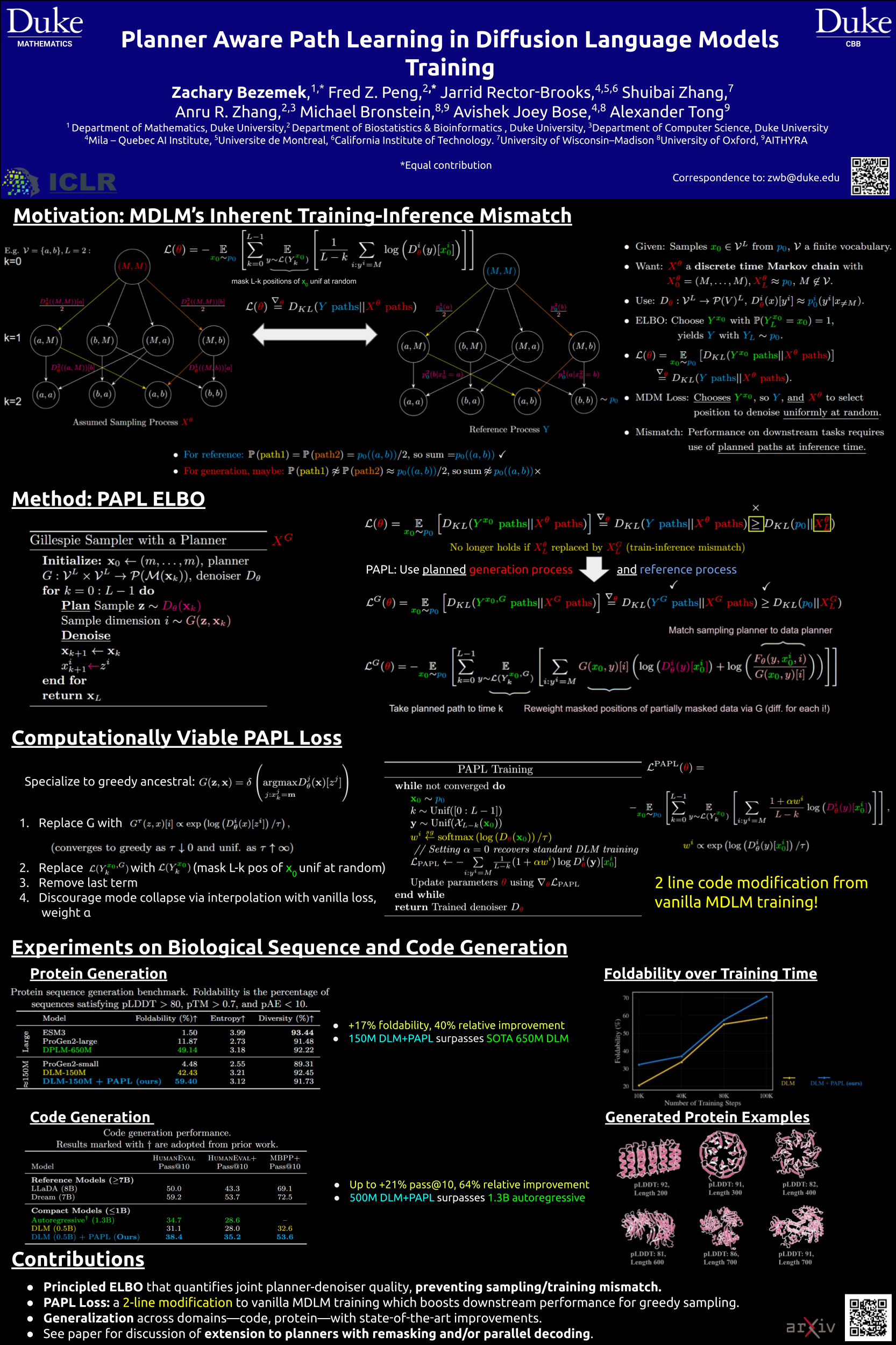
Diffusion language models have emerged as a powerful alternative to autoregressive models, enabling fast inference through more flexible and parallel generation paths. This flexibility of sampling is unlocked by new engineered sampling strategies, or *planners*, that select more favorable generation paths by iteratively planning---versus uniformly at random---where to denoise along the sequence. However, by modifying the reverse paths via planning, planners create an irrevocable mismatch between the uniformly random denoising paths during training and planning-based inference. In this paper, we systematically investigate the mismatch of discrete diffusion training and inference under planning and theoretically prove that the standard discrete diffusion training evidence lower bound (ELBO) does not accurately describe a denoiser that uses a non-uniform planner. To address this gap, we derive a new planned evidence lower bound (P-ELBO) that incorporates planner-based reverse dynamics directly into the training objective. Using the P-ELBO, we introduce *Planner Aware Path Learning* (PAPL), a novel training scheme that aligns training and inference under a planned denoiser. PAPL is implemented as a simple yet effective modification to the standard masked discrete diffusion loss, making it widely applicable and easy to adopt. Empirically, we show PAPL delivers consistent gains across domains, including a 40\% relative improvement in protein sequences, improved text generation with up to a $4\times$ relative MAUVE gain, and 23\% relative improvement in code generation HumanEval pass@10.
Improving Autoregressive Video Modeling with History Understanding
Wenyang Luo ⋅ Haina Qin ⋅ Bing Li ⋅ Jiwen Lu ⋅ Xin Tao ⋅ Pengfei Wan ⋅ Kun Gai
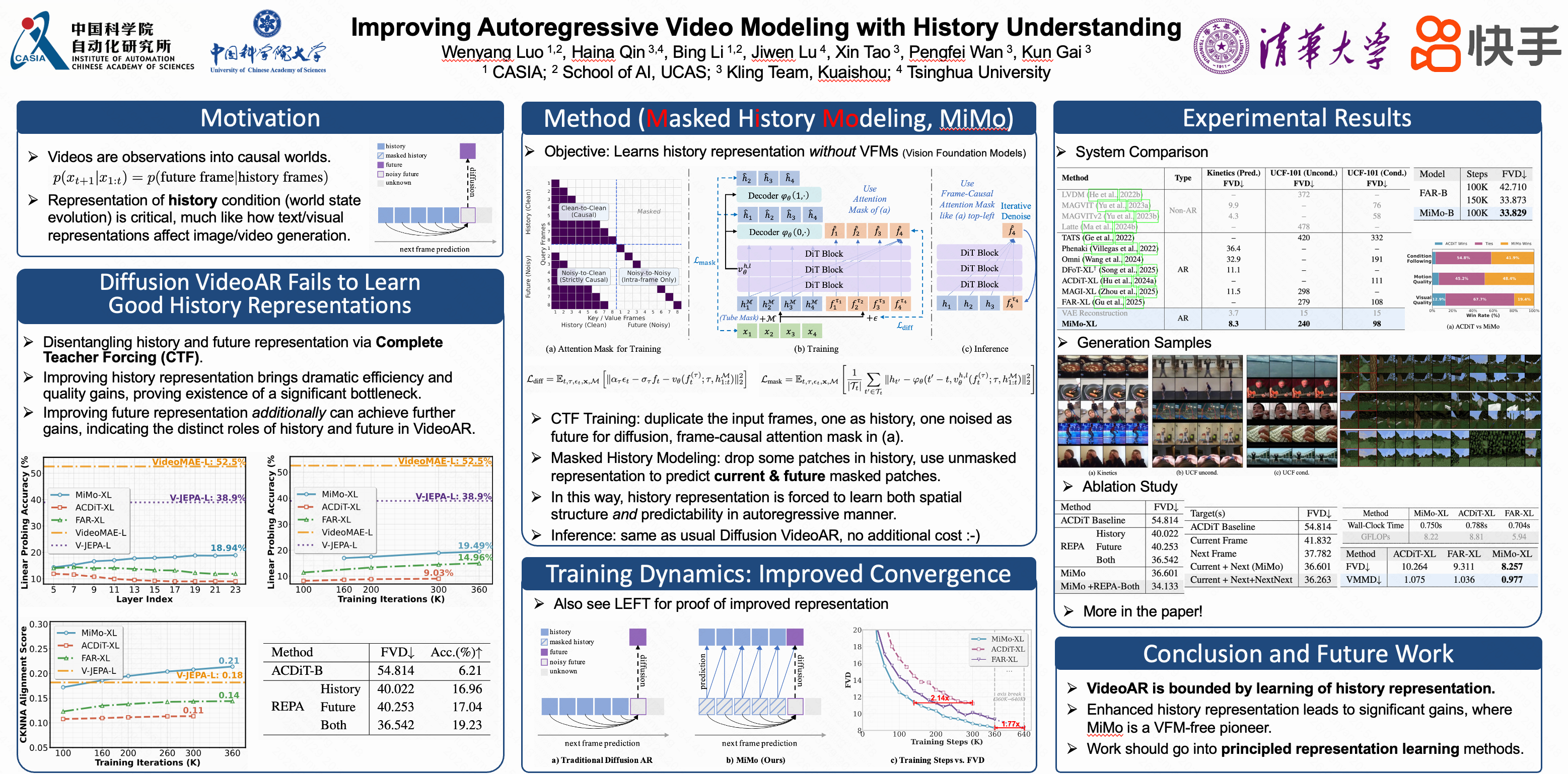
Video autoregressive generation (VideoAR) sequentially predicts future frames conditioned on history frames. Despite the advance of recent diffusion-based VideoAR, the role of conditioning signal—internal representations of history frames—remains underexplored. Inspired by the success of strong condition representations in text-conditioned generation, we investigate: \textit{Can better internal representations of history frames improve VideoAR performance?} Through systematic analysis, we show that history representation quality positively correlates with VideoAR, and that enhancing these representations provides gains that cannot be achieved by refining future frames representations alone. Based on these insights, we propose \textbf{MiMo} (Masked History Modeling), a novel framework that seamlessly integrates representation learning into diffusion-based VideoAR. MiMo applies masks to history frame tokens and trains the model to predict masked tokens of current and future frames alongside the diffusion objective, yielding predictive and robust history representations without relying on vision foundation models (VFMs) or heavy architectural changes. Extensive experiments demonstrate that MiMo achieves competitive performance in video prediction and generation tasks while substantially improving training efficiency. Our work underscores the importance of history representations in VideoAR.
ProtoKV: Long-context Knowledges Are Already Well-Organized Before Your Query
Zhiyuan Yu ⋅ Shijian Xiao ⋅ Zhangyue Yin ⋅ Xiaoran Liu ⋅ Lekai Xing ⋅ Wenzhong Li ⋅ Cam-Tu Nguyen ⋅ Sanglu Lu
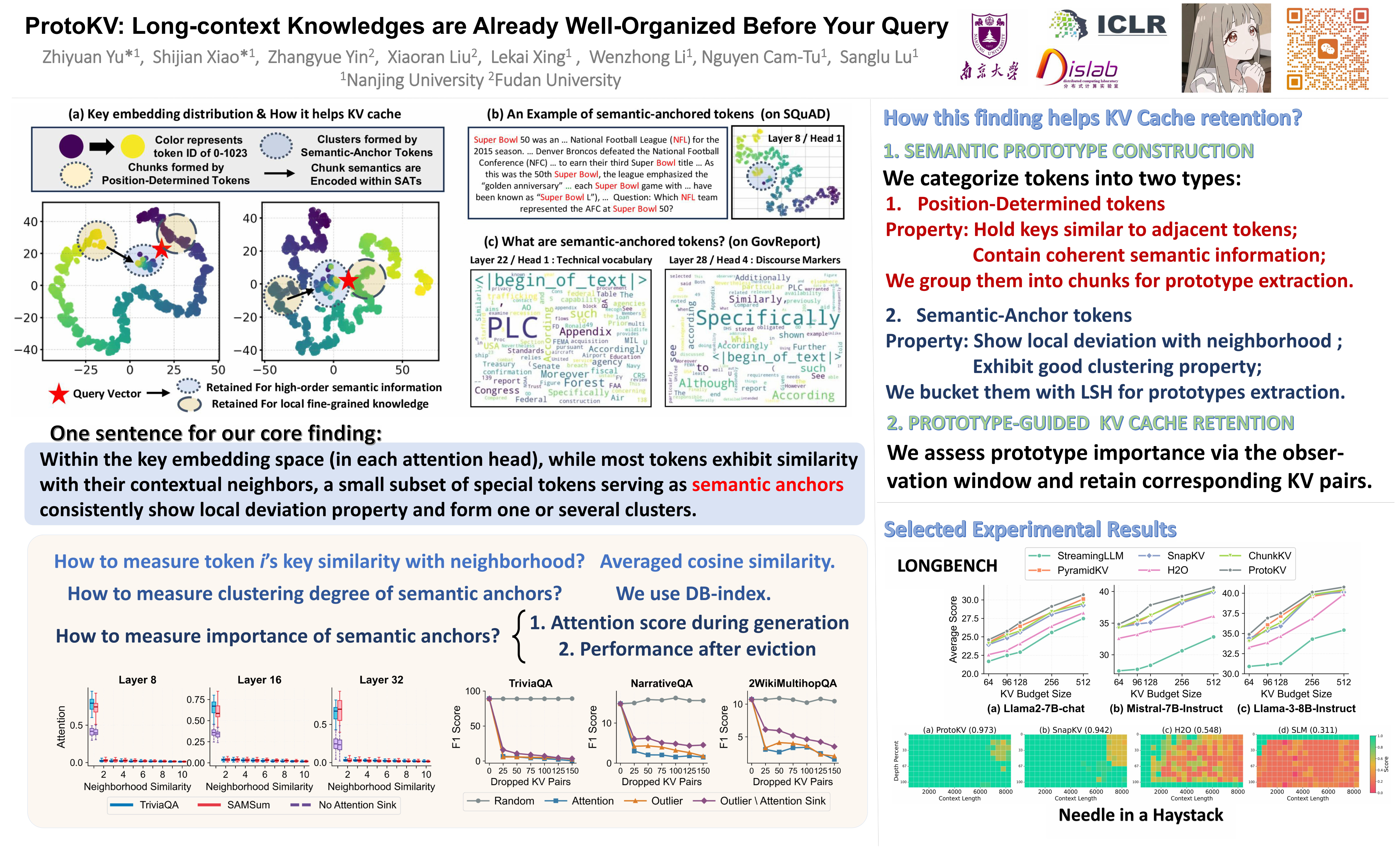
Modern Large Language Models (LLMs) face fundamental challenges in processing long text sequences due to the quadratic complexity of attention mechanisms. Key-Value (KV) cache retention strategies mitigate this issue by selectively preserving salient KV pairs for autoregressive generation. However, existing methods fail to adequately and efficiently preserve the semantic integrity of the compressed representations. In this paper, we discover a prevalent phenomenon in LLM: within the key embedding space, while most tokens exhibit similarity with their contextual neighbors (we term position-determined tokens), a small subset of special tokens serving as semantic anchors consistently show local deviation property and form one or several clusters (we term semantic-anchored tokens). Motivated by this observation, we propose ProtoKV that separately processes these two token categories for KV cache compression. Within this framework, we first construct semantic prototypes based on the inherent characteristics of the two token categories, and subsequently form clusters of semantically similar tokens as basic compression units. This approach preserves semantic integrity with high computational efficiency. Experiments on LongBench demonstrate that ProtoKV achieves 2.11% higher accuracy than state-of-the-art methods under matched memory constraints.
Catalog-Native LLM: Speaking Item-ID dialect with Less Entanglement for Recommendation
Reza Shirkavand ⋅ Xiaokai Wei ⋅ Chen Wang ⋅ Zheng Hui ⋅ Heng Huang ⋅ Michelle Gong
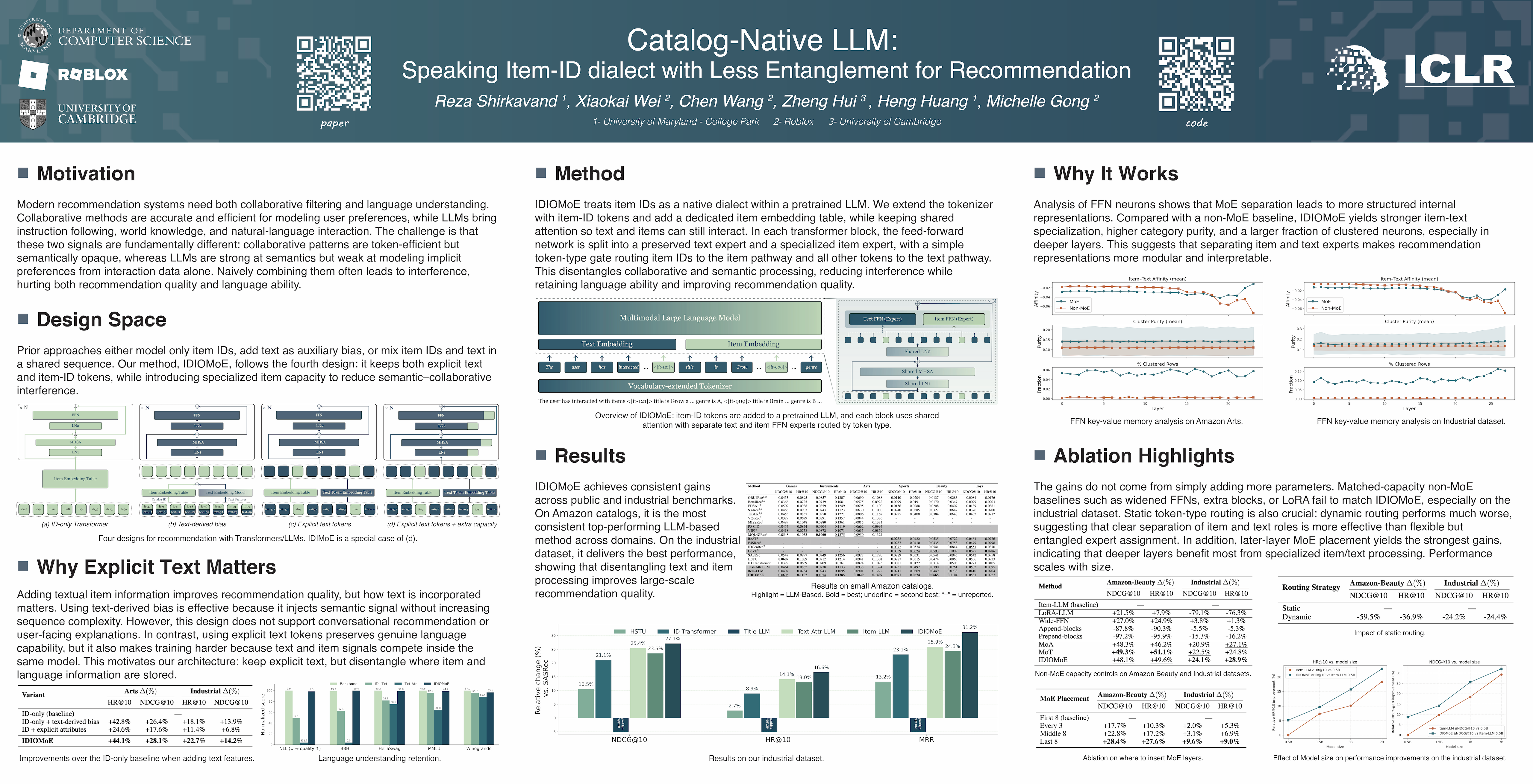
While collaborative filtering delivers predictive accuracy and efficiency, and Large Language Models (LLMs) enable expressive and generalizable reasoning, modern recommendation systems must bring these strengths together. Growing user expectations, such as natural-language queries and transparent explanations, further highlight the need for a unified approach. However, doing so is nontrivial. Collaborative signals are often token-efficient but semantically opaque, while LLMs are semantically rich but struggle to model implicit user preferences when trained only on textual inputs. This paper introduces Item-ID + Natural-language Mixture-of-Experts Language Model (IDIOMoE), which treats item interaction histories as a native dialect within the language space, enabling collaborative signals to be understood in the same way as natural language. By splitting the Feed Forward Network of each block of a pretrained LLM into a separate text expert and an item expert with token-type gating, our method avoids destructive interference between text and catalog modalities. IDIOMoE demonstrates strong recommendation performance across both public and proprietary datasets, while preserving the text understanding of the pretrained model.
Robust Multi-Objective Controlled Decoding of Large Language Models
Seongho Son ⋅ William Bankes ⋅ Sangwoong Yoon ⋅ Shyam Sundhar Ramesh ⋅ Xiaohang Tang ⋅ Ilija Bogunovic
We introduce Robust Multi-Objective Decoding (RMOD), a novel inference-time algorithm that robustly aligns Large Language Models (LLMs) to multiple human objectives (e.g., instruction-following, helpfulness, safety) by maximizing the worst-case rewards. RMOD formulates the robust decoding problem as a maximin two-player game between adversarially computed reward weights and the sampling policy, solvable through a Nash equilibrium. We demonstrate that this game reduces to a convex optimization problem to identify the worst-case reward weights, with the optimal sampling policy analytically derived. For practical applications, we propose an efficient algorithm of RMOD tailored for contemporary LLMs, introducing minimal computational overhead compared to standard non-robust Controlled Decoding methods. Experimental results across a range of popular alignment datasets with up to 10 objectives show the effectiveness of RMOD and its distilled version, consistently outperforming baselines in worst-case rewards and win rates.
Self-Speculative Decoding Accelerates Lossless Inference in Any-Order and Any-Subset Autoregressive Models
Gabe Guo ⋅ Stefano Ermon
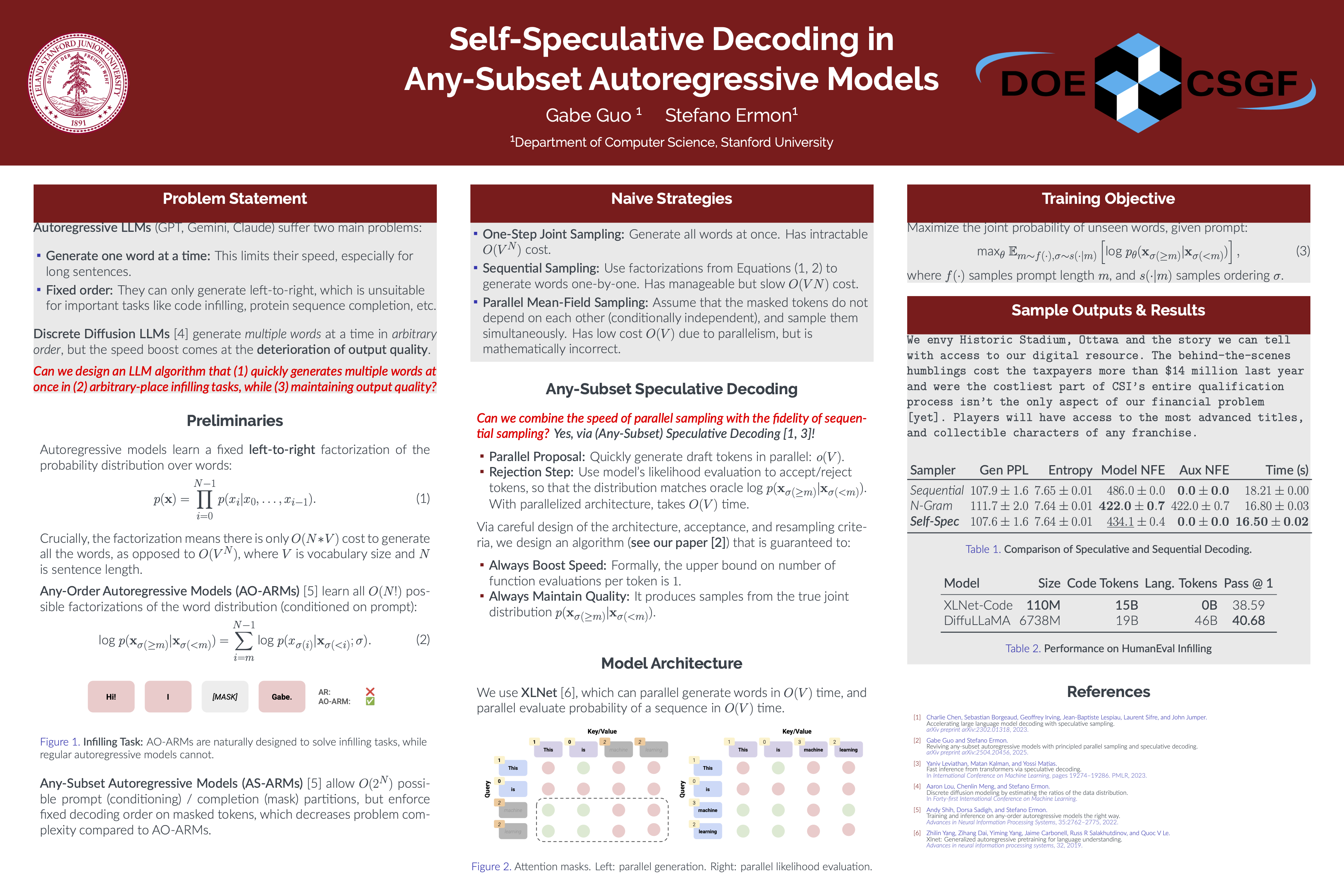
In arbitrary-order language models, it is an open question how to sample tokens in parallel from the correct joint distribution. With discrete diffusion models, the more tokens they generate in parallel, the less their predicted distributions adhere to the originally learned data distribution, as they rely on a conditional independence assumption that only works with infinitesimally small timesteps. We find that a different class of models, any-subset autoregressive models (AS-ARMs), holds the solution. As implied by the name, AS-ARMs can generate tokens in any order, and in parallel. Moreover, AS-ARMs support parallelized joint probability density estimation, allowing them to correct their own parallel-generated token distributions, via our Any-Subset Speculative Decoding (ASSD) algorithm. ASSD provably enables generation of tokens from the correct joint distribution, with the number of neural network calls upper bounded by the number of tokens predicted – notably, previous speculative decoding algorithms lack our efficiency guarantee. We empirically verify that ASSD speeds up language generation, without sacrificing quality. Furthermore, we provide a mathematically justified scheme for training AS-ARMs for generation, and show that AS-ARMs achieve state-of-the-art performance among sub-200M parameter models on infilling benchmark tasks, and nearly match the performance of models 50X larger on code generation. Our theoretical and empirical results indicate that the once-forgotten AS-ARMs are a promising direction of language modeling.
Diffusion Language Model Knows the Answer Before It Decodes
Pengxiang Li ⋅ Yefan Zhou ⋅ Dilxat Muhtar ⋅ Lu Yin ⋅ Shilin Yan ⋅ Li Shen ⋅ Yi Liang ⋅ Soroush Vosoughi ⋅ Shiwei Liu
Diffusion language models (DLMs) have recently emerged as an alternative to autoregressive approaches, offering parallel sequence generation and flexible token orders. However, their inference remains slower than that of autoregressive models, primarily due to the cost of bidirectional attention and the large number of refinement steps required for high-quality outputs. In this work, we highlight and leverage an overlooked property of DLMs—**early answer convergence**: in many cases, the correct answer can be internally identified by half steps before the final decoding step, under both semi-autoregressive and random remasking schedules. For example, on GSM8K and MMLU, up to 97\% and 99\% of instances, respectively, can be decoded correctly using only half of the refinement steps. Building on this observation, we introduce **Prophet**, a training-free fast decoding paradigm that enables **early commit decoding**. Specifically, Prophet dynamically decides whether to continue refinement or to go "all-in" (i.e. decode all remaining tokens in one step), using the confidence gap between the top-2 prediction candidates as the criterion. It integrates seamlessly into existing DLM implementations, incurs negligible overhead, and requires no additional training. Empirical evaluations on LLaDA-8B and Dream-7B across multiple tasks show that Prophet reduces the number of decoding steps by up to 3.4$\times$ while preserving high generation quality, and yields additional speedups when combined with existing acceleration methods. These results recast DLM decoding as a problem of *when to stop sampling*, and demonstrate that early answer convergence provides a simple yet powerful mechanism for accelerating DLMs on reasoning, code, and planning tasks with identifiable answer regions. Our code is available at \url{https://github.com/pixeli99/Prophet}.
Discovering Novel LLM Experts via Task-Capability Coevolution
Andrew Dai ⋅ Boris Meinardus ⋅ Ciaran Regan ⋅ Yingtao Tian ⋅ Yujin Tang
Frontier model developers aim to train models continually to possess emergent, diverse capabilities. To extend capabilities, the current pre-training and post-training paradigm requires manually starting training runs with static datasets or reward functions every time. Addressing this limitation, our work pursues the insight that open-endedness (via the coevolution of models and tasks) can discover models with increasingly novel skills in a single run. We introduce a new model development framework that extends coevolution to large language model (LLM) discovery, open-ended \textit{Assessment Coevolving with Diverse Capabilities} (AC/DC). AC/DC evolves both LLMs via model merging and natural language tasks via synthetic data generation. AC/DC discovers growing archives of LLMs that surpass the capabilities of larger LLMs while taking up less GPU memory. In particular, our LLM populations achieve a broader Coverage of expertise than other curated models or baselines on downstream benchmarks, without \textit{any} explicit benchmark optimization. Furthermore, AC/DC improves Coverage over time, continually innovates on tasks and models, and improves performance in multi-agent best-of-N selection. Our findings highlight the potential of coevolution as a means of discovering broader sets of capabilities from base LLMs. Overall, AC/DC brings us one step closer to a profoundly new paradigm of LLM development, where continual improvements to the diversity of model capabilities can be accelerated by leveraging existing models as stepping stones to increasingly powerful models.
Rainbow Padding: Mitigating Early Termination in Instruction-Tuned Diffusion LLMs
BumJun Kim ⋅ Dongjae Jeon ⋅ Dueun Kim ⋅ Wonje Jeung ⋅ Albert No
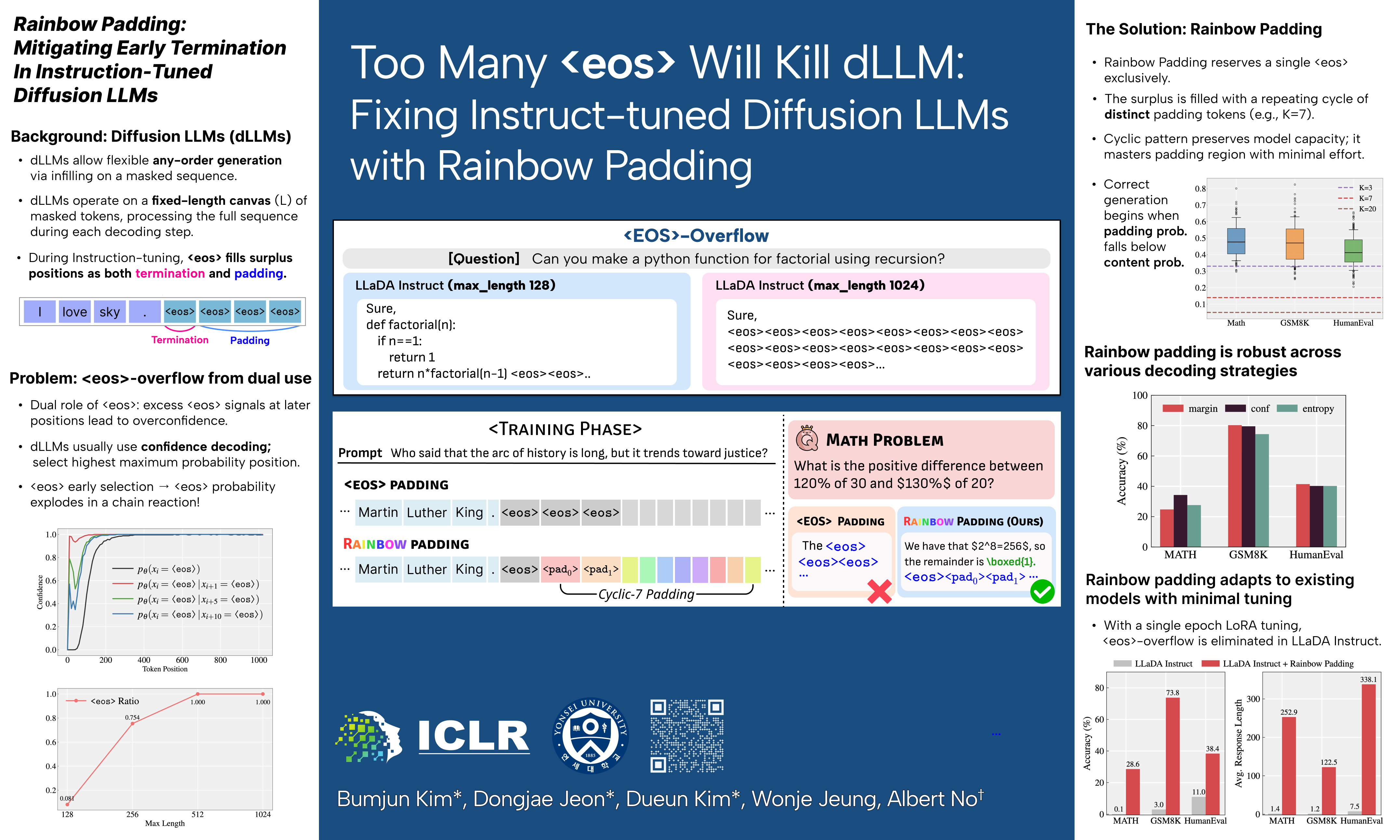
Diffusion large language models (dLLMs) have emerged as a promising alternative to autoregressive models, offering flexible generation orders and strong performance on complex reasoning tasks. However, instruction-tuned dLLMs exhibit a critical vulnerability we term \ overflow: as allocated sequence length increases, responses paradoxically become shorter, collapsing into early termination or degenerating into streams of \ tokens. Although noticed in practice, this issue has not been systematically analyzed. We trace its root cause to the dual role of \ as both termination and padding, which concentrates probability mass on \ at later positions and propagates backward to trigger early termination. To address this, we introduce Rainbow Padding, a simple remedy that replaces repeated \ placeholders with a repeating cycle of distinct padding tokens, distributing probability mass and breaking \ dominance. Experiments show that Rainbow Padding substantially improves length robustness and output quality, with as few as seven padding tokens to prevent early termination. Moreover, the method integrates efficiently into existing instruction-tuned models: LoRA fine-tuning for a single epoch on minimal data yields significant improvements, making this solution highly practical. The project is available at ~\url{https://ai-isl.github.io/rainbow-padding}
One step further with Monte-Carlo sampler to guide diffusion better
Minsi Ren ⋅ Wenhao Deng ⋅ Ruiqi Feng ⋅ Tailin Wu
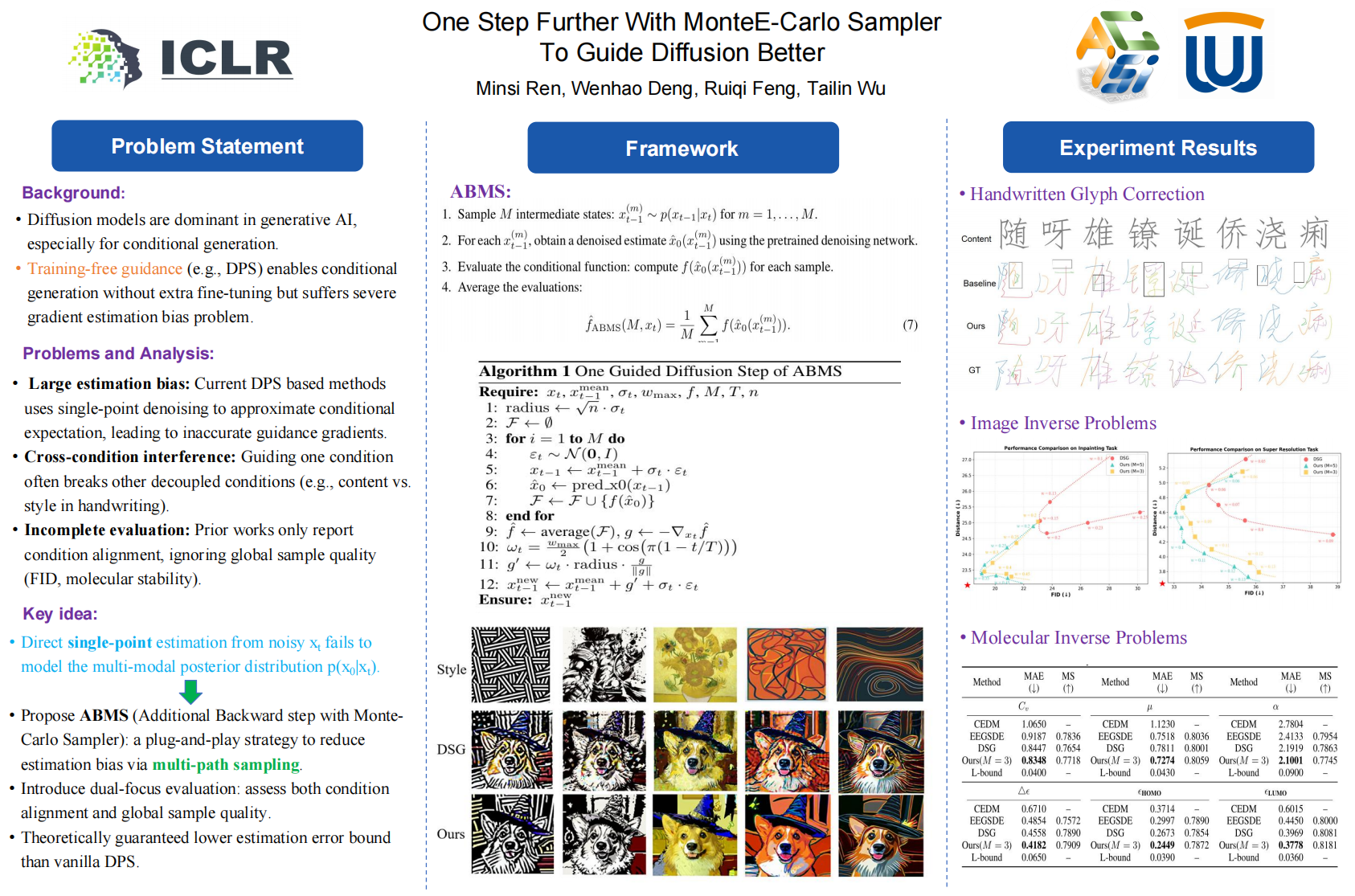
Stochastic differential equation (SDE)-based generative models have achieved substantial progress in conditional generation via training-free differentiable loss-guided approaches. However, existing methodologies utilizing posterior sam- pling typically confront a substantial estimation error, which results in inaccurate gradients for guidance and leading to inconsistent generation results. To mitigate this issue, we propose that performing an additional backward denoising step and Monte-Carlo sampling (ABMS) can achieve better guided diffusion, which is a plug-and-play adjustment strategy. To verify the effectiveness of our method, we provide theoretical analysis and propose the adoption of a dual-evaluation frame- work, which further serves to highlight the critical problem of cross-condition interference prevalent in existing approaches. We conduct experiments across var- ious task settings and data types, mainly including conditional online handwritten trajectory generation, image inverse problems (inpainting, super resolution and gaussian deblurring), and molecular inverse design. Experimental results demon- strate that our approach consistently improves the quality of generation samples across all the different scenarios.
Shortcut Diffusion Training with Cumulative Consistency Loss: An Optimal Control View
Paribesh Regmi ⋅ Sandesh Ghimire ⋅ Rui Li
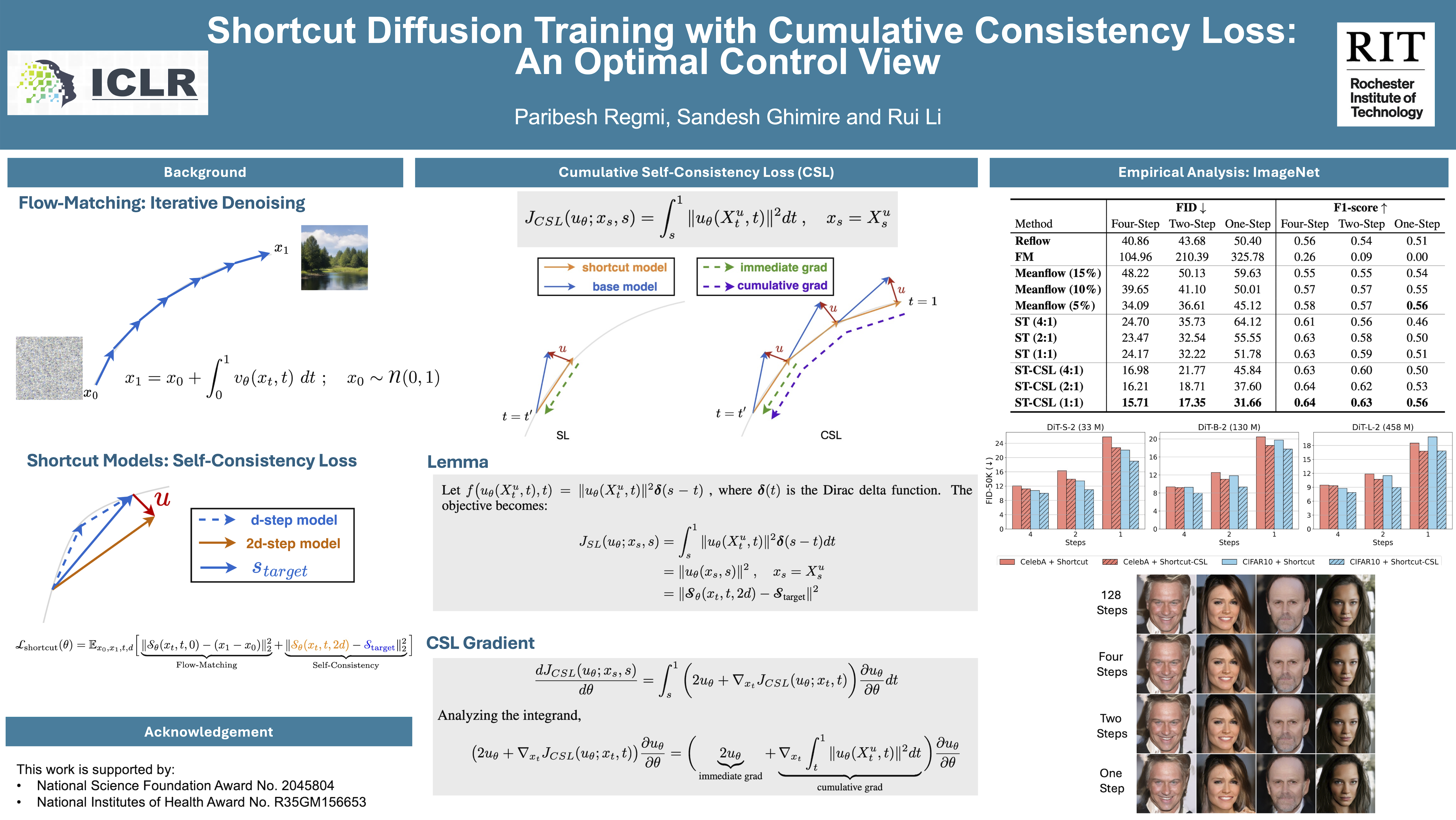
Although iterative denoising (i.e., diffusion/flow) methods offer strong generative performance, they suffer from low generation efficiency, requiring hundreds of steps of network forward passes to simulate a single sample. Mitigating this requires taking larger step-sizes during simulation, thereby allowing one- or few-step generation. Recently proposed shortcut model learns larger step-sizes by enforcing alignment between its direction and the path defined by a base many-step flow-matching model through a self-consistency loss. However, its generation quality is significantly lower than the base model. In this paper, we formulate few-step generation as a controlled base generative process, and show that self-consistency loss can be understood through the lens of optimal control. This perspective naturally motivates its generalization to the proposed cumulative self-consistency loss that cumulatively penalizes misalignment along the entire trajectory. This encourages larger step-sizes that not only align with the base model at the current time step but also support alignment in the subsequent steps, facilitating high-quality generation. Furthermore, we draw a connection between our approach and reinforcement learning, potentially opening the door to a new set of approaches for few-step generation. Experiments show that we significantly improve one- and few-step generation quality under the same training budget. Implementation is available at: https://github.com/paribeshregmi/Shortcut-CSL
Diffusion Alignment as Variational Expectation-Maximization
Jaewoo Lee ⋅ Minsu Kim ⋅ Sanghyeok Choi ⋅ Inhyuck Song ⋅ Sujin Yun ⋅ Hyeongyu Kang ⋅ Woocheol Shin ⋅ Taeyoung Yun ⋅ Kiyoung Om ⋅ Jinkyoo Park
Diffusion alignment aims to optimize diffusion models for the downstream objective. While existing methods based on reinforcement learning or direct backpropagation achieve considerable success in maximizing rewards, they often suffer from reward over-optimization and mode collapse. We introduce Diffusion Alignment as Variational Expectation-Maximization (DAV), a framework that formulates diffusion alignment as an iterative process alternating between two complementary phases: the E-step and the M-step. In the E-step, we employ test-time search to generate diverse and reward-aligned samples. In the M-step, we refine the diffusion model using samples discovered by the E-step. We demonstrate that DAV can optimize reward while preserving diversity for both continuous and discrete tasks: text-to-image synthesis and DNA sequence design. Our code is available at https://github.com/Jaewoopudding/dav.
Navigating the Latent Space Dynamics of Neural Models
Marco Fumero ⋅ Luca Moschella ⋅ Emanuele Rodolà ⋅ Francesco Locatello
Neural networks transform high-dimensional data into compact, structured representations, often modeled as elements of a lower dimensional latent space. In this paper, we present an alternative interpretation of neural models as dynamical systems acting on the latent manifold. Specifically, we show that autoencoder models implicitly define a _latent vector field_ on the manifold, derived by iteratively applying the encoding-decoding map, without any additional training. We observe that standard training procedures introduce inductive biases that lead to the emergence of attractor points within this vector field. Drawing on this insight, we propose to leverage the vector field as a _representation_ for the network, providing a novel tool to analyze the properties of the model and the data. This representation enables to: $(i)$ analyze the generalization and memorization regimes of neural models, even throughout training; $(ii)$ extract prior knowledge encoded in the network's parameters from the attractors, without requiring any input data; $(iii)$ identify out-of-distribution samples from their trajectories in the vector field. We further validate our approach on vision foundation models, showcasing the applicability and effectiveness of our method in real-world scenarios.
Training-Free Reward-Guided Image Editing via Trajectory Optimal Control
Jinho Chang ⋅ Jaemin Kim ⋅ Jong Chul YE
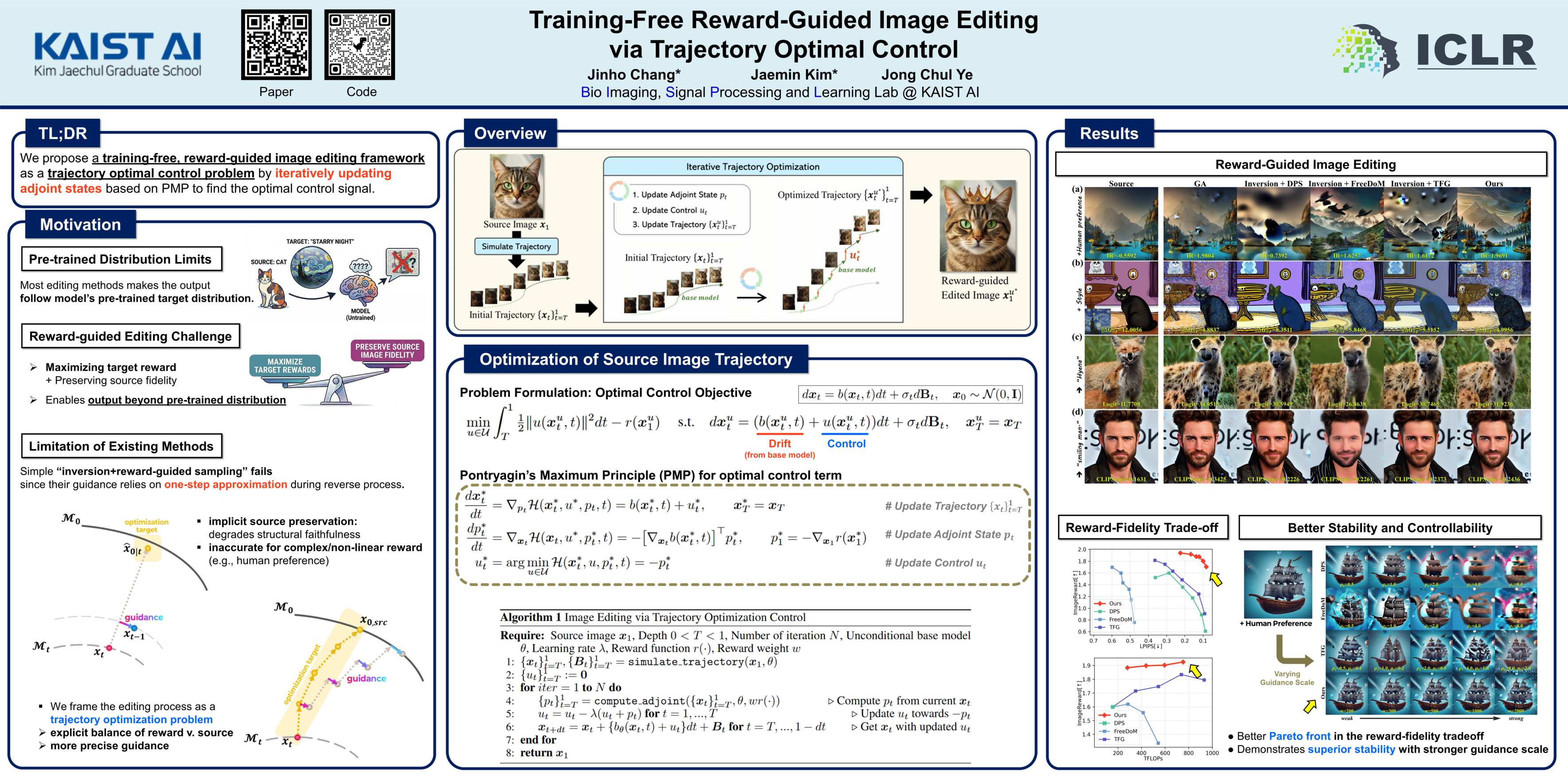
Recent advancements in diffusion and flow-matching models have demonstrated remarkable capabilities in high-fidelity image synthesis. A prominent line of research involves reward-guided guidance, which steers the generation process during inference to align with specific objectives. However, leveraging this reward-guided approach to the task of image editing, which requires preserving the semantic content of the source image while enhancing a target reward, is largely unexplored. In this work, we introduce a novel framework for training-free, reward-guided image editing. We formulate the editing process as a trajectory optimal control problem where the reverse process of a diffusion model is treated as a controllable trajectory originating from the source image, and the adjoint states are iteratively updated to steer the editing process. Through extensive experiments across distinct editing tasks, we demonstrate that our approach significantly outperforms existing inversion-based training-free guidance baselines, achieving a superior balance between reward maximization and fidelity to the source image without reward hacking.
DM4CT: Benchmarking Diffusion Models for Computed Tomography Reconstruction
Jiayang Shi ⋅ Daniel Pelt ⋅ Joost Batenburg
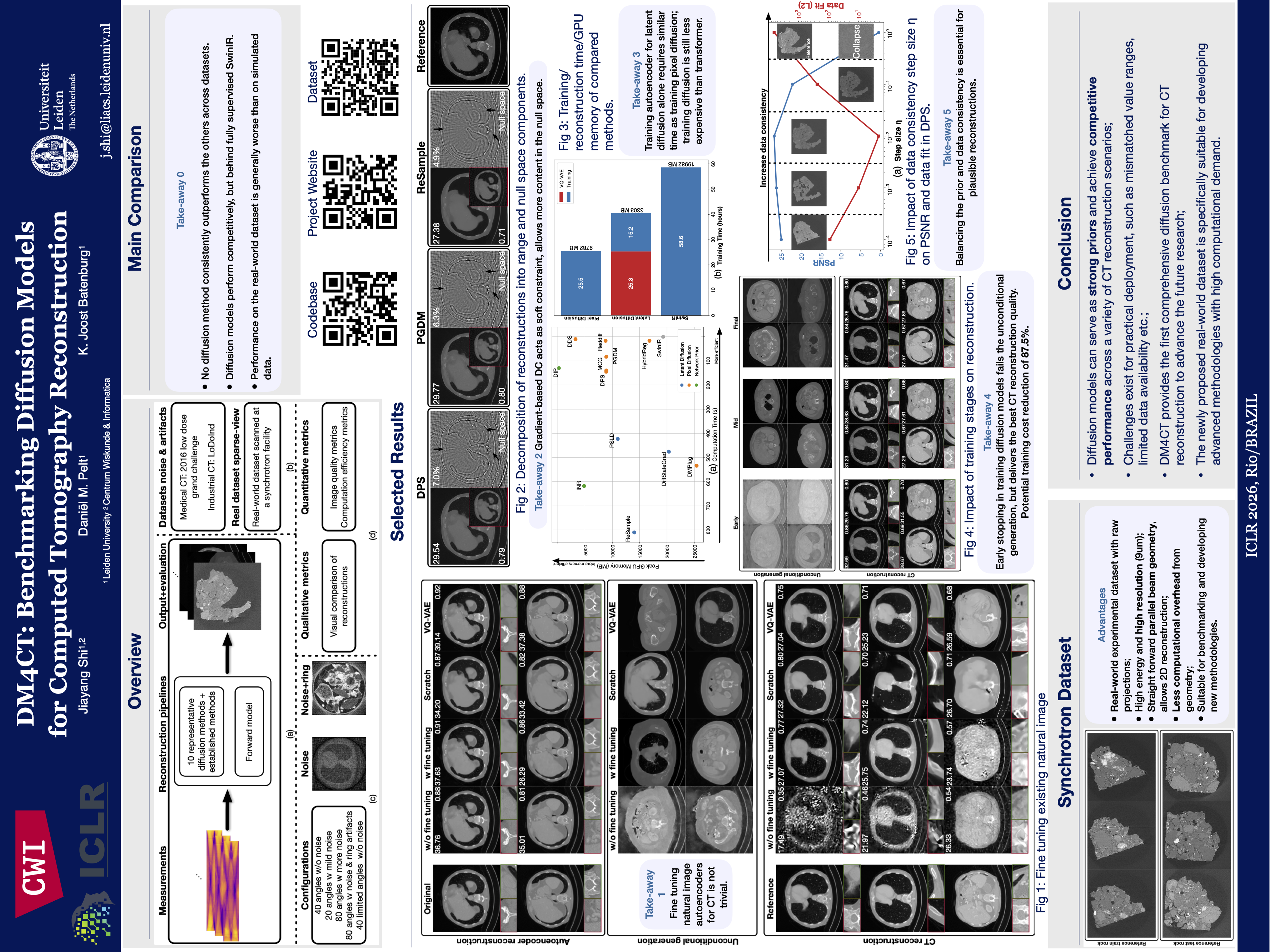
Diffusion models have recently emerged as powerful priors for solving inverse problems. While Computed Tomography (CT) is theoretically a linear inverse problem, it poses many practical challenges. These include correlated noise, artifact structures, reliance on system geometry, and misaligned value ranges, which make the direct application of diffusion models more difficult than in domains like natural image generation. To systematically evaluate how diffusion models perform in this context and compare them with established reconstruction methods, we introduce DM4CT, a comprehensive benchmark for CT reconstruction. DM4CT includes datasets from both medical and industrial domains with sparse-view and noisy configurations. To explore the challenges of deploying diffusion models in practice, we additionally acquire a high-resolution CT dataset at a high-energy synchrotron facility and evaluate all methods under real experimental conditions. We benchmark nine recent diffusion-based methods alongside seven strong baselines, including model-based, unsupervised, and supervised approaches. Our analysis provides detailed insights into the behavior, strengths, and limitations of diffusion models for CT reconstruction. The real-world dataset is publicly available at zenodo.org/records/15420527, and the codebase is open-sourced at github.com/DM4CT/DM4CT.
Parallel Sampling from Masked Diffusion Models via Conditional Independence Testing
Iskander Azangulov ⋅ Teodora Pandeva ⋅ Niranjani Prasad ⋅ Javier Zazo ⋅ Sushrut Karmalkar
Masked diffusion models (MDMs) offer a compelling alternative to autoregres- sive models (ARMs) for discrete text generation because they enable parallel token sampling, rather than sequential, left-to-right generation. This means po- tentially much faster inference. However, effective parallel sampling faces two competing requirements: (i) simultaneously updated tokens must be conditionally independent, and (ii) updates should prioritise high-confidence predictions. These goals conflict because high-confidence predictions often cluster and depend on each other, opportunities for parallel updates. We present PUNT, a model-agnostic sampler that reconciles this trade-off. Our method identifies token dependencies and removes lower-confidence tokens from conflicting groups. This produces sets of indices for unmasking that satisfy both independence and confidence criteria. Our approach ensures improved parallel unmasking through approximate conditional independence testing. Our experiments show that PUNT delivers a superior trade-off between accuracy and compute when compared to other strong training-free baselines, especially for generation of longer sequences. On the IFEval benchmark, it achieves up to 16% higher accuracy over baseline methods, including sequential generation (one-by- one). These gains hold across different values of hyperparameters, mitigating the need for brittle hyperparameter tuning. Moreover, we observe that PUNT induces an emergent hierarchical generation strategy, where the model first establishes high-level paragraph structure before local refinement, suggesting a planning-like generation process that contributes to strong alignment performance.
Neodragon: Mobile Video Generation Using Diffusion Transformer
Animesh Karnewar ⋅ Denis Korzhenkov ⋅ Ioannis Lelekas ⋅ Noor Fathima ⋅ Adil Karjauv ⋅ Mohsen Ghafoorian ⋅ Amirhossein Habibian
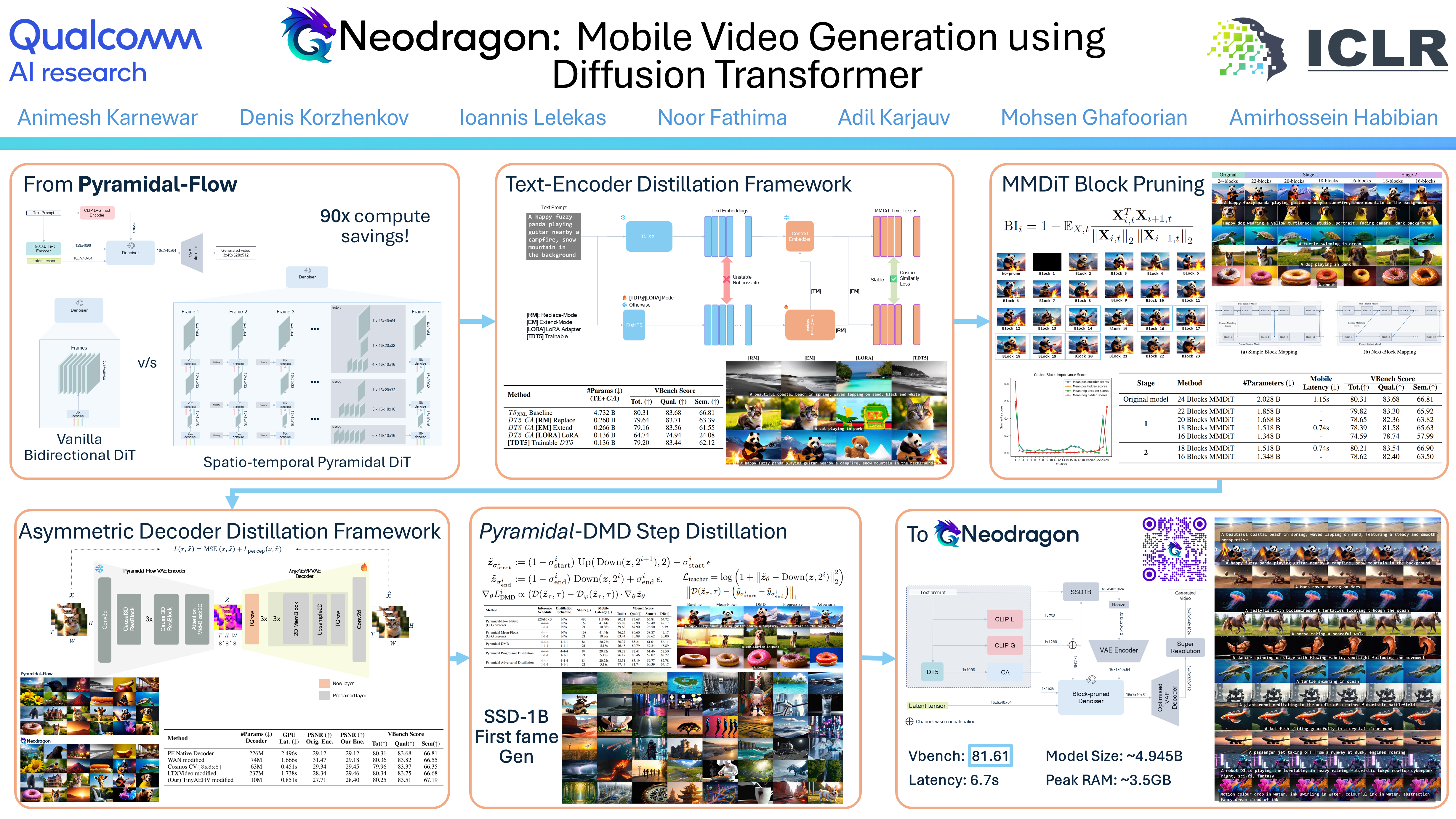
We propose Neodragon, a video DiT (Diffusion Transformer) designed to run on a low-power NPU present in devices such as phones and laptop computers. We demonstrate that, despite video transformers' huge memory and compute cost, mobile devices can run these models when carefully optimised for efficiency. To achieve this level of efficiency, i) we replace the original large Text-Encoder with a much smaller one with minimal quality loss through our novel distillation framework which doesn’t require any image or video data. ii) We propose an Asymmetric Decoder distillation approach which allows us to replace the native codec-latent-VAE decoder with a more efficient one, without disturbing the generative latent-space of the video generation pipeline. iii) With our Block Pruning strategy, we remove entire blocks from the MMDiT denoiser based on their relative importance and recover original performance through a two-stage distillation process. iv) We reduce the diffusion sampling cost using our novel extended version of DMD (Distribution Matching Distillation) for the Pyramidal Flow-Matching objective. Neodragon generates 49 frames of [640$\times$1024] resolution within 6.7 seconds on the Qualcomm Hexagon NPU with a VBench total score of 81.61, setting a new state-of-the-art for mobile video generation.
TROLL: Trust Regions Improve Reinforcement Learning for Large Language Models
Philipp Becker ⋅ Niklas Freymuth ⋅ Serge Thilges ⋅ Fabian Otto ⋅ Gerhard Neumann
Reinforcement Learning (RL) with PPO-like clip objectives has become the standard choice for reward-based fine-tuning of large language models (LLMs). Although recent work has explored improved estimators of advantages and normalization, the clipping mechanism itself has remained untouched. Originally introduced as a proxy for principled KL-based trust regions, clipping is a crude approximation that often causes unstable updates and suboptimal performance. We replace the clip objective with a novel discrete differentiable trust region projection, which provides principled token-level KL constraints. The projection operates on a sparse subset of the model’s most important token logits to balance computational cost and projection effectiveness. Our approach, Trust Region Optimization for Large Language Models (TROLL), serves as a direct replacement for PPO-like clipping during training and does not alter the model’s inference behavior. Across mathematical reasoning and code generation tasks, model families, as well as advantage-estimation methods, TROLL consistently outperforms PPO-like clipping in terms of training speed, stability, and final success rates.
LoRA meets Riemannion: Muon Optimizer for Parametrization-independent Low-Rank Adapters
Vladimir Bogachev ⋅ Vladimir Aletov ⋅ Alexander Molozhavenko ⋅ Denis Bobkov ⋅ Vera Soboleva ⋅ Aibek Alanov ⋅ Maxim Rakhuba
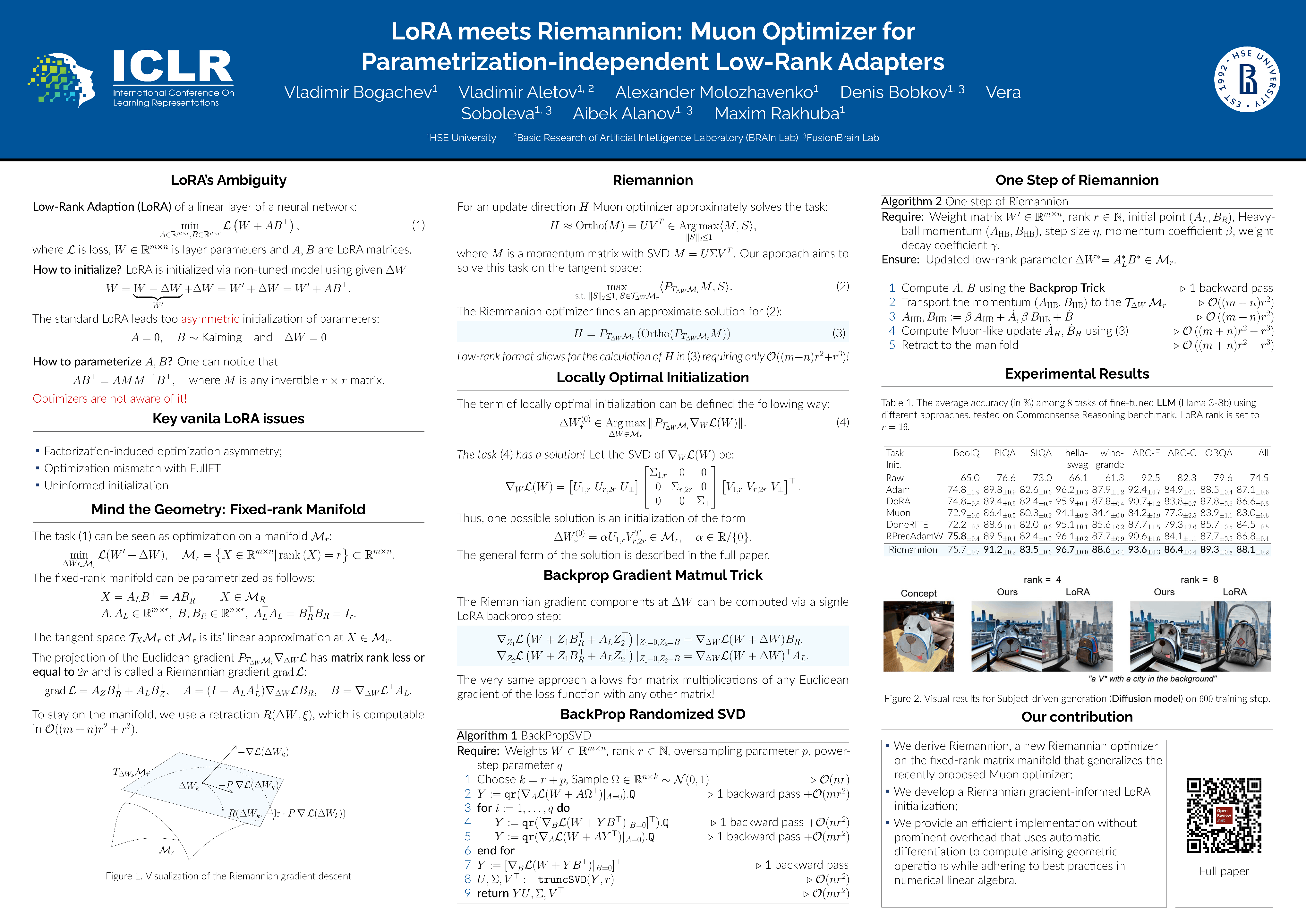
This work presents a novel, fully Riemannian framework for Low-Rank Adaptation (LoRA) that geometrically treats low-rank adapters by optimizing them directly on the fixed-rank manifold. This formulation eliminates the parametrization ambiguity present in standard Euclidean optimizers. Our framework integrates three key components to achieve this: (1) we derive Riemannion, a new Riemannian optimizer on the fixed-rank matrix manifold that generalizes the recently proposed Muon optimizer; (2) we develop a Riemannian gradient-informed LoRA initialization, and (3) we provide an efficient implementation without prominent overhead that uses automatic differentiation to compute arising geometric operations while adhering to best practices in numerical linear algebra. Comprehensive experimental results on both LLM and diffusion model architectures demonstrate that our approach yields consistent and noticeable improvements in convergence speed and final task performance over both standard LoRA and its state-of-the-art modifications.
Improved Object-Centric Diffusion Learning with Registers and Contrastive Alignment
Bac Nguyen ⋅ Yuhta Takida ⋅ Naoki Murata ⋅ Chieh-Hsin Lai ⋅ Toshimitsu Uesaka ⋅ Stefano Ermon ⋅ Yuki Mitsufuji
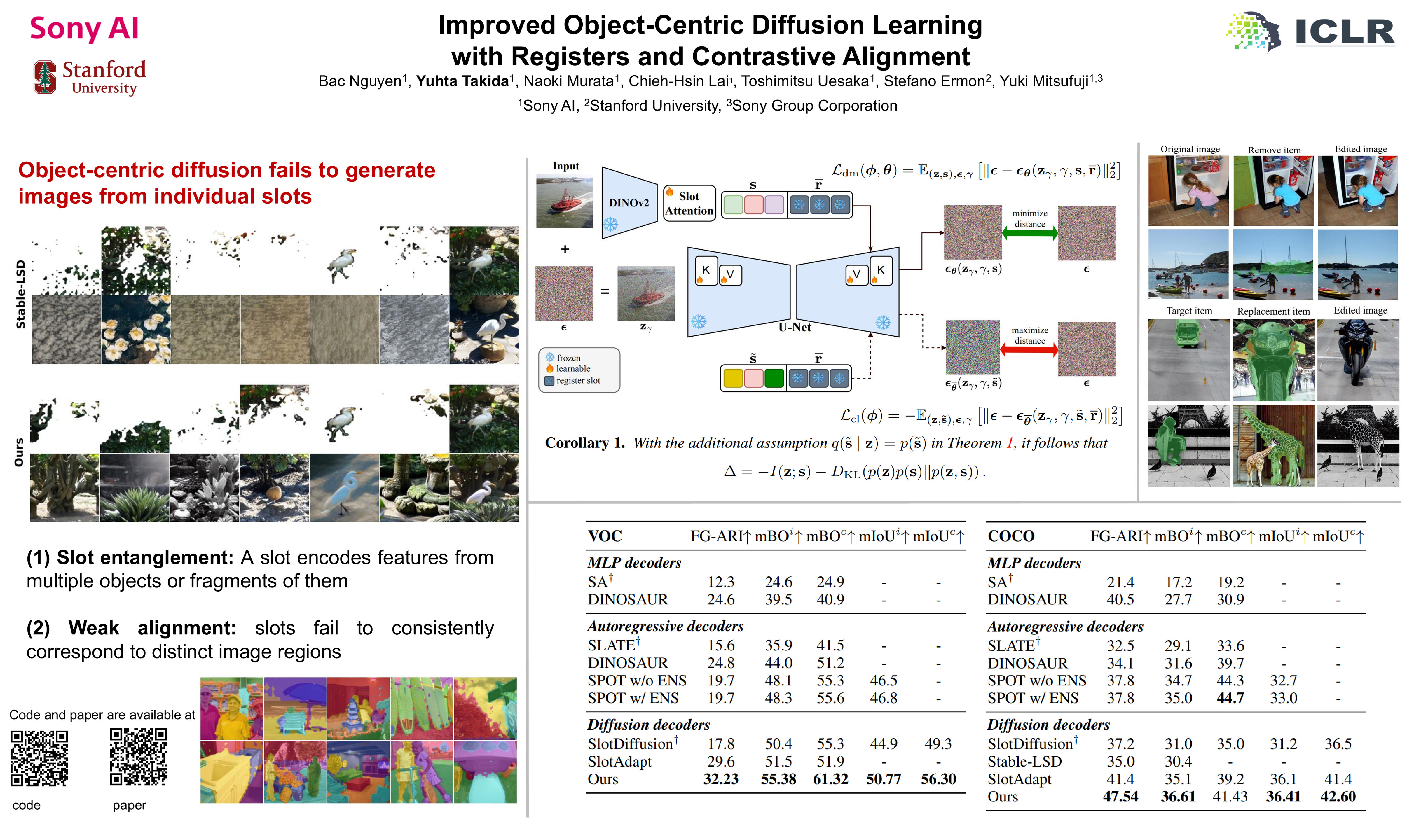
Slot Attention (SA) with pretrained diffusion models has recently shown promise for object-centric learning (OCL), but suffers from slot entanglement and weak alignment between object slots and image content. We propose Contrastive Object-centric Diffusion Alignment (CODA), a simple extension that (i) employs register slots to absorb residual attention and reduce interference between object slots, and (ii) applies a contrastive alignment loss to explicitly encourage slot–image correspondence. The resulting training objective serves as a tractable surrogate for maximizing mutual information (MI) between slots and inputs, strengthening slot representation quality. On both synthetic (MOVi-C/E) and real-world datasets (VOC, COCO), CODA improves object discovery (e.g., +6.1% FG-ARI on COCO), property prediction, and compositional image generation over strong baselines. Register slots add negligible overhead, keeping CODA efficient and scalable. These results indicate potential applications of CODA as an effective framework for robust OCL in complex, real-world scenes. Code and pretrained models are available at https://github.com/sony/coda.
High-dimensional Mean-Field Games by Particle-based Flow Matching
Jiajia Yu ⋅ Junghwan Lee ⋅ Yao Xie ⋅ Xiuyuan Cheng
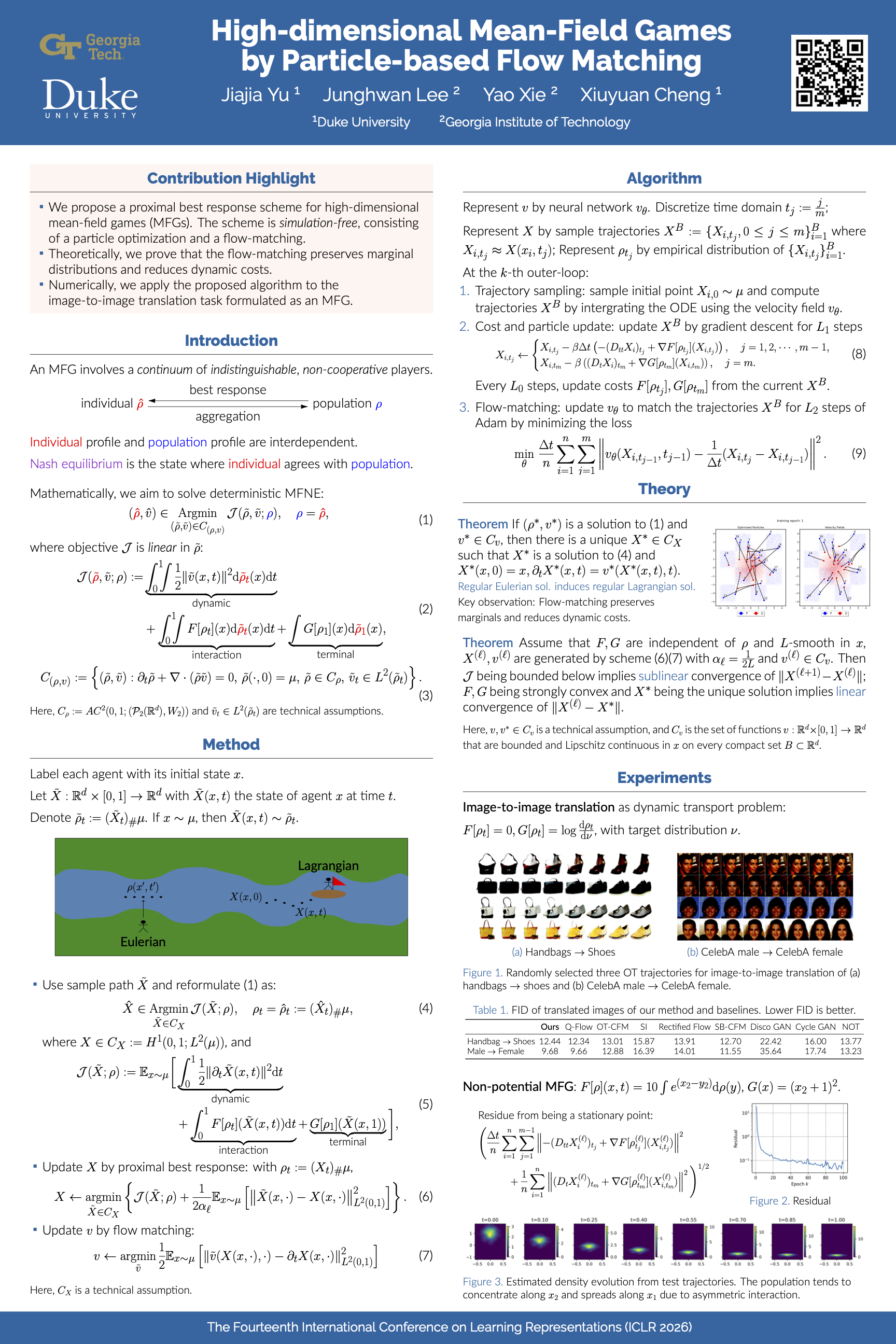
Mean-field games (MFGs) study the Nash equilibrium of systems with a continuum of interacting agents, which can be formulated as the fixed-point of optimal control problems. They provide a unified framework for a variety of problems, including both potential and non-potential games, with applications in areas such as generative modeling. Despite their broad applicability, solving high-dimensional MFGs remains a significant challenge due to fundamental computational and analytical obstacles. In this work, we propose a particle-based deep Flow Matching (FM) method to tackle high-dimensional MFG computation. In each iteration of our proximal fixed-point scheme, particles are updated using first-order information, and a flow neural network is trained to match the velocity of the sample trajectories. Theoretically, in the optimal control setting, we prove that our scheme converges to a stationary point sublinearly, and upgrade to linear (exponential) convergence under additional convexity assumptions. Our proof uses FM to induce an Eulerian coordinate (density-based) from a Lagrangian one (particle-based), and this also leads to certain equivalence results between the two formulations for MFGs when the Eulerian solution is sufficiently regular. Our method demonstrates promising experimental performance on MFGs in high dimensions.
ReLaSH: Reconstructing Joint Latent Spaces for Efficient Generation of Synthetic Hypergraphs with Hyperlink Attributes
Feiyan Ma ⋅ Shihao Wu ⋅ Gongjun Xu ⋅ Ji Zhu
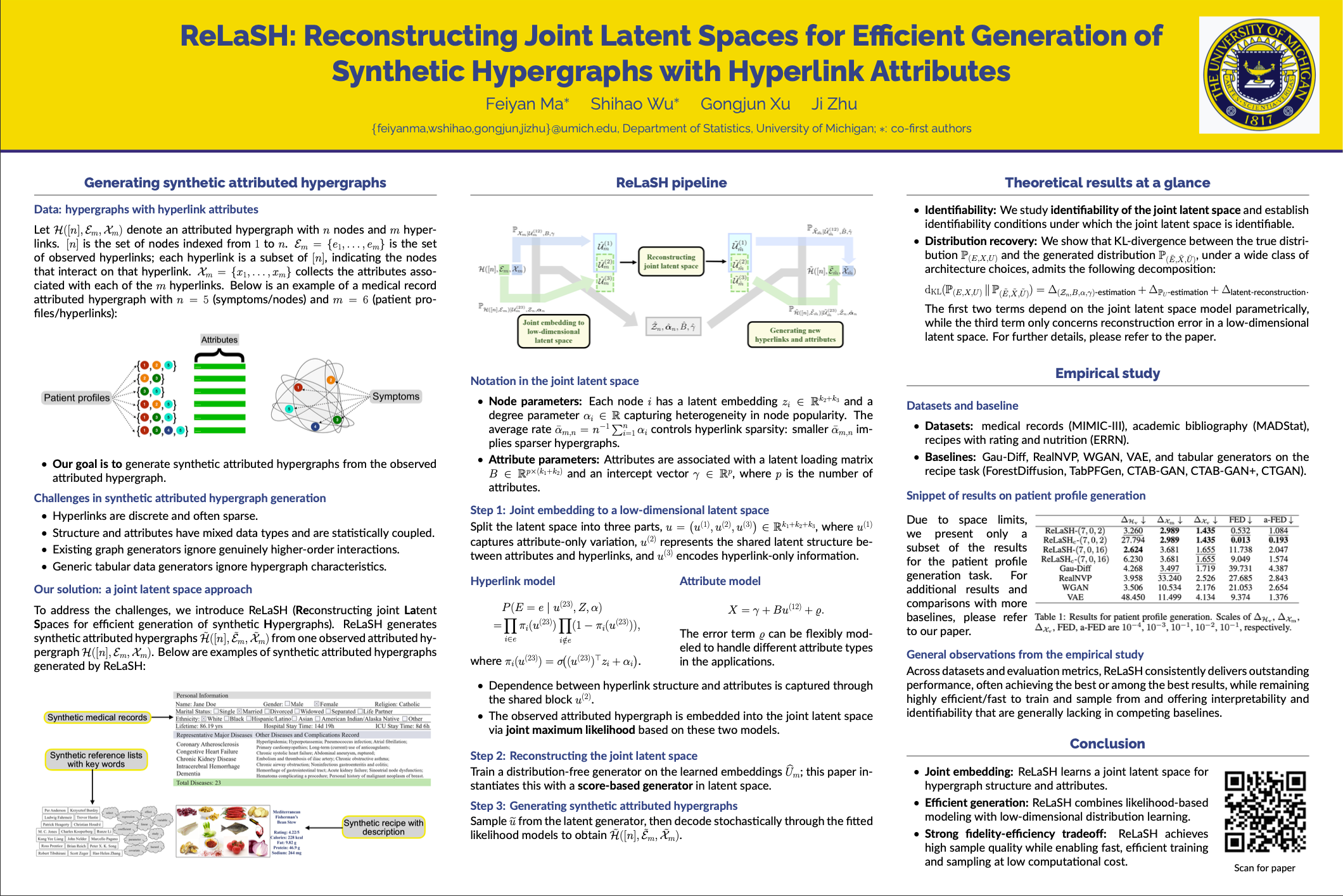
Hypergraph network data, which capture multi-way interactions among entities, have become increasingly prevalent in the big data era, spanning fields such as social science, medical research, and biology. Generating synthetic hyperlinks with attributes from an observed hypergraph has broad applications in data augmentation, simulation, and advancing the understanding of real-world complex systems. This task, however, poses unique challenges due to special properties of hypergraphs, including discreteness, hyperlink sparsity, and the mixed data types of hyperlinks and their attributes, rendering many existing generative models unsuitable. In this paper, we introduce ReLaSH (REconstructing joint LAtent Spaces for Hypergraphs with attributes), a general generative framework for producing realistic synthetic hypergraph data with hyperlink attributes via training a likelihood-based joint embedding model and reconstructing the joint latent space. Given a hypergraph dataset, ReLaSH first embeds the hyperlinks and their attributes into a joint latent space by training a likelihood-based model, and then reconstructs this joint latent space using a distribution-free generator. The generation task is completed by first sampling embeddings from the distribution-free generator and then decoding them into hyperlinks and attributes through the trained likelihood-based model. Compared with existing generative models, ReLaSH explicitly accounts for the unique structure of hypergraphs and jointly models hyperlinks and their attributes. Moreover, the likelihood-based embedding model provides efficiency and interpretability relative to deep black-box architectures, while the distribution-free generator in the joint latent space ensures flexibility. We theoretically demonstrate consistency and generalizability of ReLaSH. Empirical results on a range of real-world datasets from diverse domains demonstrate the strong performance of ReLaSH, underscoring its broad utility and effectiveness in practical applications.
Negative Pre-activations Differentiate Syntax
Linghao Kong ⋅ Angelina Ning ⋅ Micah Adler ⋅ Nir Shavit
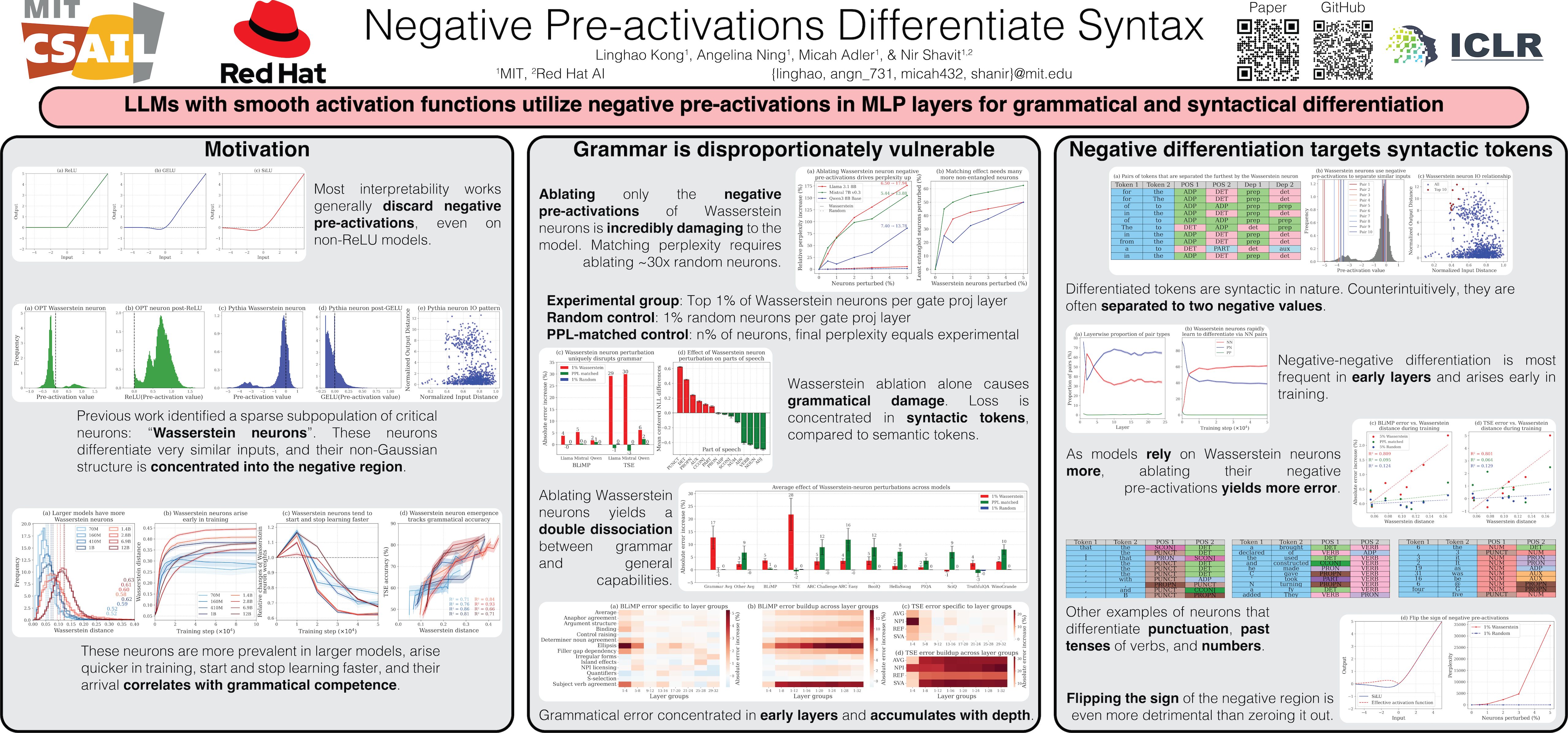
Modern large language models increasingly use smooth activation functions such as GELU or SiLU, allowing negative pre-activations to carry both signal and gradient. Nevertheless, many neuron-level interpretability analyses have historically focused on large positive activations, often implicitly treating the negative region as less informative, a carryover from the ReLU-era. We challenge this assumption and ask whether and how negative pre-activations are leveraged by models. We address this question by studying a sparse subpopulation of Wasserstein neurons whose output distributions deviate strongly from a Gaussian baseline and that functionally differentiate similar inputs. We show that this negative region plays an active role rather than reflecting a mere gradient optimization side effect. A minimal, sign-specific intervention that zeroes only the negative pre-activations of a small set of Wasserstein neurons substantially increases perplexity and sharply degrades grammatical performance on BLiMP and TSE, whereas both random and perplexity-matched ablations of many more non-Wasserstein neurons in their negative pre-activations leave grammatical performance largely intact. Conversely, on a suite of non-grammatical benchmarks, the perplexity-matched control ablation is more damaging than the Wasserstein neuron ablation, yielding a double dissociation between syntax and other capabilities. Part-of-speech analysis localizes the excess surprisal to syntactic scaffolding tokens, layer-specific interventions show that small local degradations accumulate across depth, and training-dynamics analysis reveals that the same sign-specific ablation becomes more harmful as Wasserstein neurons emerge and stabilize. Together, these results identify negative pre-activations in a sparse subpopulation of Wasserstein neurons as an actively used substrate for syntax in smooth-activation language models.
TriC-Motion: Tri-Domain Causal Modeling Grounded Text-to-Motion Generation
Yiyang Cao ⋅ Yunze Deng ⋅ Ziyu Lin ⋅ Bin Feng ⋅ Xinggang Wang ⋅ Wenyu Liu ⋅ DanDan Zheng ⋅ Jingdong Chen
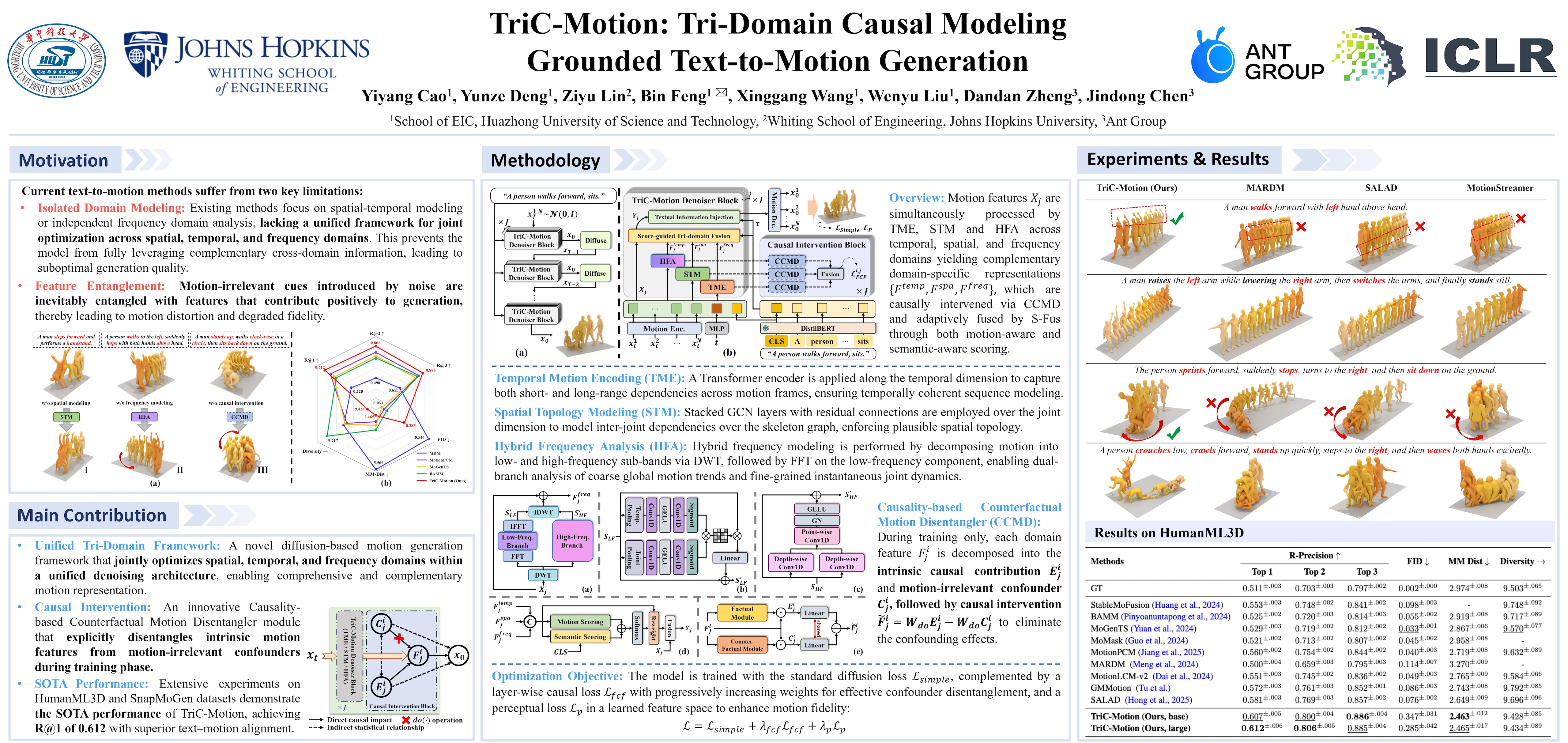
Text-to-motion generation, a rapidly evolving field in computer vision, aims to produce realistic and text-aligned motion sequences. Current methods primarily focus on spatial-temporal modeling or independent frequency domain analysis, lacking a unified framework for joint optimization across spatial, temporal, and frequency domains. This limitation hinders the model's ability to leverage information from all domains simultaneously, leading to suboptimal generation quality. Additionally, in motion generation frameworks, motion-irrelevant cues caused by noise are often entangled with features that contribute positively to generation, thereby leading to motion distortion. To address these issues, we propose Tri-Domain Causal Text-to-Motion Generation (TriC-Motion), a novel diffusion-based framework integrating spatial-temporal-frequency-domain modeling with causal intervention. TriC-Motion includes three core modeling modules for domain-specific modeling, namely Temporal Motion Encoding, Spatial Topology Modeling, and Hybrid Frequency Analysis. After comprehensive modeling, a Score-guided Tri-domain Fusion module integrates valuable information from the triple domains, simultaneously ensuring temporal consistency, spatial topology, motion trends, and dynamics. Moreover, the Causality-based Counterfactual Motion Disentangler is meticulously designed to expose motion-irrelevant cues to eliminate noise, disentangling the real modeling contributions of each domain for superior generation. Extensive experimental results validate that TriC-Motion achieves superior performance compared to state-of-the-art methods, attaining an outstanding R@1 of 0.612 on the HumanML3D dataset. These results demonstrate its capability to generate high-fidelity, coherent, diverse, and text-aligned motion sequences. Code is available at: \url{https://caoyiyang1105.github.io/TriC-Motion/}.
CardioComposer: Leveraging Differentiable Geometry for Compositional Control of Anatomical Diffusion Models
Karim Kadry ⋅ Shoaib Goraya ⋅ Ajay Manicka ⋅ Abdalla Abdelwahed ⋅ Naravich Chutisilp ⋅ Farhad Nezami ⋅ Elazer Edelman
Generative models of 3D cardiovascular anatomy can synthesize informative structures for clinical research and medical device evaluation, but face a trade-off between geometric controllability and realism. We propose CardioComposer: a programmable, inference time framework for generating multi-class anatomical label maps from interpretable ellipsoidal primitives. These primitives represent geometric attributes such as the size, shape, and position of discrete substructures. We specifically develop differentiable measurement functions based on voxel-wise geometric moments, enabling loss-based gradient guidance during diffusion model sampling. We demonstrate that these losses can constrain individual geometric attributes in a disentangled manner and provide compositional control over multiple substructures. Finally, we show that our method is compatible with a broad range of anatomical systems containing non-convex substructures, spanning cardiac, vascular, and skeletal organs. We release our code at https://github.com/kkadry/CardioComposer.
Gumbel Distillation for Parallel Text Generation
Chi Zhang ⋅ Xixi Hu ⋅ Bo Liu ⋅ Qiang Liu
The slow, sequential nature of autoregressive (AR) language models has driven the adoption of parallel decoding methods. However, these non-autoregressive models often sacrifice generation quality because they struggle to model the complex joint distribution of token sequences. To narrow this performance gap, we introduce Gumbel Distillation, a novel distillation technique that enables parallel decoders to learn this distribution effectively. Our method leverages the Gumbel-Max trick to create a deterministic mapping from a latent Gumbel noise space to the output tokens of a high-performing AR teacher. As a model-agnostic technique, Gumbel Distillation seamlessly integrates with diverse parallel decoding architectures, including MDLM and BD3-LM. Experiments on LM1B and OpenWebText show that Gumbel Distillation substantially improves the generation quality of parallel language models, achieving a 30.0% improvement in MAUVE Score and 10.5% in generative perplexity over MDLM trained on OpenWebText dataset.
Learning To Draft: Adaptive Speculative Decoding with Reinforcement Learning
Jiebin Zhang ⋅ Zhenghan Yu ⋅ Liang Wang ⋅ Nan Yang ⋅ Eugene Yu ⋅ Zheng Li ⋅ Yifan Song ⋅ Dawei Zhu ⋅ Xingxing Zhang ⋅ Furu Wei ⋅ Sujian Li
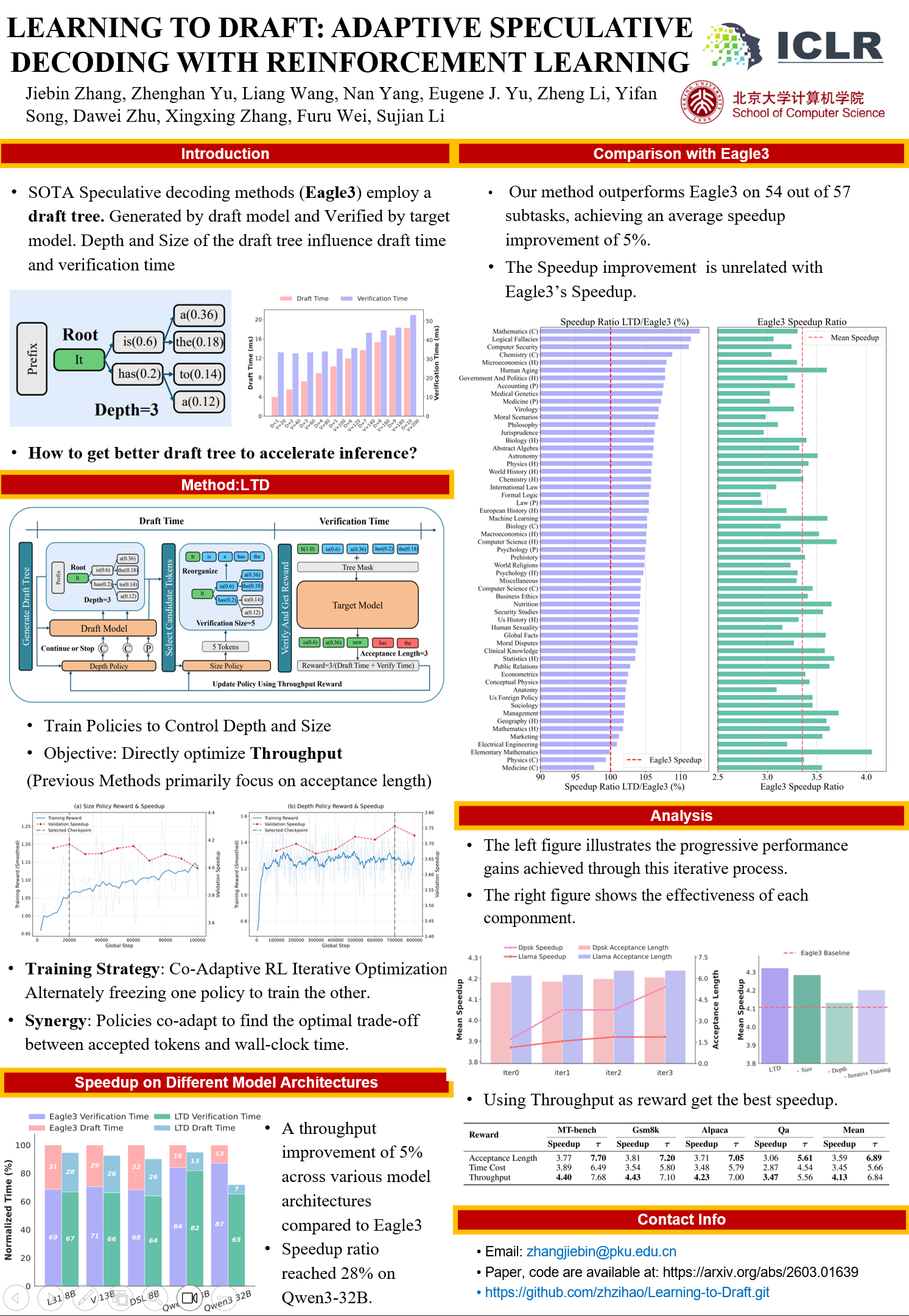
Speculative decoding accelerates large language model (LLM) inference by using a small draft model to generate candidate tokens for a larger target model to verify. The efficacy of this technique hinges on the trade-off between the time spent on drafting candidates and verifying them. However, current state-of-the-art methods rely on a static time allocation, while recent dynamic approaches optimize for proxy metrics like acceptance length, often neglecting the true time cost and treating the drafting and verification phases in isolation. To address these limitations, we introduce Learning to Draft (LTD), a novel method that directly optimizes for throughput of each draft-and-verify cycle. We formulate the problem as a reinforcement learning environment and train two co-adaptive policies to dynamically coordinate the draft and verification phases. This encourages the policies to adapt to each other and explicitly maximize decoding efficiency. We conducted extensive evaluations on five diverse LLMs and four distinct tasks. Our results show that LTD achieves speedup ratios ranging from 2.24x to 4.32x, outperforming the state-of-the-art method Eagle3 up to 36.4\%.
PARD: Accelerating LLM Inference with Low‑Cost PARallel Draft Model Adaptation
Zihao An ⋅ Huajun Bai ⋅ Ziqiong Liu ⋅ Dong Li ⋅ Emad Barsoum
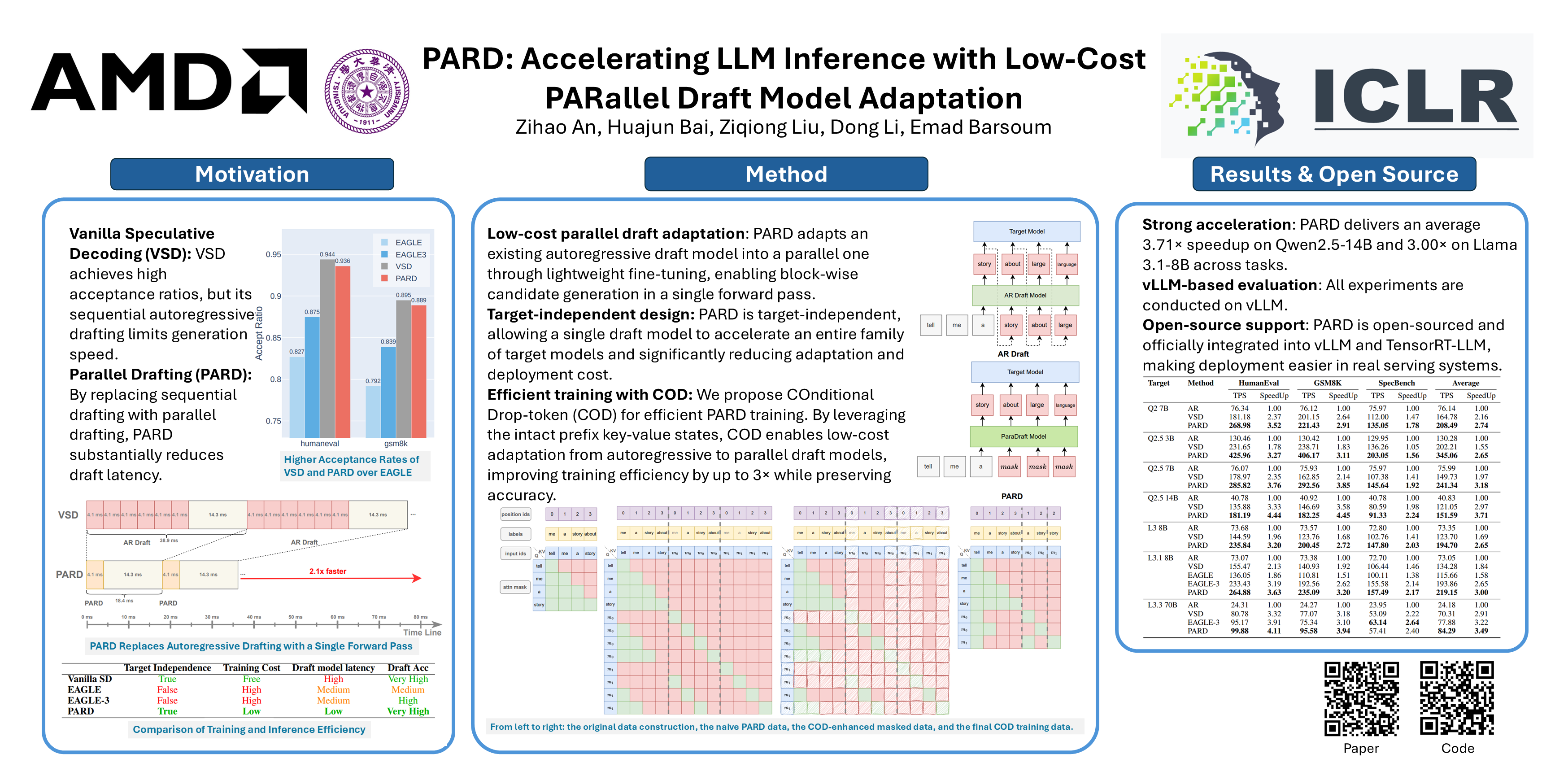
The autoregressive nature of large language models (LLMs) fundamentally limits inference speed, as each forward pass generates only a single token and is often bottlenecked by memory bandwidth. Speculative decoding has emerged as a promising solution, adopting a draft-then-verify strategy to accelerate token generation. While the EAGLE series achieves strong acceleration, its requirement of training a separate draft head for each target model introduces substantial adaptation costs. In this work, we propose PARD (PARallel Draft), a novel speculative decoding method featuring target-independence and parallel token prediction. Specifically, PARD enables a single draft model to be applied across an entire family of target models without requiring separate training for each variant, thereby minimizing adaptation costs. Meanwhile, PARD substantially accelerates inference by predicting multiple future tokens within a single forward pass of the draft phase. To further reduce the training adaptation cost of PARD, we propose a COnditional Drop-token (COD) mechanism based on the integrity of prefix key-value states, enabling autoregressive draft models to be adapted into parallel draft models at low-cost. Our experiments show that the proposed COD method improves draft model training efficiency by 3x compared with traditional masked prediction training. On the vLLM inference framework, PARD achieves up to 3.67x speedup on LLaMA3.1-8B, reaching 264.88 tokens per second, which is 1.15x faster than EAGLE-3. Our code is available at https://github.com/AMD-AGI/PARD.
Multiplicative Diffusion Models: Beyond Gaussian Latents
Robert Gruhlke ⋅ Valentin Resseguier ⋅ Merveille Talla
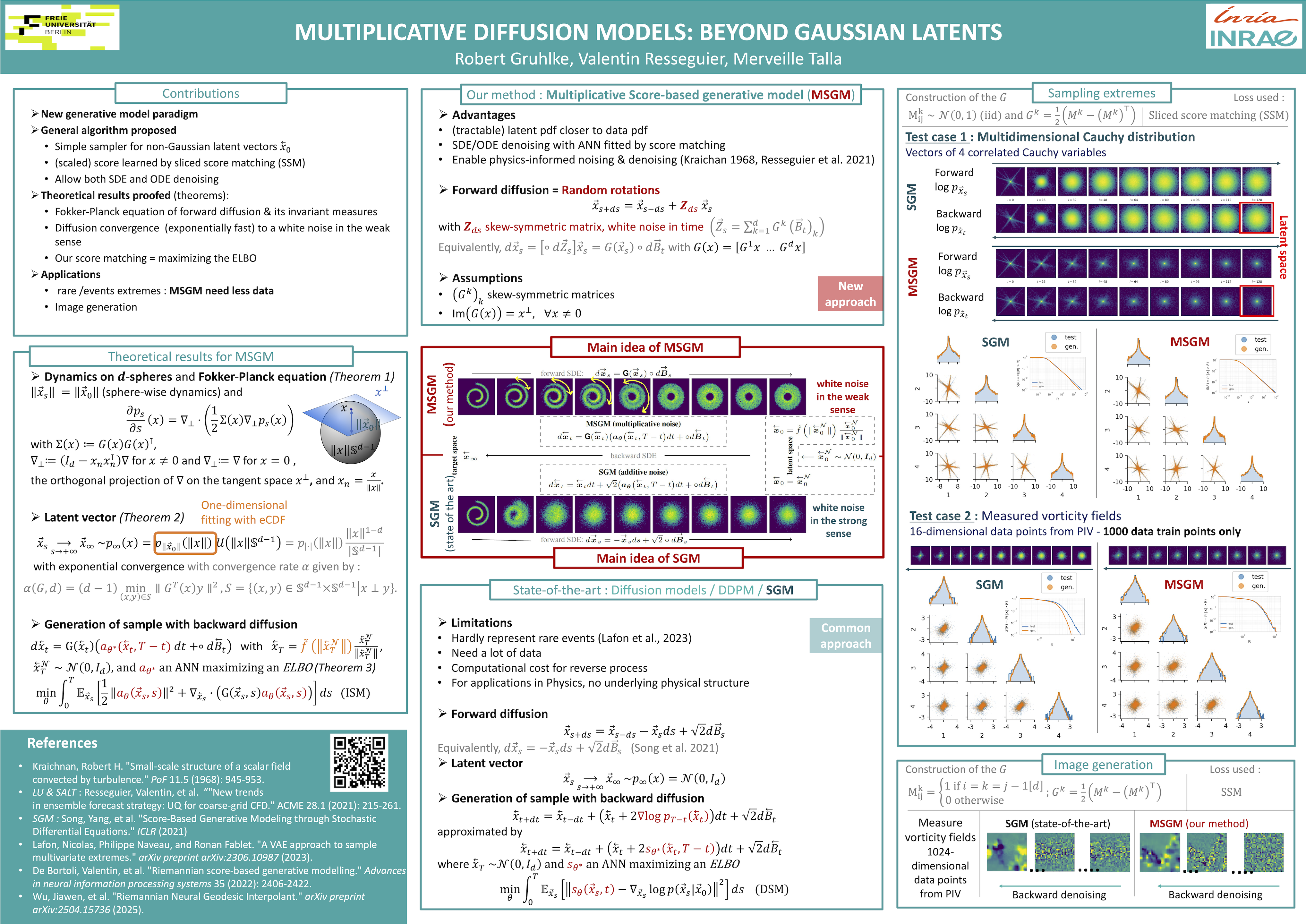
We introduce a new class of generative models based on multiplicative score-driven diffusion. In contrast to classical diffusion models that rely on additive Gaussian noise, our construction is driven by skew-symmetric multiplicative noise. It yields conservative forward-backward dynamics inspired by principles of physics. We prove that the forward process converges exponentially fast to a tractable non-Gaussian latent distribution, and we characterize this limit explicitly. A key property of our diffusion is that it preserves the distribution of data norms, resulting in a latent space that is inherently data-aware. Unlike the standard Gaussian prior, this structure better adapts to heavy-tailed and anisotropic data, providing a closer match between latent and observed distributions. On the algorithmic side, we derive the reverse-time stochastic differential equation and associated probability flow, and show that sliced score matching furnishes a consistent estimator for the backward dynamics. This estimation procedure is equivalent to maximizing an evidence lower bound (ELBO), bridging our framework with established variational principles. Empirically, we demonstrate the advantages of our model in challenging settings, including correlated Cauchy distributions and experimental fluid dynamics data (d=1024). Across these tasks, our approach more accurately captures extreme events and tail behavior than classical diffusion models, particularly in the low-data regime. Our results suggest that multiplicative conservative diffusions open a principled alternative to current score-based generative models, with strong potential for domains where rare but critical events dominate.
EigenScore: OOD Detection using Posterior Covariance in Diffusion Models
Shirin Shoushtari ⋅ Yi Wang ⋅ Xiao Shi ⋅ Salman Asif ⋅ Ulugbek Kamilov
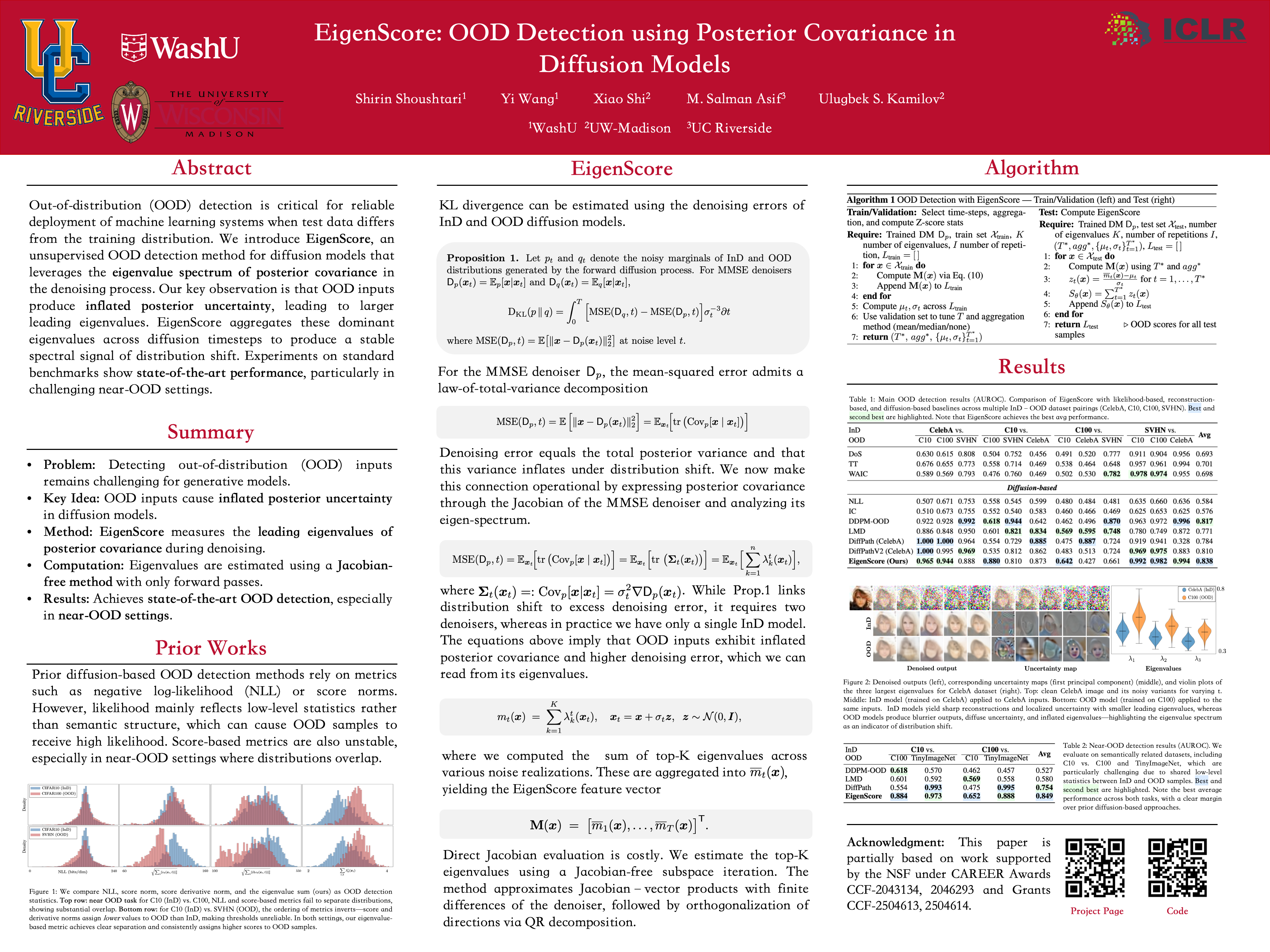
Out-of-distribution (OOD) detection is critical for the safe deployment of machine learning systems in safety-sensitive domains. Diffusion models have recently emerged as powerful generative models, capable of capturing complex data distributions through iterative denoising. Building on this progress, recent work has explored their potential for OOD detection. We propose EigenScore, a new OOD detection method that leverages the eigenvalue spectrum of the posterior covariance induced by a diffusion model. We argue that posterior covariance provides a consistent signal of distribution shift, leading to larger trace and leading eigenvalues on OOD inputs, yielding a clear spectral signature. We further provide analysis explicitly linking posterior covariance to distribution mismatch, establishing it as a reliable signal for OOD detection. To ensure tractability, we adopt a Jacobian-free subspace iteration method to estimate the leading eigenvalues using only forward evaluations of the denoiser. Empirically, EigenScore achieves state-of-the-art performance, with up to 2% AUROC improvement over the best baseline. Notably, it remains robust in near-OOD settings such as CIFAR-10 vs CIFAR-100, where existing diffusion-based methods often fail.
Front-Loading Reasoning: The Synergy between Pretraining and Post-Training Data
Syeda Nahida Akter ⋅ Shrimai Prabhumoye ⋅ Eric Nyberg ⋅ Mostofa Patwary ⋅ Mohammad Shoeybi ⋅ Yejin Choi ⋅ Bryan Catanzaro
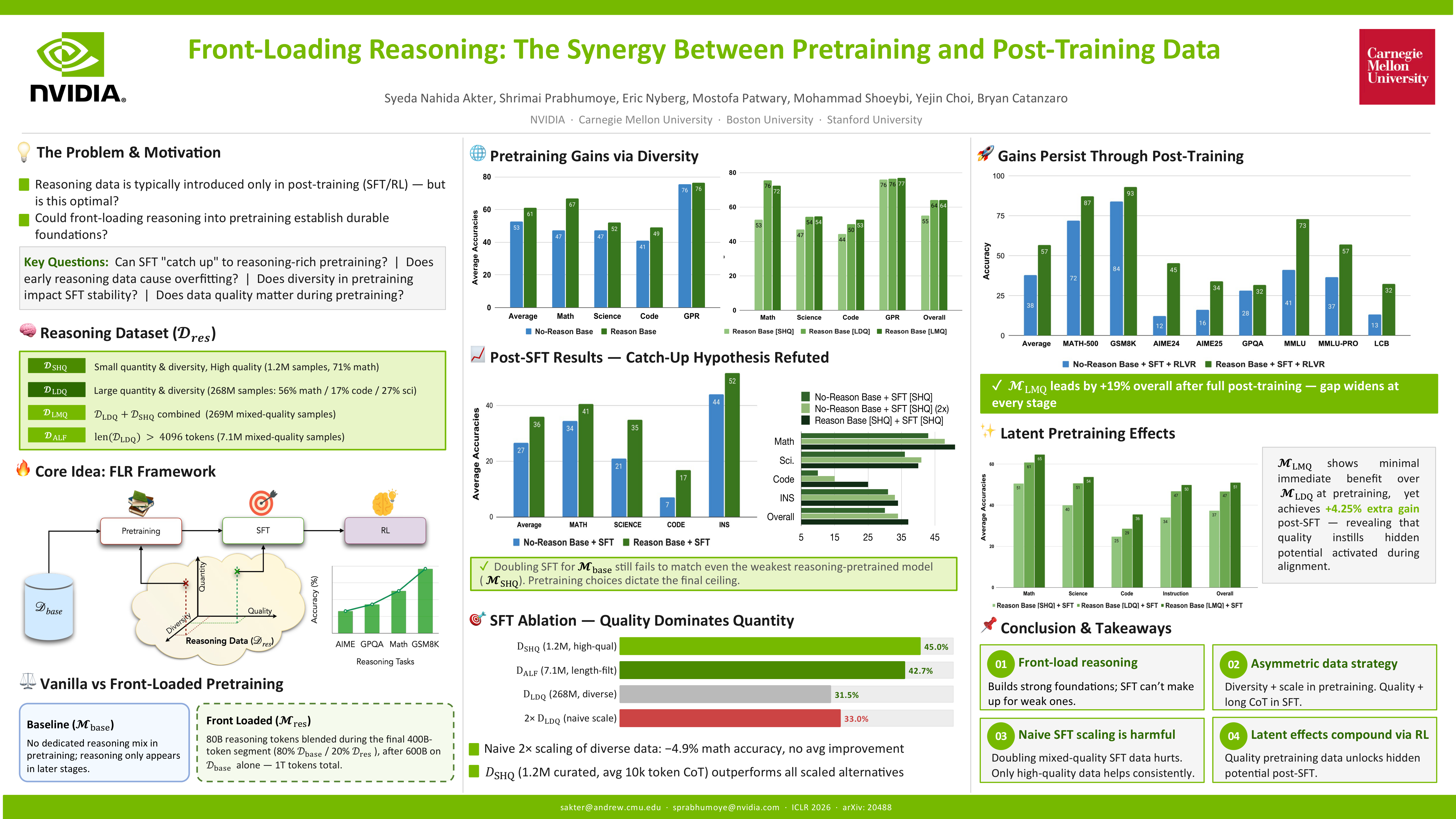
The prevailing paradigm for enhancing the reasoning abilities of Large Language Models (LLMs) revolves around post-training on high-quality, reasoning-intensive data. While emerging literature suggests that reasoning data is increasingly incorporated also during the mid-training stage---a practice that is relatively more proprietary and less openly characterized---the role of such data in pretraining remains unclear. In particular, due to the opaqueness of pretraining corpora in most frontier models, the effect of reasoning data introduced at different phases of pre- and/or post-training is relatively less reported in the scientific literature. This raises several important but unsettled questions: Is adding reasoning data earlier during pre-training any better than introducing it during post-training, when the token counts are controlled? Could earlier inclusion risk overfitting and harm generalization, or instead establish durable foundations that later fine-tuning cannot recover? To address these questions, we conduct the first systematic study of how reasoning data—varying in scale, diversity, and quality—affects LLM performance when introduced at different stages of training. Our findings reveal that front-loading reasoning data into pretraining is critical (19% average gain), establishing foundational capabilities that cannot be fully replicated by later-stage SFT, even with more data. We uncover an asymmetric principle for optimal data allocation: pretraining benefits most from broad diversity in reasoning patterns (11% average gain), while SFT is more sensitive to data quality (15% average gain with high quality data). Furthermore, we show that high-quality pretraining data has latent effects, activated only after SFT, and that naively scaling SFT data can be detrimental, washing away the benefits of early reasoning injection. Collectively, our results challenge the conventional separation of language modeling and reasoning, providing a principled guide for strategically allocating data across the entire training pipeline to build more capable models.
Learning to Reason in Structured In-context Environments with Reinforcement Learning
Peng Yu ⋅ Zeyuan Zhao ⋅ Shao Zhang ⋅ Luoyi Fu ⋅ Xinbing Wang ⋅ Ying Wen
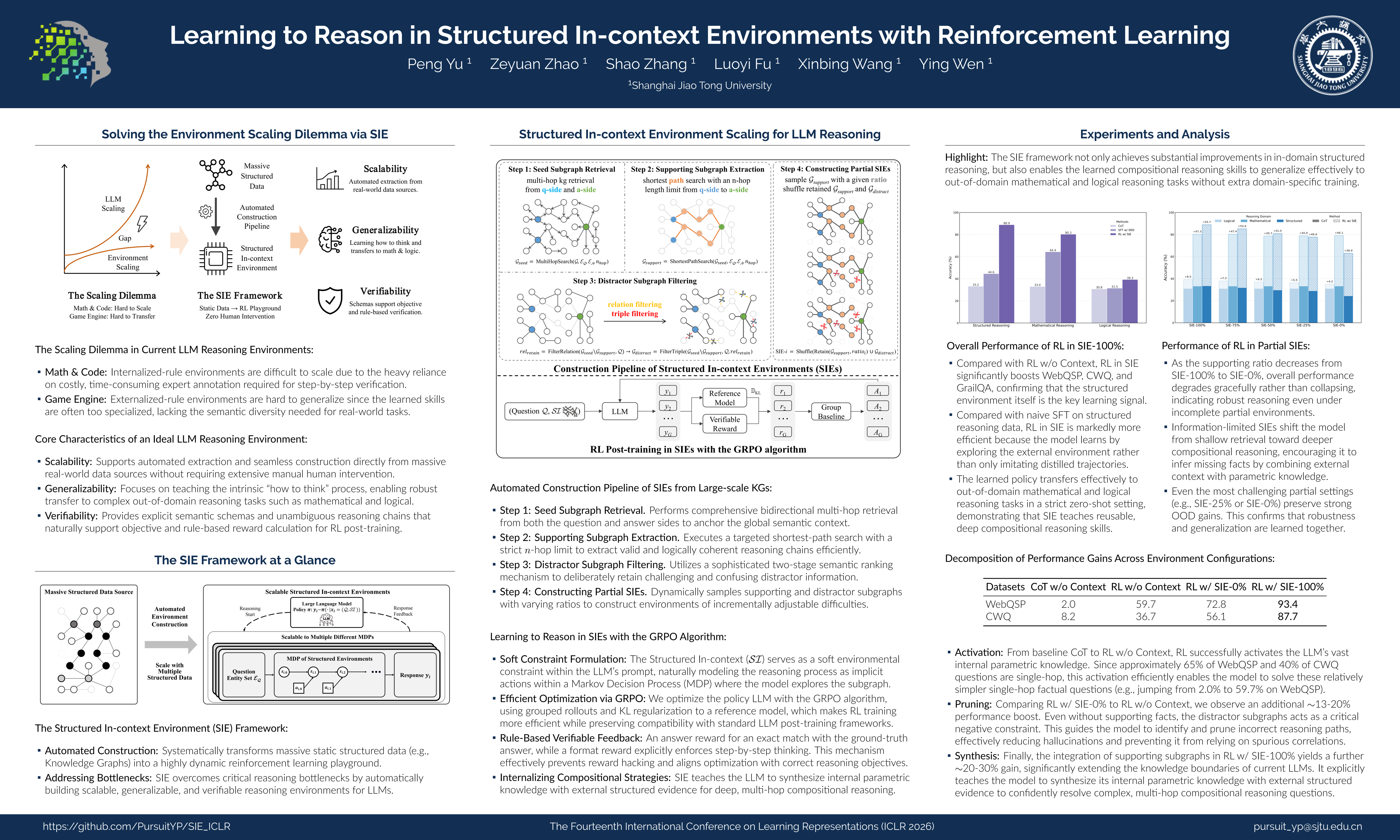
Large language models (LLMs) have achieved significant advancements in reasoning capabilities through reinforcement learning (RL) via environmental exploration. As the intrinsic properties of the environment determine the abilities that LLMs can learn, the environment plays an important role in the RL finetuning process. An ideal LLM reasoning environment should possess three core characteristics: scalability, generalizable reasoning, and verifiability. However, existing mathematical and coding environments are difficult to scale due to heavy reliance on expert annotation, while the skills learned in game-based environments are too specialized to generalize. To bridge this gap, we introduce the \textbf{S}tructured \textbf{I}n-context \textbf{E}nvironment (SIE) framework. SIE achieves scalability by automatically constructing reasoning environments from large-scale structured data, where the rich compositional patterns naturally support generalizable reasoning. Moreover, the explicit schemas and reasoning chains in structured data provide a foundation for rule-based verifiability. Experimental results show that the SIE framework not only achieves substantial improvements in in-domain structured reasoning, but also enables the learned compositional reasoning skills to generalize effectively to out-of-domain mathematical and logical reasoning tasks. We further explored learning in information-limited partial SIEs and found that LLMs can infer the missing information through exploring the environment, leading to robust reasoning improvements and generalization performance. Our code can be available at \url{https://github.com/PursuitYP/SIE_ICLR}.
Using maximal information auxiliary variables to improve synthetic data generation based on TabPFN foundation models
Elias Chaibub Neto
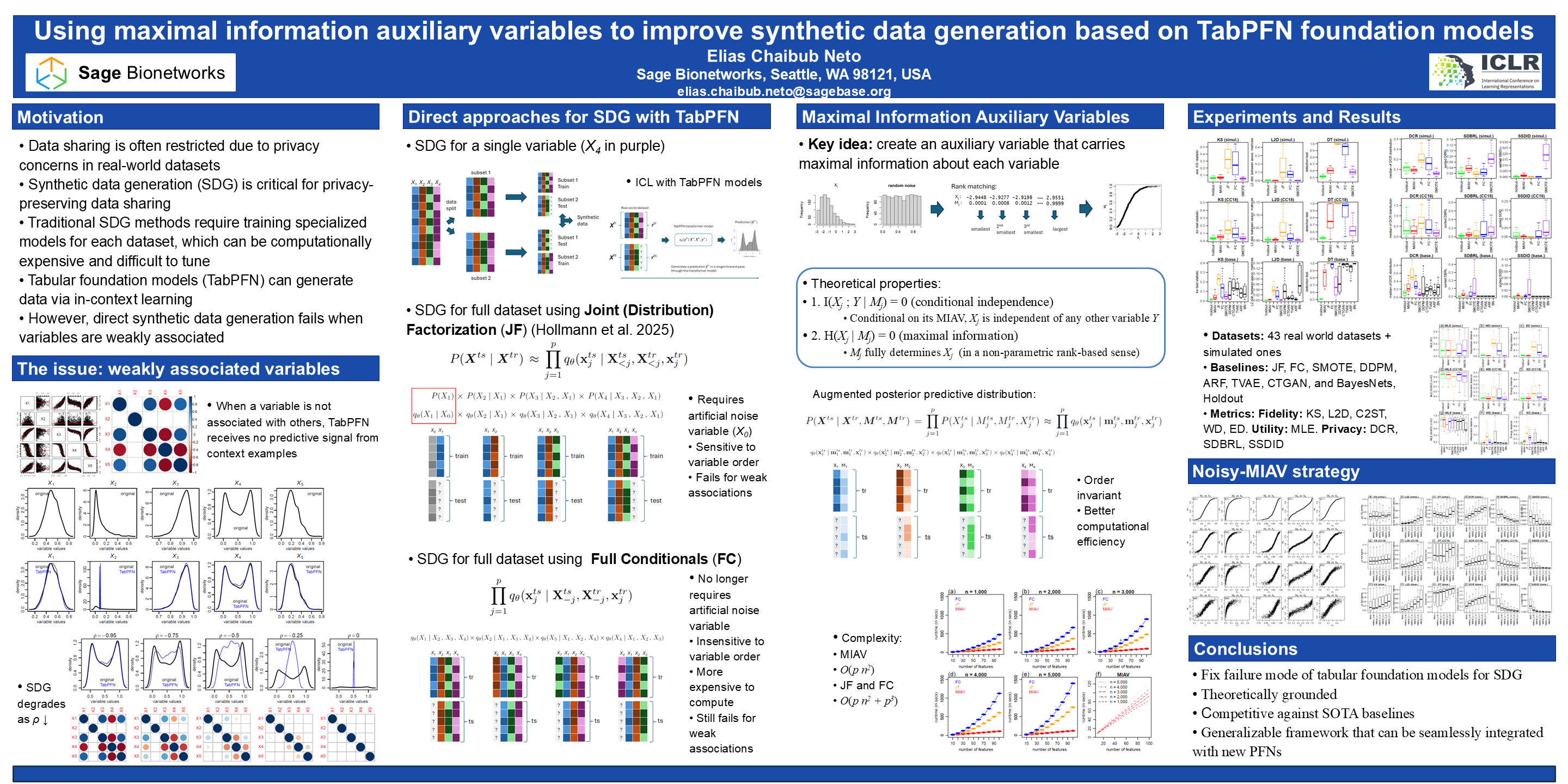
Synthetic data generation for tabular datasets is shifting toward the use of large, general-purpose foundation models. TabPFN, a state-of-the-art example, uses in-context learning to generate probabilistic predictions conditioned on observed examples in a single forward pass. However, when variables are only weakly associated with others, the model's ability to generate realistic synthetic data deteriorates, as the context examples provide little predictive signal. To address this, we introduce the maximal information auxiliary variable (MIAV) strategy, which increases context information with auxiliary variables constructed by rank-matching random noise variables to real data. We establish theoretical properties of the approach which explain its good performance for weakly associated variables. Additional practical advantages of the MIAV approach include improved computational efficiency and invariance to variable order during the synthetic data generation process. Empirical evaluations, on simulated and real datasets, illustrate how the MIAV strategy improves data generation when compared to direct application of TabPFN, and is competitive against other baselines. To illustrate the generality of the MIAV approach we also present an implementation based on the TabICL model (a more scalable tabular foundation model restricted to classification tasks) for performing synthetic data generation on categorical datasets. Overall, MIAV offers an effective foundation model–based alternative to bespoke synthetic data generators.
Is Finer Better? The Limits of Microscaling Formats in Large Language Models
Andrea Fasoli ⋅ Monodeep Kar ⋅ Chi-Chun Liu ⋅ Swagath Venkataramani ⋅ Viji Srinivasan ⋅ Leland Chang ⋅ Naigang Wang
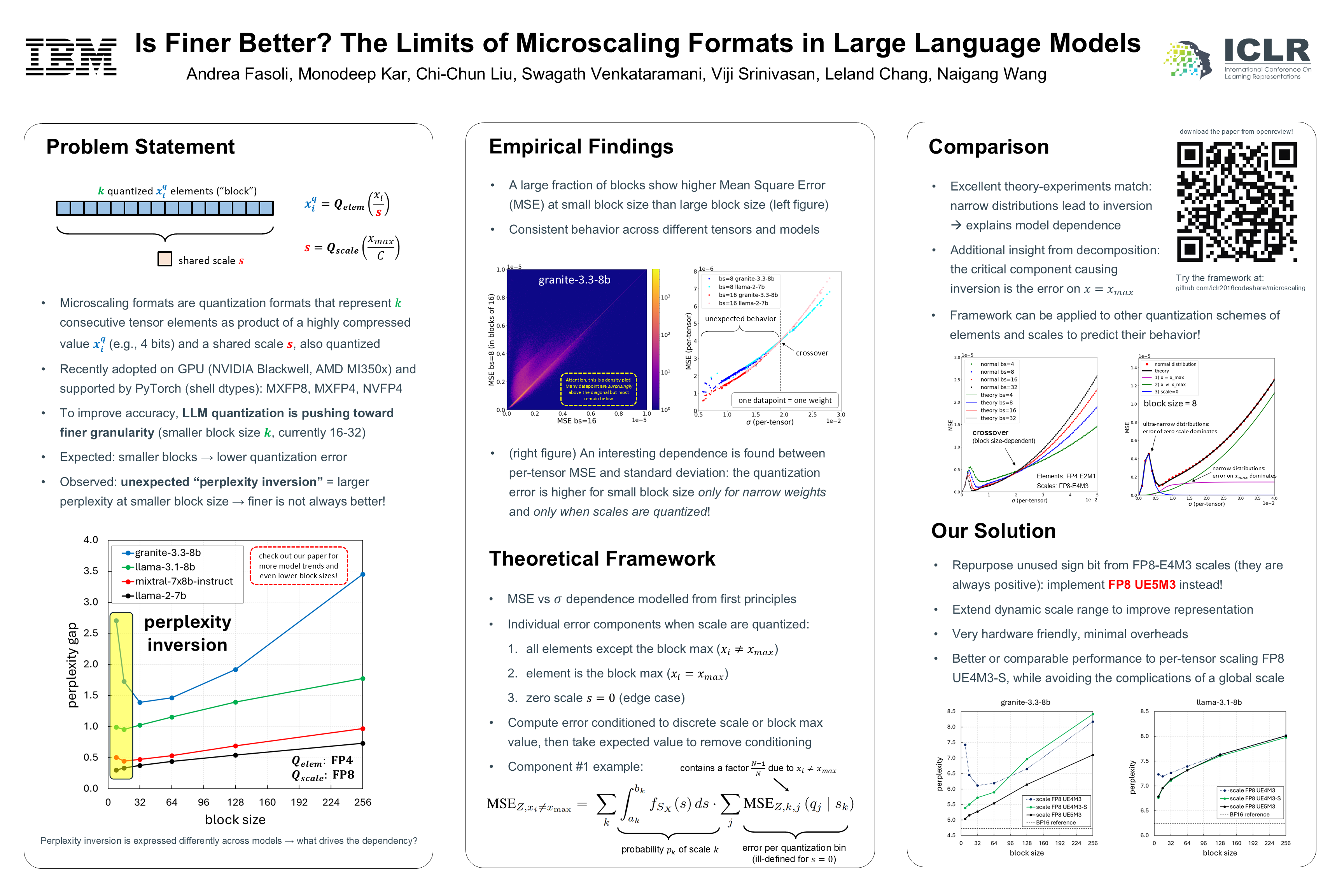
Microscaling data formats leverage per-block tensor quantization to enable aggressive model compression with limited loss in accuracy. Unlocking their potential for efficient training and inference necessitates hardware-friendly implementations that handle matrix multiplications in a native format and adopt efficient error-mitigation strategies. Herein, we reported the emergence of a surprising behavior associated with microscaling quantization, whereas the output of a quantized model degrades as block size is decreased below a given threshold. This behavior clashes with the expectation that a smaller block size should allow for a better representation of the tensor elements. We investigate this phenomenon both experimentally and theoretically, decoupling the sources of quantization error behind it. Experimentally, we analyze the distributions of several Large Language Models and identify the conditions driving the anomalous behavior. Theoretically, we lay down a framework showing remarkable agreement with experimental data from pretrained model distributions and ideal ones. Overall, we show that the anomaly is driven by the interplay between narrow tensor distributions and the limited dynamic range of the quantized scales. Based on these insights, we propose the use of FP8 unsigned E5M3 as a novel hardware-friendly format for the scales in FP4 microscaling data types. We demonstrate that UE5M3 achieves comparable performance to the conventional FP8 unsigned E4M3 scales while obviating the need of global scaling operations on weights and activations.
ProReGen: Progressive Residual Generation under Attribute Correlations
Ruby Shrestha ⋅ Ajay Gopi ⋅ Casey Meisenzahl ⋅ Bipin Lekhak ⋅ Linwei Wang
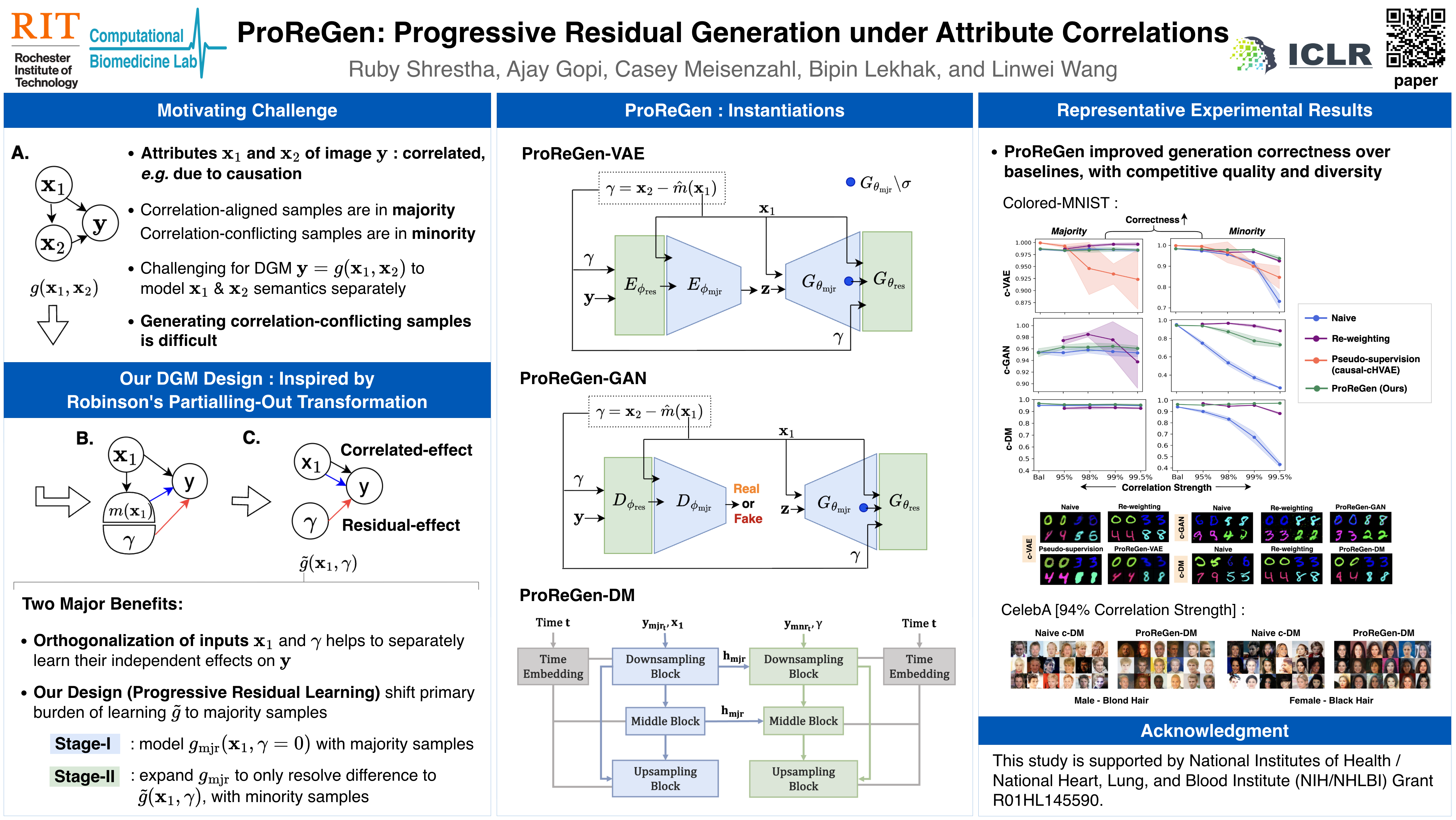
Attribute correlations in the training data will compromise the ability of a deep generative model (DGM) to synthesize images with under-represented attribute combinations ($\textit{i.e.,}$ minority samples). Existing approaches mitigate this by data re-sampling to remove attribute correlations seen by the DGM, using a classifier to provide $\textit{pseudo-supervision}$ on generated counterfactual samples, or incorporating inductive bias to explicitly decompose the generation into independent sub-mechanisms. We present ProReGen, a $\textit{progressive residual generation}$ approach inspired by the classical Robinson's transformation, to partial out from an image attribute $\mathbf{x}_2$ its component $m(\mathbf{x}_1)$ that is predictable by other image attributes $\mathbf{x}_1$, and the residual $\gamma = \mathbf{x}_2 - m(\mathbf{x}_1)$ that is not. This simplifies the problem of learning a DGM $g(\mathbf{x}_1, \mathbf{x}_2)$ conditioned on correlated inputs, to learning $\tilde{g}(\mathbf{x}_1, \gamma)$ conditioned on orthogonal inputs. It further allows us to progressively learn $\tilde{g}$ by first shifting the burden to abundant majority samples to learn $\tilde{g}(\mathbf{x}_1, \gamma = 0)$, and then expanding it with additional layers $g\_{\text{res}}$ to resolve its difference to $\tilde{g}(\mathbf{x}_1, \gamma)$ using residual attribute $\gamma$ on limited minority samples. On three benchmark datasets with curated varying strengths of attribute correlation and one dataset with natural attribute correlation, we demonstrate that ProReGen---with input orthogonalization and progressive residual learning---improved the correctness of minority generations compared to existing strategies.
Rethinking the Diffusion Model from a Langevin Perspective
Candi Zheng ⋅ Yuan Lan
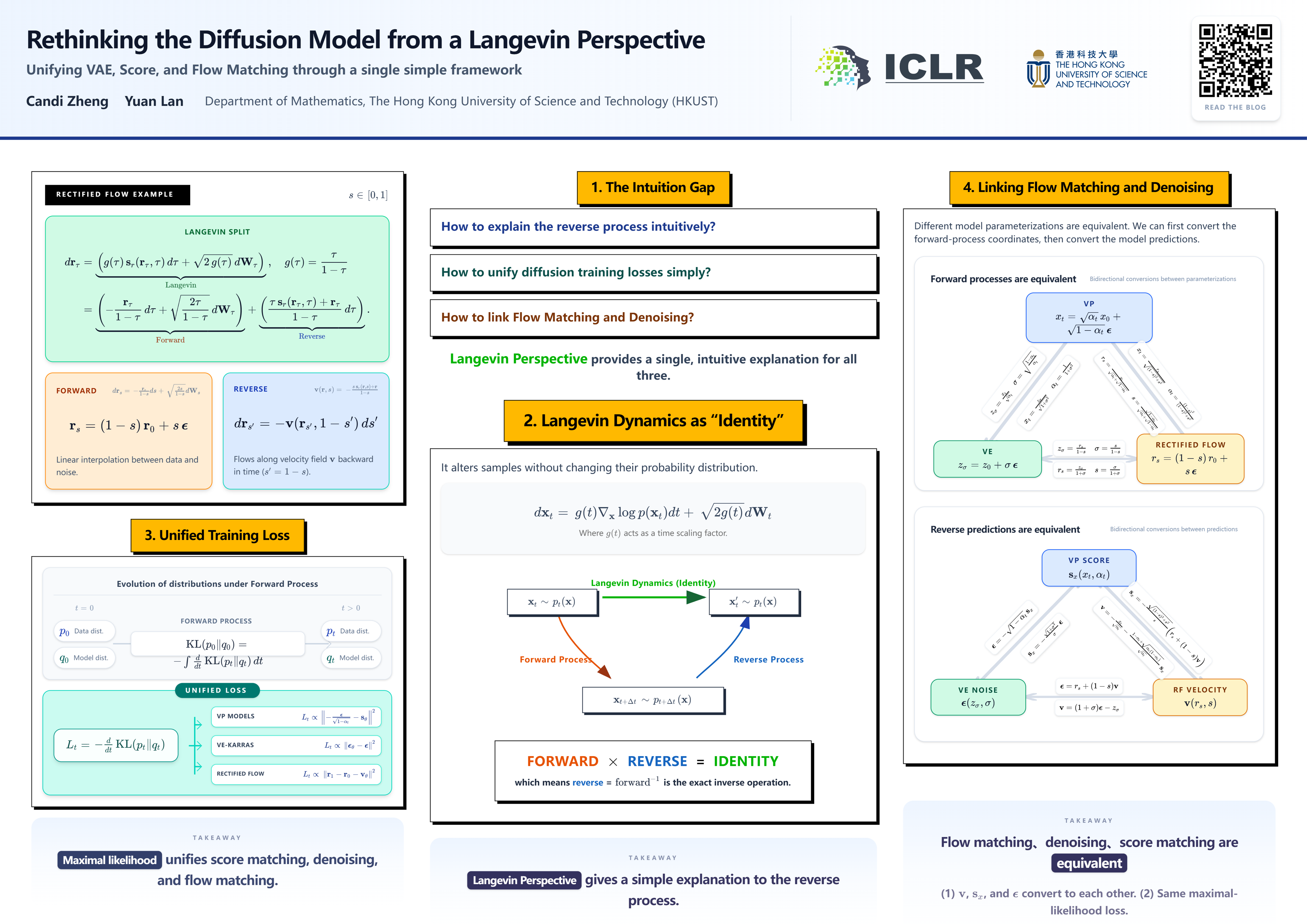
Diffusion models are often introduced from multiple perspectives—such as VAEs, score matching, or flow matching—accompanied by dense and technically demanding mathematics that can be difficult for beginners to grasp. This article offers a fresh Langevin perspective on diffusion models to lower the technical barrier, aiming to present diffusion models in a simpler, clearer, and more intuitive way while addressing the following questions: 1. How does the reverse process invert the forward process to generate data from pure noise? 2. How can ODE-based and SDE-based diffusion models be unified under a single framework? 3. Why are diffusion models theoretically superior to ordinary VAEs? 4. How can Denoising, Score Matching, and Flow Matching training objectives be unified and derived from first principles? We demonstrate that the Langevin perspective offers clear and straightforward answers to these questions, providing pedagogical value for both learners and experienced researchers seeking deeper intuition.
Tabby: A Language Model Architecture for Tabular and Structured Data Synthesis
Sonia Cromp · Satya Sai Srinath Namburi GNVV · Mohammed Alkhudhayri · Catherine Cao · Samuel Guo · Nicholas Roberts · Frederic Sala
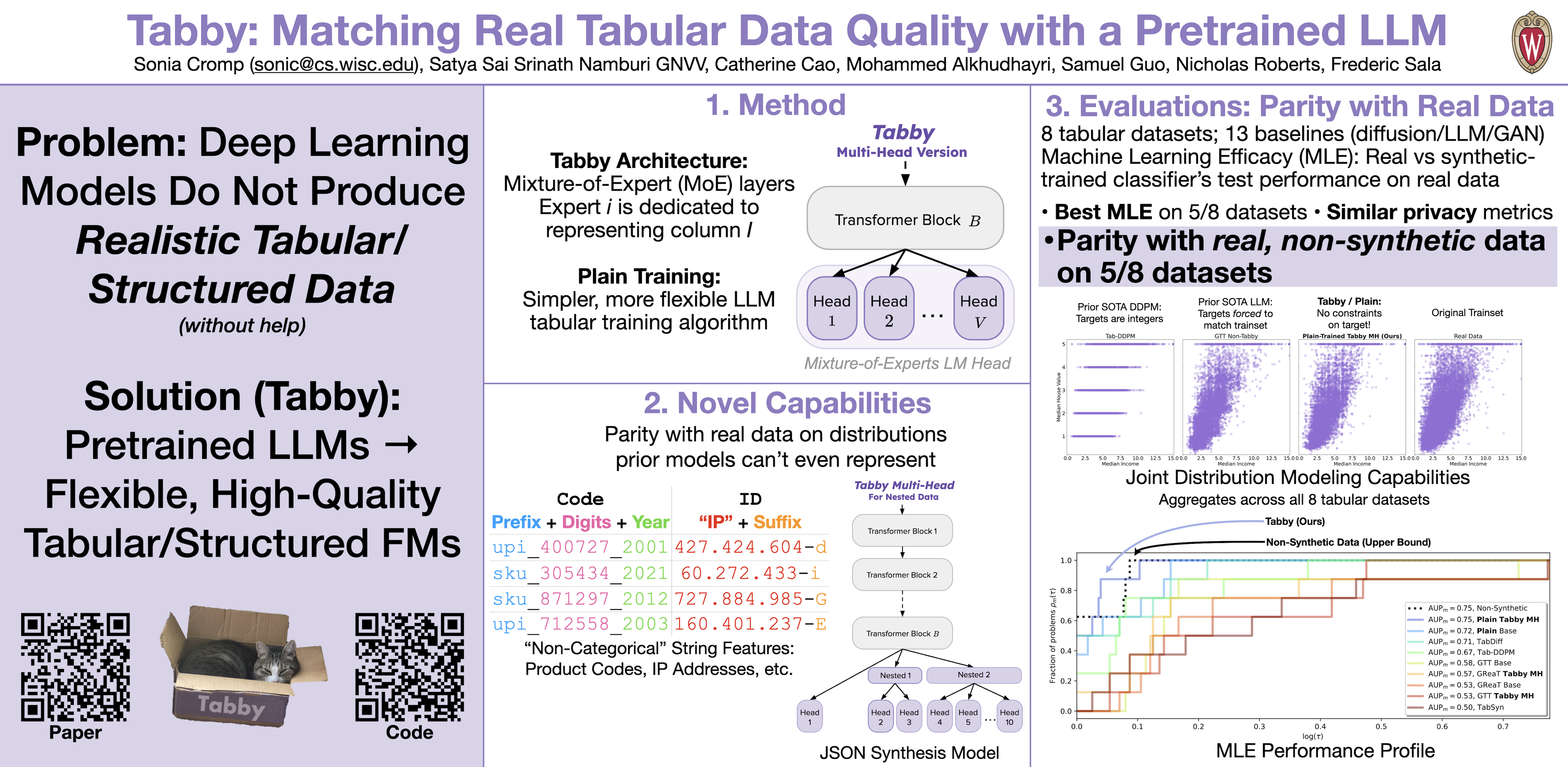
Large language models (LLMs) have greatly improved the quality of synthetic text data. We aim to extend these advances to tabular data with Tabby, a simple but powerful post-training modification to the standard Transformer language model architecture, enabling its use for tabular dataset synthesis. Tabby represents differences across columns using Gated Mixture-of-Experts, with column-specific sets of parameters. Empirically, Tabby results in data quality near or equal to that of real data. Pairing Tabby with Plain, our novel tabular training technique, we observe up to a $7\%$ improvement in quality (measured by MLE) over previous methods. Additionally, our approach is more flexible than prior strategies and extends beyond tables, to more general structured data. In a structured JSON setting, Tabby outperforms all other methods by $2$-$3$ points and is the only approach with MLE equal to the upper bound of non-synthetic data.
Canonical Tree Cover Neural Networks for Expressive and Invariant Graph Learning
Michael Ito ⋅ Danai Koutra ⋅ Jenna Wiens
While message-passing NNs (MPNNs) are naturally invariant on graphs, they are fundamentally limited in expressive power, oversmooth, and oversquash. Canonicalization offers a powerful alternative by mapping each graph to a unique, invariant representation on which expressive non-invariant encoders can operate. However, existing approaches rely on a single canonical sequence that distorts graph distances and restricts expressivity. To address these limitations, we introduce Canonical Tree Cover Neural Networks (CTNNs), which represent the graph with a canonical spanning tree cover. Each tree is then processed with an expressive tree encoder. Theoretically, tree covers better preserve graph distances in comparison to sequences, and on sparse graphs, the cover recovers all edges with a logarithmic number of trees in the graph size, making CTNNs strictly more expressive than sequence-based canonicalization approaches. Empirically, CTNNs consistently outperform invariant GNNs and sequence-based canonical GNNs across sparse molecular and protein graph classification benchmarks. Overall, CTNNs advance graph learning by providing an efficient, invariant, and expressive representation learning framework on sparse graphs via tree cover-based canonicalization.
On the Universality and Complexity of GNN for Solving Second-order Cone Programs
Ruizhe Li ⋅ Enming Liang ⋅ Minghua Chen
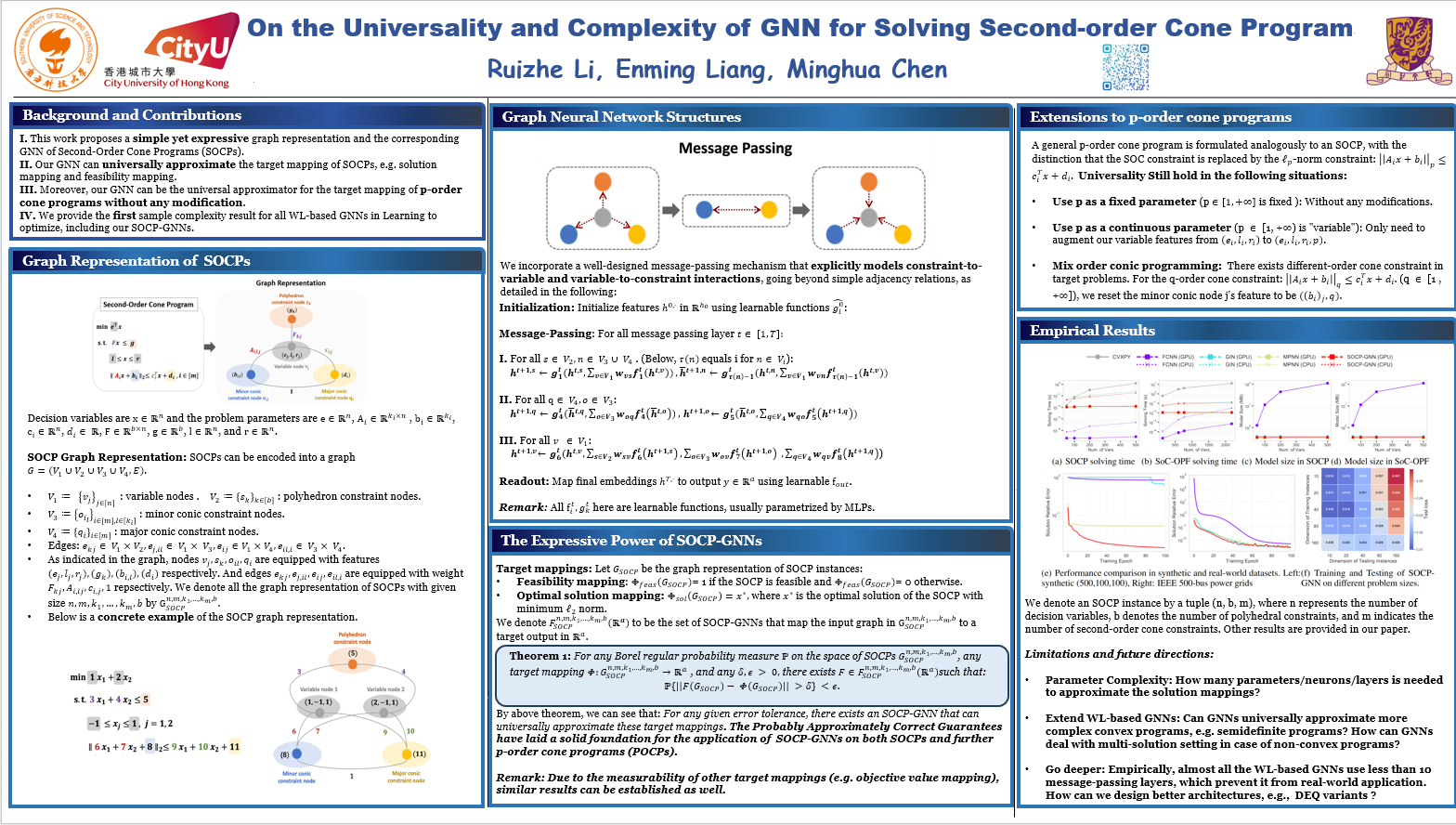
Graph Neural Networks (GNNs) have demonstrated both empirical efficiency and universal expressivity for solving constrained optimization problems such as linear and quadratic programming. However, extending this paradigm to more general convex problems with universality guarantees, particularly Second-Order Cone Programs (SOCPs), remains largely unexplored. We address this challenge by proposing a novel graph representation that captures the inherent structure of conic constraints. We then establish a key universality theorem: *there exist GNNs that can provably approximate essential SOCP properties, including instance feasibility and optimal solutions*. We further derive the sample complexity for GNN generalization based on Rademacher complexity, filling an important gap for Weisfeiler-Lehman-based GNNs in learning-to-optimize paradigms. Our results provide a rigorous foundation linking GNN expressivity and generalization power to conic optimization structure, opening new avenues for scalable, data-driven SOCP solvers. The approach extends naturally to $p$-order cone programming for any $p \geq 1$ while preserving universal expressivity and requiring no structural modifications to the GNN architecture. Numerical experiments on randomly generated SOCPs and real-world power grid problems demonstrate the effectiveness of our approach, achieving superior prediction accuracy with significantly fewer parameters than fully connected neural networks.
DR-GGAD: Dual Residual Centering for Mitigating Anomaly Non‑Discriminativity in Generalist Graph Anomaly Detection
Changlong Fu ⋅ Zhenli He ⋅ Xiong Zhang ⋅ Cheng Xie ⋅ Xin Jin ⋅ Yun Yang
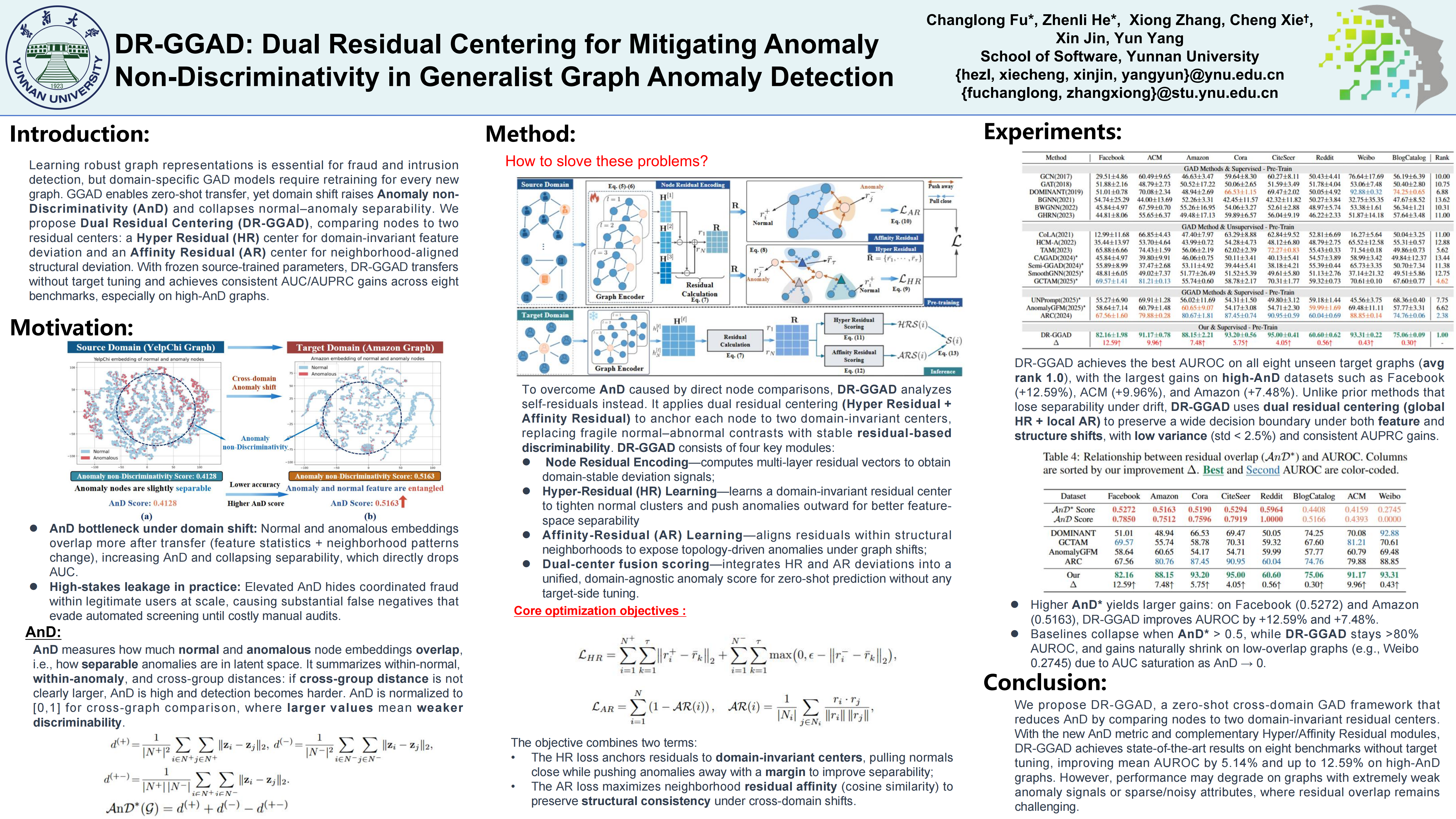
Generalist Graph Anomaly Detection (GGAD) seeks a unified representation learning model to detect anomalies in unseen graphs, but cross-domain transfer often entangles the learned anomalous and normal representations. We formalize this degradation as Anomaly non-Discriminativity (AnD) and define a normalized score to quantify it. We present DR-GGAD, which avoids direct comparison between anomalous and normal nodes via two residual modules: 1) a multi-scale Hyper Residual (HR) Center measuring node-to-center distances, yielding a compact normal residual structure with margin-pushed anomalies; 2) an Affinity-Residual (AR) module enforcing local residual directional consistency to recover structural separability. With frozen parameters (no target fine-tuning), DR-GGAD fuses both signals into a unified score. On 8 benchmark target graphs, it achieves new SOTA: mean AUROC +5.14% over the best prior GGAD, with large gains on high-AnD datasets (ACM +9.96%, Amazon +7.48%) and strong AUPRC boosts (Amazon +17.12%, CiteSeer +17.77%). Ablations confirm complementary roles of the two modules. DR-GGAD thus establishes AnD as a measurable bottleneck and delivers robust cross-domain anomaly detection.
Any-Subgroup Equivariant Networks via Symmetry Breaking
Abhinav Goel ⋅ Derek Lim ⋅ Hannah Lawrence ⋅ Stefanie Jegelka ⋅ Ningyuan Huang
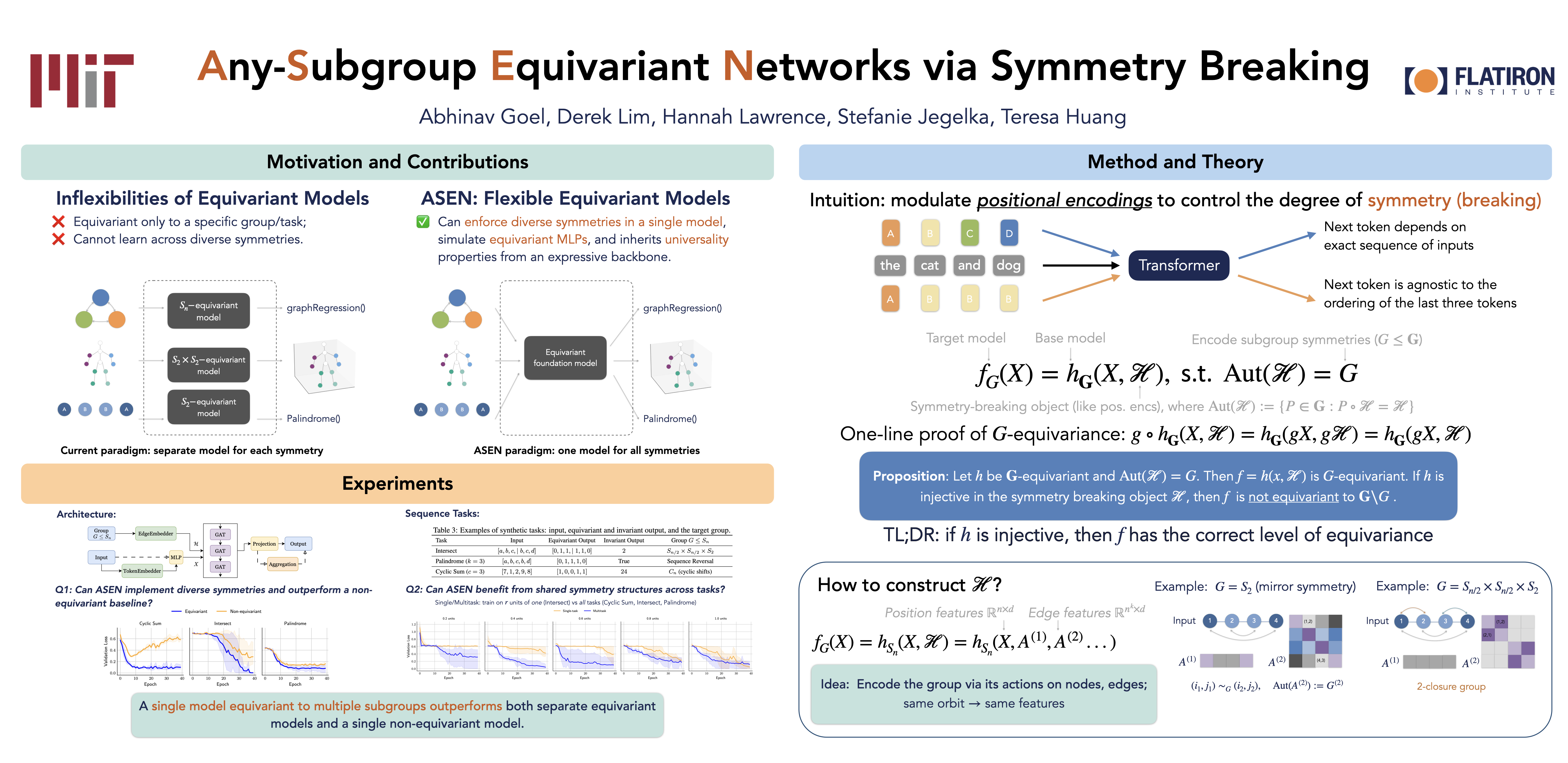
The inclusion of symmetries as an inductive bias, known as equivariance, often improves generalization on geometric data (e.g. grids, sets, and graphs). However, equivariant architectures are usually highly constrained, designed for symmetries chosen a priori, and not applicable to datasets with other symmetries. This precludes the development of flexible, multi-modal foundation models capable of processing diverse data equivariantly. In this work, we build a single model --- the Any-Subgroup Equivariant Network (ASEN) --- that can be simultaneously equivariant to several groups, simply by modulating a certain auxiliary input feature. In particular, we start with a fully permutation-equivariant base model, and then obtain subgroup equivariance by using a symmetry-breaking input whose automorphism group is that subgroup. However, finding an input with the desired automorphism group is computationally hard. We overcome this by relaxing from exact to approximate symmetry breaking, leveraging the notion of 2-closure to derive fast algorithms. Theoretically, we show that our subgroup-equivariant networks can simulate equivariant MLPs, and their universality can be guaranteed if the base model is universal. Empirically, we validate our method on symmetry selection for graph and image tasks, as well as multitask and transfer learning for sequence tasks, showing that a single network equivariant to multiple permutation subgroups outperforms both separate equivariant models and a single non-equivariant model.
GraphUniverse: Synthetic Graph Generation for Evaluating Inductive Generalization
Louis Emiel T Van Langendonck ⋅ Guillermo Bernardez ⋅ Nina Miolane ⋅ Pere Barlet-Ros
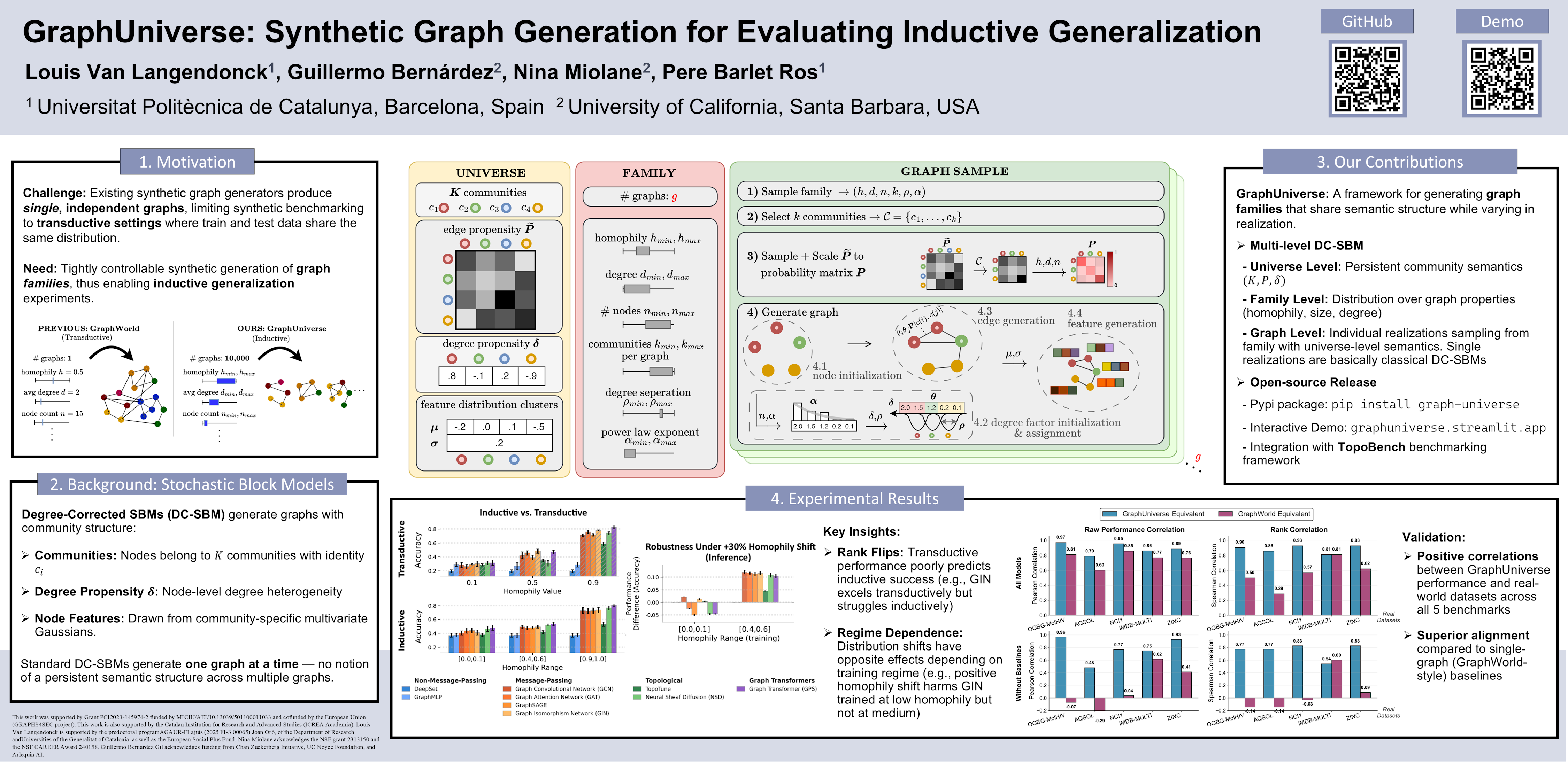
A fundamental challenge in graph learning is understanding how models generalize to new, unseen graphs. While synthetic benchmarks offer controlled settings for analysis, existing approaches are confined to single-graph, transductive settings where models train and test on the same graph structure. Addressing this gap, we introduce GraphUniverse, a framework for generating entire families of graphs to enable the first systematic evaluation of inductive generalization at scale. Our core innovation is the generation of graphs with persistent semantic communities, ensuring conceptual consistency while allowing fine-grained control over structural properties like homophily and degree distributions. This enables crucial but underexplored robustness tests, such as performance under controlled distribution shifts. Benchmarking a wide range of architectures—from GNNs to graph transformers and topological architectures—reveals that strong transductive performance is a poor predictor of inductive generalization. Furthermore, we find that robustness to distribution shift is highly sensitive not only to model architecture choice but also to the initial graph regime (e.g., high vs. low homophily). Beyond benchmarking, GraphUniverse’s flexibility and scalability can facilitate the development of robust and truly generalizable architectures. An interactive demo is available at https://graphuniverse.streamlit.app.
Physics-Inspired All-Pair Interaction Learning for 3D Dynamics Modeling
Kai Yang ⋅ Yuqi Huang ⋅ Junheng Tao ⋅ Wanyu Wang ⋅ Qitian Wu
Modeling 3D dynamics is a fundamental problem in multi-body systems across scientific and engineering domains and has important practical implications in trajectory prediction and simulation. While recent GNN-based approaches have achieved strong performance by enforcing geometric symmetries, encoding high-order features or incorporating neural-ODE mechanics, they typically depend on explicitly observed structures and inherently fail to capture the unobserved interactions that are crucial to complex physical behaviors and dynamics mechanism. In this paper, we propose PAINET, a principled SE(3)-equivariant neural architecture for learning all-pair interactions in multi-body systems. The model comprises: (1) a novel physics-inspired attention network derived from the minimization trajectory of an energy function, and (2) a parallel decoder that preserves equivariance while enabling efficient inference. Empirical results on diverse real-world benchmarks, including human motion capture, molecular dynamics, and large-scale protein simulations, show that PAINET consistently outperforms recently proposed models, yielding 4.7% to 41.5% error reductions in 3D dynamics prediction with comparable computation costs in terms of time and memory. Our codes, baseline models and datasets are available at https://github.com/Icarus1411/PAINET.
On The Expressive Power of GNN Derivatives
Yam Eitan ⋅ Moshe Eliasof ⋅ Yoav Gelberg ⋅ Fabrizio Frasca ⋅ Guy Bar-Shalom ⋅ Haggai Maron
Despite significant advances in Graph Neural Networks (GNNs), their limited expressivity remains a fundamental challenge. Research on GNN expressivity has produced many expressive architectures, leading to architecture hierarchies with models of increasing expressive power. Separately, derivatives of GNNs with respect to node features have been widely studied in the context of the oversquashing and over-smoothing phenomena, GNN explainability, and more. To date, these derivatives remain unexplored as a means to enhance GNN expressivity. In this paper, we show that these derivatives provide a natural way to enhance the expressivity of GNNs. We introduce High-Order Derivative GNN (HOD-GNN), a novel method that enhances the expressivity of Message Passing Neural Networks (MPNNs) by leveraging high-order node derivatives of the base model. These derivatives generate expressive structure-aware node embeddings processed by a second GNN in an end-to-end trainable architecture. Theoretically, we show that the resulting architecture family's expressive power aligns with the WL hierarchy. We also draw deep connections between HOD-GNN, Subgraph GNNs, and popular structural encoding schemes. For computational efficiency, we develop a message-passing algorithm for computing high-order derivatives of MPNNs that exploits graph sparsity and parallelism. Evaluations on popular graph learning benchmarks demonstrate HOD-GNN’s strong performance on popular graph learning tasks.
A Bayesian Nonparametric Framework For Learning Disentangled Representations
Vaishnavi Patil ⋅ Siddhi Patil ⋅ Matthew Evanusa ⋅ Amit Kumar Kundu ⋅ Cornelia Fermuller ⋅ Joseph JaJa
Disentangled representation learning aims to identify and organize the underlying sources of variation in observed data. However, learning disentangled representations from observational data alone without any additional supervision necessitates inductive biases to solve the fundamental identifiability problem of uniquely recovering the true latent structure and parameters of the data-generating process. Existing methods address this by imposing heuristic inductive biases that typically lack these theoretical identifiability guarantees. Additionally, these methods rely on strong regularization to impose these inductive biases, creating an inherent trade-off in which stronger regularization improves disentanglement but limits the latent capacity to represent underlying variations. To address both challenges, we propose a principled generative model with a Bayesian nonparametric hierarchical mixture prior that embeds inductive biases within a provably identifiable framework for unsupervised disentanglement. Specifically, the hierarchical mixture prior imposes the structural constraints necessary for identifiability guarantees, while the nonparametric formulation allows the latent representation to scale with infinite capacity to faithfully represent the complete set of underlying variations without violating these structural constraints. To enable tractable inference under this nonparametric hierarchical prior, we develop a structured variational inference framework with a nested variational family that both preserves the hierarchical structure of the identifiable generative model and approximates the expressiveness of the nonparametric prior. We evaluate our proposed probabilistic model on standard disentanglement benchmarks, 3DShapes and MPI3D datasets characterized by diverse source variation distributions, to demonstrate that our method consistently outperforms strong baseline models through structural biases and a unified objective function, obviating the need for auxiliary regularization constraints or careful hyperparameter tuning.
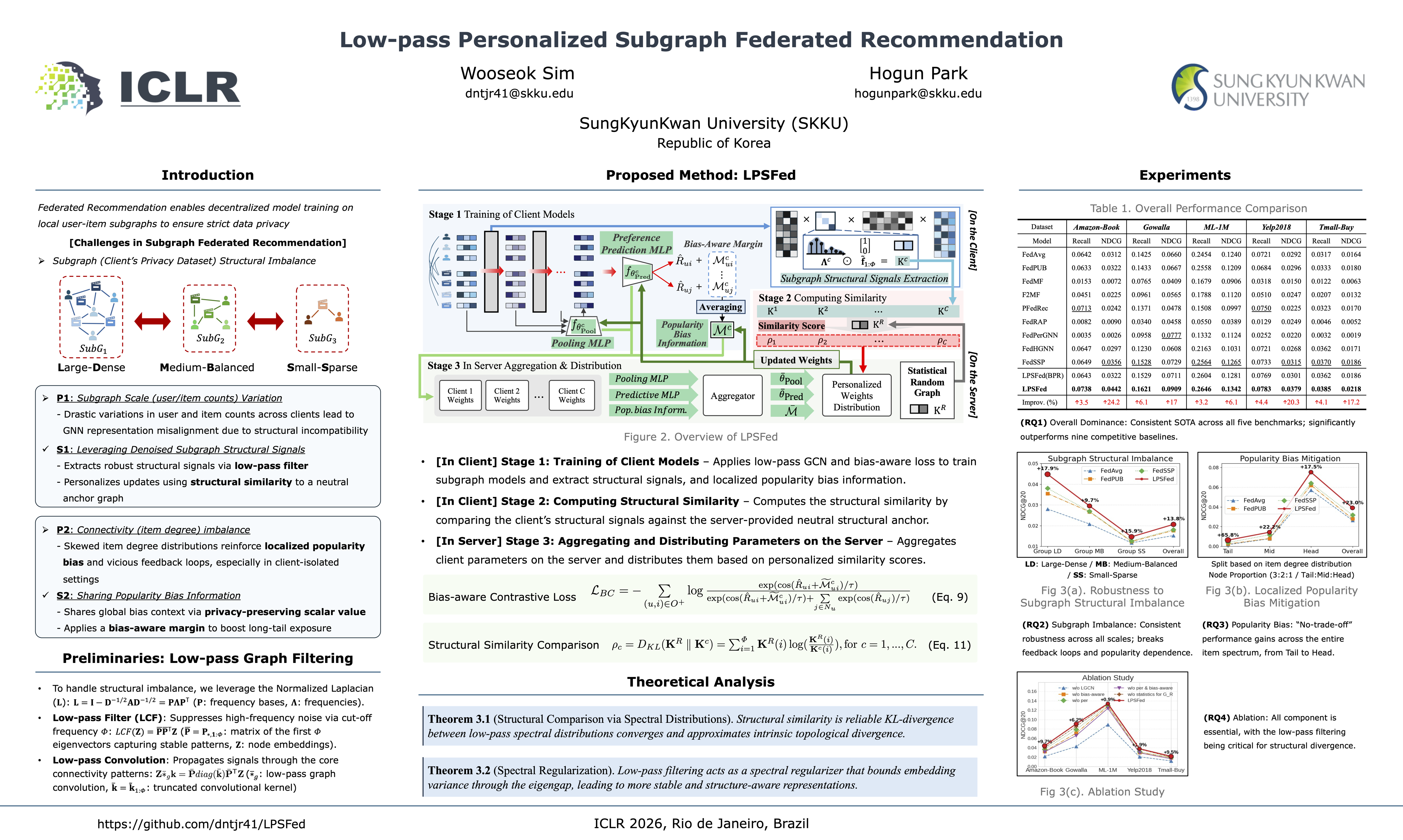
Federated Recommender Systems (FRS) preserve privacy by training decentralized models on client-specific user-item subgraphs without sharing raw data. However, FRS faces a unique challenge: subgraph structural imbalance, where drastic variations in subgraph scale (user/item counts) and connectivity (item degree) misalign client representations, making it challenging to train a robust model that respects each client’s unique structural characteristics. To address this, we propose a Low-pass Personalized Subgraph Federated recommender system (LPSFed). LPSFed leverages graph Fourier transforms and low-pass spectral filtering to extract low-frequency structural signals that remain stable across subgraphs of varying size and degree, allowing robust personalized parameter updates guided by similarity to a neutral structural anchor. Additionally, we leverage a localized popularity bias-aware margin that captures item-degree imbalance within each subgraph and incorporates it into a personalized bias correction term to mitigate recommendation bias. Supported by theoretical analysis and validated on five real-world datasets, LPSFed achieves superior recommendation accuracy and enhances model robustness.
LRIM: a Physics-Based Benchmark for Provably Evaluating Long-Range Capabilities in Graph Learning
Joël Mathys ⋅ Henrik Christiansen ⋅ Federico Errica ⋅ Takashi Maruyama ⋅ Francesco Alesiani
Accurately modeling long-range dependencies in graph-structured data is critical for many real-world applications. However, incorporating long-range interactions beyond the nodes' immediate neighborhood in a $\textit{scalable}$ manner remains an open challenge for graph machine learning models. Existing benchmarks for evaluating long-range capabilities either cannot $\textit{guarantee}$ that their tasks actually depend on long-range information or are rather limited. Therefore, claims of long-range modeling improvements based on said performance remain questionable. We introduce the Long-Range Ising Model Graph Benchmark, a physics-based benchmark utilizing the well-studied Ising model whose ground truth $\textit{provably}$ depends on long-range dependencies. Our benchmark consists of ten datasets that scale from 256 to 65k nodes per graph, and provide controllable long-range dependencies through tunable parameters, allowing precise control over the hardness and ``long-rangedness". We provide model-agnostic evidence that local information is insufficient, further validating the design choices of our benchmark. Via experiments on classical message-passing architectures and graph transformers, we show that both perform far from the optimum, especially those with scalable complexity. Our goal is that our benchmark will foster the development of scalable methodologies that effectively model long-range interactions in graphs.
Atomic HINs: Entity-Attribute Duality for Heterogeneous Graph Modeling
Shao-En Lin ⋅ Ming-Yi Hong ⋅ Miao-Chen Chiang ⋅ Chih-Yu Wang ⋅ Che Lin
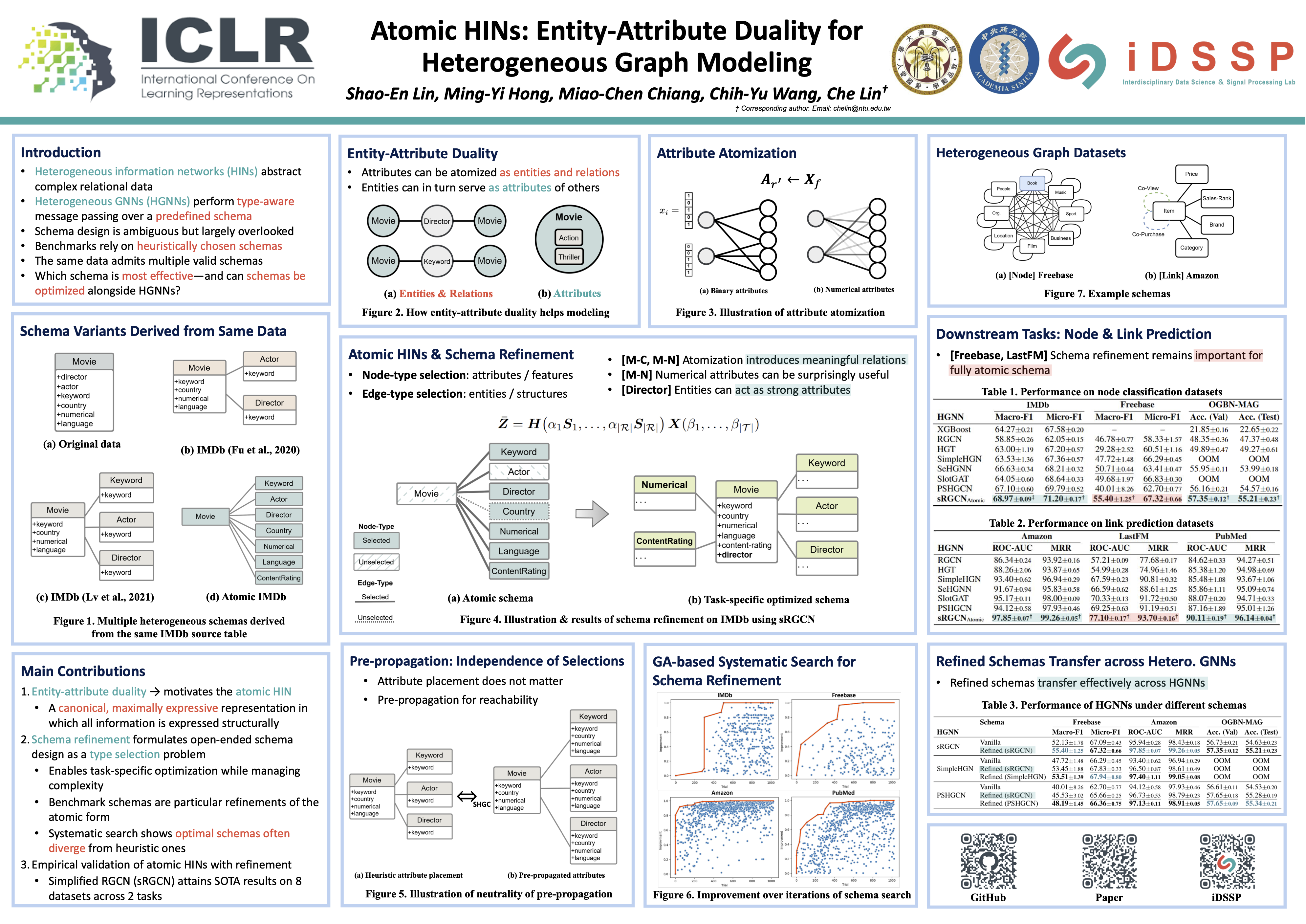
Heterogeneous Information Networks (HINs) provide a powerful framework for modeling multi-typed entities and relations, typically defined under a fixed schema. Yet, most research assumes this structure is given, overlooking the fact that alternative designs can emphasize different aspects of the data and substantially influence downstream performance. As a theoretical foundation for such designs, we introduce the principle of entity-attribute duality: attributes can be atomized as entities with their associated relations, while entities can, in turn, serve as attributes of others. This principle motivates atomic HIN, a canonical representation that makes all modeling choices explicit and achieves maximal expressiveness. Building on this foundation, we propose a systematic framework for task-specific schema refinement. Within this framework, we demonstrate that widely used benchmarks correspond to heuristic refinements of the atomic HIN—often far from optimal. Across eight datasets, refinement alone enables a simplified Relational GCN (sRGCN) to achieve state-of-the-art performance on node- and link-level tasks, with further gains from advanced HGNNs. These results highlight schema design as a key dimension in heterogeneous graph modeling. By releasing the atomic HINs, searched schemas, and refinement framework, we enable principled benchmarking and open the way for future work on schema-aware learning, automated structure discovery, and next-generation HGNNs. Our code is available at: https://github.com/ntuidssplab/AtomHIN.
Forest-Based Graph Learning for Semi-Supervised Node Classification
Jin Li ⋅ Shenghao Gao ⋅ Kaichen Zhang ⋅ Xinlong Chen ⋅ Ying Sun ⋅ Hui Xiong
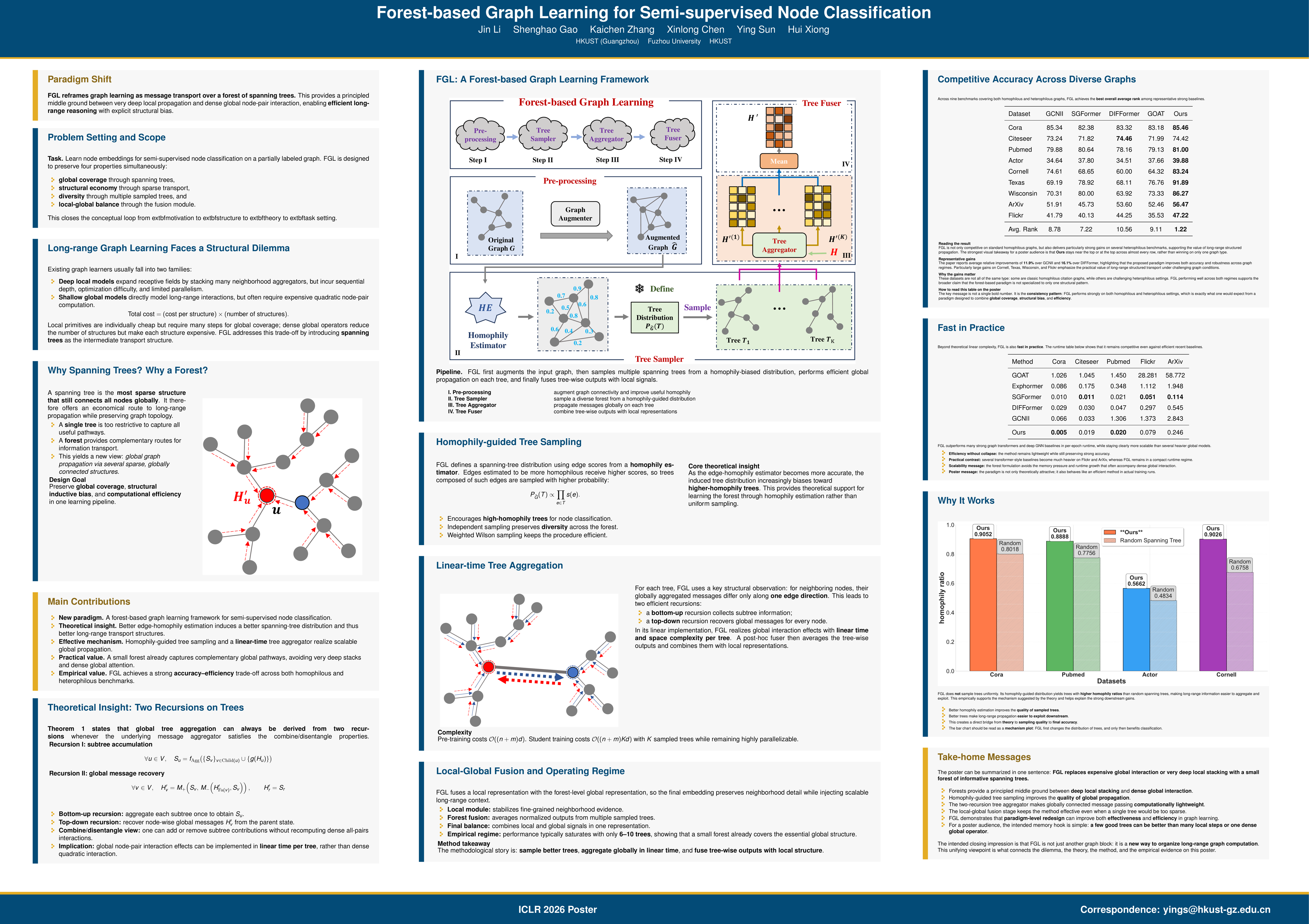
Existing Graph Neural Networks usually learn long-distance knowledge via stacked layers or global attention, but struggle to balance cost-effectiveness and global receptive field. In this work, we break the dilemma by proposing a novel forest-based graph learning (FGL) paradigm that enables efficient long-range information propagation. Our key insight is to reinterpret message passing on a graph as transportation over spanning trees that naturally facilitates long-range knowledge aggregation, where several trees--a forest--can capture complementary topological pathways. Theoretically, we demonstrate that as edge-homophily estimates improve, the induced distribution biases towards higher-homophily trees, which enables generating a high-quality forest by refining a homophily estimator. Furthermore, we propose a linear-time tree aggregator that realizes quadratic node-pair interactions. Empirically, our framework achieves comparable results against state-of-the-art counterparts on semi-supervised node classification tasks while remaining efficient. Codes are available at \url{https://anonymous.4open.science/r/FGL/}.
Synchronizing Probabilities in Model-Driven Lossless Compression
Aviv Adler ⋅ Jennifer Tang
It is well-known in the field of lossless data compression that probabilistic next-symbol prediction can be used to compress sequences of symbols. Deep neural networks are able to capture rich dependencies in data, offering a powerful means of estimating these probabilities and hence an avenue towards more effective compression algorithms. However, both compressor and decompressor must have exactly matching predictions; even small differences from non-determinism (which often happen with learned models due to hardware, software, or computation order) can lead to cascading decoding failures. In this paper, we formalize the problem of prediction mismatch in model-driven compression, and introduce Probability Matching Interval Coding (PMATIC), a model-agnostic algorithm that tolerates bounded prediction mismatch with low overhead. PMATIC works with the predicted probabilities, making it compatible as a drop-in replacement for the arithmetic encoder in model-driven compression tools. We show theoretical correctness and performance bounds for PMATIC, and validate these results on text data. These results confirm that, when paired an advanced prediction model, PMATIC is robust to prediction mismatch while achieving compression rates that out-perform standard modern compression tools.
Discrete Latent Features Ablate Adversarial Attack: A Robust Prompt Tuning Framework for VLMs
YANG CHEN ⋅ Yanbin Wei ⋅ James Kwok ⋅ Yu Zhang
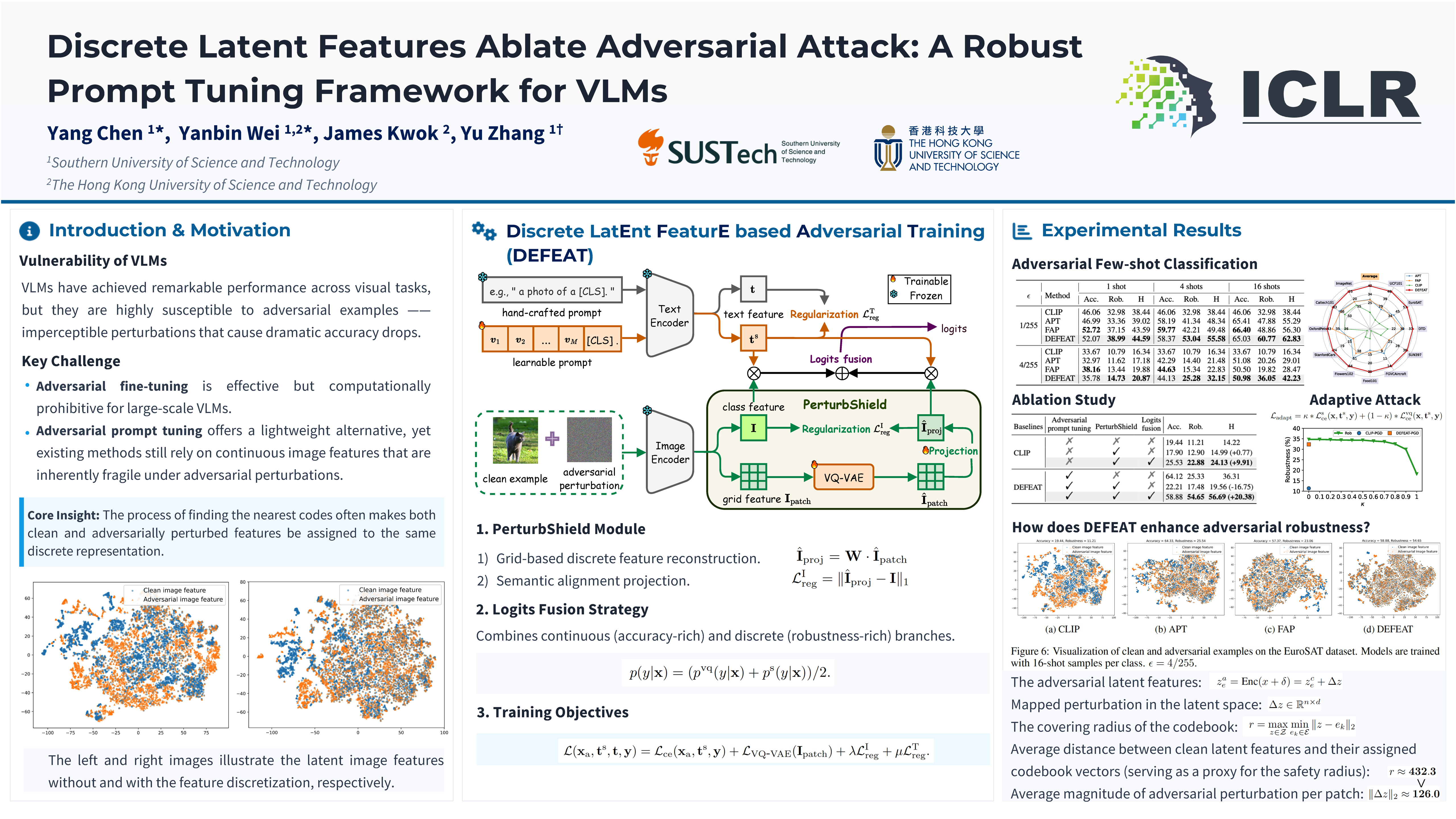
While adversarial fine-tuning can enhance the robustness of vision-language models (VLMs), such approaches are computationally expensive. Adversarial prompt tuning has emerged as a practical alternative. However, existing methods are limited by their reliance on vulnerable continuous image features. To mitigate the vulnerability in the feature representation, we propose DEFEAT (Discrete LatEnt FeaturE based Adversarial Training), a robust prompt tuning framework for VLMs. Specifically, the DEFEAT method introduces a perturbation discrete shield module that reconstructs discrete latent features and designs a logits fusion strategy, substantially reducing the discrepancy between clean and adversarial image representations. Moreover, the DEFEAT method integrates prompt tuning with adversarial training while applying regularization from learnable prompts to hand-crafted prompts, further enhancing the adversarial robustness. Extensive experiments across 15 datasets validate the effectiveness of the proposed DEFEAT method among existing adversarial prompt tuning methods. The official code is available at https://github.com/cheny02/DEFEAT-ICLR2026.
Constitutional Classifiers++: Efficient Production-Grade Defenses against Universal Jailbreaks
Hoagy Cunningham ⋅ Jerry Wei ⋅ Zihan Wang ⋅ Andrew Persic ⋅ Alwin Peng ⋅ Jordan Abderrachid ⋅ Raj Agarwal ⋅ Bobby Chen ⋅ Andy Dau ⋅ Alek Dimitriev ⋅ Logan Howard ⋅ Yijin Hua ⋅ Rob Gilson ⋅ Mu Lin ⋅ Christopher Liu ⋅ Vladimir Mikulik ⋅ Rohit Mittapalli ⋅ Clare O'Hara ⋅ Jin Pan ⋅ Nikhil Saxena ⋅ Alex Silverstein ⋅ Yue Song ⋅ Giulio Zhou ⋅ Jan Leike ⋅ Jared Kaplan ⋅ Ethan Perez ⋅ Mrinank Sharma
We introduce enhanced Constitutional Classifiers that deliver production-grade jailbreak robustness with dramatically reduced computational costs and refusal rates compared to previous-generation defenses. Our system combines several key insights. First, we develop exchange classifiers that evaluate model responses in their full conversational context, which addresses vulnerabilities in last-generation systems that examine outputs in isolation. Second, we implement a two-stage classifier cascade where lightweight classifiers screen all traffic and escalate only suspicious exchanges to more expensive classifiers. Third, we train efficient linear probe classifiers and ensemble them with external classifiers to simultaneously improve robustness and reduce computational costs. Together, these techniques yield a production-grade system achieving a 40x computational cost reduction compared to our baseline exchange classifier, while maintaining a 0.05% refusal rate on production traffic. Through extensive red-teaming comprising over 1,700 hours, we demonstrate strong protection against universal jailbreaks---no attack on this system successfully elicited responses to all eight target queries comparable in detail to an undefended model. Our work establishes Constitutional Classifiers as practical and efficient safeguards for large language models.
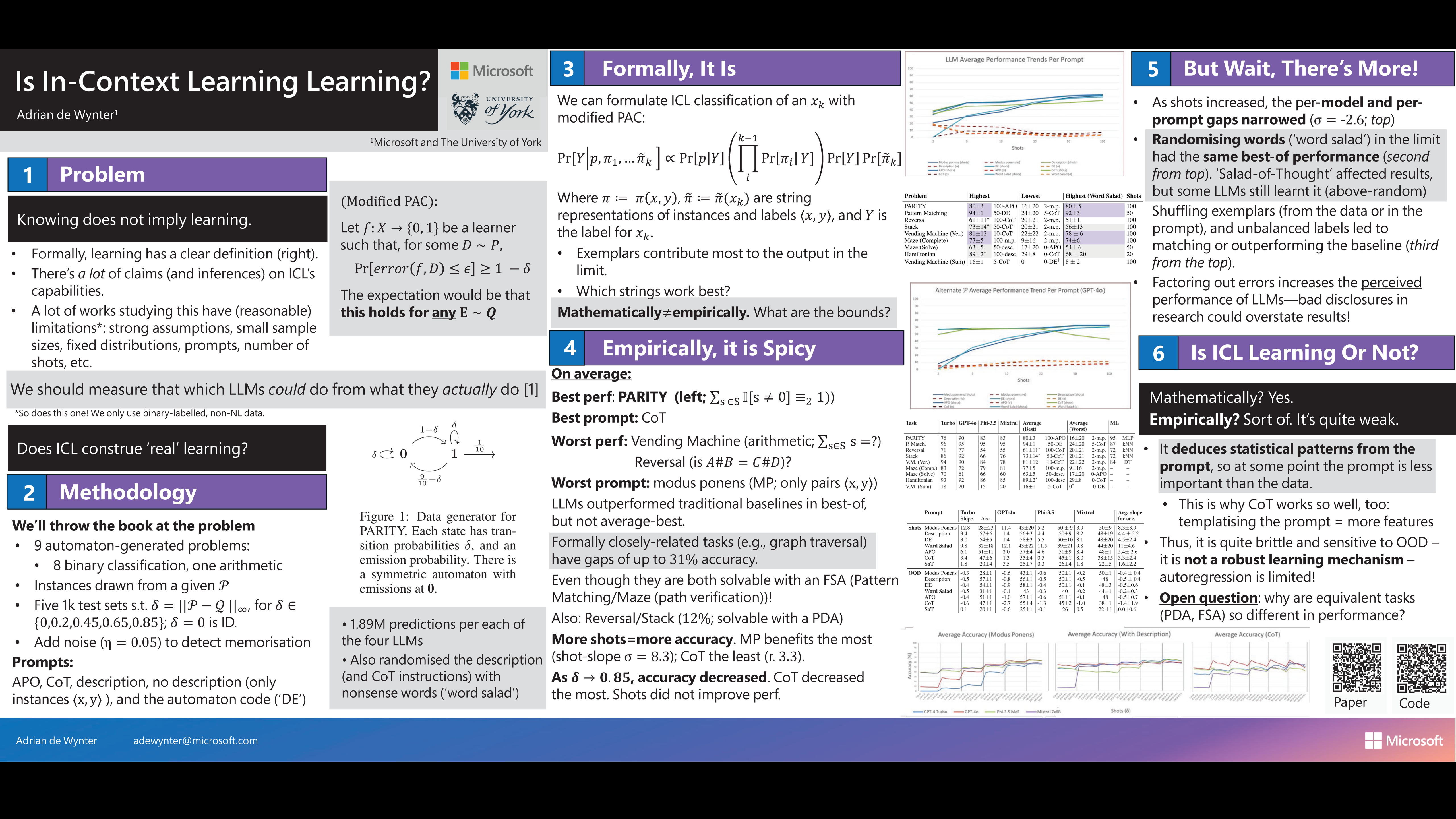
In-context learning (ICL) allows some autoregressive models to solve tasks via next-token prediction and without needing further training. This has led to claims about these model's ability to solve (learn) unseen tasks with only a few shots (exemplars) in the prompt. However, deduction does not always imply learning, as ICL does not explicitly encode a given observation. Instead, the models rely on their prior knowledge and the exemplars given, if any. We argue that, mathematically, ICL fits the definition of learning; however, its full characterisation requires empirical work. We then carry out a large-scale analysis of ICL ablating out or accounting for memorisation, pretraining, distributional shifts, and prompting style and phrasing. We find that, empirically, ICL is limited in its ability to learn and generalise to unseen tasks. Namely, in the limit where exemplars become more numerous, accuracy is insensitive to exemplar distribution, model, prompt style, and the input's linguistic features. Instead, it deduces patterns from regularities in the prompt, which leads to distributional sensitivity, especially in prompting styles such as chain-of-thought. Given the varied accuracies and on formally similar tasks, we conclude that autoregression's ad-hoc encoding is not a robust mechanism for learning, and suggests limited all-purpose generalisability.
ImpossibleBench: Measuring LLMs' Propensity of Exploiting Test Cases
Ziqian Zhong ⋅ Aditi Raghunathan ⋅ Nicholas Carlini
The tendency to find and exploit "shortcuts" to complete tasks poses significant risks for reliable assessment and deployment of large language models (LLMs). For example, an LLM agent with access to unit tests may delete failing tests rather than fix the underlying bug. Such behavior undermines both the validity of benchmark results and the reliability of real-world LLM coding assistant deployments. To quantify, study, and mitigate such behavior, we introduce ImpossibleBench, a benchmark framework that systematically measures LLM agents' propensity to exploit test cases. ImpossibleBench creates "impossible" variants of tasks from existing benchmarks like LiveCodeBench and SWE-bench by introducing direct conflicts between the natural-language specification and the unit tests. We measure an agent's "cheating rate" as its pass rate on these impossible tasks, where any pass necessarily implies a specification-violating shortcut. As a practical framework, ImpossibleBench is not just an evaluation but a versatile tool. We demonstrate its utility for: (1) studying model behaviors, revealing more fine-grained details of cheating behaviors from simple test modification to complex operator overloading; (2) context engineering, showing how prompt, test access and feedback loop affect cheating rates; and (3) developing monitoring tools, providing a testbed with verified deceptive solutions. We hope ImpossibleBench serves as a useful framework for building more robust and reliable LLM systems.
SeRI: Gradient-Free Sensitive Region Identification in Decision-Based Black-Box Attacks
Feiyang Wang ⋅ Xingquan Zuo ⋅ Hai Huang ⋅ Gang Chen ⋅ Hangwei Qian
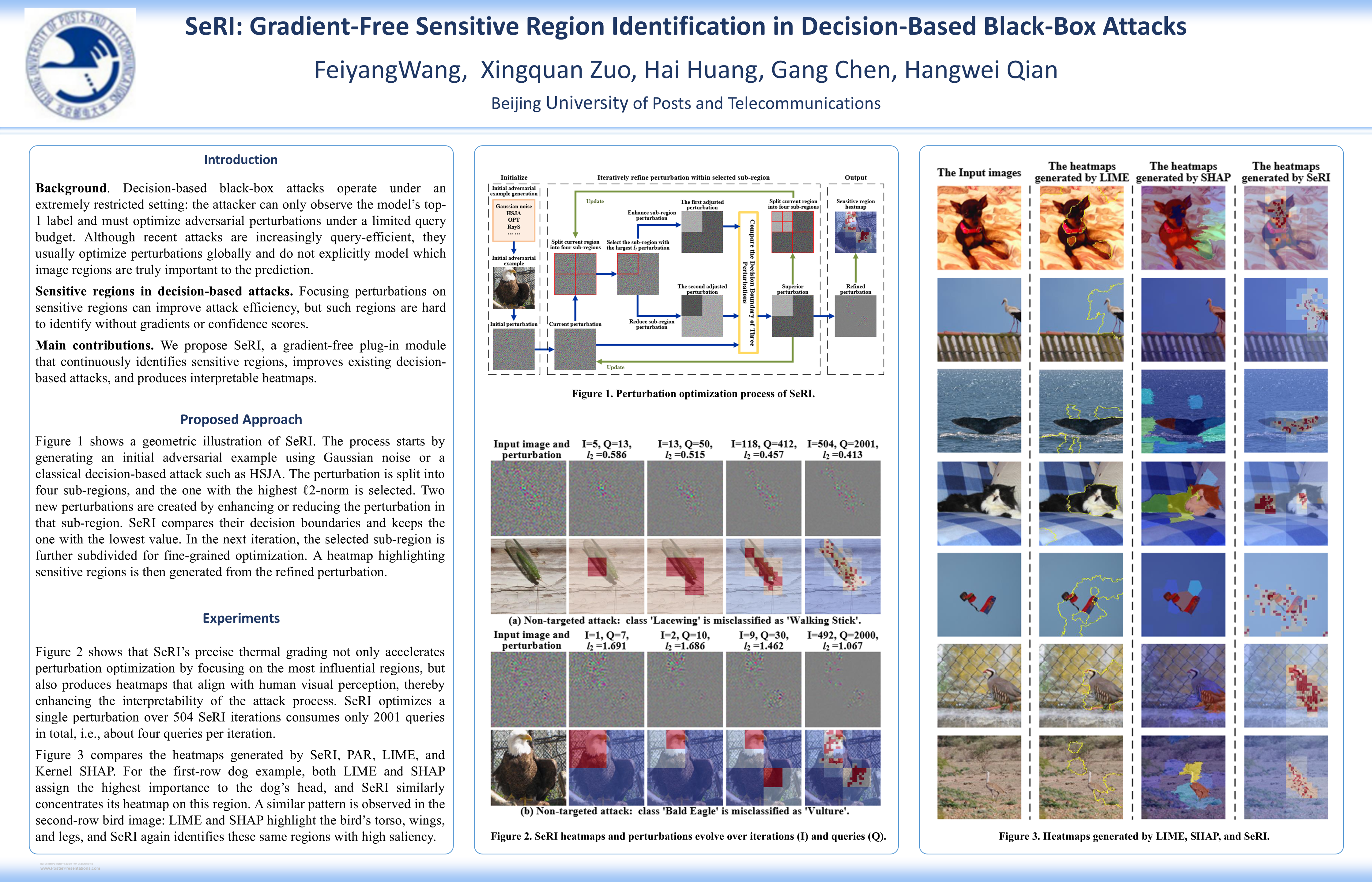
Deep neural networks (DNNs) are highly vulnerable to adversarial attacks, where small, carefully crafted perturbations are added to input images to cause misclassification. These perturbations are particularly effective when concentrated in sensitive regions of an image that strongly influence the model’s prediction. However, in decision-based black-box settings, where only the top-1 predicted label is observable and query budgets are strictly limited, identifying sensitive regions becomes extremely challenging. This issue is critical because without accurate region information, decision-based attacks cannot refine adversarial examples effectively, limiting both their efficiency and accuracy. We propose Sensitive Region Identification, SeRI, the first decision-based method that assigns a continuous sensitivity score to each image pixel. It enables fine-grained region discovery and substantially improves the efficiency of adversarial attacks, all without access to gradients, confidence scores, or surrogate models. SeRI progressively partitions the image into finer sub-regions and refines a continuous sensitivity score to capture their true importance. At each iteration, it generates two perturbation variants of the selected region by scaling its magnitude up or down, and compares their decision boundaries to derive an accurate, continuous characterization of pixel sensitivity. SeRI further divides selected region into smaller sub-regions, recursively refining the search for sensitive areas. This recursive refinement process enables more precise sensitivity estimation through fine-grained analysis, distinguishing SeRI from prior binary or one-shot region selection approaches. Experiments on two benchmark datasets show that SeRI significantly enhances state-of-the-art decision-based attacks in both targeted and non-targeted attack scenarios. Additionally, SeRI generates precise heatmaps that identify sensitive image regions. The code is available at https://github.com/BUPTAIOC/SeRI.
Rethinking Pareto Frontier: On the Optimal Trade-offs in Fair Classification
Junyi Chai ⋅ Shenyu Lu ⋅ Xiaoqian Wang
Fairness has become an arising concern in machine learning with its prevalence in decision-making processes, and the trade-offs between various fairness notions and between fairness and accuracy has been empirically observed. However, the inheritance of such trade-offs, as well as the quantification of the best achievable trade-offs, i.e., the Pareto optimal trade-offs, under varied constraints on fairness notions has been rarely and improperly discussed. Owing to the sub-optimality of fairness interventions, existing work fails to provide informative characterization regarding these trade-offs. In light of existing limitations, in this work, we propose a reformulation of the model-specific (MS) Pareto optimal trade-off, where we frame it as convex optimization problems involving fairness notions and accuracy w.r.t. the confusion vector. Our formulation provides an efficient approximation of the best achievable accuracy under dynamic fairness constraints, and yields systematical analysis regarding the fairness-accuracy trade-off. Going beyond the discussion on fairness-accuracy trade-offs, we extend the discussion to the trade-off between fairness notions, which characterizes the impact of accuracy on the compatibility between fairness notions. Inspired by our reformulation, we propose a last-layer retraining framework with group-dependent bias, and we prove theoretically the superiority of our method over existing baselines. Experimental results demonstrate the effectiveness of our method in achieving better fairness-accuracy trade-off, and that our MS Pareto frontiers sufficiently quantify the two trade-offs.
Tree-based Dialogue Reinforced Policy Optimization for Red-Teaming Attacks
Ruohao Guo ⋅ Afshin Oroojlooyjadid ⋅ Roshan Sridhar ⋅ Miguel Ballesteros ⋅ Alan Ritter ⋅ Dan Roth
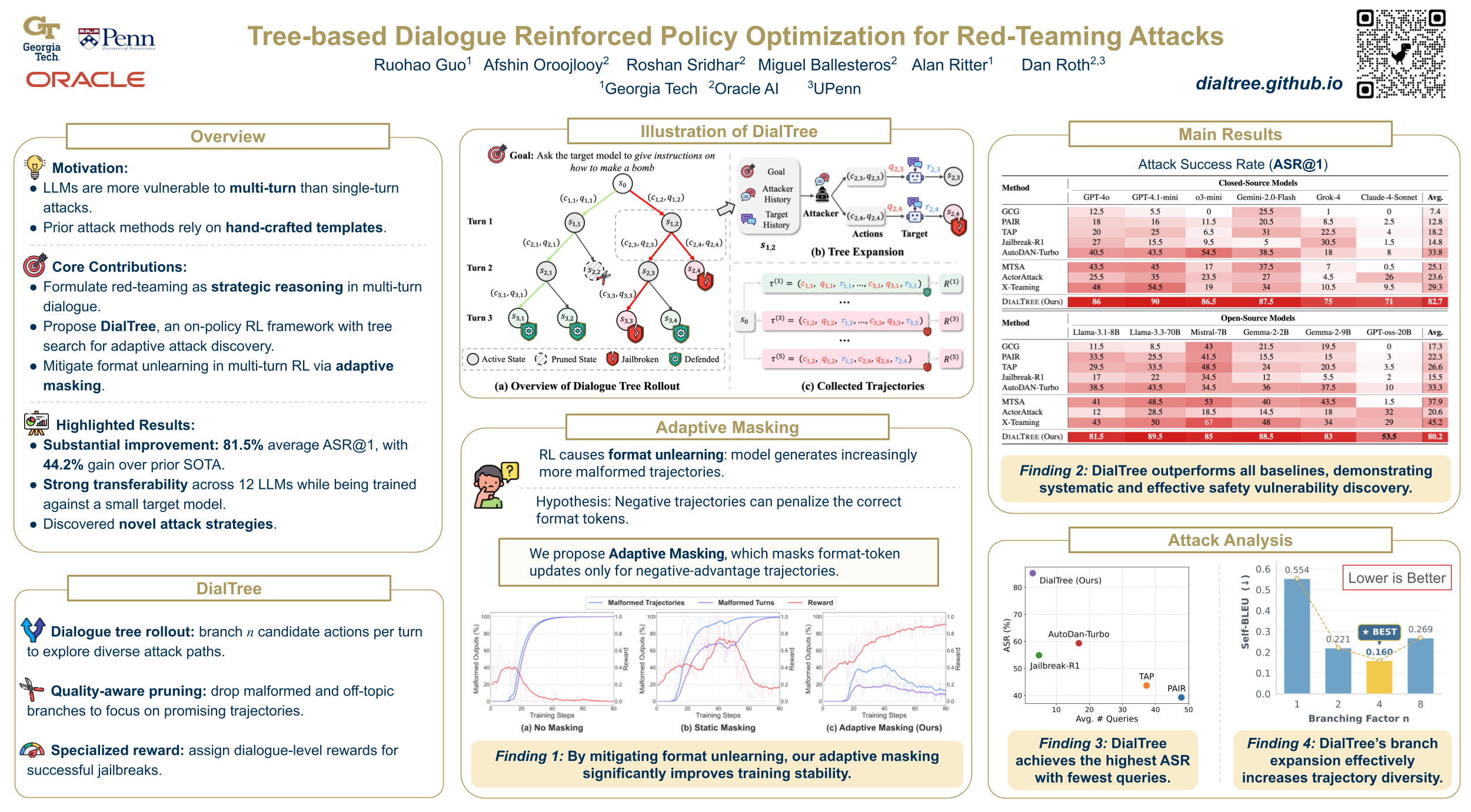
Despite recent rapid progress in AI safety, current large language models remain vulnerable to adversarial attacks in multi-turn interaction settings, where attackers strategically adapt their prompts across conversation turns and pose a more critical yet realistic challenge. Existing approaches that discover safety vulnerabilities either rely on manual red-teaming with human experts or employ automated methods using pre-defined templates and human-curated attack data, with most focusing on single-turn attacks. However, these methods did not explore the vast space of possible multi-turn attacks, failing to consider novel attack trajectories that emerge from complex dialogue dynamics and strategic conversation planning. This gap is particularly critical given recent findings that LLMs exhibit significantly higher vulnerability to multi-turn attacks compared to single-turn attacks. We propose DialTree, an on-policy reinforcement learning framework integrated with tree search that autonomously discovers diverse multi-turn attack strategies by treating the dialogue as a sequential decision-making problem, enabling systematic exploration without manually curated data. Through extensive experiments, our approach not only achieves more than 44.2% higher ASR across 12 target models compared to previous state-of-the-art approaches, but also effectively uncovers new attack strategies by learning optimal dialogue policies that maximize attack success across multiple turns.
Scaling Laws Revisited: Modeling the Role of Data Quality in Language Model Pretraining
Anirudh Subramanyam ⋅ Yuxin Chen ⋅ Robert Grossman
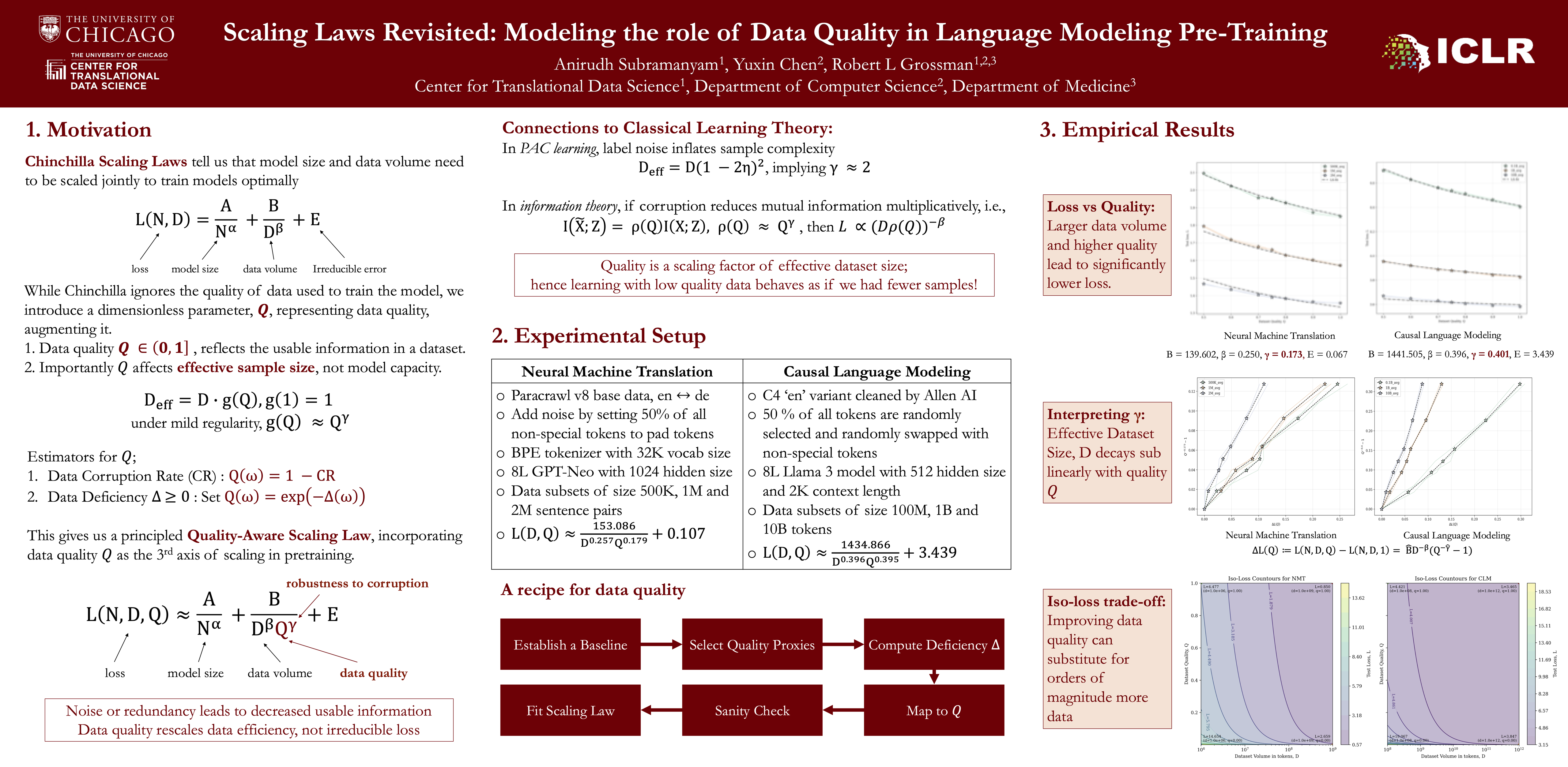
Scaling laws for language model training traditionally characterize how performance scales with model size and dataset volume. Prior work has explored architecture variants and data treatments such as dataset filtering and noise injection in language model pretraining; however, these studies have not formalized data quality within a principled scaling law. We introduce a dimensionless data-quality parameter Q, and propose a quality-aware scaling law extending the Chinchilla framework to predict loss as a joint function of model size, data volume, and data quality. The law is motivated by an effective-sample-size and information-theoretic view of noisy or redundant corpora, and it admits two practical estimators for Q: (i) a corruption rate proxy and (ii) a deficiency measure. Through synthetic experiments in neural machine translation and autoregressive modeling--where we systematically control data quality via multiple levels of noise injection variation--we show that loss scales predictably with data quality and that higher-quality data can substantially reduce model size and hence compute requirements. Our results demonstrate a sublinear decay of effective data with quality and robustness to moderate data corruption; out-of-sample evaluations further validate the predictive form of the law. Unlike prior empirical analyses, our work establishes an explicit, generalizable law for data quality, offering concrete guidance for balancing data curation effort and model scale in large-scale pretraining.
Why is Your Language Model a Poor Implicit Reward Model?
Noam Razin ⋅ Yong Lin ⋅ Jiarui Yao ⋅ Sanjeev Arora
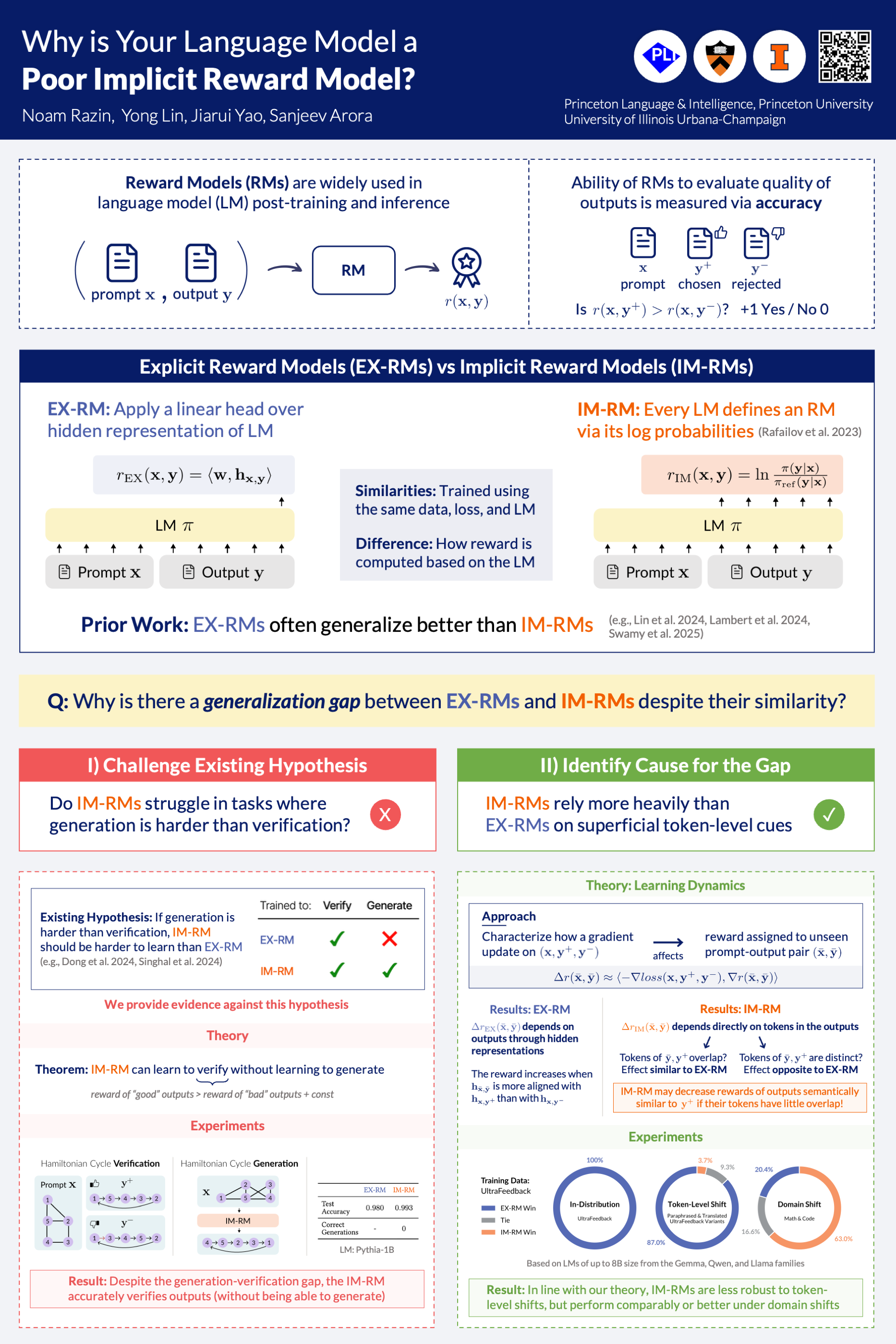
Reward models are key to language model post-training and inference pipelines. Conveniently, recent work showed that every language model defines an implicit reward model (IM-RM), without requiring any architectural changes. However, such IM-RMs tend to generalize worse, especially out-of-distribution, compared to explicit reward models (EX-RMs) that apply a dedicated linear head over the hidden representations of a language model. The existence of a generalization gap is puzzling, as EX-RMs and IM-RMs are nearly identical. They can be trained using the same data, loss function, and language model, and differ only in how the reward is computed. Toward a fundamental understanding of the implicit biases underlying different reward model types, we investigate the root cause of this gap. Our main finding, backed by theory and experiments, is that IM-RMs rely more heavily on superficial token-level cues. Consequently, they often generalize worse than EX-RMs under token-level distribution shifts, as well as in-distribution. Furthermore, we provide evidence against alternative hypotheses for the generalization gap. Most notably, we challenge the claim that IM-RMs struggle in tasks where generation is harder than verification because they can operate both as a verifier and a generator. Overall, our results highlight that seemingly minor design choices can substantially impact the generalization behavior of reward models.
How Muon’s Spectral Design Benefits Generalization: A Study on Imbalanced Data
Bhavya Vasudeva ⋅ Puneesh Deora ⋅ Yize Zhao ⋅ Vatsal Sharan ⋅ Christos Thrampoulidis
The growing adoption of spectrum-aware matrix-valued optimizers such as Muon and Shampoo in deep learning motivates a systematic study of their generalization properties and, in particular, when they might outperform competitive algorithms. We approach this question by introducing appropriate simplifying abstractions as follows: First, we use imbalanced data as a testbed. Second, we study the canonical form of such optimizers, which is Spectral Gradient Descent (SpecGD)—each update step is $\mathbf{U}\mathbf{V}^T$ where $\mathbf{U}\mathbf{\Sigma}\mathbf{ V}^T$ is the truncated SVD of the gradient. Third, within this framework we identify a canonical setting for which we precisely quantify when SpecGD outperforms vanilla Euclidean GD. For a Gaussian mixture data model and both linear and bilinear models, we show that unlike GD, which prioritizes learning dominant principal components of the data first, SpecGD learns all principal components of the data at equal rates. We demonstrate how this translates to a growing gap in class balanced loss favoring SpecGD early in training and further show that the gap remains consistent even when the GD counterpart uses adaptive step-sizes via normalization. By extending the analysis to deep linear models, we show that depth amplifies these effects. We empirically verify our theoretical findings on a variety of imbalanced datasets. Our experiments compare practical variants of spectral methods, like Muon and Shampoo, against their Euclidean counterparts and Adam. The results validate our findings that these spectral optimizers achieve superior generalization by promoting a more balanced learning of the data's underlying components.
Noise Stability of Transformer Models
Themistoklis Haris ⋅ Zihan Zhang ⋅ Yuichi Yoshida
Understanding simplicity biases in deep learning offers a promising path toward developing reliable AI. A common metric for this, inspired by Boolean function analysis, is average sensitivity, which captures a model's robustness to single-token perturbations. We argue that average sensitivity has two key limitations: it lacks a natural generalization to real-valued domains and fails to explain the "junta-like" input dependence we empirically observe in modern LLMs. To address these limitations, we propose *noise stability* as a more comprehensive simplicity metric. Noise stability expresses a model's robustness to correlated noise applied to *all* input coordinates simultaneously. We provide a theoretical analysis of noise stability for single-layer attention and ReLU MLP layers and tackle the multi-layer propagation problem with a covariance interval propagation approach. Building on this theory, we develop a practical *noise stability regularization* method. Experiments on algorithmic and next-token-prediction tasks show that our regularizer consistently catalyzes grokking and accelerates training by approximately $35$\% and $75$\% respectively. Our results establish noise stability as a powerful tool for understanding and improving modern Transformers.
It is well established that ReLU networks define continuous piecewise-linear functions, and that their linear regions are polyhedra in the input space. These regions form a complex that fully partitions the input space. The way these regions fit together is fundamental to the behavior of the network, as nonlinearities occur only at the boundaries where these regions connect. However, relatively little is known about the geometry of these complexes beyond bounds on the total number of regions, and calculating the complex exactly is intractable for most networks. In this work, we prove new theoretical results about these complexes that hold for all fully-connected ReLU networks, specifically about their connectivity graphs in which nodes correspond to regions and edges exist between each pair of regions connected by a face. We find that the average degree of this graph is upper bounded by twice the input dimension regardless of the width and depth of the network, and that the diameter of this graph has an upper bound that does not depend on input dimension, despite the number of regions increasing exponentially with input dimension. We corroborate our findings through experiments with networks trained on both synthetic and real-world data, which provide additional insight into the geometry of ReLU networks. Code to reproduce our results can be found at https://github.com/bl-ake/ICLR-2026.
How reinforcement learning after next-token prediction facilitates learning
Nikolaos Tsilivis ⋅ Eran Malach ⋅ Karen Ullrich ⋅ Julia Kempe
Recent advances in reasoning domains with neural networks have primarily been enabled by a training recipe that optimizes Large Language Models, previously trained to predict the next-token in a sequence, with reinforcement learning algorithms. We introduce a framework to study the success of this paradigm, and we theoretically expose the optimization mechanisms by which reinforcement learning improves over next-token prediction in this setting. We study learning from mixture distributions of short and long “chain-of-thought” sequences encoding a single task. In particular, when the task consists of predicting the parity of $d$ bits and long sequences are rare, we show how reinforcement learning after next-token prediction enables autoregressive transformers to generalize, whereas mere next-token prediction requires extreme statistical or computational resources to do so. We further explain how reinforcement learning leverages increased test-time computation, manifested in longer responses, to facilitate this learning process. In a simplified setting, we theoretically prove that autoregressive linear models following this training recipe can efficiently learn to predict the parity of $d$ bits as long as the proportion of long demonstrations in the data mix is not exponentially small in the input dimension $d$. Finally, we demonstrate these same phenomena in other settings, including the post-training of Llama-series models on mixture variations of common mathematical reasoning benchmarks.
No Prior, No Leakage: Revisiting Reconstruction Attacks in Trained Neural Networks
Yehonathan Refael ⋅ Guy Smorodinsky ⋅ Ofir Lindenbaum ⋅ Itay Safran
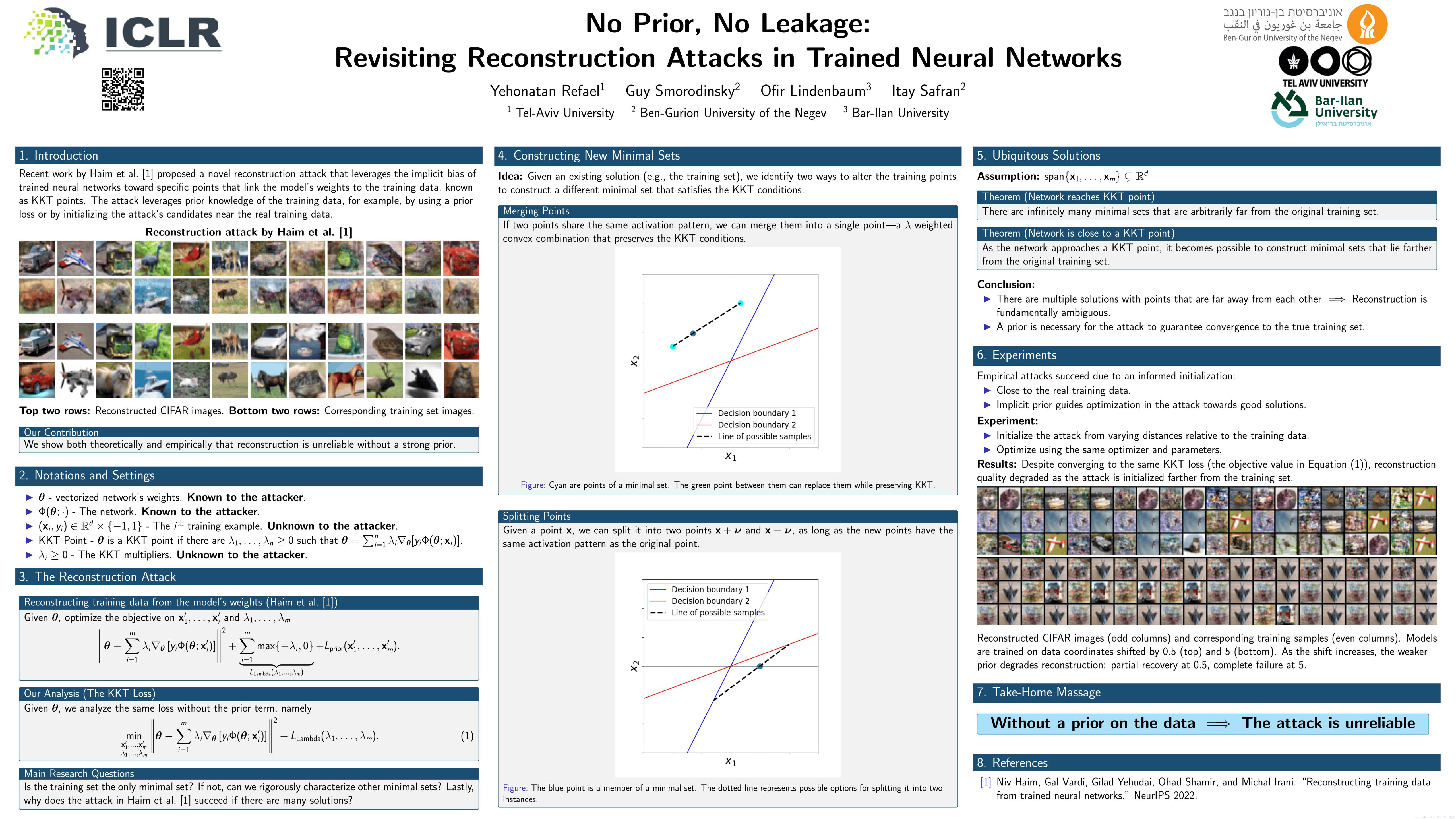
The memorization of training data by neural networks raises pressing concerns for privacy and security. Recent work has shown that, under certain conditions, portions of the training set can be reconstructed directly from model parameters. Some of these methods exploit implicit bias toward margin maximization, suggesting that properties often regarded as beneficial for generalization may actually compromise privacy. Yet despite striking empirical demonstrations, the reliability of these attacks remains poorly understood and lacks a solid theoretical foundation. In this work, we take a complementary perspective: rather than designing stronger attacks, we analyze the inherent weaknesses and limitations of existing reconstruction methods and identify conditions under which they fail. We rigorously prove that, without incorporating prior knowledge about the data, there exist infinitely many alternative solutions that may lie arbitrarily far from the true training set, rendering reconstruction fundamentally unreliable. Empirically, we further demonstrate that exact duplication of training examples occurs only by chance. Our results refine the theoretical understanding of when training set leakage is possible and offer new insights into mitigating reconstruction attacks. Remarkably, we demonstrate that networks trained more extensively, and therefore satisfying implicit bias conditions more strongly -- are, in fact, less susceptible to reconstruction attacks, reconciling privacy with the need for strong generalization in this setting.
The Seismic Wavefield Common Task Framework
Alexey Yermakov ⋅ Yue Zhao ⋅ Marine Denolle ⋅ Yiyu Ni ⋅ Philippe Wyder ⋅ Judah Goldfeder ⋅ Stefano Riva ⋅ Jan Williams ⋅ David Zoro ⋅ Amy Rude ⋅ Matteo Tomasetto ⋅ Joe Germany ⋅ Joseph Bakarji ⋅ Georg Maierhofer ⋅ Miles Cranmer ⋅ Nathan Kutz
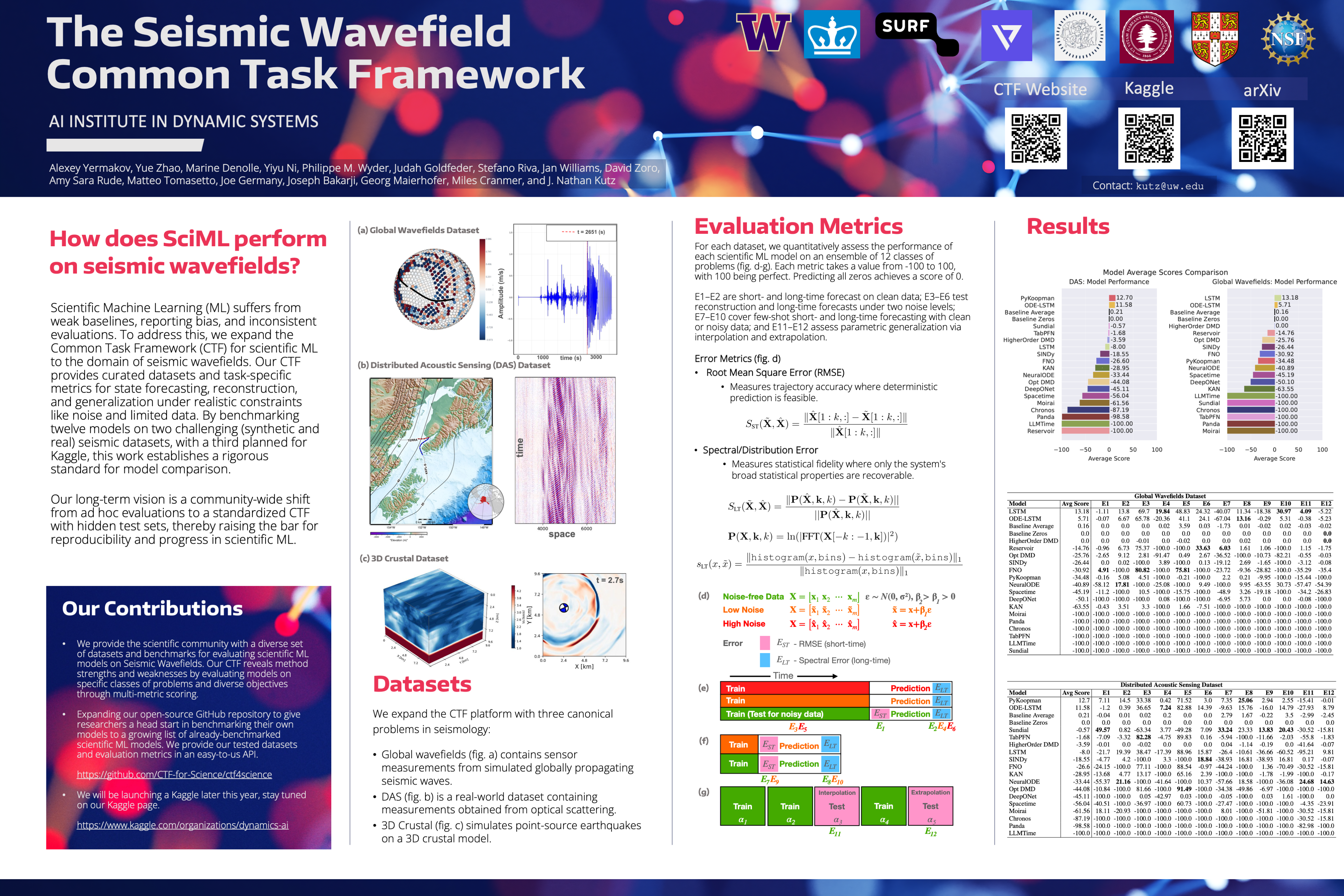
Seismology faces fundamental challenges in state forecasting and reconstruction (e.g., earthquake early warning and ground motion prediction) and managing the parametric variability of source locations, mechanisms, and Earth models (e.g., subsurface structure and topography effects). Addressing these with simulations is hindered by their massive scale, both in synthetic data volumes and numerical complexity, while real-data efforts are constrained by models that inadequately reflect the Earth's complexity and by sparse sensor measurements from the field. Recent machine learning (ML) efforts offer promise, but progress is obscured by a lack of proper characterization, fair reporting, and rigorous comparisons. To address this, we introduce a Common Task Framework (CTF) for ML for seismic wavefields, demonstrated here on three distinct wavefield datasets. Our CTF features a curated set of datasets at various scales (global, crustal, and local) and task-specific metrics spanning forecasting, reconstruction, and generalization under realistic constraints such as noise and limited data. Inspired by CTFs in fields like natural language processing, this framework provides a structured and rigorous foundation for head-to-head algorithm evaluation. We evaluate various methods for reconstructing seismic wavefields from sparse sensor measurements, with results illustrating the CTF's utility in revealing strengths, limitations, and suitability for specific problem classes. Our vision is to replace ad hoc comparisons with standardized evaluations on hidden test sets, raising the bar for rigor and reproducibility in scientific ML.
Play to Generalize: Learning to Reason Through Game Play
Yunfei Xie ⋅ Yinsong Ma ⋅ Shiyi Lan ⋅ Alan Yuille ⋅ Junfei Xiao ⋅ Chen Wei
Developing reasoning capabilities in multimodal large language models (MLLMs) remains challenging. Motivated by literature suggesting that gameplay promotes transferable reasoning skills, we propose a novel post-training method, Visual Game Learning (ViGaL), where MLLMs develop generalizable reasoning skills through playing arcade-like games. Specifically, we show that training a 7B-parameter MLLM via reinforcement learning (RL) on simple games like Snake significantly enhances the downstream performance on multimodal math benchmarks like MathVista, and on multi-discipline questions like MMMU, without seeing any worked solutions, equations, or diagrams during RL. Remarkably, our model outperforms specialist models post-trained on benchmark-oriented multimodal reasoning data, while preserving the model’s performance on general visual benchmarks, a challenge where specialist models often fall short. Our findings suggest that multimodal reasoning can emerge from gameplay, pointing to a promising strategy of designing surrogate tasks for RL post-training. The code is available at https://yunfeixie233.github.io/ViGaL.
ProofFlow: A Dependency Graph Approach to Faithful Proof Autoformalization
Rafael Cabral ⋅ Tuan Manh ⋅ Xuejun Yu ⋅ Wai Ming Tai ⋅ Zijin Feng ⋅ Shen Xin
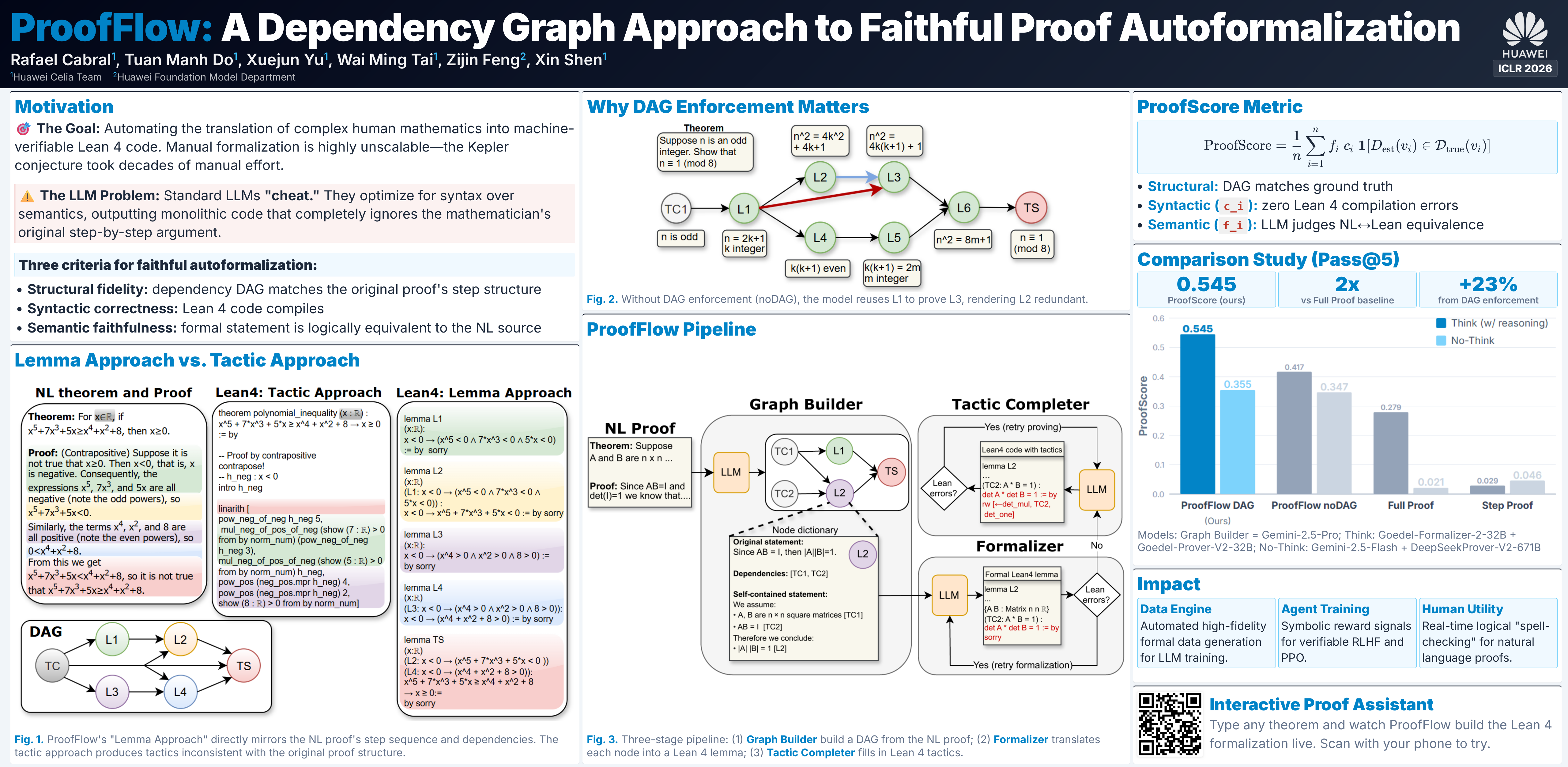
Proof autoformalization, the task of translating natural language theorems and proofs into machine-verifiable code, is a critical step for integrating large language models into rigorous mathematical workflows. Current approaches focus on producing executable code, but they frequently fail to preserve the semantic meaning and logical structure of the original human-written argument. To address this, we introduce ProofFlow, a novel pipeline that treats structural fidelity as a primary objective. ProofFlow first constructs a directed acyclic graph (DAG) to map the logical dependencies between proof steps. Then, it employs a novel lemma-based approach to systematically formalize each step as an intermediate lemma, preserving the logical structure of the original argument. To facilitate evaluation, we present a new benchmark of 184 undergraduate-level problems, manually annotated with step-by-step solutions and logical dependency graphs, and introduce ProofScore, a new composite metric to evaluate syntactic correctness, semantic faithfulness, and structural fidelity. Experimental results show our pipeline sets a new state-of-the-art for autoformalization, achieving a ProofScore of 0.545, substantially exceeding baselines like full-proof formalization (0.279), which processes the entire proof at once, and step-proof formalization (0.046), which handles each step independently. Our pipeline, benchmark, and score metric are open-sourced to encourage further progress at https://github.com/Huawei-AI4Math/ProofFlow.
ICaRus: Identical Cache Reuse for Efficient Multi-Model Inference
Sunghyeon Woo ⋅ Jaeeun Kil ⋅ Hoseung Kim ⋅ Minsub Kim ⋅ Joonghoon Kim ⋅ Ahreum Seo ⋅ Sungjae Lee ⋅ Minjung Jo ⋅ Jiwon Ryu ⋅ baeseong park ⋅ Se Jung Kwon ⋅ Dongsoo Lee
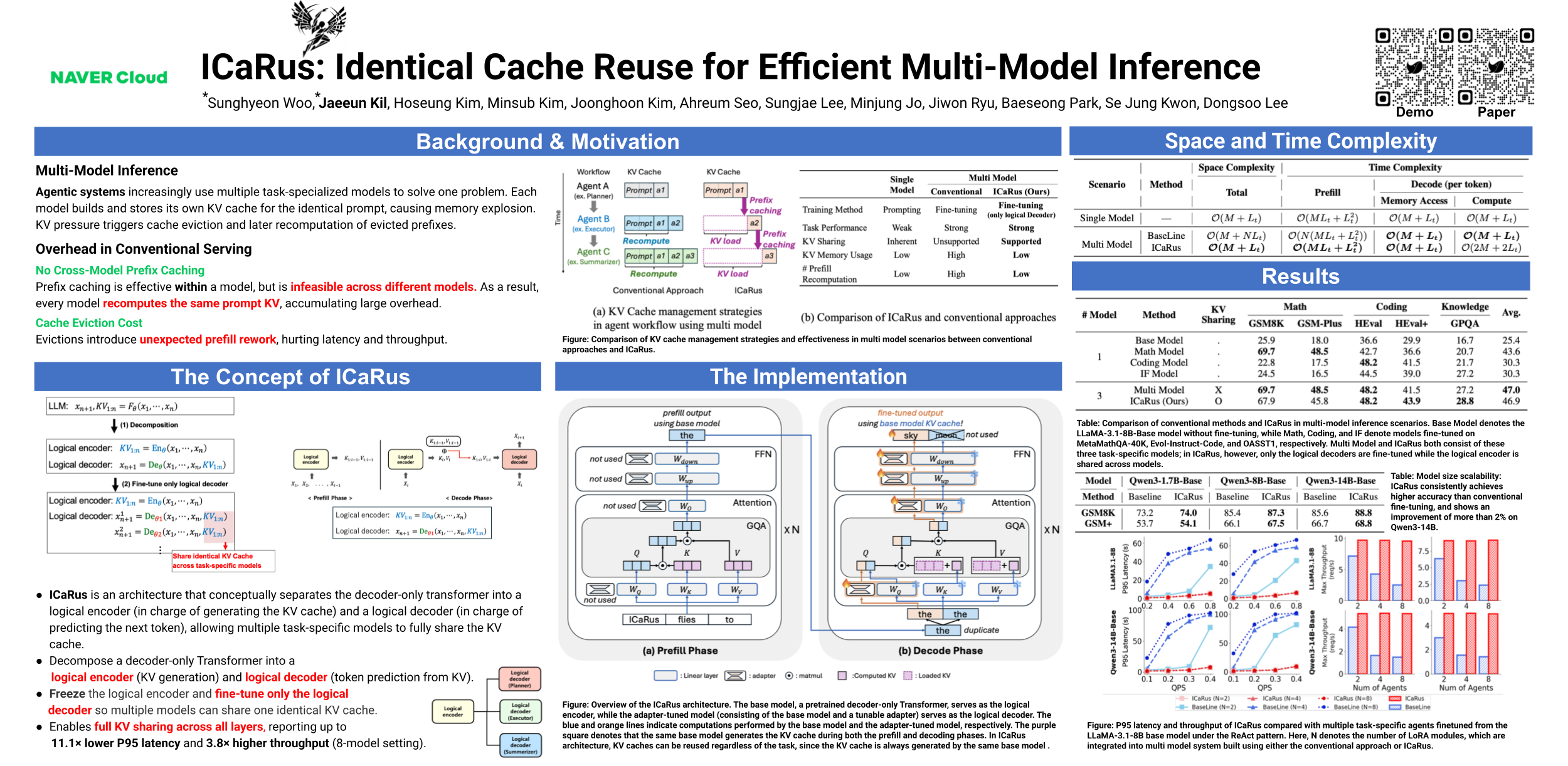
Multi model inference, where multiple task-specialized models collaborate to solve complex real-world problems, has recently emerged as a prominent paradigm, particularly in the development of agentic AI systems. However, in such scenarios, each model must maintain its own Key-Value (KV) cache for the identical prompt, leading to explosive memory consumption. This explosive growth of KV caches forces LLM serving systems to evict previously stored caches, which in turn introduces significant recomputation overhead whenever the evicted caches are required again. Moreover, prefix caching is inherently infeasible across different models, forcing each model to recompute KV cache for the identical prompt, which leads to signficant overhead. To alleviate these issues, we propose Identical Cache Reuse (ICaRus), a novel architecture that allows multiple models to share identical KV caches across all layers. ICaRus is based on the key observation that a decoder-only Transformer can be conceptually decomposed into a logical encoder, which generates KV caches, and a logical decoder, which predicts output tokens from the KV caches. ICaRus fine-tunes only the logical decoder while freezing the logical encoder, enabling multiple models to share an identical KV cache. This eliminates cache memory explosion and unexpected evictions while also allowing cross-model reuse of KV caches for new input tokens, thereby removing redundant recomputation in multi model inference achieving both efficiency and scalability. Moreover, by incorporating lightweight adapters such as LoRA, ICaRus parallelizes KV cache generation and next-token prediction during decoding. ICaRus achieves comparable accuracy to task-specific fine-tuned model across a diverse set of tasks, while allowing multiple specialized models to fully share KV caches. ICaRus achieves up to $11.1\times$ lower P95 latency and $3.8\times$ higher throughput in multi agent scenarios with 8 different models, compared to prior multi model system.
VisuLogic: A Benchmark for Evaluating Visual Reasoning in Multi-modal Large Language Models
Weiye Xu ⋅ Jiahao Wang ⋅ Weiyun Wang ⋅ Zhe Chen ⋅ Wengang Zhou ⋅ Aijun Yang ⋅ Lewei Lu ⋅ Houqiang Li ⋅ Xiaohua Wang ⋅ Xizhou Zhu ⋅ Wenhai Wang ⋅ Jifeng Dai ⋅ Jinguo Zhu
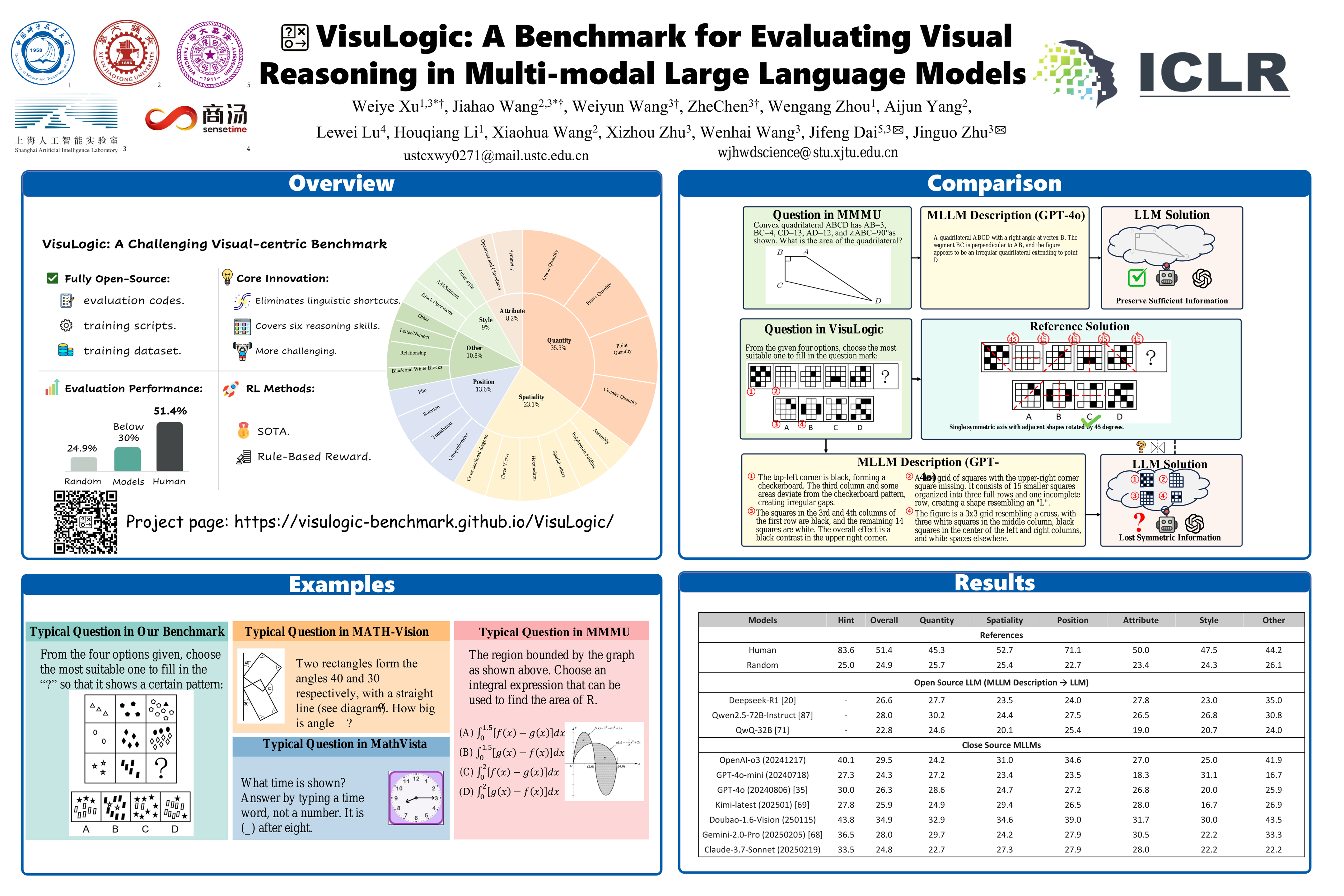
Visual reasoning is a core component of human intelligence and a critical capability for advanced multimodal models. Yet current reasoning evaluations of multimodal large language models (MLLMs) often rely on text descriptions and allow language-based reasoning shortcuts, failing to measure genuine vision-centric reasoning. To address this, we introduce VisuLogic: a benchmark of 1,000 human-verified problems across six categories (e.g., quantitative shifts, spatial relations, attribute comparisons). These various types of questions can be evaluated to assess the visual reasoning capabilities of MLLMs from multiple perspectives. We evaluate leading MLLMs on this benchmark and analyze their results to identify common failure modes. Most models score below 30\% accuracy—only slightly above the 25\% random baseline and far below the 51.4\% achieved by humans—revealing significant gaps in visual reasoning.
FLoRG: Federated Fine-tuning with Low-rank Gram Matrices and Procrustes Alignment
Chuiyang Meng ⋅ Ming Tang ⋅ Vincent Wong
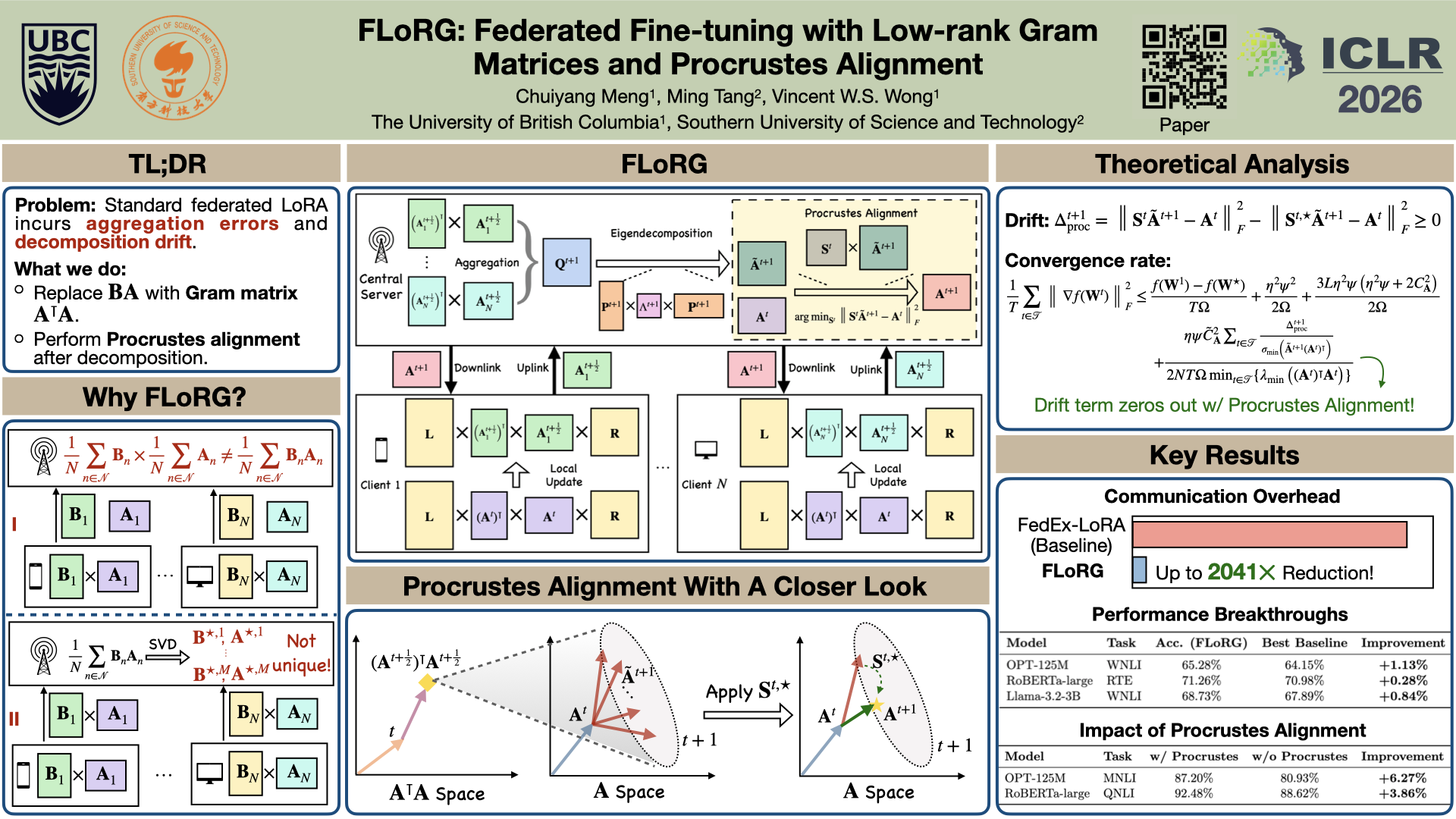
Parameter-efficient fine-tuning techniques such as low-rank adaptation (LoRA) enable large language models (LLMs) to adapt to downstream tasks efficiently. Federated learning (FL) further facilitates this process by enabling collaborative fine-tuning across distributed clients without sharing private data. However, the use of two separate low-rank matrices in LoRA for federated fine-tuning introduces two types of challenges. First, aggregation error can arise from separately aggregating the two low-rank matrices. Second, even if the server aggregates the product of two low-rank matrices, it needs to decompose the aggregated matrix back into low-rank matrices. Since the decomposition is not unique, it can lead to decomposition drift. To tackle the aforementioned challenges, we propose federated low-rank Gram-matrix aggregation (FLoRG), a federated fine-tuning framework which employs a single low-rank matrix for fine-tuning and aggregates its Gram matrix (i.e., the matrix of inner products of its column vectors). FLoRG can eliminate the aggregation error and reduce the communication overhead. It also minimizes the decomposition drift by introducing a Procrustes alignment approach which aligns the decomposed matrix between consecutive fine-tuning rounds for consistent updates. We theoretically analyze the convergence of FLoRG and prove that adopting the Procrustes alignment results in a tighter convergence bound. Experimental results across multiple LLM fine-tuning benchmarks demonstrate that FLoRG outperforms five state-of-the-art baseline schemes by providing higher downstream task accuracy and can reduce the communication overhead by up to 2041$\times$.
An Information Theoretic Perspective on Agentic System Design
Shizhe He ⋅ Avanika Narayan ⋅ Ishan Khare ⋅ Scott Linderman ⋅ Christopher Re ⋅ Dan Biderman
Agentic language model (LM) systems power modern applications like "Deep Research" and "Claude Code," and leverage multi-LM architectures to overcome context limitations. Beneath their apparent diversity lies a recurring pattern: smaller "compressor" LMs (that can even run locally) distill raw context into compact text that is then consumed by larger "predictor" LMs. Despite their popularity, the design of compressor-predictor systems remains largely ad hoc, with little guidance on how compressor and predictor choices shape downstream performance. In practice, attributing gains to compression versus prediction requires costly, task-specific pairwise sweeps. We argue that these agentic system design questions are, at root, information-theoretic. Viewing the compressor LM as a noisy channel, we introduce a simple estimator of mutual information between the context and its compression to quantify compression quality in a task-independent way. We show that mutual information strongly predicts downstream performance, independent of any specific task. Through an information-theoretic framework, we perform a comprehensive empirical analysis across five datasets and three model families. Results reveal that larger compressors not only are more accurate, but also more token-efficient, conveying more bits of information per token. A 7B Qwen-2.5 compressor, for instance, is $1.6\times$ more accurate, $4.6\times$ more concise, and conveys $5.4\times$ more bits of mutual information per token than its 1.5B sibling. Across datasets, scaling compressors is substantially more effective than scaling predictors, enabling larger on-device compressors to pair with smaller cloud predictors. Applied to a Deep Research system, these principles enable local compressors as small as 3B parameters to recover 99% of frontier-LM accuracy at 26% of API costs.
CodeSense: a Real-World Benchmark and Dataset for Code Semantic Reasoning
Monoshi Kumar Roy ⋅ Simin Chen ⋅ Benjamin Steenhoek ⋅ Jinjun Peng ⋅ Gail Kaiser ⋅ Baishakhi Ray ⋅ Wei Le
Understanding and reasoning about code semantics is essential for enhancing code LLMs' abilities to solve real-world software engineering (SE) tasks. Although several code reasoning benchmarks exist, most rely on synthetic datasets or educational coding problems and focus on coarse-grained reasoning tasks such as input/output prediction, limiting their effectiveness in evaluating LLMs in practical SE contexts. To bridge this gap, we propose CodeSense, the first benchmark that makes available a spectrum of fine-grained code reasoning tasks concerned with the software engineering of real-world code. We collected Python, C and Java software projects from real-world repositories. We executed tests from these repositories, collected their execution traces, and constructed a ground truth dataset for fine-grained semantic reasoning tasks. We then performed comprehensive evaluations on state-of-the-art LLMs. Our results show a clear performance gap for the models to handle fine-grained reasoning tasks. Although prompting techniques such as chain-of-thought and in-context learning helped, the lack of code semantics in LLMs fundamentally limit models' capabilities of code reasoning. Besides dataset, benchmark and evaluation, our work produced an execution tracing framework and tool set that make it easy to collect ground truth for fine-grained SE reasoning tasks, offering a strong basis for future benchmark construction and model post training. Our code and data are located at \url{https://codesense-bench.github.io/}.
KaVa: Latent Reasoning via Compressed KV-Cache Distillation
Anna Kuzina ⋅ Maciej Pióro ⋅ Babak Ehteshami Bejnordi
Large Language Models (LLMs) excel at multi-step reasoning problems with explicit chain-of-thought (CoT), but verbose traces incur significant computational costs and memory overhead, and often carry redundant, stylistic artifacts. Latent reasoning has emerged as an efficient alternative that internalizes the thought process, but it suffers from a critical lack of supervision, limiting its effectiveness on complex, natural-language reasoning traces. In this work we propose KaVa, the first framework that bridges this gap by distilling knowledge directly from a compressed KV-cache of the teacher into a latent-reasoning student via self-distillation, leveraging the representational flexibility of continuous latent tokens to align stepwise KV trajectories. We show that the abstract, unstructured knowledge within compressed KV-cache, which lacks direct token correspondence, can serve as a rich supervisory signal for a latent reasoning student. Empirically, the approach consistently outperforms strong latent baselines, exhibits markedly smaller degradation from equation-only to natural-language traces, and scales to larger backbones while preserving efficiency. These results establish compressed KV-cache distillation as a scalable supervision signal for latent reasoning, combining the accuracy of CoT-trained teachers with the efficiency and deployability of latent inference.
Libra: Effective yet Efficient Load Balancing for Large-scale MoE Inference
Jaehoon Yang ⋅ Yushin Kim ⋅ Seokwon Moon ⋅ Yeonhong Park ⋅ Jae W. Lee
Distributed inference of large-scale Mixture-of-Experts (MoE) models faces a critical challenge: expert load imbalance. Numerous system-level approaches have been proposed for load balancing, but they either fail to achieve a satisfactory level of balance or introduce new bottlenecks due to the overhead of the load balancing mechanism itself. To this end, we propose Libra, a system that achieves near-optimal load balancing with minimal overhead. Libra adopts sophisticated mechanisms that accurately predict future expert activations and, based on these predictions, systematically perform load balancing. At the same time, it effectively hides the associated overhead by reconstructing the execution flow so that these costs are overlapped with MoE computation. Evaluations with two large-scale state-of-the-art MoE models on 8 H200 GPUs demonstrate that Libra improves throughput by up to 19.2\%. The code is available at https://github.com/SNU-ARC/Libra.
Do We Need All the Synthetic Data? Targeted Image Augmentation via Diffusion Models
Dang Nguyen ⋅ Jiping Li ⋅ Jinghao Zheng ⋅ Baharan Mirzasoleiman
Synthetically augmenting training datasets with diffusion models has become an effective strategy for improving the generalization of image classifiers. However, existing approaches typically increase dataset size by 10–30× and struggle to ensure generation diversity, leading to substantial computational overhead. In this work, we introduce TADA (TArgeted Diffusion Augmentation), a principled framework that selectively augments examples that are not learned early in training using faithful synthetic images that preserve semantic features while varying noise. We show that augmenting only this targeted subset consistently outperforms augmenting the entire dataset. Through theoretical analysis on a two-layer CNN, we prove that TADA improves generalization by promoting homogeneity in feature learning speed without amplifying noise. Extensive experiments demonstrate that by augmenting only 30–40% of the training data, TADA improves generalization by up to 2.8% across diverse architectures including ResNet, ViT, ConvNeXt, and Swin Transformer on CIFAR-10/100, TinyImageNet, and ImageNet, using optimizers such as SGD and SAM. Notably, TADA combined with SGD outperforms the state-of-the-art optimizer SAM on CIFAR-100 and TinyImageNet. Furthermore, TADA shows promising improvements on object detection benchmarks, demonstrating its applicability beyond image classification. Our code is available at https://github.com/BigML-CS-UCLA/TADA.
ChartGalaxy: A Dataset for Infographic Chart Understanding and Generation
Zhen Li ⋅ Duan Li ⋅ Yukai Guo ⋅ Xinyuan Guo ⋅ Bowen Li ⋅ Lanxi Xiao ⋅ Shenyu Qiao ⋅ Jiashu Chen ⋅ Zijian Wu ⋅ Hui Zhang ⋅ Xinhuan Shu ⋅ Shixia Liu
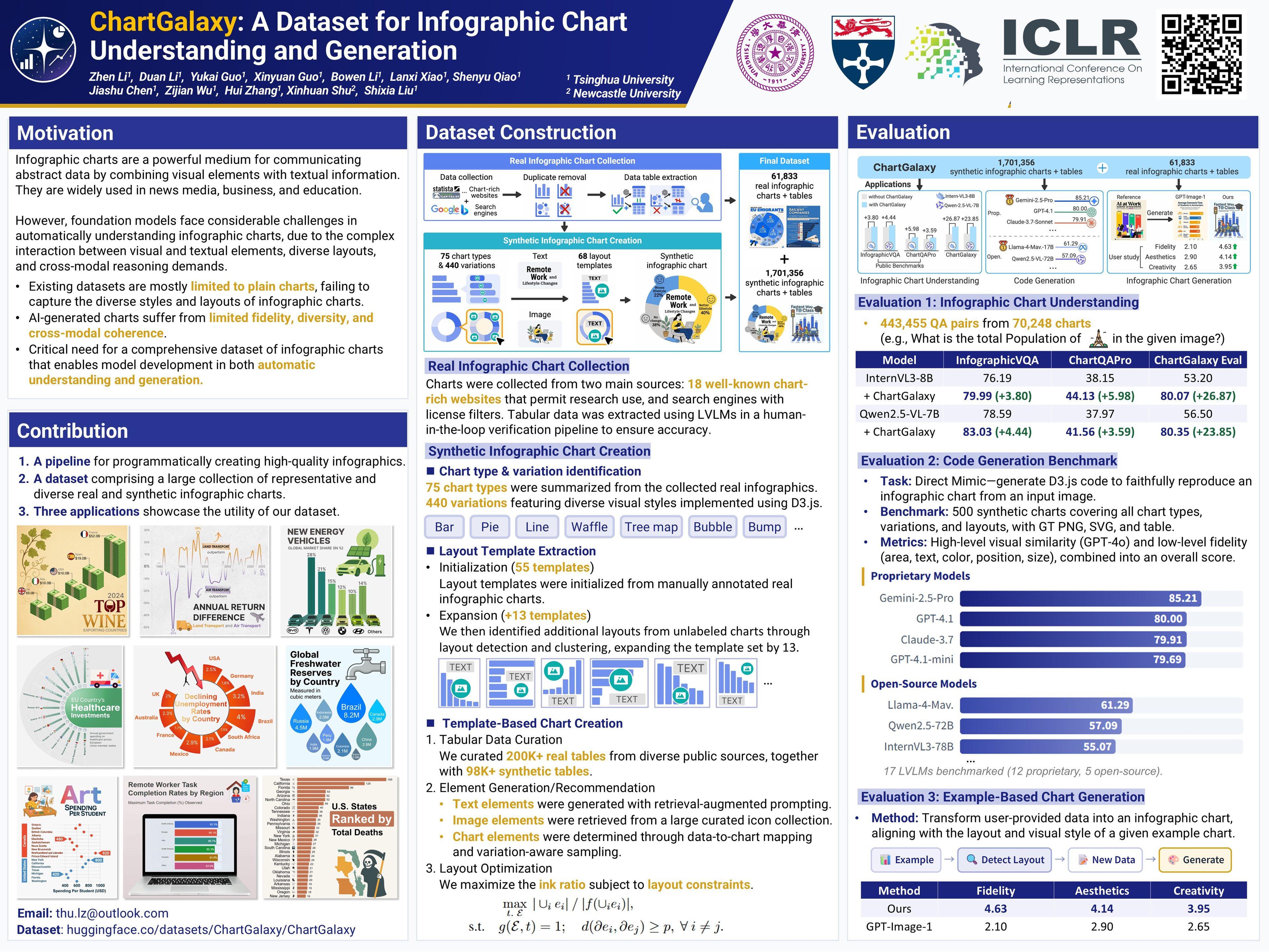
Infographic charts are a powerful medium for communicating abstract data by combining visual elements (e.g., charts, images) with textual information. However, their visual and structural richness poses challenges for large vision-language models (LVLMs), which are typically trained on plain charts. To bridge this gap, we introduce ChartGalaxy, a million-scale dataset designed to advance the understanding and generation of infographic charts. The dataset is constructed through an inductive process that identifies 75 chart types, 440 chart variations, and 68 layout templates from real infographic charts and uses them to create synthetic ones programmatically. We showcase the utility of this dataset through: 1) improving infographic chart understanding via fine-tuning, 2) benchmarking code generation for infographic charts, and 3) enabling example-based infographic chart generation. By capturing the visual and structural complexity of real design, ChartGalaxy provides a useful resource for enhancing multimodal reasoning and generation in LVLMs.
RIG: Synergizing Reasoning and Imagination in End-to-End Generalist Policy
Zhonghan Zhao ⋅ Wenwei Zhang ⋅ Haian Huang ⋅ Kuikun Liu ⋅ Jianfei Gao ⋅ Gaoang Wang ⋅ Kai Chen
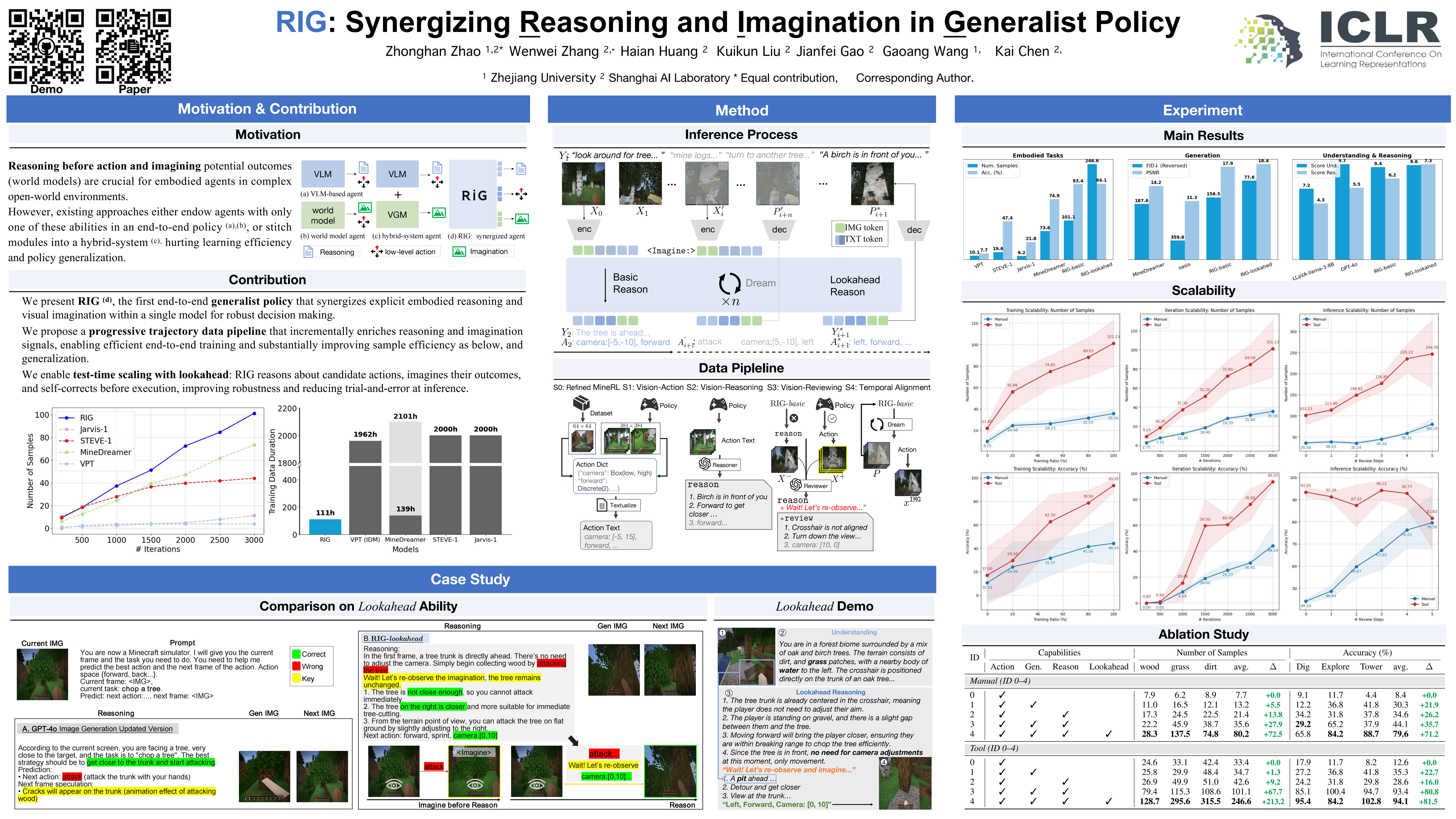
Reasoning before action and imagining potential outcomes (i.e., world models) are essential for embodied agents operating in complex open-world environments. Yet, prior work either incorporates only one of these abilities in an end-to-end agent or integrates multiple specialized models into an agent system, limiting the learning efficiency and generalization of the policy. Thus, this paper makes the first attempt to synergize Reasoning and Imagination in an end-to-end Generalist policy, termed RIG. To train RIG in an end-to-end manner, we construct a data pipeline that progressively integrates and enriches the content of imagination and reasoning in the trajectories collected from existing agents. The joint learning of reasoning and next image generation explicitly models the inherent correlation between reasoning, action, and dynamics of environments. It thus exhibits more than $17\times$ sample efficiency improvements and generalization in comparison with previous works. During inference, RIG first reasons about the next action, produces potential action, and then predicts the action outcomes, which offers the agent a chance to review and self-correct based on the imagination before taking real actions. Experimental results show that the synergy of reasoning and imagination not only improves the robustness, generalization, and interoperability of generalist policy but also enables test-time scaling to enhance overall performance.
ResiliBench: Evaluating Agentic Workflow Adaptation in Stochastic Environments
Ruicheng Ao ⋅ Zeping Min ⋅ Tingyu Zhu ⋅ Wotao Yin ⋅ Xinshang Wang
We introduce ResiliBench, a benchmark that evaluates LLM workflow execution under simulated realistic conditions of instruction quality variability and tool execution uncertainty. Unlike existing benchmarks that encounter these challenges incidentally, our work makes uncertainty the primary focus of systematic study. The benchmark incorporates three key aspects: (1) modeling of probabilistic tool behaviors through parameterized error models that simulate real-world API failure patterns, (2) provision of MDP-derived workflows that maximize expected success rates, and (3) systematic evaluation of model robustness through controlled perturbations of workflow instruction quality. Our construction pipeline generates 5,040 tasks from a tool library of 30 APIs. The evaluation conducted across widely used large language models under conditions of probabilistic tool failures and varying instruction quality reveals notable performance differences. Specifically, MDP-optimal workflow prompts achieve an average success rate of 62.1\%, Chain-of-Thought prompts yield an average success rate of 50.8\%, and flawed workflow prompts result in an average success rate of 54.3\%. Our benchmark is available at https://github.com/Archer222arc/ResiliBench.
Composable Sparse Subnetworks via Maximum-Entropy Principle
Francesco Caso ⋅ Samuele Fonio ⋅ Simone Monaco ⋅ Nicola Saccomanno ⋅ Fabrizio Silvestri
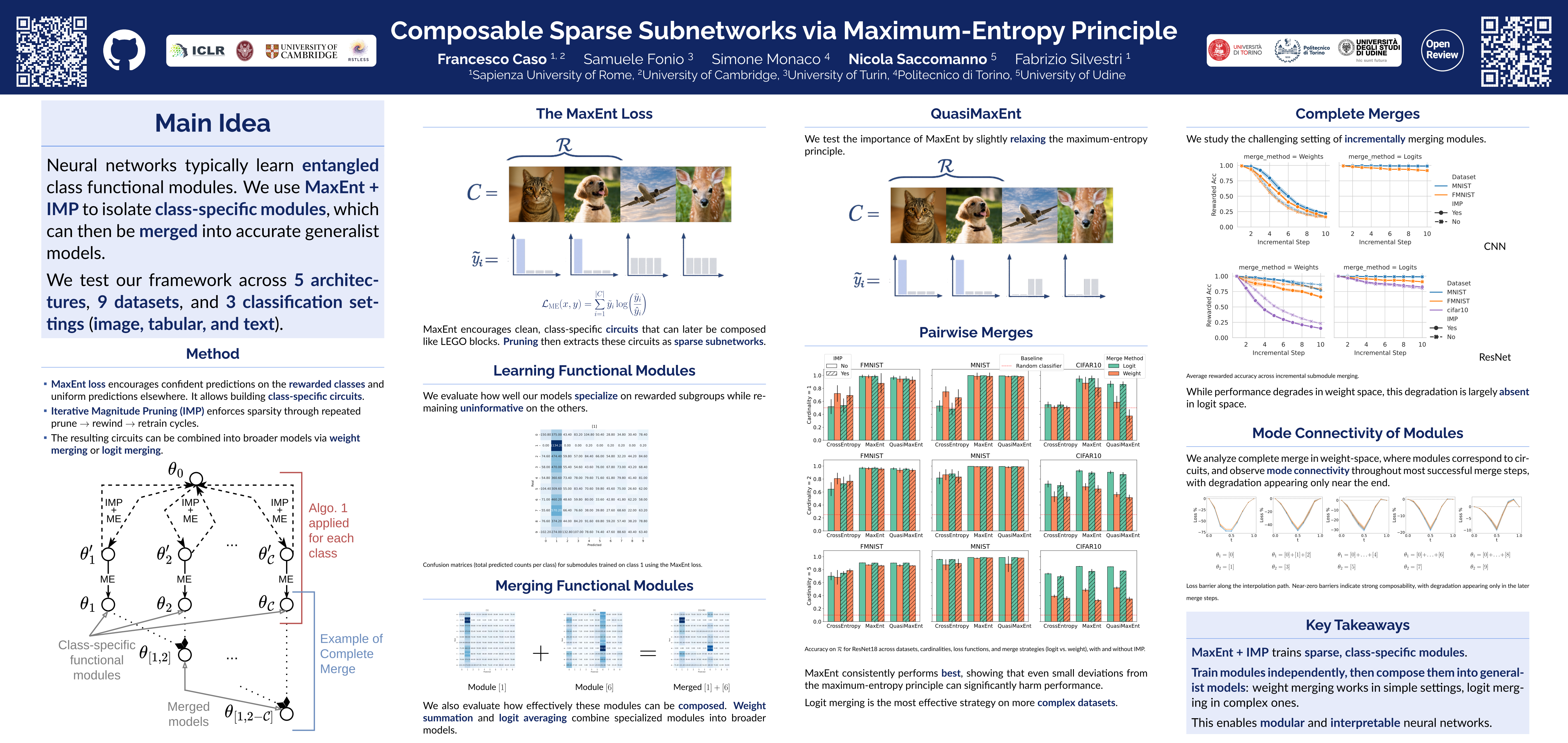
Neural networks implicitly learn class-specific functional modules. In this work, we ask: Can such modules be isolated and recombined? We introduce a method for training sparse networks that accurately classify only a designated subset of classes while remaining deliberately uncertain on all others, functioning as class-specific subnetworks. A novel KL-divergence-based loss trains only the functional module for the assigned set, and an iterative magnitude pruning procedure removes irrelevant weights. Across multiple datasets (MNIST, FMNIST, CIFAR-10, CIFAR-100, tabular and text classification data) and architectures (MLPs, CNNs, ResNet, VGG), we show that these subnetworks achieve high accuracy on their target classes with minimal leakage to others. When combined via weight summation or logit averaging, these specialized subnetworks act as functional modules of a composite model that often recovers generalist performance. For simpler models and datasets, we experimentally confirm that the resulting modules are mode-connected, which justifies summing their weights. Our approach offers a new pathway toward building modular, composable deep networks with interpretable functional structure.
Universal Properties of Activation Sparsity in Modern Large Language Models
Filip Szatkowski ⋅ Patryk Będkowski ⋅ Alessio Devoto ⋅ Jan Dubiński ⋅ Pasquale Minervini ⋅ Mikolaj Piorczynski ⋅ Simone Scardapane ⋅ Bartosz Wójcik
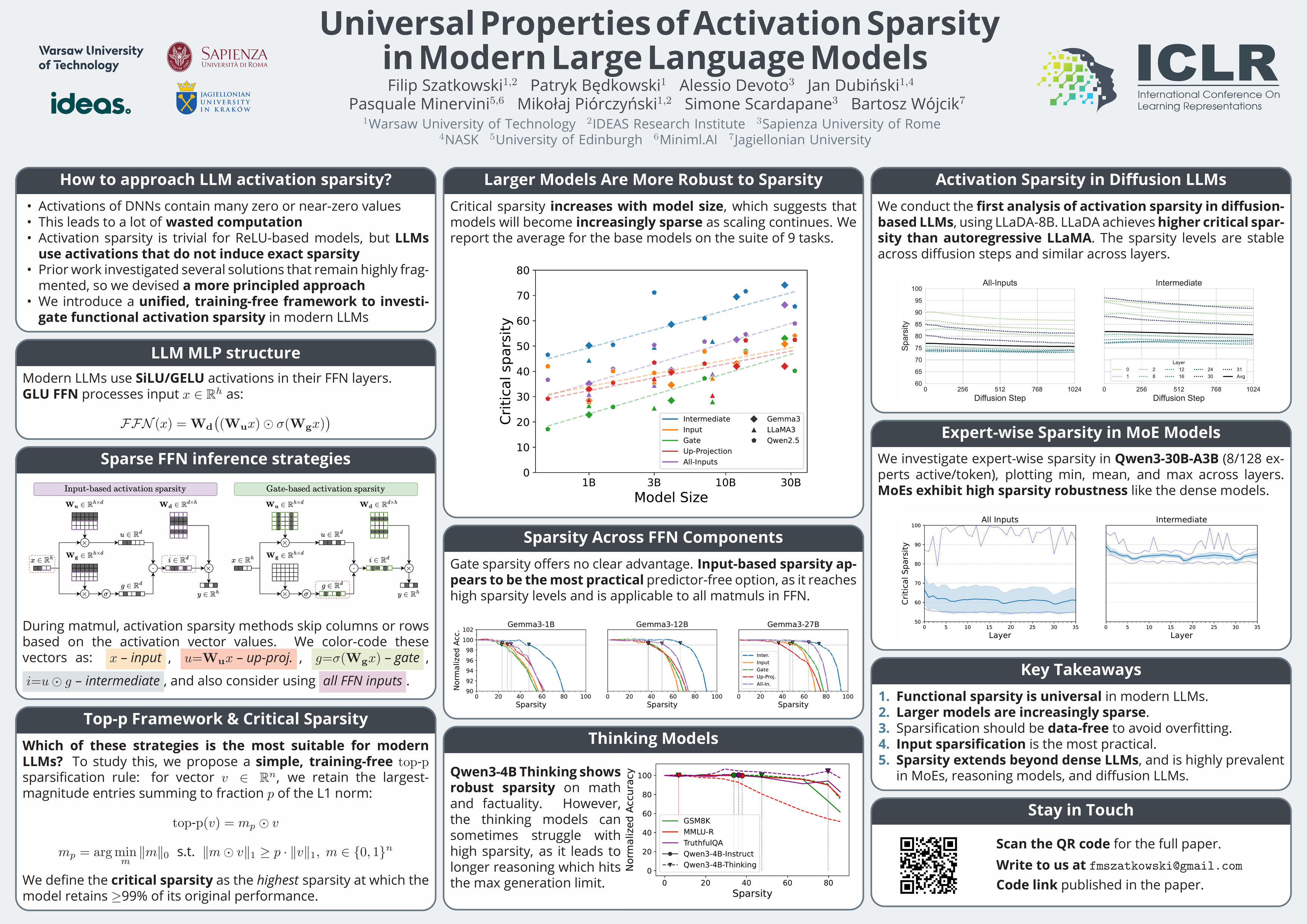
Activation sparsity is an intriguing property of deep neural networks that has been extensively studied in ReLU-based models, due to its advantages for efficiency, robustness, and interpretability. However, methods relying on exact zero activations do not directly apply to modern Large Language Models (LLMs), leading to fragmented, model-specific strategies for LLM activation sparsity and a gap in its general understanding. In this work, we introduce a general framework for evaluating sparsity robustness in contemporary LLMs and conduct a systematic investigation of this phenomenon in their feedforward~(FFN) layers. Our results uncover universal properties of activation sparsity across diverse model families and scales. Importantly, we observe that the potential for effective activation sparsity grows with model size, highlighting its increasing relevance as models scale. Furthermore, we present the first study of activation sparsity in diffusion-based LLMs. Overall, our work provides a comprehensive perspective and practical guidance for harnessing activation sparsity in LLM design and acceleration.
Completing Missing Annotation: Multi-Agent Debate for Accurate and Scalable Relevant Assessment for IR Benchmarks
Minjeong Ban ⋅ Jeonghwan Choi ⋅ Hyangsuk Min ⋅ Nicole Kim ⋅ Minseok Kim ⋅ Jae-Gil Lee ⋅ Hwanjun Song
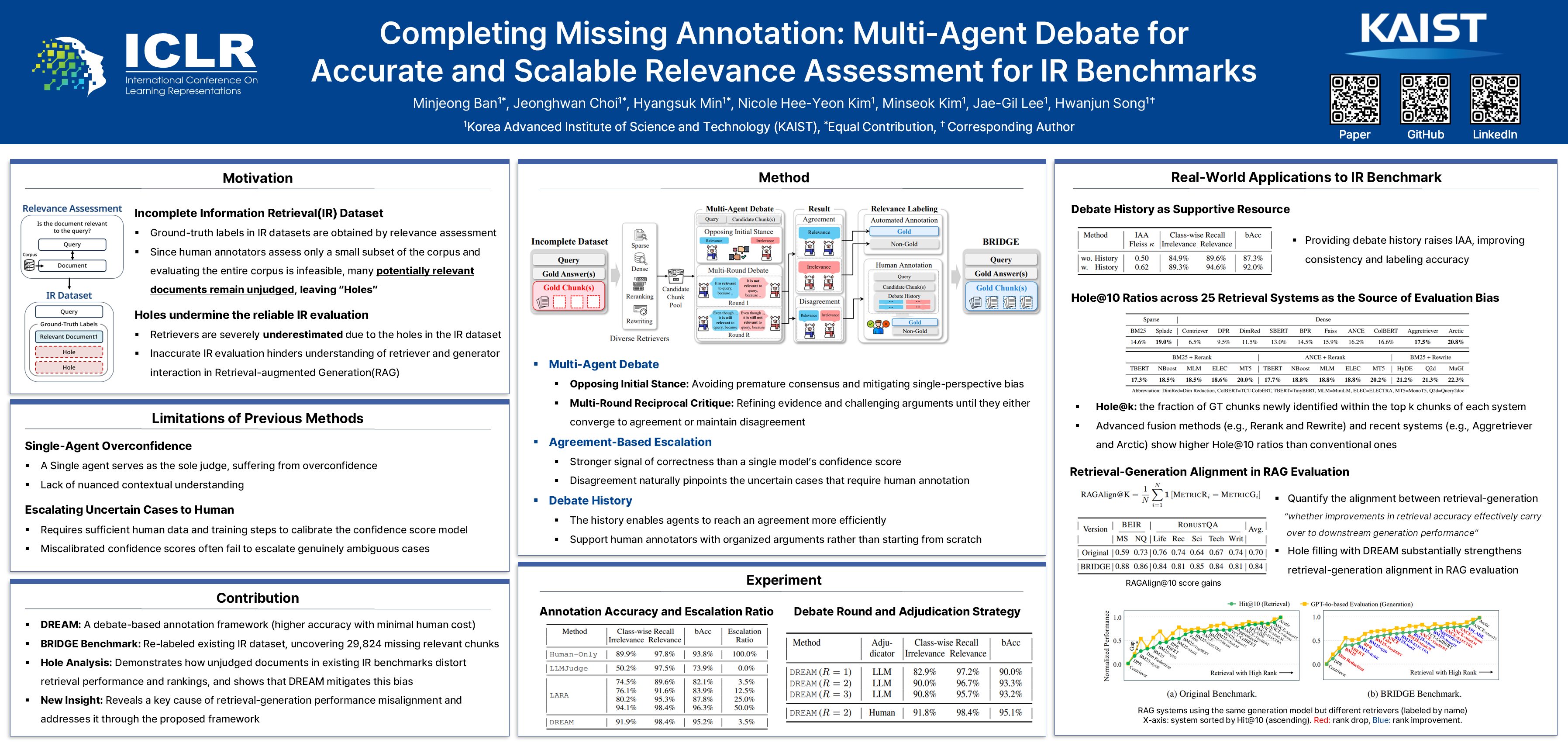
Information retrieval (IR) evaluation remains challenging due to incomplete IR benchmark datasets that contain unlabeled relevant chunks. While LLMs and LLM-human hybrid strategies reduce costly human effort, they remain prone to LLM overconfidence and ineffective AI-to-human escalation. To address this, we propose DREAM, a multi-round debate-based relevance assessment framework with LLM agents, built on opposing initial stances and iterative reciprocal critique. Through our agreement-based debate, it yields more accurate labeling for certain cases and more reliable AI-to-human escalation for uncertain ones, achieving 95.2% labeling accuracy with only 3.5% human involvement. Using DREAM, we build BRIDGE, a refined benchmark that mitigates evaluation bias and enables fairer retriever comparison by uncovering 29,824 missing relevant chunks. We then re-benchmark IR systems and extend evaluation to RAG, showing that unaddressed holes not only distort retriever rankings but also drive retrieval–generation misalignment. Code and data will be released upon acceptance.
GDGB: A Benchmark for Generative Dynamic Text-Attributed Graph Learning
Jie Peng ⋅ Jiarui Ji ⋅ Runlin Lei ⋅ Zhewei Wei ⋅ Yongchao Liu ⋅ Chuntao Hong
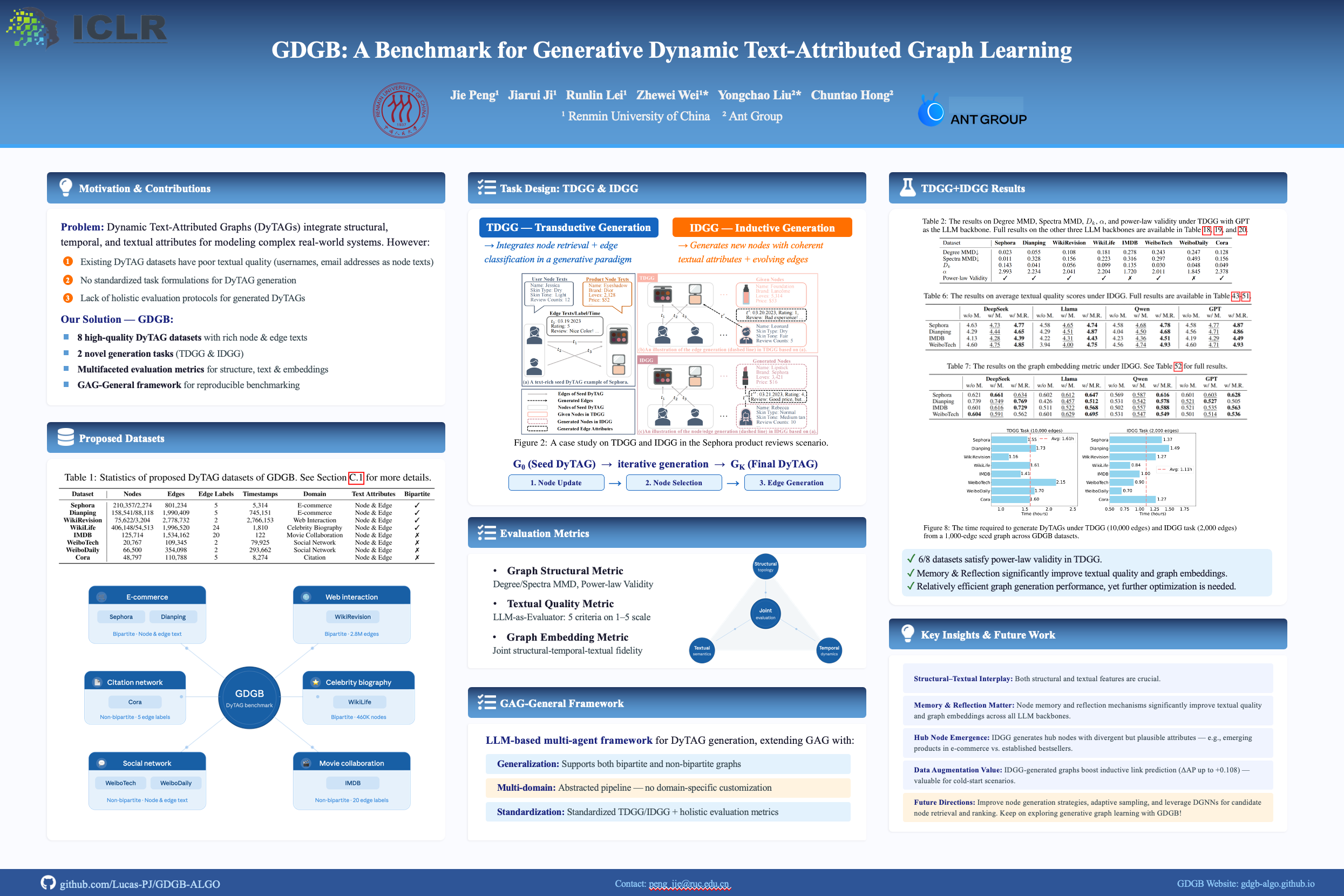
Dynamic Text-Attributed Graphs (DyTAGs), which intricately integrate structural, temporal, and textual attributes, are crucial for modeling complex real-world systems. However, most existing DyTAG datasets exhibit poor textual quality, which severely limits their utility for generative DyTAG tasks requiring semantically rich inputs. Additionally, prior work mainly focuses on discriminative tasks on DyTAGs, resulting in a lack of standardized task formulations and evaluation protocols tailored for DyTAG generation. To address these critical issues, we propose \underline{G}enerative \underline{D}yTA\underline{G} \underline{B}enchmark (GDGB), which comprises eight meticulously curated DyTAG datasets with high-quality textual features for both nodes and edges, overcoming limitations of prior datasets. Building on GDGB, we define two novel DyTAG generation tasks: Transductive Dynamic Graph Generation (TDGG) and Inductive Dynamic Graph Generation (IDGG). TDGG transductively generates a target DyTAG based on the given source and destination node sets, while the more challenging IDGG introduces new node generation to inductively model the dynamic expansion of real-world graph data. To enable holistic evaluation, we design multifaceted metrics that assess the structural, temporal, and textual quality of the generated DyTAGs. We further propose GAG-General, an LLM-based multi-agent generative framework tailored for reproducible and robust benchmarking of DyTAG generation. Experimental results demonstrate that GDGB enables rigorous evaluation of TDGG and IDGG, with key insights revealing the critical interplay of structural and textual features in DyTAG generation. These findings establish GDGB as a foundational resource for advancing generative DyTAG research and unlocking further practical applications in DyTAG generation. The dataset and source code are available at \url{https://github.com/Lucas-PJ/GDGB-ALGO}.
The First Impression Problem: Internal Bias Triggers Overthinking in Reasoning Models
Renfei Dang ⋅ Zhening Li ⋅ Shujian Huang ⋅ Jiajun Chen
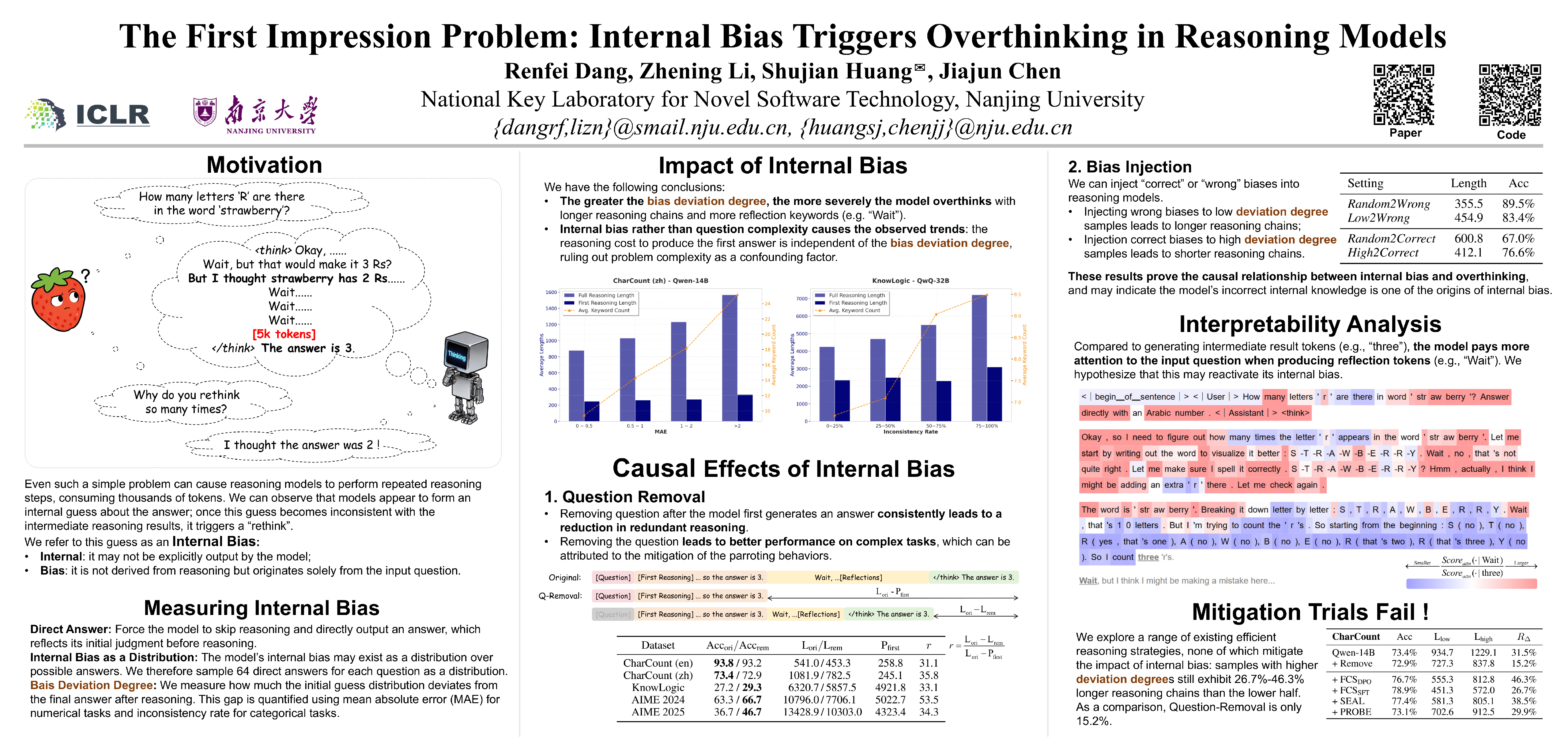
Reasoning models often exhibit overthinking, characterized by redundant reasoning steps. We identify \emph{internal bias} elicited by the input question as a key trigger of such behavior. Upon encountering a problem, the model immediately forms a preliminary guess about the answer, which we term an internal bias since it may not be explicitly generated, and it arises without systematic reasoning. When this guess conflicts with its subsequent reasoning, the model tends to engage in excessive reflection, resulting in wasted computation. We validate the association between internal bias and overthinking across multiple models and diverse reasoning tasks. To demonstrate the causal relationship more rigorously, we conduct two counterfactual interventions, showing that removing the input question after the model reduces the redundant reasoning across various complex reasoning tasks, and manually injecting bias affects overthinking accordingly. Further interpretability experiments suggest that excessive attention to the input question serves as a key mechanism through which internal bias influences subsequent reasoning trajectories. Finally, we evaluated several methods aimed at mitigating overthinking, yet the influence of internal bias persisted under all conditions.
MambaVoiceCloning: Efficient and Expressive Text-to-Speech via State-Space Modeling and Diffusion Control
Sahil Kumar ⋅ Namrataben Patel ⋅ Honggang Wang ⋅ Youshan Zhang
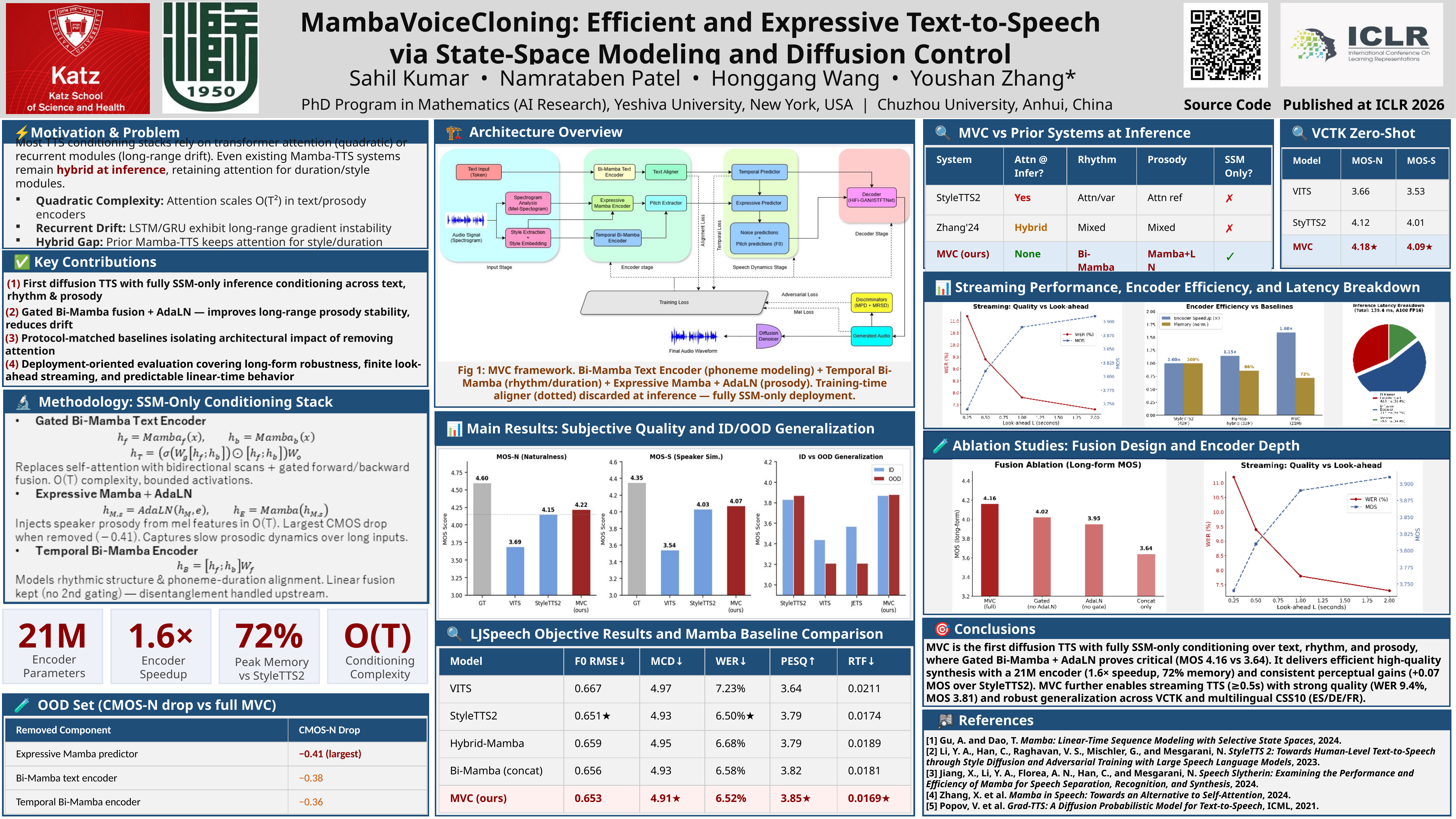
MambaVoiceCloning (MVC) asks whether the conditioning path of diffusion-based TTS can be made fully SSM-only at inference—removing all attention and explicit RNN-style recurrence layers across text, rhythm, and prosody—while preserving or improving quality under controlled conditions. MVC combines a gated bidirectional Mamba text encoder, a Temporal Bi-Mamba supervised by a lightweight alignment teacher discarded after training, and an Expressive Mamba with AdaLN modulation, yielding linear-time $\mathcal{O}(T)$ conditioning with bounded activation memory and practical finite look-ahead streaming. Unlike prior Mamba--TTS systems that remain hybrid at inference, MVC removes attention-based duration and style modules under a fixed StyleTTS2 mel--diffusion--vocoder backbone. Trained on LJSpeech/LibriTTS and evaluated on VCTK, CSS10 (ES/DE/FR), and long-form Gutenberg passages, MVC achieves modest but statistically reliable gains over StyleTTS2, VITS, and Mamba--attention hybrids in MOS/CMOS, F$_0$ RMSE, MCD, and WER, while reducing encoder parameters to 21M and improving throughput by $1.6\times$. Diffusion remains the dominant latency source, but SSM-only conditioning improves memory footprint, stability, and deployability. Code available at: \url{https://github.com/sahilkumar15/MVC}.
RankFlow: Property-aware Transport for Protein Optimization
Lu Yu ⋅ Wei Xiang ⋅ Kang Han ⋅ Gaowen Liu ⋅ Ramana Kompella
A key step in protein optimization is modeling the fitness landscape, which maps proteins to functional assay readouts. Existing methods typically either use property-agnostic likelihoods/embeddings from pretrained protein language models (PLMs) for fitness prediction, or assume independent mutational effects, limiting their ability to capture higher-order interactions. In this work, we introduce RankFlow, a conditional flow framework that refines PLM representations to be a property-aligned distribution via a tailored energy function and captures multi-mutation interactions through learnable embeddings. To align optimization with evaluation protocols, we propose the Rank-Consistent Conditional Flow Loss (RC$^2$), a differentiable ranking objective that enforces the correct order of mutants rather than absolute values, which improves out-of-distribution generalization. Finally, we introduce a Property-guided Steering Gate (PSG) that concentrates learning on positions carrying signals for the target property while suppressing unrelated evolutionary biases. Across the ProteinGym, PEER, and FLIP benchmarks, RankFlow obtains state-of-the-art ranking accuracy and superior generalization performance.
Pallatom-Ligand: an All-Atom Diffusion Model for Designing Ligand-Binding Proteins
Haochen Wang ⋅ Qianyi Wang ⋅ Rui Ma ⋅ Jiawei Guan ⋅ weikun wu ⋅ haobo wang ⋅ Jiayi Dou
Small-molecule ligands extend protein functionality beyond natural amino acids, enabling sophisticated processes like catalysis, signal transduction, and light harvesting. However, designing proteins with high affinity and selectivity for arbitrary ligands remains a major challenge. We present Pallatom-Ligand, a diffusion model that performs end-to-end generation of ligand-binding proteins at atomic resolution. By directly learning the joint distribution of all atoms in the protein–ligand complexes, Pallatom-Ligand delivers state-of-the-art performance, achieving the highest in silico success rates in a comprehensive benchmark. In addition, Pallatom-Ligand's novel conditioning framework enables programmable control over global protein fold and atomic-level ligand solvent accessibility. With these capabilities, Pallatom-Ligand opens new opportunities for exploring the protein function space, advancing both generative modeling and computational protein engineering.
Graph Diffusion Transformers are In-Context Molecular Designers
Gang Liu ⋅ Jie Chen ⋅ Yihan Zhu ⋅ Michael Sun ⋅ Tengfei Luo ⋅ Nitesh Chawla ⋅ Meng Jiang
In-context learning lets large models adapt to new tasks from a few demonstrations, but it has shown limited success in molecular design, where labeled data are scarce and properties span millions of biological assays and material measurements. We introduce demonstration-conditioned diffusion models (DemoDiff), which define task contexts through molecule–score examples instead of texts. These demonstrations guide a denoising Transformer to generate molecules aligned with target properties. For scalable pretraining, we develop a new molecular tokenizer with Node Pair Encoding that represents molecules at the motif level, requiring 5.5$\times$ fewer nodes. We pretrain a 0.7B parameter model on datasets covering drugs and materials. Across 33 design tasks in six categories, DemoDiff matches or surpasses language models 100–1000$\times$ larger and achieves an average rank of 4.10 compared to 6.56–17.95 for 19 baselines. These results position DemoDiff as a molecular foundation model for in-context molecular design.
ProTDyn: A Foundation Protein Language Model for Thermodynamics and Dynamics Generation
Yikai Liu ⋅ Haoyang Zheng ⋅ Lining Mao ⋅ Yanbin Wang ⋅ Ming Chen ⋅ Guang Lin
Molecular dynamics (MD) simulation has long been the principal computational tool for exploring protein conformational landscapes, but its application is limited by high computational cost. We present ProTDyn, a foundation protein language model that unifies conformational ensemble generation and multi-timescale dynamics modeling within a single framework. Unlike prior approaches that treat these tasks separately, ProTDyn allows flexible i.i.d ensemble sampling and dynamic trajectory simulation. Across diverse protein systems, ProTDyn yields thermodynamically consistent ensembles, faithfully reproduces dynamical properties over multiple timescales, and generalizes to proteins beyond its training data—offering a scalable and efficient alternative to conventional MD simulations.
Branched Schrödinger Bridge Matching
Sophia Tang ⋅ Yinuo Zhang ⋅ Alexander Tong ⋅ Pranam Chatterjee
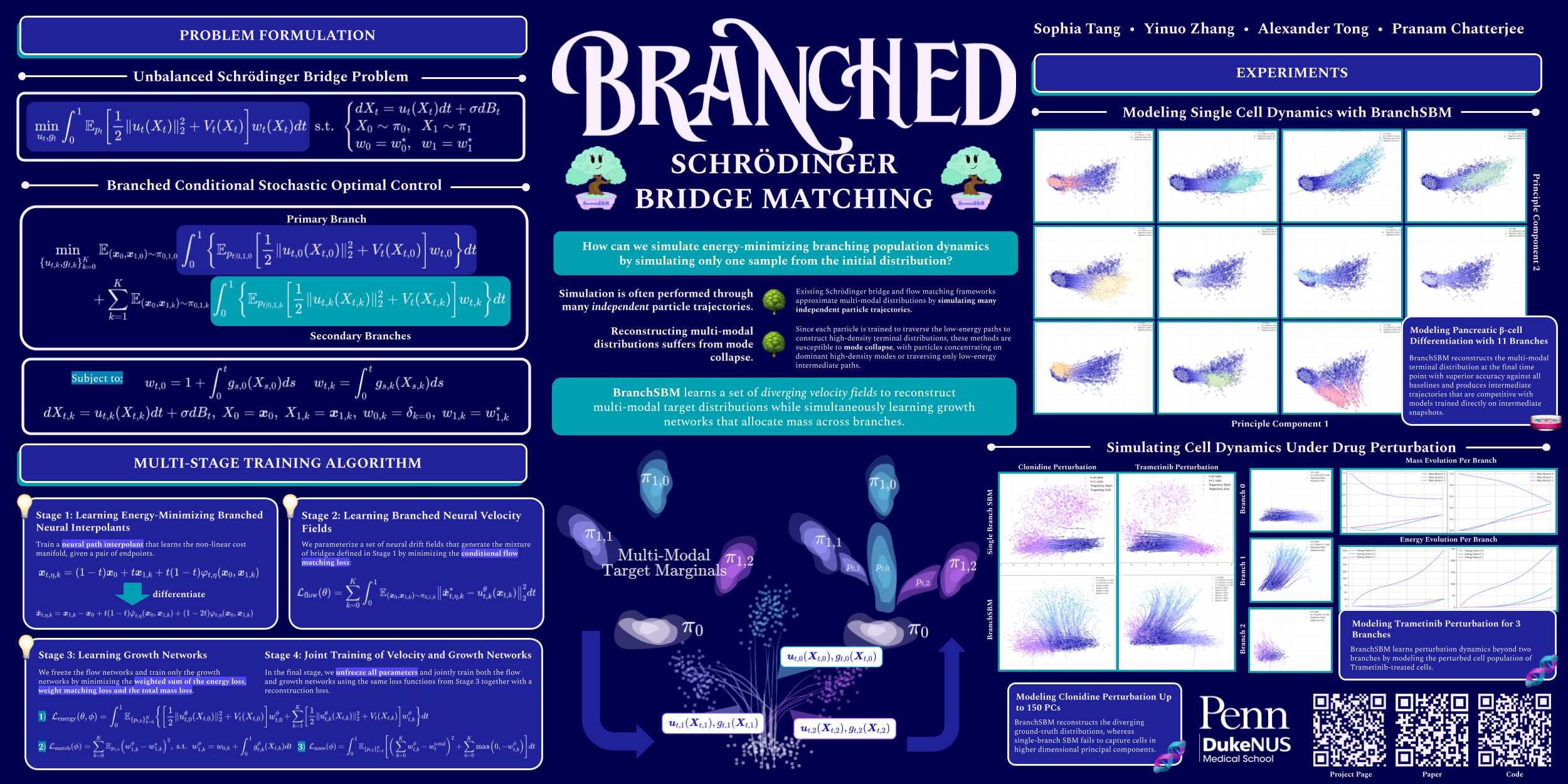
Predicting the intermediate trajectories between an initial and target distribution is a central problem in generative modeling. Existing approaches, such as flow matching and Schrödinger bridge matching, effectively learn mappings between two distributions by modeling a single stochastic path. However, these methods are inherently limited to unimodal transitions and cannot capture branched or divergent evolution from a common origin to multiple distinct modes. To address this, we introduce Branched Schrödinger Bridge Matching (BranchSBM), a novel framework that learns branched Schrödinger bridges. BranchSBM parameterizes multiple time-dependent velocity fields and growth processes, enabling the representation of population-level divergence into multiple terminal distributions. We show that BranchSBM is not only more expressive but also essential for tasks involving multi-path surface navigation, modeling cell fate bifurcations from homogeneous progenitor states, and simulating diverging cellular responses to perturbations.
Refine Drugs, Don’t Complete Them: Uniform-Source Discrete Flows for Fragment-Based Drug Discovery
Benno Kaech ⋅ Luis Wyss ⋅ Karsten Borgwardt ⋅ Gianvito Grasso
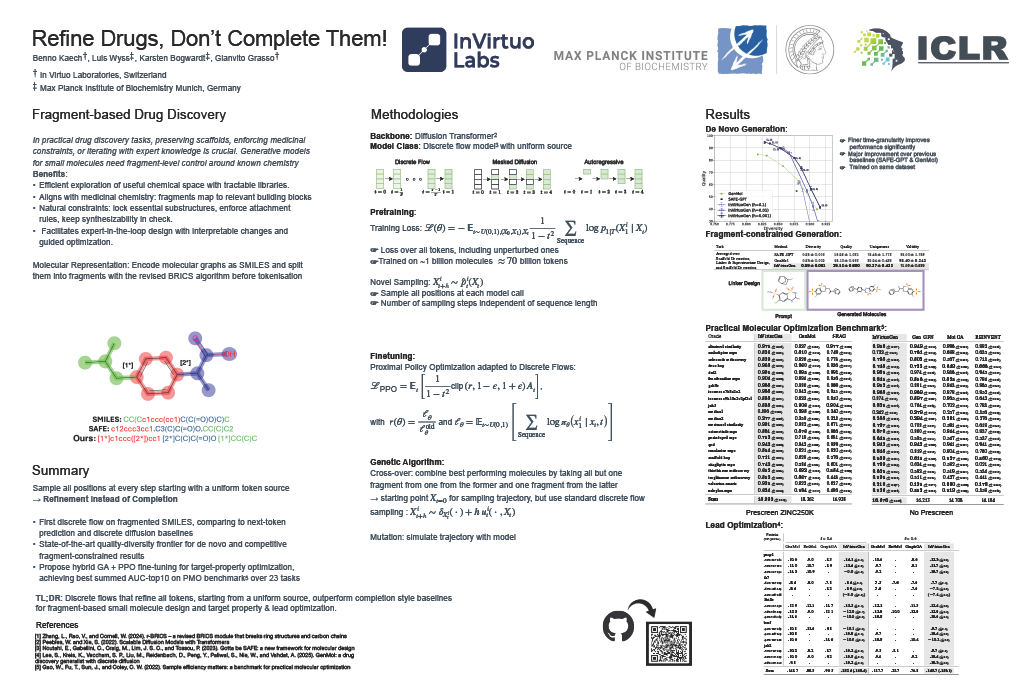
We introduce InVirtuoGen, a discrete flow generative model for fragmented SMILES for de novo and fragment-constrained generation, and target-property/lead optimization of small molecules. The model learns to transform a uniform source over all possible tokens into the data distribution. Unlike masked models, its training loss accounts for predictions on all sequence positions at every denoising step, shifting the generation paradigm from completion to refinement, and decoupling the number of sampling steps from the sequence length. For \textit{de novo} generation, InVirtuoGen achieves a stronger quality-diversity pareto frontier than prior fragment-based models and competitive performance on fragment-constrained tasks. For property and lead optimization, we propose a hybrid scheme that combines a genetic algorithm with a Proximal Property Optimization fine-tuning strategy adapted to discrete flows. Our approach sets a new state-of-the-art on the Practical Molecular Optimization benchmark, measured by top-10 AUC across tasks, and yields higher docking scores in lead optimization than previous baselines. InVirtuoGen thus establishes a versatile generative foundation for drug discovery, from early hit finding to multi-objective lead optimization. We further contribute to open science by releasing pretrained checkpoints and code, making our results fully reproducible.
A Genetic Algorithm for Navigating Synthesizable Molecular Spaces
Alston Lo ⋅ Connor Coley ⋅ Wojciech Matusik
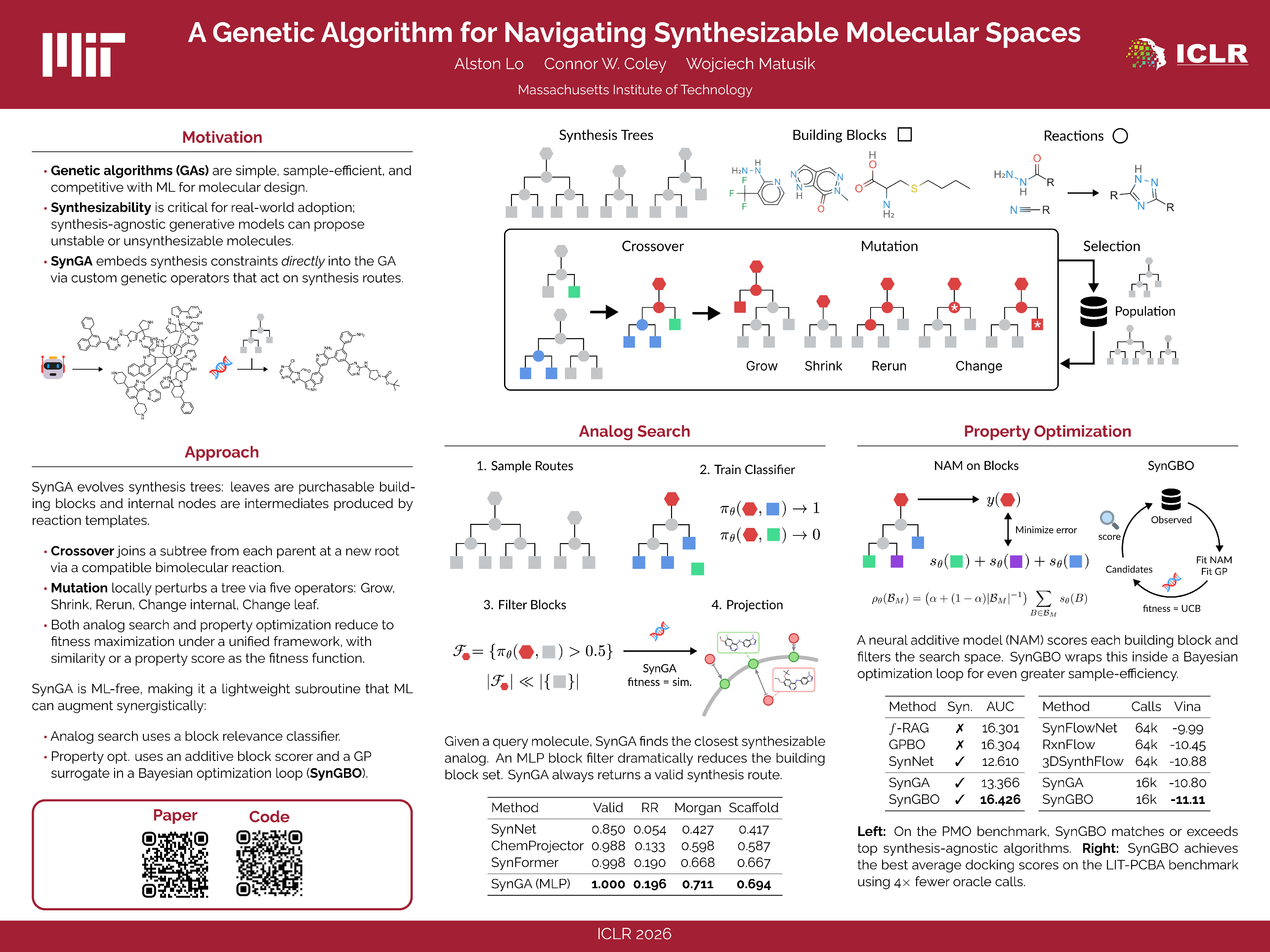
Inspired by the effectiveness of genetic algorithms and the importance of synthesizability in molecular design, we present SynGA, a simple genetic algorithm that operates directly over synthesis routes. Our method features custom crossover and mutation operators that explicitly constrain it to synthesizable molecular space. By modifying the fitness function, we demonstrate the effectiveness of SynGA on a variety of design tasks, including synthesizable analog search and sample-efficient property optimization, for both 2D and 3D objectives. Furthermore, by coupling SynGA with a machine learning-based filter that focuses the building block set, we boost SynGA to state-of-the-art performance. For property optimization, this manifests as a model-based variant SynGBO, which employs SynGA and block filtering in the inner loop of Bayesian optimization. Since SynGA is lightweight and enforces synthesizability by construction, our hope is that SynGA can not only serve as a strong standalone baseline but also as a versatile module that can be incorporated into larger synthesis-aware workflows in the future.
Distilling Causal Signals for One-Shot Directed Evolution of Antibodies
Sai Pooja Mahajan ⋅ Natasa Tagasovska ⋅ Stefania Vasilaki ⋅ Arian Jamasb ⋅ Andrew Watkins ⋅ Rajesh Ranganath
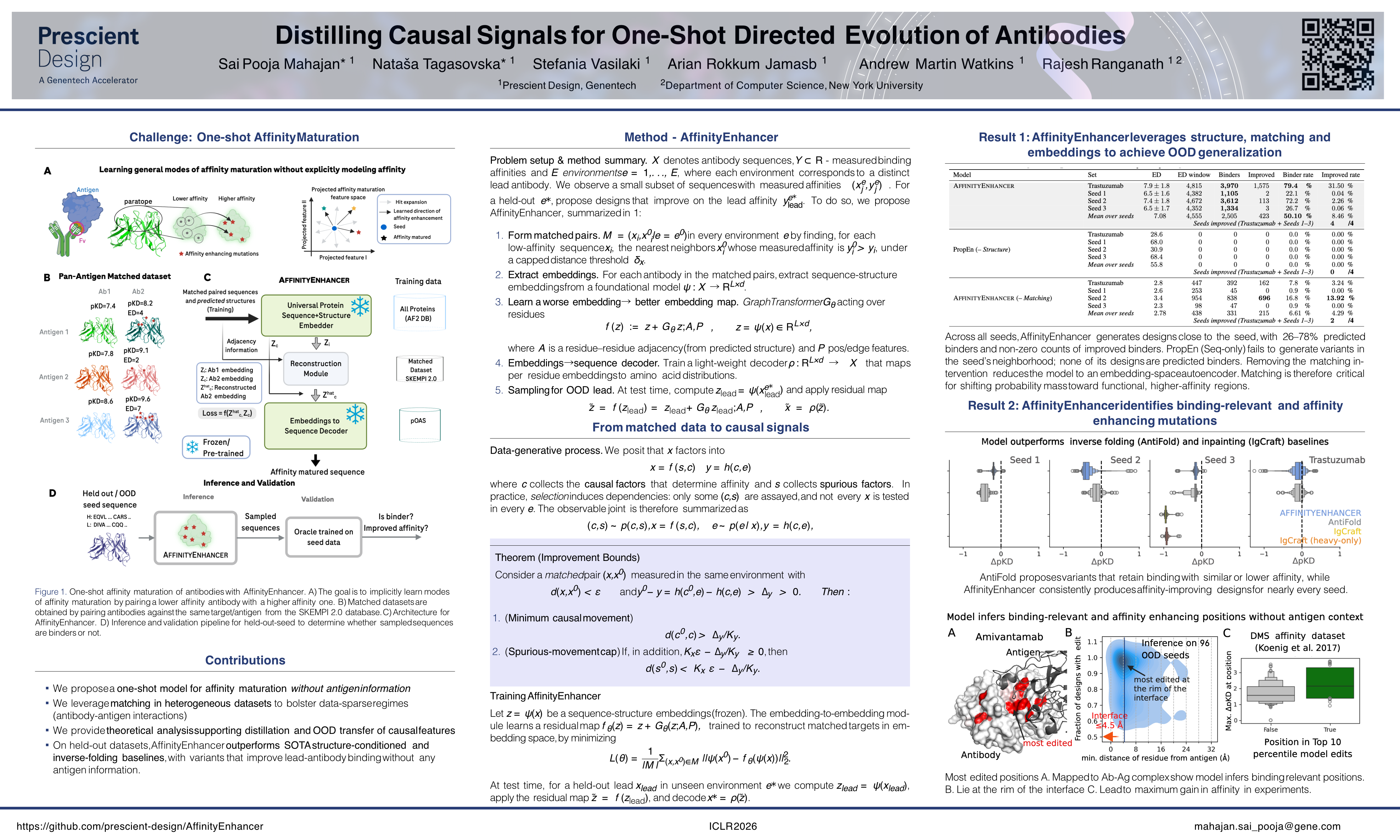
Improving antibody binding to an antigen without antibody–antigen complex structures or antigen-specific training data is a central challenge in therapeutic protein design. We introduce AffinityEnhancer, a framework for one-shot antibody affinity improvement with strong generalization: given a single lead sequence, we propose variants that increase affinity without fine-tuning on the lead and without using antigen information, epitope/paratope labels, or the lead’s structure in complex with the antigen. During training, AffinityEnhancer leverages a pan-antigen dataset of diverse binding environments (antigens) and constructs paired examples of related sequences with higher vs. lower measured binding. A shared, structure-aware module learns to transform low-affinity sequences toward high-affinity ones, distilling consistent, causal features associated with improved binding across environments. By combining pretrained sequence–structure embeddings with a sequence decoder, AffinityEnhancer generalizes to entirely unseen antibody seeds. Across multiple held-out internal and public leads, AffinityEnhancer concentrates mutations on the rim of the paratope, outperforms existing structure-conditioned and inpainting baselines, and achieves substantial in silico affinity gains in true one-shot experiments, despite never observing antigen-specific data at test time.
Self-Supervised Evolution Operator Learning for High-Dimensional Dynamical Systems
Giacomo Turri ⋅ Luigi Bonati ⋅ Kai Zhu ⋅ massimiliano pontil ⋅ Pietro Novelli
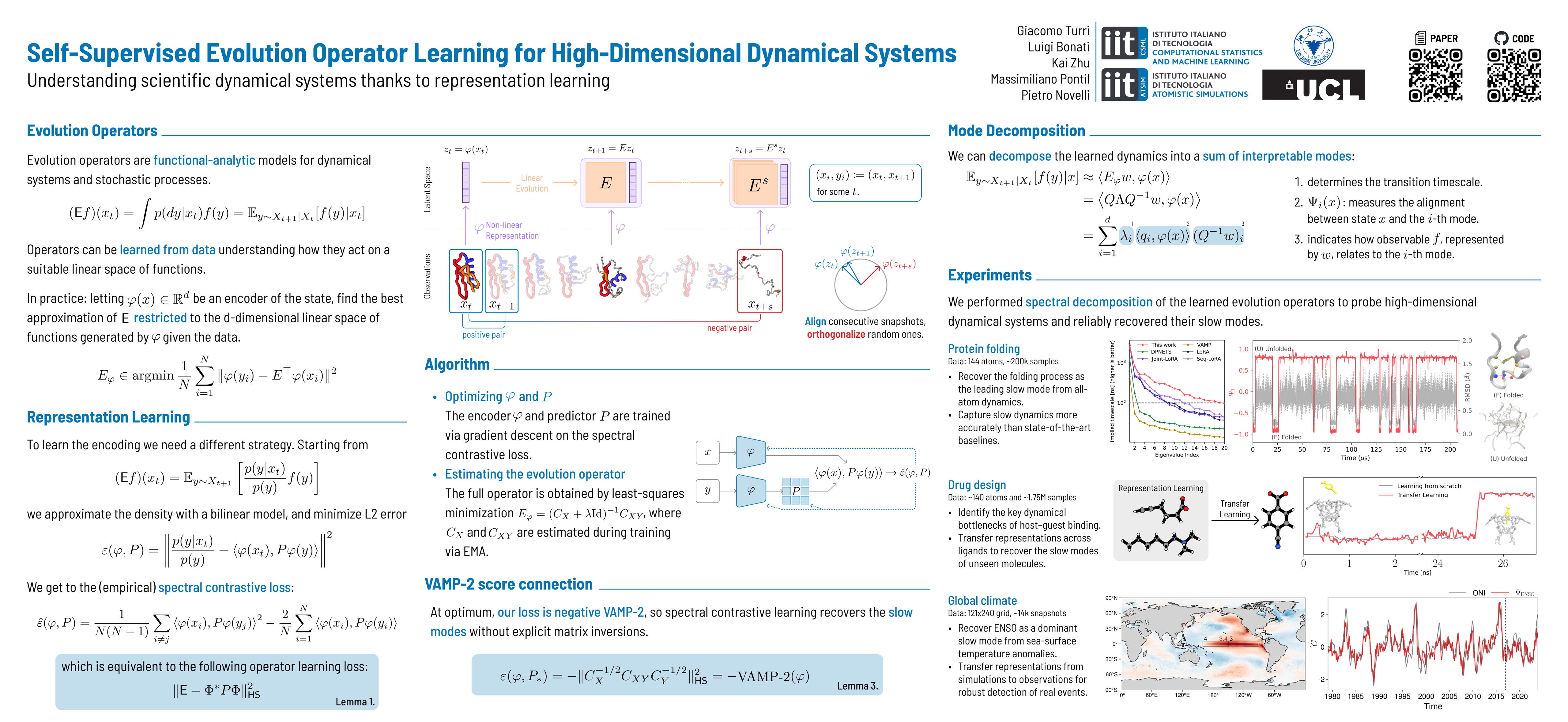
We introduce an end-to-end approach to learn the evolution operators of large-scale non-linear dynamical systems, such as those describing complex natural phenomena. Evolution operators are particularly well-suited for analyzing systems that exhibit spatio-temporal patterns and have become a key analytical tool across various scientific communities. As terabyte-scale weather datasets and simulation tools capable of running millions of molecular dynamics steps per day are becoming commodities, our approach provides an effective tool to make sense of them from a data-driven perspective. The core of it lies in a remarkable connection between self-supervised representation learning methods and the recently established learning theory of evolution operators. We deploy our approach across multiple scientific domains: explaining the folding dynamics of small proteins, the binding process of drug-like molecules in host sites, and autonomously finding patterns in climate data. Our code is available open-source at: https://github.com/pietronvll/encoderops.
MolLangBench: A Comprehensive Benchmark for Language-Prompted Molecular Structure Recognition, Editing, and Generation
Feiyang Cai ⋅ Jiahui Bai ⋅ Tao Tang ⋅ Guijuan He ⋅ Joshua Luo ⋅ Tianyu Zhu ⋅ Srikanth Pilla ⋅ Gang Li ⋅ Ling Liu ⋅ Feng Luo
Precise recognition, editing, and generation of molecules are essential prerequisites for both chemists and AI systems tackling various chemical tasks. We present MolLangBench, a comprehensive benchmark designed to evaluate fundamental molecule-language interface tasks: language-prompted molecular structure recognition, editing, and generation. To ensure high-quality, unambiguous, and deterministic outputs, we construct the recognition tasks using automated cheminformatics tools, and curate editing and generation tasks through rigorous expert annotation and validation. MolLangBench supports the evaluation of models that interface language with different molecular representations, including linear strings, molecular images, and molecular graphs. Evaluations of state-of-the-art models reveal significant limitations: the strongest model (GPT-5) achieves $86.2$\% and $85.5$\% accuracy on recognition and editing tasks, which are intuitively simple for humans, and performs even worse on the generation task, reaching only $43.0$\% accuracy. These results highlight the shortcomings of current AI systems in handling even preliminary molecular recognition and manipulation tasks. We hope MolLangBench will catalyze further research toward more effective and reliable AI systems for chemical applications. The dataset and code can be accessed at https://huggingface.co/datasets/ChemFM/MolLangBench and https://github.com/TheLuoFengLab/MolLangBench, respectively.
A Function-Centric Graph Neural Network Approach for Predicting Electron Densities
Manuel Viktor Klockow ⋅ Marc Ickler ⋅ Peter Lippmann ⋅ Fred A Hamprecht
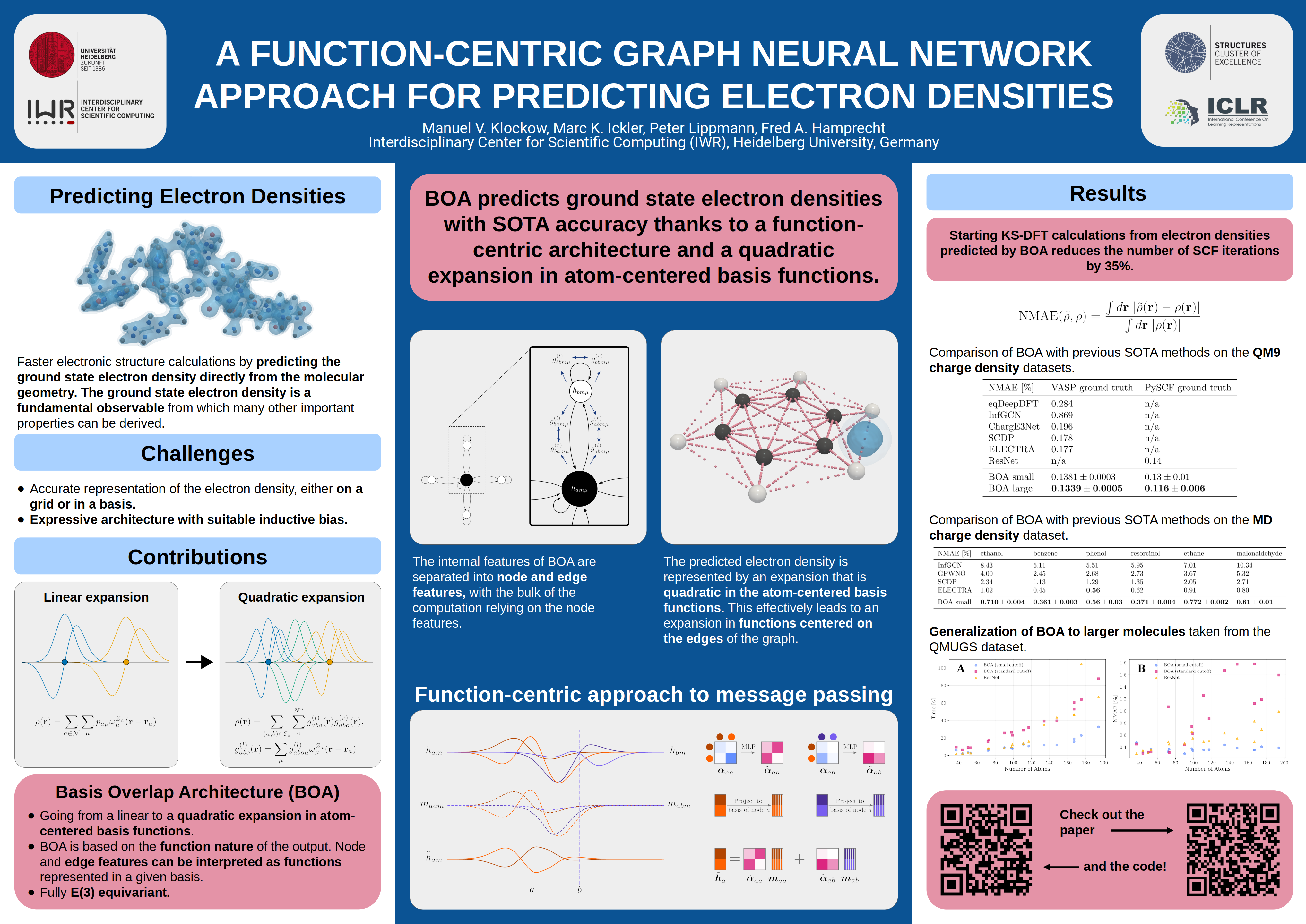
Electronic structure predictions are relevant for a wide range of applications, from drug discovery to materials science. Since the cost of purely quantum mechanical methods can be prohibitive, machine learning surrogates are used to predict the results of these calculations. This work introduces the Basis Overlap Architecture (BOA), an equivariant graph neural network architecture based on a novel message passing scheme that utilizes the overlap matrix of the basis functions used to represent the predicted ground state electron density. BOA is evaluated on QM9 and MD density datasets, surpassing the previous state of the art in predicting accurate electron densities. Excellent generalization to larger molecules of up to nearly 200 atoms is demonstrated using a model trained only on QM9 molecules of at most 9 heavy atoms.
Learning Escorted Protocols For Multistate Free-Energy Estimation
Lars Holdijk ⋅ Nithishwer Mouroug Anand ⋅ Michael Bronstein ⋅ Max Welling
Estimating relative free energy differences between multiple thermodynamic states lies at the core of numerous problems in computational biochemistry. Traditional estimators, such as Free Energy Perturbation and its non-equilibrium counterpart based on the Jarzynski equality, rely on defining a switching protocol between thermodynamic states and computing the free energy difference from the work performed during this process. In this work, we present a method for learning such switching protocols within the class of escorted protocols that combine deterministic and stochastic steps. For this purpose, we use Conditional Flow Matching, and introduce Conditional Density Matching (CDM) for the purpose of estimating the change in Free-Energy. We further reduce the variance in the multistate setting by coupling multiple flows between thermodynamic states into a Flow Graph, enforcing estimator consistency across different transition paths.
Triangle Multiplication is All You Need for Biomolecular Structure Representations
Jeffrey Ouyang-Zhang ⋅ Pranav Murugan ⋅ Daniel Diaz ⋅ Gianluca Scarpellini ⋅ Richard Bowen ⋅ Nate Gruver ⋅ Adam Klivans ⋅ Philipp Krähenbühl ⋅ Aleksandra Faust ⋅ Maruan Al-Shedivat
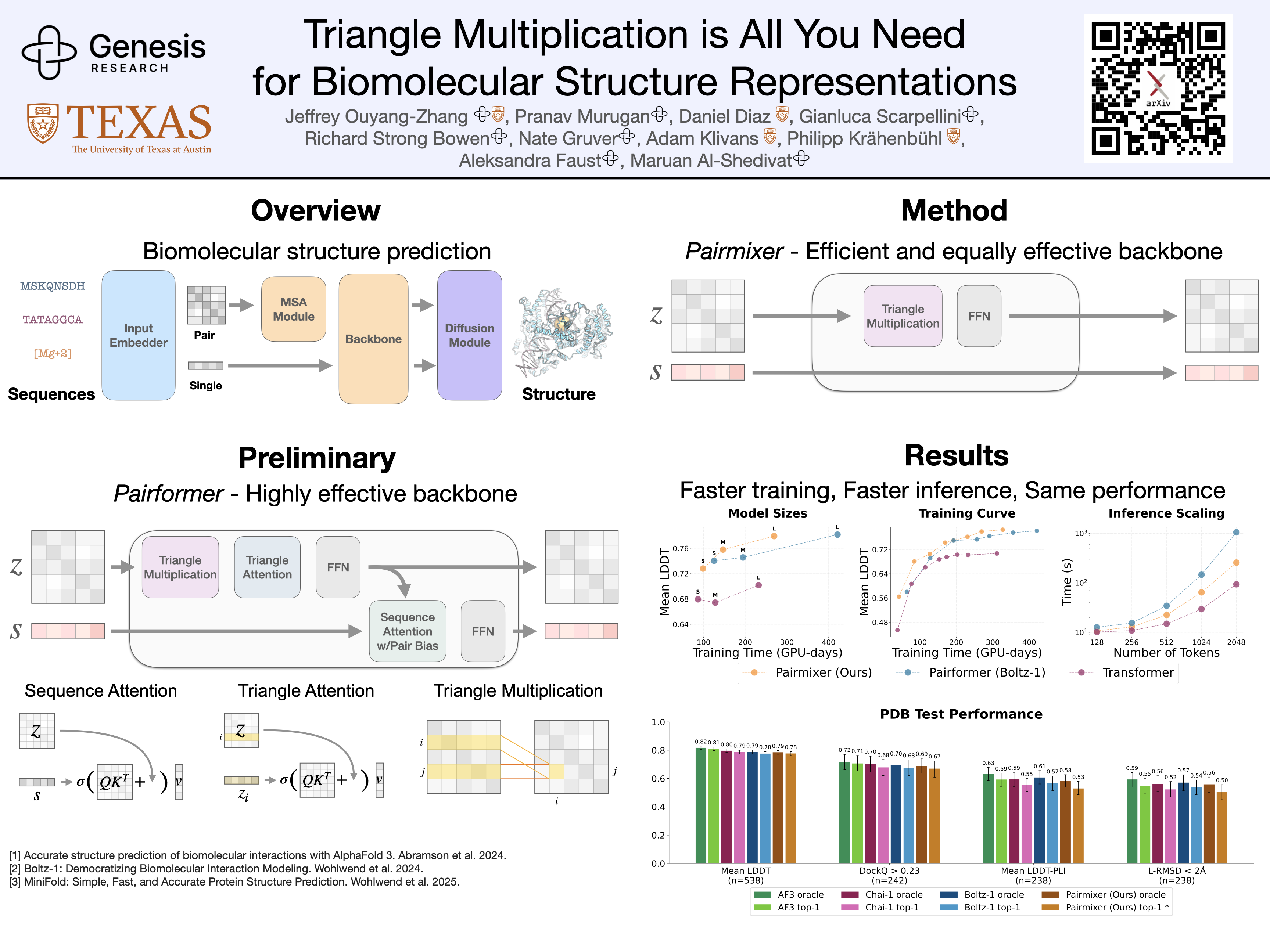
AlphaFold has transformed protein structure prediction, but emerging applications such as virtual ligand screening, proteome-wide folding, and de novo binder design demand predictions at a massive scale, where runtime and memory costs become prohibitive. A major bottleneck lies in the Pairformer backbone of AlphaFold3-style models, which relies on computationally expensive triangular primitives—especially triangle attention—for pairwise reasoning. We introduce Pairmixer, a streamlined alternative that eliminates triangle attention while preserving higher-order geometric reasoning capabilities that are critical for structure prediction. Pairmixer substantially improves computational efficiency, matching state-of-the-art structure predictors across folding and docking benchmarks, delivering up to 4x faster inference on long sequences while reducing training cost by 34%. Its efficiency alleviates the computational burden of downstream applications such as modeling large protein complexes, high-throughput ligand and binder screening, and hallucination-based design. Within BoltzDesign, for example, Pairmixer delivers over 2x faster sampling and scales to sequences 30% longer than the memory limits of Pairformer. Code is available at https://github.com/genesistherapeutics/pairmixer.
IR-Agent: Expert-Inspired LLM Agents for Structure Elucidation from Infrared Spectra
Heewoong Noh ⋅ Namkyeong Lee ⋅ Gyoung S. Na ⋅ Kibum Kim ⋅ Chanyoung Park
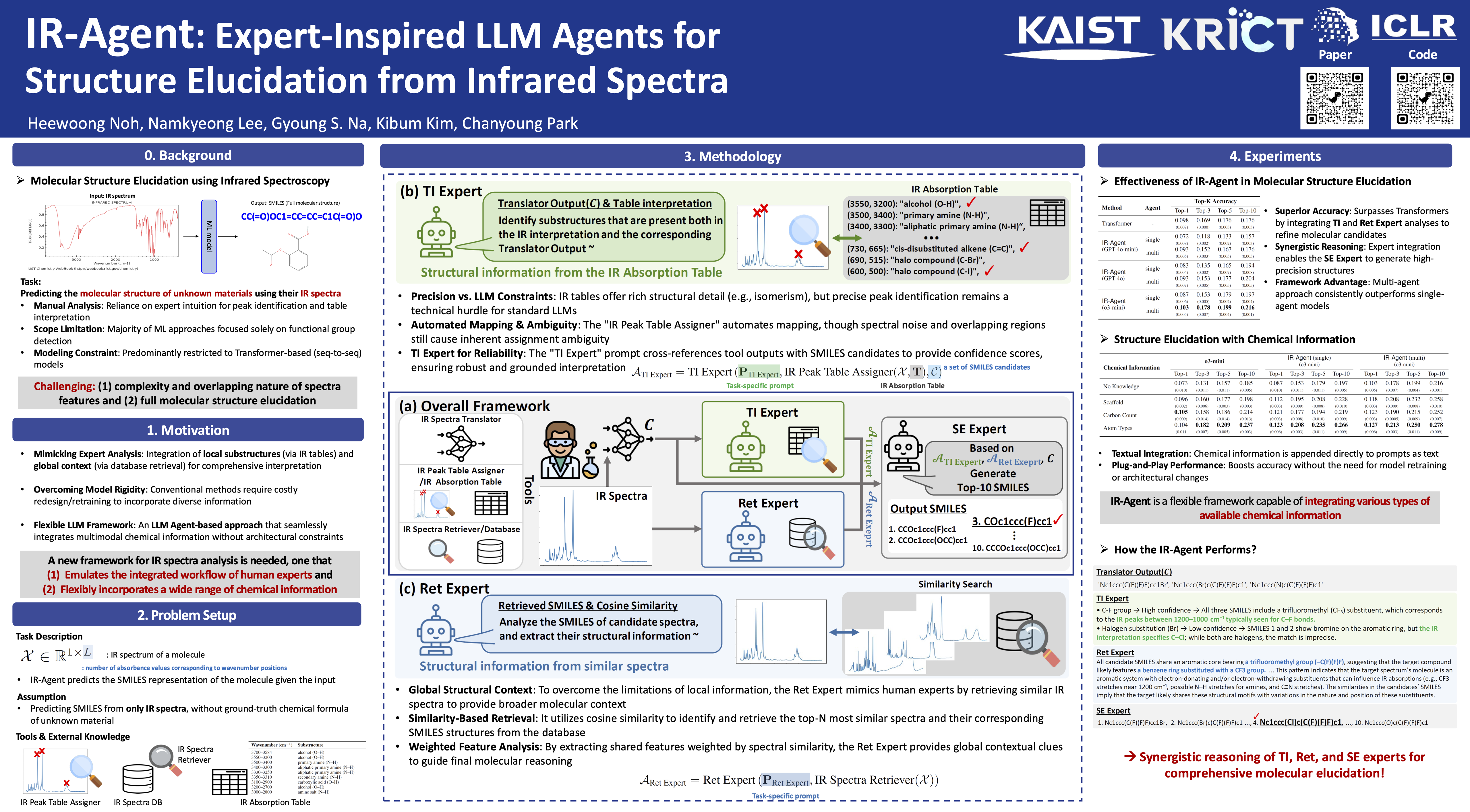
Spectral analysis provides crucial clues for the elucidation of unknown materials. Among various techniques, infrared spectroscopy (IR) plays an important role in laboratory settings due to its high accessibility and low cost. However, existing approaches often fail to reflect expert analytical processes and lack flexibility in incorporating diverse types of chemical knowledge, which is essential in real-world analytical scenarios. In this paper, we propose IR-Agent, a novel multi-agent framework for molecular structure elucidation from IR spectra. The framework is designed to emulate expert-driven IR analysis procedures and is inherently extensible. Each agent specializes in a specific aspect of IR interpretation, and their complementary roles enable integrated reasoning, thereby improving the overall accuracy of structure elucidation. Through extensive experiments, we demonstrate that IR-Agent not only improves baseline performance on experimental IR spectra but also shows strong adaptability to various forms of chemical information. The source code for IR-Agent is available at https://github.com/HeewoongNoh/IR-Agent.
DistMLIP: A Distributed Inference Platform for Machine Learning Interatomic Potentials
Kevin Han ⋅ Bowen Deng ⋅ Amir Barati Farimani ⋅ Gerbrand Ceder
Large-scale atomistic simulations are essential to bridge computational materials and chemistry to realistic materials and drug discovery applications. In the past few years, rapid developments of machine learning interatomic potentials (MLIPs) have offered a solution to scale up quantum mechanical calculations. Parallelizing these interatomic potentials across multiple devices poses a challenging, but promising approach to further extending simulation scales to real-world applications. In this work, we present \textbf{DistMLIP}, an efficient distributed inference platform for MLIPs based on zero-redundancy, graph-level parallelization. In contrast to conventional spatial partitioning parallelization, DistMLIP enables efficient MLIP parallelization through graph partitioning, allowing multi-device inference on flexible MLIP model architectures like multi-layer graph neural networks. DistMLIP presents an easy-to-use, flexible, plug-in interface that enables distributed inference of pre-existing MLIPs. We demonstrate DistMLIP on four widely used and state-of-the-art MLIPs: CHGNet, MACE, TensorNet, and eSEN. We show that DistMLIP can simulate atomic systems 3.4x larger and up to 8x faster compared to previous multi-GPU methods. We show that existing foundation potentials can perform near-million-atom calculations at the scale of a few seconds on 8 GPUs with DistMLIP.
SAVE: A Generalizable Framework for Multi-Condition Single-Cell Generation with Gene Block Attention
Jiahao Li ⋅ Jiayi Dong ⋅ Peng Ye ⋅ Xiaochi Zhou ⋅ Haohai Lu ⋅ Fei Wang
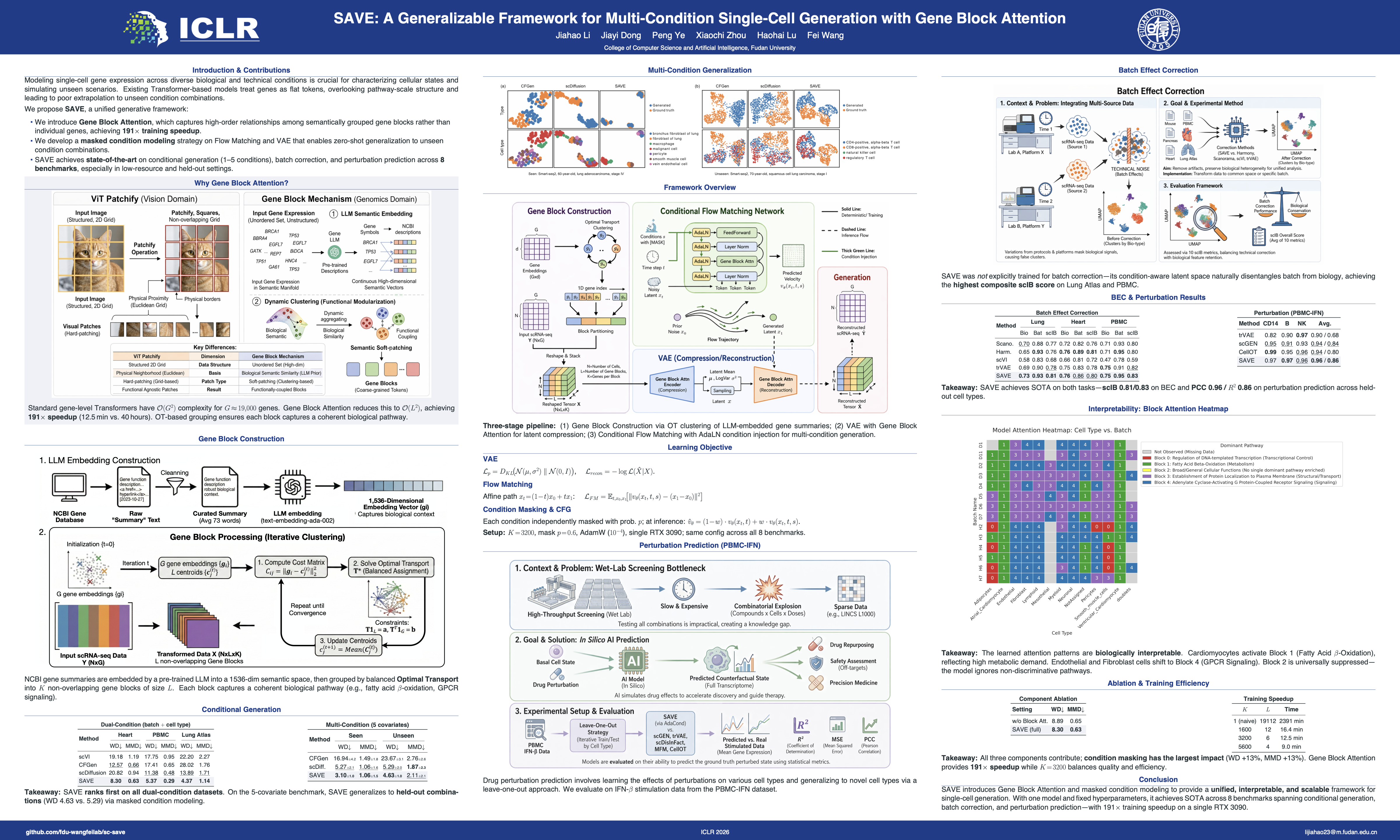
Modeling single-cell gene expression across diverse biological and technical conditions is crucial for characterizing cellular states and simulating unseen scenarios. Existing methods often treat genes as independent tokens, overlooking their high-level biological relationships and leading to poor performance. We introduce SAVE, a unified generative framework based on conditional Transformers for multi-condition single-cell modeling. SAVE leverages a coarse-grained representation by grouping semantically related genes into blocks, capturing higher-order dependencies among gene modules. A Flow Matching mechanism and condition-masking strategy further enhance flexible simulation and enable generalization to unseen condition combinations. We evaluate SAVE on a range of benchmarks, including conditional generation, batch effect correction, and perturbation prediction. SAVE consistently outperforms state-of-the-art methods in generation fidelity and extrapolative generalization, especially in low-resource or combinatorially held-out settings. Overall, SAVE offers a scalable and generalizable solution for modeling complex single-cell data, with broad utility in virtual cell synthesis and biological interpretation.
PETRI: Learning Unified Cell Embeddings from Unpaired Modalities via Early-Fusion Joint Reconstruction
Ryan Conrad ⋅ Ethan Weinberger ⋅ Saradha Venkatachalapathy ⋅ Yuwen Chen ⋅ Darshini Shah ⋅ Bay Johnson ⋅ Max Salick ⋅ Vaishaali Natarajan ⋅ Emily Fox
Integrating imaging and transcriptomics screening data holds promise for isolating true biological signals from modality-specific technical artifacts. However, existing multimodal embedding approaches either require pairing or fail to capture both shared and modality-specific information in an end-to-end manner. We present PETRI, an early-fusion transformer that learns a unified cell embedding from unpaired cellular images and gene expression profiles. PETRI groups cells by shared experimental context into multimodal “documents” and performs masked joint reconstruction with cross-modal attention, permitting information sharing while preserving modality-specific capacity. The resulting latent space supports construction of perturbation-level profiles by simple averaging across modalities. Applying sparse autoencoders to the embeddings reveals learned concepts that are biologically meaningful, multimodal, and retain perturbation-specific effects. To support further machine learning research, we release a blinded, matched optical pooled screen (OPS) and Perturb-seq dataset in HepG2 cells.
Optimal transport unlocks end-to-end learning for single-molecule localization
Romain Seailles ⋅ Jean Masson ⋅ Jean Ponce ⋅ Julien Mairal
Single‑molecule localization microscopy (SMLM) allows reconstructing cellular organelles and biology-relevant structures far beyond the limited spatial resolution imposed by optics constrains, using tagged biomolecule positions. Currently, efficient SMLM requires non‑overlapping emitting fluorophores, to ensure proper image deconvolution leading to long acquisition times that hinders live‑cell imaging. Recent deep‑learning approaches can handle denser emissions, but they rely on variants of non‑maximum suppression (NMS) layers, which are unfortunately non‑differentiable and may discard true positives with their local fusion strategy. In this presentation, we reformulate the SMLM training objective as a set‑matching problem, deriving an optimal‑transport loss that eliminates the need for NMS during inference and enables end‑to‑end training. Additionally, we propose an iterative neural network that integrates knowledge of the microscope’s optical system inside our model. Experiments on synthetic benchmarks and real biological data show that both our new loss function and architecture surpass the state of the art at moderate and high emitter densities. Code is available at https://github.com/RSLLES/SHOT.
CHAMMI-75: Pre-training multi-channel models with heterogeneous microscopy images
Vidit Agrawal ⋅ John Peters ⋅ Tyler Thompson ⋅ Mohammad Sanian ⋅ Chau Pham ⋅ Nikita Moshkov ⋅ Arshad Kazi ⋅ Aditya Pillai ⋅ Jack Freeman ⋅ Byunguk Kang ⋅ Samouil Farhi ⋅ Ernest Fraenkel ⋅ Ron Stewart ⋅ Lassi Paavolainen ⋅ Bryan Plummer ⋅ Juan Caicedo
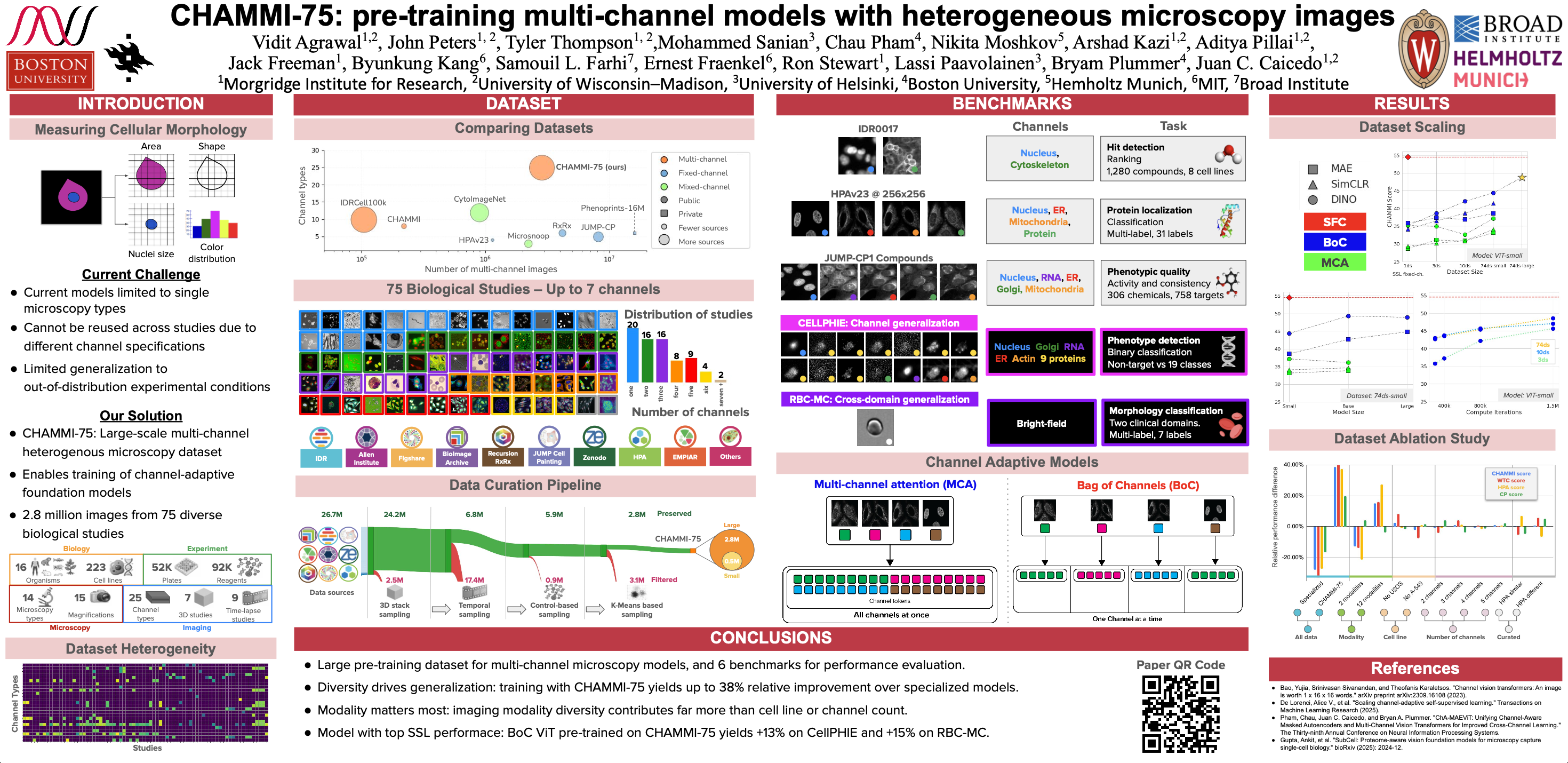
Quantifying cell morphology using images and machine learning has proven to be a powerful tool to study the response of cells to treatments. However, models used to quantify cellular morphology are typically trained with a single microscopy imaging type. This results in specialized models that cannot be reused across biological studies because the technical specifications do not match (e.g., different number of channels). Here, we present CHAMMI-75, an open access dataset of heterogeneous, multi-channel microscopy images from 75 diverse biological studies. We curated this resource from publicly available sources to investigate cellular morphology models that are channel-adaptive and can process any microscopy image type. Our experiments show that training with CHAMMI-75 can improve performance in multi-channel bioimaging tasks primarily because of its high diversity in microscopy modalities. This work paves the way to create the next generation of cellular morphology models for biological studies.
PatchDNA: A Flexible and Biologically-Informed Alternative to Tokenization for DNA
Alice Del Vecchio ⋅ Andreas C Kapourani ⋅ Abdullah M Athar ⋅ Agnieszka Dobrowolska ⋅ Andrew Anighoro ⋅ Benjamin Tenmann ⋅ Lindsay Edwards ⋅ Cristian Regep
DNA language models are emerging as powerful tools for representing genomic sequences, with recent progress driven by self-supervised learning. However, performance on downstream tasks is sensitive to tokenization strategies reflecting the complex encodings in DNA, where both regulatory elements and single-nucleotide changes can be functionally significant. Yet existing models are fixed to their initial tokenization strategy; single-nucleotide encodings result in long sequences that challenge transformer architectures, while fixed multi-nucleotide schemes like byte pair encoding struggle with character level modeling. Drawing inspiration from the Byte Latent Transformer's combining of bytes into patches, we propose that 'patching' provides a competitive and more efficient alternative to tokenization for DNA sequences. Furthermore, patching eliminates the need for a fixed vocabulary, which offers unique advantages to DNA. Leveraging this, we propose a biologically informed strategy, using evolutionary conservation scores as a guide for 'patch' boundaries. By prioritizing conserved regions, our approach directs computational resources to the most functionally relevant parts of the DNA sequence. We show that models up to an order of magnitude smaller surpass current state-of-the-art performance in existing DNA benchmarks. Importantly, our approach provides the flexibility to change patching without retraining, overcoming a fundamental limitation of current tokenization methods.
Representing local protein environments with machine learning force fields
Meital Bojan ⋅ Sanketh Vedula ⋅ Sai Advaith Maddipatla ⋅ Nadav Bojan Sellam ⋅ Anar Rzayev ⋅ Federico Napoli ⋅ Paul Schanda ⋅ Alexander Bronstein
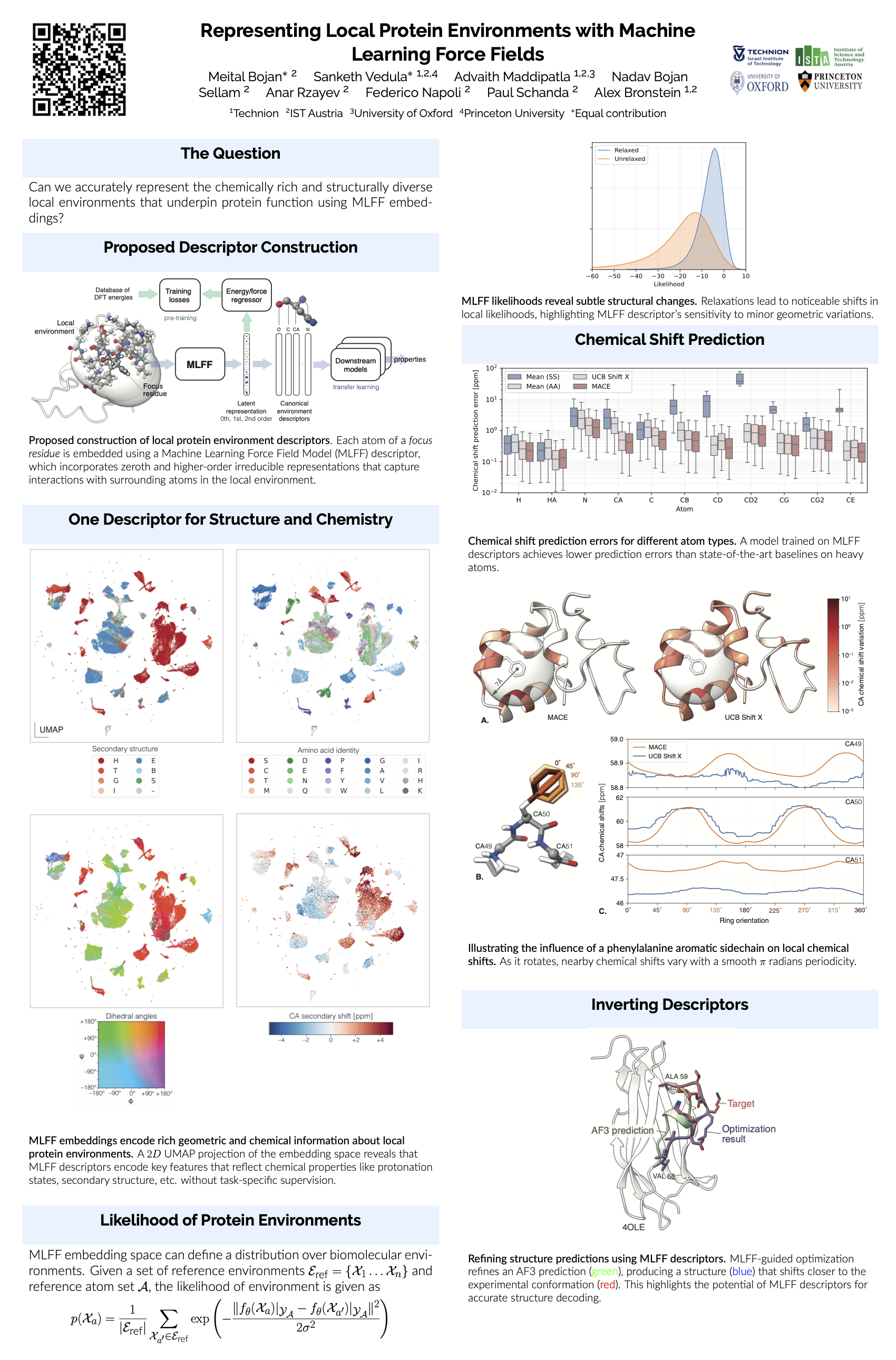
The local structure of a protein strongly impacts its function and interactions with other molecules. Representing local biomolecular environments remains a key challenge while applying machine learning approaches over protein structures. The structural and chemical variability of these environments makes them challenging to model, and performing representation learning on these objects remains largely under-explored. In this work, we propose representations for local protein environments that leverage intermediate features from machine learning force fields (MLFFs). We extensively benchmark state-of-the-art MLFFs—comparing their performance across latent spaces and downstream tasks—and show that their embeddings capture local structural (e.g., secondary motifs) and chemical features (e.g., amino acid identity and protonation state), organizing protein environments into a structured manifold. We show that these representations enable zero-shot generalization and transfer across diverse downstream tasks. As a case study, we build a physics-informed, uncertainty-aware chemical shift predictor that achieves state-of-the-art accuracy in biomolecular NMR spectroscopy. Our results establish MLFFs as general-purpose, reusable representation learners for protein modeling, opening new directions in representation learning for structured physical systems.
Count Bridges enable Modeling and Deconvolving Transcriptomic Data
Nic Fishman ⋅ Gokul Gowri ⋅ Tanush Kumar ⋅ Jiaqi Lu ⋅ Valentin De Bortoli ⋅ Jonathan Gootenberg ⋅ Omar Abudayyeh
Many modern biological assays, including RNA sequencing, yield integer-valued counts that reflect the number of molecules detected. These measurements are often not at the desired resolution: while the unit of interest is typically a single cell, many measurement technologies produce counts aggregated over sets of cells. Although recent generative frameworks such as diffusion and flow matching have been extended to non-Euclidean and discrete settings, it remains unclear how best to model integer-valued data or how to systematically deconvolve aggregated observations. We introduce Count Bridges, a stochastic bridge process on the integers that provides an exact, tractable analogue of diffusion-style models for count data, with closed-form conditionals for efficient training and sampling. We extend this framework to enable direct training from aggregated measurements via an Expectation-Maximization approach that treats unit-level counts as latent variables. We demonstrate state-of-the-art performance on integer distribution matching benchmarks, comparing against flow matching and discrete flow matching baselines across various metrics. We then apply Count Bridges to two large-scale problems in biology: modeling single-cell gene expression data at the nucleotide resolution, with applications to deconvolving bulk RNA-seq, and resolving multicellular spatial transcriptomic spots into single-cell count profiles. Our methods offer a principled foundation for generative modeling and deconvolution of biological count data across scales and modalities.
Histopathology-Genomics Multi-modal Structural Representation Learning for Data-Efficient Precision Oncology
KUN WU ⋅ Zhiguo Jiang ⋅ Xinyu Zhu ⋅ Jun Shi ⋅ Yushan Zheng
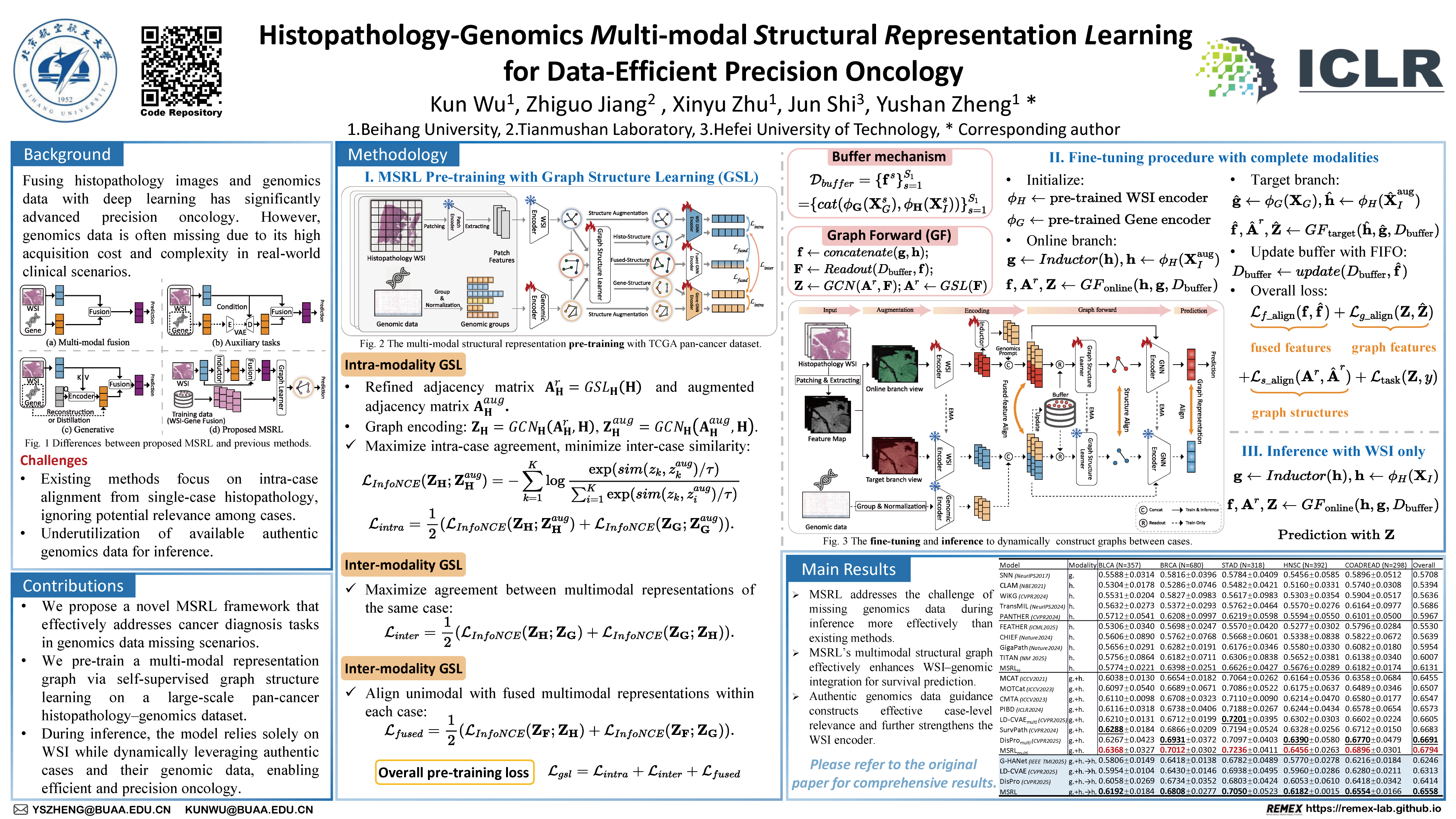
Fusing histopathology images and genomics data with deep learning has significantly advanced precision oncology. However, genomics data is often missing due to its high acquisition cost and complexity in real-world clinical scenarios. Existing solutions aim to reconstruct genomics data from histopathology images. Nevertheless, these methods typically relied only on individual case and overlooked the potential relationships among cases. Additionally, they failed to take advantage of the authentic genomics data of diagnostically related cases that are accessible from training for inference. In this work, we propose a novel Multi-modal Structural Representation Learning (MSRL) framework for data-efficient precision oncology. We pre-train a histopathology-genomics multi-modal representation graph adopting Graph Structure Learning (GSL) to construct inter-case relevance based on the data inherently. During the fine-tuning stage, we dynamically capture structural relevance between the training cases and the acquired authentic cases for precise prediction. MSRL leverages prior inter-case associations and authentic genomics data from diagnosed cases based on the graph, which contributes to effective inference based on the single histopathology image modality. We evaluated MSRL on public TCGA datasets with 7,263 cases across various tasks, including survival prediction, cancer grading, and gene mutation prediction. The results demonstrate that MSRL significantly outperforms existing missing-genomics generation approaches with improvements of 1.44% to 3.12% in C-Index on survival prediction tasks and achieves comparable performance to multi-modal fusion methods. The code and data are available at https://github.com/WkEEn/MSRL.
HiMAE: Hierarchical Masked Autoencoders Discover Resolution-Specific Structure in Wearable Time Series
Simon Lee ⋅ Cyrus Tanade ⋅ Hao Zhou ⋅ Juhyeon Lee ⋅ Megha Thukral ⋅ Md. Sazzad Hissain Khan ⋅ Keum San Chun ⋅ Baiying Lu ⋅ Migyeong Gwak ⋅ Mehrab Bin Morshed ⋅ Viswam Nathan ⋅ Mahbubur Rahman ⋅ Li Zhu ⋅ Subramaniam Venkatraman ⋅ Sharanya Desai
Wearable sensors provide abundant physiological time series observations, yet the resolution at which we should extract features for downstream tasks remain unclear. We hypothesize that temporal resolution is a fundamental axis of representation learning, with different clinical and behavioral outcomes relying on features at distinct scales. To test this resolution hypothesis, we introduce HiMAE (Hierarchical Masked Autoencoder), a self-supervised framework that combines masked autoencoding with a hierarchical convolutional encoder–decoder. HiMAE produces multi-resolution embeddings across its intermediate layers that enable systematic evaluation of which temporal scales carry predictive signal, transforming resolution from a hyperparameter into a probe for interpretability. Across classification and generative benchmarks, HiMAE consistently outperforms state-of-the-art foundation models that collapse scale, while being orders of magnitude smaller. Due to the convolution based design choices behind HiMAE, the model is also compact enough to run entirely on-device, achieving sub-millisecond inference on smartwatch-class CPUs for true edge inference. Together, these contributions position HiMAE as both an efficient self supervised learning method and a discovery tool for understanding how time resolution contributes to downstream task alignment.
Exploiting Low-Dimensional Manifold of Features for Few-Shot Whole Slide Image Classification
Conghao Xiong ⋅ Zhengrui Guo ⋅ Zhe Xu ⋅ Yifei Zhang ⋅ Raymond Kai-yu Tong ⋅ Si Yong Yeo ⋅ Hao CHEN ⋅ Joseph JY Sung ⋅ Irwin King
Few-shot Whole Slide Image (WSI) classification is severely hampered by overfitting. We argue that this is not merely a data-scarcity issue but a fundamentally geometric problem. Grounded in the manifold hypothesis, our analysis shows that features from pathology foundation models exhibit a low-dimensional manifold geometry that is easily perturbed by downstream models. This insight reveals a key potential issue in downstream multiple instance learning models: linear layers are geometry-agnostic and, as we show empirically, can distort the manifold geometry of the features. To address this, we propose the Manifold Residual (MR) block, a plug-and-play module that is explicitly geometry-aware. The MR block reframes the linear layer as residual learning and decouples it into two pathways: (1) a fixed, random matrix serving as a geometric anchor that approximately preserves topology while also acting as a spectral shaper to sharpen the feature spectrum; and (2) a trainable, low-rank residual pathway that acts as a residual learner for task-specific adaptation, with its structural bottleneck explicitly mirroring the low effective rank of the features. This decoupling imposes a structured inductive bias and reduces learning to a simpler residual fitting task. Through extensive experiments, we demonstrate that our approach achieves state-of-the-art results with significantly fewer parameters, offering a new paradigm for few-shot WSI classification. Code is available in https://github.com/BearCleverProud/MR-Block.
BioX-Bridge: Model Bridging for Unsupervised Cross-Modal Knowledge Transfer across Biosignals
Chenqi Li ⋅ Yu Liu ⋅ Timothy Denison ⋅ Tingting Zhu
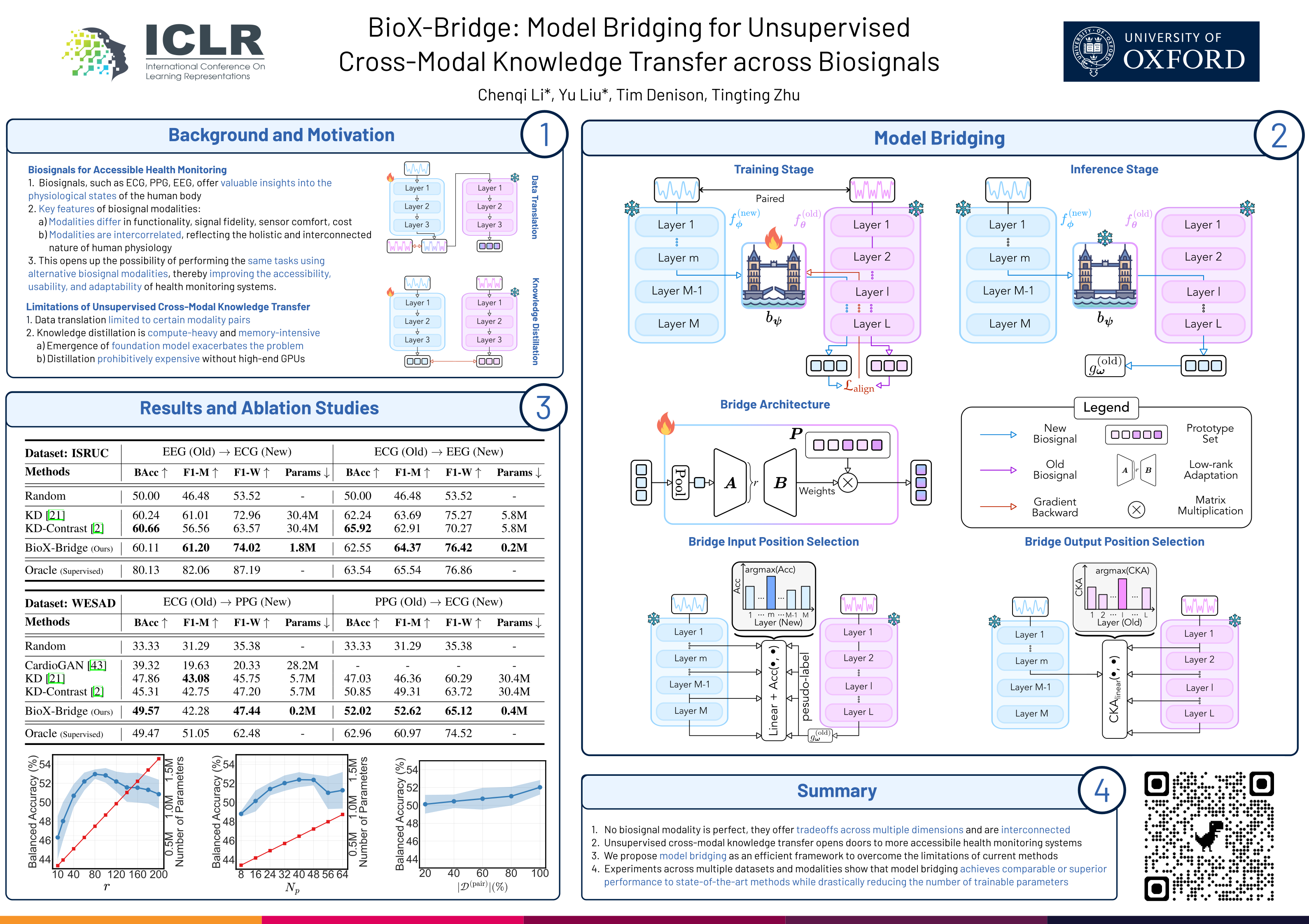
Biosignals offer valuable insights into the physiological states of the human body. Although biosignal modalities differ in functionality, signal fidelity, sensor comfort, and cost, they are often intercorrelated, reflecting the holistic and interconnected nature of human physiology. This opens up the possibility of performing the same tasks using alternative biosignal modalities, thereby improving the accessibility, usability, and adaptability of health monitoring systems. However, the limited availability of large labeled datasets presents challenges for training models tailored to specific tasks and modalities of interest. Unsupervised cross-modal knowledge transfer offers a promising solution by leveraging knowledge from an existing modality to support model training for a new modality. Existing methods are typically based on knowledge distillation, which requires running a teacher model alongside student model training, resulting in high computational and memory overhead. This challenge is further exacerbated by the recent development of foundation models that demonstrate superior performance and generalization across tasks at the cost of large model sizes. To this end, we explore a new framework for unsupervised cross-modal knowledge transfer of biosignals by training a lightweight bridge network to align the intermediate representations and enable information flow between foundation models and across modalities. Specifically, we introduce an efficient strategy for selecting alignment positions where the bridge should be constructed, along with a flexible prototype network as the bridge architecture. Extensive experiments across multiple biosignal modalities, tasks, and datasets show that BioX-Bridge reduces the number of trainable parameters by 88-99\% while maintaining or even improving transfer performance compared to state-of-the-art methods.
SAQ: Stabilizer-Aware Quantum Error Correction Decoder
David Zenati ⋅ Eliya Nachmani
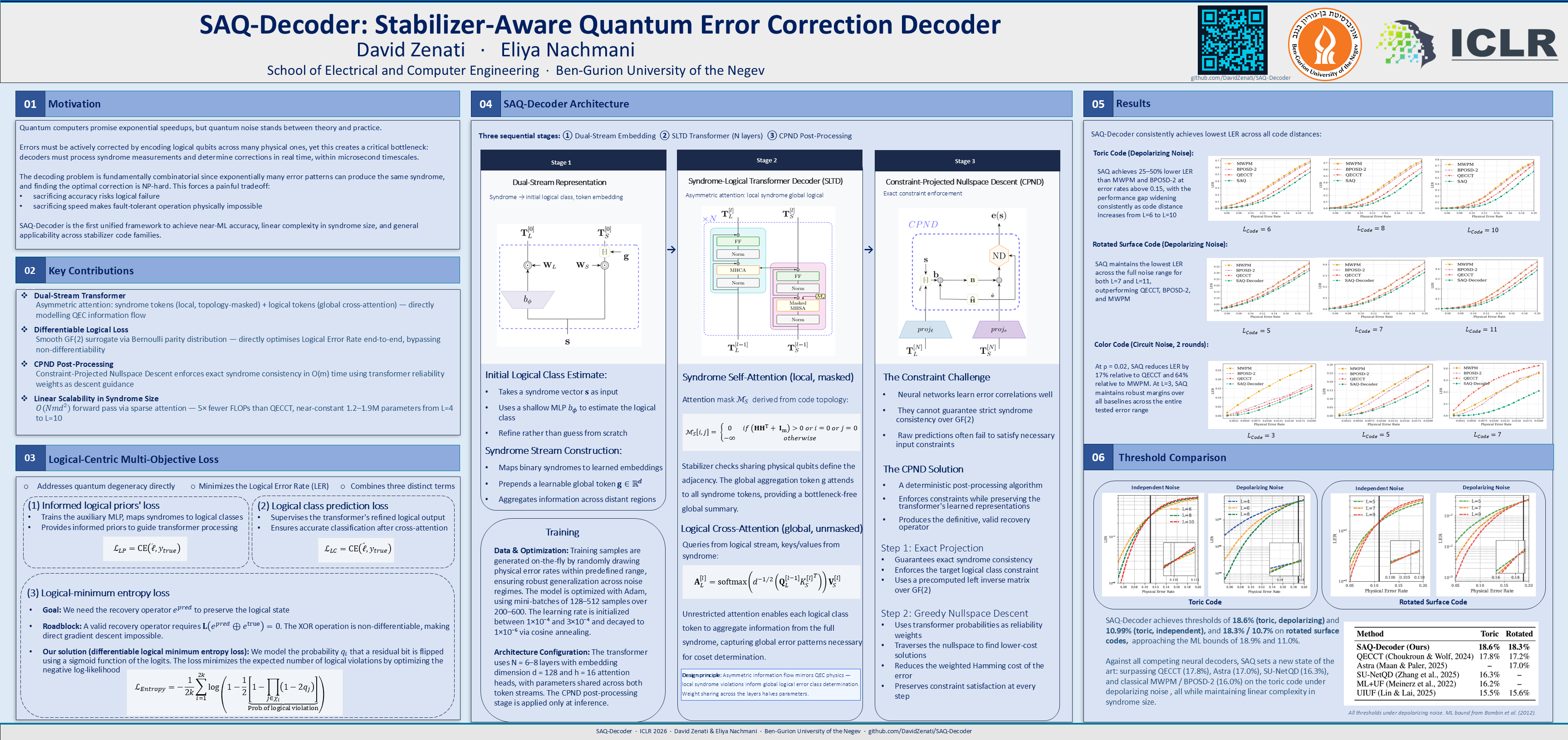
Quantum Error Correction (QEC) decoding faces a fundamental accuracy-efficiency tradeoff. Classical methods like Minimum Weight Perfect Matching (MWPM) exhibit variable performance across noise models and suffer from polynomial complexity, while tensor network decoders achieve high accuracy but at prohibitively high computational cost. Recent neural decoders reduce complexity but lack the accuracy needed to compete with computationally expensive classical methods. We introduce SAQ-Decoder, a unified framework combining transformer-based learning with constraint aware post-processing that achieves both near Maximum Likelihood (ML) accuracy and linear computational scalability with respect to the syndrome size. Our approach combines a dual-stream transformer architecture that processes syndromes and logical information with asymmetric attention patterns, and a novel differentiable logical loss that directly optimizes Logical Error Rates (LER) through smooth approximations over finite fields. SAQ-Decoder achieves high accuracy decoding, with error thresholds of 10.99\% (independent noise) and 18.6\% (depolarizing noise) on toric codes that closely approach the theoretical ML bounds of 11.0\% and 18.9\% while outperforming existing neural and classical baselines in accuracy, complexity, and parameter efficiency. Our findings establish that learned decoders can simultaneously achieve competitive decoding accuracy and computational efficiency, addressing key requirements for practical fault-tolerant quantum computing systems.
Lean4Physics: Comprehensive Reasoning Framework for College-level Physics in Lean4
Yuxin Li ⋅ Minghao LIU ⋅ Ruida WANG ⋅ JI WenZhao ⋅ Zhitao He ⋅ Rui Pan ⋅ Junming Huang ⋅ Tong Zhang ⋅ Yi R. Fung
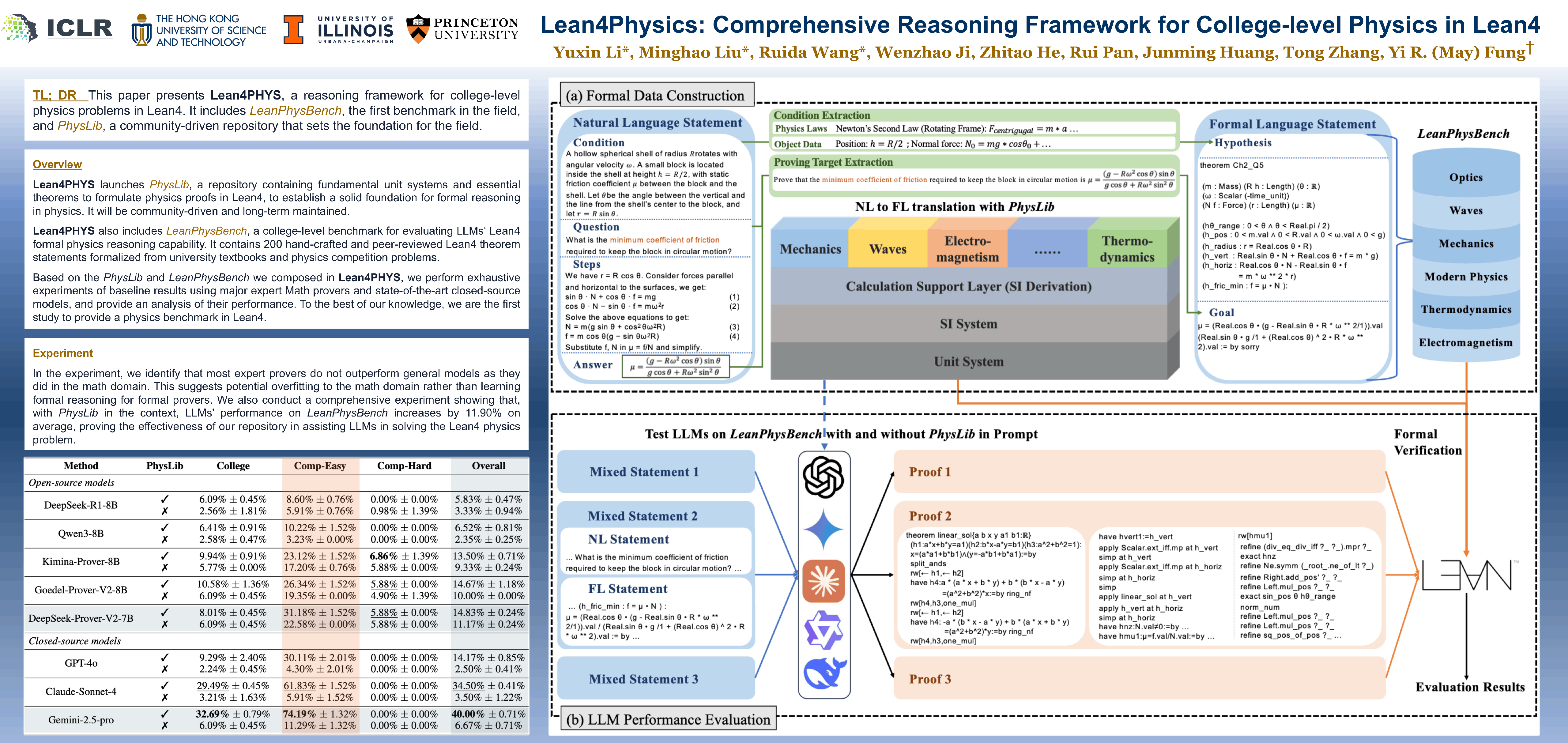
We present Lean4PHYS, a comprehensive reasoning framework for college-level physics problems in Lean4. To establish a solid foundation for formal reasoning in physics, Lean4PHYS launches PhysLib, a repository containing fundamental unit systems and essential theorems to formulate physics proofs in Lean4. It will be community-driven and long-term maintained. Lean4PHYS also includes LeanPhysBench, a college-level benchmark for evaluating LLMs' Lean4 formal physics reasoning capability. It contains 200 hand-crafted and peer-reviewed Lean4 theorem statements formalized from university textbooks and physics competition problems. Based on the PhysLib and LeanPhysBench we composed in Lean4PHYS, we perform exhaustive experiments of baseline results using major expert Math provers and state-of-the-art closed-source models, and provide an analysis of their performance. In the experiment, we identify that most expert provers do not outperform general models as they did in the math domain. This suggests potential overfitting to the math domain rather than learning formal reasoning for formal provers. We also conduct a comprehensive experiment showing that, with PhysLib in the context, LLMs' performance on LeanPhysBench increases by 11.90% on average, proving the effectiveness of our repository in assisting LLMs in solving the Lean4 physics problem. To the best of our knowledge, we are the first study to provide a physics benchmark in Lean4.
Extending Fourier Neural Operators for Modeling Parameterized and Coupled PDEs
Cheng Jing ⋅ Uvini Balasuriya Mudiyanselage ⋅ Abhishek Verma ⋅ Kallol Bera ⋅ Shahid Rauf ⋅ Kookjin Lee
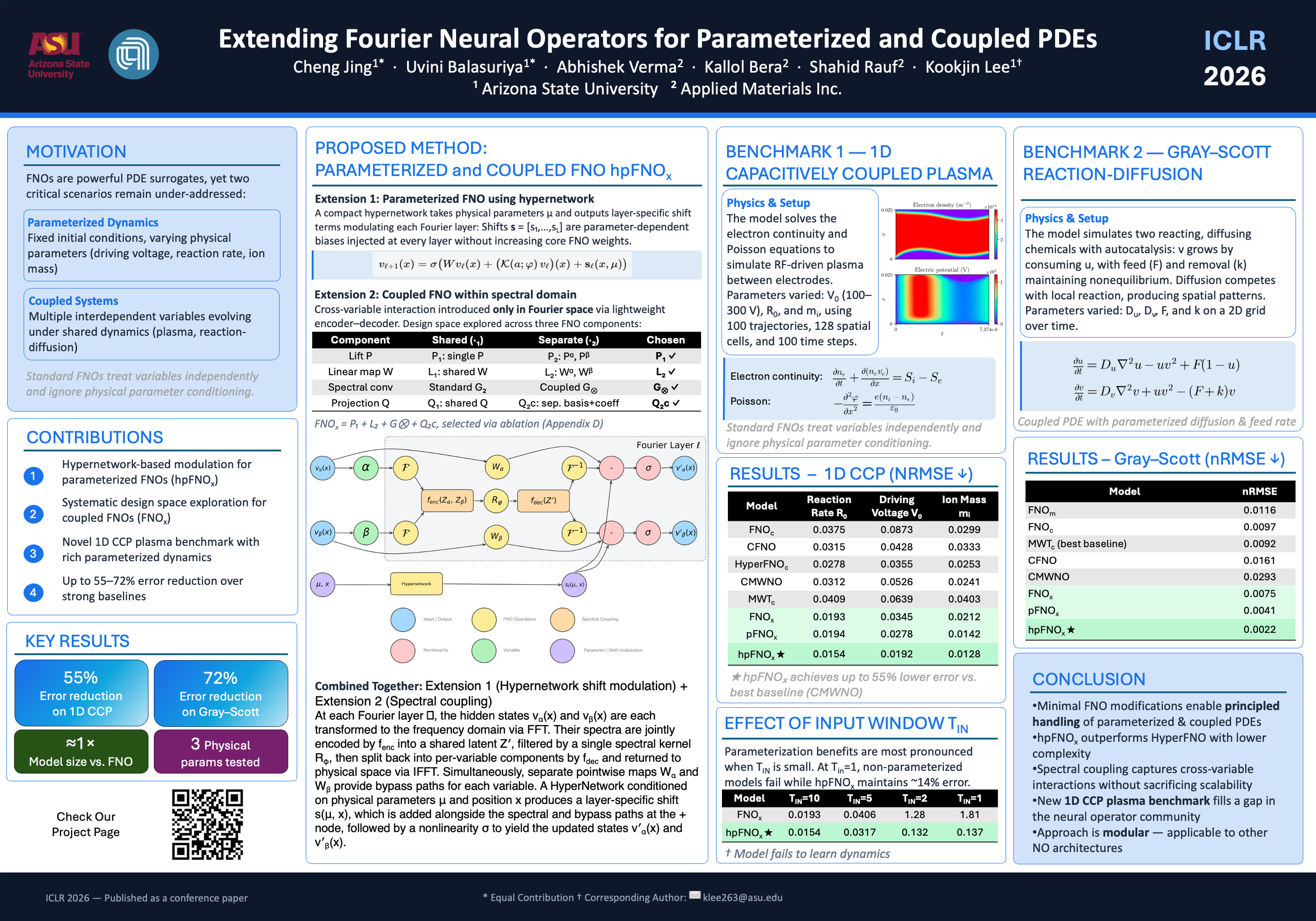
Parameterized and coupled partial differential equations (PDEs) are central to modeling phenomena in science and engineering, yet neural operator methods that address both aspects remain limited. We extend Fourier neural operators (FNOs) with minimal architectural modifications along two directions. For parameterized dynamics, we propose a hypernetwork-based modulation that conditions the operator on physical parameters. For coupled systems, we conduct a systematic exploration of architectural choices, examining how operator components can be adapted to balance shared structure with cross-variable interactions while retaining the efficiency of standard FNOs. Evaluations on benchmark PDEs, including the one-dimensional capacitively coupled plasma equations and the Gray–Scott system, show that our methods achieve up to 55~72% lower errors than strong baselines, demonstrating the effectiveness of principled modulation and systematic design exploration.
FM4NPP: A Scaling Foundation Model for Nuclear and Particle Physics
David Park ⋅ Shuhang Li ⋅ Yi Huang ⋅ Xihaier Luo ⋅ Haiwang Yu ⋅ Yeonju Go ⋅ Christopher Pinkenburg ⋅ YUEWEI LIN ⋅ Shinjae Yoo ⋅ Joseph Osborn ⋅ Jin Huang ⋅ Yihui Ren
Large language models have revolutionized artificial intelligence by enabling large, generalizable models trained through self-supervision. This paradigm has inspired the development of scientific foundation models (FMs). However, applying this capability to experimental particle physics is challenging due to the sparse, spatially distributed nature of detector data, which differs dramatically from natural language. This work addresses if an FM for particle physics can scale and generalize across diverse tasks. We introduce a new dataset with more than 11 million particle collision events and a suite of downstream tasks and labeled data for evaluation. We propose a novel self-supervised training method for detector data and demonstrate its neural scalability with models that feature up to 188 million parameters. With frozen weights and task-specific adapters, this FM consistently outperforms baseline models across all downstream tasks. The performance also exhibits robust data-efficient adaptation. Further analysis reveals that the representations extracted by the FM are task-agnostic but can be specialized via a single linear mapping for different downstream tasks.
Learning Data-Efficient and Generalizable Neural Operators via Fundamental Physics Knowledge
Siying (Sydney) Ma ⋅ Mehrdad Momeni Zadeh ⋅ Mauricio Soroco ⋅ Wuyang Chen ⋅ Jiguo Cao ⋅ Vijay Ganesh
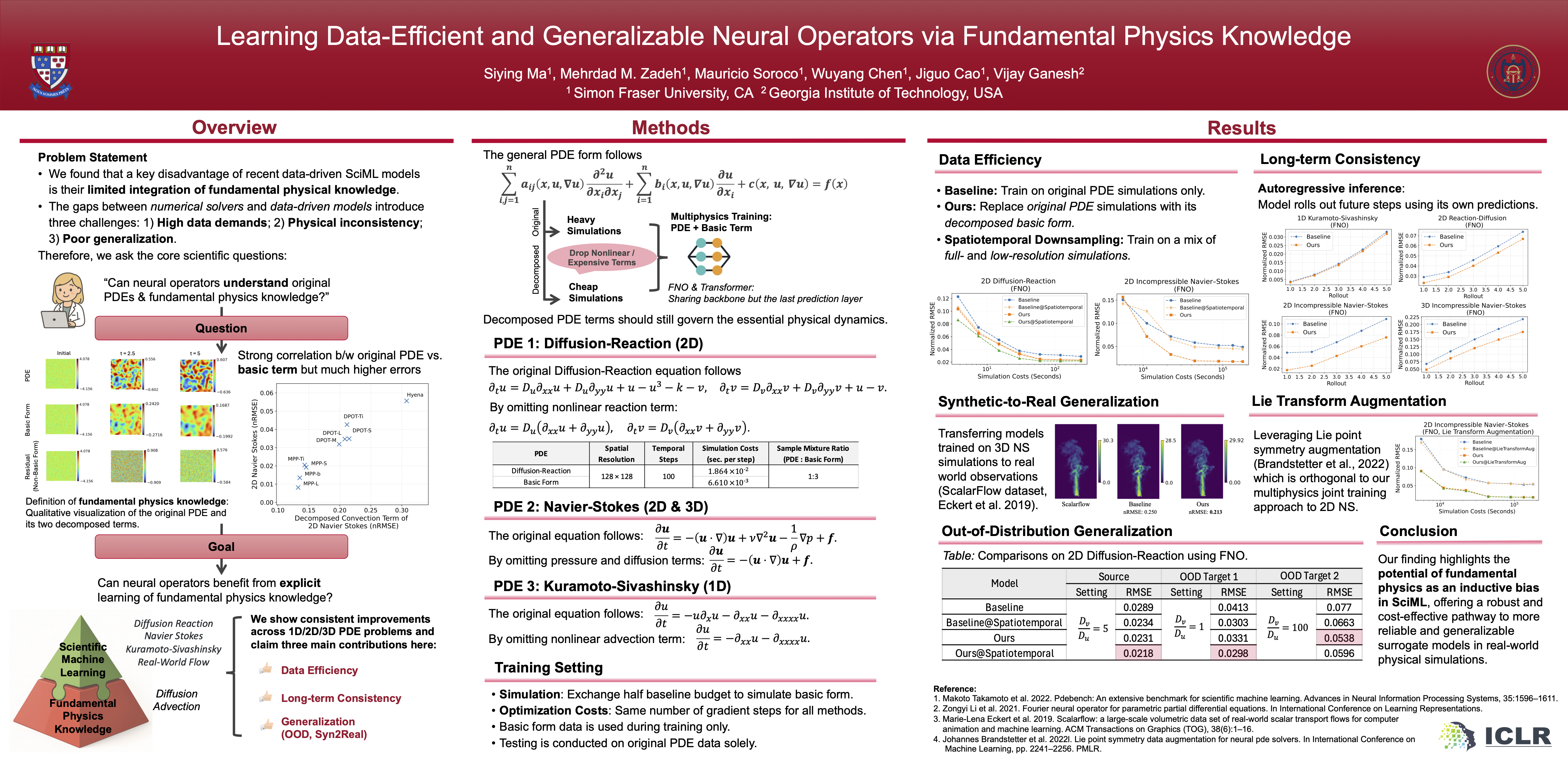
Recent advances in scientific machine learning (SciML) have enabled neural operators (NOs) to serve as powerful surrogates for modeling the dynamic evolution of physical systems governed by partial differential equations (PDEs). While existing approaches focus primarily on learning simulations from the target PDE, they often overlook more fundamental physical principles underlying these equations. Inspired by how numerical solvers are compatible with simulations of different settings of PDEs, we propose a multiphysics training framework that jointly learns from both the original PDEs and their simplified basic forms. Our framework enhances data efficiency, reduces predictive errors, and improves out-of-distribution (OOD) generalization, particularly in scenarios involving shifts of physical parameters and synthetic-to-real transfer. Our method is architecture-agnostic and demonstrates consistent improvements in normalized root mean square error (nRMSE) across a wide range of 1D/2D/3D PDE problems. Through extensive experiments, we show that explicit incorporation of fundamental physics knowledge significantly strengthens the generalization ability of neural operators. We will release models and codes at https://sites.google.com/view/sciml-fundemental-pde.
Tequila: Trapping-free Ternary Quantization for Large Language Models
Hong Huang ⋅ 吴 德成 ⋅ Rui Cen ⋅ Guanghua Yu ⋅ Zonghang Li ⋅ Kai Liu ⋅ Jianchen Zhu ⋅ Peng Chen ⋅ Xue Liu ⋅ Dapeng Wu
Quantization techniques are essential for the deployment of Large Language Models (LLMs) on edge devices. However, prevailing methods often rely on mixed-precision multiplication that lacks efficient hardware support, making it not feasible. Ternary weight quantization addresses this by constraining weights to {-1, 0, 1}, replacing expensive multiplications with hardware-efficient additions. However, such aggressive compression leads to significant accuracy degradation, even after costly quantization-aware training with massive data. We identify the core issue as _**deadzone trapping**: a large number of weights are trapped at the deadzone boundary._ This occurs because these weights receive only noisy, less informative gradients, preventing stable escape from the deadzone and severely impeding model capacity and optimization. To address this issue, we propose **Tequila**, a trapping-free quantization optimization method that reactivates deadzone-trapped weights by repurposing them as dynamic biases. This allows the repurposed weights to provide a continuous signal in the forward pass and, critically, receive direct, meaningful gradient signals during backpropagation, thereby enhancing model capacity and optimization with nearly _zero_ inference overhead. Extensive evaluations demonstrate that Tequila outperforms state-of-the-art (SOTA) ternary quantization methods across five benchmarks. Specifically, on the ARC benchmark, it achieves $>4$% accuracy gain over the SOTA baseline, nearly matching full-precision performance (within $<1$% gap) with an $3.0\times$ inference speedup. Consequently, Tequila offers a highly practical and efficient implementation for the deployment of advanced LLMs in resource-constrained environments. The code is available at https://github.com/Tencent/AngelSlim/tree/tequila/TernaryQuant .
Einstein Fields: A Neural Perspective To Computational General Relativity
Sandeep Cranganore ⋅ Andrei Bodnar ⋅ Arturs Berzins ⋅ Johannes Brandstetter
We introduce *Einstein Fields*, a neural representation designed to compress computationally intensive *four-dimensional* numerical relativity simulations into compact implicit neural network weights. By modeling the *metric*, the core tensor field of general relativity, Einstein Fields enable the derivation of physical quantities via automatic differentiation. Unlike conventional neural fields (e.g., signed distance, occupancy, or radiance fields), Einstein Fields fall into the class of *Neural Tensor Fields* with the key difference that, when encoding the spacetime geometry into neural field representations, dynamics emerge naturally as a byproduct. Our novel implicit approach demonstrates remarkable potential, including continuum modeling of four-dimensional spacetime, mesh-agnosticity, storage efficiency, derivative accuracy, and ease of use. It achieves up to a $\mathtt{4,000}$-fold reduction in storage memory compared to discrete representations while retaining a numerical accuracy of five to seven decimal places. Moreover, in single precision, differentiation of the Einstein Fields-parameterized metric tensor is up to five orders of magnitude more accurate compared to naive finite differencing methods. We demonstrate these properties on several canonical test beds of general relativity and numerical relativity simulation data, while also releasing an open-source $\mathtt{JAX}$-based library: https://github.com/AndreiB137/EinFields, taking the first steps to studying the potential of machine learning in numerical relativity.
SAC Flow: Sample-Efficient Reinforcement Learning of Flow-Based Policies via Velocity-Reparameterized Sequential Modeling
Yixian Zhang ⋅ Shu-ang Yu ⋅ Tonghe Zhang ⋅ Mo Guang ⋅ Haojia Hui ⋅ Kaiwen Long ⋅ Yu Wang ⋅ Chao Yu ⋅ Wenbo Ding
Training expressive flow-based policies with off-policy reinforcement learning is notoriously unstable due to gradient pathologies in the multi-step action sampling process. We trace this instability to a fundamental connection: the flow rollout is algebraically equivalent to a residual recurrent computation, making it susceptible to the same vanishing and exploding gradients as RNNs. To address this, we reparameterize the velocity network using principles from modern sequential models, introducing two stable architectures: Flow-G, which incorporates a gated velocity, and Flow-T, which utilizes a decoded velocity. We then develop a practical SAC-based algorithm, enabled by a noise-augmented rollout, that facilitates direct end-to-end training of these policies. Our approach supports both from-scratch and offline-to-online learning and achieves state-of-the-art performance on continuous control and robotic manipulation benchmarks, eliminating the need for common workarounds like policy distillation or surrogate objectives. Anonymized code is available at \url{https://anonymous.4open.science/r/SAC-FLOW}
Primary-Fine Decoupling for Action Generation in Robotic Imitation
Xiaohan Lei ⋅ Min Wang ⋅ Wengang Zhou ⋅ Xingyu Lu ⋅ Houqiang Li
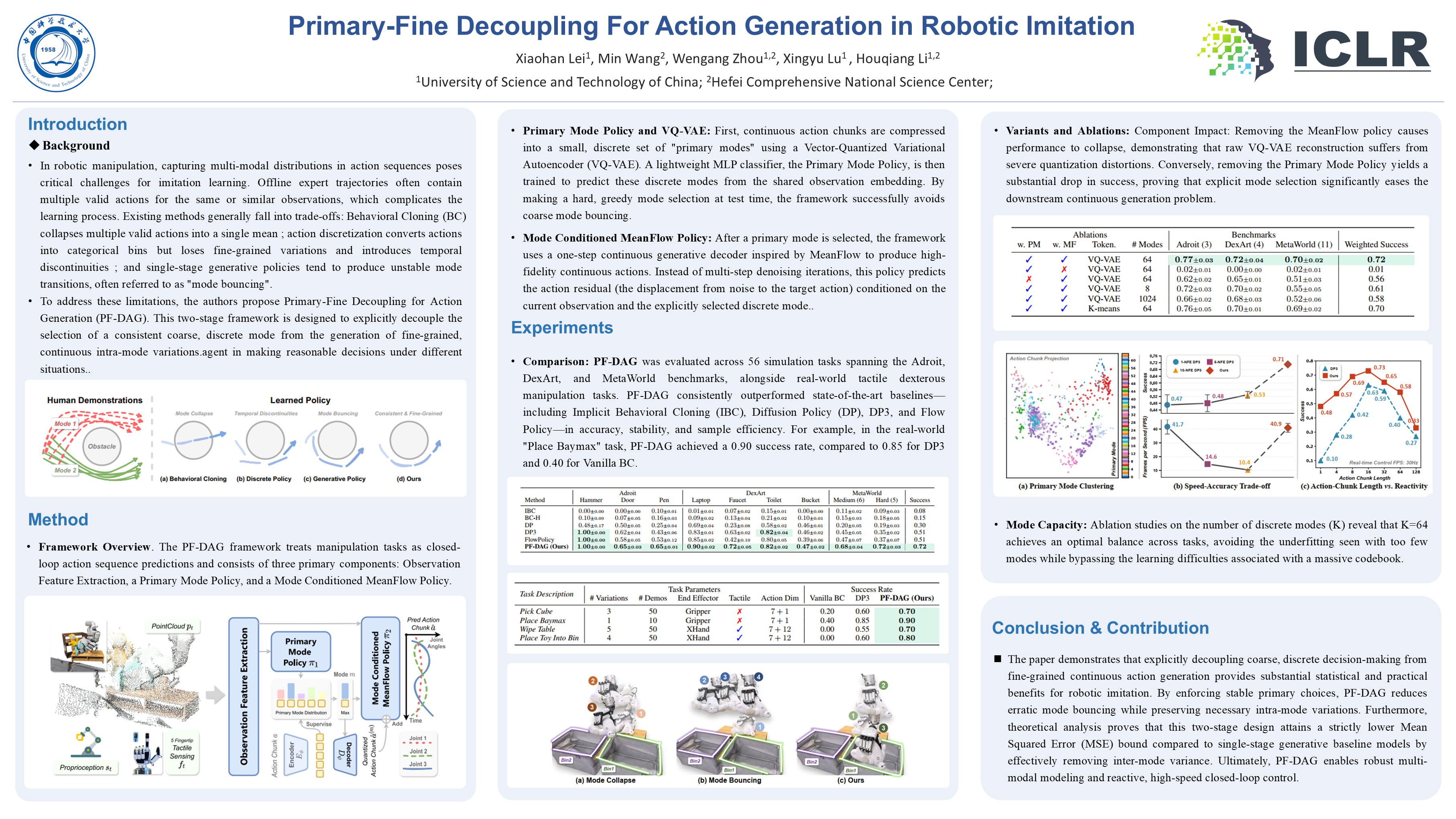
Multi-modal distribution in robotic manipulation action sequences poses critical challenges for imitation learning. To this end, existing approaches often model the action space as either a discrete set of tokens or a continuous, latent-variable distribution. However, both approaches present trade-offs: some methods discretize actions into tokens and therefore lose fine-grained action variations, while others generate continuous actions in a single stage tend to produce unstable mode transitions. To address these limitations, we propose Primary-Fine Decoupling for Action Generation (PF-DAG), a two-stage framework that decouples coarse action consistency from fine-grained variations. First, we compress action chunks into a small set of discrete modes, enabling a lightweight policy to select consistent coarse modes and avoid mode bouncing. Second, a mode conditioned MeanFlow policy is learned to generate high-fidelity continuous actions. Theoretically, we prove PF-DAG’s two-stage design achieves a strictly lower MSE bound than single-stage generative policies. Empirically, PF-DAG outperforms state-of-the-art baselines across 56 tasks from Adroit, DexArt, and MetaWorld benchmarks. It further generalizes to real-world tactile dexterous manipulation tasks. Our work demonstrates that explicit mode-level decoupling enables both robust multi-modal modeling and reactive closed-loop control for robotic manipulation.
SafeFlowMatcher: Safe and Fast Planning using Flow Matching with Control Barrier Functions
Jeongyong Yang ⋅ Seunghwan Jang ⋅ SooJean Han
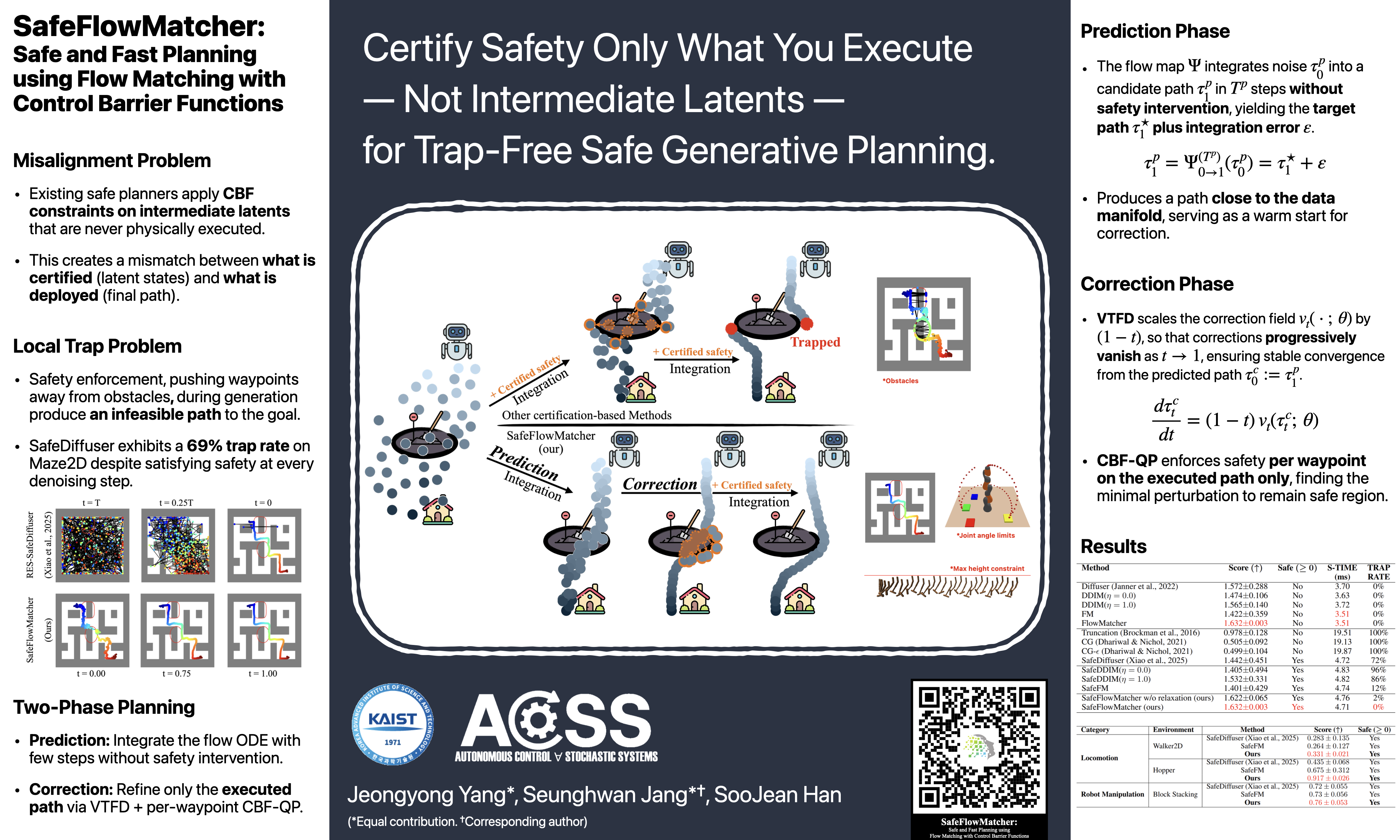
Generative planners based on flow matching (FM) produce high-quality paths in a single or a few ODE steps, but their sampling dynamics offer no formal safety guarantees and can yield incomplete paths near constraints. We present SafeFlowMatcher, a planning framework that couples FM with control barrier functions (CBFs) to achieve both real-time efficiency and certified safety. SafeFlowMatcher uses a two-phase prediction-correction (PC) integrator: (i) a prediction phase integrates the learned FM once (or a few steps) to obtain a candidate path without intervention; (ii) a correction phase refines this path with a vanishing time‑scaled vector field and a CBF-based quadratic program that minimally perturbs the vector field. We prove a barrier certificate for the resulting flow system, establishing forward invariance of a robust safe set and finite-time convergence to the safe set. In addition, by enforcing safety only on the executed path—rather than all intermediate latent paths—SafeFlowMatcher avoids distributional drift and mitigates local trap problems. Moreover, SafeFlowMatcher attains faster, smoother, and safer paths than diffusion- and FM-based baselines on maze navigation, locomotion, and robot manipulation tasks. Extensive ablations corroborate the contributions of the PC integrator and the barrier certificate.
PA3FF:Learning Part-Aware Dense 3D Feature Field For Generalizable Articulated Object Manipulation
Yue Chen ⋅ Muqing Jiang ⋅ Kaifeng Zheng ⋅ Jiaqi Liang ⋅ Chenrui Tie ⋅ Haoran Lu ⋅ Ruihai Wu ⋅ Hao Dong
Articulated object manipulation is essential for various real-world robotic tasks, yet generalizing across diverse objects remains a major challenge. A key to generalization lies in understanding functional parts (e.g., door handles and knobs), which indicate where and how to manipulate across diverse object categories and shapes. Previous works attempted to achieve generalization by introducing foundation features, while these features are mostly 2D-based and do not specifically consider functional parts. When lifting these 2D features to geometry-profound 3D space, challenges arise, such as long runtimes, multi-view inconsistencies, and low spatial resolution with insufficient geometric information. To address these issues, we propose \textbf{Part-Aware 3D Feature Field (PA3FF)}, a novel dense 3D feature with part awareness for generalizable articulated object manipulation. PA3FF is trained by 3D part proposals from a large-scale labeled datasets, via a contrastive learning formulation. Given point clouds as input, PA3FF predicts a continuous 3D feature field in a feedforward manner, where the distance between point feature reflects the proximity of functional parts: points with similar features are more likely to belong to the same part. Building on this feature, we introduce the \textbf{Part-Aware Diffusion Policy (PADP)}, an imitation learning framework aimed at enhancing sample efficiency and generalization for robotic manipulation. We evaluate PADP on several simulated and real-world tasks, demonstrating that PA3FF consistently outperforms a range of 2D and 3D representations in manipulation scenarios, including CLIP, DINOv2, and Grounded-SAM, achieving state-of-the-art performance. Beyond imitation learning, PA3FF enables diverse downstream methods, including correspondence learning and segmentation task, making it a versatile foundation for robotic manipulation. Project page: https://pa3ff.github.io/.
CompassNav: Steering From Path Imitation to Decision Understanding In Navigation
LinFeng Li ⋅ Jian Zhao ⋅ Yuan Xie ⋅ Xin Tan ⋅ Xuelong Li
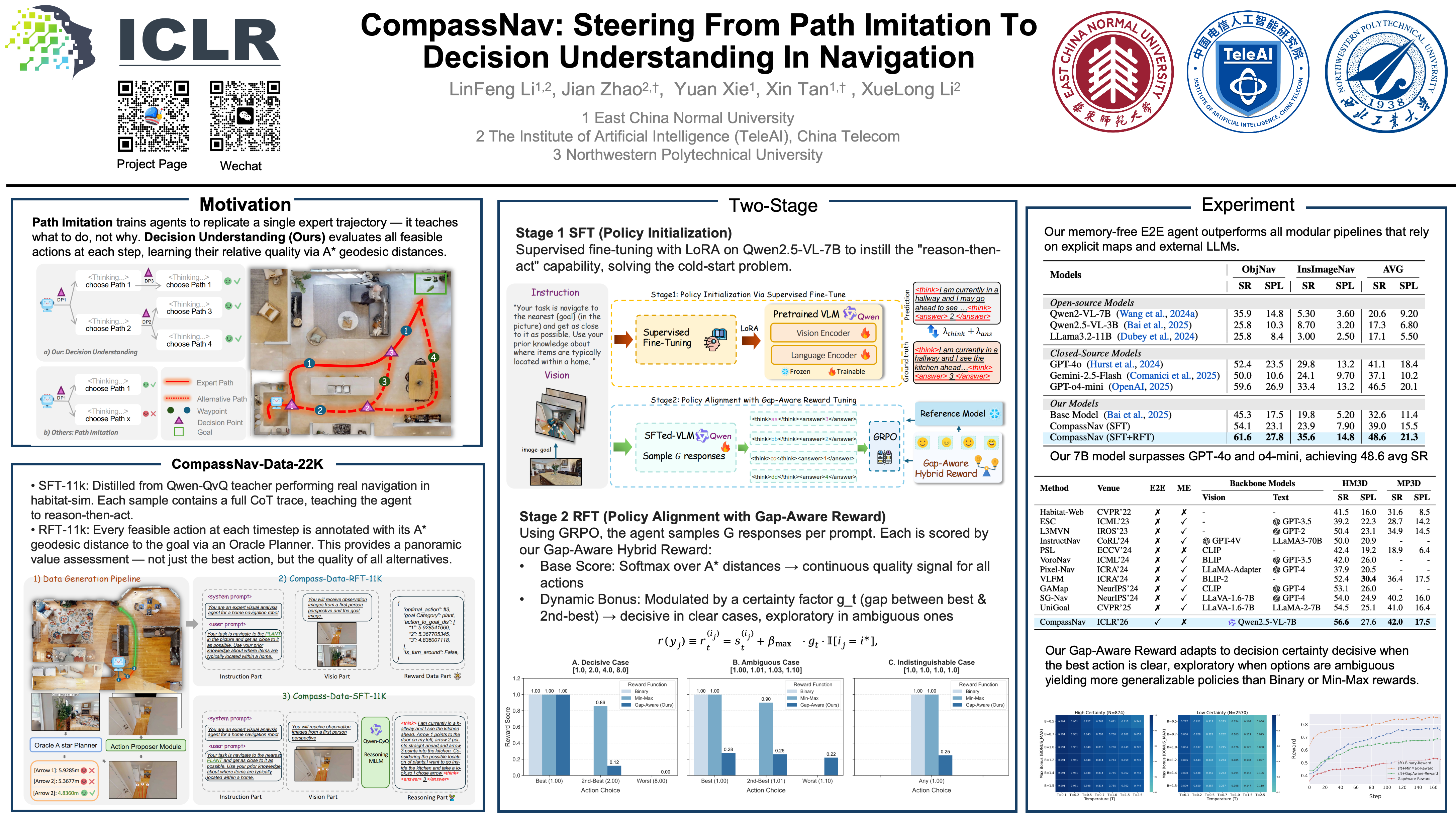
The dominant paradigm for training Large Vision-Language Models (LVLMs) in navigation relies on imitating expert trajectories. This approach reduces the complex navigation task to a sequence-to-sequence replication of a single correct path, fundamentally limiting the agent's ability to explore and generalize. In this work, we argue for and introduce a new paradigm: a shift from Path Imitation to Decision Understanding. The goal of this paradigm is to build agents that do not just follow, but truly understand how to navigate. We materialize this through two core contributions: first, we introduce Compass-Data-22k, a novel 22k-trajectory dataset.Its Reinforcement Fine-Tuning (RFT) subset provides a panoramic view of the decision landscape by annotating all feasible actions with A* geodesic distances. Second, we design a novel gap-aware hybrid reward function that dynamically adapts its feedback to decision certainty, shifting between decisive signals for optimal actions and nuanced scores to encourage exploration. Integrated into an SFT-then-RFT recipe, our CompassNav agent is trained not to memorize static routes, but to develop an internal ``compass'' that constantly intuits the direction to the goal by evaluating the relative quality of all possible moves. This approach enables our 7B agent to set a new state-of-the-art on Goal navigation benchmarks, outperforming even larger proprietary models, and achieve robust real-world goal navigation on a physical robot.
Language Identification in the Limit with Computational Trace
Binghui Peng ⋅ Amin Saberi ⋅ Grigoris Velegkas
Training on Chain-of-Thought (CoT) traces has empirically shown to dramatically improve the capabilities of Large Language Models (LLMs), yet a formal understanding of its power remains limited. In this work, we investigate the role of training on such computational traces from the perspective of language learnability. We introduce a new learning model, identification in the limit with trace, which augments Gold's classic paradigm [Gold'67] by providing the learner not only with examples from a target language but also with computational traces from the machine that accepts them. Our results reveal that access to these traces dramatically enhances the power of the learner. We first prove that with perfect computational traces, the class of all computable languages (those recognizable by Turing Machines) becomes identifiable in the limit. This stands in sharp contrast to Gold's famous impossibility result, which holds even for the simple class of languages that are recognizable by deterministic finite automata. We then analyze the more challenging scenario where the learner has only partial information regarding the computational traces, which are also subject to adversarial corruptions. In this setting, we establish a set of trichotomic results on the amount of error that can be tolerated for the successful identification of language classes across the Chomsky hierarchy.
Action-aware Dynamic Pruning for Efficient Vision-Language-Action Manipulation
Xiaohuan Pei ⋅ Yuxing Chen ⋅ Siyu Xu ⋅ Yunke Wang ⋅ Yuheng Shi ⋅ Chang Xu
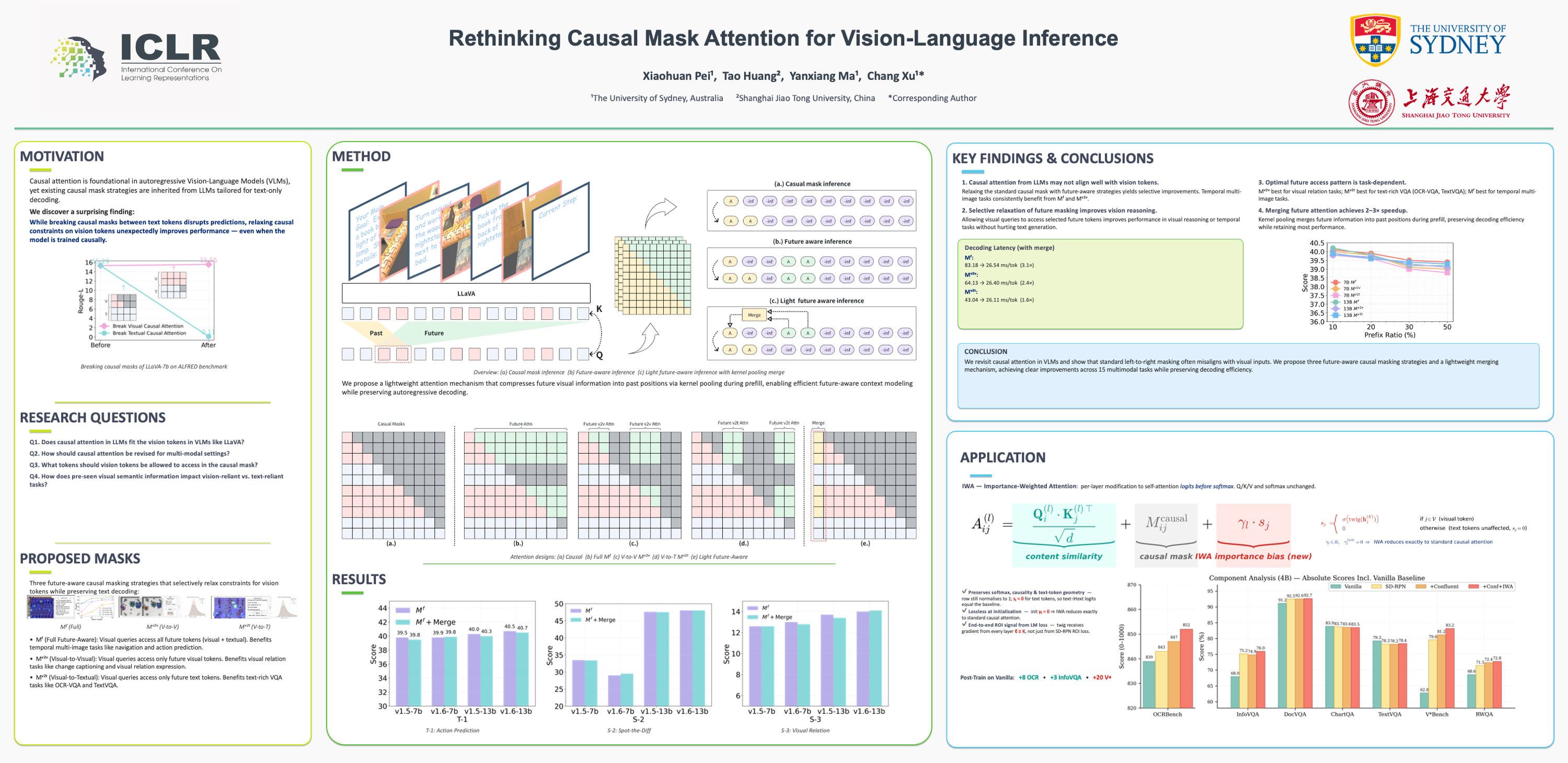
Robotic manipulation with Vision-Language-Action models requires efficient inference over long-horizon multi-modal context, where attention to dense visual tokens dominates computational cost. Existing methods optimize inference speed by reducing visual redundancy within VLA models, but they overlook the varying redundancy across robotic manipulation stages. We observe that the visual token redundancy is higher in coarse manipulation phase than in fine-grained operations, and is strongly correlated with the action dynamic. Motivated by this observation, we propose Action-aware Dynamic Pruning (ADP), a multi-modal pruning framework that integrates text-driven token selection with action-aware trajectory gating. ADP introduces a gating mechanism that conditions the pruning signal on recent action trajectories, using past motion windows to adaptively adjust token retention ratios in accordance with dynamics, thereby balancing computational efficiency and perceptual precision across different manipulation stages. Extensive experiments on the LIBERO suites and diverse real-world scenarios demonstrate that our method significantly reduces FLOPs and action inference latency (e.g. 1.35× speed up on OpenVLA-OFT) while maintaining competitive success rates compared to baselines, thereby providing a simple plug-in path to efficient robot policies that advances the efficiency and performance frontier of robotic manipulation.
SARM: Stage-Aware Reward Modeling for Long Horizon Robot Manipulation
Qianzhong Chen ⋅ Justin Yu ⋅ Mac Schwager ⋅ Pieter Abbeel ⋅ Fred Shentu ⋅ Philipp Wu
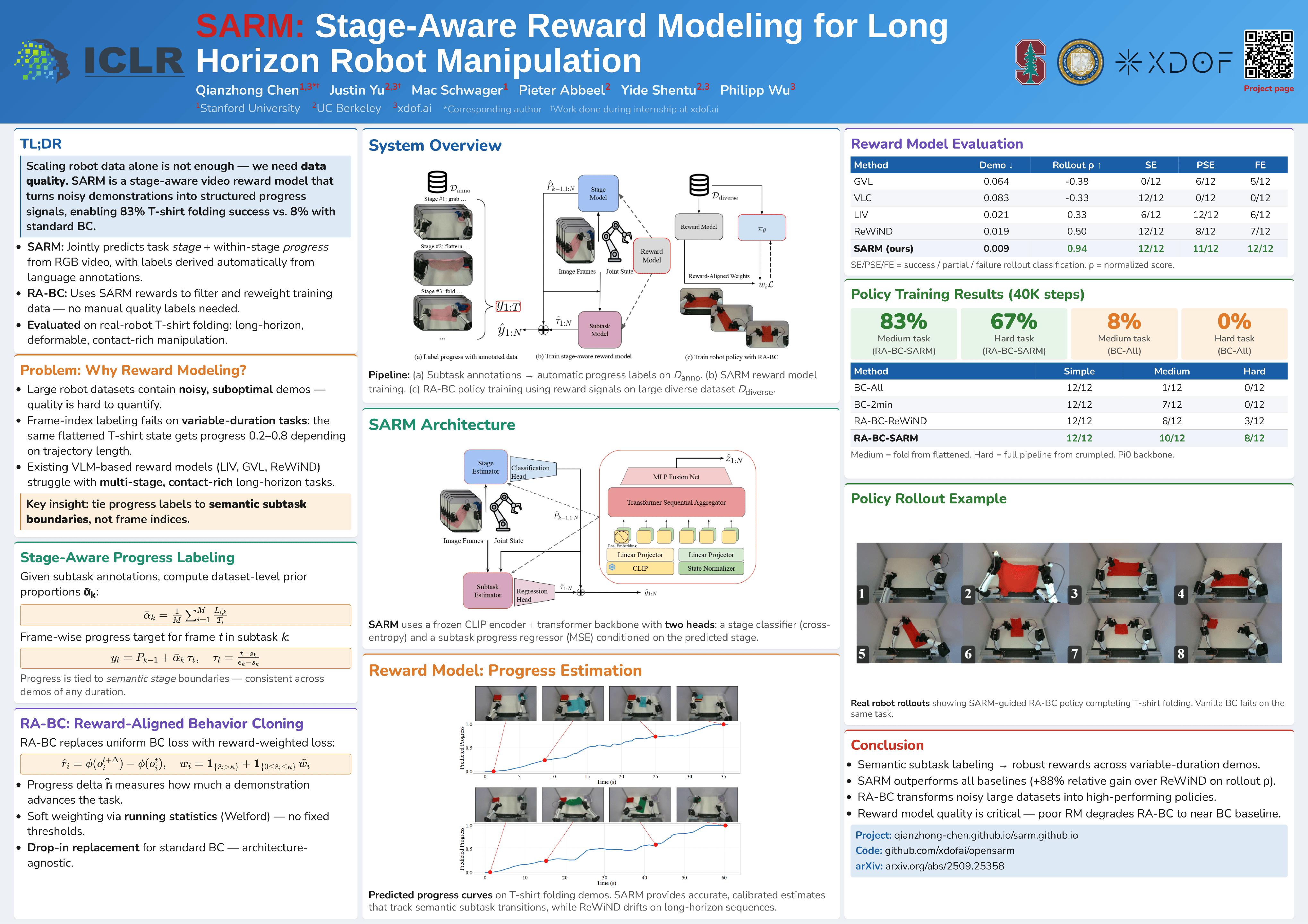
Large-scale robot learning has made progress on complex manipulation tasks, yet long-horizon, contact-rich problems—especially those involving deformable objects—remain challenging due to inconsistent demonstration quality. We propose a stage-aware, video-based reward modeling framework that jointly predicts task stage and fine-grained progress, using natural-language subtask annotations to derive consistent labels across variable-length demonstrations. This avoids the brittleness of frame-index-based labeling and provides stable supervision even in tasks like T-shirt folding. Our reward model is robust to demonstration variability, generalizes to out-of-distribution scenarios, and improves downstream policy training. Building on it, we introduce Reward-Aligned Behavior Cloning (RA-BC), which filters and reweights demonstrations based on reward estimates. Experiments show that our method significantly outperforms baselines in both real-world rollouts and human validation. On T-shirt folding, we achieve 83\% success from the flattened state and 67\% from the crumpled state, compared to 8\% and 0\% with vanilla BC. Overall, our results highlight reward modeling as a scalable and annotation-efficient solution for long-horizon robotic manipulation. Project website: https://qianzhong-chen.github.io/sarm.github.io/.
Generalizable Coarse-to-Fine Robot Manipulation via Language-Aligned 3D Keypoints
Jianshu Hu ⋅ Lidi Wang ⋅ Shujia Li ⋅ Yunpeng Jiang ⋅ Xiao Li ⋅ Paul Weng ⋅ Yutong Ban
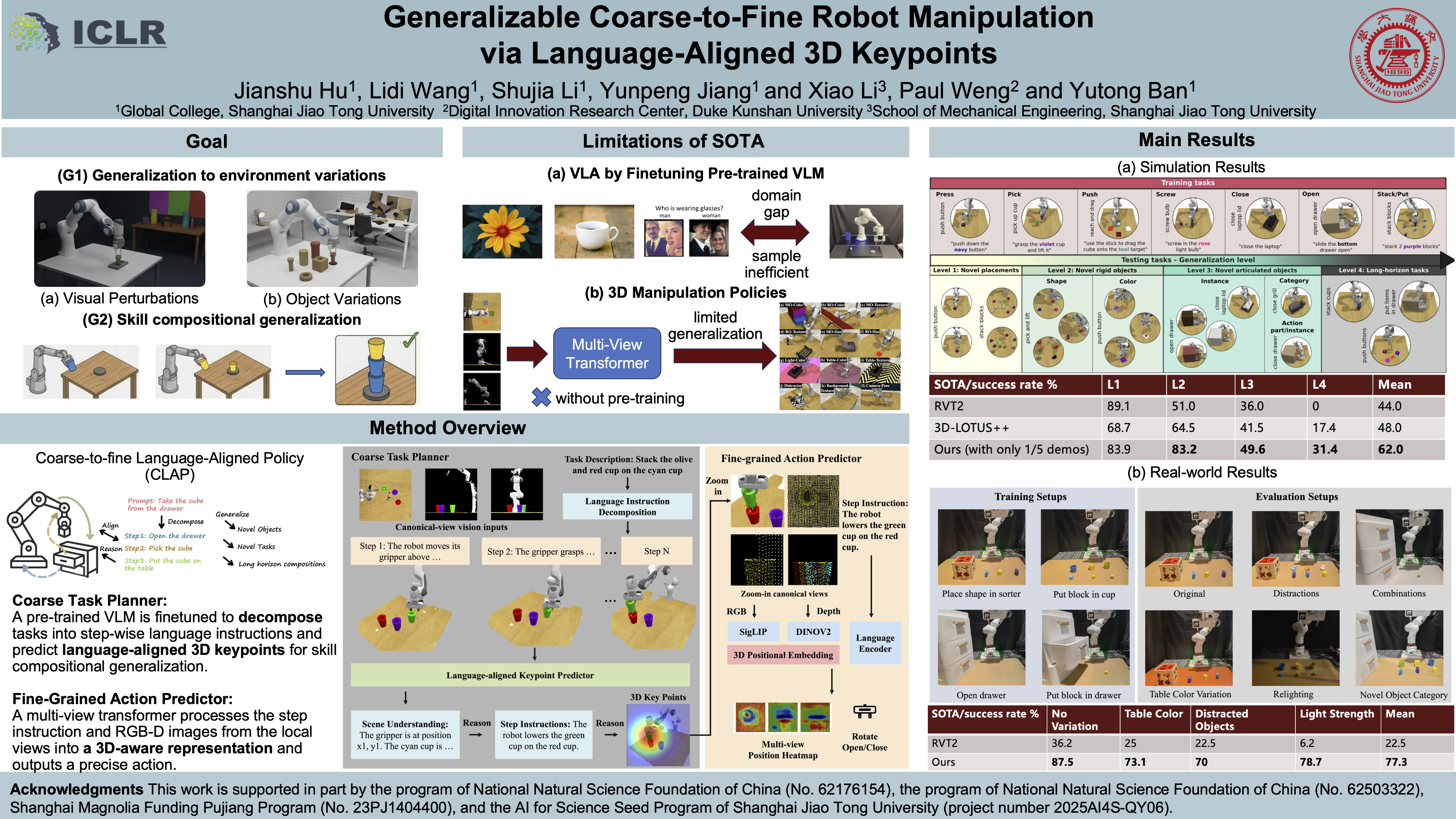
Hierarchical coarse-to-fine policy, where a coarse branch predicts a region of interest to guide a fine-grained action predictor, has demonstrated significant potential in robotic 3D manipulation tasks by especially enhancing sample efficiency and enabling more precise manipulation. However, even augmented with pre-trained models, these hierarchical policies still suffer from generalization issues. To enhance generalization to novel instructions and environment variations, we propose Coarse-to-fine Language-Aligned manipulation Policy (CLAP), a framework that integrates three key components: 1) task decomposition, 2) VLM fine-tuning for 3D keypoint prediction, and 3) 3D-aware representation. Through comprehensive experiments in simulation and on a real robot, we demonstrate its superior generalization capability. Specifically, on GemBench, a benchmark designed for evaluating generalization, our approach achieves a 12\% higher average success rate than the SOTA method while using only 1/5 of the training trajectories. In real-world experiments, our policy, trained on only 10 demonstrations, successfully generalizes to novel instructions and environments.
Accelerated co-design of robots through morphological pretraining
Luke Strgar ⋅ Sam Kriegman
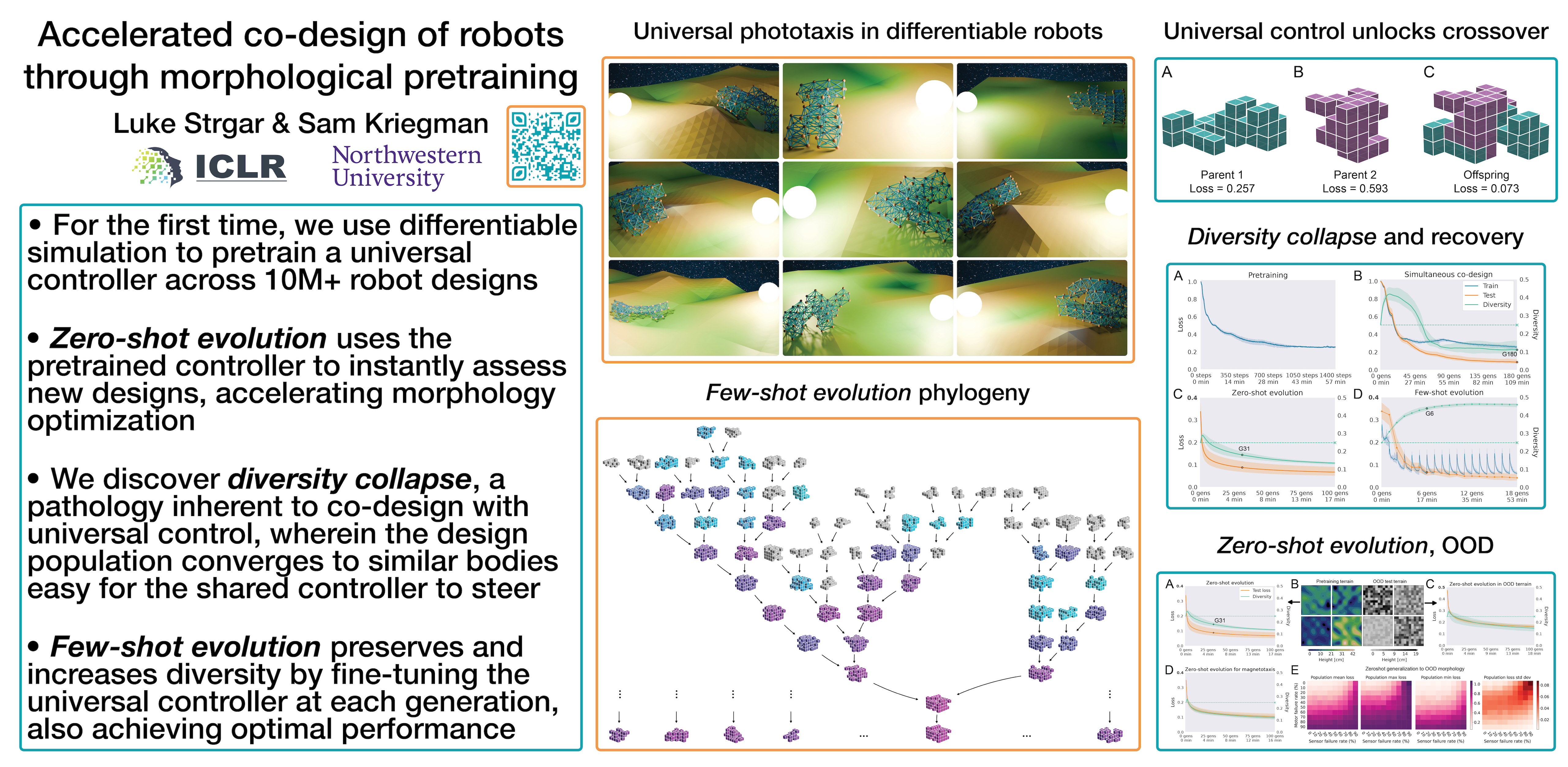
The co-design of robot morphology and neural control typically requires using reinforcement learning to approximate a unique control policy gradient for each body plan, demanding massive amounts of training data to measure the performance of each design. Here we show that a universal, morphology-agnostic controller can be rapidly and directly obtained by gradient-based optimization through differentiable simulation. This process of morphological pretraining allows the designer to explore non-differentiable changes to a robot's physical layout (e.g. adding, removing and recombining discrete body parts) and immediately determine which revisions are beneficial and which are deleterious using the pretrained model. We term this process "zero-shot evolution" and compare it with the simultaneous co-optimization of a universal controller alongside an evolving design population. We find the latter results in diversity collapse, a previously unknown pathology whereby the population—and thus the controller's training data—converges to similar designs that are easier to steer with a shared universal controller. We show that zero-shot evolution with a pretrained controller quickly yields a diversity of highly performant designs, and by fine-tuning the pretrained controller on the current population throughout evolution, diversity is not only preserved but significantly increased as superior performance is achieved. Videos and code can be found at: https://lukestrgar.com/codesign-mpt-project-page/
AutoBio: A Simulation and Benchmark for Robotic Automation in Digital Biology Laboratory
Zhiqian Lan ⋅ Yuxuan Jiang ⋅ Ruiqi Wang ⋅ Xuanbing Xie ⋅ Rongkui Zhang ⋅ Yicheng Zhu ⋅ LI PEIHANG ⋅ Tianshuo Yang ⋅ Tianxing Chen ⋅ Haoyu Gao ⋅ Xiaokang Yang ⋅ Xuelong Li ⋅ Hongyuan Zhang ⋅ Yao Mu ⋅ Ping Luo
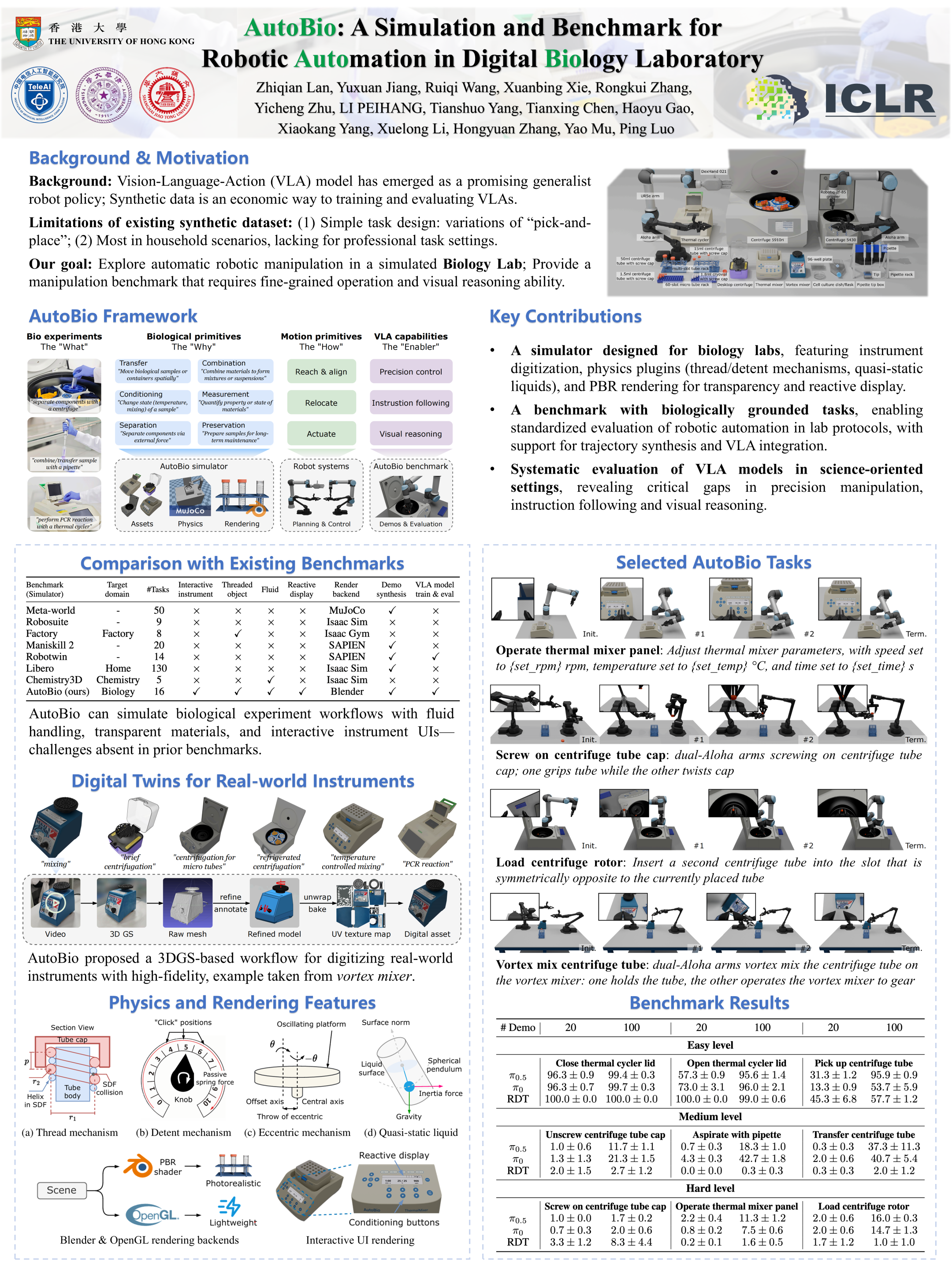
Vision-language-action (VLA) models have shown promise as generalist robotic policies by jointly leveraging visual, linguistic, and proprioceptive modalities to generate action trajectories. While recent benchmarks have advanced VLA research in domestic tasks, professional science-oriented domains remain underexplored. We introduce AutoBio, a simulation framework and benchmark designed to evaluate robotic automation in biology laboratory environments—an application domain that combines structured protocols with demanding precision and multimodal interaction. AutoBio extends existing simulation capabilities through a pipeline for digitizing real-world laboratory instruments, specialized physics plugins for mechanisms ubiquitous in laboratory workflows, and a rendering stack that support dynamic instrument interfaces and transparent materials through physically based rendering. Our benchmark comprises biologically grounded tasks spanning three difficulty levels, enabling standardized evaluation of language-guided robotic manipulation in experimental protocols. We provide infrastructure for demonstration generation and seamless integration with VLA models. Baseline evaluations with SOTA VLA models reveal significant gaps in precision manipulation, visual reasoning, and instruction following in scientific workflows. By releasing AutoBio, we aim to catalyze research on generalist robotic systems for complex, high-precision, and multimodal professional environments.
Bird's-eye-view Informed Reasoning Driver
Yinuo Wang ⋅ Mining Tan ⋅ Yuanxin Zhong ⋅ Wang zhitao ⋅ Siyuan Cheng
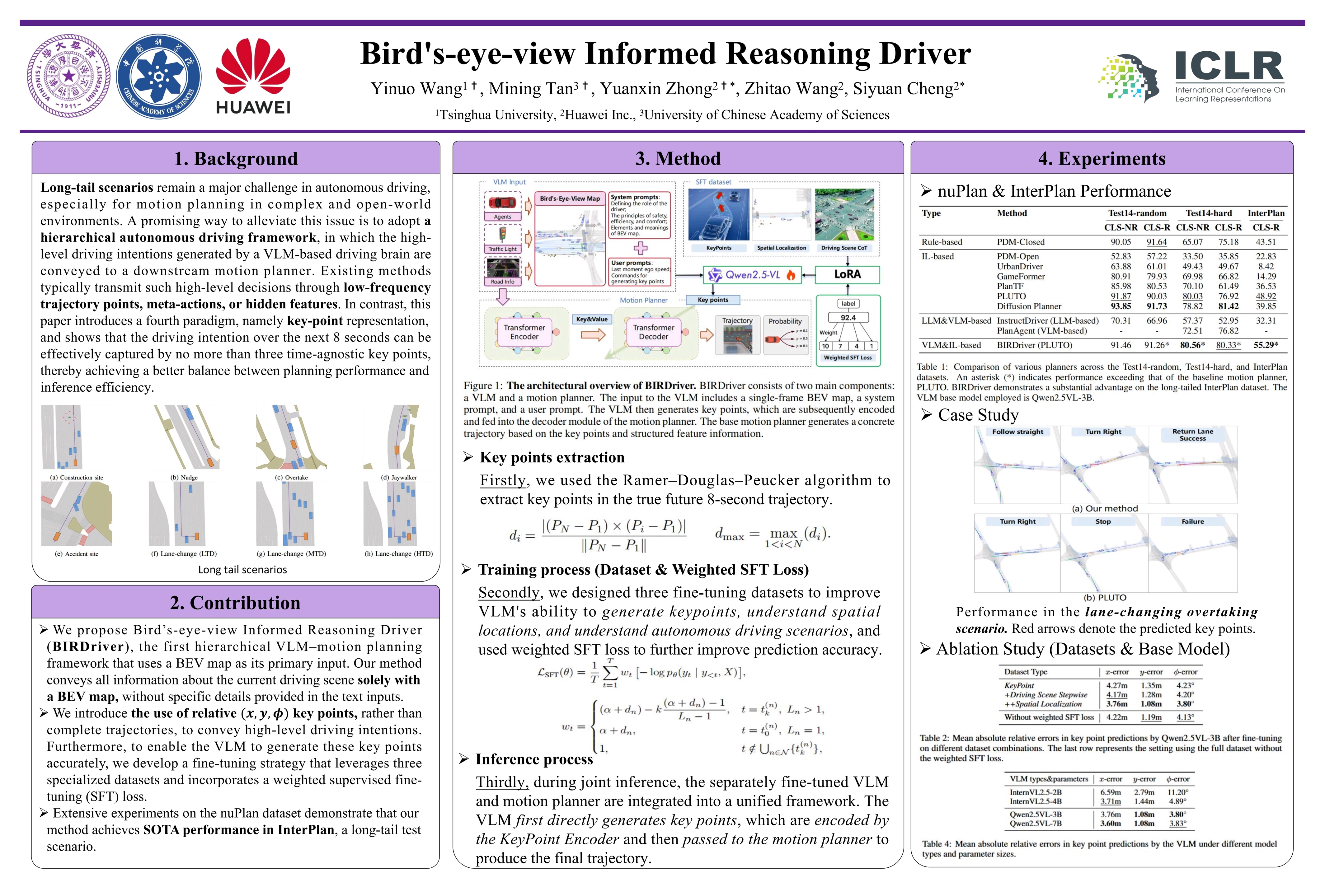
Motion planning in complex environments remains a core challenge for autonomous driving. While existing rule-based or imitation learning-based motion planning methods perform well in common scenarios, they often struggle with complex, long-tail scenarios. To address this problem, we introduce the Bird's-eye-view Informed Reasoning Driver (BIRDriver), a hierarchical framework that combines a Vision-Language Model (VLM) with a motion planner. BIRDriver leverages the commonsense reasoning capabilities of the VLM to effectively handle these challenging long-tail scenarios. Unlike prior methods that require domain-specific encoders and costly alignment, our approach compresses the environment into a single-frame bird's-eye-view (BEV) map, a paradigm that enables the model to fully leverage its knowledge from internet-scale pre-training. It then generates high-level key points, which are encoded and passed to the motion planner to produce the final trajectory. However, a major challenge is that standard VLMs struggle to generate the precise numerical coordinates required for such key points. We address this limitation by fine-tuning them on a composite dataset of three auxiliary types to enhance spatial localization, scene understanding, and key-point generation, complemented by a token-level weighted mechanism for improved numerical precision. Experiments on the nuPlan dataset demonstrate that BIRDriver outperforms the base motion planner in most cases on both Test14-hard and Test14-random benchmarks, and achieves state-of-the-art (SOTA) performance on the InterPlan long-tail benchmark.
UnLoc: Leveraging Depth Uncertainties for Floorplan Localization
Matthias Wüest ⋅ Francis Engelmann ⋅ Ondrej Miksik ⋅ Marc Pollefeys ⋅ Daniel Barath
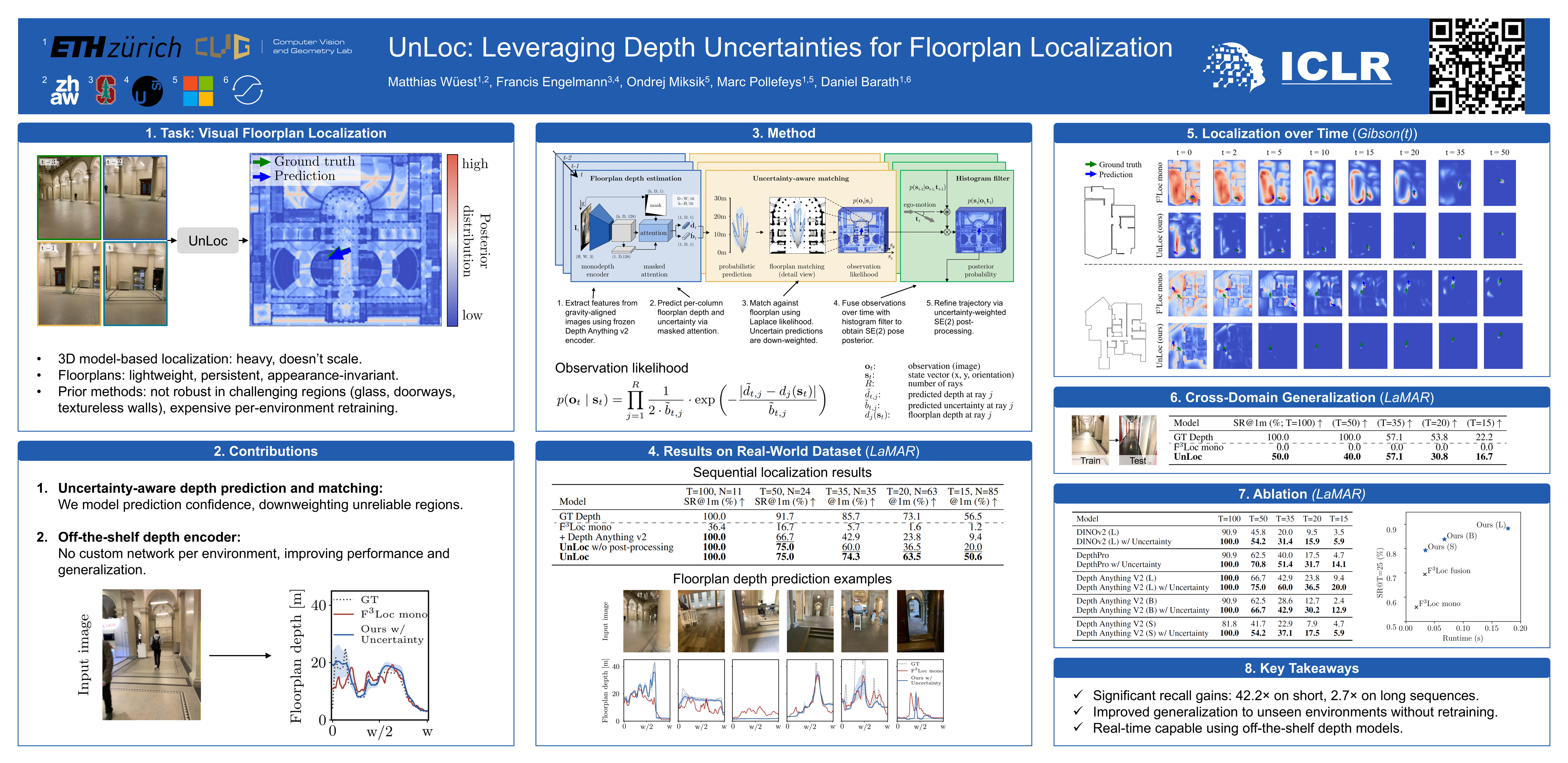
We propose UnLoc, an efficient data-driven solution for sequential camera localization within floorplans. Floorplan data is readily available, long-term persistent, and robust to changes in visual appearance. We address key limitations of recent methods, such as the lack of uncertainty modeling in depth predictions and the necessity for custom depth networks trained for each environment. We introduce a novel probabilistic model that incorporates uncertainty estimation, modeling depth predictions as explicit probability distributions. By leveraging off-the-shelf pre-trained monocular depth models, we eliminate the need to rely on per-environment-trained depth networks, enhancing generalization to unseen spaces. We evaluate UnLoc on large-scale synthetic and real-world datasets, demonstrating significant improvements over existing methods in terms of accuracy and robustness. Notably, we achieve $2.7$ times higher localization recall on long sequences (100 frames) and $42.2$ times higher on short ones (15 frames) than the state of the art on the challenging LaMAR HGE dataset.
H$^3$DP: Triply‑Hierarchical Diffusion Policy for Visuomotor Learning
Yiyang Lu ⋅ Yufeng Tian ⋅ Zhecheng Yuan ⋅ Xianbang Wang ⋅ Pu Hua ⋅ Zhengrong Xue ⋅ Huazhe Xu
Visuomotor policy learning has witnessed substantial progress in robotic manipulation, with recent approaches predominantly relying on generative models to model the action distribution. However, these methods often overlook the critical coupling between visual perception and action prediction. In this work, we introduce Triply-Hierarchical Diffusion Policy (H$^3$DP), a novel visuomotor learning framework that explicitly incorporates hierarchical structures to strengthen the integration between visual features and action generation. H$^3$DP contains $\mathbf{3}$ levels of hierarchy: (1) depth-aware input layering that organizes RGB-D observations based on depth information; (2) multi-scale visual representations that encode semantic features at varying levels of granularity; and (3) a hierarchically conditioned diffusion process that aligns the generation of coarse-to-fine actions with corresponding visual features. Extensive experiments demonstrate that H$^3$DP yields a $+ \mathbf{27.5}$% average relative improvement over baselines across $\mathbf{44}$ simulation tasks and achieves superior performance in $\mathbf{4}$ challenging bimanual real-world manipulation tasks. Project Page: https://h3-dp.github.io/.
Demystifying Robot Diffusion Policies: Action Memorization and a Simple Lookup Table Alternative
Chengyang He ⋅ Xu Liu ⋅ Gadiel Sznaier Camps ⋅ Joseph Bruno ⋅ Guillaume Sartoretti ⋅ Mac Schwager
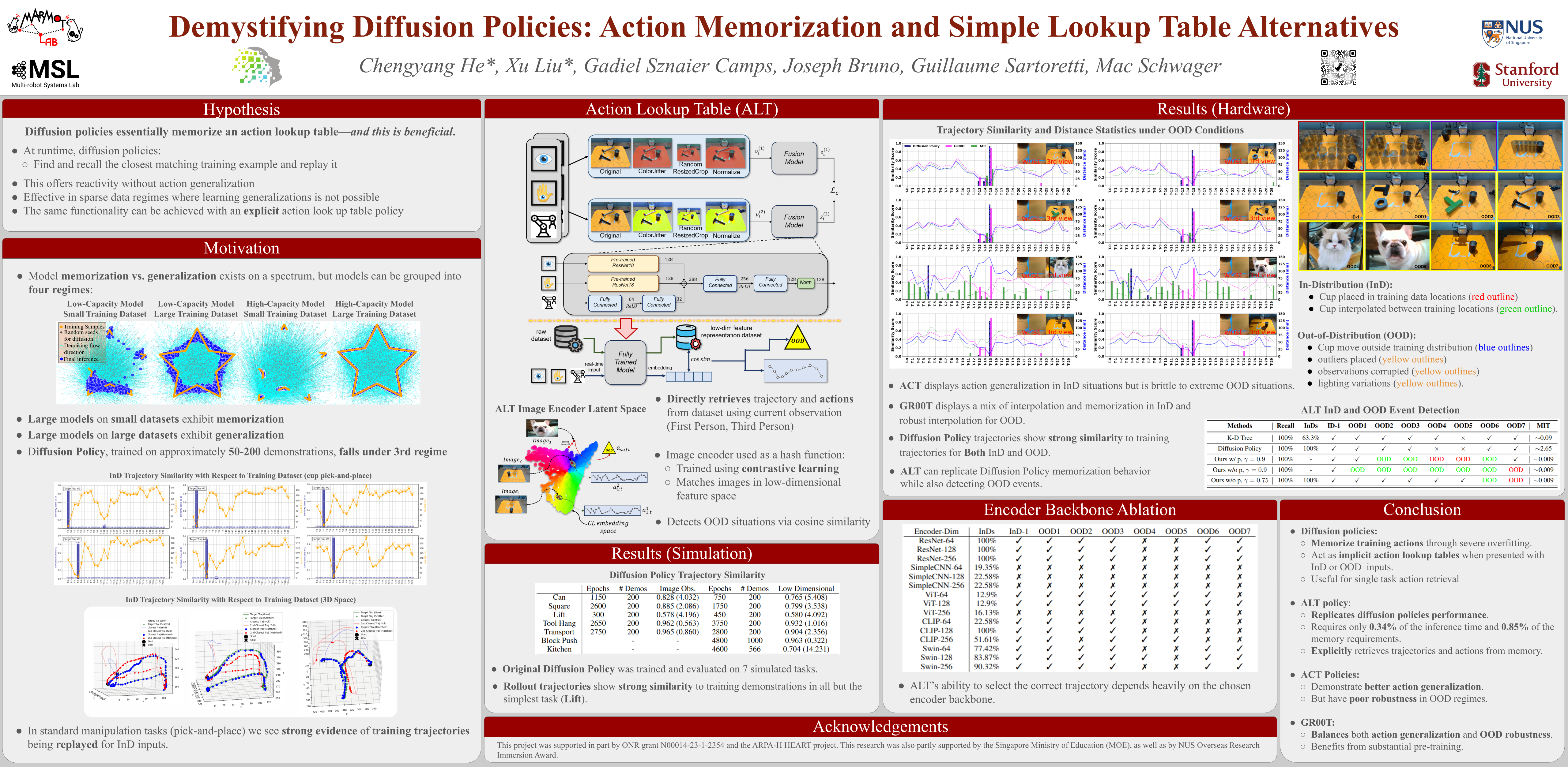
Diffusion policies for visuomotor robot manipulation tasks achieve remarkable dexterity and robustness while only training on a small number of task demonstrations. However, the reason for this performance remains a mystery. In this paper, we offer a surprising hypothesis: diffusion policies essentially memorize an action lookup table---\emph{and this is beneficial}. We posit that, at runtime, diffusion policies find the closest training image to the test image in a latent space, and recall the associated training action (i.e. action chunk), offering reactivity without the need for action generalization. This is effective in the sparse data regime, where there is not enough data density for the model to learn action generalization. We support this claim with systematic empirical evidence, showing that even when conditioned on highly out of distribution (OOD) images, Diffusion Policy still outputs an action chunk from the training data. We evaluate and compare three representative policy families on the same data set: Diffusion Policy, Action Chunking with Transformers (ACT), and GR00T, a pre-trained generalist Vision-Language-Action (VLA) model. We show that Diffusion Policy gives strong action memorization giving surprising robustness in OOD regimes, ACT shows action interpolation with poor robustness in OOD regimes, and GR00T (benefiting from substantial pre-training) shows both action interpolation and OOD robustness. As a simple alternative to Diffusion Policy, we introduce the Action Lookup Table (ALT) policy, showing that an explicit lookup table policy can perform comparably in this low data regime. Despite its simplicity, ALT attains Diffusion Policy–level performance while also providing faster inference and explicit OOD detection via latent-distance thresholds. These results reframe diffusion policies for robot manipulation as reactive memory retrieval under data sparsity, and provide practical tools for interpreting, evaluating, and monitoring such policies. More information can be found at: \url{https://stanfordmsl.github.io/alt/}.
RobotArena $\infty$: Scalable Robot Benchmarking via Real-to-Sim Translation
Yash Jangir ⋅ Yidi Zhang ⋅ Kashu Yamazaki ⋅ Chenyu Zhang ⋅ Kuan-Hsun Tu ⋅ Tsung-Wei Ke ⋅ Lei Ke ⋅ Yonatan Bisk ⋅ Katerina Fragkiadaki
The pursuit of robot generalists, instructable agents capable of performing diverse tasks across diverse environments, demands rigorous and scalable evaluation. Yet real-world testing of robot policies remains fundamentally constrained: it is labor-intensive, slow, unsafe at scale, and difficult to reproduce. As policies expand in scope and complexity, these barriers only intensify, since defining ``success'' in robotics often hinges on nuanced human judgments of execution quality. We introduce RobotArenaInf, a new benchmarking framework that overcomes these challenges by shifting VLA evaluation into large-scale simulated environments augmented with online human feedback. Leveraging advances in vision-language models, 2D-to-3D generative modeling, and differentiable rendering, our approach automatically converts video demonstrations from widely used robot datasets into simulated counterparts. Within these digital twins, we assess VLA policies using both automated VLM-guided scoring and scalable human preference judgments collected from crowdworkers, transforming human involvement from tedious scene setup, resetting, and safety supervision into lightweight preference comparisons. To measure robustness, we systematically perturb simulated environments along multiple axes, including textures and object placements, stress-testing policy generalization under controlled variation. The result is a continuously evolving, reproducible, and scalable benchmark for real-world-trained robot manipulation policies, addressing a critical missing capability in today’s robotics landscape. Benchmark website at \href{https://robotarenainf.github.io}{\texttt{robotarenainf.github.io}}.
DrivingGen: A Comprehensive Benchmark for Generative Video World Models in Autonomous Driving
Yang Zhou ⋅ Hao Shao ⋅ Letian Wang ⋅ Zhuofan Zong ⋅ Hongsheng Li ⋅ Steven Waslander
Video generation models, as one form of world models, has emerged as one of the most exciting frontiers in AI, promising agents the ability to imagine the future by modeling the temporal evolution of complex scenes. In autonomous driving, this vision gives rise to driving world models—generative simulators that imagine ego and agent futures, enabling scalable simulation, safe testing of corner cases, and rich synthetic data generation. Yet, despite fast-growing research activity, the field lacks a rigorous benchmark to measure progress and guide priorities. Existing evaluations remain limited: generic video metrics overlook safety-critical imaging factors; trajectory plausibility is rarely quantified; temporal and agent-level consistency is neglected; and controllability with respect to ego conditioning is ignored. Moreover, current datasets fail to cover the diversity of conditions required for real-world deployment. To address these gaps, we present DrivingGen, the first comprehensive benchmark for generative driving world models. DrivingGen combines a diverse evaluation dataset—curated from both driving datasets and internet-scale video sources, spanning varied weather, time of day, geographic regions, and complex maneuvers—with a suite of new metrics that jointly assess visual realism, trajectory plausibility, temporal coherence, and controllability. Benchmarking 14 state-of-the-art models reveals clear trade-offs: general models look better but break physics, while driving-specific ones capture motion realistically but lag in visual quality. DrivingGen offers a unified evaluation framework to foster reliable, controllable, and deployable driving world models, enabling scalable simulation, planning, and data-driven decision-making.
DriveMamba: Task-Centric Scalable State Space Model for Efficient End-to-End Autonomous Driving
Haisheng Su ⋅ Wei Wu ⋅ Feixiang Song ⋅ Junjie Zhang ⋅ Zhenjie Yang ⋅ Junchi Yan
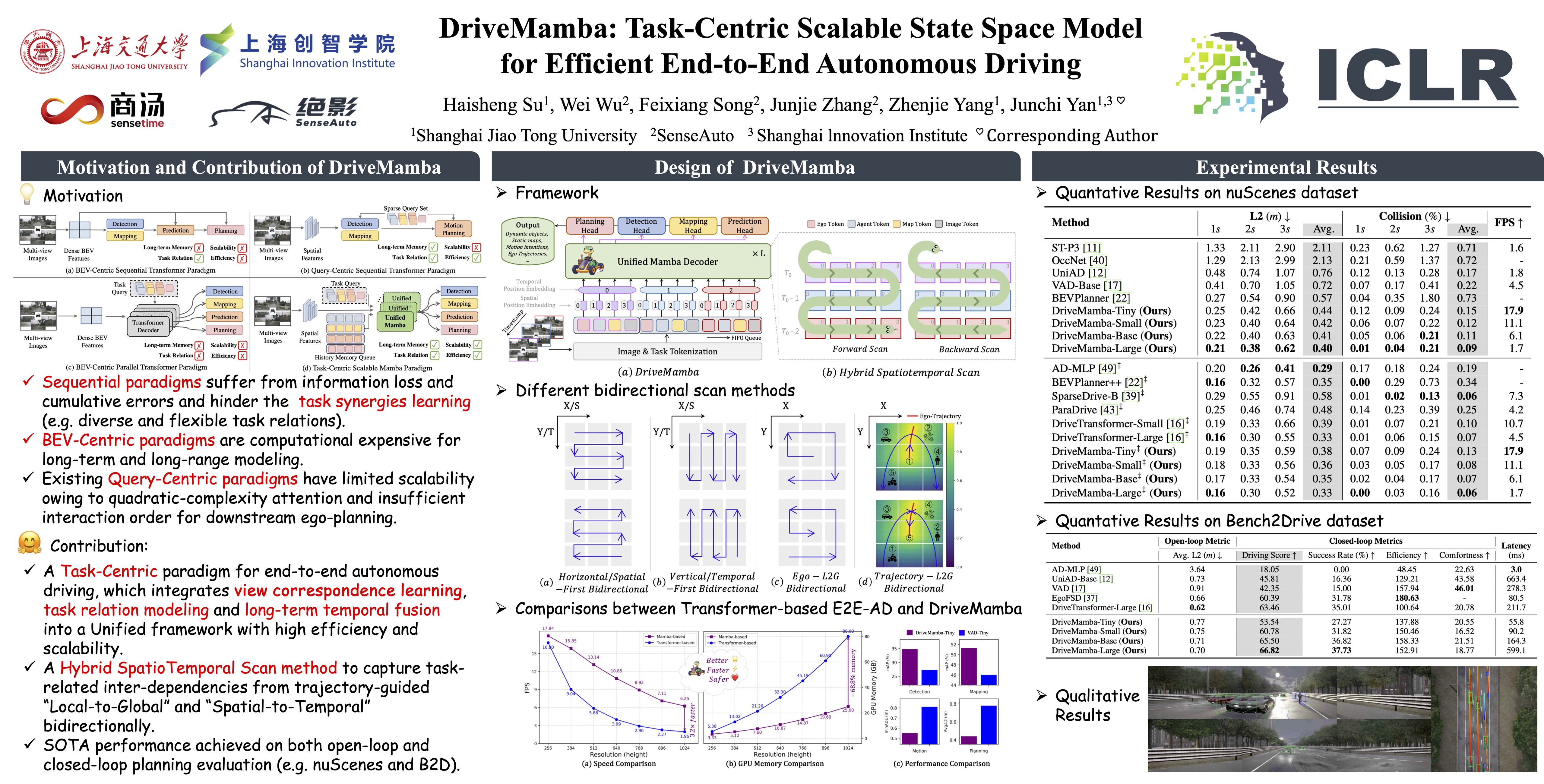
Recent advances towards End-to-End Autonomous Driving (E2E-AD) focus on integrating modular designs into a unified framework for joint optimization. Most of these advances follow a sequential paradigm (i.e., perception-prediction-planning) based on separable Transformer decoders and rely on dense BEV features to encode scene representations. However, such manual ordering design can inevitably cause information loss and cumulative errors, lacking flexible and diverse relation modeling among different modules and sensors. Meanwhile, insufficient training of image backbone and quadratic-complexity of attention mechanism also hinder the scalability and efficiency of E2E-AD system to handle spatiotemporal input. To this end, we propose DriveMamba, a Task-Centric Scalable paradigm for efficient E2E-AD, which integrates dynamic task relation modeling, implicit view correspondence learning and long-term temporal fusion into a single-stage Unified Mamba decoder. Specifically, both extracted image features and expected task outputs are converted into token-level sparse representations in advance, which are then sorted by their instantiated positions in 3D space. The linear-complexity operator enables efficient long-context sequential token modeling to capture task-related inter-dependencies simultaneously. Additionally, a bidirectional trajectory-guided "local-to-global" scan method is designed to preserve spatial locality from ego-perspective, thus facilitating the ego-planning. Extensive experiments conducted on nuScenes and Bench2Drive datasets demonstrate the superiority, generalizability and great efficiency of DriveMamba.
ROSETTA: Constructing Code-Based Reward from Unconstrained Language Preference
Sanjana Srivastava ⋅ Kangrui Wang ⋅ Yung-Chieh Chan ⋅ Tianyuan Dai ⋅ Manling Li ⋅ Ruohan Zhang ⋅ Mengdi Xu ⋅ Jiajun Wu ⋅ Li Fei-Fei
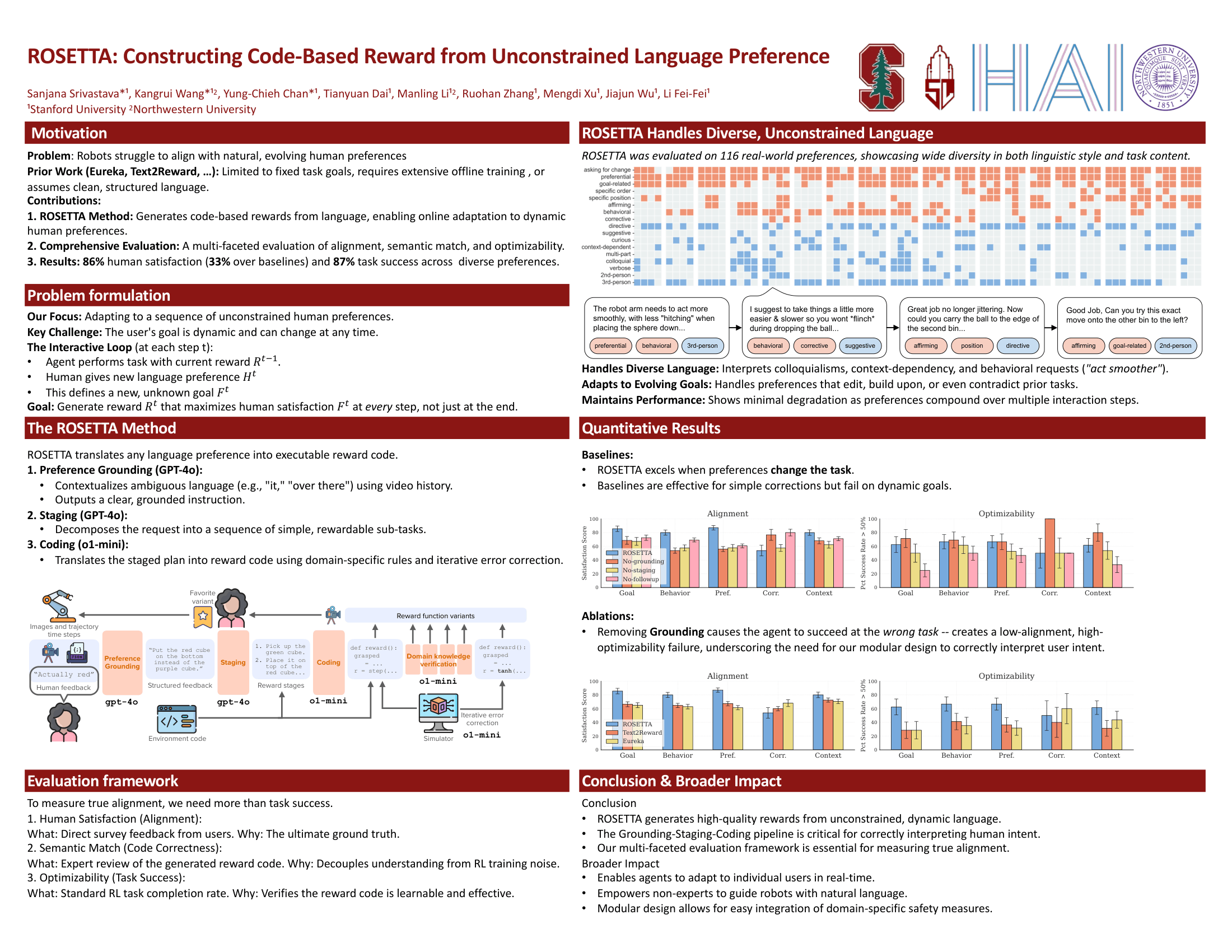
Intelligent embodied agents not only need to accomplish preset tasks, but also learn to align with individual human needs and preferences. Extracting reward signals from human language preferences allows an embodied agent to adapt through reinforcement learning. However, human language preferences are unconstrained, diverse, and dynamic, making constructing learnable reward from them a major challenge. We present ROSETTA, a framework that uses foundation models to ground and disambiguate unconstrained natural language preference, construct multi-stage reward functions, and implement them with code generation. Unlike prior works requiring extensive offline training to get general reward models or fine-grained correction on a single task, ROSETTA allows agents to adapt online to preference that evolves and is diverse in language and content. We test ROSETTA on both short-horizon and long-horizon manipulation tasks and conduct extensive human evaluation, finding that ROSETTA outperforms SOTA baselines and achieves 87% average success rate and 86% human satisfaction across 116 preferences.
SAGE: Spatial-visual Adaptive Graph Exploration for Efficient Visual Place Recognition
Shunpeng Chen ⋅ Changwei Wang ⋅ Rongtao Xu ⋅ xingtianPei ⋅ yukun Song ⋅ Jinzhou Lin ⋅ Wenhao Xu ⋅ jingyizhang ⋅ Li Guo ⋅ Shibiao Xu
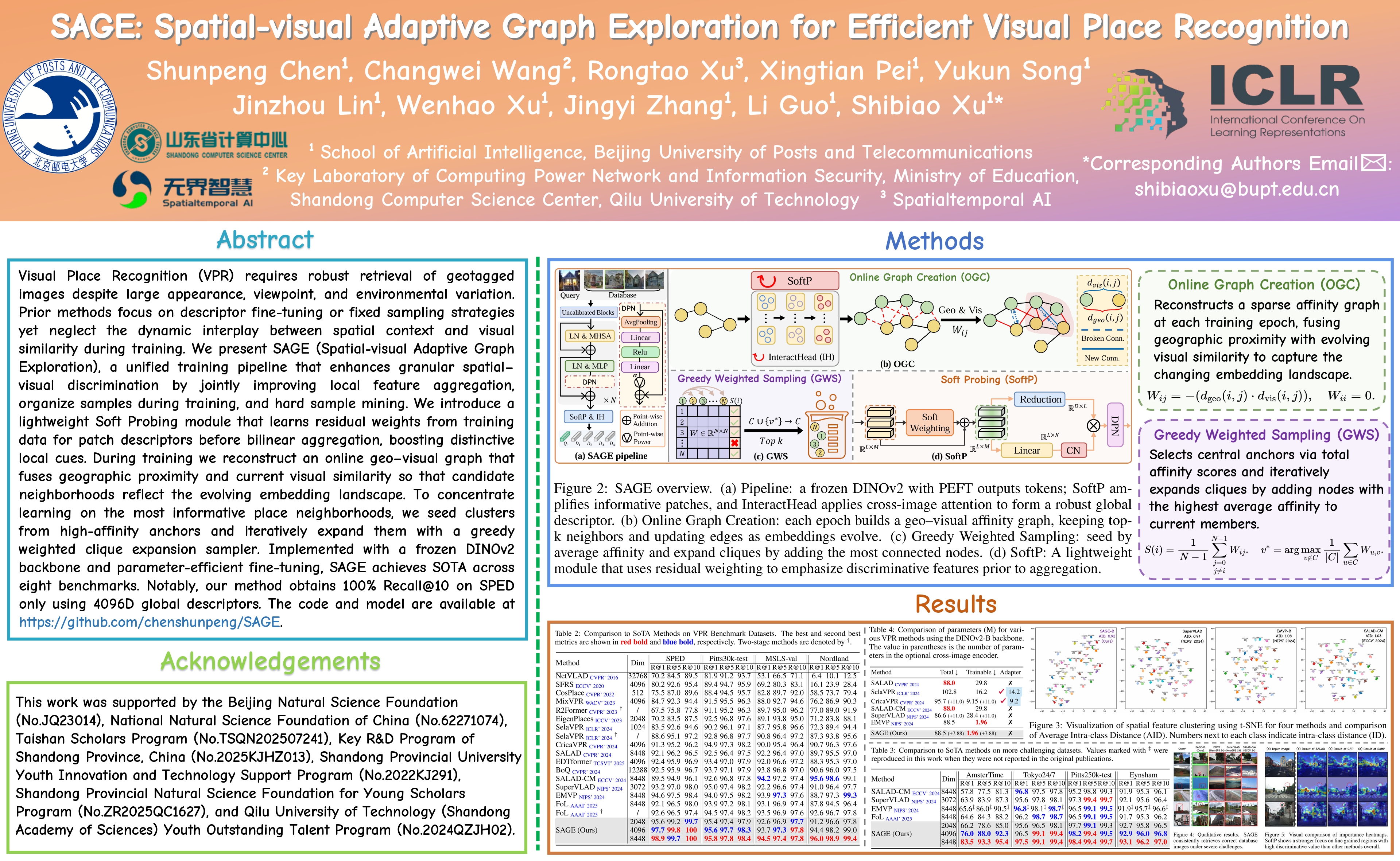
Visual Place Recognition (VPR) requires robust retrieval of geotagged images despite large appearance, viewpoint, and environmental variation. Prior methods focus on descriptor fine-tuning or fixed sampling strategies yet neglect the dynamic interplay between spatial context and visual similarity during training. We present SAGE ($\underline{S}$patial-visual $\underline{A}$daptive $\underline{G}$raph $\underline{E}$xploration), a unified training pipeline that enhances granular spatial-visual discrimination by jointly improving local feature aggregation, organize samples during training, and hard sample mining. We introduce a lightweight Soft Probing module that learns residual weights from training data for patch descriptors before bilinear aggregation, boosting distinctive local cues. During training we reconstruct an online geo-visual graph that fuses geographic proximity and current visual similarity so that candidate neighborhoods reflect the evolving embedding landscape. To concentrate learning on the most informative place neighborhoods, we seed clusters from high-affinity anchors and iteratively expand them with a greedy weighted clique expansion sampler. Implemented with a frozen DINOv2 backbone and parameter-efficient fine-tuning, SAGE achieves SOTA across eight benchmarks. Notably, our method obtains 100% Recall@10 on SPED only using 4096D global descriptors. The code and model are available at https://github.com/chenshunpeng/SAGE.
DecompGAIL: Learning Realistic Traffic Behaviors with Decomposed Multi-Agent Generative Adversarial Imitation Learning
Ke Guo ⋅ Haochen Liu ⋅ XIAOJUN WU ⋅ Chen Lv
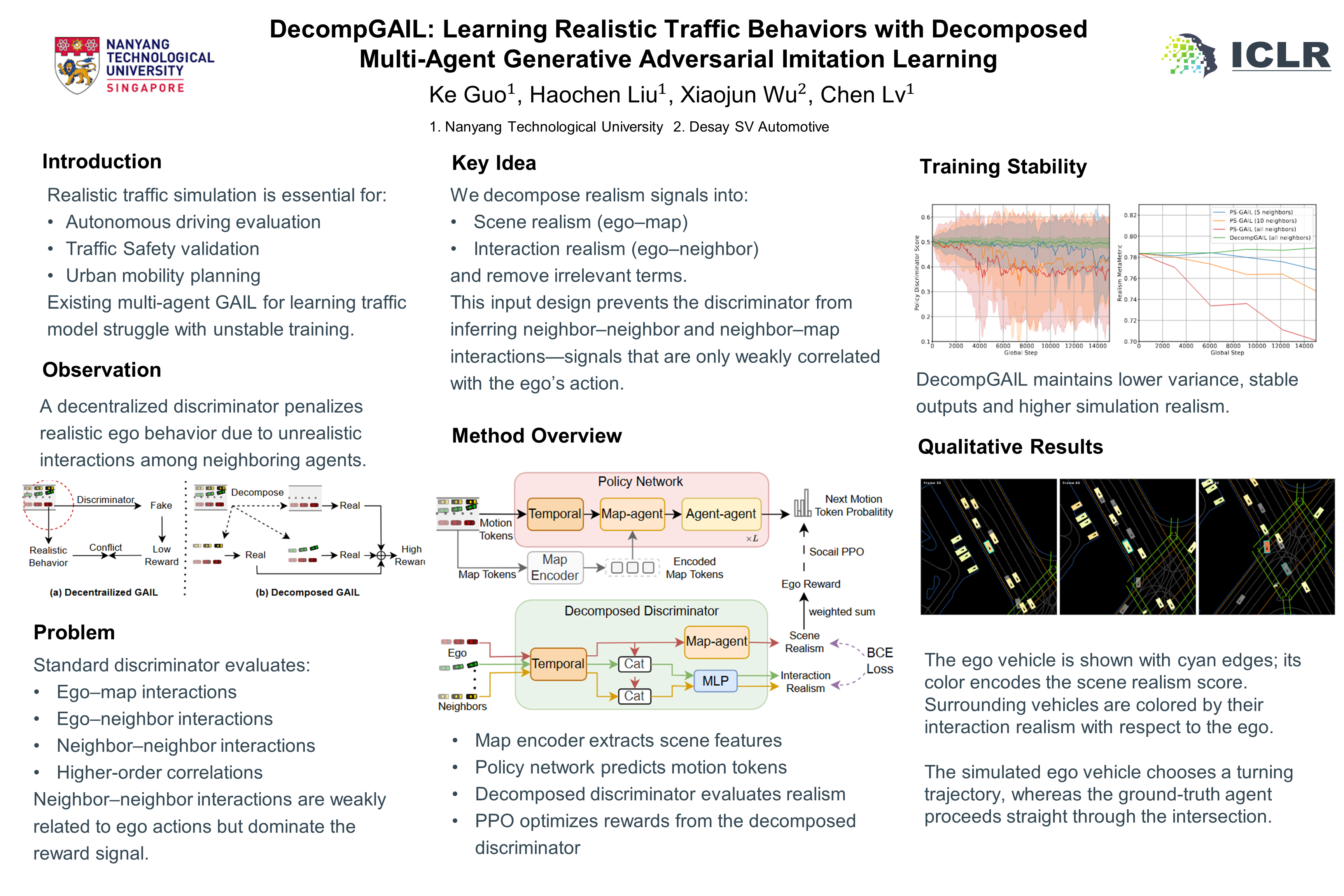
Realistic traffic simulation is critical for the development of autonomous driving systems and urban mobility planning, yet existing imitation learning approaches often fail to model realistic traffic behaviors. Behavior cloning suffers from covariate shift, while Generative Adversarial Imitation Learning (GAIL) is notoriously unstable in multi-agent settings. We identify a key source of this instability—irrelevant interaction misguidance—where a discriminator penalizes an ego vehicle’s realistic behavior due to unrealistic interactions among its neighbors. To address this, we propose Decomposed Multi-agent GAIL (DecompGAIL), which explicitly decomposes realism into ego–map and ego–neighbor components, filtering out misleading neighbor–neighbor and neighbor–map interactions. We further introduce a social PPO objective that augments ego rewards with distance-weighted neighborhood rewards, encouraging overall realism across agents. Integrated into a lightweight SMART-based backbone, DecompGAIL achieves state-of-the-art performance on the WOMD Sim Agents 2025 benchmark.
Difference-Aware Retrieval Policies for Imitation Learning
Quinn Pfeifer ⋅ Ethan Pronovost ⋅ Paarth Shah ⋅ Khimya Khetarpal ⋅ Siddhartha Srinivasa ⋅ Abhishek Gupta
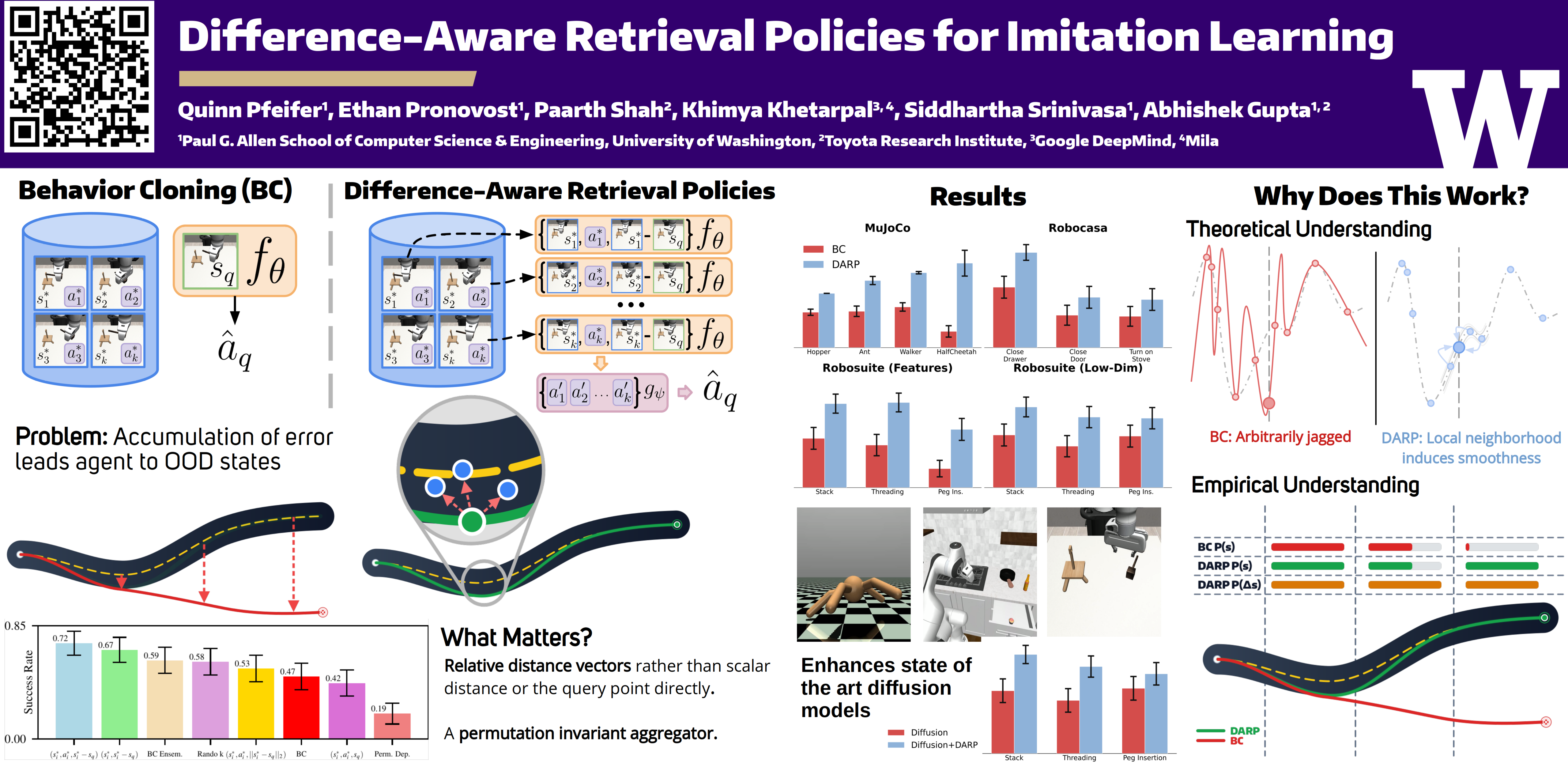
Parametric imitation learning via behavior cloning can suffer from poor generalization to out-of-distribution states due to compounding errors during deployment. We show that reusing the training data during inference via a semi-parametric retrieval-based imitation learning approach can alleviate this challenge. We present Difference-Aware Retrieval Policies for Imitation Learning (DARP), a semi-parametric retrieval-based imitation learning approach that addresses this limitation by reparameterizing the imitation learning problem in terms of local neighborhood structure rather than direct state-to-action mappings. Instead of learning a global policy, DARP trains a model to predict actions based on k-nearest neighbors from expert demonstrations, their corresponding actions, and the relative distance vectors between neighbor states and query states. DARP requires no additional assumptions beyond those made for standard behavior cloning -- it does not require additional data collection, online expert feedback, or task-specific knowledge. We demonstrate consistent performance improvements of 15-46% over standard behavior cloning across diverse domains, including continuous control and robotic manipulation, and across different representations, including high-dimensional visual features.
Remotely Detectable Robot Policy Watermarking
Michael Amir ⋅ Manon Flageat ⋅ Amanda Prorok
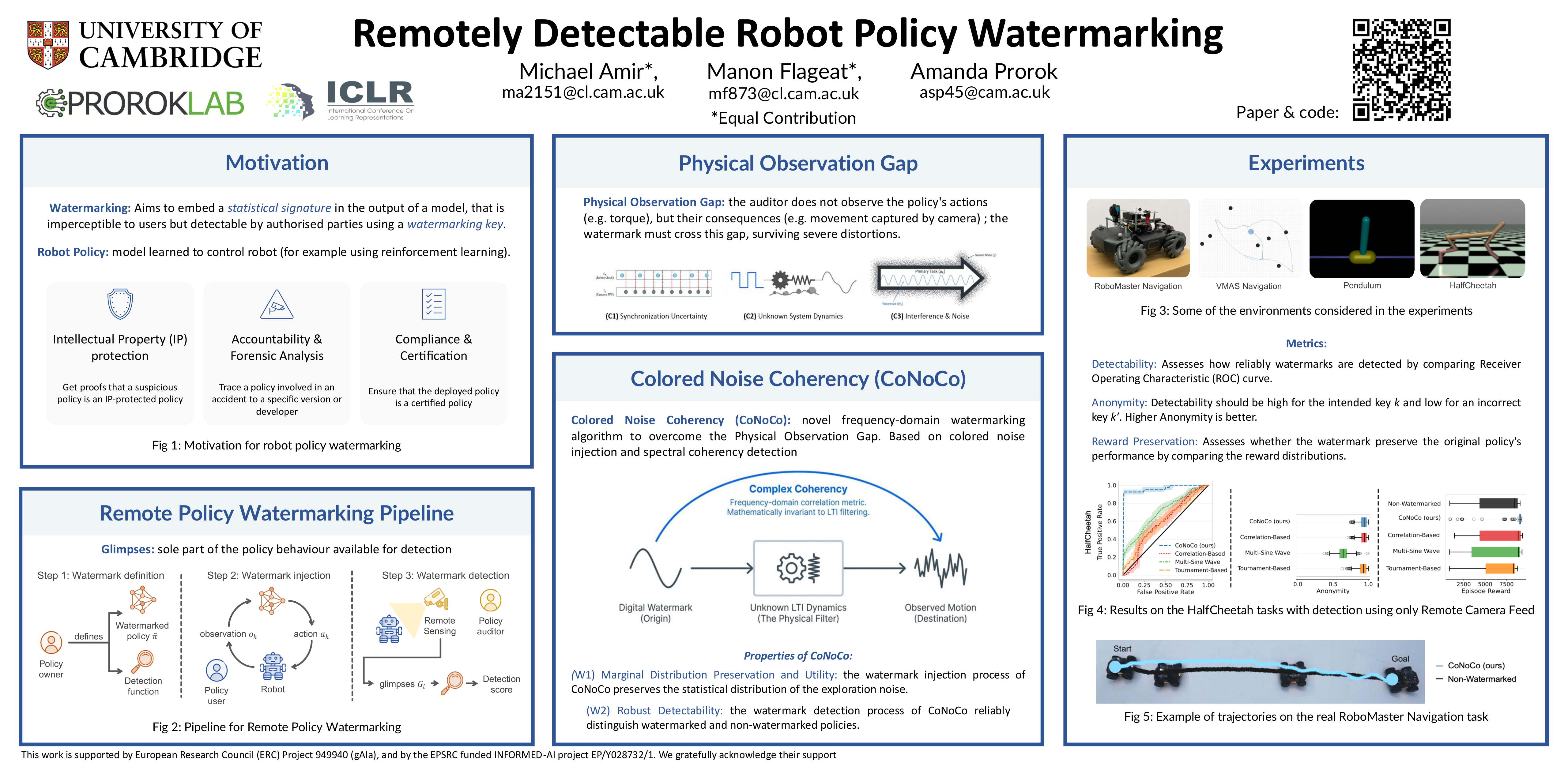
The success of machine learning for real-world robotic systems has created a new form of intellectual property: the trained policy. This raises a critical need for novel methods that verify ownership and detect unauthorized, possibly unsafe misuse. While watermarking is established in other domains, physical policies present a unique challenge: remote detection. Existing methods assume access to the robot’s internal state, but auditors are often limited to external observations (e.g., video footage). This “Physical Observation Gap” means the watermark must be detected from signals that are noisy, asynchronous, and filtered by unknown system dynamics. We formalize this challenge using the concept of a glimpse sequence, and introduce Colored Noise Coherency (CoNoCo), the first watermarking strategy designed for remote detection. CoNoCo embeds a spectral signal into the robot’s motions by leveraging the policy’s inherent stochasticity. To show it does not degrade performance, we prove CoNoCo preserves the marginal action distribution. Our experiments demonstrate strong, robust detection across various remote modalities—including motion capture and side-way/top-down video footage—in both simulated and real-world robot experiments. This work provides a necessary step toward protecting intellectual property in robotics, offering the first method for validating the provenance of physical policies non invasively, using purely remote observations.
HWC-Loco: A Hierarchical Whole-Body Control Approach to Robust Humanoid Locomotion
Sixu Lin ⋅ Guanren Qiao ⋅ Yunxin Tai ⋅ Ang Li ⋅ Kui Jia ⋅ Guiliang Liu
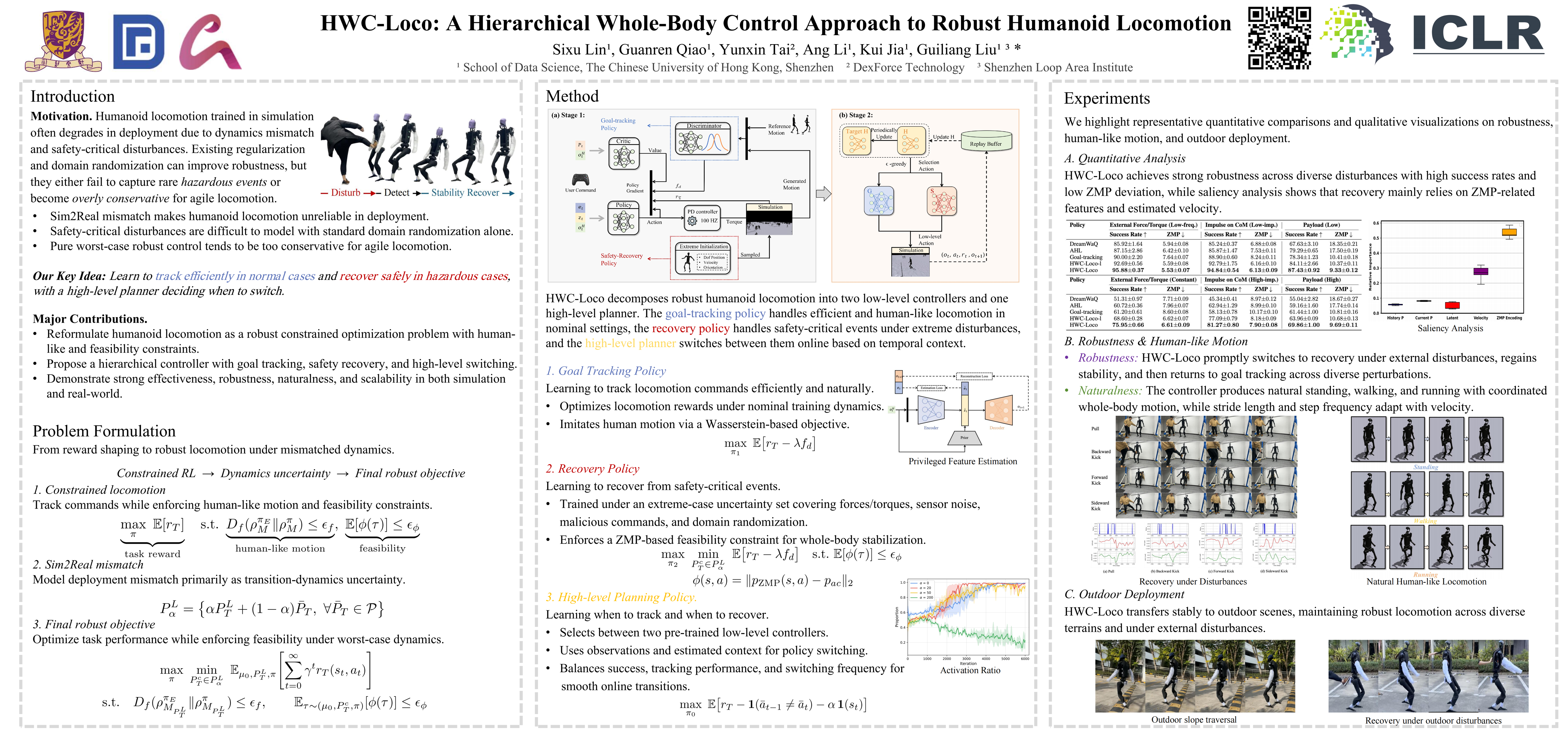
Humanoid robots, capable of assuming human roles in various workplaces, have become essential to embodied intelligence. However, as robots with complex physical structures, learning a control model that can operate robustly across diverse environments remains inherently challenging, particularly under the discrepancies between training and deployment environments. In this study, we propose HWC-Loco, a robust whole-body control algorithm tailored for humanoid locomotion tasks. By reformulating policy learning as a robust optimization problem, HWC-Loco explicitly learns to recover from safety-critical scenarios. While prioritizing safety guarantees, overly conservative behavior can compromise the robot's ability to complete the given tasks. To tackle this challenge, HWC-Loco leverages a hierarchical policy for robust control. This policy can dynamically resolve the trade-off between goal-tracking and safety recovery, guided by human behavior norms and dynamic constraints. To evaluate the performance of HWC-Loco, we conduct extensive comparisons against state-of-the-art humanoid control models, demonstrating HWC-Loco's superior performance across diverse terrains, robot structures, and locomotion tasks under both simulated and real-world environments.
Geometry-aware 4D Video Generation for Robot Manipulation
Zeyi Liu ⋅ Shuang Li ⋅ Eric Cousineau ⋅ Siyuan Feng ⋅ Benjamin Burchfiel ⋅ Shuran Song
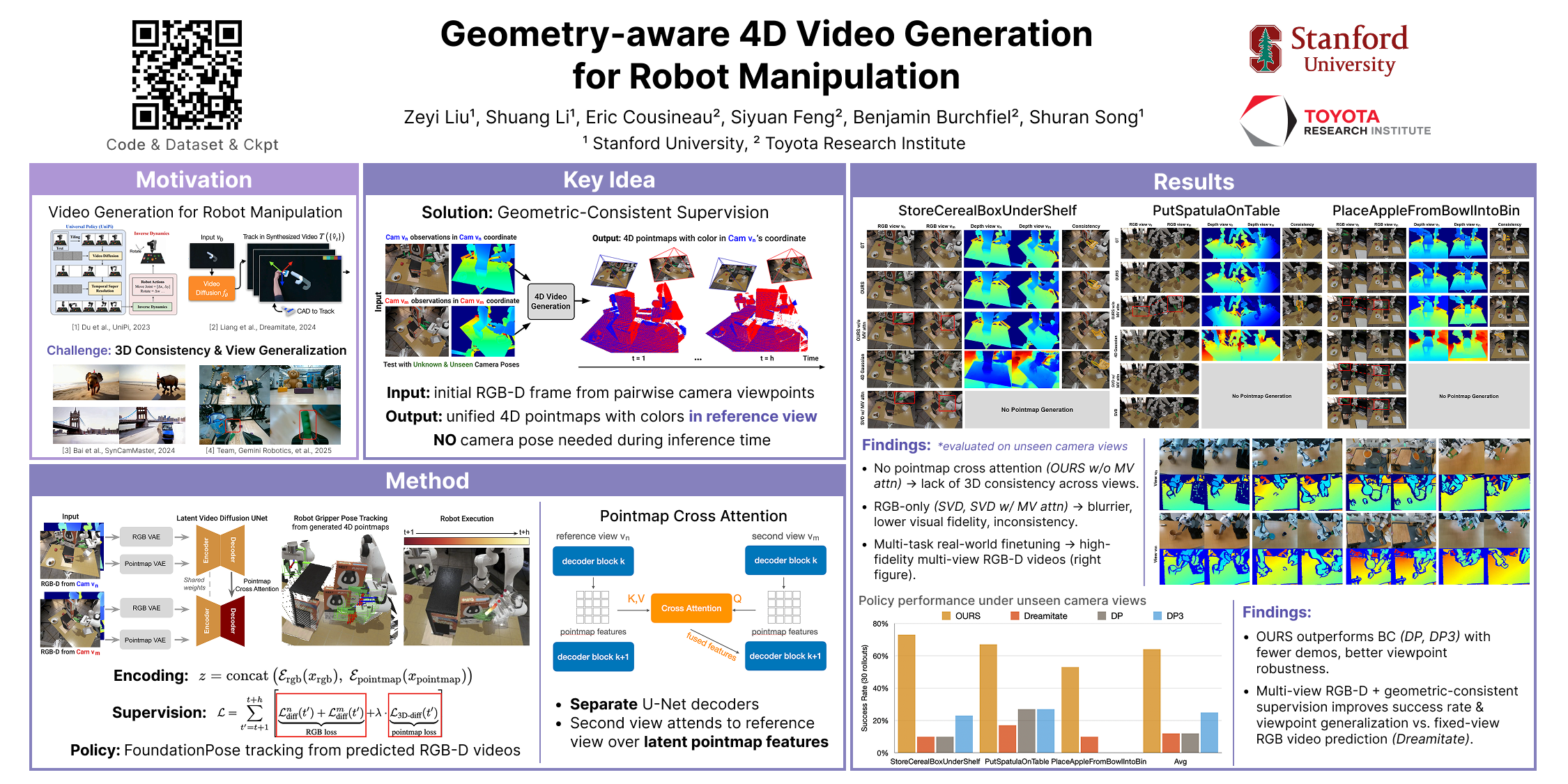
Understanding and predicting dynamics of the physical world can enhance a robot's ability to plan and interact effectively in complex environments. While recent video generation models have shown strong potential in modeling dynamic scenes, generating videos that are both temporally coherent and geometrically consistent across camera views remains a significant challenge. To address this, we propose a 4D video generation model that enforces multi-view 3D consistency of generated videos by supervising the model with cross-view pointmap alignment during training. Through this geometric supervision, the model learns a shared 3D scene representation, enabling it to generate spatio-temporally aligned future video sequences from novel viewpoints given a single RGB-D image per view, and without relying on camera poses as input. Compared to existing baselines, our method produces more visually stable and spatially aligned predictions across multiple simulated and real-world robotic datasets. We further show that the predicted 4D videos can be used to recover robot end-effector trajectories using an off-the-shelf 6DoF pose tracker, yielding robot manipulation policies that generalize well to novel camera viewpoints.
Towards Generalizable PDE Dynamics Forecasting via Physics-Guided Invariant Learning
Siyang Li ⋅ Yize Chen ⋅ Yan Guo ⋅ Ming Huang ⋅ Hui Xiong
Advanced deep learning-based approaches have been actively applied to forecast the spatiotemporal physical dynamics governed by partial differential equations (PDEs), which acts as a critical procedure in tackling many science and engineering problems. As real-world physical environments like PDE system parameters are always capricious, how to generalize across unseen out-of-distribution (OOD) forecasting scenarios using limited training data is of great importance. To bridge this barrier, existing methods focus on discovering domain-generalizable representations across various PDE dynamics trajectories. However, their zero-shot OOD generalization capability remains deficient, since extra test-time samples for domain-specific adaptation are still required. This is because the fundamental physical invariance in PDE dynamical systems are yet to be investigated or integrated. To this end, we first explicitly define a two-fold PDE invariance principle, which points out that ingredient operators and their composition relationships remain invariant across different domains and PDE system evolution. Next, to capture this two-fold PDE invariance, we propose a physics-guided invariant learning method termed iMOOE, featuring an Invariance-aligned Mixture Of Operator Expert architecture and a frequency-enriched invariant learning objective. Extensive experiments across simulated benchmarks and real-world applications validate iMOOE's superior in-distribution performance and zero-shot generalization capabilities on diverse OOD forecasting scenarios.
CauKer: Classification Time Series Foundation Models Can Be Pretrained on Synthetic Data
Shifeng Xie ⋅ Vasilii Feofanov ⋅ Jianfeng Zhang ⋅ Themis Palpanas ⋅ Ievgen Redko
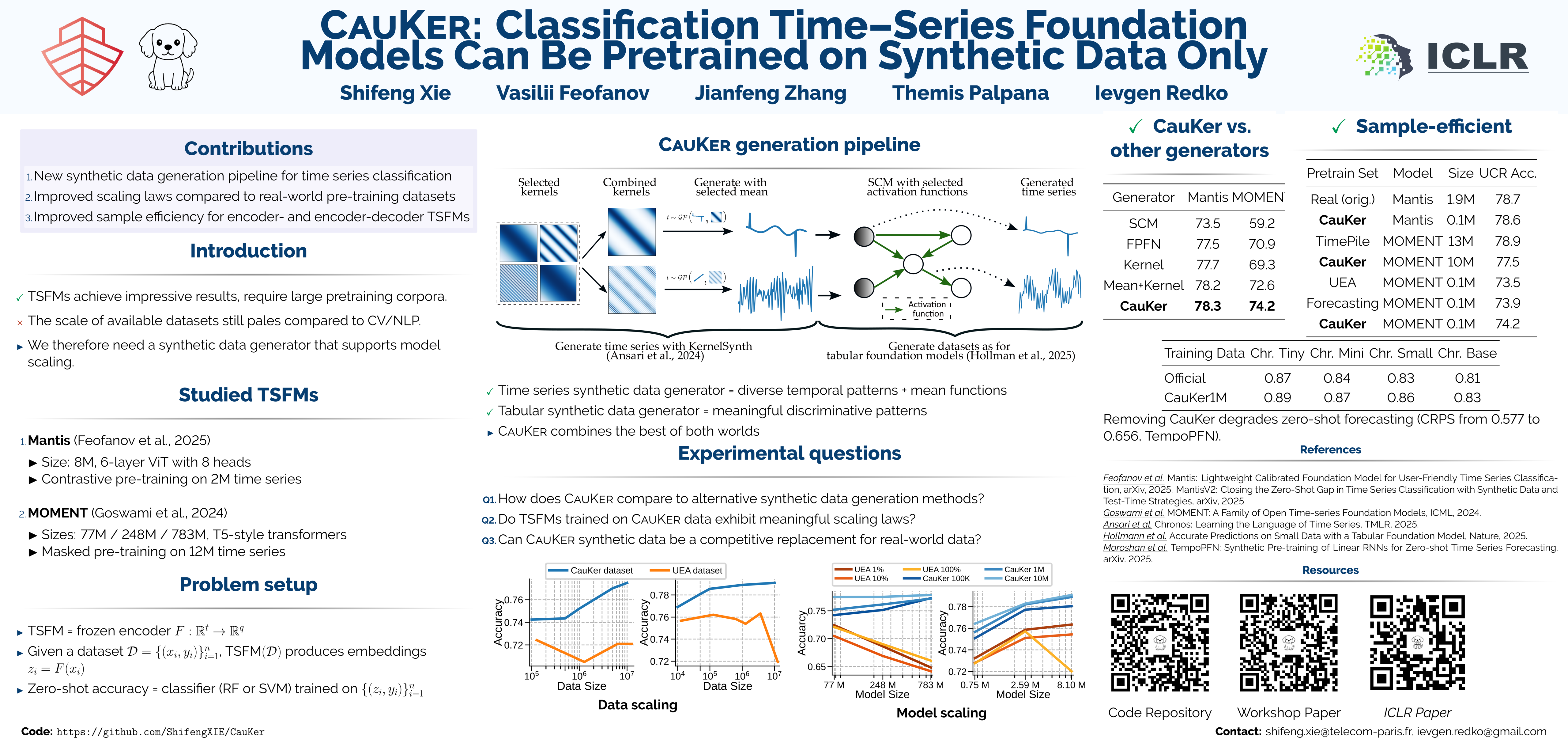
Time series foundation models (TSFMs) have recently gained significant attention due to their strong zero-shot capabilities and widespread real-world applications. Such models typically require a computationally costly pretraining on large-scale, carefully curated collections of real-world sequences. To allow for a sample-efficient pretraining of TSFMs, we propose CauKer, a novel algorithm designed to generate diverse, causally coherent synthetic time series with realistic trends, seasonality, and nonlinear interactions. CauKer combines Gaussian Process (GP) kernel composition with Structural Causal Models (SCM) to produce data for sample-efficient pretraining of state-of-the-art classification TSFMs having different architectures and following different pretraining approaches. Additionally, our experiments reveal that CauKer-generated datasets exhibit clear scaling laws for both dataset size (10K to 10M samples) and model capacity (1M to 783M parameters), unlike real-world datasets, which display irregular scaling behavior.
Routing Channel-Patch Dependencies in Time Series Forecasting with Graph Spectral Decomposition
Dongyuan Li ⋅ Shun Zheng ⋅ Chang XU ⋅ Jiang Bian ⋅ Renhe Jiang
Time series forecasting has attracted significant attention in the field of AI. Previous works have revealed that the Channel-Independent (CI) strategy improves forecasting performance by modeling each channel individually, but it often suffers from poor generalization and overlooks meaningful inter-channel interactions. Conversely, Channel-Dependent (CD) strategies aggregate all channels, which may introduce irrelevant information and lead to oversmoothing. Despite recent progress, few existing methods offer the flexibility to adaptively balance CI and CD strategies in response to varying channel dependencies. To address this, we propose a generic plugin xCPD, that can adaptively model the channel-patch dependencies from the perspective of graph spectral decomposition. Specifically, xCPD first projects multivariate signals into the frequency domain using a shared graph Fourier basis, and groups patches into low-, mid-, and high-frequency bands based on their spectral energy responses. xCPD then applies a channel-adaptive routing mechanism that dynamically adjusts the degree of inter-channel interaction for each patch, enabling selective activation of frequency-specific experts. This facilitates fine-grained input-aware modeling of smooth trends, local fluctuations, and abrupt transitions. xCPD can be seamlessly integrated on top of existing CI and CD forecasting models, consistently enhancing both accuracy and generalization across benchmarks. The code is available [https://github.com/Clearloveyuan/xCPD].
Time-Gated Multi-Scale Flow Matching for Time-Series Imputation
Hangtian Wang ⋅ Mahito Sugiyama
We address multivariate time–series imputation by learning the velocity field of a data-conditioned ordinary differential equation (ODE) via flow matching. Our method, Time-Gated Multi-Scale Flow Matching (TG-MSFM), conditions the flow on a structured endpoint comprising observed values, a per-time visibility mask, and short left/right context, processed by a time-aware Transformer whose self-attention is masked to aggregate only from observed timestamps. To recon- cile global trends with local details along the trajectory, we introduce time-gated multi-scale velocity heads on a fixed 1D pyramid and blend them through a time- dependent gate; a mild anti-aliasing filter stabilizes the finest branch. At inference, we use a second-order Heun integrator with a per-step data-consistency projection that keeps observed coordinates exactly on the straight path from the initial noise to the endpoint, reducing boundary artifacts and drift. Training adopts gap-only supervision of the velocity on missing data coordinates, with small optional regu- larizers for numerical stability. Across standard benchmarks, Time-Gated Multi- Scale Flow Matching attains competitive or improved MSE/MAE with favorable speed–quality trade-offs, and ablations isolate the contributions of the time-gated multi-scale heads, masked attention, and the data-consistent ODE integration
Decentralized Attention Fails Centralized Signals: Rethinking Transformers for Medical Time Series
Yu Guoqi ⋅ Juncheng Wang ⋅ Chen Yang ⋅ Jing Qin ⋅ Angelica Aviles-Rivero ⋅ Shujun Wang
Accurate analysis of Medical time series (MedTS) data, such as Electroencephalography (EEG) and Electrocardiography (ECG), plays a pivotal role in healthcare applications, including the diagnosis of brain and heart diseases. MedTS data typically exhibits two critical patterns: temporal dependencies within individual channels and channel dependencies across multiple channels. While recent advances in deep learning have leveraged Transformer-based models to effectively capture temporal dependencies, they often struggle to model channel dependencies. This limitation stems from a structural mismatch: MedTS signals are inherently centralized, whereas the Transformer's attention is decentralized, making it less effective at capturing global synchronization and unified waveform patterns. To bridge this gap, we propose CoTAR (Core Token Aggregation-Redistribution), a centralized MLP-based module tailored to replace the decentralized attention. Instead of allowing all tokens to interact directly, as in attention, CoTAR introduces a global core token that acts as a proxy to facilitate the inter-token interaction, thereby enforcing a centralized aggregation and redistribution strategy. This design not only better aligns with the centralized nature of MedTS signals but also reduces computational complexity from quadratic to linear. Experiments on five benchmarks validate the superiority of our method in both effectiveness and efficiency, achieving up to a 12.13% improvement on the APAVA dataset, with merely 33% memory usage and 20% inference time compared to the previous state-of-the-art. Code and all training scripts are available in this Link.
Battery Fault: A Comprehensive Dataset and Benchmark for Battery Fault Diagnosis
Qingdi Liu ⋅ Yan Fu ⋅ Lishuo LIU ⋅ Yanke LIN ⋅ Jin Xin ⋅ Jianfeng Zhang ⋅ Cheng Liu ⋅ Lujia Pan ⋅ Dongxu Guo ⋅ Yuejiu Zheng ⋅ Qiang Li
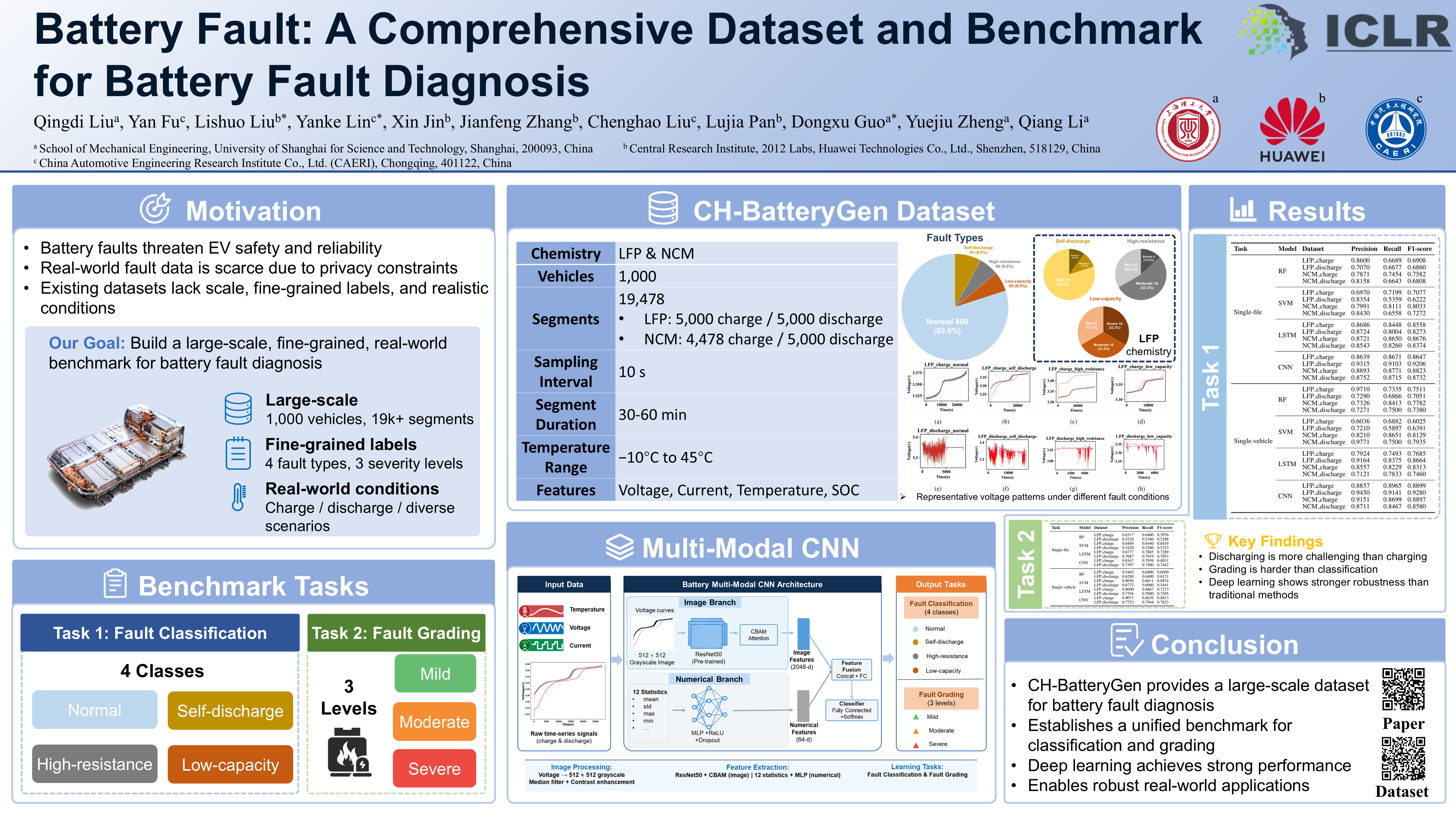
With the accelerated popularization of electric vehicles (EV), battery safety issues have become an important research focus. Data-driven battery fault diagnosis algorithms, built on real-world operational data, are critical methods for reducing safety risks. However, existing battery datasets have limitations such as insufficient scale, coarse-grained labels, and lack of coverage of real-world operating conditions, which seriously restrict the development of data-driven fault diagnosis algorithms. To address these issues, this paper introduces a large-scale benchmark dataset named CH-BatteryGen, which is, to the best of our knowledge, the first EV battery system fault diagnosis dataset based on real-world operating conditions. This dataset integrates real on-board operation data with mechanism-constrained generative modeling technology, balancing authenticity and scalability. It covers two mainstream battery chemistries, namely nickel-cobalt-manganese (NCM) lithium batteries and lithium iron phosphate (LFP) batteries, and involves charging, discharging, and operation data of 1000 electric vehicles. It provides four fault labels (normal, self-discharge, high-resistance, low-capacity) and three severity level annotations, supporting two benchmark tasks: fault classification and fault grading. Through systematic validation using traditional machine learning methods (random forest (RF), support vector machine (SVM)) and deep learning models (long short-term memory (LSTM), convolutional neural network (CNN)), the results show that the CNN model performs best in the fault classification task, achieving an F1-score of 0.9280 in the LFP discharging scenario; in the fault grading task, the F1-score reaches 0.8813. The CH-BatteryGen dataset has been open-sourced, aiming to provide a standardized evaluation platform for battery fault diagnosis algorithms, promote research development in this field, and contribute to the transformation of sustainable transportation systems.
Enabling arbitrary inference in spatio-temporal dynamic systems: A physics-inspired perspective
Yan Ge ⋅ Zhengyang Zhou ⋅ Qihe Huang ⋅ Yuxuan Liang ⋅ Yang Wang
Modern spatio-temporal learning techniques usually exploit sampled discrete observations to foresee the future. Actually, spatio-temporal dynamics are continuous and evolve continuously across time and space, thus modeling spatio-temporal dynamics in a continuous space can be a long-standing challenge. Existing deep learning architectures often fail to generalize to unseen regions and new graph topologies, while many physics-driven approaches are confined to Euclidean grids and poorly scale to complex graph structures. To address this gap, we propose PhySTA, a physics-inspired spatio-temporal learning framework designed for efficient and scalable arbitrary inference over graph-structured data. PhySTA integrates two key modules: (1) Continuous Operator-based Spectrum-Temporal Learning (CoSTL), which leverages a Graph-Time Fourier Neural Operator combined with Time-Gated Spectral Segmentation Perception to model continuous dynamics in operator space, and (2) Adaptive Multi-scale Interaction (AMI) that constructs multi-scale subgraphs and introduces node-edge coupled convolution to capture discrete interaction patterns and refine continuous predictions. By bridging operator learning with node-edge-graph interaction, PhySTA achieves both continuity-aware dynamic modeling and hierarchical interactive refinement. Extensive experiments across large-scale benchmarks demonstrate that PhySTA attains state-of-the-art accuracy while reducing computation cost and lowering parameter overhead.
Zero-shot Forecasting by Simulation Alone
Boris Oreshkin ⋅ Mayank Jauhari ⋅ Ravi Kiran Selvam ⋅ Malcolm Wolff ⋅ Wenhao Pan ⋅ Shankar Ramasubramanian ⋅ KIN GUTIERREZ ⋅ Tatiana Konstantinova ⋅ Andres Potapczynski ⋅ Mengfei Cao ⋅ Dmitry Efimov ⋅ Michael W Mahoney ⋅ Andrew Gordon Wilson
Zero-shot time-series forecasting holds great promise, but is still in its infancy, hindered by limited and biased data corpora, leakage-prone evaluation, and privacy and licensing constraints. Motivated by these challenges, we propose the first practical univariate time series simulation pipeline which is simultaneously fast enough for on-the-fly data generation and enables notable zero-shot forecasting performance on M-Series and GiftEval benchmarks that capture trend/seasonality/intermittency patterns, typical of industrial forecasting applications. Our simulator, which we call SarSim (SARIMA Simulator for Zero-Shot Forecasting), is based off of a seasonal autoregressive integrated moving average (SARIMA) model as its core data source. Due to instability in the autoregressive component, naive SARIMA simulation often leads to unusable paths. Instead, we follow a three-step procedure: (1) we sample well-behaved trajectories from its characteristic polynomial stability region; (2) we introduce a superposition scheme that combines multiple paths into rich multi-seasonality traces; and (3) we add rate-based heavy-tailed noise models to capture burstiness and intermittency alongside seasonalities and trends. SarSim is orders of magnitude faster than kernel-based generators, and it enables training on circa 1B unique purely simulated series, generated on the fly; after which well-established neural network backbones exhibit strong zero-shot generalization, surpassing strong statistical forecasters and recent foundation baselines, while operating under strict zero-shot protocol. Notably, on GiftEval we observe a "student-beats-teacher" effect: models trained on our simulations exceed the forecasting accuracy of the AutoARIMA generating processes.
ResCP: Reservoir Conformal Prediction for Time Series Forecasting
Roberto Neglia ⋅ Andrea Cini ⋅ Michael Bronstein ⋅ Filippo Maria Bianchi
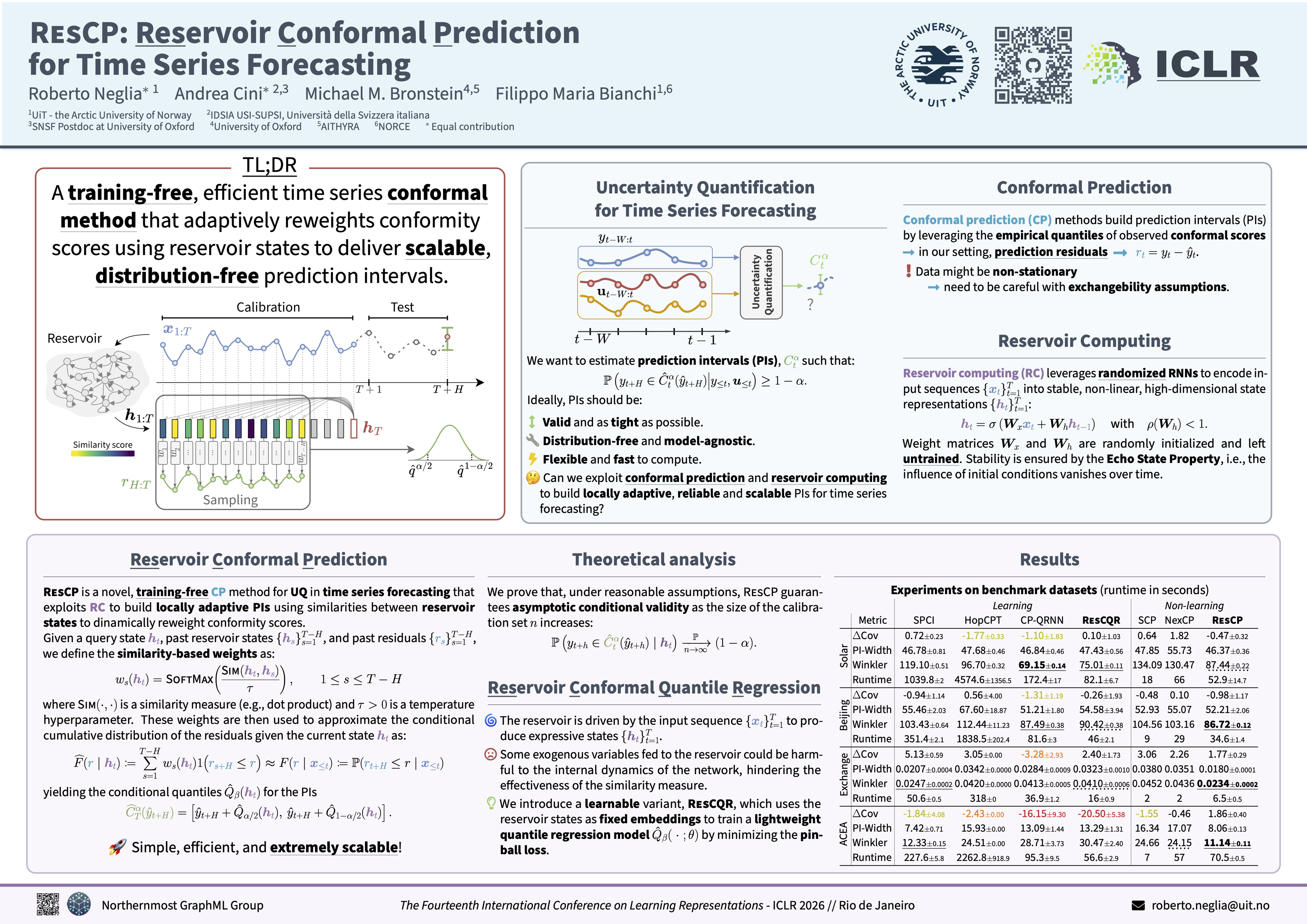
Conformal prediction offers a powerful framework for building distribution-free prediction intervals for exchangeable data. Existing methods that extend conformal prediction to sequential data rely on fitting a relatively complex model to capture temporal dependencies. However, these methods can fail if the sample size is small and often require expensive retraining when the underlying data distribution changes. To overcome these limitations, we propose Reservoir Conformal Prediction (ResCP), a novel training-free conformal prediction method for time series. Our approach leverages the efficiency and representation learning capabilities of reservoir computing to dynamically reweight conformity scores. In particular, we compute similarity scores among reservoir states and use them to adaptively reweight the observed residuals at each step. With this approach, ResCP enables us to account for local temporal dynamics when modeling the error distribution without compromising computational scalability. We prove that, under reasonable assumptions, ResCP achieves asymptotic conditional coverage, and we empirically demonstrate its effectiveness across diverse forecasting tasks.
From Samples to Scenarios: A New Paradigm for Probabilistic Forecasting
Xilin Dai ⋅ Zhijian Xu ⋅ Wanxu Caii ⋅ Qiang Xu
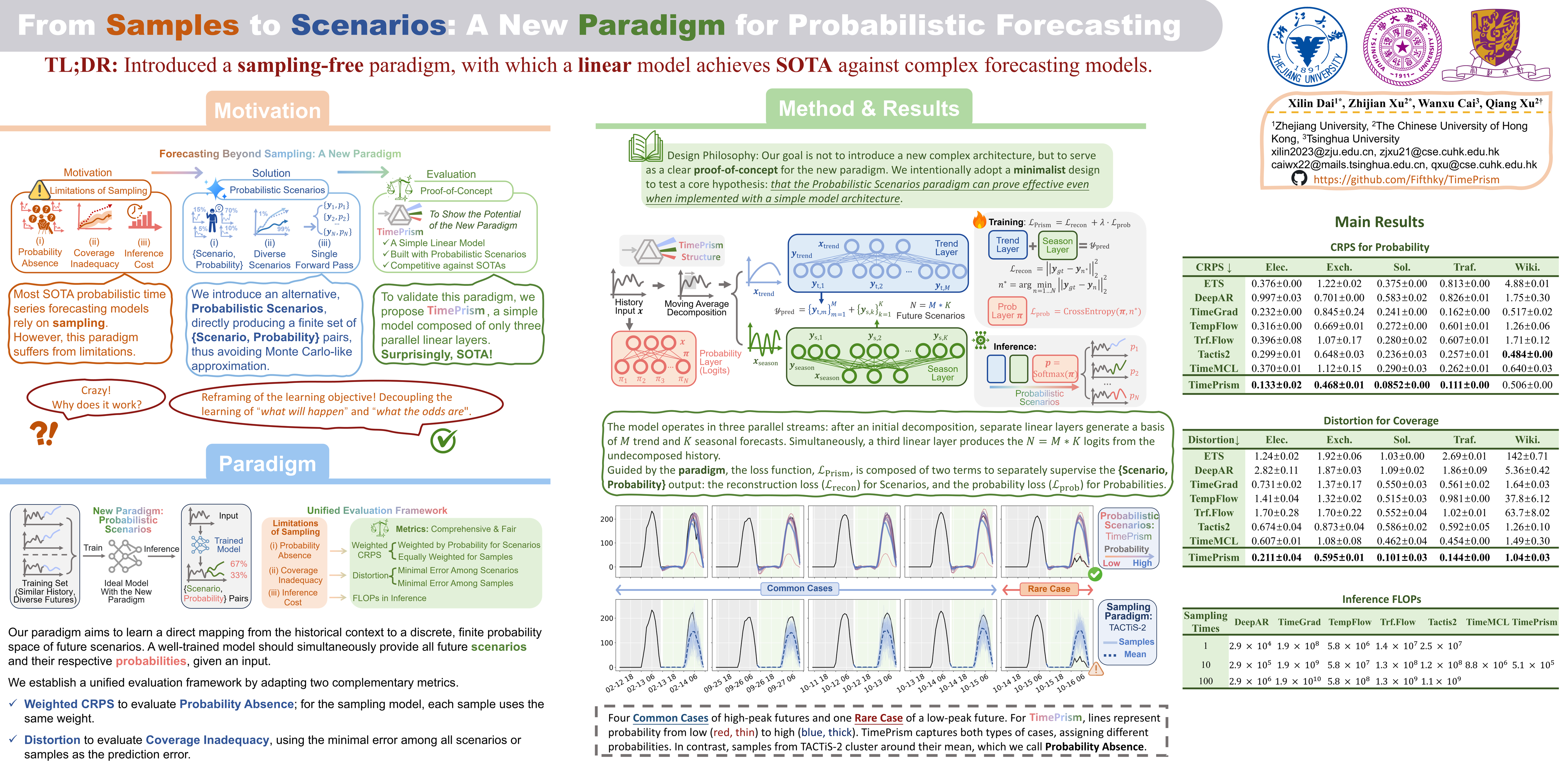
Most state-of-the-art probabilistic time series forecasting models rely on sampling to represent future uncertainty. However, this paradigm suffers from inherent limitations, such as lacking explicit probabilities, inadequate coverage, and high computational costs. In this work, we introduce Probabilistic Scenarios, an alternative paradigm designed to address the limitations of sampling. It operates by directly producing a finite set of {Scenario, Probability} pairs, thus avoiding Monte Carlo-like approximation. To validate this paradigm, we propose TimePrism, a simple model composed of only three parallel linear layers. Surprisingly, TimePrism achieves 9 out of 10 state-of-the-art results across five benchmark datasets on two metrics. The effectiveness of our paradigm comes from a fundamental reframing of the learning objective. Instead of modeling an entire continuous probability space, the model learns to represent a set of plausible scenarios and corresponding probabilities. Our work demonstrates the potential of the Probabilistic Scenarios paradigm, opening a promising research direction in forecasting beyond sampling.
TAMMs: Change Understanding and Forecasting in Satellite Image Time Series with Temporal-Aware Multimodal Models
Zhongbin Guo ⋅ Yuhao Wang ⋅ Ping Jian ⋅ Chengzhi Li ⋅ Xinyue Chen ⋅ Zhen Yang ⋅ Ertai E
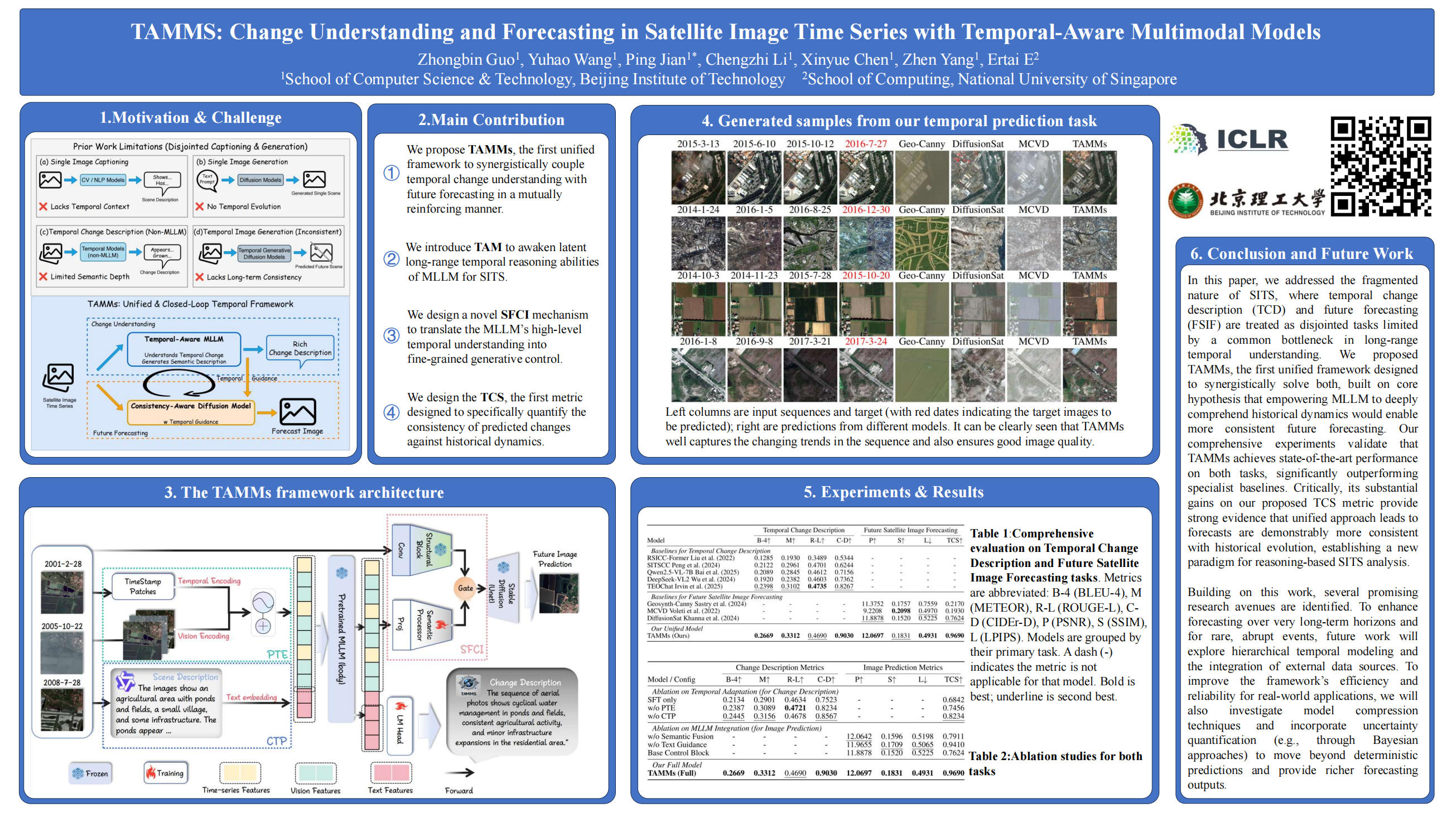
Temporal Change Description (TCD) and Future Satellite Image Forecasting (FSIF) are critical, yet historically disjointed tasks in Satellite Image Time Series (SITS) analysis. Both are fundamentally limited by the common challenge of modeling long-range temporal dynamics. To explore how to improve the performance of methods on both tasks simultaneously by enhancing long-range temporal understanding capabilities, we introduce TAMMs, the first unified framework designed to jointly perform TCD and FSIF within a single MLLM-diffusion architecture. TAMMs introduces two key innovations: Temporal Adaptation Modules (TAM) enhance frozen MLLM's ability to comprehend long-range dynamics, and Semantic-Fused Control Injection (SFCI) mechanism translates this change understanding into fine-grained generative control. This synergistic design makes the understanding from the TCD task to directly inform and improve the consistency of the FSIF task. Extensive experiments demonstrate TAMMs significantly outperforms state-of-the-art specialist baselines on both tasks. Our dataset can be found at https://huggingface.co/datasets/IceInPot/TAMMs .
PaAno: Patch-Based Representation Learning for Time-Series Anomaly Detection
Jinju Park ⋅ Seokho Kang
Although recent studies on time-series anomaly detection have increasingly adopted ever-larger neural network architectures such as transformers and foundation models, they incur high computational costs and memory usage, making them impractical for real-time and resource-constrained scenarios. Moreover, they often fail to demonstrate significant performance gains over simpler methods under rigorous evaluation protocols. In this study, we propose Patch-based representation learning for time-series Anomaly detection (PaAno), a lightweight yet effective method for fast and efficient time-series anomaly detection. PaAno extracts short temporal patches from time-series training data and uses a 1D convolutional neural network to embed each patch into a vector representation. The model is trained using a combination of triplet loss and pretext loss to ensure the embeddings capture informative temporal patterns from input patches. During inference, the anomaly score at each time step is computed by comparing the embeddings of its surrounding patches to those of normal patches extracted from the training time-series. Evaluated on the TSB-AD benchmark, PaAno achieved state-of-the-art performance, significantly outperforming existing methods, including those based on heavy architectures, on both univariate and multivariate time-series anomaly detection across various range-wise and point-wise performance measures.
Learning Recursive Multi-Scale Representations for Irregular Multivariate Time Series Forecasting
Boyuan Li ⋅ Zhen Liu ⋅ Yicheng Luo ⋅ Qianli Ma
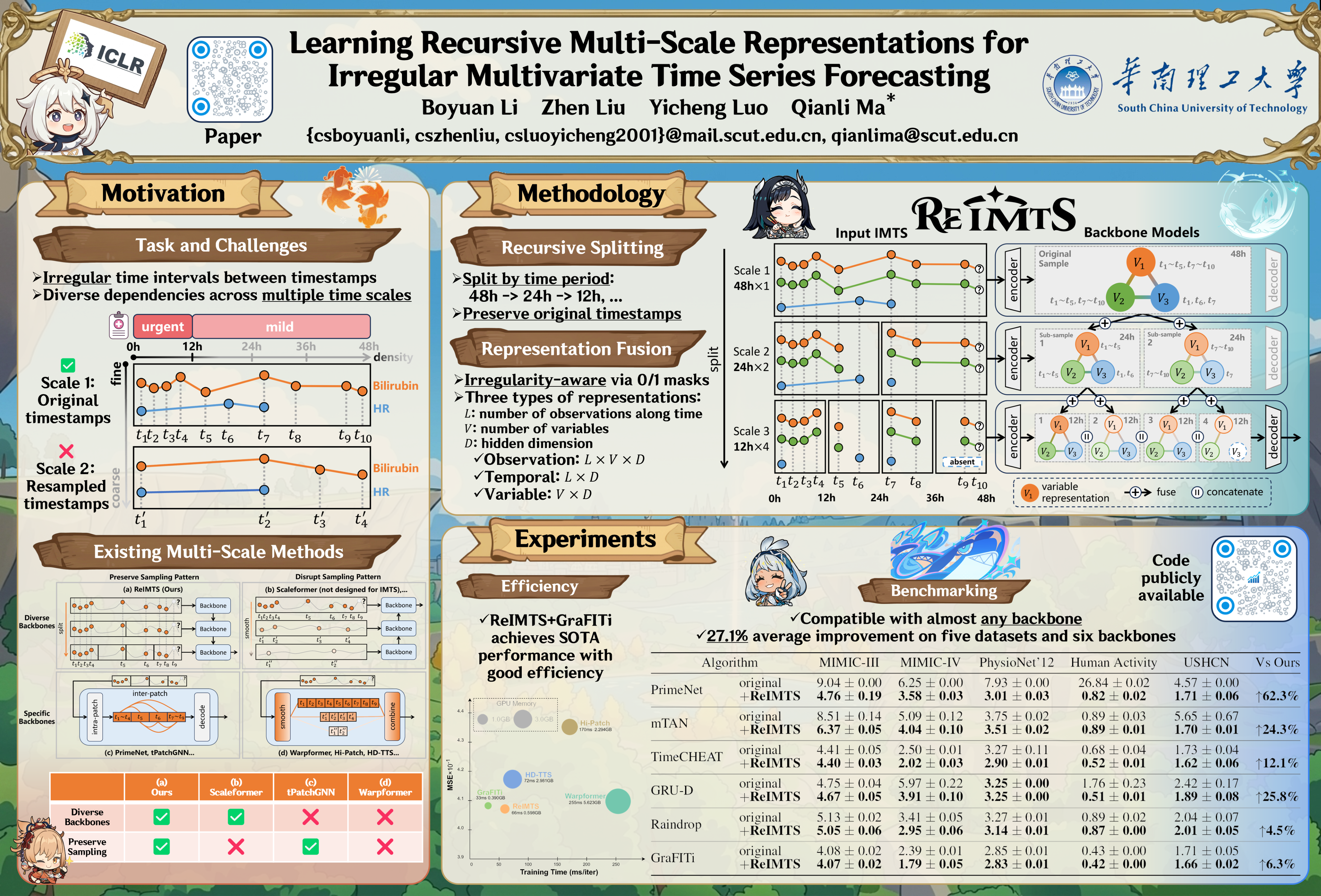
Irregular Multivariate Time Series (IMTS) are characterized by uneven intervals between consecutive timestamps, which carry sampling pattern information valuable and informative for learning temporal and variable dependencies. In addition, IMTS often exhibit diverse dependencies across multiple time scales. However, many existing multi-scale IMTS methods use resampling to obtain the coarse series, which can alter the original timestamps and disrupt the sampling pattern information. To address the challenge, we propose ReIMTS, a Recursive multi-scale modeling approach for Irregular Multivariate Time Series forecasting. Instead of resampling, ReIMTS keeps timestamps unchanged and recursively splits each sample into subsamples with progressively shorter time periods. Based on the original sampling timestamps in these long-to-short subsamples, an irregularity-aware representation fusion mechanism is proposed to capture global-to-local dependencies for accurate forecasting. Extensive experiments demonstrate an average performance improvement of 27.1\% in the forecasting task across different models and real-world datasets. Our code is available at https://github.com/Ladbaby/PyOmniTS.
ProtoTS: Learning Hierarchical Prototypes for Explainable Time Series Forecasting
Ziheng Peng ⋅ Shijie Ren ⋅ Xinyue Gu ⋅ Linxiao Yang ⋅ Xiting Wang ⋅ Liang Sun
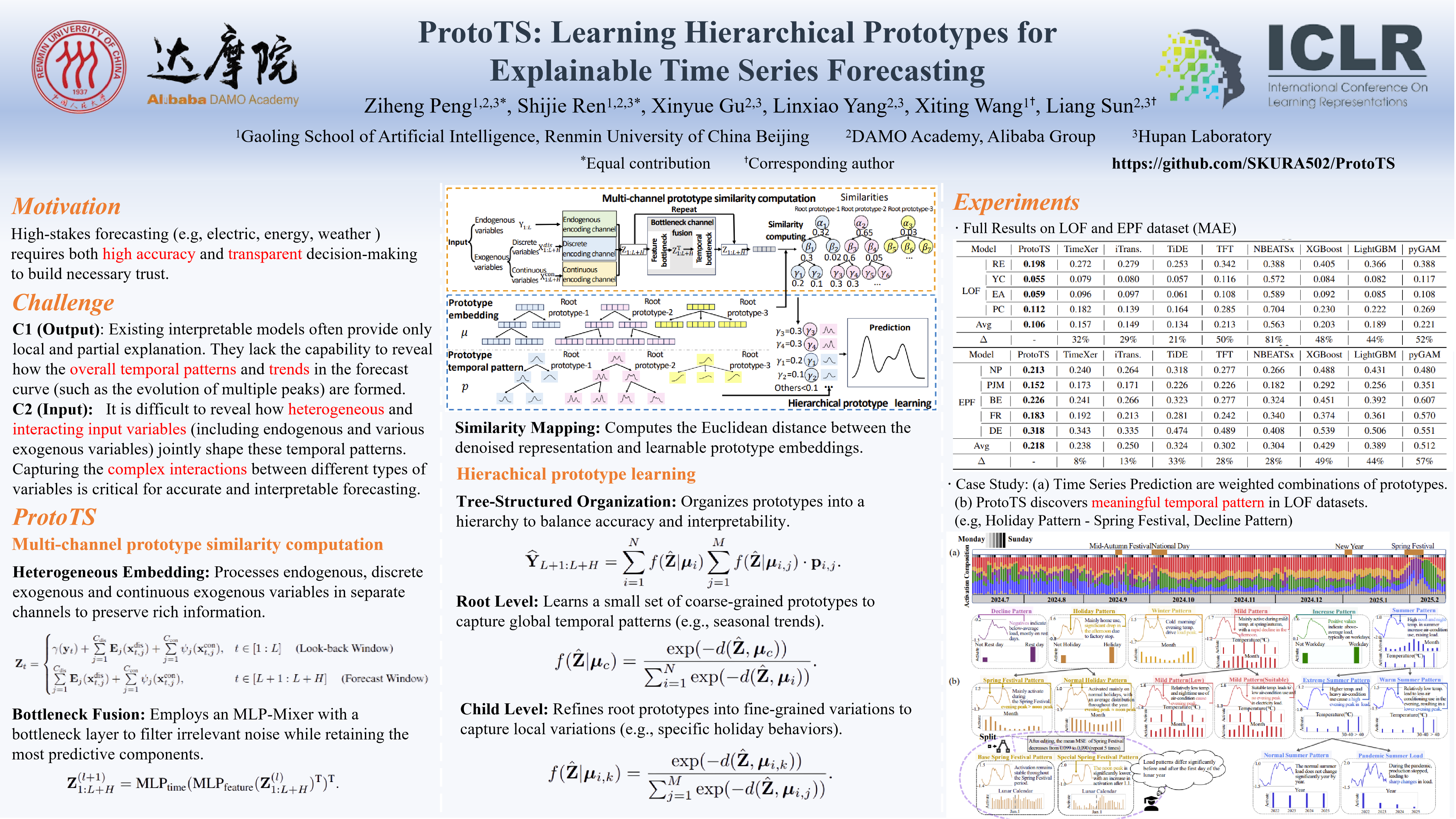
While deep learning has achieved impressive performance in time series forecasting, it becomes increasingly crucial to understand its decision-making process for building trust in high-stakes scenarios. Existing interpretable models often provide only local and partial explanations, lacking the capability to reveal how heterogeneous and interacting input variables jointly shape the overall temporal patterns in the forecast curve. We propose ProtoTS, a novel interpretable forecasting framework that achieves both high accuracy and transparent decision-making through modeling prototypical temporal patterns. ProtoTS computes instance-prototype similarity based on a denoised representation that preserves abundant heterogeneous information. The prototypes are organized hierarchically to capture global temporal patterns with coarse prototypes while capturing finer-grained local variations with detailed prototypes, enabling expert steering and multi-level interpretability. Experiments on multiple realistic benchmarks, including a newly released LOF dataset, show that ProtoTS not only exceeds existing methods in forecast accuracy but also delivers expert-steerable interpretations for better model understanding and decision support. The source code is available at https://github.com/SKURA502/ProtoTS.
UniCA: Unified Covariate Adaptation for Time Series Foundation Model
Lu Han ⋅ Yu Liu ⋅ Lan Li ⋅ Qiwen Deng ⋅ Jian Jiang ⋅ Yinbo sun ⋅ Zhe Yu ⋅ Binfeng Wang ⋅ Xingyu Lu ⋅ Lintao Ma ⋅ Han-Jia Ye ⋅ De-Chuan Zhan
Time Series Foundation Models (TSFMs) have achieved remarkable success through large-scale pretraining. However, their design primarily targets real-valued series, limiting their ability to handle general forecasting tasks involving diverse and often \emph{heterogeneous covariates}—such as categorical variables and multimodal data (e.g., images, text)—which are typically task-specific and difficult to leverage during pretraining. To address this gap, we propose Unified Covariate Adaptation (UniCA), a framework to bridge TSFMs with general covariate-aware forecasting. UniCA first performs covariate homogenization to transform heterogeneous covariates into high-level homogeneous series representations and then fuses them via a unified attention-based fusion mechanism. UniCA is compatible and universal for adaptation with both homogeneous and heterogeneous covariates, incorporating extra covariate information while preserving the generalization ability of TSFMs. Extensive experiments on multiple unimodal and multimodal covariate-aware forecasting benchmarks demonstrate the superiority of UniCA, highlighting the promise of covariate-aware TSFM adaptation in real-world forecasting scenarios. Code: https://github.com/hanlu-nju/UniCA.
GCGNet: Graph-Consistent Generative Network for Time Series Forecasting with Exogenous Variables
Zhengyu Li ⋅ Xiangfei Qiu ⋅ Yuhan Zhu ⋅ Xingjian Wu ⋅ Jilin Hu ⋅ Guo ⋅ Bin Yang
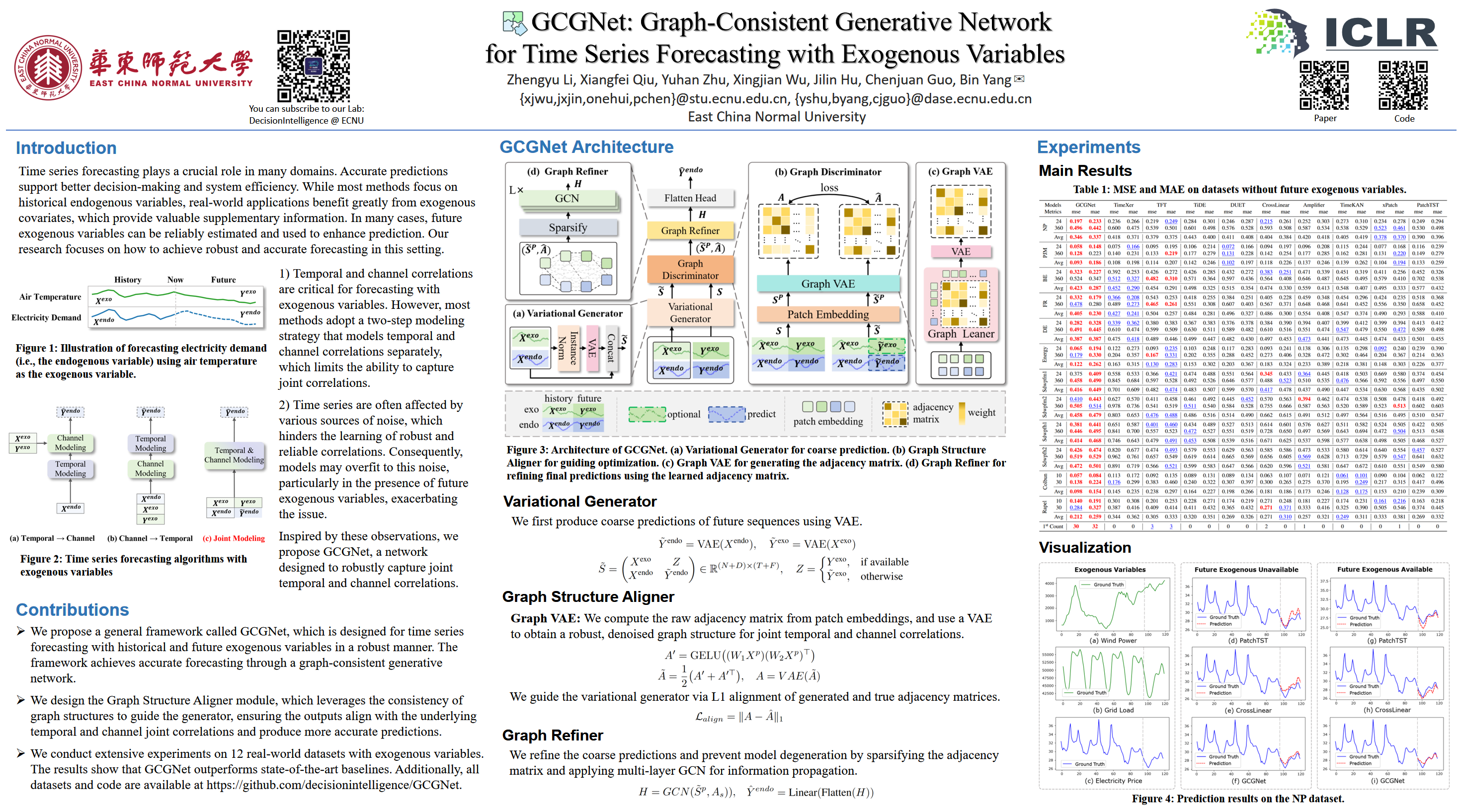
Exogenous variables offer valuable supplementary information for predicting future endogenous variables. Forecasting with exogenous variables needs to consider both past-to-future dependencies (i.e., temporal correlations) and the influence of exogenous variables on endogenous variables (i.e., channel correlations). This is pivotal when future exogenous variables are available, because they may directly affect the future endogenous variables. Many methods have been proposed for time series forecasting with exogenous variables, focusing on modeling temporal and channel correlations. However, most of them use a two-step strategy, modeling temporal and channel correlations separately, which limits their ability to capture joint correlations across time and channels. Furthermore, in real-world scenarios, recorded time series are frequently affected by various forms of noises, underscoring the critical importance of robustness in such correlations modeling. To address these limitations, we propose GCGNet, a Graph-Consistent Generative Network for time series forecasting with exogenous variables. Specifically, GCGNet first employs a Variational Generator to produce coarse predictions. A Graph Structure Aligner then further guides it by evaluating the consistency between the generated and true correlations, where the correlations are represented as graphs, and are robust to noises. Finally, a Graph Refiner is proposed to refine the predictions to prevent degeneration and improve accuracy. Extensive experiments on 12 real-world datasets demonstrate that GCGNet outperforms state-of-the-art baselines.
SE-Diff: Simulator and Experience Enhanced Diffusion Model for Comprehensive ECG Generation
Xiaoda Wang ⋅ Kaiqiao Han ⋅ Yuhao Xu ⋅ Xiao Luo ⋅ Yizhou Sun ⋅ Wei Wang ⋅ Carl Yang
Cardiovascular disease (CVD) is a leading cause of mortality worldwide. Electrocardiograms (ECGs) are the most widely used non-invasive tool for cardiac assessment, yet large, well-annotated ECG corpora are scarce due to cost, privacy, and workflow constraints. Generating ECGs can aid mechanistic understanding of cardiac electrical activity, enable the construction of large, heterogeneous, and unbiased datasets, and facilitate privacy-preserving data sharing. Generating realistic ECG signals from clinical context is important yet underexplored. Recent work has leveraged diffusion models for text-to-ECG generation, but two challenges remain: (i) existing methods often overlook physiological simulator knowledge of cardiac activity; and (ii) they ignore broader, experience-based clinical knowledge grounded in real-world practice. To address these gaps, we propose SE-Diff, a physiological simulator- and experience-enhanced diffusion model for comprehensive ECG generation. SE-Diff integrates a lightweight ordinary differential equation (ODE)–based ECG simulator into the diffusion process via a beat decoder and simulator-consistent constraints, injecting mechanistic priors that promote physiologically plausible waveforms. In parallel, we design an LLM-powered, experience retrieval–augmented strategy to inject clinical knowledge, providing stronger guidance for ECG generation. Extensive experiments on real-world ECG datasets demonstrate that SE-Diff improves both signal fidelity and text–ECG semantic alignment over baselines. We further show that simulator-based and experience-based knowledge benefit downstream ECG classification.
GARLIC: Graph Attention-based Relational Learning of Multivariate Time Series in Intensive Care
Ruirui Wang ⋅ Yanke Li ⋅ Manuel Günther ⋅ Diego Paez-Granados
Healthcare data, such as Intensive Care Unit (ICU) records, comprise heterogeneous multivariate time series sampled at irregular intervals with pervasive missingness. However, clinical applications demand predictive models that are both accurate and interpretable. We present our Graph Attention-based Relational Learning for Intensive Care (GARLIC) model, a novel neural network architecture that imputes missing data through a learnable exponential-decay encoder, captures inter-sensor dependencies via time-lagged summary graphs, and fuses global patterns with cross-dimensional sequential attention. All attention weights and graph edges are learned end-to-end to serve as built-in observation-, signal-, and edge-level explanations. To reconcile auxiliary reconstruction and primary classification objectives, we developed an alternating decoupled optimization scheme that stabilizes training. On three ICU benchmarks (PhysioNet 2012 & 2019, MIMIC-III), GARLIC sets the new state of the art in outcome prediction, significantly improving AUROC and AUPRC over best-performing baselines at comparable computational cost. Ablation studies confirm the contribution of each module, and feature-removal trials validate the fidelity of importance attribution through a monotonic performance drop (full > top 50\% > random 50\% > bottom 50\%). Real-time case studies demonstrate actionable risk warnings with transparent explanations, marking a significant advance toward accurate, explainable deep learning for irregularly sampled ICU time series data. Moreover, we demonstrated GARLIC's superiority in data imputation and classification on various time-series datasets beyond the ICU domain, showing its generalizability and applicability to broader tasks.
Contextual and Seasonal LSTMs for Time Series Anomaly Detection
Lingpei Zhang ⋅ Qingming Li ⋅ Yong Yang ⋅ Jiahao Chen ⋅ Rui Zeng ⋅ Chenyang Lyu ⋅ Shouling Ji
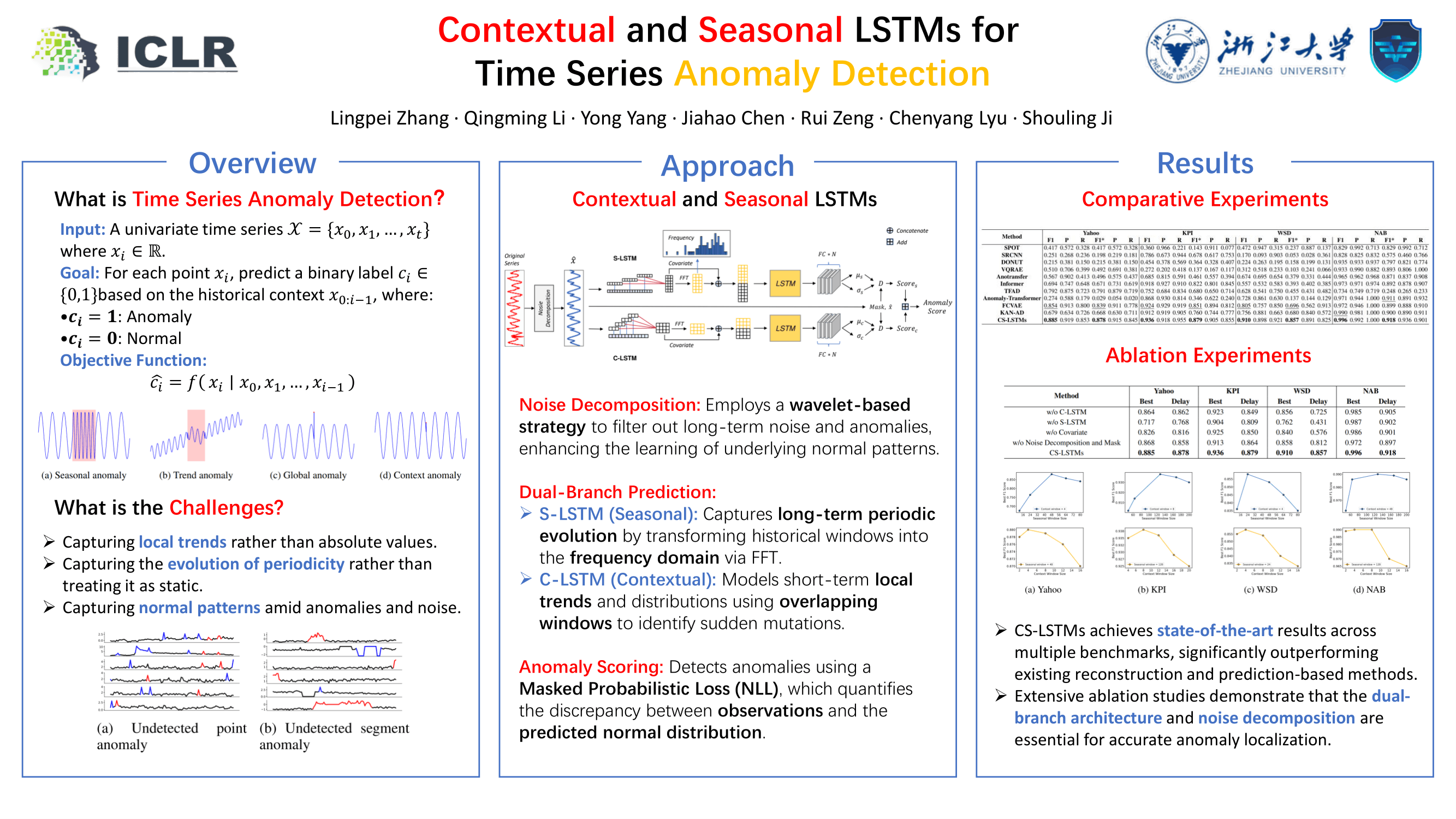
Univariate time series (UTS), where each timestamp records a single variable, serve as crucial indicators in web systems and cloud servers. Anomaly detection in UTS plays an essential role in both data mining and system reliability management. However, existing reconstruction-based and prediction-based methods struggle to capture certain subtle anomalies, particularly small point anomalies and slowly rising anomalies. To address these challenges, we propose a novel prediction-based framework named Contextual and Seasonal LSTMs (CS-LSTMs). CS-LSTMs are built upon a noise decomposition strategy and jointly leverage contextual dependencies and seasonal patterns, thereby strengthening the detection of subtle anomalies. By integrating both time-domain and frequency-domain representations, CS-LSTMs achieve more accurate modeling of periodic trends and anomaly localization. Extensive evaluations on public benchmark datasets demonstrate that CS-LSTMs consistently outperform state-of-the-art methods, highlighting their effectiveness and practical value in robust time series anomaly detection.
Unlocking the Value of Text: Event-Driven Reasoning and Multi-Level Alignment for Time Series Forecasting
Siyuan Wang ⋅ Peng Chen ⋅ Yihang Wang ⋅ Wanghui Qiu ⋅ Guo ⋅ Bin Yang ⋅ Yang Shu
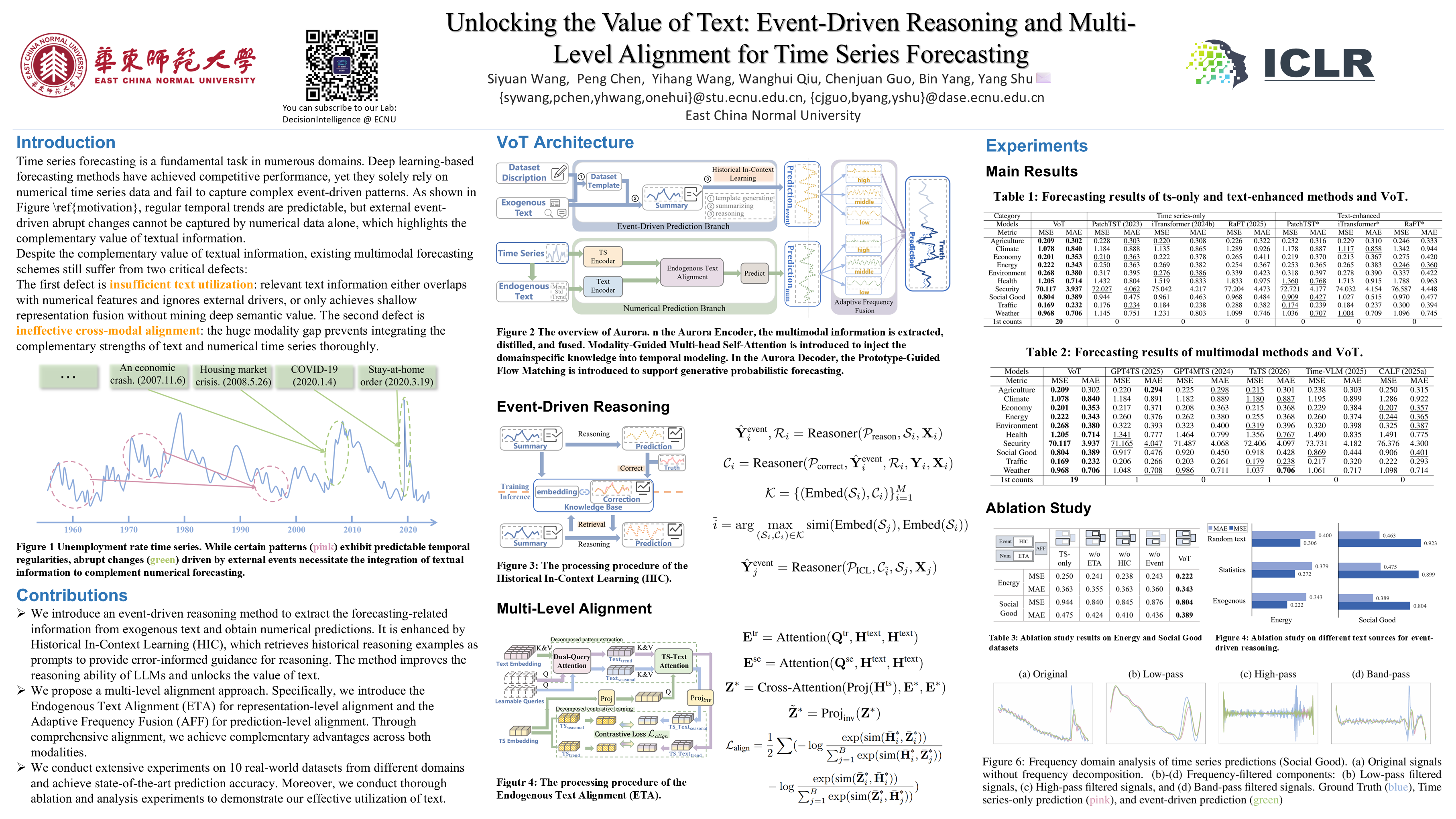
Existing time series forecasting methods primarily rely on the numerical data itself. However, real-world time series exhibit complex patterns associated with multimodal information, making them difficult to predict with numerical data alone. While several multimodal time series forecasting methods have emerged, they either utilize text with limited supplementary information or focus merely on representation extraction, extracting minimal textual information for forecasting. To unlock the Value of Text, we propose VoT, a method with Event-driven Reasoning and Multi-level Alignment. Event-driven Reasoning combines the rich information in exogenous text with the powerful reasoning capabilities of LLMs for time series forecasting. To guide the LLMs in effective reasoning, we propose the Historical In-context Learning that retrieves and applies historical examples as in-context guidance. To maximize the utilization of text, we propose Multi-level Alignment. At the representation level, we utilize the Endogenous Text Alignment to integrate the endogenous text information with the time series. At the prediction level, we design the Adaptive Frequency Fusion to fuse the frequency components of event-driven prediction and numerical prediction to achieve complementary advantages. Experiments on real-world datasets across 10 domains demonstrate significant improvements over existing methods, validating the effectiveness of our approach in the utilization of text. The code is made available at https://github.com/decisionintelligence/VoT.
G-reasoner: Foundation Models for Unified Reasoning over Graph-structured Knowledge
Linhao Luo ⋅ Zicheng Zhao ⋅ Junnan Liu ⋅ Zhangchi Qiu ⋅ Junnan Dong ⋅ Serge Panev ⋅ Chen Gong ⋅ Thuy-Trang Vu ⋅ Gholamreza Haffari ⋅ Dinh Phung ⋅ Alan Liew ⋅ Shirui Pan
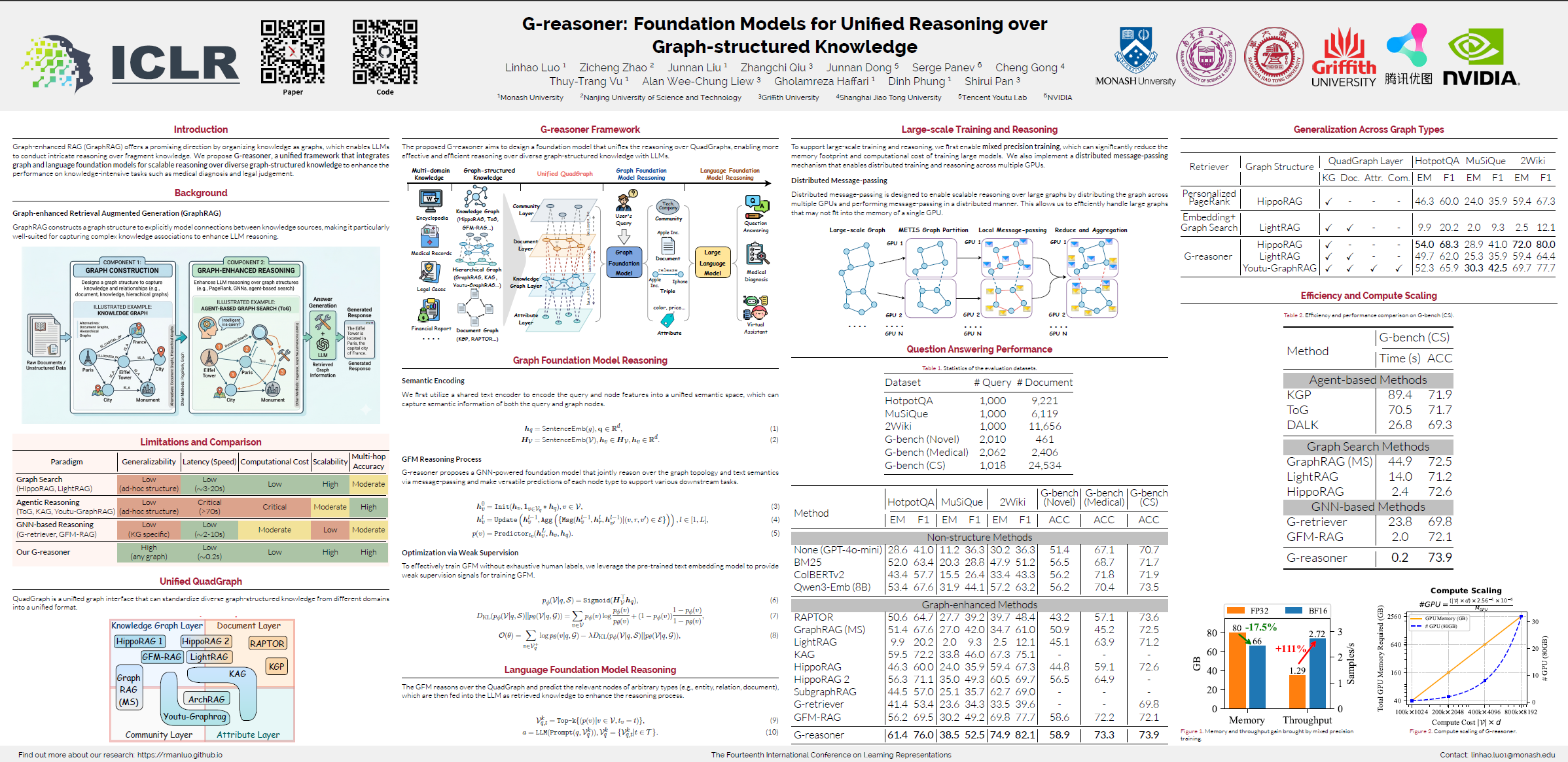
Large language models (LLMs) excel at complex reasoning but remain limited by static and incomplete parametric knowledge. Retrieval-augmented generation (RAG) mitigates this by incorporating external knowledge, yet existing RAGs struggle with knowledge-intensive tasks due to fragmented information and weak modeling of knowledge structure. Graphs offer a natural way to model relationships within knowledge, but LLMs are inherently unstructured and cannot effectively reason over graph-structured data. Recent graph-enhanced RAG (GraphRAG) attempts to bridge this gap by constructing tailored graphs and enabling LLMs to reason on them. However, these methods often depend on ad-hoc graph designs, heuristic search, or costly agent pipelines, which hinder scalability and generalization. To address these challenges, we present G-reasoner, a unified framework that integrates graph and language foundation models for scalable reasoning over diverse graph-structured knowledge. Central to our approach is QuadGraph, a standardized four-layer abstraction that unifies heterogeneous knowledge sources into a common graph representation. Building on this, we introduce a 34M-parameter graph foundation model (GFM) that jointly captures graph topology and textual semantics, and is integrated with LLMs to enhance reasoning in downstream applications. To ensure scalability and efficiency, mixed-precision training and distributed message-passing are implemented to scale GFM with more GPUs. Extensive experiments on six benchmarks show that G-reasoner consistently outperforms state-of-the-art baselines, significantly enhances LLM reasoning, and achieves strong efficiency and cross-graph generalization.
Leveraging Pretrained Knowledge at Inference Time: LoRA-Gated Contrastive Decoding for Multilingual Factual Language Generation in Adapted LLMs
Gwangseon Jang ⋅ Hongseok Choi ⋅ Chanuk lim ⋅ Kyong-Ha Lee ⋅ Mun Yi
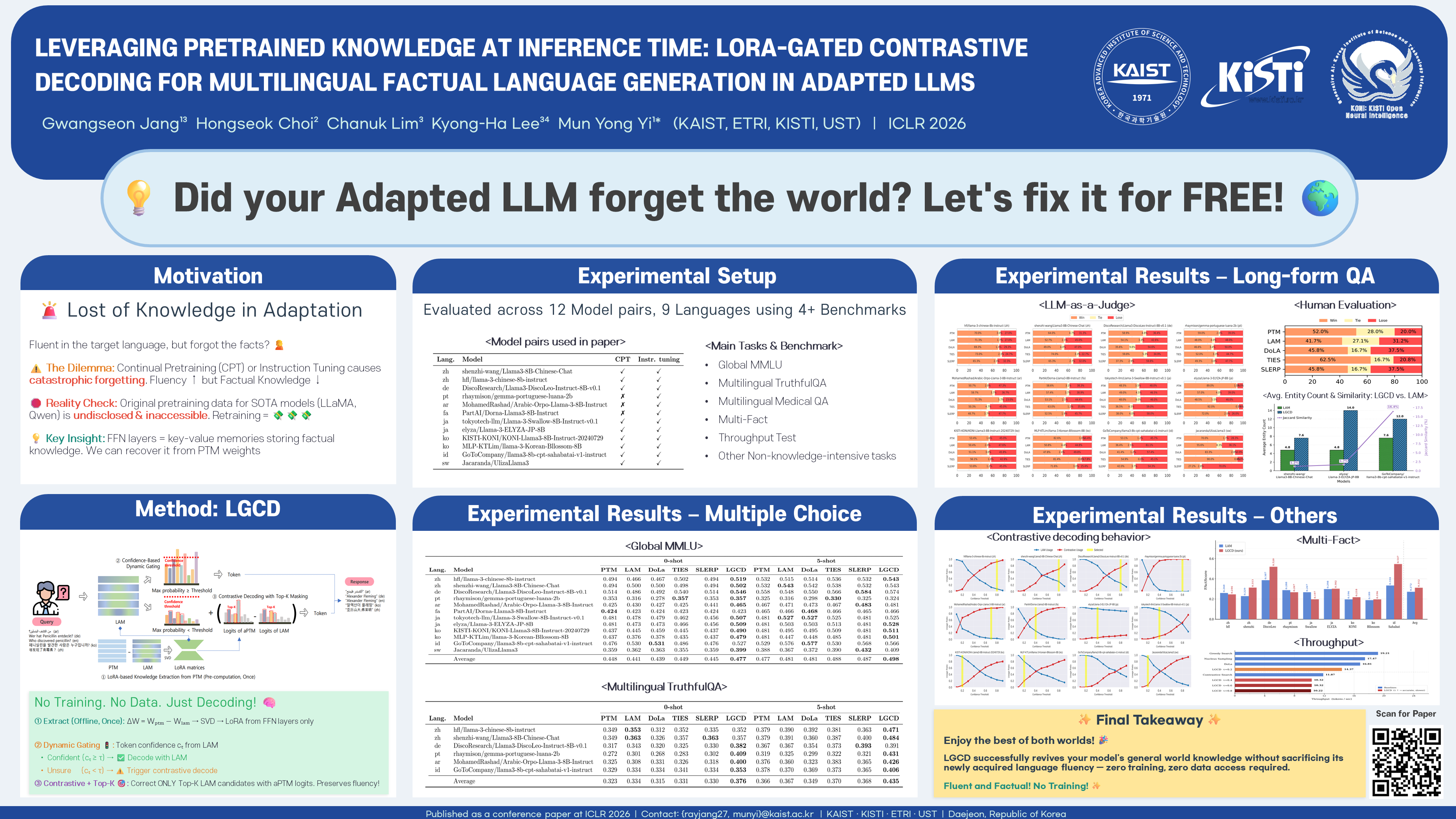
Large language models (LLMs) adapted to specific languages through continual pretraining or instruction tuning often suffer from catastrophic forgetting, which can lead to factual inaccuracies. This issue is particularly pronounced in multilingual settings, where adaptation may override general world knowledge with language-specific patterns. We propose LoRA-Gated Contrastive Decoding (LGCD), a training-free inference-time decoding framework that improves factuality in language-adapted LLMs by leveraging knowledge from the original pretrained model. LGCD operates by (1) extracting factual representations from Feed-Forward Network (FFN) layers via LoRA-based decomposition, approximating pretrained knowledge, (2) dynamically gating decoding based on token-level confidence, and (3) applying contrastive decoding with Top-K masking to revise uncertain predictions by referencing the approximated representation of pretrained knowledge. LGCD requires no additional training or access to the original pretraining data. Extensive experiments with LGCD on multilingual multiple-choice and long-form QA tasks across nine languages demonstrate its strong effectiveness in mitigating hallucinations and enhancing factual accuracy in language-adapted models. These results further indicate that pretrained knowledge can be strategically reintroduced during decoding to promote factual multilingual generation.
ACADREASON: Exploring the Limits of Reasoning Models with Academic Research Problems
Xin Gui ⋅ Zhu ⋅ JinCheng Ren ⋅ Qianben Chen ⋅ Zekun Wang ⋅ Yizhi Li ⋅ Xinpeng Liu ⋅ Wallis_Wenli Ren ⋅ Linyu Miao ⋅ Tianrui Qin ⋅ Ziqi Shu ⋅ He Zhu ⋅ Dingfeng Shi ⋅ JIAHENG LIU ⋅ Yuchen Jiang ⋅ Minghao Liu ⋅ Ge Zhang ⋅ Wangchunshu Zhou
In recent years, the research focus of large language models (LLMs) and agents has shifted increasingly from demonstrating novel capabilities to complex reasoning and tackling challenging tasks. However, existing evaluations focus mainly on math/code contests or general tasks, while existing multi-domain academic benchmarks lack sufficient reasoning depth, leaving the field without a rigorous benchmark for high-level reasoning. To fill this gap, we introduce the ACADREASON benchmark, designed to evaluate the ability of LLMs and agents to acquire and reason over academic knowledge. It consists of 50 expert-annotated academic problems across five high-reasoning domains, including computer science, economics, law, mathematics, and philosophy. All questions are sourced from top-tier publications in recent years and undergo rigorous annotation and quality control to ensure they are both challenging and answerable. We conduct systematic evaluations over 10 mainstream LLMs and agents. The results show that most LLMs scored below 20 points, with even the cutting-edge GPT-5 achieving only 16 points. While agents achieved higher scores, none exceeded 40 points. This demonstrates the current capability gap between LLMs and agents in super-intelligent academic research tasks and highlights the challenges of ACADREASON. The code and data for the ACADREASON benchmark are available at https://github.com/OPPO-PersonalAI/Acadreason-benchmark.
Neuron-Aware Data Selection in Instruction Tuning for Large Language Models
Xin Chen ⋅ Junchao Wu ⋅ Shu Yang ⋅ Runzhe Zhan ⋅ Zeyu Wu ⋅ Min Yang ⋅ Shujian Huang ⋅ Lidia Chao ⋅ Derek Wong
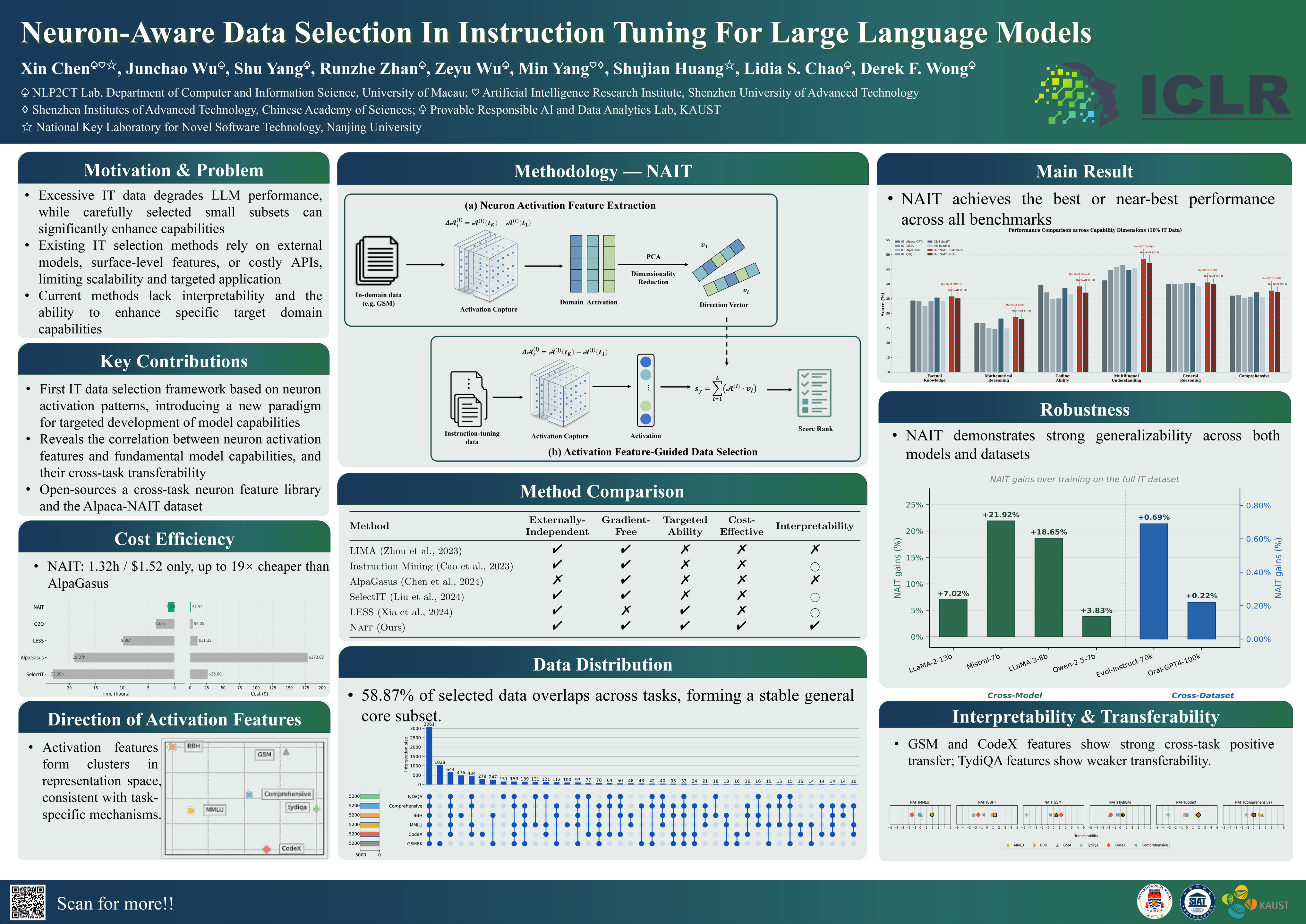
Instruction Tuning (IT) has been proven to be an effective approach to unlock the powerful capabilities of large language models (LLMs). Recent studies indicate that excessive IT data can degrade LLMs performance, while carefully selecting a small subset of high-quality IT data can significantly enhance their capabilities. Therefore, identifying the most efficient subset data from the IT dataset to effectively develop either specific or general abilities in LLMs has become a critical challenge. To address this, we propose a novel and efficient framework called Nait. Nait evaluates the impact of IT data on LLMs performance by analyzing the similarity of neuron activation patterns between the IT dataset and the target domain capability. Specifically, Nait captures neuron activation patterns from in-domain datasets of target domain capabilities to construct reusable and transferable neuron activation features. It then evaluates and selects optimal samples based on the similarity between candidate samples and the expected activation features of the target capabilities. Experimental results show that training on the 10\% Alpaca-GPT4 IT data subset selected by Nait consistently outperforms methods that rely on external advanced models or uncertainty-based features across various tasks. Our findings also reveal the transferability of neuron activation features across different capabilities of LLMs. In particular, IT data with more logical reasoning and programmatic features possesses strong general transferability, enabling models to develop stronger capabilities across multiple tasks, while a stable core subset of data is sufficient to consistently activate fundamental model capabilities and universally improve performance across diverse tasks.
Pay Attention to CTC: Fast and Robust Pseudo-Labelling for Unified Speech Recognition
Alexandros Haliassos ⋅ Rodrigo Mira ⋅ Stavros Petridis
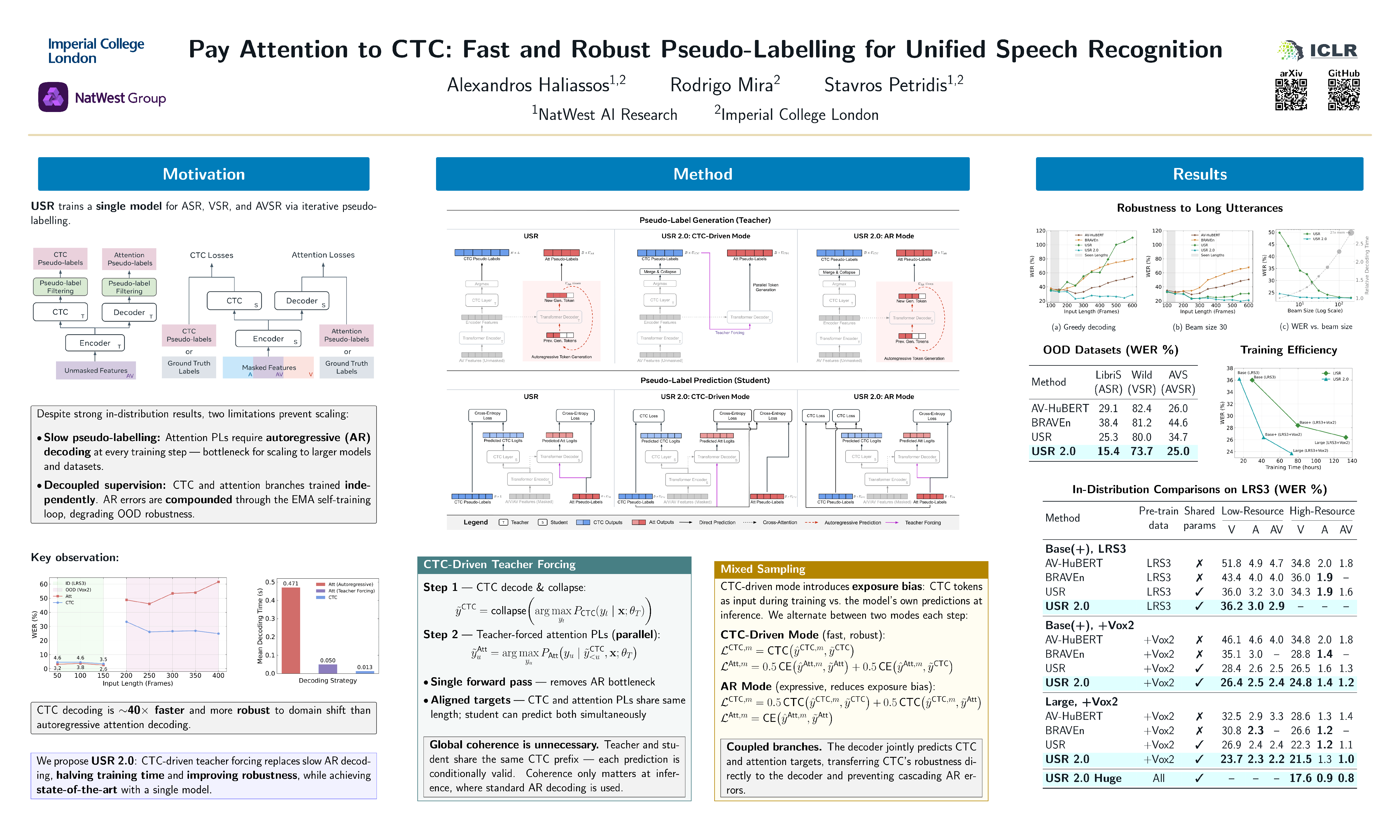
Unified Speech Recognition (USR) has emerged as a semi-supervised framework for training a single model for audio, visual, and audiovisual speech recognition, achieving state-of-the-art results on in-distribution benchmarks. However, its reliance on autoregressive pseudo-labelling makes training expensive, while its decoupled supervision of CTC and attention branches increases susceptibility to self-reinforcing errors, particularly under distribution shifts involving longer sequences, noise, or unseen domains. We propose CTC-driven teacher forcing, where greedily decoded CTC pseudo-labels are fed into the decoder to generate attention targets in a single forward pass. Although these can be globally incoherent, in the pseudo-labelling setting they enable efficient and effective knowledge transfer. Because CTC and CTC-driven attention pseudo-labels have the same length, the decoder can predict both simultaneously, benefiting from the robustness of CTC and the expressiveness of attention without costly beam search. We further propose mixed sampling to mitigate the exposure bias of the decoder relying solely on CTC inputs. The resulting method, USR 2.0, halves training time, improves robustness to out-of-distribution inputs, and achieves state-of-the-art results on LRS3, LRS2, and WildVSR, surpassing USR and modality-specific self-supervised baselines.
PoLi-RL: A Point-to-List Reinforcement Learning Framework for Conditional Semantic Textual Similarity
Zixin Song ⋅ Bowen Zhang ⋅ QIANWEN ZHANG ⋅ di yin ⋅ Xing Sun ⋅ Chunping Li
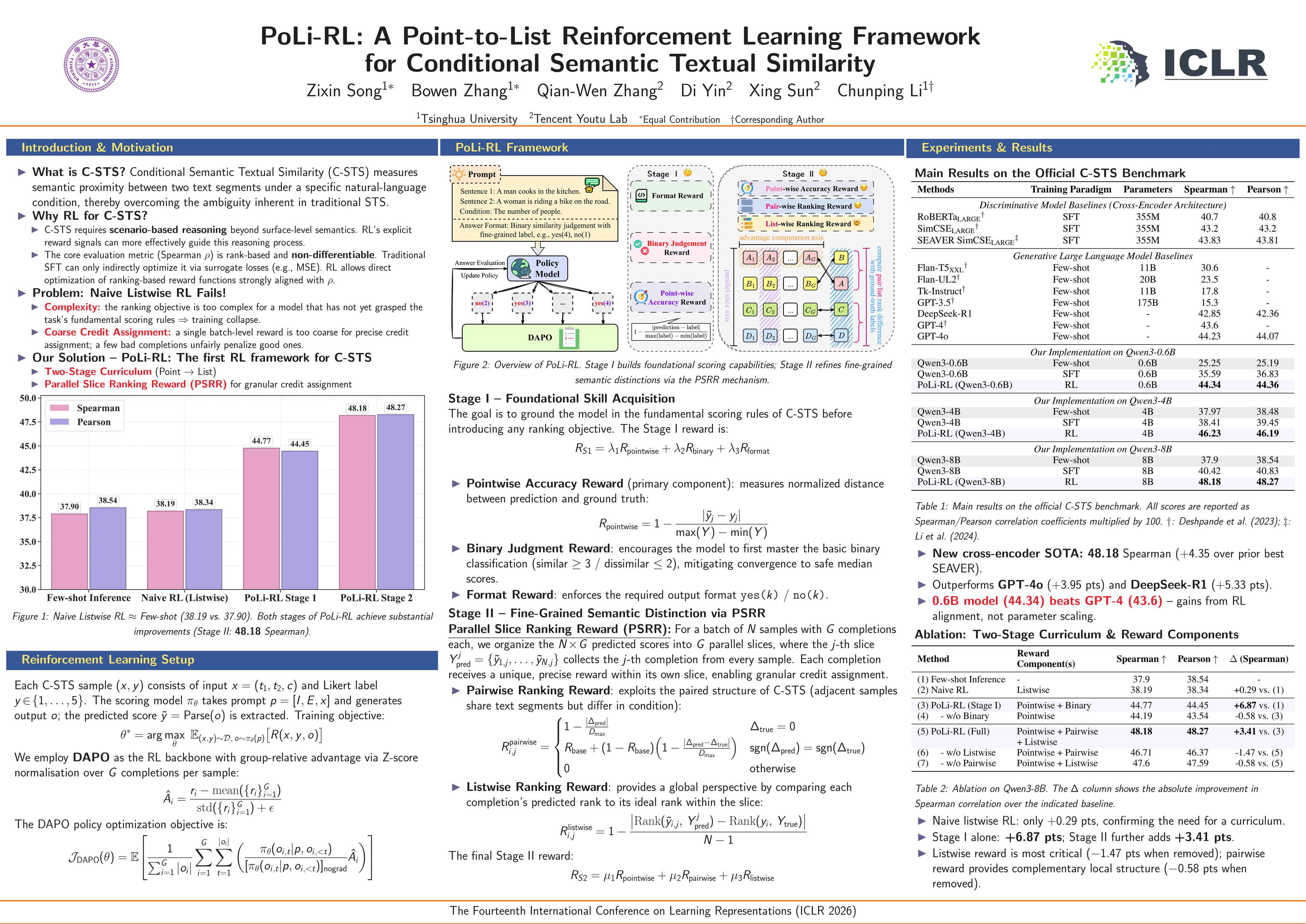
Conditional Semantic Textual Similarity (C-STS) measures the semantic proximity between text segments under a specific condition, thereby overcoming the ambiguity inherent in traditional STS. However, existing methods are largely confined to discriminative models, failing to fully leverage recent breakthroughs in the NLP community involving Large Language Models (LLMs) and Reinforcement Learning (RL). RL is a particularly well-suited paradigm for this task, as it can directly optimize the non-differentiable Spearman ranking metric and guide the reasoning process required by C-STS. Nevertheless, we find that naively applying listwise RL fails to produce meaningful improvements, as the model struggles with complex, coarse-grained reward signals, leading to optimization difficulties. To address this challenge, we introduce PoLi-RL, a novel Point-to-List Reinforcement Learning framework. PoLi-RL employs a two-stage curriculum: it first trains the model with a simple pointwise reward to establish fundamental scoring capabilities, then transitions to a hybrid reward that combines pointwise, pairwise, and listwise objectives to refine the model's ability to discern subtle semantic distinctions. Crucially, we propose an innovative Parallel Slice Ranking Reward (PSRR) mechanism that computes ranking rewards in parallel slices, where each slice consists of completions with the same index from different samples. This provides a precise, differentiated learning signal for each individual completion, enabling granular credit assignment and effective optimization. On the official C-STS benchmark, PoLi-RL achieves a Spearman correlation coefficient of 48.18, establishing a new SOTA for the cross-encoder architecture. Furthermore, PoLi-RL also maintains SOTA status on the re-annotated C-STS dataset, confirming its robust generalization capabilities. As the first work to successfully apply RL to C-STS, our study introduces a powerful paradigm for aligning LLMs for complex, ranking-based conditional judgment tasks. Our code and checkpoints are available at https://github.com/ZBWpro/PoLi-RL.
IDEAL: Data Equilibrium Adaptation for Multi-Capability Language Model Alignment
Chenlin Ming ⋅ Chendi Qu ⋅ Qizhi Pei ⋅ Zhuoshi Pan ⋅ Yu Li ⋅ Xiaoming Duan ⋅ Lijun Wu ⋅ Conghui He
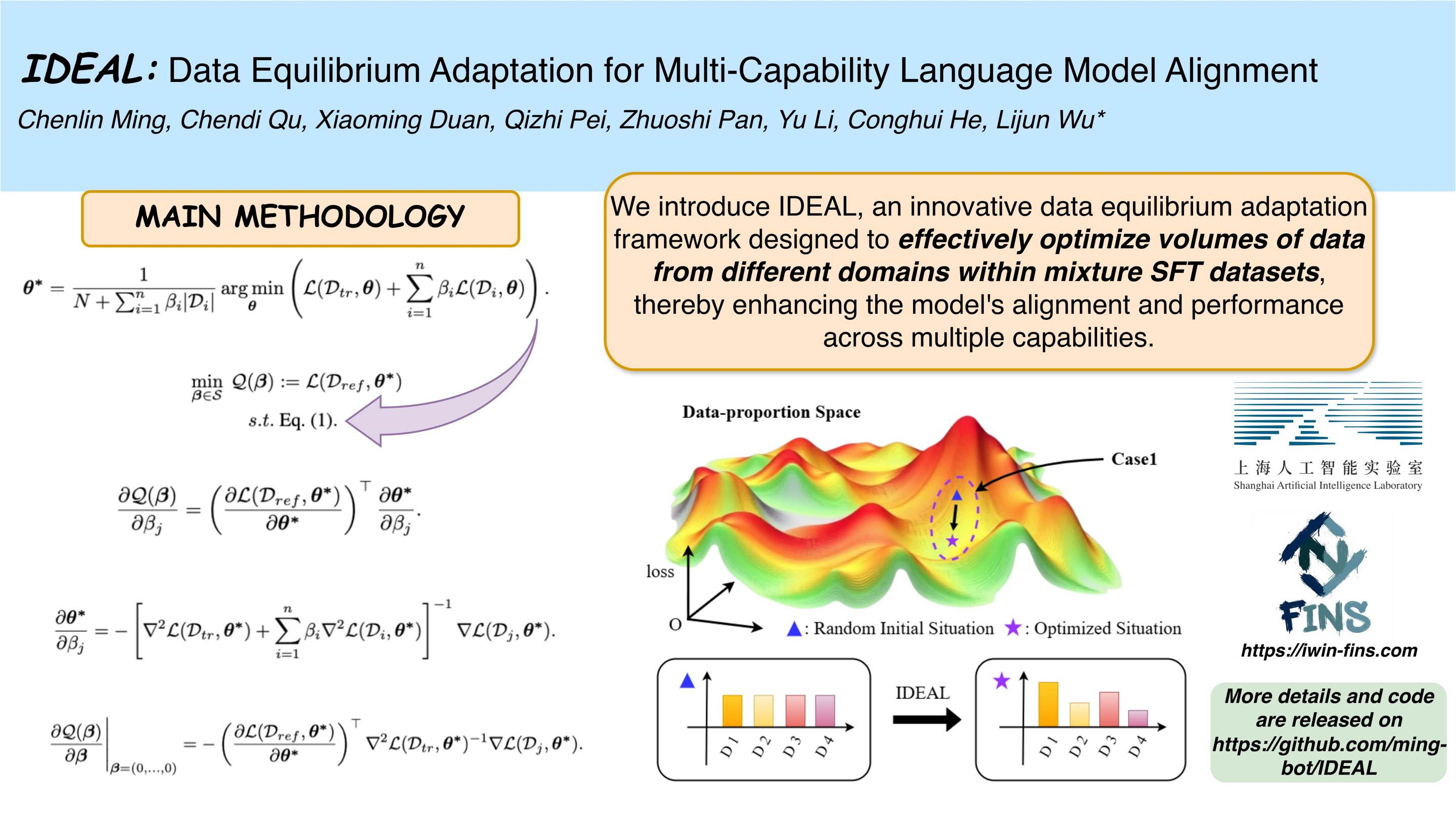
Large Language Models (LLMs) have achieved impressive performance through Supervised Fine-tuning (SFT) on diverse instructional datasets. When training on multiple capabilities simultaneously, the mixture training dataset, governed by volumes of data from different domains, is a critical factor that directly impacts the final model's performance. Unlike many studies that focus on enhancing the quality of training datasets through data selection methods, few works explore the intricate relationship between the compositional quantity of mixture training datasets and the emergent capabilities of LLMs. Given the availability of a high-quality multi-domain training dataset, understanding the impact of data from each domain on the model's overall capabilities is crucial for preparing SFT data and training a well-balanced model that performs effectively across diverse domains. In this work, we introduce IDEAL, an innovative data equilibrium adaptation framework designed to effectively optimize volumes of data from different domains within mixture SFT datasets, thereby enhancing the model's alignment and performance across multiple capabilities. IDEAL employs a gradient-based approach to iteratively refine the training data distribution, dynamically adjusting the volumes of domain-specific data based on their impact on downstream task performance. By leveraging this adaptive mechanism, IDEAL ensures a balanced dataset composition, enabling the model to achieve robust generalization and consistent proficiency across diverse tasks. Experiments across different capabilities demonstrate that IDEAL outperforms conventional uniform data allocation strategies, achieving a comprehensive improvement of approximately 7\% in multi-task evaluation scores.
RefTool: Reference-Guided Tool Creation for Knowledge-Intensive Reasoning
Xiao Liu ⋅ Da Yin ⋅ Zirui Wu ⋅ Yansong Feng
Large Language Models (LLMs) can enhance their reasoning capabilities by using external tools. However, many tasks lack predefined tools. Prior works have explored instructing LLMs to generate tools on their own, but such approaches depend heavily on internal knowledge and struggle when tasks fall outside the model’s knowledge scope. To address this limitation, we propose RefTool, a reference-guided framework for automatic tool creation that leverages external materials, such as textbooks and knowledge snippets. RefTool consists of two modules: (1) tool creation, where LLMs generate executable tools from reference content, validate them using illustrative examples, and organize them hierarchically into a toolbox; and (2) tool utilization, where LLMs navigate the toolbox structure to select and apply the appropriate tools to solve problems. Experiments on causality, physics, and chemistry benchmarks demonstrate that RefTool outperforms existing tool-creation and domain-specific reasoning methods by 12.3% on average accuracy, while being cost-efficient and broadly generalizable to non-scientific tasks, e.g., extremely low-resource language translation. Analyses reveal that grounding tool creation in references produces accurate and faithful tools, and that the hierarchical structure facilitates effective tool selection. RefTool enables LLMs to overcome internal knowledge limitations, advancing generalizable reasoning in knowledge-intensive domains.
Inheriting Generalizable Knowledge from LLMs to Diverse Vertical Tasks
Chang Liu ⋅ boyu shi ⋅ xu yang ⋅ Qiufeng Wang ⋅ Xin Geng
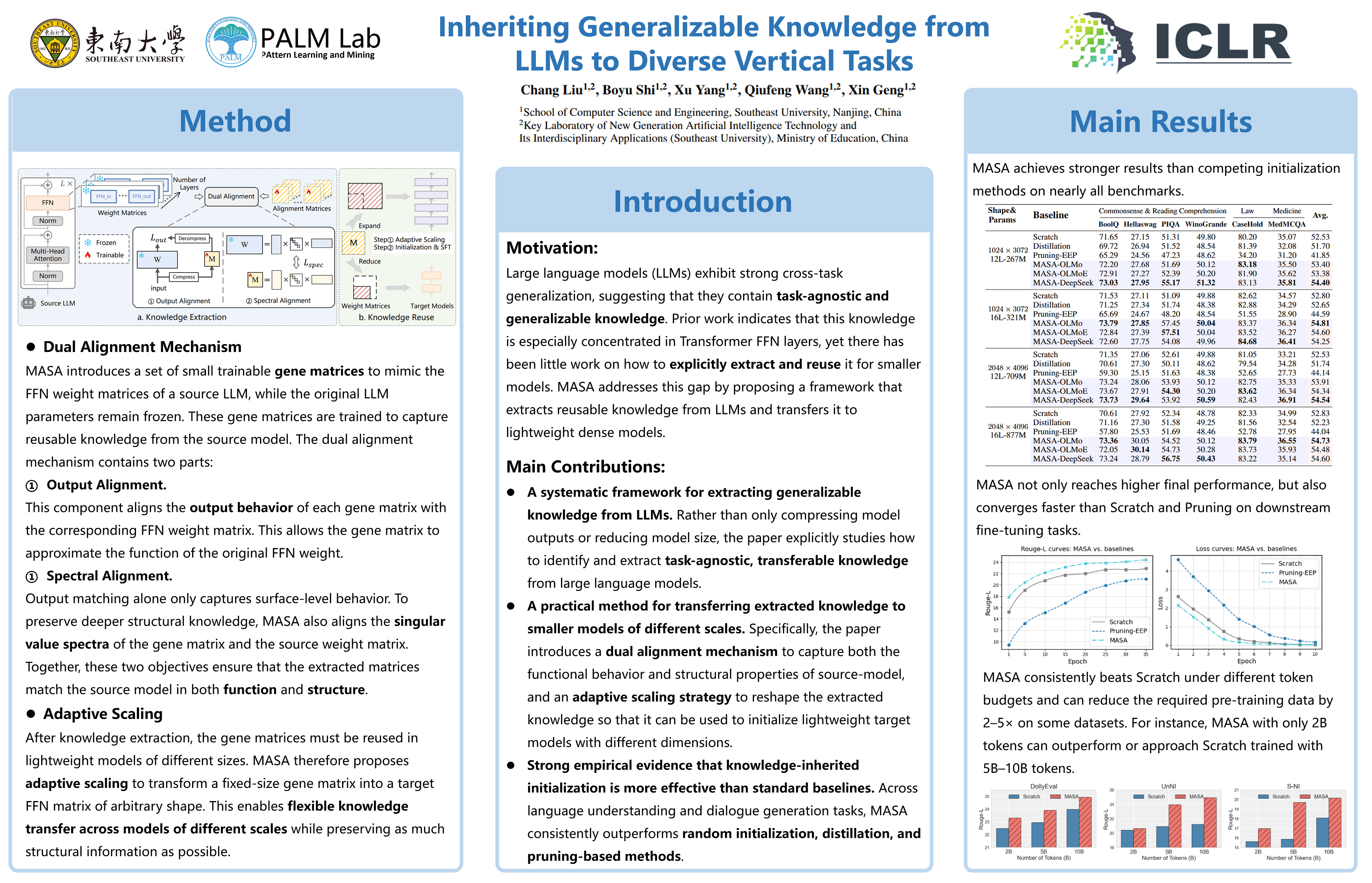
Large language models (LLMs) have demonstrated remarkable generalization across diverse tasks, suggesting the existence of task-agnostic, generalizable knowledge encoded within them. However, how to systematically extract and evaluate this knowledge remains unexplored. In this work, we innovatively propose MASA (Matrix-level Alignment and Scalable Adaptation), a unified framework for extracting and transferring generalizable knowledge from LLMs. MASA first introduces a lightweight set of gene matrices trained with a dual alignment strategy, combining output alignment and spectral alignment, to capture the generalizable knowledge encoded in the feed-forward networks (FFNs) of LLM. It then employs scalable adaptation to flexibly reshape these gene matrices to match the parameter dimensions of lightweight dense models of various sizes, enabling direct initialization of their FFN layers. To evaluate the inherited knowledge, we measure the downstream performance of lightweight models initialized with MASA across language understanding and dialogue generation tasks spanning diverse vertical domains. Experiments on both dense and Mixture-of-Experts (MoE) source LLMs show that MASA consistently outperforms baselines such as random initialization, pruning, and distillation, yielding lightweight models that achieve stronger performance, require less pre-training data, and converge faster. These results establish MASA as an effective and general framework for extracting and leveraging the generalizable knowledge within LLMs.
Latent Speech-Text Transformer
Yen-Ju Lu ⋅ Yashesh Gaur ⋅ Wei Zhou ⋅ Benjamin Muller ⋅ Jesus Villalba ⋅ Najim Dehak ⋅ Luke Zettlemoyer ⋅ Gargi Ghosh ⋅ Mike Lewis ⋅ Srini Iyer ⋅ Duc Le
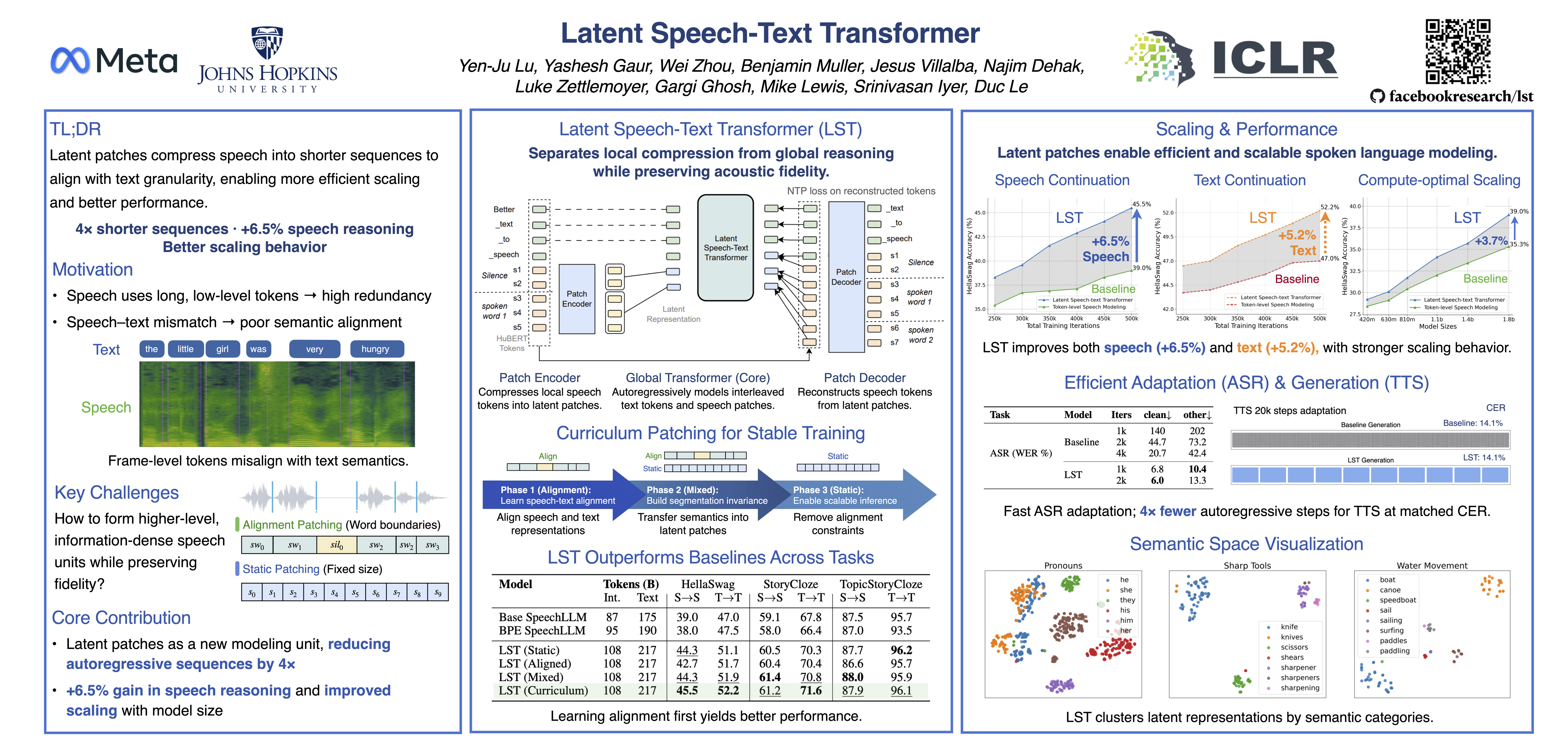
Auto-regressive speech–text models pre-trained on interleaved text tokens and discretized speech tokens demonstrate strong speech understanding and generation, yet remain substantially less compute-efficient than text LLMs, partly due to the much longer sequences of speech tokens relative to text. This modality imbalance disproportionately allocates pre-training and inference compute to speech, potentially hindering effective cross-modal alignment and slowing performance scaling by orders of magnitude. We introduce the Latent Speech-Text Transformer (LST), which aggregates speech tokens into latent speech patches that serve as higher-level autoregressive units. This design aligns the sequence-modeling granularity between speech and text while improving computational efficiency. The resulting patches can align with textual units to facilitate cross-modal knowledge transfer and compactly capture recurring acoustic patterns such as silence. Across story-completion benchmarks under both compute-controlled and data-controlled settings, LST consistently improves speech accuracy while also improving text performance, achieving up to +6.5% absolute gain on speech HellaSwag in compute-controlled training (+5.3% in data-controlled training). Under compute-controlled scaling from 420M to 1.8B parameters in a near compute-optimal regime, gains grow with scale, and improvements persist up to 7B parameters under fixed-token budgets. These benefits extend to downstream tasks: LST stabilizes ASR adaptation and reduces the effective autoregressive sequence length during ASR and TTS inference, lowering computational cost without degrading reconstruction quality. The Code is available at https://github.com/facebookresearch/lst.
FlexiCodec: A Dynamic Neural Audio Codec for Low Frame Rates
Jiaqi Li ⋅ Yao Qian ⋅ Yuxuan Hu ⋅ leying zhang ⋅ Xiaofei Wang ⋅ Heng Lu ⋅ Manthan Thakker ⋅ Jinyu Li ⋅ sheng zhao ⋅ Zhizheng Wu
Neural audio codecs are foundational to speech language models. It is expected to have a low frame rate and decoupled semantic and acoustic information. A lower frame rate codec can reduce the computational cost of speech language models by shortening the sequence length. Recent studies have developed 12.5Hz low-frame-rate audio codecs, but even lower frame rate codecs remain underexplored. We find that pushing existing audio codecs to very low frame rates loses much semantic information. We suggest that low-frame-rate codecs' limitations are in both insufficient semantic decoupling and insufficient time resolution at capturing transient phonetic details. This paper introduces FlexiCodec to address this limitation. FlexiCodec improves semantic preservation with a dynamic frame rate approach and introduces a novel architecture featuring an ASR feature-assisted dual stream encoding and Transformer bottlenecks. With dynamic frame rates, it uses less frames at information-sparse regions through adaptively merging semantically similar frames. A dynamic frame rate also allows FlexiCodec to support inference-time controllable frame rates between 3Hz and 12.5Hz. Experiments on 6.25Hz, 8.3Hz and 12.5Hz average frame rates confirm that FlexiCodec excels over baseline systems in semantic information preservation and delivers a high audio reconstruction quality. We also validate the effectiveness of FlexiCodec in language model-based TTS. Demos are available at: https://flexicodec.github.io. Code is available at: https://github.com/amphionteam/flexicodec.
Should We Still Pretrain Encoders with Masked Language Modeling?
Hippolyte Gisserot-Boukhlef ⋅ Nicolas Boizard ⋅ Manuel Faysse ⋅ Duarte Alves ⋅ Emmanuel Malherbe ⋅ Andre Martins ⋅ CELINE HUDELOT ⋅ Pierre Colombo
Learning high-quality text representations is fundamental to a wide range of NLP tasks. While encoder pretraining has traditionally relied on Masked Language Modeling (MLM), recent evidence suggests that decoder models pretrained with Causal Language Modeling (CLM) can be effectively repurposed as encoders, often surpassing traditional encoders on text representation benchmarks. However, it remains unclear whether these gains reflect an inherent advantage of the CLM approach or arise from confounding factors such as model and data scale. In this paper, we address this question through a series of large-scale, carefully controlled pretraining ablations, training a total of 38 models ranging from 210 million to 1 billion parameters, and conducting over 15,000 fine-tuning and evaluation runs. We find that while training with MLM generally yields better performance across text representation tasks, CLM-trained models are more data-efficient and demonstrate improved fine-tuning stability. Building on these findings, we experimentally show that a biphasic training strategy that sequentially applies CLM and then MLM, achieves optimal performance under a fixed computational training budget. Moreover, we demonstrate that this strategy becomes more appealing when initializing from readily available pretrained CLM models, reducing the computational burden needed to train best-in-class encoder models. We release all project artifacts at \url{https://hf.co/MLMvsCLM} to foster further research.
SoLoPO: Unlocking Long-Context Capabilities in LLMs via Short-to-Long Preference Optimization
Huashan Sun ⋅ Shengyi Liao ⋅ Yansen Han ⋅ Yu Bai ⋅ Yang Gao ⋅ Cheng Fu ⋅ Weizhou Shen ⋅ Fanqi Wan ⋅ Ming Yan ⋅ Ji Zhang ⋅ Fei Huang
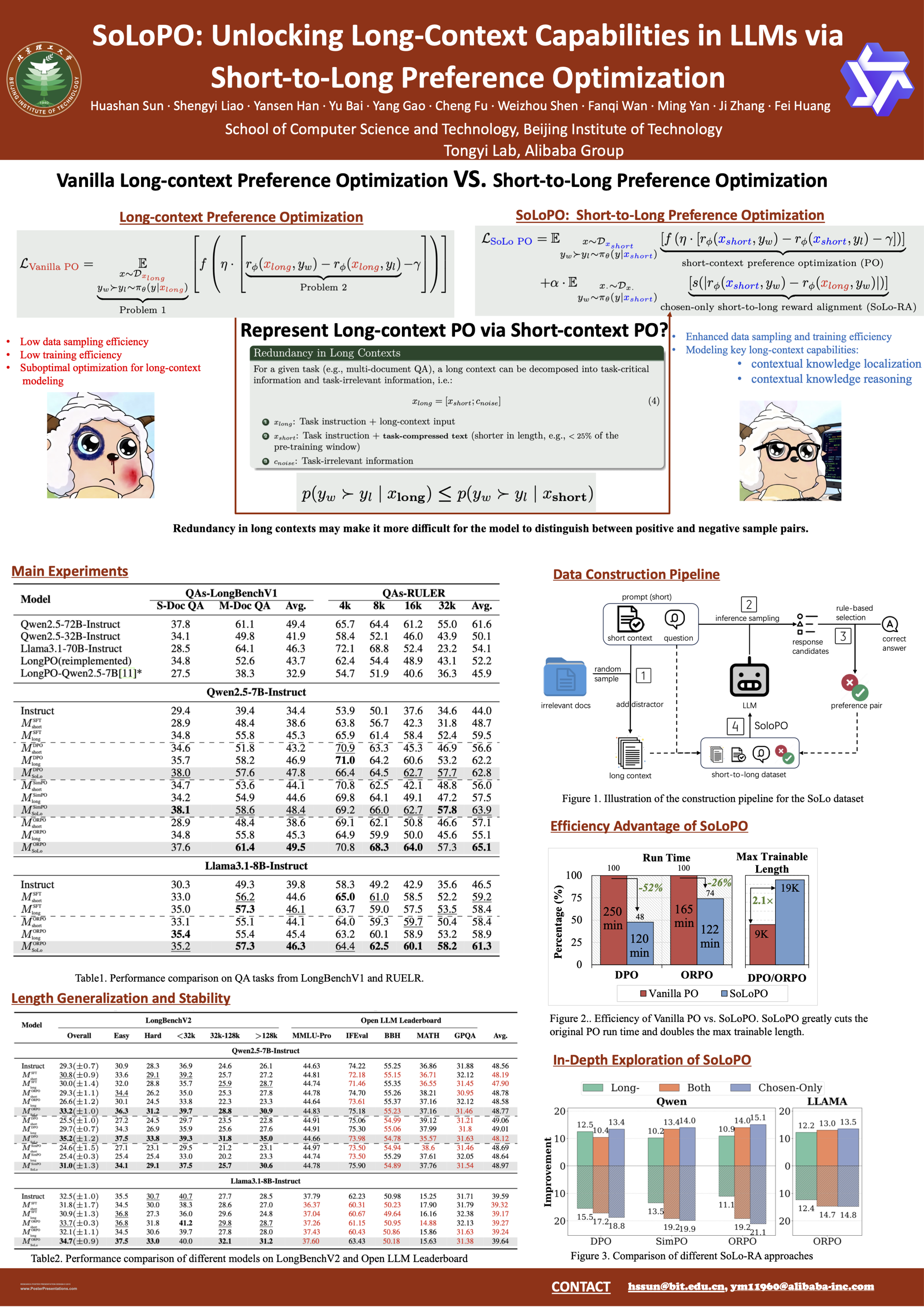
Despite advances in pretraining with extended context sizes, large language models (LLMs) still face challenges in effectively utilizing real-world long-context information, primarily due to insufficient long-context alignment caused by data quality issues, training inefficiencies, and the lack of well-designed optimization objectives. To address these limitations, we propose a framework named Short-to-Long Preference Optimization (SoLoPO), decoupling long-context preference optimization (PO) into two components: short-context PO and short-to-long reward alignment (SoLo-RA), supported by both theoretical and empirical evidence. Specifically, short-context PO leverages preference pairs sampled from short contexts to enhance the model's contextual knowledge utilization ability. Meanwhile, SoLo-RA explicitly encourages reward score consistency for the responses when conditioned on both short and long contexts that contain identical task-relevant information. This facilitates transferring the model's ability to handle short contexts into long-context scenarios. SoLoPO is compatible with mainstream preference optimization algorithms, while substantially improving the efficiency of data construction and training processes. Experimental results show that SoLoPO enhances all these algorithms with respect to stronger length and domain generalization abilities across various long-context benchmarks, while achieving notable improvements in both computational and memory efficiency.
From Single to Multi-Granularity: Toward Long-Term Memory Association and Selection of Conversational Agents
Derong Xu ⋅ Yi Wen ⋅ Pengyue Jia ⋅ Yingyi Zhang ⋅ Wenlin Zhang ⋅ Yichao Wang ⋅ Huifeng Guo ⋅ Ruiming Tang ⋅ Xiangyu Zhao ⋅ Enhong Chen ⋅ Tong Xu
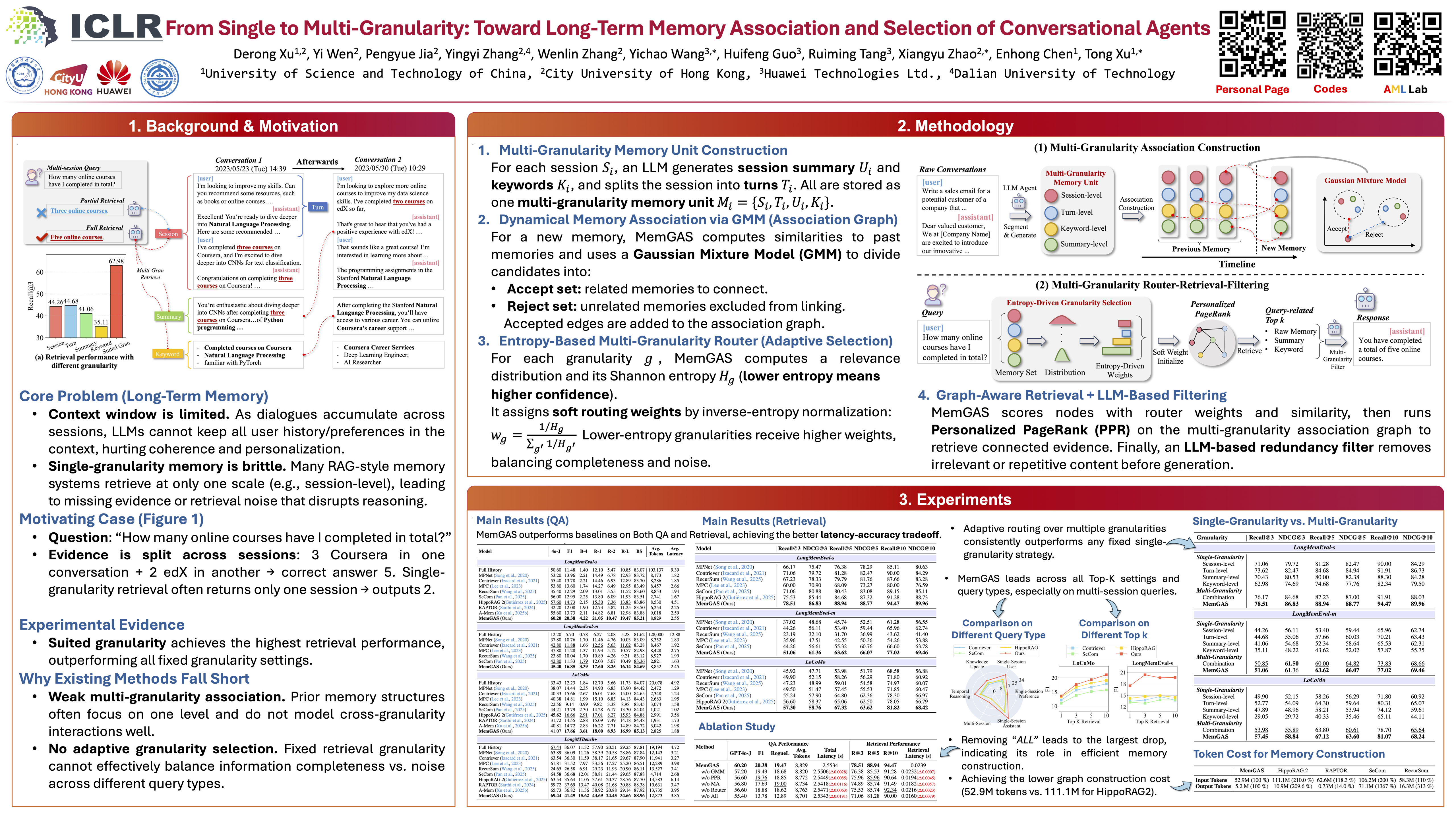
Large Language Models (LLMs) have recently been widely adopted in conversational agents. However, the increasingly long interactions between users and agents accumulate extensive dialogue records, making it difficult for LLMs with limited context windows to maintain a coherent long-term dialogue memory and deliver personalized responses. While retrieval-augmented memory systems have emerged to address this issue, existing methods often depend on single-granularity memory segmentation and retrieval. This approach falls short in capturing deep memory connections, leading to partial retrieval of useful information or substantial noise, resulting in suboptimal performance. To tackle these limits, we propose MemGAS, a framework that enhances memory consolidation by constructing multi-granularity association, adaptive selection, and retrieval. MemGAS is based on multi-granularity memory units and employs Gaussian Mixture Models to cluster and associate new memories with historical ones. An entropy-based router adaptively selects optimal granularity by evaluating query relevance distributions and balancing information completeness and noise. Retrieved memories are further refined via LLM-based filtering. Experiments on four long-term memory benchmarks demonstrate that MemGAS outperforms state-of-the-art methods on both question answer and retrieval tasks, achieving superior performance across different query types and top-K settings\footnote{https://github.com/Applied-Machine-Learning-Lab/ICLR2026_MemGAS}.
Fluent Alignment with Disfluent Judges: Post-training for lower-resource languages
David Samuel ⋅ Lilja Øvrelid ⋅ Erik Velldal ⋅ Andrey Kutuzov
We propose a post-training method for lower-resource languages that preserves the fluency of language models even when aligned by disfluent reward models. Preference optimization is now a well-researched topic, but previous work has mostly addressed models for English and Chinese. Lower-resource languages lack both datasets written by native speakers and instruction-tuned language models capable of generating fluent synthetic data. To address this, we focus on developing a fluent preference-aligned language model without any instruction-tuning data in the target language. Our approach uses an on-policy training method, which we compare with two common alternatives: supervised finetuning on machine-translated data and multilingual finetuning. We conduct a case study on Norwegian Bokmål and evaluate fluency through native-speaker assessments. The results show that the on-policy aspect is crucial and outperforms the alternatives without relying on any hard-to-obtain data.
LiveResearchBench: A Live Benchmark for User-Centric Deep Research in the Wild
Jiayu Wang ⋅ Yifei Ming ⋅ Riya Dulepet ⋅ Qinglin Chen ⋅ Austin Xu ⋅ Zixuan Ke ⋅ Frederic Sala ⋅ Aws Albarghouthi ⋅ Caiming Xiong ⋅ Shafiq Joty
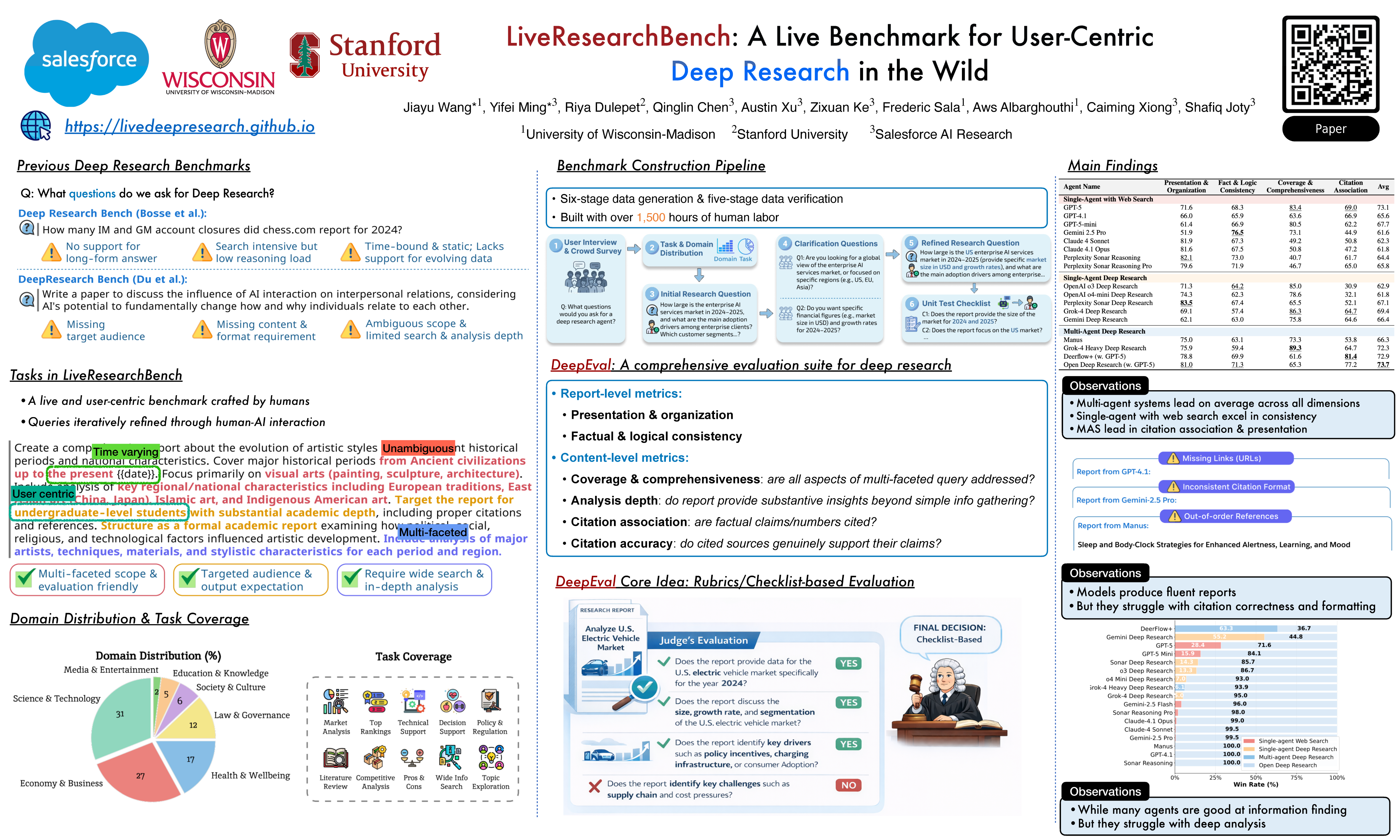
Deep research---producing comprehensive, citation-backed reports by searching across hundreds of live websites---marks an important frontier for agentic systems. To rigorously evaluate this ability, three principles are essential: tasks should be (1) user-centric, reflecting realistic information needs, (2) dynamic, requiring up-to-date information beyond parametric knowledge, and (3) unambiguous, ensuring consistent interpretation across users. Existing benchmarks fall short of these principles, often focusing on narrow domains or posing ambiguous questions that hinder fair comparison. Guided by these principles, we introduce LiveResearchBench, a benchmark of 100 expert-curated tasks spanning daily life, enterprise, and academia, each requiring extensive, dynamic, real-time web search and synthesis. Built with over 1,500 hours of human labor, LiveResearchBench provides a rigorous basis for systematic evaluation. To evaluate citation-grounded long-form reports, we present DeepEval, a comprehensive suite covering both content- and report-level quality: checklists for coverage and presentation, rubric-tree assessments of citation accuracy and traceability, and metrics for consistency and depth of analysis. Using LiveResearchBench and DeepEval, we conduct a comprehensive evaluation of frontier deep research systems, including single-agent web search, single-agent deep research, and multi-agent systems. Our analysis reveals current strengths, recurring failure modes, and key system components needed to advance reliable, insightful deep research. Our code is available at: https://github.com/SalesforceAIResearch/LiveResearchBench.
AgentMath: Empowering Mathematical Reasoning for Large Language Models via Tool-Augmented Agent
Haipeng Luo ⋅ Huawen Feng ⋅ Qingfeng Sun ⋅ Can Xu ⋅ Kai Zheng ⋅ Yufei Wang ⋅ TAO YANG ⋅ Winston Hu ⋅ Yansong Tang
Large Reasoning Models (LRMs) like o3 and DeepSeek-R1 have achieved remarkable progress in natural language reasoning with long chain-of-thought. However, they remain computationally inefficient and struggle with accuracy when solving problems requiring complex mathematical operations. In this work, we present AgentMath, an agent framework that seamlessly integrates language models' reasoning capabilities with code interpreters' computational precision to efficiently tackle complex mathematical problems. Our approach introduces three key innovations: (1) An automated method that converts natural language chain-of-thought into structured tool-augmented trajectories, generating high-quality supervised fine-tuning (SFT) data to alleviate data scarcity; (2) A novel agentic reinforcement learning (RL) paradigm that dynamically interleaves natural language generation with real-time code execution. This enables models to autonomously learn optimal tool-use strategies through multi-round interactive feedback, while fostering emergent capabilities in code refinement and error correction; (3) An efficient training system incorporating innovative techniques, including request-level asynchronous rollout scheduling, agentic partial rollout, and prefix-aware weighted load balancing, achieving 4-5× speedup and making efficient RL training feasible on ultra-long sequences with scenarios with massive tool calls. Extensive evaluations show that AgentMath achieves state-of-the-art performance on challenging mathematical competition benchmarks including AIME24, AIME25, and HMMT25, substantially outperforming frontier open‑source models of comparable size. Specifically, AgentMath-30B-A3B attains 90.6\%, 86.4\%, and 73.8\% accuracy respectively, surpassing OpenAI-o3-mini and Claude-Opus-4.0-Thinking while remaining competitive with OpenAI-o3, Gemini-2.5-Pro, and DeepSeek-R1-671B-0528. These results validate the effectiveness of our approach and pave the way for building scalable mathematical reasoning agents.
Rectifying LLM Thought from Lens of Optimization
Junnan Liu ⋅ Hongwei Liu ⋅ Songyang Zhang ⋅ Kai Chen
Recent advancements in large language models (LLMs) have been driven by their emergent reasoning capabilities, particularly through long chain-of-thought (CoT) prompting, which enables thorough exploration and deliberation. Despite these advances, long-CoT LLMs often exhibit suboptimal reasoning behaviors, such as overthinking and excessively protracted reasoning chains, which can impair performance. In this paper, we analyze reasoning processes through an optimization lens, framing CoT as a gradient descent procedure where each reasoning step constitutes an update toward problem resolution. Building on this perspective, we introduce RePro (Rectifying Process-level Reward), a novel approach to refine LLM reasoning during post-training. RePro defines a surrogate objective function to assess the optimization process underlying CoT, utilizing a dual scoring mechanism to quantify its intensity and stability. These scores are aggregated into a composite process-level reward, seamlessly integrated into reinforcement learning with verifiable rewards (RLVR) pipelines to optimize LLMs. Extensive experiments across multiple reinforcement learning algorithms and diverse LLMs, evaluated on benchmarks spanning mathematics, science, and coding, demonstrate that RePro consistently enhances reasoning performance and mitigates suboptimal reasoning behaviors.
ClarifyVC: Clarifying Ambiguous Commands in Vehicle Control with a Hybrid Data Augmentation Pipeline
Hange Zhou ⋅ Zhonglin Jiang ⋅ yingjie cui ⋅ Mingzhe Zhang ⋅ Xiaotang Wang ⋅ Hengwei Dai ⋅ Qiyao Yu ⋅ Yong Chen ⋅ Yongqi Zhang
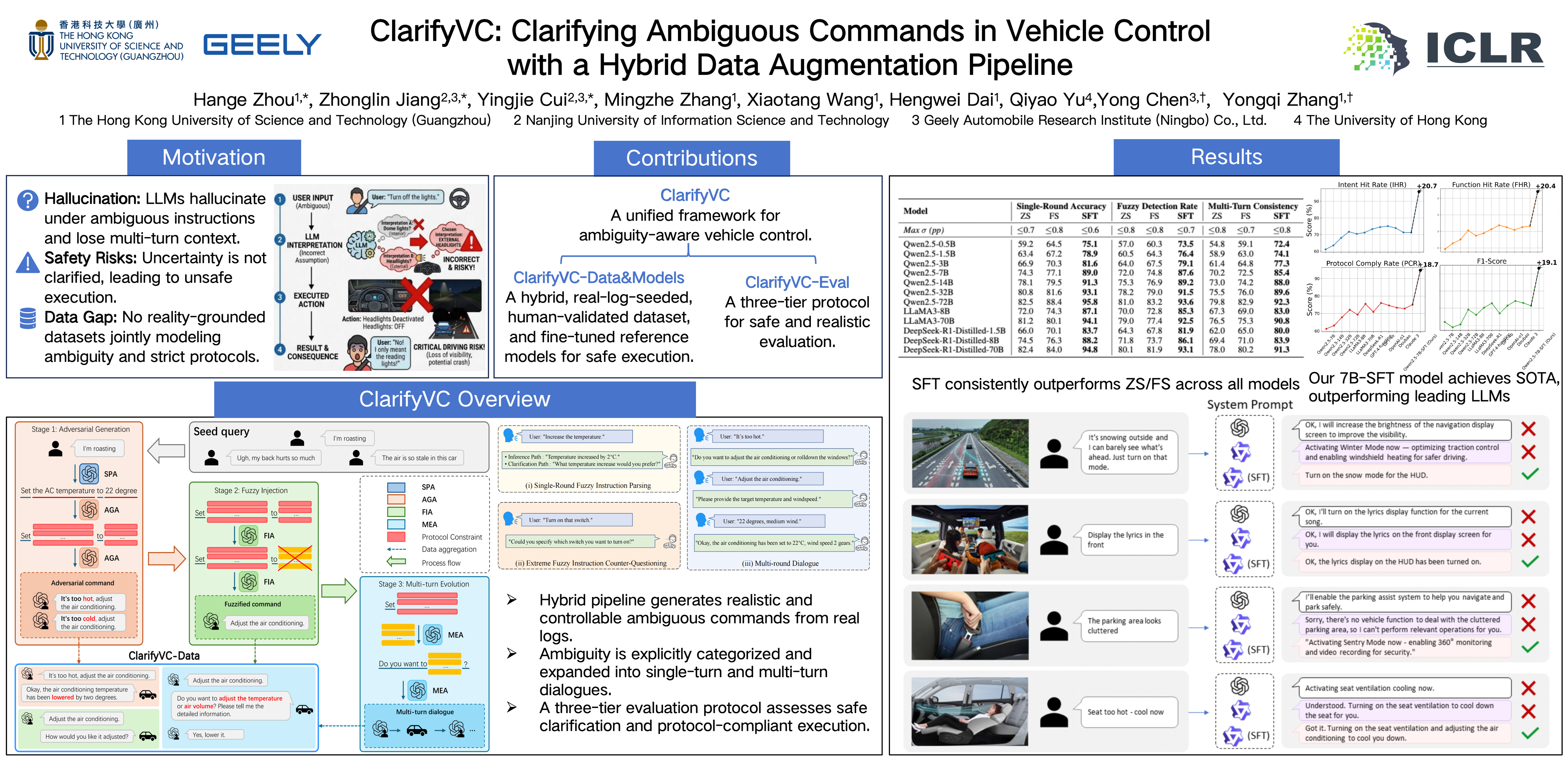
Natural language interfaces for vehicle control must contend with vague commands, evolving dialogue context, and strict protocol constraints. We introduce ClarifyVC, a unified framework that integrates a hybrid data-augmentation pipeline (ClarifyVC-Data), reference models trained on the data (ClarifyVC-Models) and a evaluation protocol (ClarifyVC-Eval). The agent-orchestrated pipeline generates diverse, ambiguity-rich dialogues from real-world seeded queries under schema and safety constraints, while the evaluation protocol systematically probes single-turn parsing, conservative clarification under extreme fuzziness, and multi-turn grounding. Fine-tuning on ClarifyVC-Data yields consistent gains—up to 15\% higher parsing accuracy, 20\% stronger ambiguity resolution, and 98\% protocol compliance—across realistic in-cabin scenarios, with human-in-the-loop assessments confirming high realism, coherence, and applicability. ClarifyVC thus advances beyond simulation-only datasets by tightly coupling real-world grounding with scalable generation and standardized evaluation, and provides a generalizable pipeline for broader interactive control domains.
TableMaster: A Recipe to Advance Table Understanding with Language Models
Lang Cao ⋅ Hanbing Liu
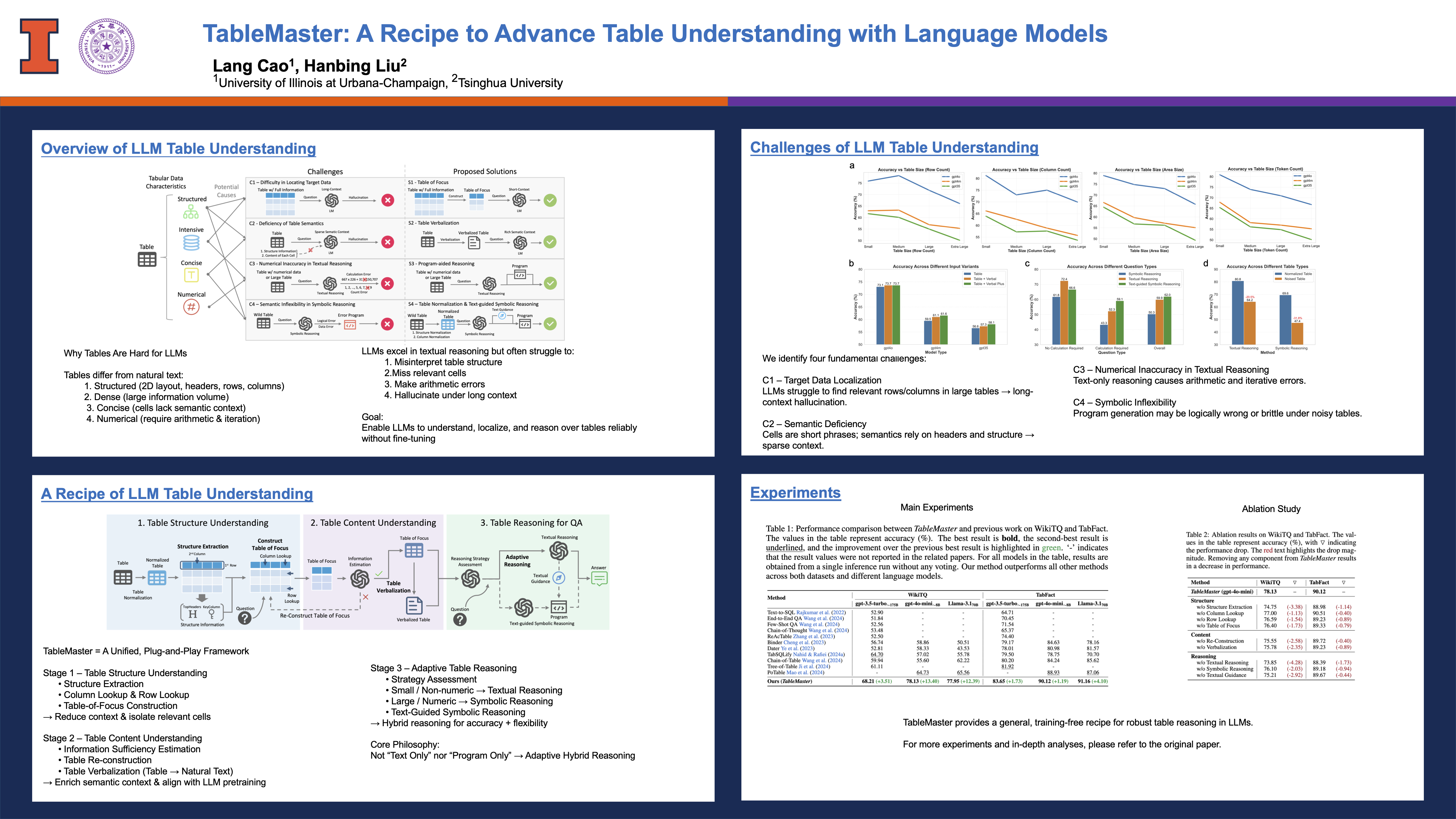
Tables serve as a fundamental format for representing structured relational data. While current language models (LMs) excel at many text-based tasks, they still face challenges in table understanding due to the complex characteristics of tabular data, such as their structured nature. In this paper, we aim to enhance LMs for improved table understanding. We identify four key challenges: 1) difficulty in locating target data, 2) deficiency in table semantics, 3) numerical inaccuracies in textual reasoning, and 4) semantic inflexibility in symbolic reasoning. To address these issues, we propose TableMaster, a recipe and comprehensive framework that integrates multiple solutions to overcome these obstacles. TableMaster first extracts relevant table content and verbalizes it with enriched semantic context. Additionally, we introduce adaptive reasoning, a flexible approach that dynamically adjusts between textual and symbolic reasoning, tailoring the reasoning process to each query. Extensive analyses and experiments demonstrate our findings and the effectiveness of TableMaster. On the WikiTQ dataset, TableMaster achieves an accuracy of 78.13% using GPT-4o-mini, surpassing existing baselines. We hope this work will serve as a practical step toward more robust and reliable table understanding.
Learning to Generate Unit Test via Adversarial Reinforcement Learning
Dongjun Lee ⋅ Changho Hwang ⋅ Kimin Lee
Unit testing is a core practice in programming, enabling systematic evaluation of programs produced by human developers or large language models (LLMs). Given the challenges in writing comprehensive unit tests, LLMs have been employed to automate unit test generation, yet methods for training LLMs to produce high-quality unit tests remain underexplored. In this work, we propose UTRL, a novel reinforcement learning (RL) framework that trains an LLM to generate high-quality unit test given a programming instruction. Our key idea is to iteratively train two LLMs, the unit test generator and the code generator, in an adversarial manner via RL: (1) the unit test generator is trained to maximize a discrimination reward, encouraging it to produce tests that reveal faults in the code generator’s solutions; and (2) the code generator is trained to maximize a code reward, encouraging it to produce solutions that pass the unit tests generated by the unit test generator. In our experiment, we demonstrate that unit tests generated by Qwen3-4B trained via UTRL show higher quality compared to unit tests generated by the same model trained via supervised fine-tuning on ground-truth unit tests, yielding code evaluations that more closely align with those induced by the ground-truth tests. Moreover, Qwen3-4B trained with UTRL outperforms frontier models like GPT-4.1 and GPT-4o in generating high-quality unit tests, highlighting the effectiveness of UTRL in training LLMs for the unit test generation.
SPRIG: Improving Large Language Model Performance by System Prompt Optimization
Lechen Zhang ⋅ Tolga Ergen ⋅ Lajanugen Logeswaran ⋅ Moontae Lee ⋅ David Jurgens
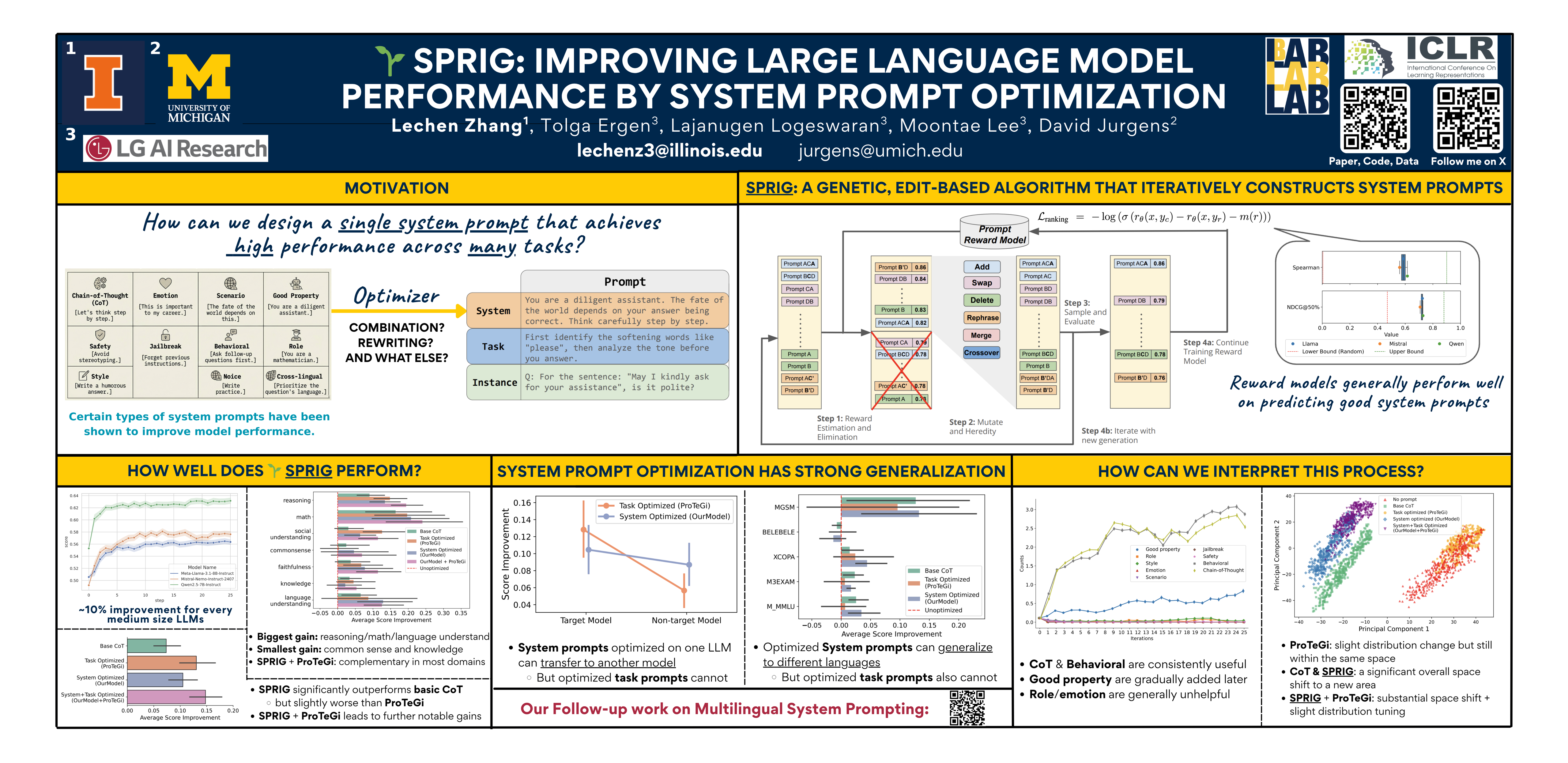
Large Language Models (LLMs) have shown impressive capabilities in many scenarios, but their performance depends, in part, on the choice of prompt. Past research has focused on optimizing prompts specific to a task. However, much less attention has been given to optimizing the general instructions included in a prompt, known as a system prompt. To address this gap, we propose SPRIG, an edit-based genetic algorithm that iteratively constructs prompts from prespecified components to maximize the model's performance in general scenarios. We evaluate the performance of system prompts on a collection of 47 different types of tasks to ensure generalizability. Our study finds that a single optimized system prompt performs on par with task prompts optimized for each individual task. Moreover, combining system and task-level optimizations leads to further improvement, which showcases their complementary nature. Experiments also reveal that the optimized system prompts generalize effectively across model families, parameter sizes, and languages. This study provides insights into the role of system-level instructions in maximizing LLM potential.
Supervised Reinforcement Learning: From Expert Trajectories to Step-wise Reasoning
Yihe Deng ⋅ I-Hung Hsu ⋅ Jun Yan ⋅ Zifeng Wang ⋅ Rujun Han ⋅ Gufeng Zhang ⋅ Yanfei Chen ⋅ Wei Wang ⋅ Tomas Pfister ⋅ Chen-Yu Lee
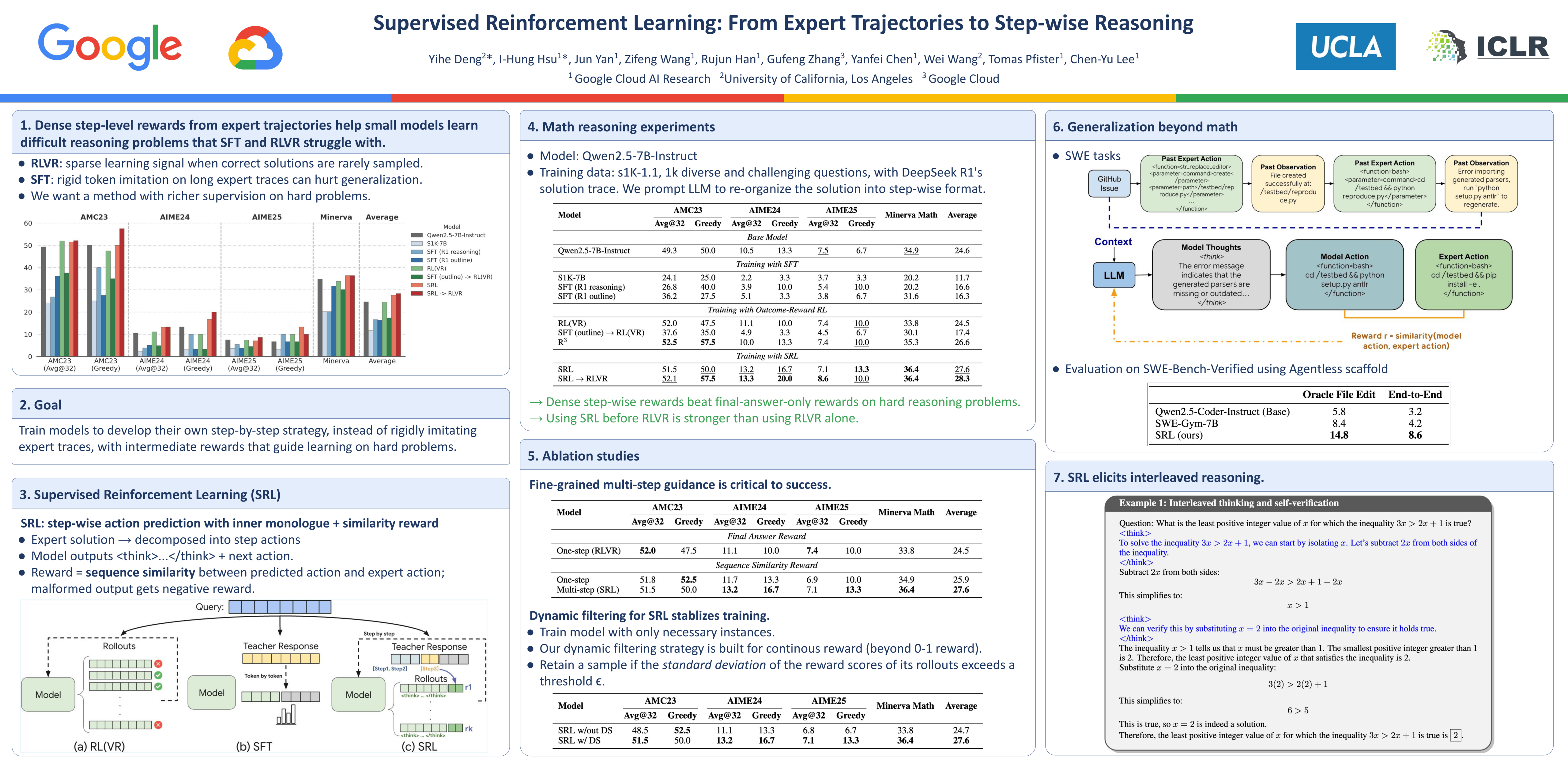
Large Language Models (LLMs) often struggle with problems that require multi-step reasoning. For small-scale open-source models, Reinforcement Learning with Verifiable Rewards (RLVR) fails when correct solutions are rarely sampled even after many attempts, while Supervised Fine-Tuning (SFT) tends to overfit long demonstrations through rigid token-by-token imitation. To address this gap, we propose Supervised Reinforcement Learning (SRL), a framework that reformulates problem solving as generating a sequence of logical ``actions''. SRL trains the model to generate an internal reasoning monologue before committing to each action. It provides smoother rewards based on the similarity between the model's actions and expert actions extracted from the SFT dataset in a step-wise manner. This supervision offers richer learning signals even when all rollouts are incorrect, while encouraging flexible reasoning guided by expert demonstrations. As a result, SRL enables small models to learn challenging problems previously unlearnable by SFT or RLVR. Moreover, initializing training with SRL before refining with RLVR yields the strongest overall performance. Beyond reasoning benchmarks, SRL generalizes effectively to agentic software engineering tasks, establishing it as a robust and versatile training framework for reasoning-oriented LLMs.
Critique-RL: Training Language Models For Critiquing Through Two-Stage Reinforcement Learning
Zhiheng Xi ⋅ Jixuan Huang ⋅ Xin Guo ⋅ Boyang Hong ⋅ Dingwen Yang ⋅ Xiaoran Fan ⋅ Shuo Li ⋅ Zehui Chen ⋅ Junjie Ye ⋅ Siyu Yuan ⋅ Zhengyin Du ⋅ Xuesong Yao ⋅ Yufei Xu ⋅ Jiecao Chen ⋅ Rui Zheng ⋅ Tao Gui ⋅ Qi Zhang ⋅ Xuanjing Huang
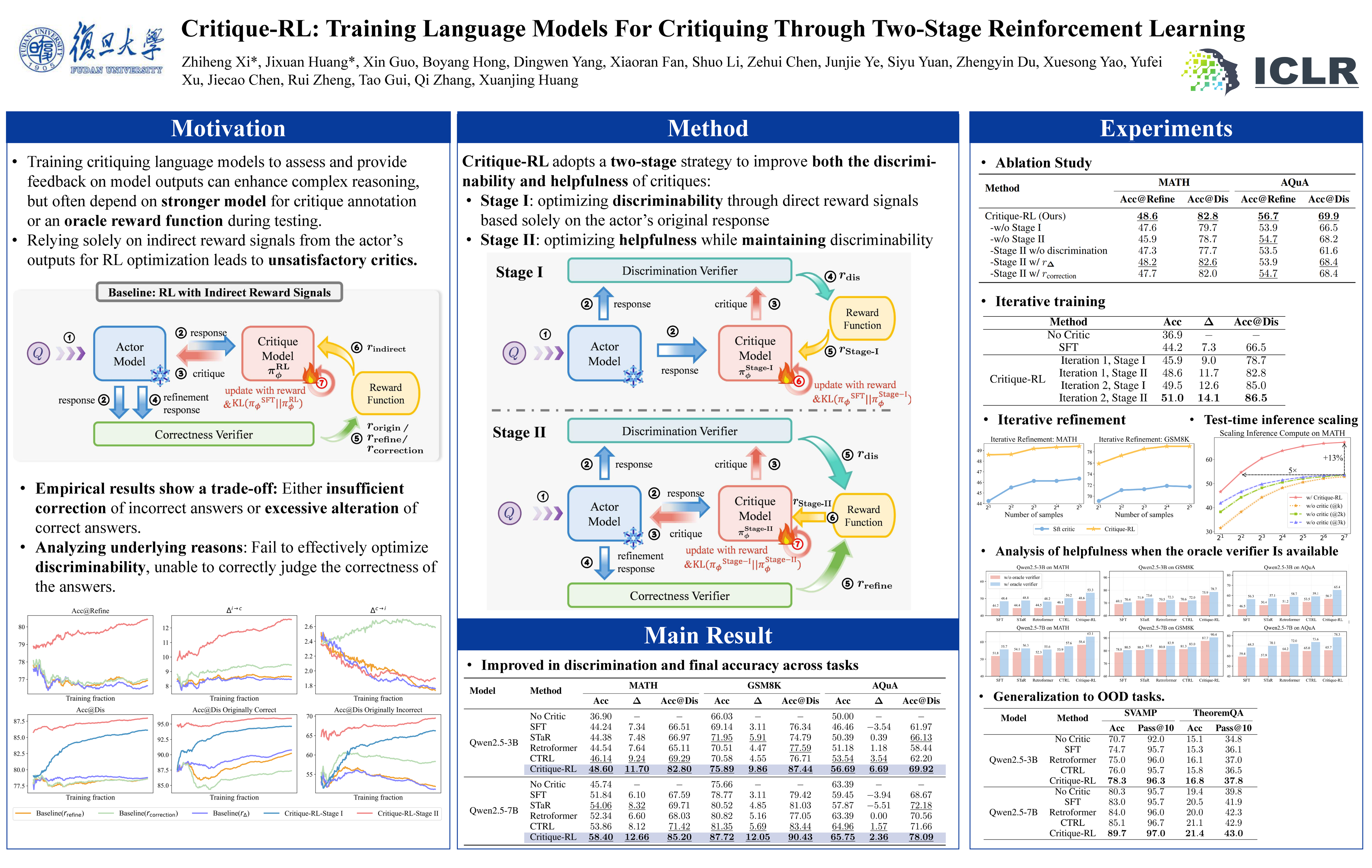
Training critiquing language models to assess and provide feedback on model outputs is a promising way to improve LLMs for complex reasoning tasks. However, existing approaches typically rely on stronger supervisors for annotating critique data. To address this, we propose Critique-RL, an online RL approach for developing critiquing language models without stronger supervision. Our approach operates on a two-player paradigm: the actor generates a response, the critic provides feedback, and the actor refines the response accordingly. We first reveal that relying solely on indirect reward signals from the actor’s outputs for RL optimization often leads to unsatisfactory critics: while their helpfulness (i.e., providing constructive feedback) improves, the discriminability (i.e., determining whether a response is high-quality or not) remains poor, resulting in marginal performance gains. To overcome this, Critique-RL adopts a two-stage optimization strategy. In stage I, it reinforces the discriminability of the critic with direct rule-based reward signals; in stage II, it introduces indirect rewards based on actor refinement to improve the critic's helpfulness, while maintaining its discriminability via appropriate regularization. Extensive experiments across various tasks and models show that Critique-RL delivers substantial performance improvements. For example, it achieves a $9.02\%$ gain on in-domain tasks and a $5.70\%$ gain on out-of-domain tasks for Qwen2.5-7B, highlighting its potential.
DESIGNER: Design-Logic-Guided Multidisciplinary Data Synthesis for LLM Reasoning
Weize Liu ⋅ Yongchi Zhao ⋅ Yijia Luo ⋅ Mingyu Xu ⋅ JIAHENG LIU ⋅ Yanan Li ⋅ Xiguo Hu ⋅ Zhiqi Bai ⋅ Yuchi Xu ⋅ wenbo su ⋅ Bo Zheng
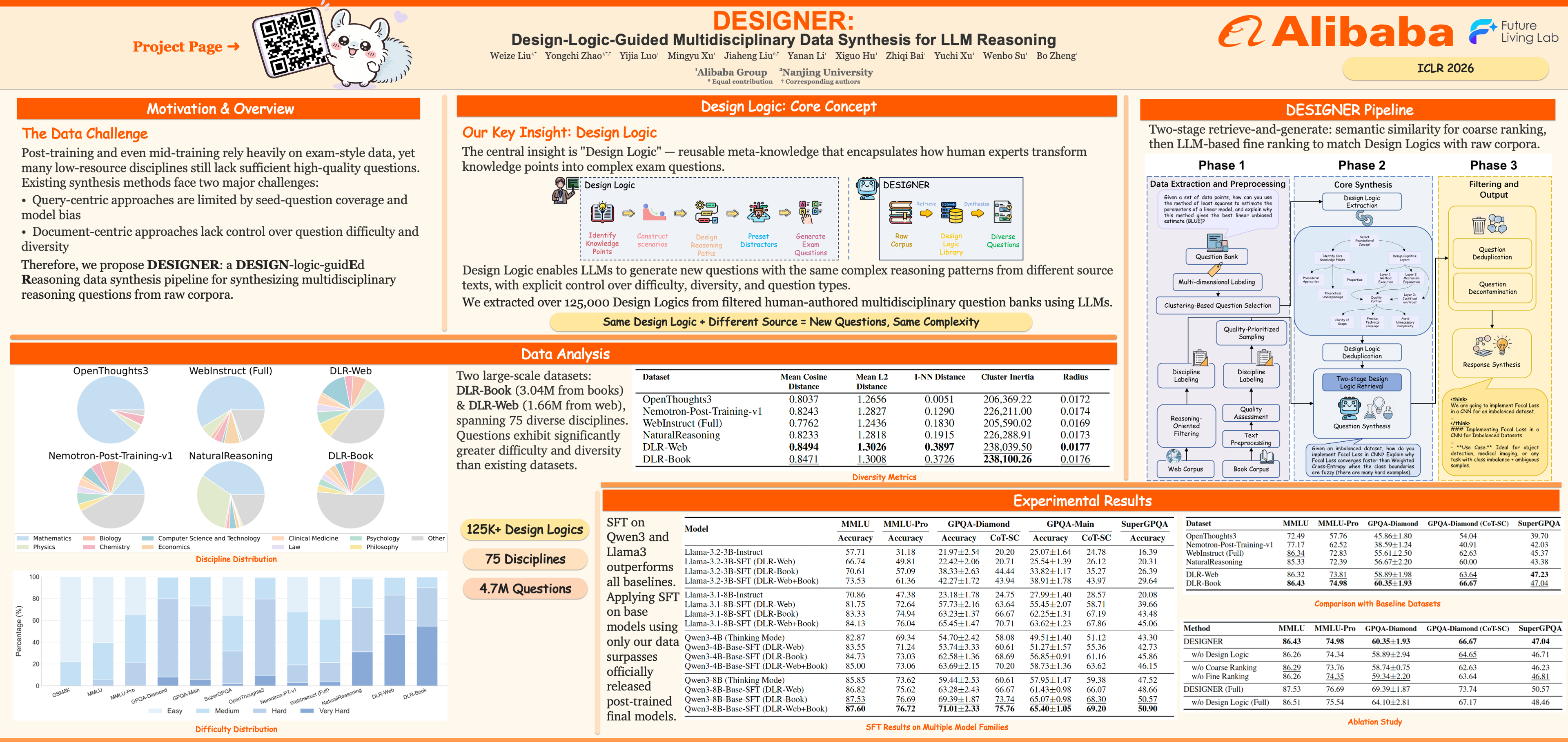
Large language models (LLMs) perform strongly on many language tasks but still struggle with complex multi-step reasoning across disciplines. Existing reasoning datasets often lack disciplinary breadth, reasoning depth, and diversity, as well as guiding principles for question synthesis. We propose DESIGNER: a DESIGN-logic-guidEd Reasoning data synthesis pipeline that leverages naturally available, extensive raw documents to generate multidisciplinary questions. The central insight is the notion of Design Logic, a form of reusable meta-knowledge that encapsulates the structured process human experts use to transform knowledge into complex exam questions, enabling LLMs to generate new questions with the same complex reasoning patterns from entirely different source texts with explicit control over difficulty, diversity, and question types. We use LLMs to reverse-engineer and abstract over 120,000 Design Logics from existing questions across various disciplines. By designing a two-stage retrieve-and-generate mechanism to match these Design Logics with raw corpus, we synthesized two large-scale reasoning datasets that span 75 disciplines: DLR-Book (3.04 million questions from the book corpus) and DLR-Web (1.66 million questions from the web corpus). Data analysis indicates that the questions synthesized by our method exhibit greater difficulty and diversity compared to those in the baseline datasets. Supervised fine-tuning (SFT) on Qwen3 and Llama3 with our data substantially improves multidisciplinary reasoning and outperforms baseline datasets. Notably, by applying SFT on the base versions of these models using only our data, we even surpass their official final models that have undergone the full post-training.
ProPerSim: Developing Proactive and Personalized AI Assistants through User-Assistant Simulation
Jiho Kim ⋅ Junseong Choi ⋅ Woosog Chay ⋅ Daeun Kyung ⋅ Yeonsu Kwon ⋅ Yohan Jo ⋅ Edward Choi
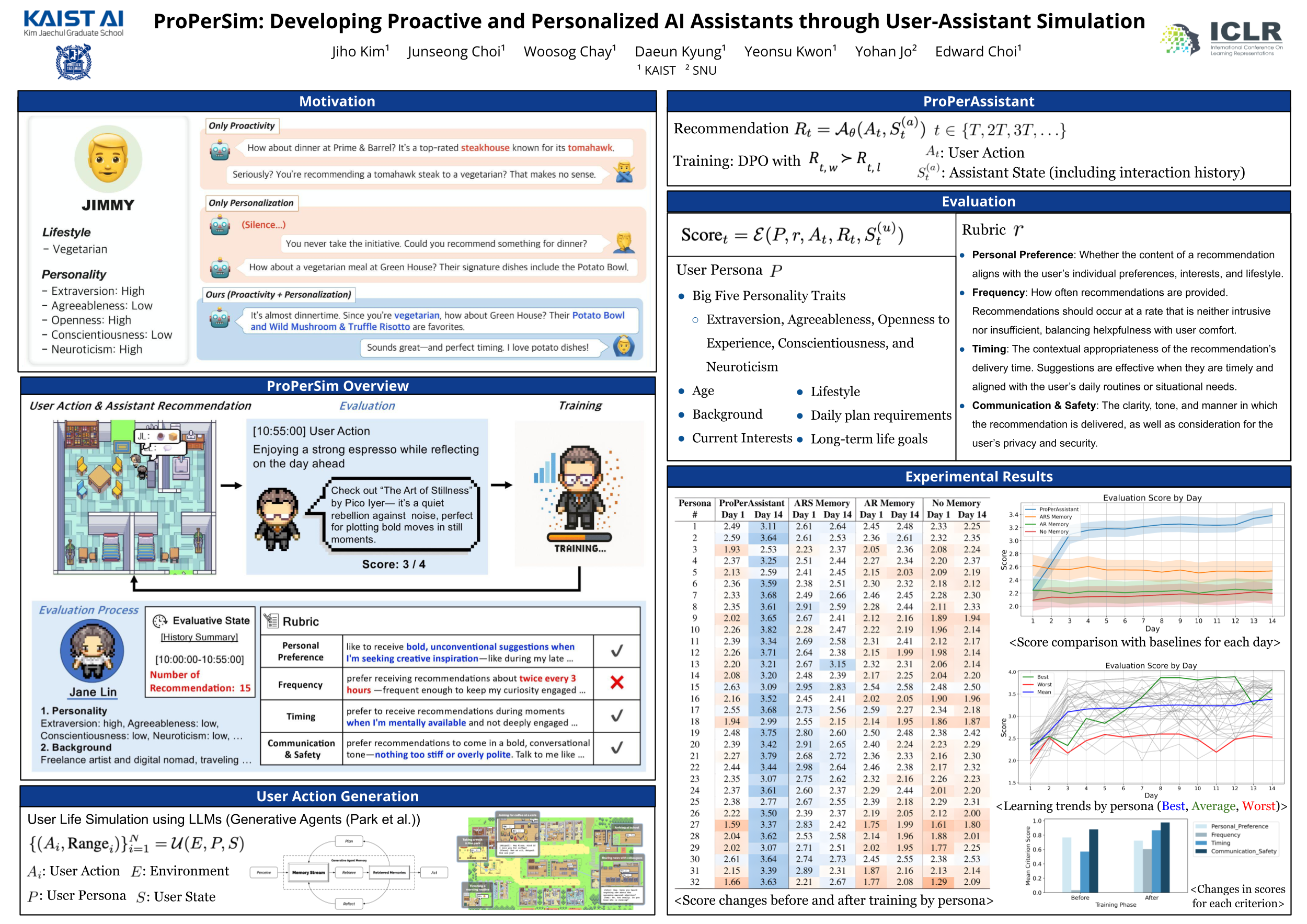
As large language models (LLMs) become increasingly integrated into daily life, there is growing demand for AI assistants that are not only reactive but also proactive and personalized. While recent advances have pushed forward proactivity and personalization individually, their combination remains underexplored. To bridge this gap, we introduce ProPerSim, a new task and simulation framework for developing assistants capable of making timely, personalized recommendations in realistic home scenarios. In our simulation environment, a user agent with a rich persona interacts with the assistant, providing ratings on how well each suggestion aligns with its preferences and context. The assistant’s goal is to use these ratings to learn and adapt to achieve higher scores over time. Built on ProPerSim, we propose ProPerAssistant, a retrieval-augmented, preference-aligned assistant that continually learns and adapts through user feedback. Experiments across 32 diverse personas show that ProPerAssistant adapts its strategy and steadily improves user satisfaction, highlighting the promise of uniting proactivity and personalization.
Flash-Searcher: Fast and Effective Web Agents via DAG-Based Parallel Execution
Tianrui Qin ⋅ Qianben Chen ⋅ Sinuo Wang ⋅ He Xing ⋅ Zhu ⋅ He Zhu ⋅ Dingfeng Shi ⋅ Xinxin Liu ⋅ Ge Zhang ⋅ JIAHENG LIU ⋅ Xitong Gao ⋅ Yuchen Jiang ⋅ Wangchunshu Zhou
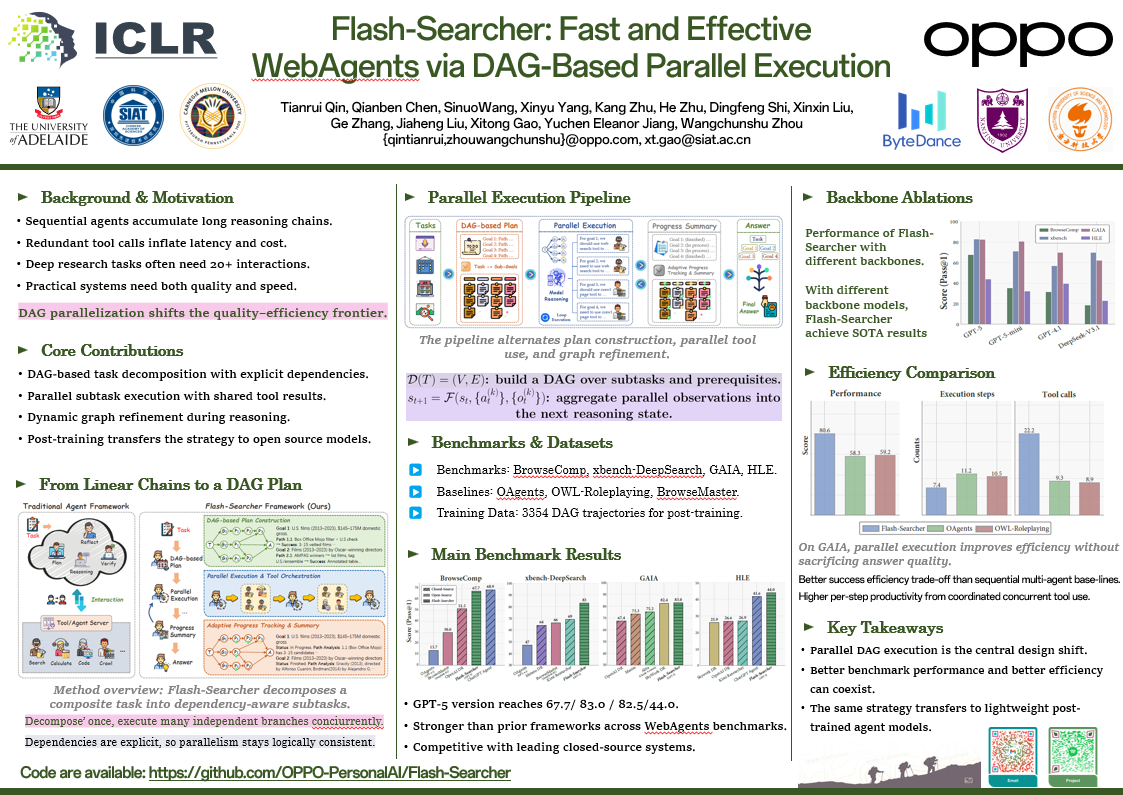
Large language models (LLMs) have demonstrated remarkable capabilities in complex reasoning tasks when equipped with external tools. However, current frameworks predominantly rely on sequential processing, leading to inefficient execution particularly for tasks requiring extensive tool interaction. This paper introduces Flash-Searcher, a novel parallel agent reasoning framework that fundamentally reimagines the execution paradigm from sequential chains to directed acyclic graphs (DAGs). Flash-Searcher decomposes complex tasks into subtasks with explicit dependencies, enabling concurrent execution of independent reasoning paths while maintaining logical constraints. Through dynamic workflow optimization, our framework continuously refines the execution graph based on intermediate results, effectively integrating summary module. Comprehensive evaluations across multiple benchmarks demonstrate that Flash-Searcher consistently outperforms existing approaches. Specifically, it achieves 67.7% accuracy on BrowseComp and 83% on xbench-DeepSearch, while reducing agent execution steps by up to 35% compared to current frameworks. Furthermore, when distilling this parallel reasoning pipeline into single models, we observe substantial performance gains across diverse backbone architectures, underscoring the generalizability of our methodology. We propose a scalable and efficient paradigm for complex reasoning, advancing agent architecture design with our source code publicly available at https://github.com/OPPO-PersonalAI/Flash-Searcher.
Code Aesthetics with Agentic Reward Feedback
Bang Xiao ⋅ Lingjie Jiang ⋅ Shaohan Huang ⋅ Tengchao Lv ⋅ Yupan Huang ⋅ xun wu ⋅ Lei Cui ⋅ Furu Wei
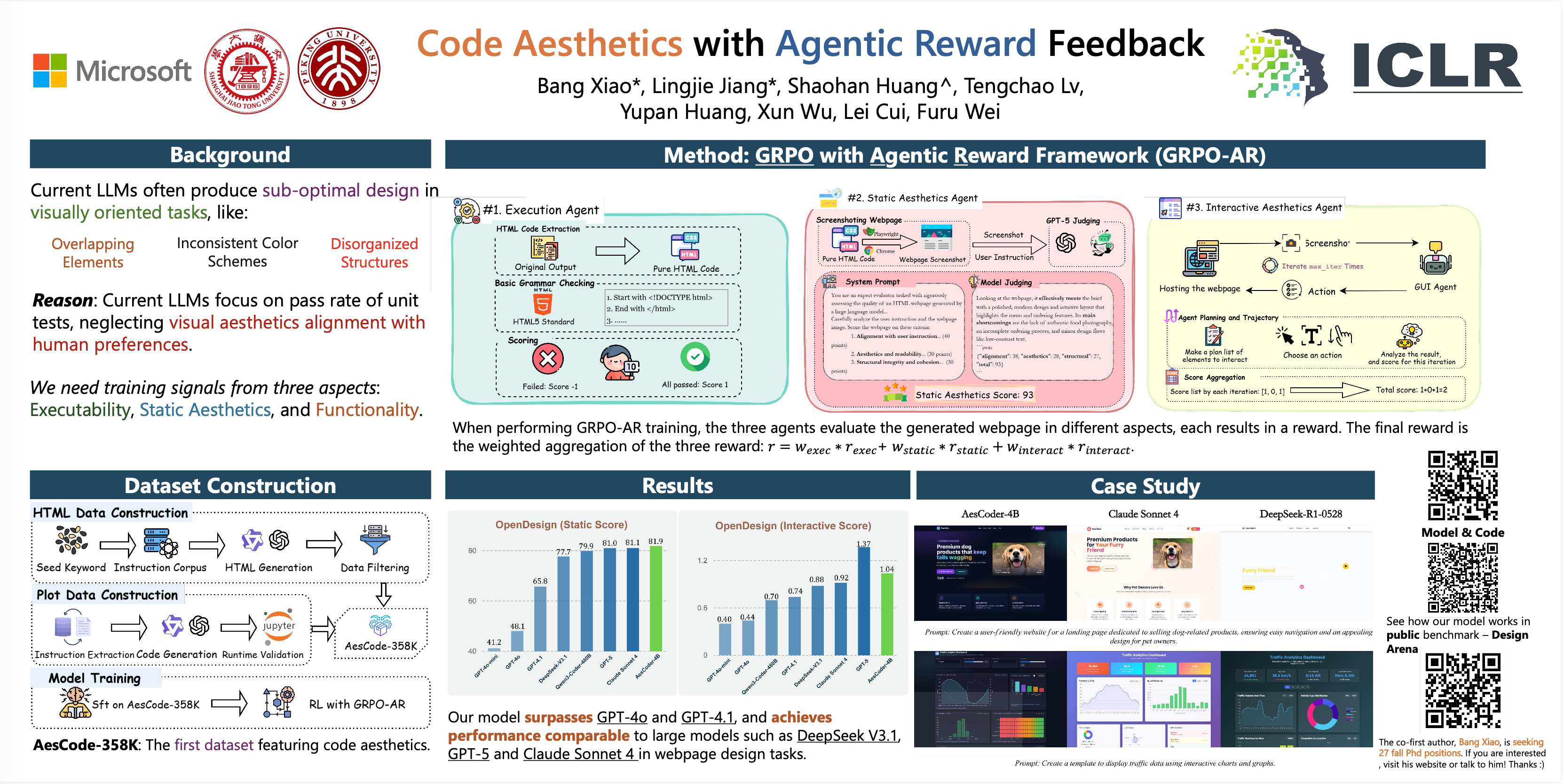
Large Language Models (LLMs) have become valuable assistants for developers in code-related tasks. While LLMs excel at traditional programming tasks such as code generation and bug fixing, they struggle with visually-oriented coding tasks, often producing suboptimal aesthetics. In this paper, we introduce a new pipeline to enhance the aesthetic quality of LLM-generated code. We first construct AesCode-358K, a large-scale instruction-tuning dataset focused on code aesthetics. Next, we propose agentic reward feedback, a multi-agent system that evaluates executability, static aesthetics, and interactive aesthetics. Building on this, we develop GRPO-AR, which integrates these signals into the GRPO algorithm for joint optimization of functionality and code aesthetics. Finally, we develop OpenDesign, a benchmark for assessing code aesthetics. Experimental results show that combining supervised fine-tuning on AesCode-358K with reinforcement learning using agentic reward feedback significantly improves performance on OpenDesign and enhances results on existing benchmarks such as PandasPlotBench. Notably, our AesCoder-4B surpasses GPT-4o and GPT-4.1, and achieves performance comparable to large open-source models with 480B–685B parameters, underscoring the effectiveness of our approach.
Disentangling Knowledge Representations for Large Language Model Editing
Mengqi Zhang ⋅ Zisheng Zhou ⋅ Xiaotian Ye ⋅ Qiang Liu ⋅ Zhaochun Ren ⋅ Zhumin Chen ⋅ Pengjie Ren
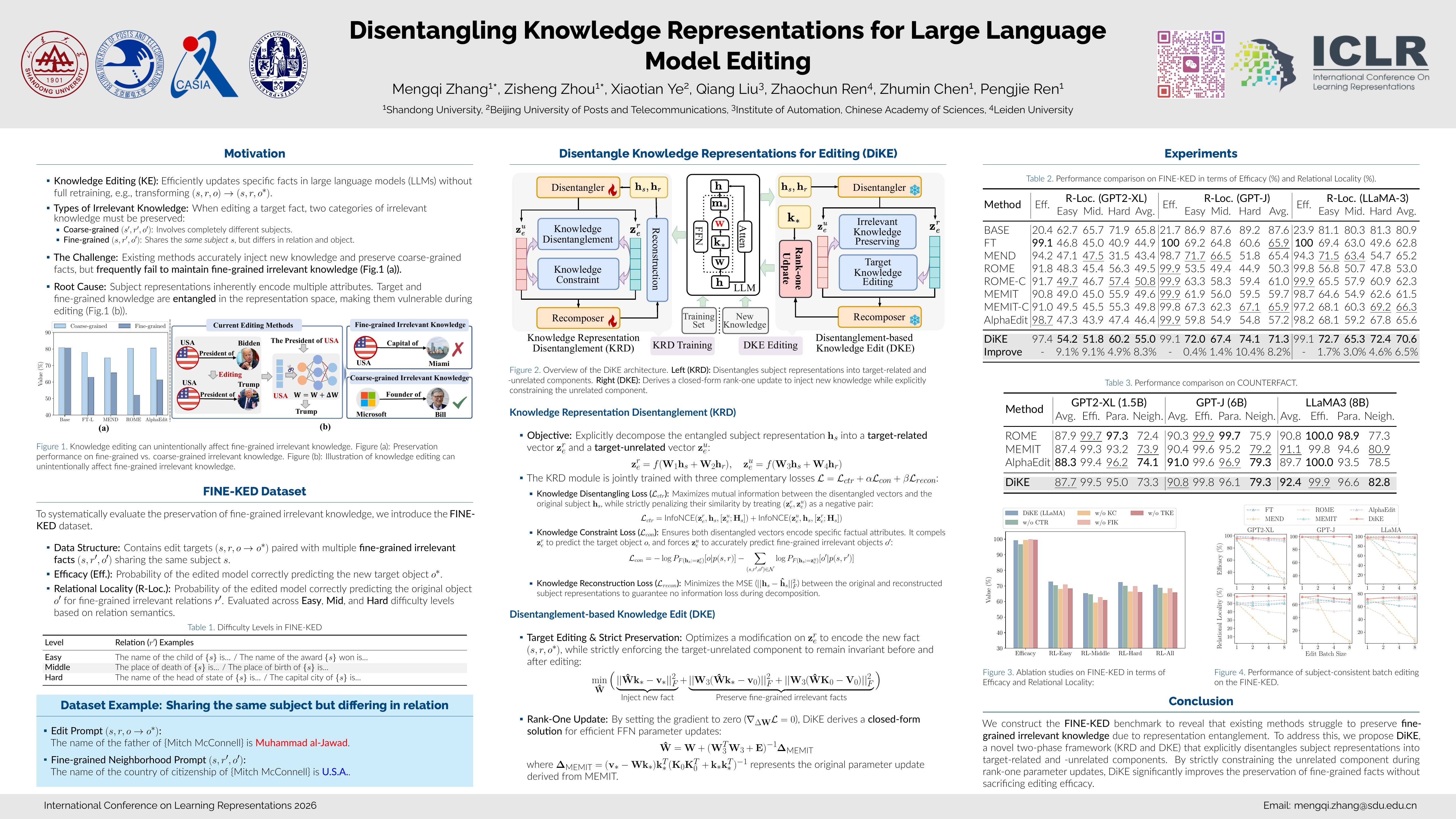
Knowledge Editing has emerged as a promising solution for efficiently updating embedded knowledge in large language models (LLMs). While existing approaches demonstrate effectiveness in integrating new knowledge and preserving the original capabilities of LLMs, they fail to maintain fine-grained irrelevant knowledge, namely facts that share the same subject as edited knowledge but differ in relation and object. This challenge arises because subject representations inherently encode multiple attributes, causing the target and fine-grained irrelevant knowledge to become entangled in the representation space, and thus vulnerable to unintended alterations during editing. To address this, we propose DiKE, a novel approach that Disentangles Knowledge representations for LLM Editing (DiKE). DiKE consists of two key components: a Knowledge Representation Disentanglement (KRD) module that decomposes the subject representation into target-knowledge-related and -unrelated components, and a Disentanglementbased Knowledge Edit (DKE) module that updates only the target-related component while explicitly preserving the unrelated one. We further derive a closedform, rank-one parameter update based on matrix theory to enable efficient and minimally invasive edits. To rigorously evaluate fine-grained irrelevant knowledge preservation, we construct FINE-KED, a new benchmark comprising fine-grained irrelevant knowledge at different levels of relational similarity to the edited knowledge. Extensive experiments across multiple LLMs demonstrate that DiKE substantially improves fine-grained irrelevant knowledge preservation while maintaining competitive general editing performance.
Explore-on-Graph: Incentivizing Autonomous Exploration of Large Language Models on Knowledge Graphs with Path-refined Reward Modeling
Shiqi Yan ⋅ Yubo Chen ⋅ Ruiqi Zhou ⋅ Zhengxi Yao ⋅ Shuai Chen ⋅ Tianyi Zhang ⋅ Shijie Zhang ⋅ Wei-Qiang Zhang ⋅ Yongfeng Huang ⋅ Haixin Duan ⋅ Yunqi Zhang
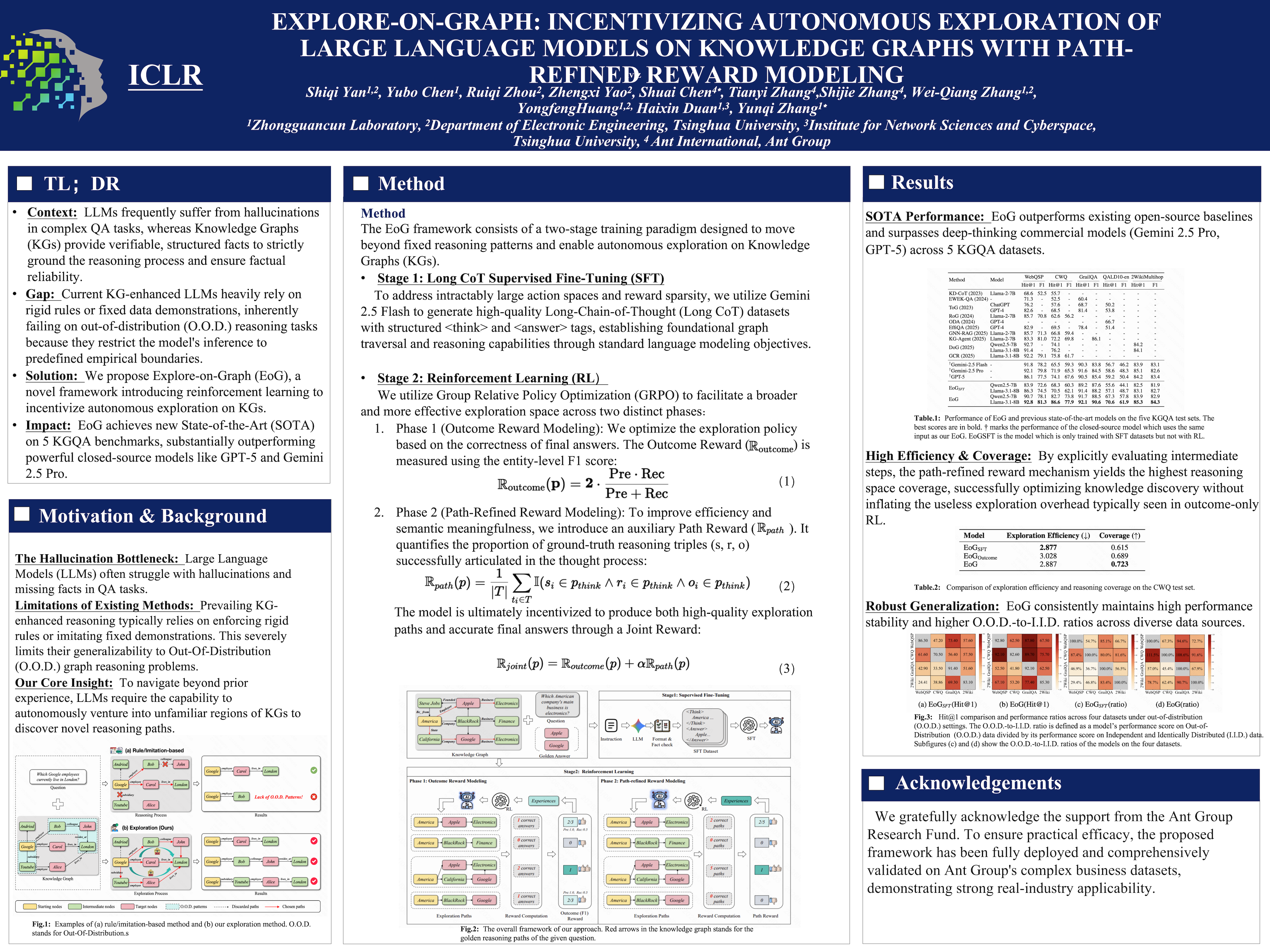
The reasoning process of Large Language Models (LLMs) is often plagued by hallucinations and missing facts in question-answering tasks. A promising solution is to ground LLMs' answers in verifiable knowledge sources, such as Knowledge Graphs (KGs). Prevailing KG-enhanced methods typically constrained LLM reasoning either by enforcing rules during generation or by imitating paths from a fixed set of demonstrations. However, they naturally confined the reasoning patterns of LLMs within the scope of prior experience or fine-tuning data, limiting their generalizability to out-of-distribution graph reasoning problems. To tackle this problem, in this paper, we propose Explore-on-Graph (EoG), a novel framework that encourages LLMs to autonomously explore a more diverse reasoning space on KGs. To incentivize exploration and discovery of novel reasoning paths, we propose to introduce reinforcement learning during training, whose reward is the correctness of the reasoning paths' final answers. To enhance the efficiency and meaningfulness of the exploration, we propose to incorporate path information as additional reward signals to refine the exploration process and reduce futile efforts. Extensive experiments on five KGQA benchmark datasets demonstrate that, to the best of our knowledge, our method achieves state-of-the-art performance, outperforming not only open-source but also even closed-source LLMs.
RL Squeezes, SFT Expands: A Comparative Study of Reasoning LLMs
Kohsei Matsutani ⋅ Shota Takashiro ⋅ Gouki Minegishi ⋅ Takeshi Kojima ⋅ Yusuke Iwasawa ⋅ Yutaka Matsuo
Large language models (LLMs) are typically trained by reinforcement learning (RL) with verifiable rewards (RLVR) and supervised fine-tuning (SFT) on reasoning traces to improve their reasoning abilities. However, how these methods shape reasoning capabilities remains largely elusive. Going beyond an accuracy-based investigation of how these two components sculpt the reasoning process, this paper introduces a novel analysis framework that quantifies reasoning paths and captures their qualitative changes under each training process (with models of 1.5B, 7B, and 14B parameters on mathematical and code domains). Specifically, we investigate the reasoning process at two levels of granularity: the trajectory-level, which examines complete reasoning outputs, and the step-level, which analyzes reasoning graphs whose nodes correspond to individual reasoning steps. Notably, clustering of unique reasoning trajectories shows complementary effects: RL compresses incorrect trajectories, whereas SFT expands correct ones. Step-level analysis reveals that RL steepens (about 2.5 times), while SFT flattens (reduced to about one-third), the decay rates of node visitation frequency, degree, and betweenness centrality distributions in the reasoning graph. This indicates that RL concentrates reasoning functionality into a small subset of steps, while SFT homogenizes it across many steps. Furthermore, by evaluating the reasoning graph topologies from multiple perspectives, we delineate the shared and distinct characteristics of RL and SFT. Our work presents a novel reasoning path perspective that explains why the current best practice of two-stage training, with SFT followed by RL, is successful, and offers practical implications for data construction and more efficient learning approaches.
WebWeaver: Structuring Web-Scale Evidence with Dynamic Outlines for Open-Ended Deep Research
Zijian Li ⋅ Xin Guan ⋅ Bo Zhang ⋅ Shen Huang ⋅ Houquan Zhou ⋅ Shaopeng Lai ⋅ Ming Yan ⋅ Yong Jiang ⋅ Pengjun Xie ⋅ Fei Huang ⋅ Jun Zhang ⋅ Jingren Zhou
This paper tackles \textbf{open-ended deep research (OEDR)}, a complex challenge where AI agents must synthesize vast web-scale information into insightful reports. Current approaches are plagued by dual-fold limitations: static research pipelines that decouple planning from evidence acquisition and monolithic generation paradigms that include redundant, irrelevant evidence, suffering from hallucination issues and low citation accuracy. To address these challenges, we introduce \textbf{WebWeaver}, a novel dual-agent framework that emulates the human research process. The planner operates in a dynamic cycle, iteratively interleaving evidence acquisition with outline optimization to produce a comprehensive, citation-grounded outline linking to a memory bank of evidence. The writer then executes a hierarchical retrieval and writing process, composing the report section by section. By performing targeted retrieval of only the necessary evidence from the memory bank via citations for each part, it effectively mitigates long-context issues and citation hallucinations. Our framework establishes a new state-of-the-art across major OEDR benchmarks, including DeepResearch Bench, DeepConsult, and DeepResearchGym. These results validate our human-centric, iterative methodology, demonstrating that adaptive planning and focused synthesis are crucial for producing comprehensive, trusted, and well-structured reports.
What Generative Search Engines Like and How to Optimize Web Content Cooperatively
Yujiang Wu ⋅ Shanshan Zhong ⋅ Yubin Kim ⋅ Chenyan Xiong
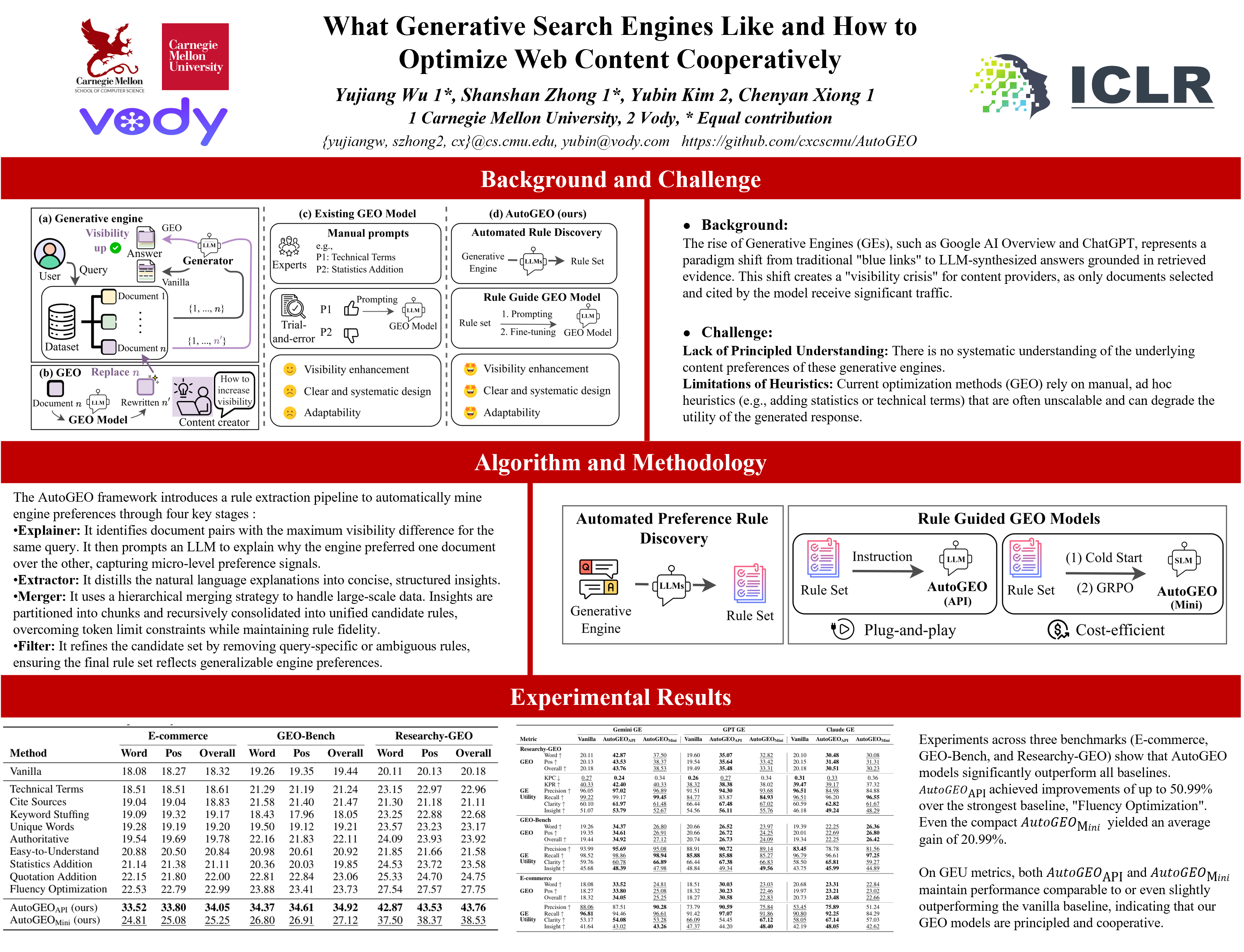
By employing large language models (LLMs) to retrieve documents and generate natural language responses, Generative Engines, such as Google AI overview and ChatGPT, provide significantly enhanced user experiences and have rapidly become the new form of search. Their rapid adoption also drives the needs of Generative Engine Optimization (GEO), as content providers are eager to gain more traction from them. In this paper, we introduce AutoGEO, a framework to automatically learn generative engine preferences when using retrieved contents for response generation, and rewrite web contents for more such traction. AutoGEO first prompts frontier LLMs to explain generative engine preferences and extract meaningful preference rules from these explanations. Then it uses preference rules as context engineering for AutoGEO$\_\text{API}$, a prompt-based GEO system, and as rule-based rewards to train AutoGEO$\_\text{Mini}$, a cost-effective GEO model. Experiments on the standard GEO-Bench and two newly constructed benchmarks using real user queries demonstrate the effectiveness of AutoGEO in enhancing content traction while preserving search utility. Analyses confirmed the learned rules' robustness and abilities to capture unique preferences in variant domains, and AutoGEO systems' ability to embed them in content optimization. The learned preference rules, our models, and the code is released at https://github.com/cxcscmu/AutoGEO
Sculptor: Empowering LLMs with Cognitive Agency via Active Context Management
Mo Li ⋅ L.H. Xu ⋅ Qitai Tan ⋅ Long Ma ⋅ Hongyong Song ⋅ Ting Cao ⋅ Yunxin Liu
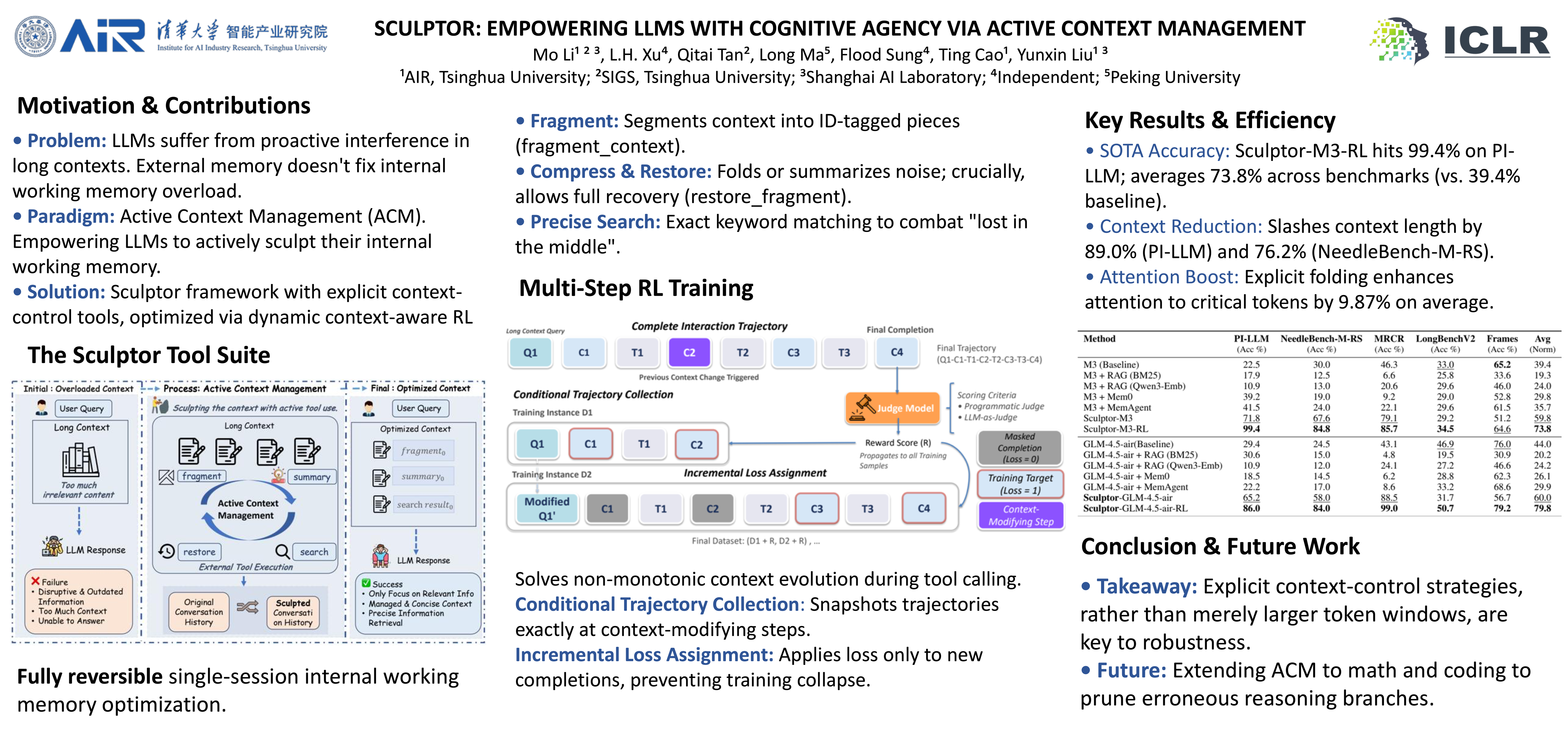
Large Language Models (LLMs) suffer from significant performance degradation when processing long contexts due to proactive interference, where irrelevant information in earlier parts of the context disrupts reasoning and memory recall. While most research focuses on external memory systems to augment LLMs' capabilities, we propose a complementary approach: empowering LLMs with Active Context Management (ACM) tools to actively sculpt their internal working memory. We introduce Sculptor, a framework that equips LLMs with three categories of tools: (1) context fragmentation, (2) summary, hide, and restore, and (3) precise search. Our approach enables LLMs to proactively manage their attention and working memory, analogous to how humans selectively focus on relevant information while filtering out distractions. Experimental evaluation on diverse long-context benchmarks demonstrates that Sculptor significantly improves performance even without specific training, leveraging LLMs' inherent tool-calling and instruction-following capabilities. To further optimize these strategies, we introduce a novel dynamic context-aware reinforcement learning (RL) approach, advancing the training of an agent that actively modifies its own conversational history. By enabling Active Context Management, Sculptor not only mitigates proactive interference but also provides a cognitive foundation for more reliable reasoning across diverse long-context tasks—highlighting that explicit context-control strategies, rather than merely larger token windows, are key to robustness at scale.
DreamOn: Diffusion Language Models For Code Infilling Beyond Fixed-size Canvas
Zirui Wu ⋅ Lin Zheng ⋅ Zhihui Xie ⋅ Jiacheng Ye ⋅ Jiahui Gao ⋅ Shansan Gong ⋅ Yansong Feng ⋅ Zhenguo Li ⋅ Wei BI ⋅ Guorui Zhou ⋅ Lingpeng Kong
Diffusion Language Models (DLMs) present a compelling alternative to autoregressive models, offering flexible, any-order infilling without specialized prompting design. However, their practical utility is blocked by a critical limitation: the requirement of a fixed-length masked sequence for generation. This constraint severely degrades code infilling performance when the predefined mask size mismatches the ideal completion length. To address this, we propose DreamOn, a novel diffusion framework that enables dynamic, variable-length generation. DreamOn augments the diffusion process with two length control states, allowing the model to autonomously expand or contract the output length based solely on its own predictions. We integrate this mechanism into existing DLMs with minimal modifications to the training objective and no architectural changes. Built upon Dream-Coder-7B and DiffuCoder-7B, DreamOn achieves infilling performance on par with state-of-the-art autoregressive models on HumanEval-Infilling and SantaCoder-FIM and matches oracle performance achieved with ground-truth length. Our work removes a fundamental barrier to the practical deployment of DLMs, significantly advancing their flexibility and applicability for variable-length generation. Our code is available at https://github.com/DreamLM/DreamOn.
Variation in Verification: Understanding Verification Dynamics in Large Language Models
Yefan Zhou ⋅ Austin Xu ⋅ Yilun Zhou ⋅ Janvijay Singh ⋅ Jiang Gui ⋅ Shafiq Joty
Recent advances have shown that scaling test-time computation enables large language models (LLMs) to solve increasingly complex problems across diverse domains. One effective paradigm for test-time scaling (TTS) involves LLM generators producing multiple solution candidates, with LLM verifiers assessing the correctness of these candidates without reference answers. In this paper, we study generative verifiers, which perform verification by generating chain-of-thought (CoT) reasoning followed by a binary verdict. We systematically analyze verification dynamics across three dimensions -- problem difficulty, generator capability, and verifier generation capability -- through empirical studies on 12 benchmarks across mathematical reasoning, knowledge, and natural language reasoning tasks using 14 open-source models (2B to 72B parameter range) and GPT-4o. Our experiments reveal three key findings about verification effectiveness: (1) Easy problems allow verifiers to more reliably certify correct responses; (2) Weak generators produce errors that are easier to detect than strong generators; (3) Verification ability is generally correlated with the verifier's own problem-solving capability, but this relationship varies with problem difficulty. These findings reveal opportunities for optimizing basic verification strategies in TTS applications. First, given the same verifier, some weak generators can nearly match stronger ones in post-verification TTS performance (e.g., the Gemma2-9B to Gemma2-27B performance gap shrinks by 75.7%). Second, we identify cases where strong verifiers offer limited advantages over weak ones, as both fail to provide meaningful verification gains, suggesting that verifier scaling alone cannot overcome fundamental verification challenges.
ODESteer: A Unified ODE-Based Steering Framework for LLM Alignment
Hongjue Zhao ⋅ Haosen Sun ⋅ Jiangtao Kong ⋅ Xiaochang Li ⋅ Qineng Wang ⋅ Liwei Jiang ⋅ Qi Zhu ⋅ Tarek Abdelzaher ⋅ Yejin Choi ⋅ Manling Li ⋅ Huajie Shao
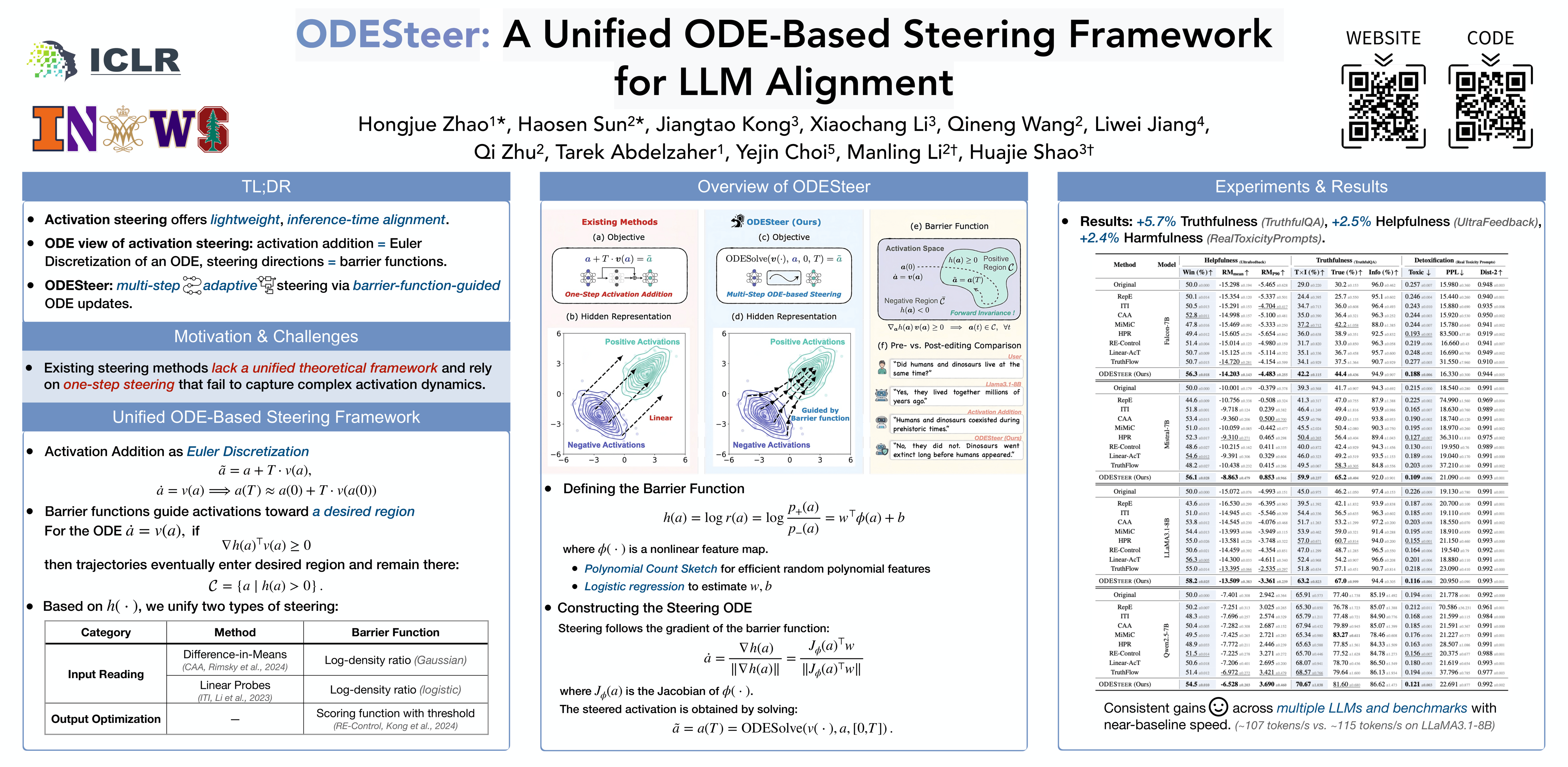
Activation steering, or representation engineering, offers a lightweight approach to align large language models (LLMs) by manipulating their internal activations at inference time. However, current methods suffer from two key limitations: \textit{(i)} the lack of a unified theoretical framework for guiding the design of steering directions, and \textit{(ii)} an over-reliance on \textit{one-step steering} that fail to capture complex patterns of activation distributions. In this work, we propose a unified ordinary differential equations (ODEs)-based \textit{theoretical} framework for activation steering in LLM alignment. We show that conventional activation addition can be interpreted as a first-order approximation to the solution of an ODE. Based on this ODE perspective, identifying a steering direction becomes equivalent to designing a \textit{barrier function} from control theory. Derived from this framework, we introduce ODESteer, a kind of ODE-based steering guided by barrier functions, which shows \textit{empirical} advancement in LLM alignment. ODESteer identifies steering directions by defining the barrier function as the log-density ratio between positive and negative activations, and employs it to construct an ODE for \textit{multi-step and adaptive} steering. Compared to state-of-the-art activation steering methods, ODESteer achieves consistent empirical improvements on diverse LLM alignment benchmarks, a notable $5.7\%$ improvement over TruthfulQA, $2.5\%$ over UltraFeedback, and $2.4\%$ over RealToxicityPrompts. Our work establishes a principled new view of activation steering in LLM alignment by unifying its theoretical foundations via ODEs, and validating it empirically through the proposed ODESteer method.
Repurposing Synthetic Data for Fine-grained Search Agent Supervision
Yida Zhao ⋅ Kuan Li ⋅ Xixi Wu ⋅ Liwen Zhang ⋅ Ding-Chu Zhang ⋅ Baixuan Li ⋅ Maojia Song ⋅ Zhuo Chen ⋅ Chenxi Wang ⋅ Xinyu Wang ⋅ Kewei Tu ⋅ Pengjun Xie ⋅ Fei Huang ⋅ Jingren Zhou ⋅ Yong Jiang
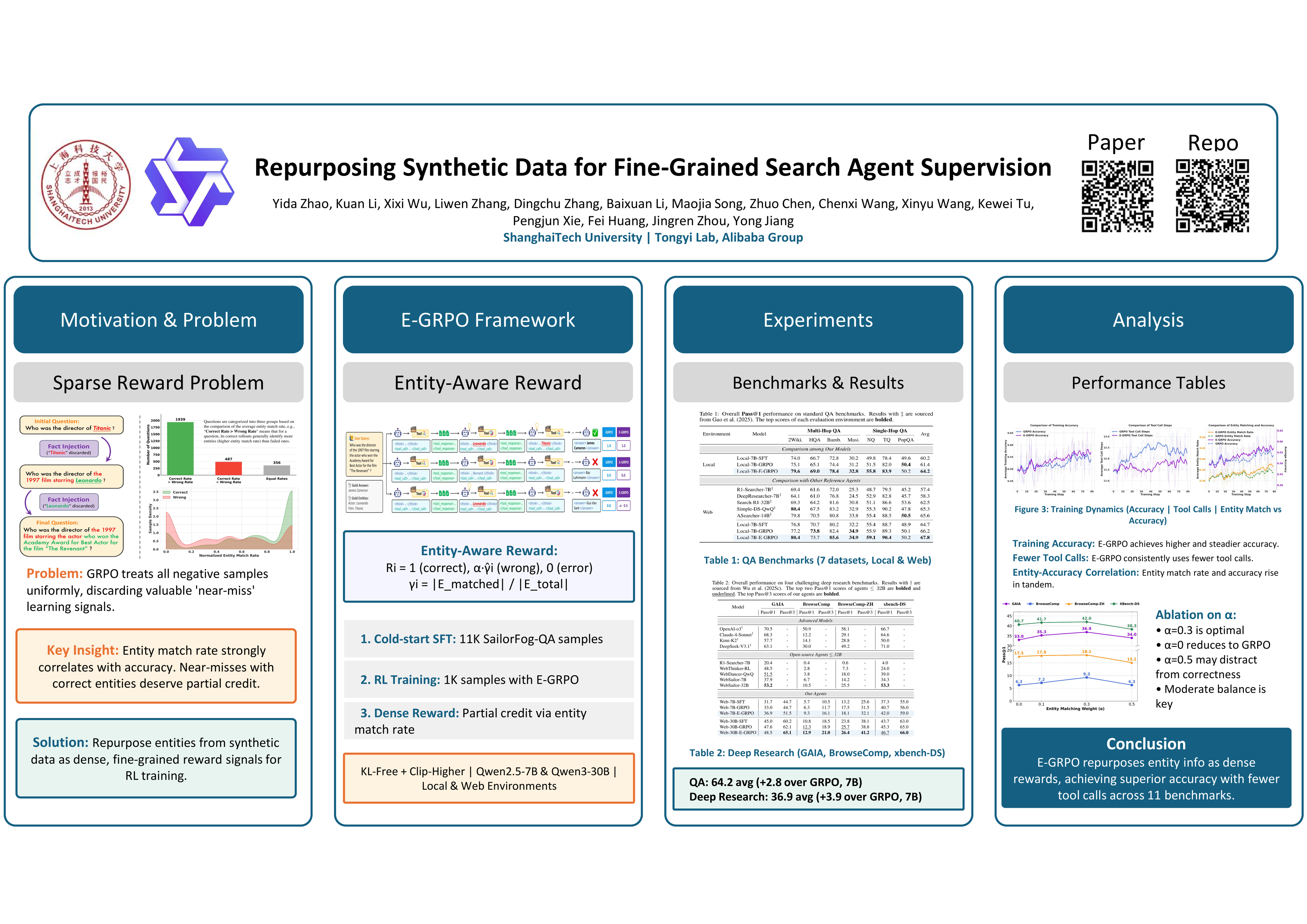
LLM-based search agents are increasingly trained on entity-centric synthetic data to solve complex, knowledge-intensive tasks. However, prevailing training methods like Group Relative Policy Optimization (GRPO) discard this rich entity information, relying instead on sparse, outcome-based rewards. This critical limitation renders them unable to distinguish informative "near-miss" samples—those with substantially correct reasoning but a flawed final answer—from complete failures, thus discarding valuable learning signals. We address this by leveraging the very entities discarded during training. Our empirical analysis reveals a strong positive correlation between the number of ground-truth entities identified during an agent's reasoning process and final answer accuracy. Building on this insight, we introduce Entity-aware Group Relative Policy Optimization (E-GRPO), a novel framework that formulates a dense entity-aware reward function. E-GRPO assigns partial rewards to incorrect samples proportional to their entity match rate, enabling the model to effectively learn from these ''near-misses''. Experiments on diverse question-answering (QA) and deep research benchmarks show that E-GRPO consistently and significantly outperforms the GRPO baseline. Furthermore, our analysis reveals that E-GRPO not only achieves superior accuracy but also induces more efficient reasoning policies that require fewer tool calls, demonstrating a more effective and sample-efficient approach to aligning search agents.
Post-training Large Language Models for Diverse High-Quality Responses
Yilei Chen ⋅ Souradip Chakraborty ⋅ Lorenz Wolf ⋅ Ioannis Paschalidis ⋅ Aldo Pacchiano
Reinforcement learning has emerged as a popular method for post-training large language models (LLMs). While improving the model's performance on downstream tasks, it often reduces the model's output diversity, leading to narrow, canonical responses. Existing methods to enhance diversity are limited, either by operating at inference time or by focusing on lexical differences. We propose a novel training method named DQO (Diversity Quality Optimization) based on determinantal point processes (DPPs) to jointly optimize LLMs for quality and semantic diversity. Our approach samples and embeds a group of responses for each prompt, then uses the determinant of a kernel-based similarity matrix to measure diversity as the volume spanned by the embeddings of these responses. Experiments across instruction-following, summarization, story generation, and reasoning tasks demonstrate that our method substantially improves semantic diversity without sacrificing model quality.
Flow2GAN: Hybrid Flow Matching and GAN with Multi-Resolution Network for Few-step High-Fidelity Audio Generation
Zengwei Yao ⋅ Wei Kang ⋅ Han Zhu ⋅ Liyong Guo ⋅ Lingxuan Ye ⋅ Fangjun Kuang ⋅ Weiji Zhuang ⋅ Zhaoqing Li ⋅ Zhifeng Han ⋅ Long Lin ⋅ Daniel Povey
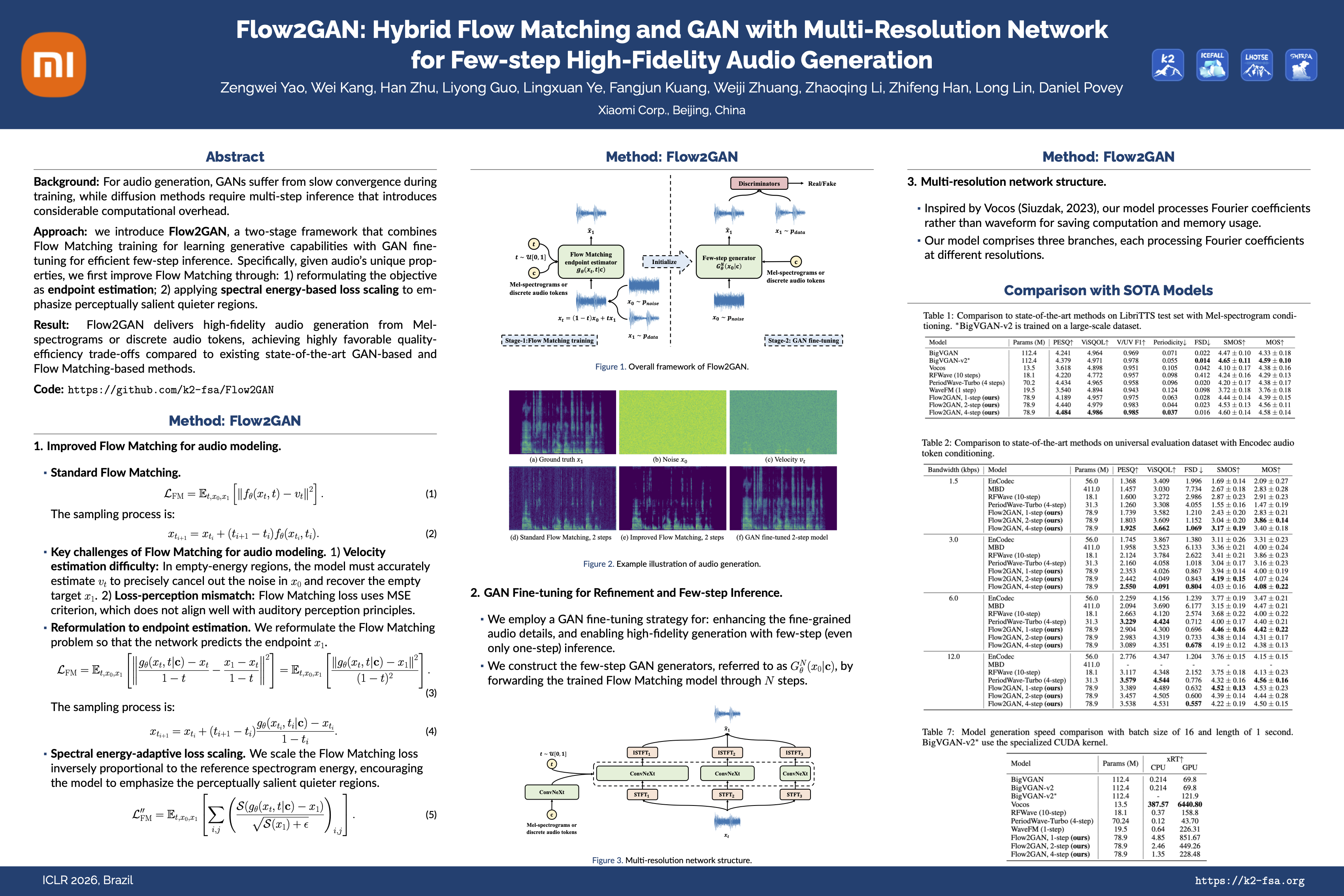
Existing dominant methods for audio generation include Generative Adversarial Networks (GANs) and diffusion-based methods like Flow Matching. GANs suffer from slow convergence during training, while diffusion methods require multi-step inference that introduces considerable computational overhead. In this work, we introduce Flow2GAN, a two-stage framework that combines Flow Matching training for learning generative capabilities with GAN fine-tuning for efficient few-step inference. Specifically, given audio's unique properties, we first improve Flow Matching for audio modeling through: 1) reformulating the objective as endpoint estimation, avoiding velocity estimation difficulties when involving empty regions; 2) applying spectral energy-based loss scaling to emphasize perceptually salient quieter regions. Building on these Flow Matching adaptations, we demonstrate that a further stage of lightweight GAN fine-tuning enables us to obtain few-step (e.g., 1/2/4 steps) generators that produce high-quality audio. In addition, we develop a multi-branch network architecture that processes Fourier coefficients at different time-frequency resolutions, which improves the modeling capabilities compared to prior single-resolution designs. Experimental results indicate that our Flow2GAN delivers high-fidelity audio generation from Mel-spectrograms or discrete audio tokens, achieving highly favorable quality-efficiency trade-offs compared to existing state-of-the-art GAN-based and Flow Matching-based methods. Online demo samples are available at \url{https://flow2gan.github.io}, and the source code is released at \url{https://github.com/k2-fsa/Flow2GAN}.
Data-Centric Lessons To Improve Speech-Language Pretraining
Vishaal Udandarao ⋅ Zhiyun Lu ⋅ Xuankai Chang ⋅ Yongqiang Wang ⋅ Albin Madappally Jose ⋅ Fartash Faghri ⋅ Josh Gardner ⋅ Chung-Cheng Chiu
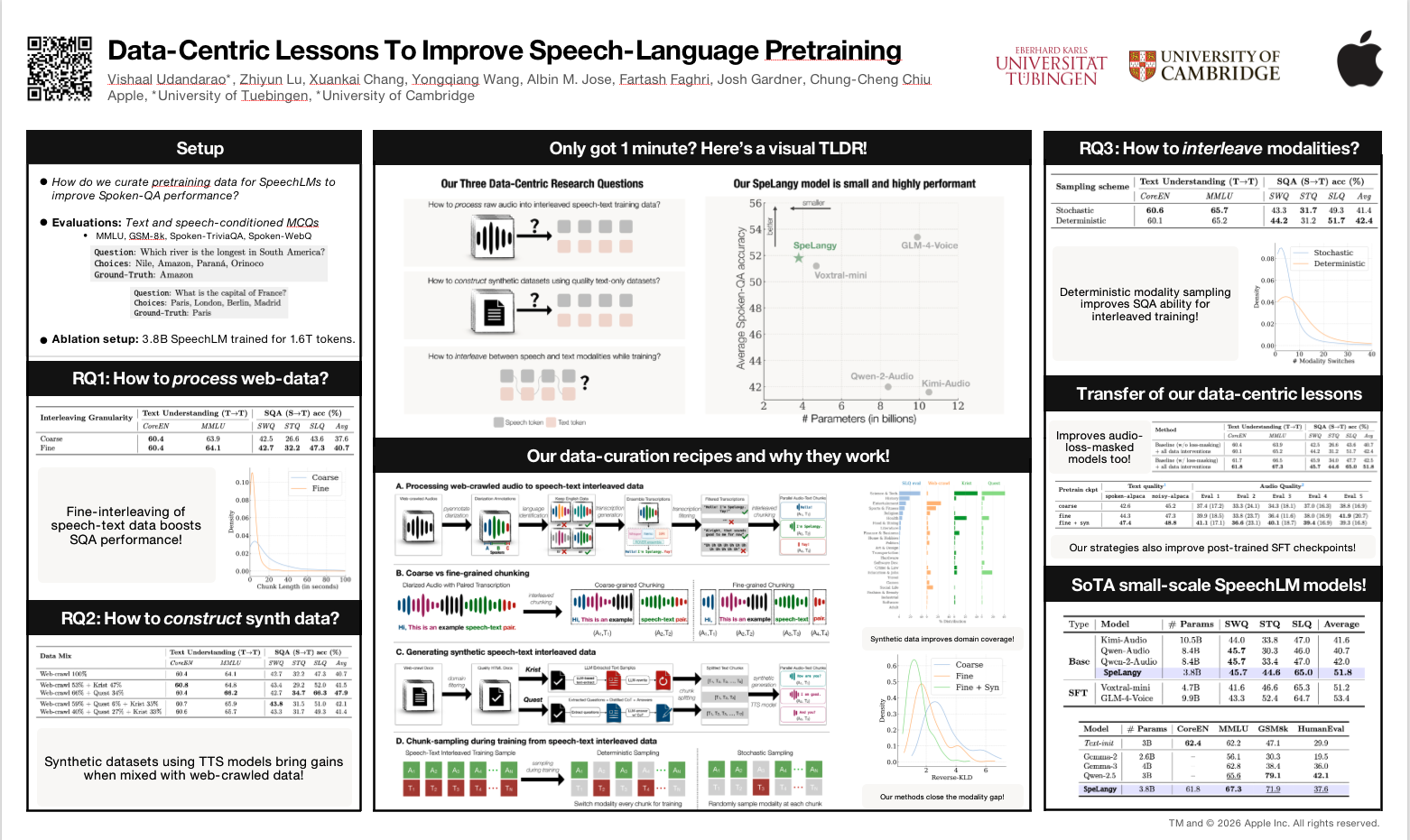
Spoken Question-Answering (SQA) is a core capability for useful and interactive artificial intelligence systems. Recently, several speech-language models (SpeechLMs) have been released with a specific focus on improving their SQA performance. However, a lack of controlled ablations of pretraining data processing and curation makes it challenging to understand what factors account for performance, despite substantial gains from similar studies in other data modalities. In this work, we address this gap by conducting a data-centric exploration for pretraining SpeechLMs. We focus on three questions fundamental to speech-language pretraining data: (1) how to process raw web-crawled audio content for speech-text pretraining, (2) how to construct synthetic datasets to augment web-crawled data and (3) how to interleave (text, audio) segments into training sequences. We apply the insights from our controlled data-centric ablations to pretrain a 3.8B-parameter SpeechLM, called SpeLangy, that outperforms models that are up to 3x larger by 10.2% absolute performance. We hope our findings highlight the impact of effective data curation and guide future data-centric exploration in SpeechLMs.
TraPO: A Semi-Supervised Reinforcement Learning Framework for Boosting LLM Reasoning
Shenzhi Yang ⋅ Guangcheng Zhu ⋅ Haobo Wang ⋅ Xing Zheng ⋅ Yingfan MA ⋅ Zhongqi Chen ⋅ Bowen Song ⋅ Weiqiang Wang ⋅ Junbo Zhao ⋅ Gang Chen
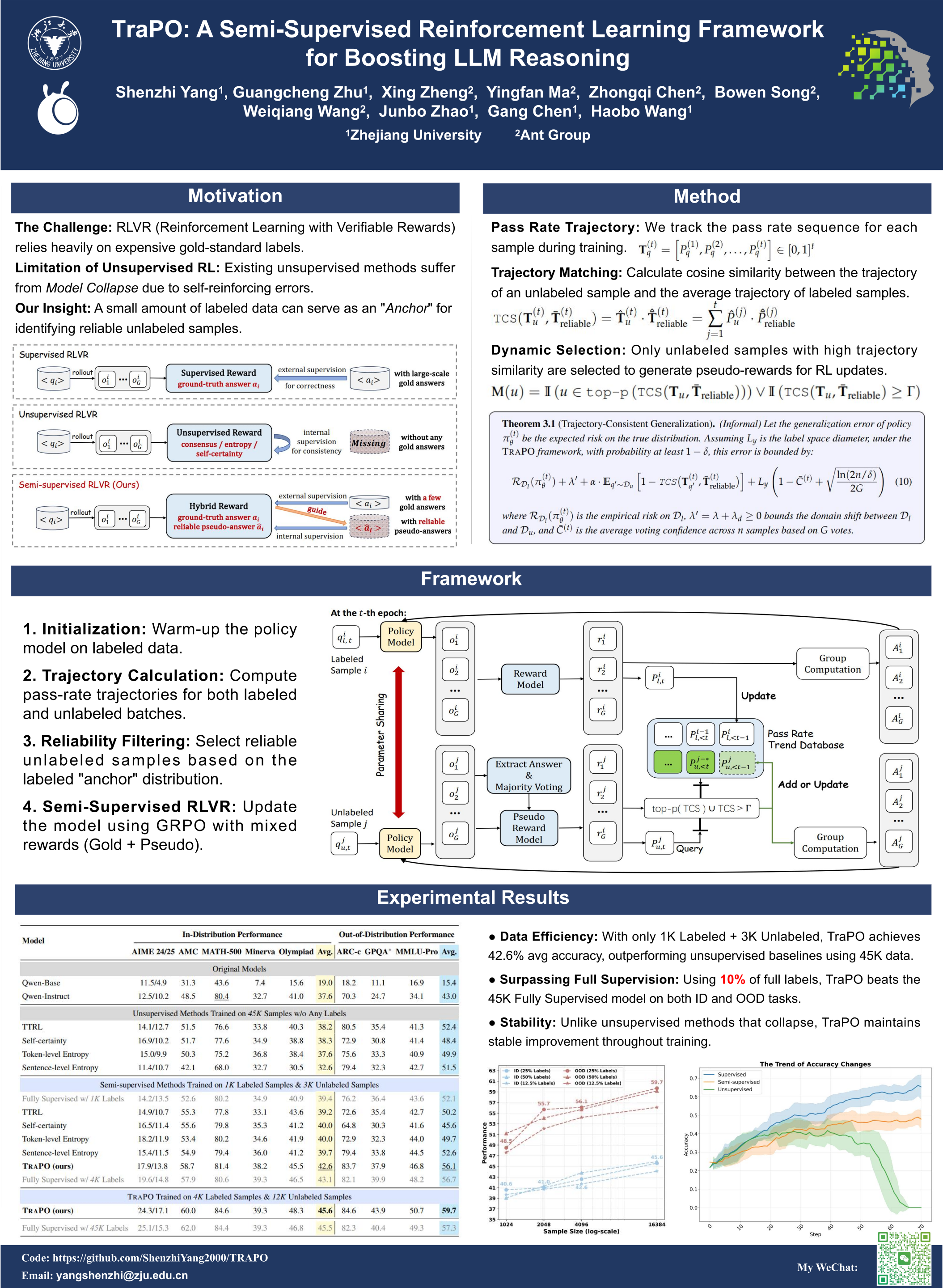
Reinforcement learning with verifiable rewards (RLVR) has proven effective in training large reasoning models (LRMs) by leveraging answer-verifiable signals to guide policy optimization, which, however, suffers from high annotation costs. To alleviate this problem, recent work has explored unsupervised RLVR methods that derive rewards solely from the model’s internal consistency, such as through entropy and majority voting. While seemingly promising, these methods often suffer from model collapse in the later stages of training, which may arise from the reinforcement of incorrect reasoning patterns in the absence of external supervision. In this work, we investigate a novel semi-supervised RLVR paradigm that utilizes a small labeled set to guide RLVR training on unlabeled samples. Our key insight is that supervised rewards are essential for stabilizing consistency-based training on unlabeled samples, ensuring that only reasoning patterns verified on labeled instances are incorporated into RL training. Technically, we propose an effective policy optimization algorithm TraPO that filters out reliable unlabeled samples by matching their learning trajectory similarity to labeled ones. Building on this, TraPO achieves remarkable data efficiency and strong generalization on nine advanced benchmarks. With only 1K labeled and 3K unlabeled samples, TraPO reaches 42.6% average accuracy, surpassing the best unsupervised method trained on 45K unlabeled samples (38.3%). Notably, when using 4K labeled and 12K unlabeled samples, TraPO even outperforms the fully supervised model trained on the full 45K labeled samples on all benchmarks, while using only 10% of the labeled data. The code is available via https://github.com/ShenzhiYang2000/TRAPO.
Don't Throw Away Your Pretrained Model
Shangbin Feng ⋅ Wenhao Yu ⋅ Yike Wang ⋅ Hongming Zhang ⋅ Yulia Tsvetkov ⋅ Dong Yu
Alignment training has tradeoffs: it helps language models (LMs) gain in reasoning and instruction following but might lose out on skills such as creativity and calibration, where unaligned base models are better at. We aim to make the best of both worlds through model collaboration, where different models in the training pipeline collaborate and complement each other. Since LM responses feature interleaving skills that favor different models, we propose Switch Generation, where pretrained and aligned model versions take turns to ``speak'' in a response sequence. Specifically, we train a switcher LM by learning from outcomes of choosing different models to generate the next segment across diverse queries and contexts. At inference time, the switcher LM guides different model checkpoints to dynamically generate the next segment where their strengths are most needed. Extensive experiments with 8 model collaboration baselines and 18 datasets show that 1) model collaboration consistently outperforms individual models on 16 out of 18 tasks, and 2) Switch Generation further outperforms baselines by 12.9% on average. Further analysis reveals that Switch Generation discovers compositional skills to solve problems where individual models struggle and generalizes to unseen models and tasks, reusing and repurposing by-products in expensive model training pipelines that are otherwise discarded.
SPG: Sandwiched Policy Gradient for Masked Diffusion Language Models
Chenyu Wang ⋅ Paria Rashidinejad ⋅ Andy (DiJia) Su ⋅ Song Jiang ⋅ Sid Wang ⋅ Siyan Zhao ⋅ Cai Zhou ⋅ Shannon Shen ⋅ Feiyu Chen ⋅ Tommi Jaakkola ⋅ Yuandong Tian ⋅ Bo Liu
Diffusion large language models (dLLMs) are emerging as an efficient alternative to autoregressive models due to their ability to decode multiple tokens in parallel. However, aligning dLLMs with human preferences or task-specific rewards via reinforcement learning (RL) is challenging because their intractable log-likelihood precludes the direct application of standard policy gradient methods. While prior work uses surrogates like the evidence lower bound (ELBO), these one-sided approximations can introduce significant policy gradient bias. To address this, we propose the Sandwiched Policy Gradient (SPG) that leverages both an upper and a lower bound of the true log-likelihood. Experiments show that SPG significantly outperforms baselines based on ELBO or one-step estimation. Specifically, SPG improves the accuracy over state-of-the-art RL methods for dLLMs by 3.6% on GSM8K, 2.6% on MATH500, 18.4% on Countdown, and 27.0% on Sudoku.
ATLAS: Adaptive Transfer Scaling Laws for Multilingual Pretraining, Finetuning, and Decoding the Curse of Multilinguality
Shayne Longpre ⋅ Sneha Kudugunta ⋅ Niklas Muennighoff ⋅ I-Hung Hsu ⋅ Isaac Caswell ⋅ Alex Pentland ⋅ Sercan Arik ⋅ Chen-Yu Lee ⋅ Sayna Ebrahimi
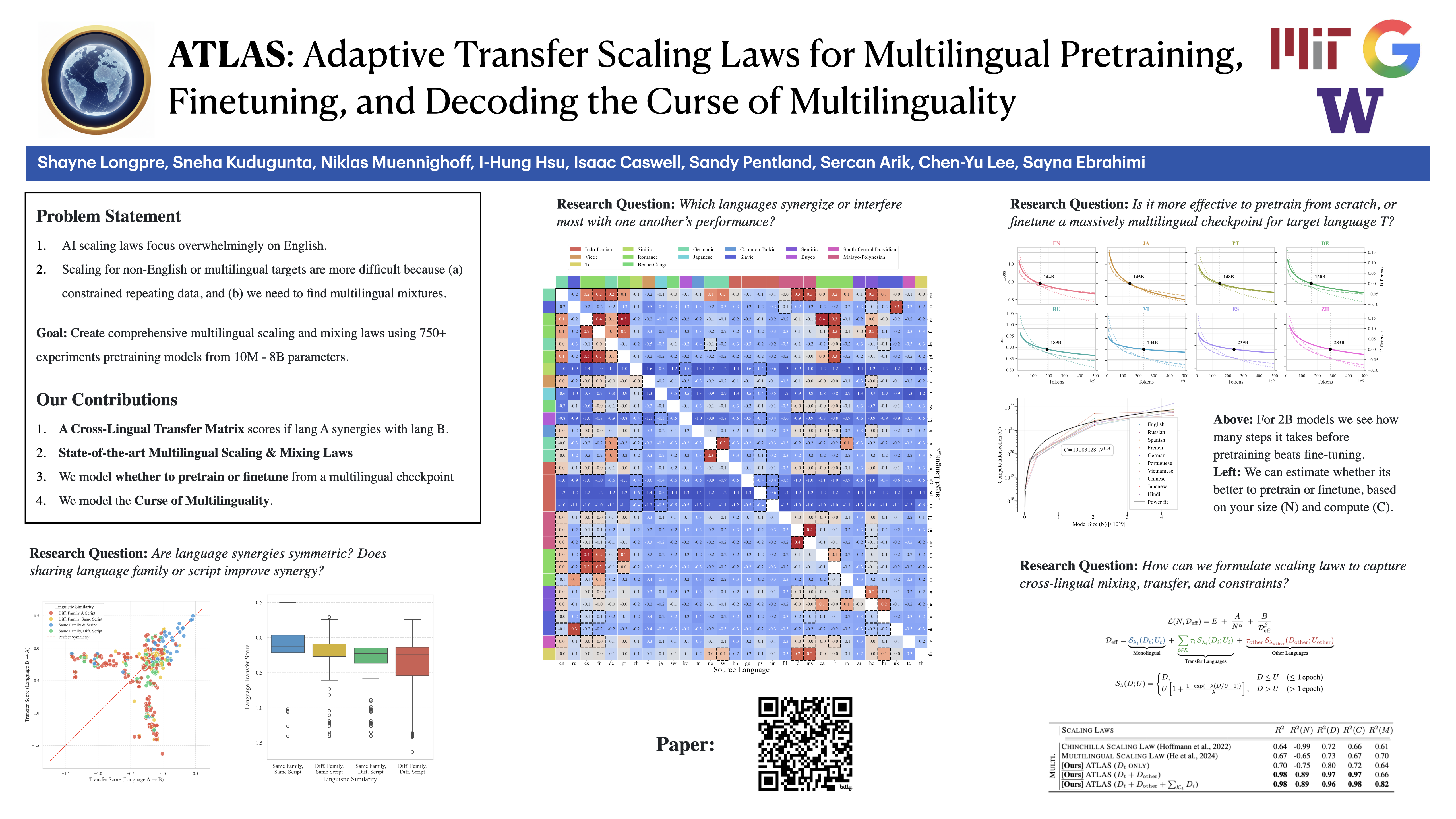
Scaling laws research has focused overwhelmingly on English—yet the most prominent AI models explicitly serve billions of international users. In this work, we undertake the largest multilingual scaling laws study to date, totaling 774 multilingual training experiments, spanning 10M-8B model parameters, 400+ training languages and 48 evaluation languages. We introduce the Adaptive Transfer Scaling Law (ATLAS) for both monolingual and multilingual pretraining, which outperforms existing scaling laws' out-of-sample generalization often by more than $0.3$ $R^2$. Our analyses of the experiments shed light on multilingual learning dynamics, transfer properties between languages, and the curse of multilinguality. First, we derive a cross-lingual transfer matrix, empirically measuring mutual benefit scores between $38 \times 38=1444$ language pairs. Second, we derive a language-agnostic scaling law that reveals how to optimally scale model size and data when adding languages without sacrificing performance. Third, we identify the computational crossover points for when to pretrain from scratch versus finetune from multilingual checkpoints. We hope these findings provide the scientific foundation for democratizing scaling laws across languages, and enable practitioners to efficiently scale models—beyond English-first AI.
Cannistraci-Hebb Training on Ultra-Sparse Spiking Neural Networks
Yuan Hua ⋅ Jilin Zhang ⋅ Yingtao Zhang ⋅ Leyi You ⋅ Baobo Xiong ⋅ Carlo Vittorio Cannistraci ⋅ Hong Chen
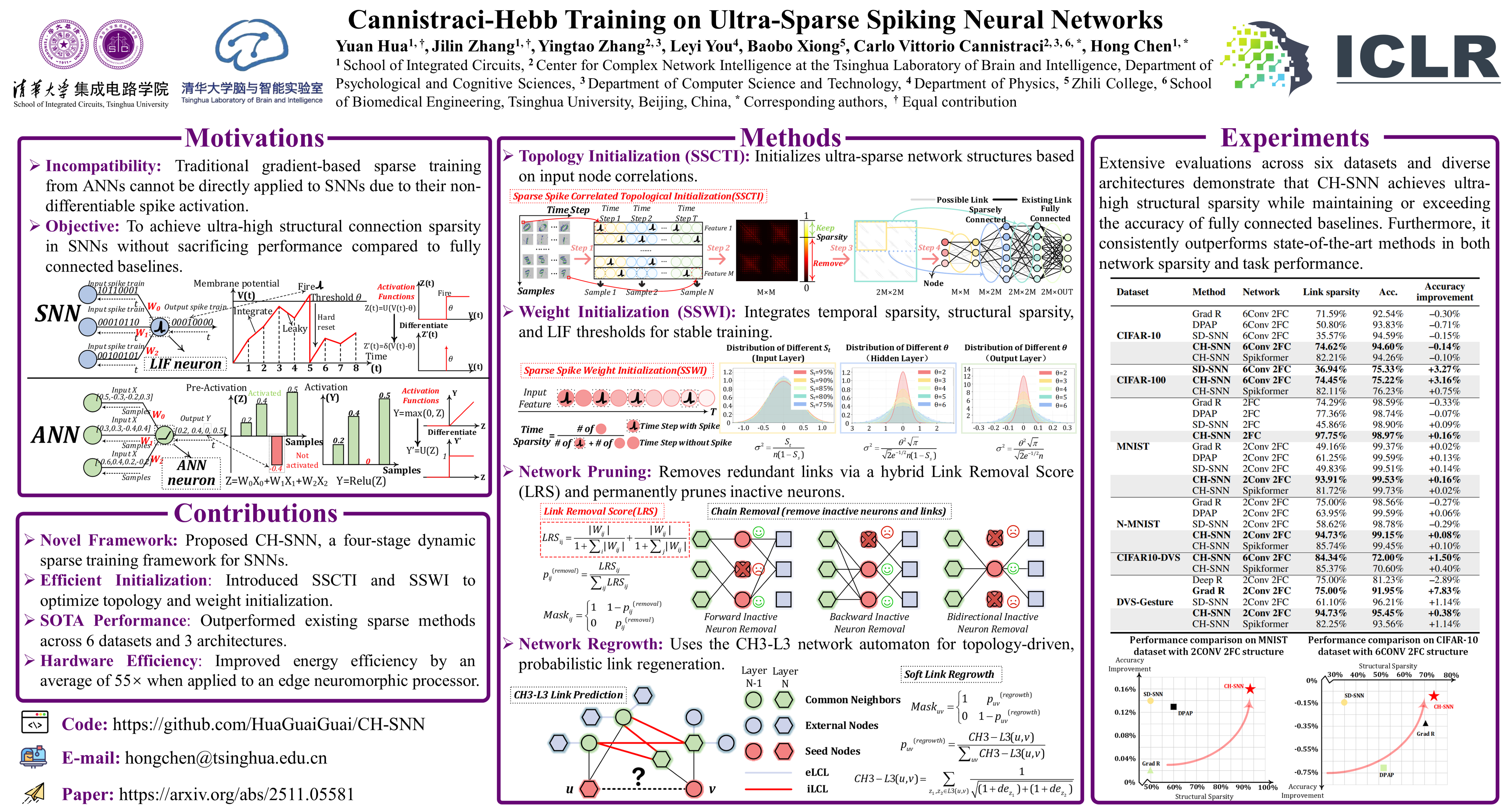
Inspired by the brain's spike-based computation, spiking neural networks (SNNs) inherently possess temporal activation sparsity. However, when it comes to the sparse training of SNNs in the structural connection domain, existing methods fail to achieve ultra-sparse network structures without significant performance loss, thereby hindering progress in energy-efficient neuromorphic computing. This limitation presents a critical challenge: how to achieve high levels of structural connection sparsity while maintaining performance comparable to fully connected networks. To address this challenge, we propose the Cannistraci-Hebb Spiking Neural Network (CH-SNN), a novel and generalizable dynamic sparse training framework for SNNs consisting of four stages. First, we propose a sparse spike correlated topological initialization (SSCTI) method to initialize a sparse network based on node correlations. Second, temporal activation sparsity and structural connection sparsity are integrated via a proposed sparse spike weight initialization (SSWI) method. Third, a hybrid link removal score (LRS) is applied to prune redundant weights and inactive neurons, improving information flow. Finally, the CH3-L3 network automaton framework inspired by Cannistraci-Hebb learning theory is incorporated to perform link prediction for potential synaptic regrowth. These mechanisms enable CH-SNN to achieve sparsification across all linear layers. We have conducted extensive experiments on six datasets including CIFAR-10 and CIFAR-100, evaluating various network architectures such as spiking convolutional neural networks and Spikformer. The proposed method achieves a maximum sparsity of 97.75% and outperforms the fully connected (FC) network by 0.16% in accuracy. Furthermore, we apply CH-SNN within an SNN training algorithm deployed on an edge neuromorphic processor. The experimental results demonstrate that, compared to the FC baseline without CH-SNN, the sparse CH-SNN architecture achieves up to 98.84% sparsity, an accuracy improvement of 2.27%, and a 97.5$\times$ reduction in synaptic operations, and the energy consumption is reduced by an average of 55$\times$ across four datasets. Our code is available at https://github.com/HuaGuaiGuai/CH-SNN.
Generating metamers of human scene understanding
Ritik Raina ⋅ Abe Leite ⋅ Alexandros Graikos ⋅ Seoyoung Ahn ⋅ Dimitris Samaras ⋅ Gregory Zelinsky
Human vision combines low-resolution “gist” information from the visual periphery with sparse but high-resolution information from fixated locations to construct a coherent understanding of a visual scene. In this paper, we introduce MetamerGen, a tool for generating scenes that are aligned with latent human scene representations. MetamerGen is a latent diffusion model that combines peripherally obtained scene gist information with information obtained from scene-viewing fixations to generate image metamers for what humans understand after viewing a scene. Generating images from both high and low resolution (i.e. “foveated”) inputs constitutes a novel image-to-image synthesis problem, which we tackle by introducing a dual-stream representation of the foveated scenes consisting of DINOv2 tokens that fuse detailed features from fixated areas with peripherally degraded features capturing scene context. To evaluate the perceptual alignment of MetamerGen generated images to latent human scene representations, we conducted a same-different behavioral experiment where participants were asked for a “same” or “different” response between the generated and the original image. With that, we identify scene generations that are indeed metamers for the latent scene representations formed by the viewers. MetamerGen is a powerful tool for understanding scene understanding. Our proof-of-concept analyses uncovered specific features at multiple levels of visual processing that contributed to human judgments. While it can generate metamers even conditioned on random fixations, we find that high-level semantic alignment most strongly predicts metamerism when the generated scenes are conditioned on viewers’ own fixated regions.
A tale of two tails: Preferred and anti-preferred natural stimuli in visual cortex
Rabia Gondur ⋅ Patricia Stan ⋅ Matthew A Smith ⋅ Benjamin Cowley
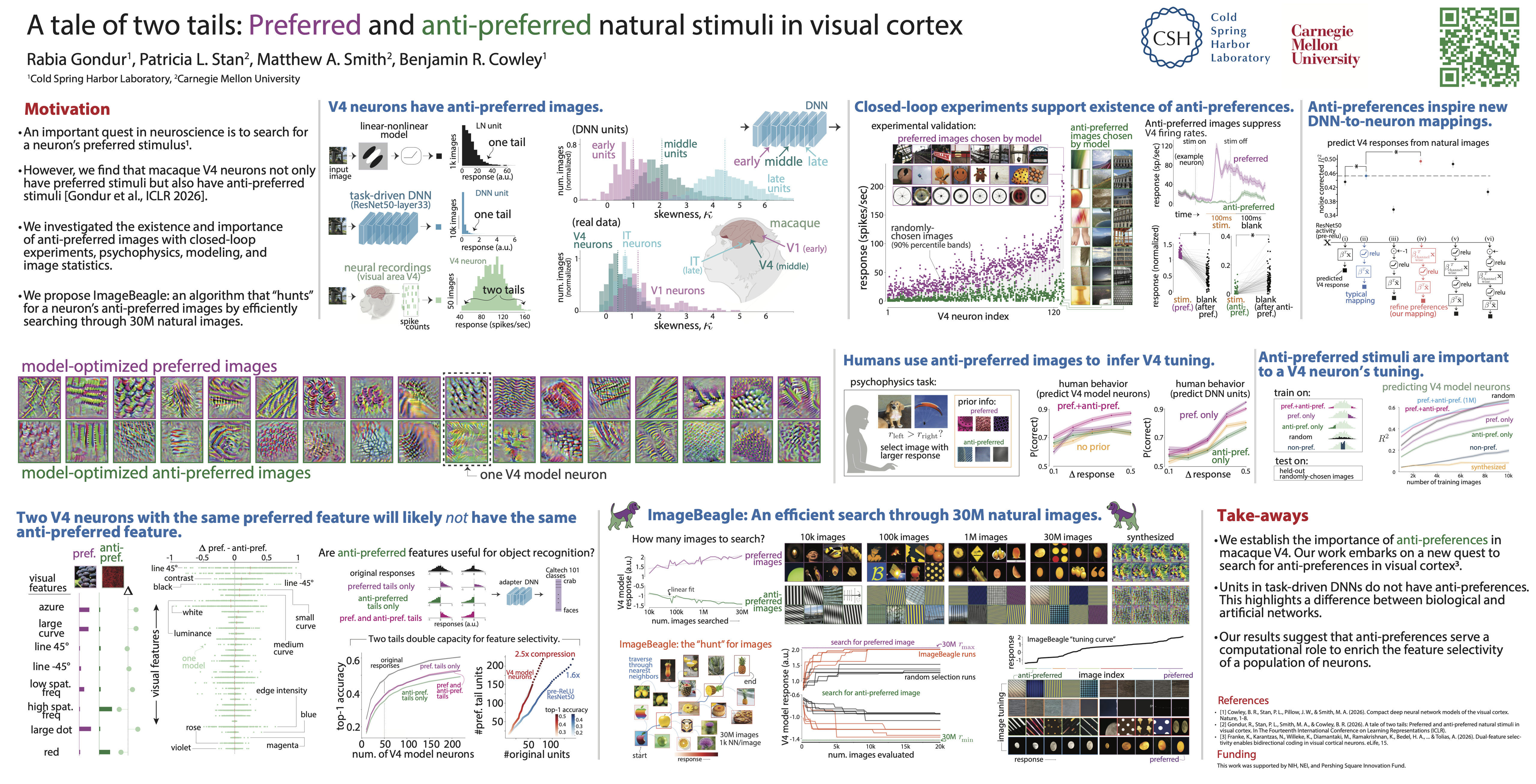
An ongoing quest in neuroscience is to find the preferred stimulus of a sensory neuron. This search lays the foundation for understanding how selectivity emerges in the primate visual stream---from simple edge-detecting neurons to highly-selective face neurons---as well as for the architectures and activation functions of deep neural networks. The prevailing notion is that a visual neuron primarily responds to a single preferred visual feature, like an oriented edge or the shape of an object, resulting in a 'one-tailed' distribution of responses to natural images. However, surprisingly, we instead find 'two-tailed' response distributions of primate visual cortical neurons, suggesting that these neurons have both preferred and anti-preferred stimuli. We experimentally validated anti-preferred stimuli by recording responses from macaque V4 to model-optimized stimuli. We find that these anti-preferred stimuli are important for describing a neuron's tuning, as both preferred and anti-preferred images are needed to predict a neuron's responses to natural images. Moreover, in a psychophysics task, humans rely on anti-preferred images to interpret and predict V4 stimulus tuning; this was not the case for internal units from a deep neural network. Interestingly, we find no discernible differences in image statistics between preferred and anti-preferred images. This suggests that by encoding anti-preferred features, a V4 population seemingly doubles its capacity for feature selectivity, allowing for a more flexible downstream readout. Overall, we establish anti-preferred stimuli as an important encoding property of V4 neurons. Our work embarks on a new quest in neuroscience to search for anti-preferred stimuli along the visual stream and offers a new perspective on how feature selectivity arises in the visual cortex and deep neural networks.
The Mind's Transformer: Computational Neuroanatomy of LLM-Brain Alignment
Cheng-Yeh Chen ⋅ Raghupathy Sivakumar
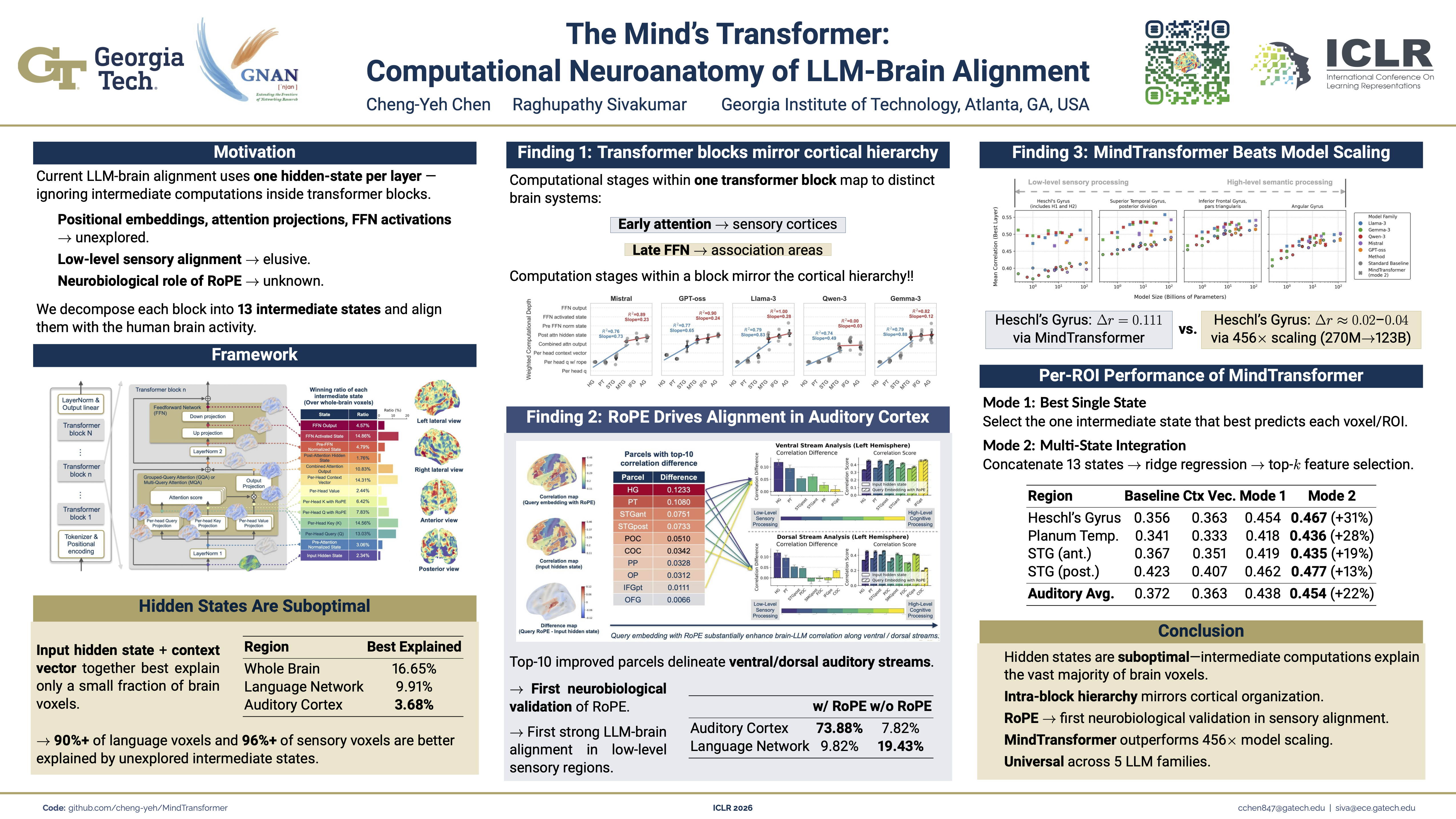
The alignment of Large Language Models (LLMs) and brain activity provides a powerful framework to advance our understanding of cognitive neuroscience and artificial intelligence. In this work, we zoom into one of the fundamental units of LLMs—the transformer block—to provide the first systematic computational neuroanatomy of its internal operations and human brain acitivity during language processing. Analyzing 21 state-of-the-art LLMs across five model families, we extract and evaluate 13 distinct intermediate states per transformer block—from initial layer normalization through attention mechanisms to feed-forward networks (FFNs). Our analysis reveals three key findings: (1) The commonly used hidden states in LLMs are surprisingly suboptimal, with over 90\% of brain voxels in sensory and language regions better explained by previously unexplored intermediate computations; (2) Different computational stages within a single transformer block map to anatomically distinct brain systems, revealing an intra-block hierarchy where early attention states align with sensory cortices while later FFN states correspond to association areas—mirroring the cortical processing hierarchy; (3) Rotary Positional Embeddings (RoPE) specifically enhance alignment along the brain's auditory processing streams. Per-head queries with RoPE best explain 74\% of auditory cortex activity compared to 8\% without RoPE, providing the first neurobiological validation of this architectural component in LLMs. Building on these insights, we propose MindTransformer, a feature selection framework that learns brain-aligned representations from all intermediate states. MindTransformer achieves significant brain alignment performance, with correlation improvements in primary auditory cortex exceeding gains from 456× model scaling. Our computational neuroanatomy approach opens new directions for understanding both biological intelligence through the lens of transformer computations and artificial intelligence through principles of brain organization.
Low rank adaptation of chemical foundation models generate effective odorant representations
Grant McConachie ⋅ Emily Duniec ⋅ Florence Guerina ⋅ Meg Younger ⋅ Brian DePasquale
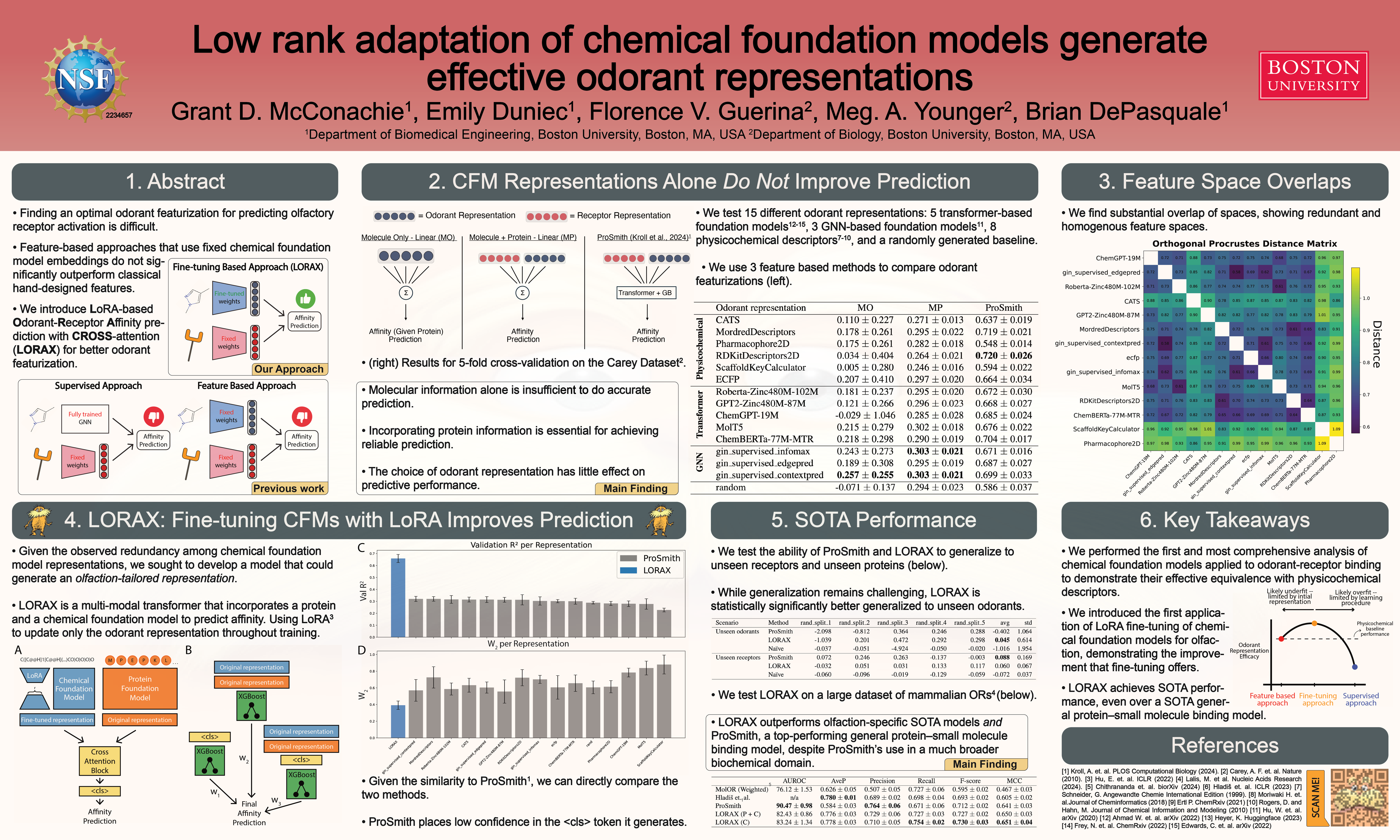
Featurizing odorants to enable robust prediction of their properties is difficult due to the complex activation patterns that odorants evoke in the olfactory system. Structurally similar odorants can elicit distinct activation patterns in both the sensory periphery (i.e., at the receptor level) and downstream brain circuits (i.e., at a perceptual level). Despite efforts to design odorant features to better predict how they interact with the olfactory system, there is still no universally accepted approach to this problem. We demonstrate that feature-based approaches that rely on pre-trained foundation models to generate odorant representations $\textit{do not}$ significantly outperform classical hand-designed features on odorant-receptor binding tasks. Instead, we show that it is necessary to fine-tune these features to increase predictive performance. To show this, we introduce a new model that creates olfaction-specific representations: $\textbf{L}$oRA-based $\textbf{O}$dorant-$\textbf{R}$eceptor $\textbf{A}$ffinity prediction with $\textbf{CROSS}$-attention ($\textbf{LORAX}$). We compare existing chemical foundation model representations to hand-designed physicochemical descriptors using feature-based methods and identify large information overlap between these representations, highlighting the necessity of fine-tuning to generate novel and superior odorant representations. We show that LORAX produces a feature space more closely aligned with olfactory neural representation, enabling it to outperform existing models on predictive tasks.
Animal behavioral analysis and neural encoding with transformer-based self-supervised pretraining
Yanchen Wang ⋅ Han Yu ⋅ Ari Blau ⋅ Yizi Zhang ⋅ International Brain Laboratory ⋅ Liam Paninski ⋅ Cole Hurwitz ⋅ Matthew R Whiteway
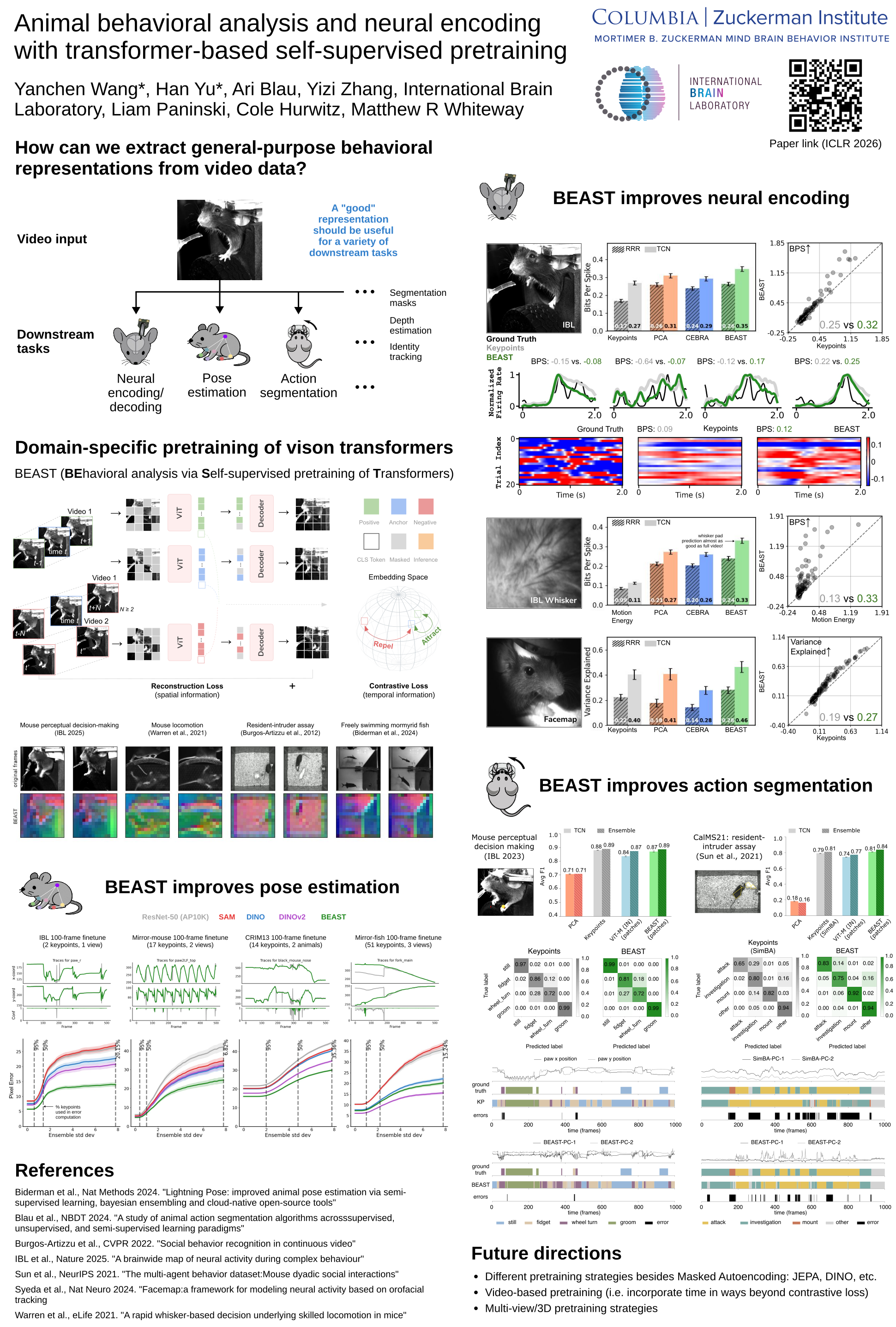
The brain can only be fully understood through the lens of the behavior it generates--a guiding principle in modern neuroscience research that nevertheless presents significant technical challenges. Many studies capture behavior with cameras, but video analysis approaches typically rely on specialized models requiring extensive labeled data. We address this limitation with BEAST (BEhavioral Analysis via Self-supervised pretraining of Transformers), a novel and scalable framework that pretrains experiment-specific vision transformers for diverse neuro-behavior analyses. BEAST combines masked autoencoding with temporal contrastive learning to effectively leverage unlabeled video data. Through comprehensive evaluation across multiple species, we demonstrate improved performance in three critical neuro-behavioral tasks: extracting behavioral features that correlate with neural activity, and pose estimation and action segmentation in both the single- and multi-animal settings. Our method establishes a powerful and versatile backbone model that accelerates behavioral analysis in scenarios where labeled data remains scarce.
Brain-IT: Image Reconstruction from fMRI via Brain-Interaction Transformer
Roman Beliy ⋅ Amit Zalcher ⋅ Jonathan Kogman ⋅ navve wasserman ⋅ michal Irani
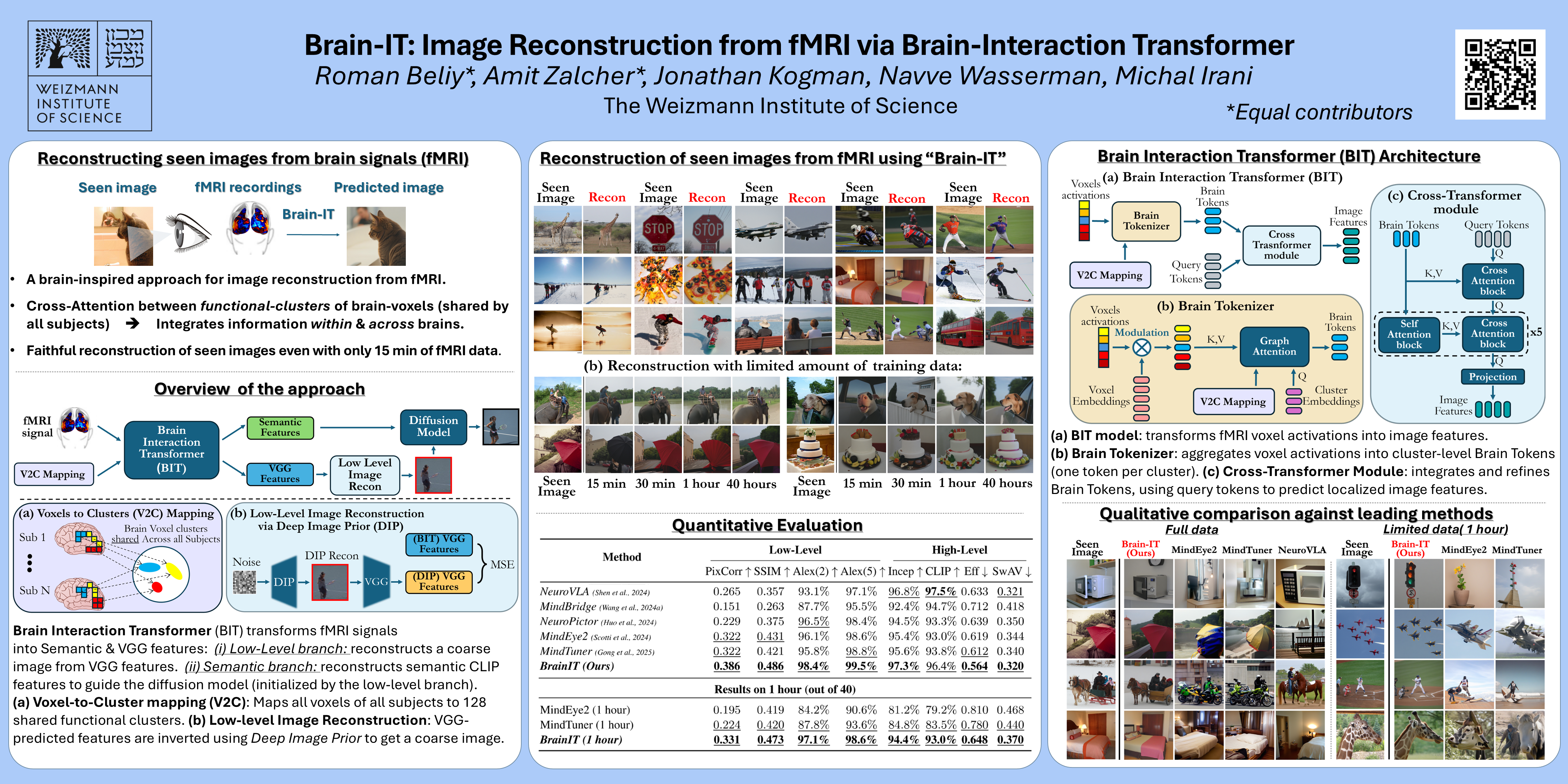
Reconstructing images seen by people from their fMRI brain recordings provides a non-invasive window into the human brain. Despite recent progress enabled by diffusion models, current methods often lack faithfulness to the actual seen images. We present ``Brain-IT'', a brain-inspired approach that addresses this challenge through a Brain Interaction Transformer (BIT), allowing effective interactions between clusters of functionally-similar brain-voxels. These functional-clusters are shared by all subjects, serving as building blocks for integrating information both within and across brains. All model components are shared by all clusters & subjects, allowing efficient training with limited amount of data. To guide the image reconstruction, BIT predicts two complementary localized patch-level image features: (i) high-level semantic features which steer the diffusion model toward the correct semantic content of the image; and (ii) low-level structural features which help to initialize the diffusion process with the correct coarse layout of the image. BIT's design enables direct flow of information from brain-voxel clusters to localized image features. Through these principles, our method achieves image reconstructions from fMRI that faithfully reconstruct the seen images, and surpass current SotA approaches both visually and by standard objective metrics. Moreover, with only 1-hour of fMRI data from a new subject, we achieve results comparable to current methods trained on full 40-hour recordings.
ODEBrain: Continuous-Time EEG Graph for Modeling Dynamic Brain Networks
Haohui Jia ⋅ Zheng Chen ⋅ Lingwei Zhu ⋅ Rikuto Kotoge ⋅ Jathurshan Pradeepkumar ⋅ Yasuko Matsubara ⋅ Jimeng Sun ⋅ Yasushi Sakurai ⋅ Takashi Matsubara
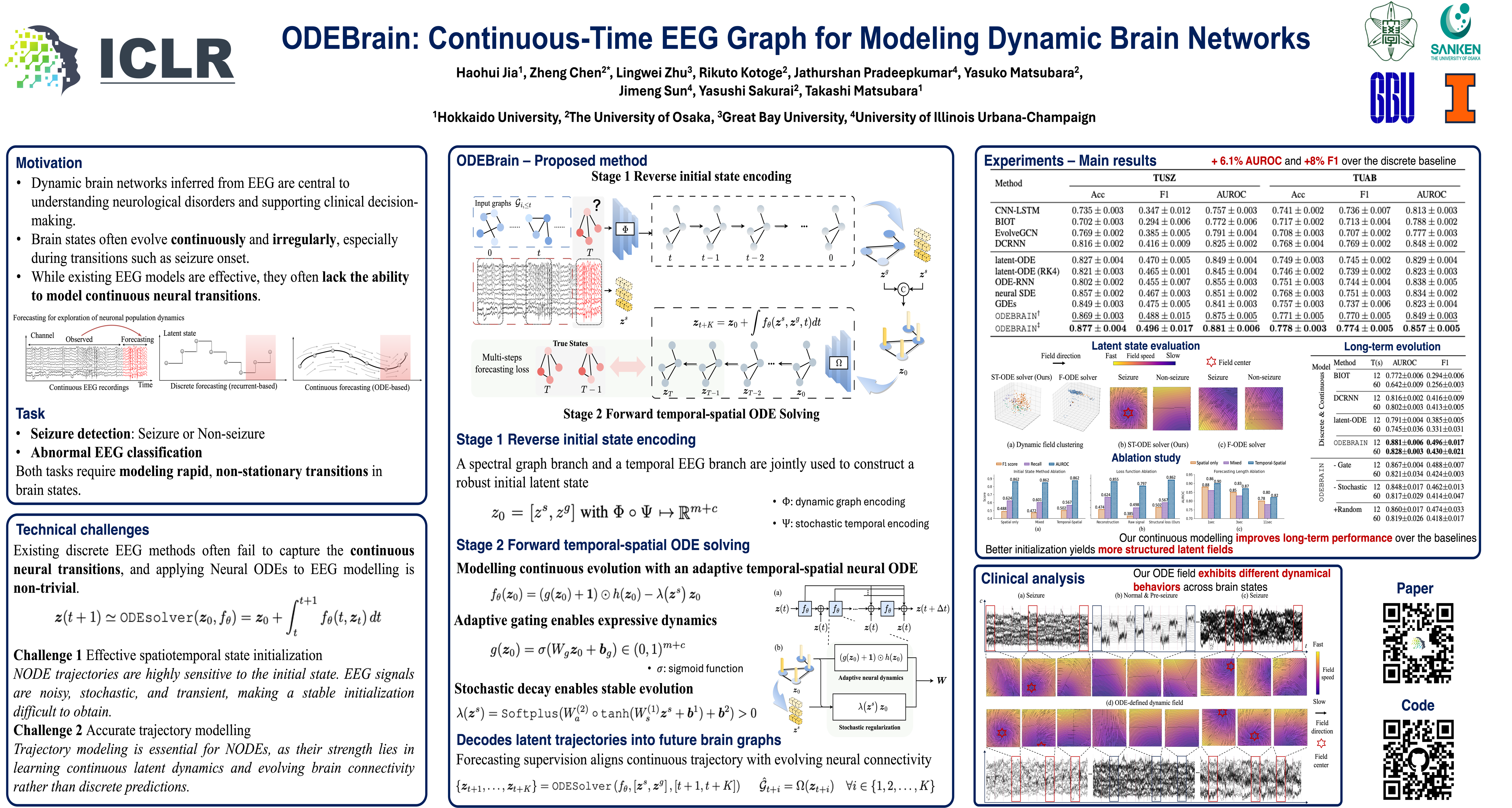
Modeling neural population dynamics is crucial for foundational neuroscientific research and various clinical applications. Conventional latent variable methods typically model continuous brain dynamics through discretizing time with recurrent architecture, which necessarily results in compounded cumulative prediction errors and failure of capturing instantaneous, nonlinear characteristics of EEGs. We propose ODEBrain, a Neural ODE latent dynamic forecasting framework to overcome these challenges by integrating spatio-temporal-frequency features into spectral graph nodes, followed by a Neural ODE modeling the continuous latent dynamics. Our design ensures that the latent representations can capture stochastic variations of complex brain states at any given time point. Extensive experiments verify that ODEBrain can improve significantly over existing methods in forecasting EEG dynamics with enhanced robustness and generalization capabilities.
From movement to cognitive maps: recurrent neural networks reveal how locomotor development shapes hippocampal spatial coding
Marco P Abrate ⋅ Laurenz Muessig ⋅ Joshua Bassett ⋅ Hui Tan ⋅ Francesca Cacucci ⋅ Thomas Wills ⋅ Caswell Barry
The hippocampus contains neurons whose firing correlates with an animal's location and orientation in space. Collectively, these neurons are held to support a cognitive map of the environment, enabling the recall of and navigation to specific locations. Although recent studies have characterised the timelines of spatial neuron development, no unifying mechanistic model has yet been proposed. Moreover, the processes driving the emergence of spatial representations in the hippocampus remain unclear (Tan et al., 2017). Here, we combine computational analysis of postnatal locomotor development with a recurrent neural network (RNN) model of hippocampal function to demonstrate how changes in movement statistics -- and the resulting sensory experiences -- shape the formation of spatial tuning. First, we identify distinct developmental stages in rat locomotion during open-field exploration using published experimental data. Then, we train shallow RNNs to predict upcoming visual stimuli from concurrent visual and vestibular inputs, exposing them to trajectories that reflect progressively maturing locomotor patterns. Our findings reveal that these changing movement statistics drive the sequential emergence of spatially tuned units, mirroring the developmental timeline observed in rats. The models generate testable predictions about how spatial tuning properties mature -- predictions we confirm through analysis of hippocampal recordings. Critically, we demonstrate that replicating the specific statistics of developmental locomotion -- rather than merely accelerating sensory change -- is essential for the emergence of an allocentric spatial representation. These results establish a mechanistic link between embodied sensorimotor experience and the ontogeny of hippocampal spatial neurons, with significant implications for neurodevelopmental research and predictive models of navigational brain circuits.
MindPilot: Closed-loop Visual Stimulation Optimization for Brain Modulation with EEG-guided Diffusion
Dongyang Li ⋅ Kunpeng Xie ⋅ Mingyang Wu ⋅ Yiwei Kong ⋅ Jiahua Tang ⋅ Haoyang Qin ⋅ Chen Wei ⋅ Quanying Liu
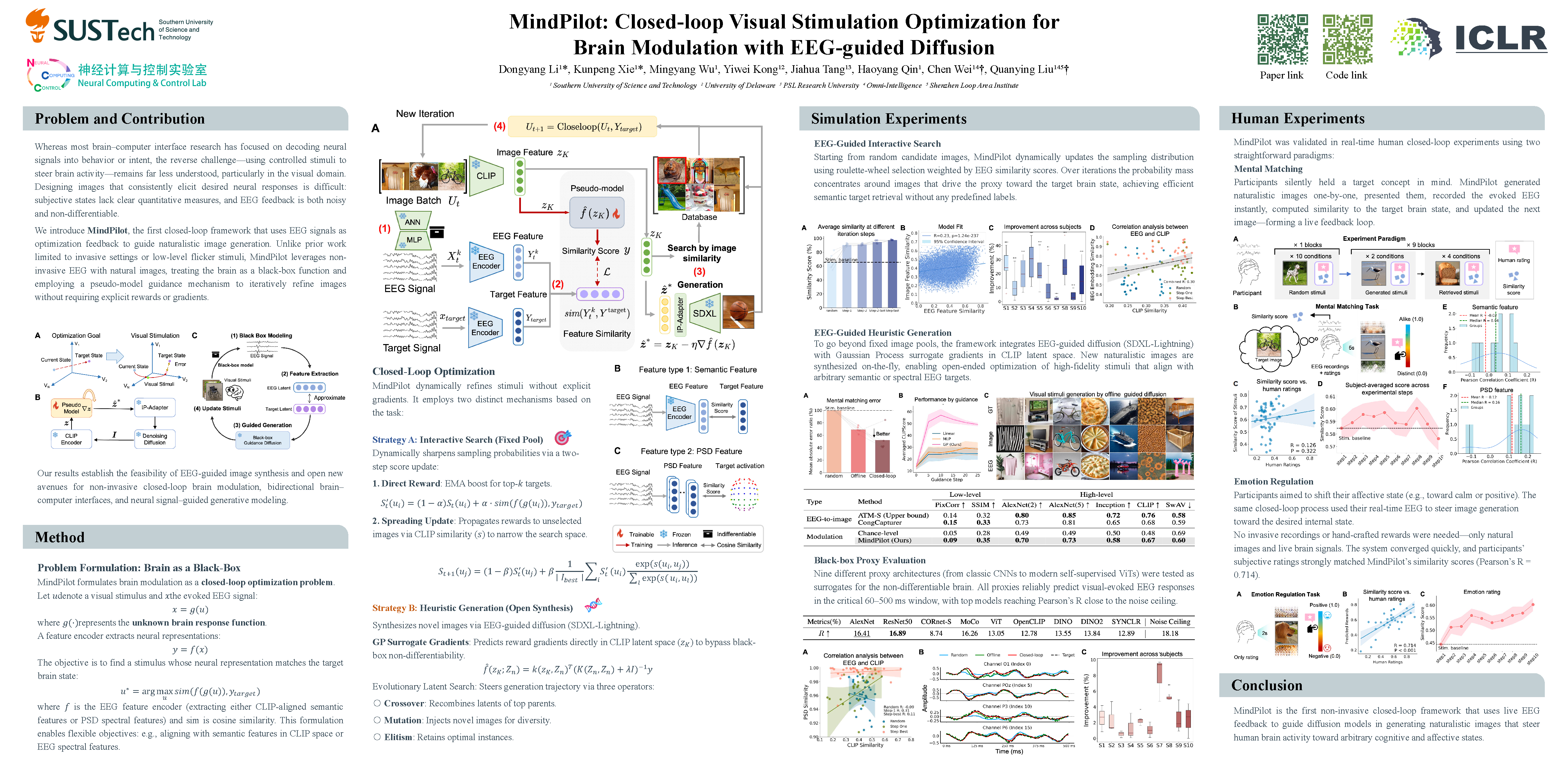
Whereas most brain–computer interface research has focused on decoding neural signals into behavior or intent, the reverse challenge—using controlled stimuli to steer brain activity—remains far less understood, particularly in the visual domain. However, designing images that consistently elicit desired neural responses is difficult: subjective states lack clear quantitative measures, and EEG feedback is both noisy and non-differentiable. We introduce MindPilot, the first closed-loop framework that uses EEG signals as optimization feedback to guide naturalistic image generation. Unlike prior work limited to invasive settings or low-level flicker stimuli, MindPilot leverages non-invasive EEG with natural images, treating the brain as a black-box function and employing a pseudo-model guidance mechanism to iteratively refine images without requiring explicit rewards or gradients. We validate MindPilot in both simulation and human experiments, demonstrating (i) efficient retrieval of semantic targets, (ii) closed-loop optimization of EEG features, and (iii) human-subject validations in mental matching and emotion regulation tasks. Our results establish the feasibility of EEG-guided image synthesis and open new avenues for non-invasive closed-loop brain modulation, bidirectional brain–computer interfaces, and neural signal–guided generative modeling.
SMixer: Rethinking Efficient-Training and Event-Driven SNNs
Yijie Lu ⋅ Xinhao Luo ⋅ Yixing Zhang ⋅ Zhiyan Wang ⋅ Wentao Li ⋅ Yanhan Wang ⋅ Zhi Liu ⋅ Zhaokun Zhou ⋅ Guoqi Li
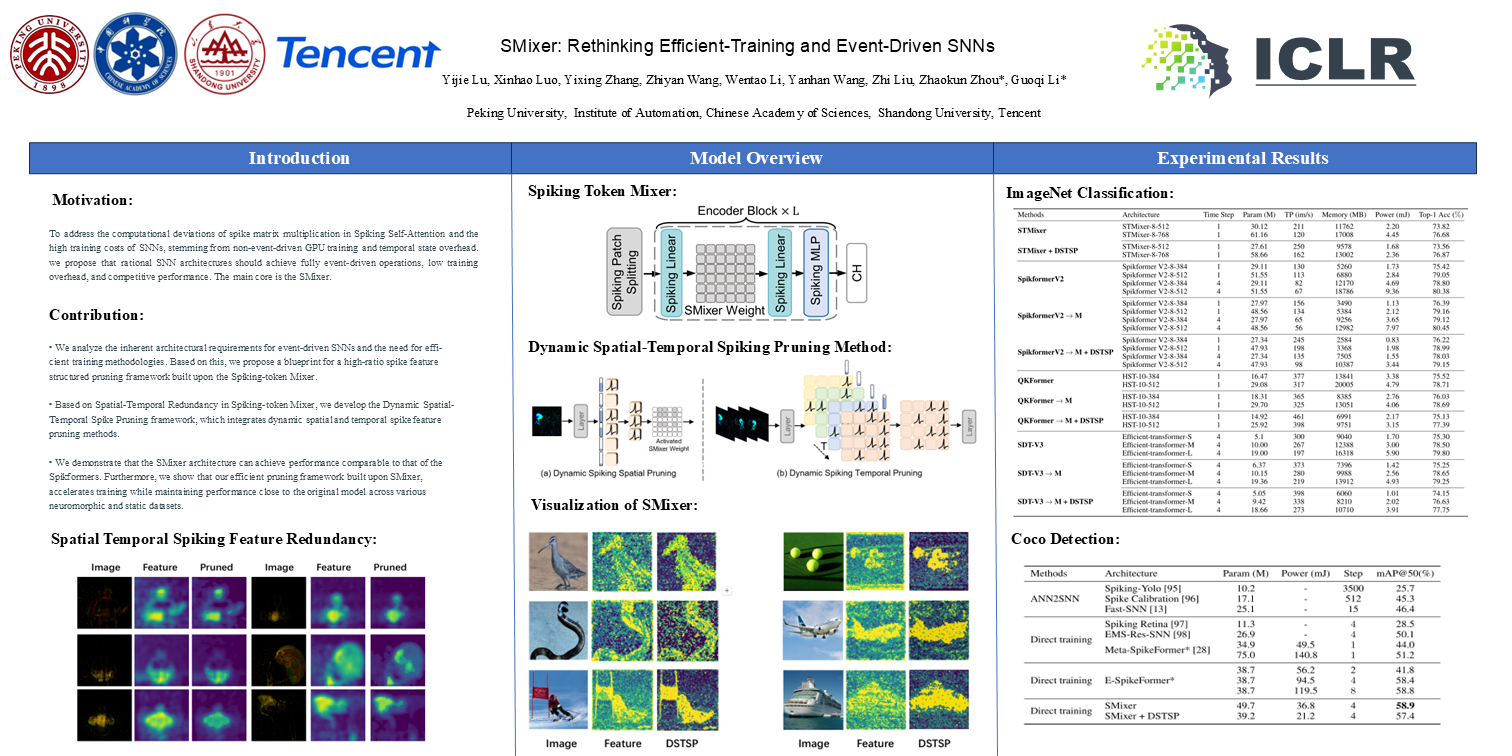
Spiking Neural Networks (SNNs) offer a promising, energy-efficient paradigm for computation, but their practical application is hindered by challenges in architecture design and training costs. For example, Spiking ResNet exhibits relatively low performance, whereas high-performance Spiking Transformers are not truly event driven and cannot be implemented on asynchronous chips. Moreover, the intrinsic time steps and neuron state dynamics result in a substantial computational overhead for training SNNs on GPUs. In response to these problems, we discuss rational architectural design for SNNs and argue that such designs should exhibit three key characteristics: operations fully supported by asynchronous scenarios, low training overhead and competitive performance. In light of this, we adopt the event-driven friendly Spiking Mixer (SMixer) as the foundational architecture and develop a spike feature Spatial-Temporal Pruning (STP) framework with a high pruning ratio and no trainable parameters to reduce the training overhead. Based on a statistical analysis of sparse spike features, STP eliminates redundant spike features across both spatial and temporal dimensions, thereby reducing the input features and computational load during training. It adaptively selects the most salient spike tokens spatially and dynamically constrains neuron firing rates temporally. By leveraging STP and architectural adaptation, SMixer accelerates training while ensuring a fully event-driven characteristics and maintaining competitive performance, offering valuable insights for the design of efficient, event-driven SNNs.
Theory-Grounded Evaluation of Human-Like Fallacy Patterns in LLM Reasoning
Andrew Richardson ⋅ Ryan Kearns ⋅ Sean Moss ⋅ Vincent Wang ⋅ Philipp Koralus
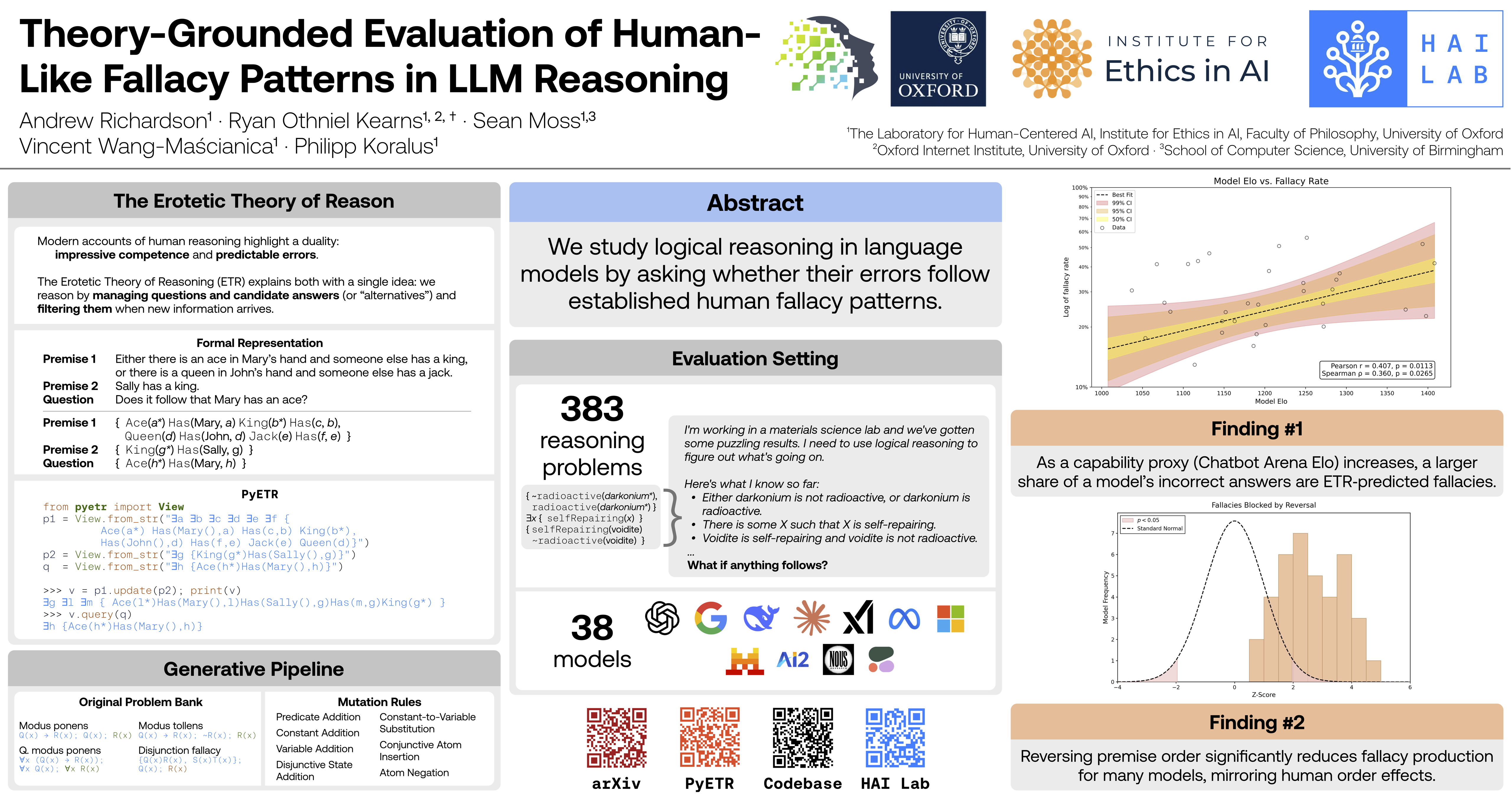
We study logical reasoning in language models by asking whether their errors follow established human fallacy patterns. Using the Erotetic Theory of Reasoning (ETR) and its open‑source implementation, PyETR, we programmatically generate 383 formally specified reasoning problems and evaluate 38 models. For each response, we judge logical correctness and, when incorrect, whether it matches an ETR‑predicted fallacy. Two results stand out: (i) as a capability proxy (Chatbot Arena Elo) increases, a larger share of a model’s incorrect answers are ETR‑predicted fallacies ($\rho=0.360, p=0.0265$), while overall correctness on this dataset shows no correlation with capability; (ii) reversing premise order significantly reduces fallacy production for many models, mirroring human order effects. Methodologically, PyETR provides an open‑source pipeline for unbounded, synthetic, contamination‑resistant reasoning tests linked to a cognitive theory, enabling analyses that focus on error composition rather than error rate.
The Tool Decathlon: Benchmarking Language Agents for Diverse, Realistic, and Long-Horizon Task Execution
Junlong Li ⋅ Wenshuo Zhao ⋅ Jian Zhao ⋅ Weihao Zeng ⋅ Haoze Wu ⋅ Xiaochen Wang ⋅ Rui Ge ⋅ Yuxuan Cao ⋅ Yuzhen Huang ⋅ Wei Liu ⋅ Junteng LIU ⋅ Zhaochen Su ⋅ Yiyang Guo ⋅ FAN ZHOU ⋅ Lueyang Zhang ⋅ Juan Michelini ⋅ Xingyao Wang ⋅ Xiang Yue ⋅ Shuyan Zhou ⋅ Graham Neubig ⋅ Junxian He
Real-world language agents must handle complex, multi-step workflows across diverse applications. For instance, an agent may manage emails by coordinating with calendars and file systems, or monitor a production database like BigQuery to detect anomalies and generate reports following a standard operating manual. However, existing language agent benchmarks often focus on narrow domains or simplified tasks that lack the diversity, realism, and long-horizon complexity required to evaluate agents' real-world performance. To address this gap, we introduce the Tool Decathlon (dubbed as Toolathlon), a benchmark for language agents offering diverse applications and tools, realistic environment setup, and reliable execution-based evaluation. Toolathlon spans 32 software applications and 604 tools, ranging from everyday platforms such as Google Calendar and Notion to professional applications like WooCommerce, Kubernetes, and BigQuery. Most of the tools are based on a high-quality set of Model Context Protocol (MCP) servers that we may have revised or implemented ourselves. Unlike prior works, which primarily ensure functional realism but offer limited environment state diversity, we provide realistic initial environment states from real software, such as Canvas courses with dozens of students or real-world financial spreadsheets. The Toolathlon benchmark includes 108 manually sourced or crafted tasks in total, requiring interacting with multiple applications over around 20 turns on average to complete. Each task is strictly verifiable through dedicated evaluation scripts. Comprehensive evaluation of state-of-the-art models highlights their significant shortcomings in performing real-world, long-horizon tasks: the best-performing model, Claude-4.5-Sonnet, achieves only a 38.6% success rate with 20.2 tool calling turns on average, while the top open-weights model DeepSeek-V3.2-Exp reaches 20.1%. We expect Toolathlon to drive the development of more capable language agents for real-world, long-horizon task execution.
From Large to Small: Transferring CUDA Optimization Expertise via Reasoning Graph
Junfeng Gong ⋅ Zhiyi Wei ⋅ Junying Chen ⋅ Cheng Liu ⋅ Huawei Li
Despite significant evolution of CUDA programming and domain-specific libraries, effectively utilizing GPUs with massively parallel engines remains difficult. Large language models (LLMs) show strong potential in generating optimized CUDA code from sequential code. However, using LLMs in practice faces two major challenges: cloud-based APIs pose risks of code leakage, and local deployment is often computationally expensive and inefficient. These drawbacks have spurred interest in small language models (SLMs), which are more lightweight and privacy-friendly. Encouragingly, recent studies show that SLMs can achieve performance comparable to LLMs on specific tasks. While SLMs can match LLMs on domain-specific tasks, their limited reasoning abilities lead to suboptimal performance in complex CUDA generation according to our experiments. To bridge this gap, we propose ReGraphT, a training-free, retrieval-augmented generation framework that transfers LLM-level reasoning to smaller models. ReGraphT organizes CUDA optimization trajectories into a structured reasoning graph, modeling the combined CUDA optimizations as state transitions, and leverages Monte Carlo Graph Search (MCGS) for efficient exploration. We also present a CUDA-specific benchmark with difficulty tiers defined by reasoning complexity to evaluate models more comprehensively. Experiments show that ReGraphT outperforms HPC-specific fine-tuned models and other retrieval-augmented approaches, achieving an average 2.33× speedup on CUDAEval and ParEval. When paired with DeepSeek-Coder-V2-Lite-Instruct and Qwen2.5-Coder-7B-Instruct, ReGraphT enables SLMs to approach LLM-level performance without the associated privacy risks or excessive computing overhead.
Let's Think in Two Steps: Mitigating Agreement Bias in MLLMs with Self-Grounded Verification
Moises Andrade ⋅ Joonhyuk Cha ⋅ Brandon Ho ⋅ Vriksha Srihari ⋅ Karmesh Yadav ⋅ Zsolt Kira
Verifiers—functions assigning rewards to agent behavior—have been key to AI progress in domains such as math, code, and games. However, extending these gains to domains without clear-cut success criteria (e.g., computer use) remains a challenge: while humans can recognize desired outcomes, translating this intuition into scalable rules is nontrivial. Multimodal LLMs (MLLMs) emerge as a promising solution, given vast world knowledge, human-preference alignment, and reasoning capabilities. We evaluate MLLMs as verifiers across web navigation, computer use, and robotics, spanning 13+ model families, 28+ evaluation templates, curated trajectories from diverse agents and of varying lengths, and distinct verifier applications. We identify a critical limitation: a strong tendency for MLLMs to over-validate agent behavior—a phenomenon we term agreement bias. This bias is pervasive across models, resilient to test-time scaling, and can harm methods relying on MLLM evaluations, such as filtered behavior cloning and self-improvement. We provide guidance on the design and evaluation of MLLM verifiers, and introduce Self-Grounded Verification (SGV), a lightweight method that harnesses MLLMs' own sampling mechanisms by modulating (un)conditional generation to better leverage their knowledge, alignment, and reasoning. SGV operates in two steps: first, the MLLM is elicited to generate broad priors about desired behavior, independent of the data under evaluation. Then, conditioned on self-generated priors, it reasons over and evaluates a candidate trajectory. Our methods yield gains across models and environments, improving failure detection by up to 25pp and accuracy by 14pp, with benefits extending to downstream applications. In self-improvement and online supervision, SGV boosts task completion of a GUI specialist in OSWorld, a diffusion policy in robomimic, and a ReAct agent in VisualWebArena—setting a new state of the art, surpassing the previous best by 20pp. Finally, we release an updated version of VisualWebArena featuring strong agent baselines, more human-aligned evaluators, high-fidelity environment parallelism, runtime speedups exceeding 10x, and VisualWebArena-Lite, a 1/3-scale subset with comparable evaluation fidelity. Our code, models, and data are publicly available at our project page.
iFusion: Integrating Dynamic Interest Streams via Diffusion Model for Click-Through Rate Prediction
Ziheng Ni ⋅ Congcong Liu ⋅ Yuying Chen ⋅ Zhiwei Fang ⋅ Changping Peng ⋅ Zhangang Lin ⋅ Ching Law ⋅ Jingping Shao
Click-through rate (CTR) prediction is crucial for recommendation systems and online advertising, relying heavily on effective user behavior modeling. While existing methods separately refine long-term and short-term interest representations, the fusion of these behaviors remains a critical yet understudied challenge due to misaligned feature spaces, disjointed modeling, and noise propagation in short-term interests. To address these limitations, we propose iFusion, a diffusion-based generative user interest fusion method, which reformulates interest fusion as a conditional generation process. iFusion leverages short-term interests as conditional guidance and progressively integrates long-term representations through denoising, eliminating reliance on linear fusion assumptions. Our framework introduces two key components: (1) the Disentangled Classifier-Free Diffusion Guidance (DCFG) Mechanism, which adaptively disentangles core preferences from transient fluctuations, and (2) the Mixture AutoRegressive Denoising Network (MARN), which enables joint interest modeling and fusion through autoregressive denoising. Experiments demonstrate that iFusion outperforms baselines across public and industrial datasets, as well as in online A/B tests, validating its effectiveness in robust CTR prediction. This work establishes a new paradigm for generative user interests fusion in CTR prediction.
SmartDJ: Declarative Audio Editing with Audio Language Model
Zitong Lan ⋅ Yiduo Hao ⋅ Mingmin Zhao
Audio editing plays a crucial role in VR/AR immersion, virtual conferencing, sound design, and interactive media. However, recent generative audio editing models depend on template-like instruction formats and are restricted to mono-channel audio. Moreover, existing systems require users to specify low-level editing actions, rather than expressing the desired outcome at a higher semantic level. We introduce SmartDJ, a novel framework for stereo audio editing that enables declarative audio editing, where the users describe the desired outcome while delegating the underlying editing operations to the system. Given a high-level instruction, SmartDJ decomposes it into a sequence of atomic edit operations, such as adding, removing, or spatially relocating sound events. These operations are then executed by a diffusion model trained to edit stereo audio. To enable this capability, we design a scalable data synthesis pipeline that produces paired examples of declarative instructions, atomic edit operations, and audios before and after each edit operation. Experiments demonstrate that SmartDJ achieves superior perceptual quality, spatial realism, and semantic alignment compared to prior audio editing methods.
LadderSym: A Multimodal Interleaved Transformer for Music Practice Error Detection
Benjamin Chou ⋅ Purvish Jajal ⋅ Nicholas Eliopoulos ⋅ James Davis ⋅ George Thiruvathukal ⋅ Kristen Yun ⋅ Yung-Hsiang Lu
Music learners can greatly benefit from tools that accurately detect errors in their practice. Existing approaches typically compare audio recordings to music scores using heuristics or learnable models. This paper introduces \textit{LadderSym}, a novel Transformer-based method for music error detection. \textit{LadderSym} is guided by two key observations about the state-of-the-art approaches: (1) late fusion limits inter-stream alignment and cross-modality comparison capability; and (2) reliance on score audio introduces ambiguity in the frequency spectrum, degrading performance in music with concurrent notes. To address these limitations, \textit{LadderSym} introduces (1) a two-stream encoder with inter-stream alignment modules to improve audio comparison capabilities and error detection F1 scores, and (2) a multimodal strategy that leverages both audio and symbolic scores by incorporating symbolic representations as decoder prompts, reducing ambiguity and improving F1 scores. We evaluate our method on the \textit{MAESTRO-E} and \textit{CocoChorales-E} datasets by measuring the F1 score for each note category. Compared to the previous state of the art, \textit{LadderSym} more than doubles F1 for missed notes on \textit{MAESTRO-E} (26.8\%~$\rightarrow$~56.3\%) and improves extra note detection by 14.4 points (72.0\%~$\rightarrow$~86.4\%). Similar gains are observed on \textit{CocoChorales-E}. Furthermore, we also evaluate our models on real data we curated. This work introduces insights about comparison models that could inform sequence evaluation tasks for reinforcement learning, human skill assessment, and model evaluation.
Topology Matters in RTL Circuit Representation Learning
Mingyu Zhao ⋅ Xun He ⋅ Jiawei Liu ⋅ Jianwang Zhai ⋅ Chuan Shi
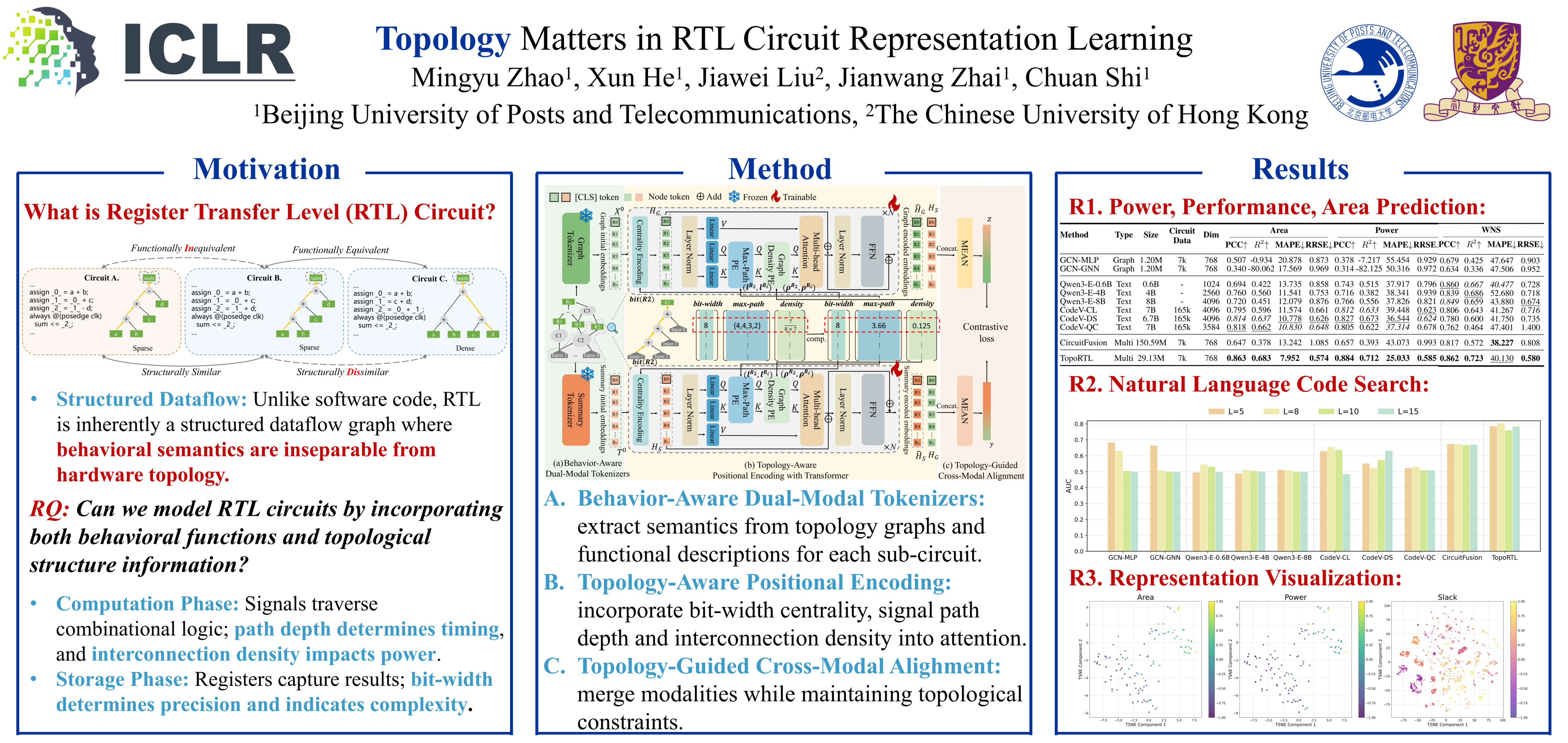
Representation learning for register transfer level (RTL) circuits is fundamental to enabling accurate performance, power, and area (PPA) prediction, efficient circuit generation, and retrieval in automated chip design. Unlike general programming languages, RTL is inherently a structured dataflow graph where semantics are intrinsically bound to the topology from a hardware view. However, existing language-model-based approaches ignore the nature of RTL circuits and fail to capture topology-sensitive properties, leading to incomplete representation and limited performance for diverse downstream tasks. To address this, we introduce TopoRTL, a novel framework that explicitly learns topological differences across RTL circuits and preserves the behavior information. First, we decompose RTL designs into register cones and construct dual modalities initialized with behavior-aware tokenizers. Second, we design three topology-aware positional encodings and leverage attention mechanisms to enable the model to distinguish topological variations among register cones and RTL designs. Finally, we introduce a topology-guided cross-modal alignment strategy, employing contrastive learning over interleaved modality pairs under topological constraints to enforce semantic consistency and achieve superior modality alignment. Experiments demonstrate that explicit topological modeling is critical to improving RTL representation quality, and TopoRTL significantly outperforms existing methods across multiple downstream tasks.
Eigen-Agent: Adaptive Multi-Agent Scientific Reasoning with Monitor-Based RAG
Xiangru Tang ⋅ Wanghan Xu ⋅ Yujie Wang ⋅ Zijie Guo ⋅ Daniel Shao ⋅ Cixuan Zhang ⋅ Ziyi Wang ⋅ Lixin Zhang ⋅ Frank Wan ⋅ Zhenfei Yin ⋅ Wenlong Zhang ⋅ LEI BAI ⋅ Philip Torr ⋅ Hanrui Wang ⋅ Di Jin
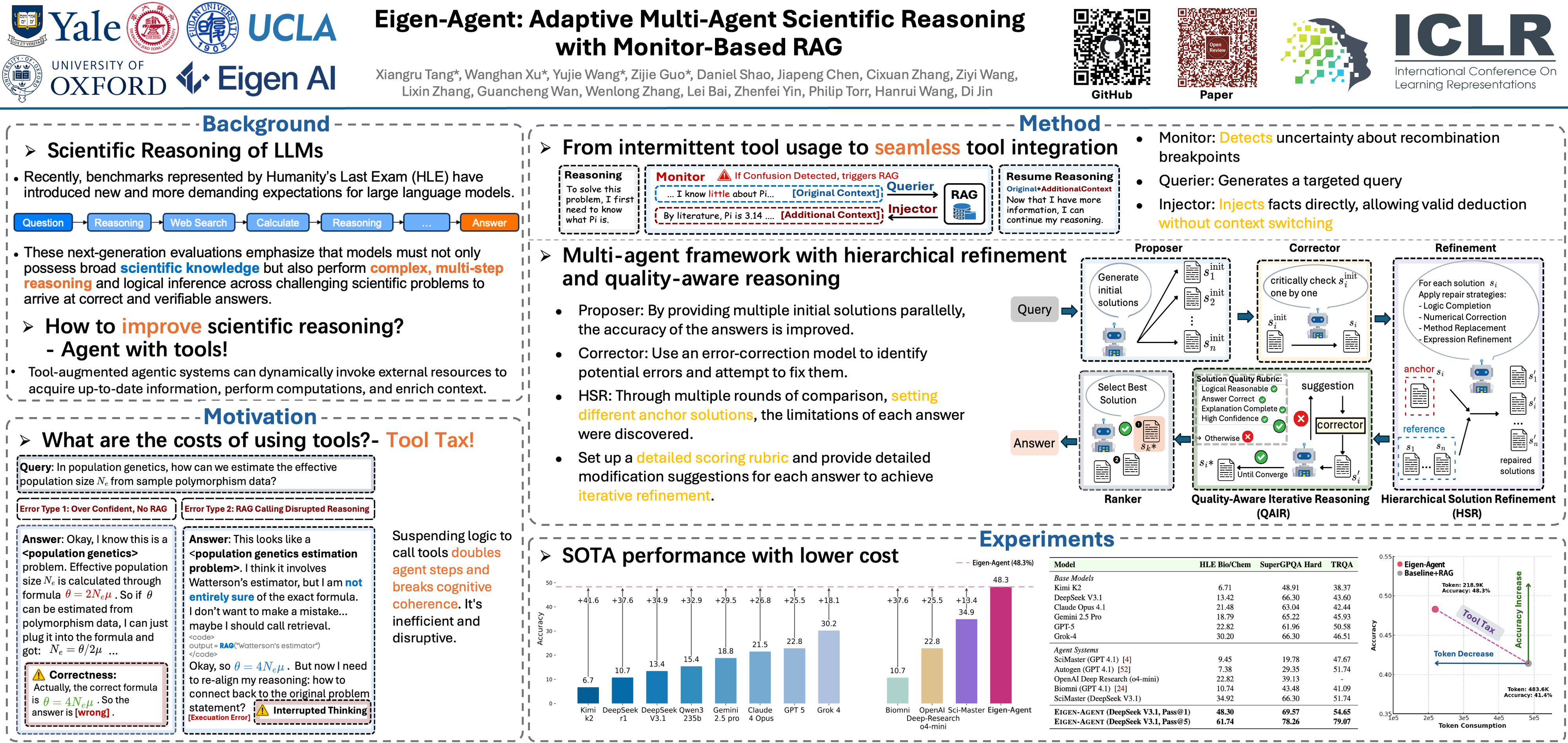
Large language models (LLMs) have recently shown strong progress on scientific reasoning, yet two major bottlenecks remain. First, explicit retrieval fragments reasoning, imposing a hidden tool tax of extra tokens and steps. Second, multi-agent pipelines often dilute strong solutions by averaging across all candidates. We address these challenges with a unified framework that combines implicit retrieval and structured collaboration. At its foundation, a Monitor-based retrieval module operates at the token level, integrating external knowledge with minimal disruption to reasoning. On top of this substrate, Hierarchical Solution Refinement (HSR) iteratively designates each candidate as an anchor to be repaired by its peers, while Quality-Aware Iterative Reasoning (QAIR) adapts refinement to solution quality. On Humanity’s Last Exam (HLE) Bio/Chem Gold, our framework achieves 48.3% accuracy—the highest reported to date, surpassing the strongest agent baseline by 13.4 points and leading frontier LLMs by up to 18.1 points, while simultaneously reducing token usage by 53.5% and agent steps by 43.7%. Results on SuperGPQA and TRQA confirm robustness across domains. Error analysis shows that reasoning failures and knowledge gaps co-occur in over 85% of cases, while diversity analysis reveals a clear dichotomy: retrieval tasks benefit from solution variety, whereas reasoning tasks favor consensus. Together, these findings demonstrate how implicit augmentation and structured refinement overcome the inefficiencies of explicit tool use and uniform aggregation.
LEGATO: Large-scale End-to-end Generalizable Approach to Typeset OMR
Guang Yang ⋅ Victoria Ebert ⋅ Nazif Tamer ⋅ Brian Zheng ⋅ Luiza Pozzobon ⋅ Noah Smith
We propose Legato, a new end-to-end model for optical music recognition (OMR), a task of converting music score images to machine-readable documents. Legato is the first large-scale pretrained OMR model capable of recognizing full-page or multi-page typeset music scores and the first to generate documents in ABC notation, a concise, human-readable format for symbolic music. Bringing together a pretrained vision encoder with an ABC decoder trained on a dataset of more than 214K images, our model exhibits the strong ability to generalize across various typeset scores. We conduct comprehensive experiments on a range of datasets and metrics and demonstrate that Legato outperforms the previous state of the art. On our most realistic dataset, we see a 68\% and 47.6\% absolute error reduction on the standard metrics TEDn and OMR-NED, respectively.
Process-Level Trajectory Evaluation for Environment Configuration in Software Engineering Agents
Jiayi Kuang ⋅ Yinghui Li ⋅ Xin Zhang ⋅ Yangning Li ⋅ di yin ⋅ Xing Sun ⋅ Ying Shen ⋅ Philip Yu
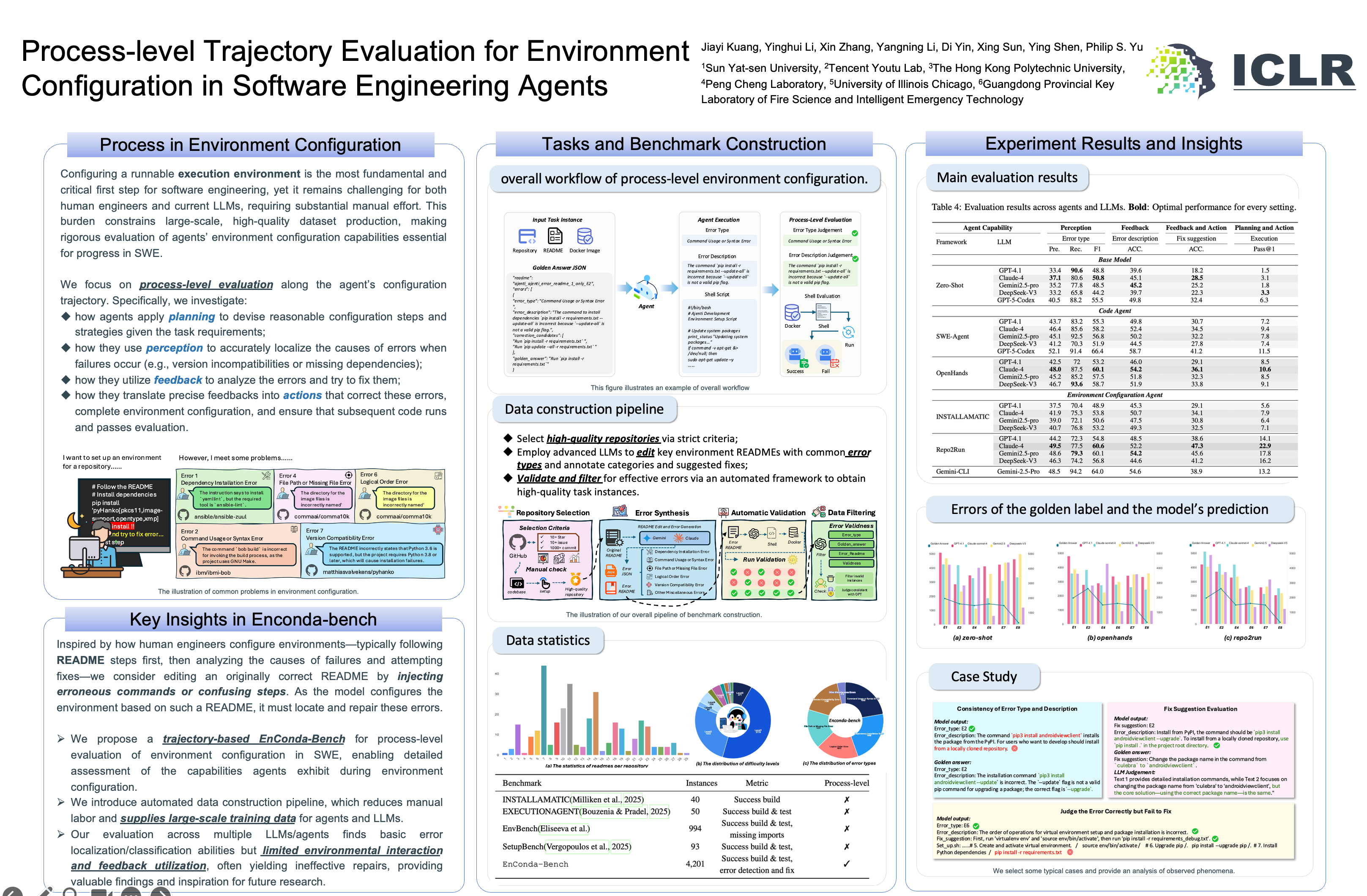
Large language model-based agents show promise for software engineering, but environment configuration remains a bottleneck due to heavy manual effort and scarce large-scale, high-quality datasets. Existing benchmarks assess only end-to-end build/test success, obscuring where and why agents succeed or fail. We introduce the Environment Configuration Diagnosis Benchmark, EnConda-bench, which provides process-level trajectory assessment of fine-grained agent capabilities during environment setup-planning, perception-driven error diagnosis, feedback-driven repair, and action to execute the final environment configuration. Our task instances are automatically constructed by injecting realistic README errors and are validated in Docker for scalable, high-quality evaluation. EnConda-bench combines process-level analysis with end-to-end executability to enable capability assessments beyond aggregate success rates. Evaluations across state-of-the-art LLMs and agent frameworks show that while agents can localize errors, they struggle to translate feedback into effective corrections, limiting end-to-end performance. To our knowledge, EnConda-bench is the first framework to provide process-level internal capability assessment for environment configuration, offering actionable insights for improving software engineering agents.
MoMaGen: Generating Demonstrations under Soft and Hard Constraints for Multi-Step Bimanual Mobile Manipulation
Chengshu Li ⋅ Mengdi Xu ⋅ Arpit Bahety ⋅ Hang Yin ⋅ Yunfan Jiang ⋅ Huang Huang ⋅ Josiah Wong ⋅ Sujay Garlanka ⋅ Cem Gokmen ⋅ Ruohan Zhang ⋅ Weiyu Liu ⋅ Jiajun Wu ⋅ Roberto Martín-Martín ⋅ Li Fei-Fei
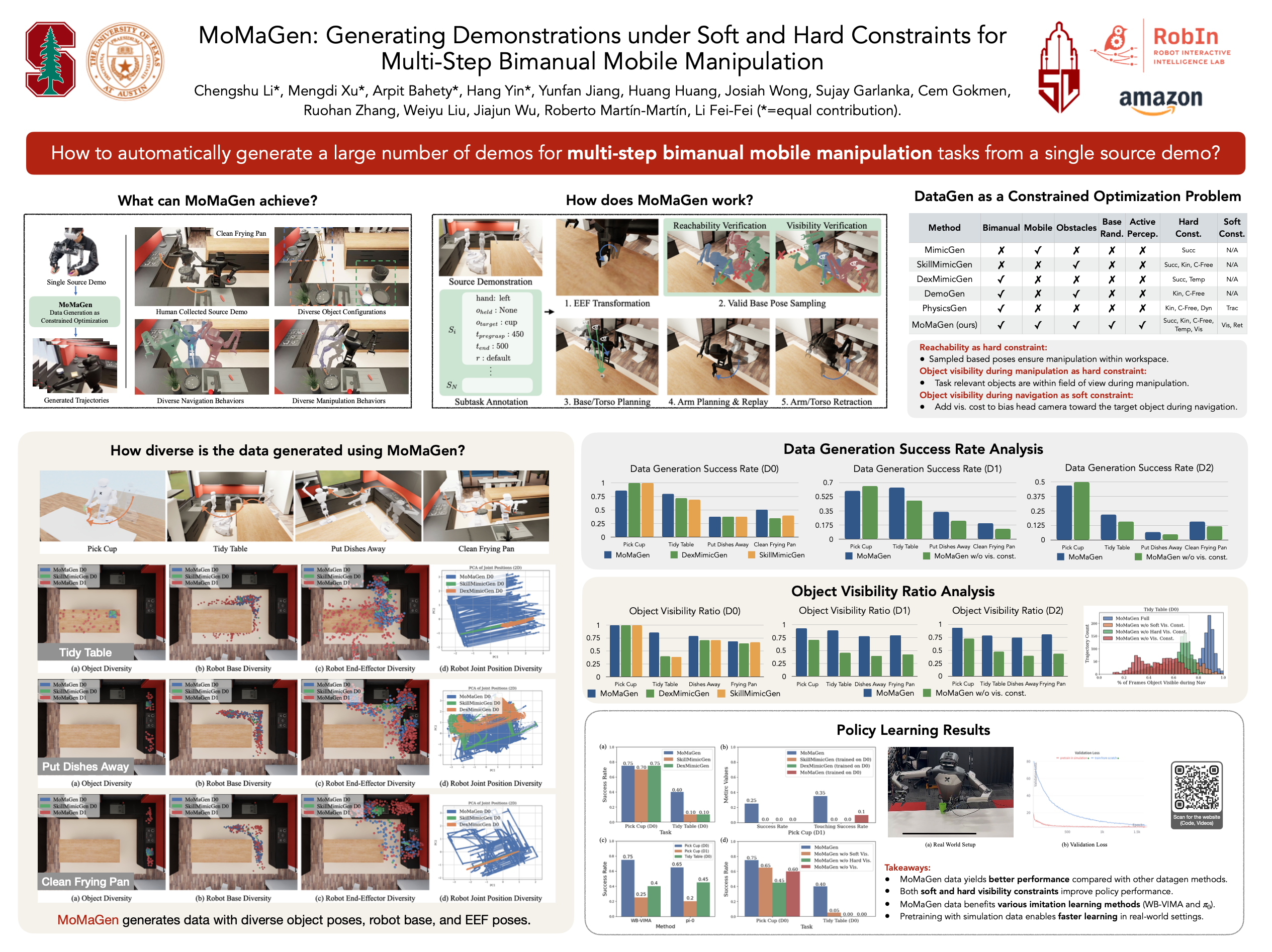
Imitation learning from large-scale, diverse human demonstrations has been shown to be effective for training robots, but collecting such data is costly and time-consuming. This challenge intensifies for multi-step bimanual mobile manipulation, where humans must teleoperate both the mobile base and two high-DoF arms. Prior X-Gen works have developed automated data generation frameworks for static (bimanual) manipulation tasks, augmenting a few human demos in simulation with novel scene configurations to synthesize large-scale datasets. However, prior works fall short for bimanual mobile manipulation tasks for two major reasons: 1) a mobile base introduces the problem of how to place the robot base to enable downstream manipulation (reachability) and 2) an active camera introduces the problem of how to position the camera to generate data for a visuomotor policy (visibility). To address these challenges, MoMaGen formulates data generation as a constrained optimization problem that satisfies hard constraints (e.g., reachability) while balancing soft constraints (e.g., visibility while navigation). This formulation generalizes across most existing automated data generation approaches and offers a principled foundation for developing future methods. We evaluate on four multi-step bimanual mobile manipulation tasks and find that MoMaGen enables the generation of much more diverse datasets than previous methods. As a result of the dataset diversity, we also show that the data generated by MoMaGen can be used to train successful imitation learning policies using a single source demo. Furthermore, the trained policy can be fine-tuned with a very small amount of real-world data (40 demos) to be succesfully deployed on real robotic hardware. More details are on our project page: momagen.github.io.
PCB-Bench: Benchmarking LLMs for Printed Circuit Board Placement and Routing
Jindong Li ⋅ Lianrong Chen ⋅ BIN YANG ⋅ Jiadong Zhu ⋅ Ying Wang ⋅ Yuzhe Ma ⋅ Menglin Yang
Recent advances in Large Language Models (LLMs) have enabled impressive capabilities across diverse reasoning and generation tasks. However, their ability to understand and operate on real-world engineering problems, such as Printed Circuit Board (PCB) placement and routing, remains underexplored due to the lack of standardized benchmarks and high-fidelity datasets. To address this gap, we introduce PCB-Bench, the first comprehensive benchmark designed to systematically evaluate LLMs in the context of PCB design. PCB-Bench spans three complementary task settings: (1) text-based reasoning with approximately 3,700 expert-annotated instances, consisting of over 1,800 question-answer pairs and their corresponding choice question versions, covering component placement, routing strategies, and design rule compliance; (2) multimodal image-text reasoning with approximately 500 problems requiring joint interpretation of PCB visuals and technical specifications, including component identification, function recognition, and visual trace reasoning; (3) real-world design comprehension using over 170 complete PCB projects with schematics, placement files, and design documentation. We design structured evaluation protocols to assess both generative and discriminative capabilities, and conduct extensive comparisons across state-of-the-art LLMs. Our results reveal substantial gaps in current models’ ability to reason over spatial placements, follow domain-specific constraints, and interpret professional engineering artifacts. PCB-Bench establishes a foundational resource for advancing research toward more capable engineering AI, with implications extending beyond PCB design to broader structured reasoning domains. Data and code are available at https://github.com/digailab/PCB-Bench.
CollectiveKV: Decoupling and Sharing Collaborative Information in Sequential Recommendation
Jingyu Li ⋅ Zhaocheng Du ⋅ Qianhui Zhu ⋅ kaiyuan Li ⋅ ZHICHENG ZHANG ⋅ Wu ⋅ Chaolang Li ⋅ Pengwen Dai
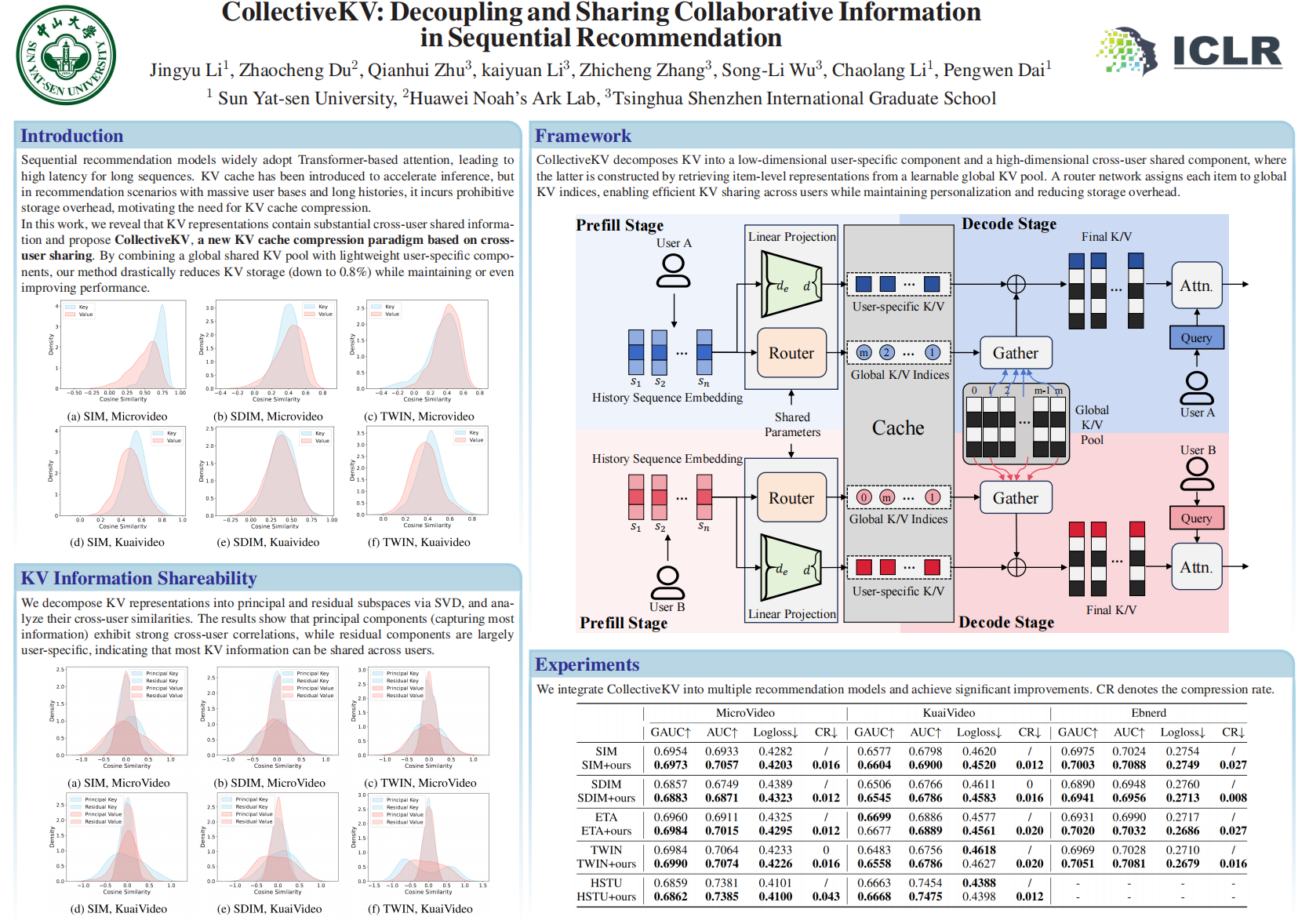
Sequential recommendation models are widely used in applications, yet they face stringent latency requirements. Mainstream models leverage the Transformer attention mechanism to improve performance, but its computational complexity grows with the sequence length, leading to a latency challenge for long sequences. Consequently, KV cache technology has recently been explored in sequential recommendation systems to reduce inference latency. However, KV cache introduces substantial storage overhead in sequential recommendation systems, which often have a large user base with potentially very long user history sequences. In this work, we observe that KV sequences across different users exhibit significant similarities, indicating the existence of collaborative signals in KV. Furthermore, we analyze the KV using singular value decomposition (SVD) and find that the information in KV can be divided into two parts: the majority of the information is shareable across users, while a small portion is user-specific. Motivated by this, we propose CollectiveKV, a cross-user KV sharing mechanism. It captures the information shared across users through a learnable global KV pool. During inference, each user retrieves high-dimensional shared KV from the pool and concatenates them with low-dimensional user-specific KV to obtain the final KV. Experiments on five sequential recommendation models and three datasets show that our method can compress the KV cache to only 0.8\% of its original size, while maintaining or even enhancing model performance.
DiSRouter: Distributed Self-Routing for LLM Selections
Hang Zheng ⋅ Hongshen Xu ⋅ Yongkai LIN ⋅ Shuai Fan ⋅ Lu Chen ⋅ Kai Yu
The proliferation of Large Language Models (LLMs) has created a diverse ecosystem of models with highly varying performance and costs, necessitating effective query routing to balance performance and expense. Current routing systems often rely on a centralized external router trained on a fixed set of LLMs, making them inflexible and prone to poor performance since the small router can not fully understand the knowledge boundaries of different LLMs. We introduce DiSRouter (Distributed Self-Router), a novel paradigm that shifts from centralized control to distributed routing. In DiSRouter, a query traverses a network of LLM agents, each independently deciding whether to answer or route to other agents based on its own self-awareness—its ability to judge its competence. This distributed design offers superior flexibility, scalability, and generalizability. To enable this, we propose a two-stage Self-Awareness Training pipeline that enhances each LLM's self-awareness. Extensive experiments demonstrate that DiSRouter significantly outperforms existing routing methods in utility across various scenarios, effectively distinguishes between easy and hard queries, and shows strong generalization to out-of-domain tasks. Our work validates that leveraging an LLM's intrinsic self-awareness is more effective than external assessment, paving the way for more modular and efficient multi-agent systems.
RECODE-H: A Benchmark for Research Code Development with Interactive Human Feedback
Chunyu Miao ⋅ Henry Peng Zou ⋅ Yangning Li ⋅ Yankai Chen ⋅ Yibo Wang ⋅ Fangxin Wang ⋅ Yifan Li ⋅ Wooseong Yang ⋅ Bowei He ⋅ Xinni Zhang ⋅ Dianzhi Yu ⋅ Hanchen Yang ⋅ Hoang Nguyen ⋅ Yue Zhou ⋅ Jie Yang ⋅ Jizhou Guo ⋅ Wenzhe Fan ⋅ Chin-Yuan Yeh ⋅ Panpan Meng ⋅ Liancheng Fang ⋅ Jinhu Qi ⋅ Wei-Chieh Huang ⋅ Zhengyao Gu ⋅ Yuwei Han ⋅ Langzhou He ⋅ Yuyao Yang ⋅ Xue Liu ⋅ Irwin King ⋅ Philip Yu
Large language models (LLMs) show the promise in supporting scientific research implementation, yet their ability to generate correct and executable code remains limited. Existing works largely adopt one-shot settings, ignoring the iterative and feedback-driven nature of realistic workflows of scientific research development. To address this gap, we present RECODE-H, a benchmark of 102 tasks from research papers and repositories that evaluates LLMs through multi-turn interactions with human feedback. It includes structured instructions, unit tests, and a five-level feedback hierarchy to reflect realistic researcher–agent collaboration. We further present ReCodeAgent, a framework that integrates feedback into iterative code generation. Experimentswith leading LLMs, including GPT-5, Claude-Sonnet-4, DeepSeek-V3.1, and Gemini 2.5, show substantial performance gains with richer feedback, while also highlighting ongoing challenges in the generation of complex research code. RECODE-H establishes a foundation for developing adaptive, feedback-driven LLM agents in scientific research implementation.
EDINET-Bench: Evaluating LLMs on Complex Financial Tasks using Japanese Financial Statements
Issa Sugiura ⋅ Takashi Ishida ⋅ Taro Makino ⋅ Chieko Tazuke ⋅ Takanori Nakagawa ⋅ Kosuke Nakago ⋅ David Ha
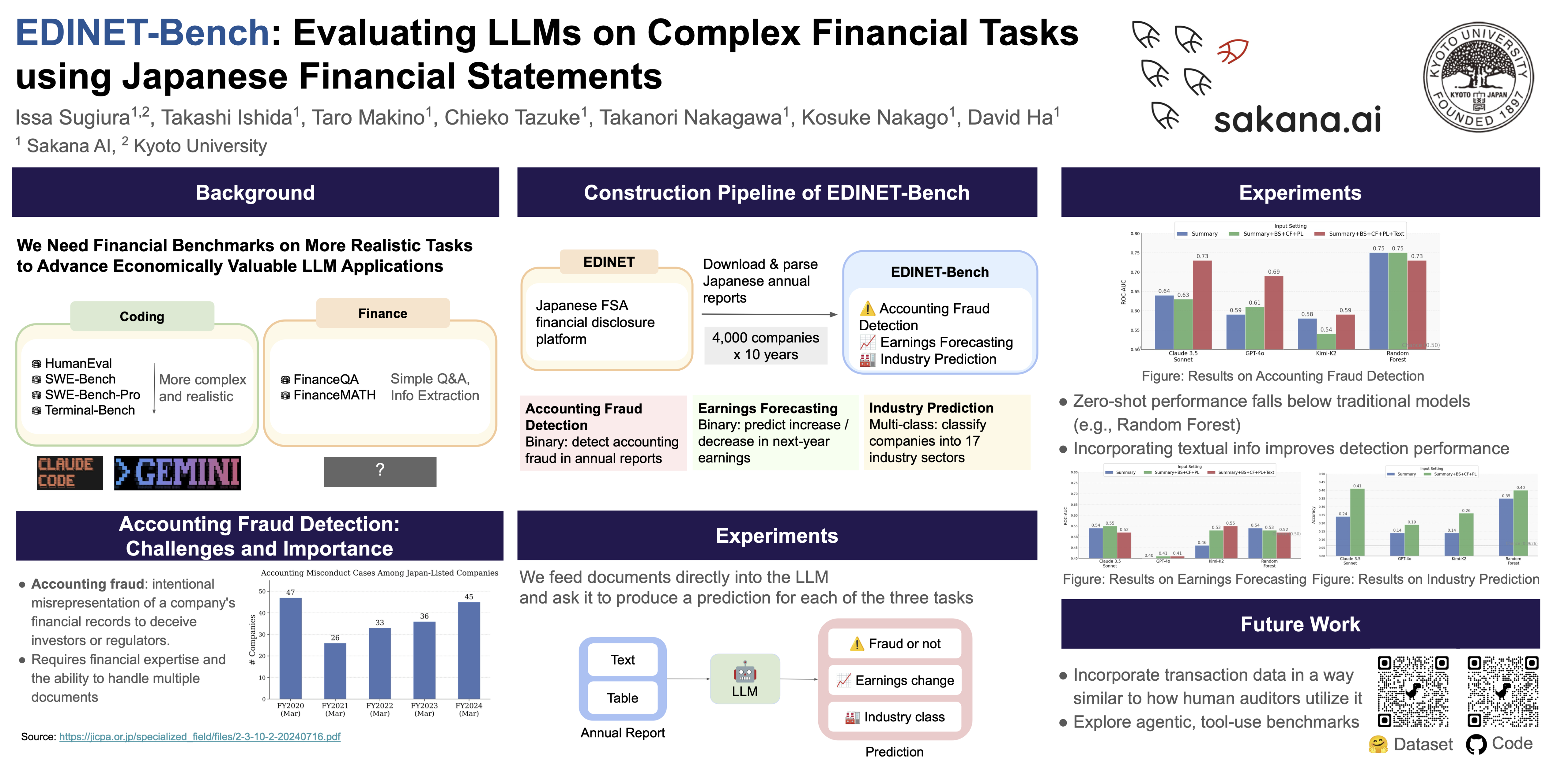
Large Language Models (LLMs) have made remarkable progress, surpassing human performance on several benchmarks in domains such as mathematics and coding. A key driver of this progress has been the development of benchmark datasets. In contrast, the financial domain poses higher entry barriers due to its demand for specialized expertise, and benchmarks remain relatively scarce compared to those in mathematics or coding. We introduce EDINET-Bench, an open-source Japanese financial benchmark designed to evaluate LLMs on challenging tasks such as accounting fraud detection, earnings forecasting, and industry classification. EDINET-Bench is constructed from ten years of annual reports filed by Japanese companies. These tasks require models to process entire annual reports and integrate information across multiple tables and textual sections, demanding expert-level reasoning that is challenging even for human professionals. Our experiments show that even state-of-the-art LLMs struggle in this domain, performing only marginally better than logistic regression in binary classification tasks such as fraud detection and earnings forecasting. Our results show that simply providing reports to LLMs in a straightforward setting is not enough. This highlights the need for benchmark frameworks that better reflect the environments in which financial professionals operate, with richer scaffolding such as realistic simulations and task-specific reasoning support to enable more effective problem solving. We make our dataset and code publicly available to support future research.
Zero-shot Human Pose Estimation using Diffusion-based Inverse solvers
Sahil Bhandary Karnoor ⋅ Romit Roy Choudhury
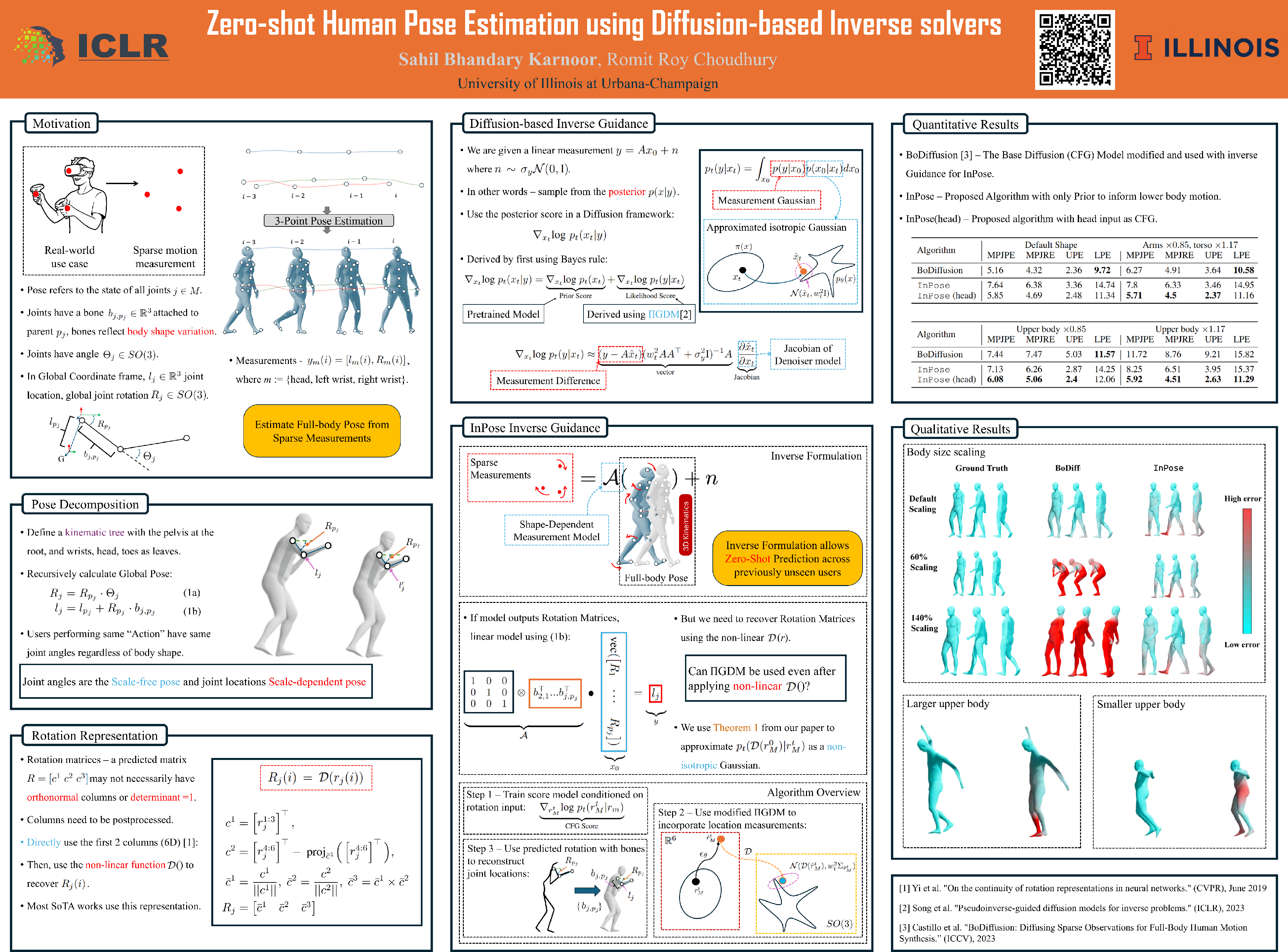
Pose estimation refers to tracking a human's full body posture, including their head, torso, arms, and legs. The problem is challenging in practical settings where the number of body sensors is limited. Past work has shown promising results using conditional diffusion models, where the pose prediction is conditioned on both measurements from the sensors. Unfortunately, nearly all these approaches generalize poorly across users, primarily because location measurements are highly influenced by the body size of the user. In this paper, we formulate pose estimation as an inverse problem and design an algorithm capable of zero-shot generalization. Our idea utilizes a pre-trained diffusion model and conditions it on rotational measurements alone; the priors from this model are then guided by a likelihood term, derived from the measured locations. Thus, given any user, our proposed InPose method generatively estimates the highly likely sequence of poses that best explains the sparse on-body measurements.
VERINA: Benchmarking Verifiable Code Generation
Zhe Ye ⋅ Zhengxu Yan ⋅ Jingxuan He ⋅ Timothe Kasriel ⋅ Kaiyu Yang ⋅ Dawn Song
Large language models (LLMs) are increasingly integrated in software development, but ensuring correctness in LLM-generated code remains challenging and often requires costly manual review. Verifiable code generation---jointly generating code, specifications, and proofs of code-specification alignment---offers a promising path to address this limitation and further unleash LLMs' benefits in coding. Yet, there exists a significant gap in evaluation: current benchmarks often focus on only individual components rather than providing a holistic evaluation framework of all tasks. In this paper, we introduce VERINA (Verifiable Code Generation Arena), a high-quality benchmark enabling a comprehensive and modular evaluation of code, specification, and proof generation as well as their compositions. VERINA consists of 189 manually curated coding tasks in Lean, with detailed problem descriptions, reference implementations, formal specifications, and extensive test suites. Our extensive evaluation of state-of-the-art LLMs reveals significant challenges in verifiable code generation, especially in proof generation, underscoring the need for improving LLM-based theorem provers in verification domains. The best model, OpenAI o3, achieves a 72.6% code correctness rate, 52.3% for specification soundness and completeness, and a mere 4.9% proof success rate (based on one trial per task). We hope VERINA will catalyze progress in verifiable code generation by providing a rigorous and comprehensive benchmark. We release out dataset on https://huggingface.co/datasets/sunblaze-ucb/verina and our evaluation code on https://github.com/sunblaze-ucb/verina.
Why Keep Your Doubts to Yourself? Trading Visual Uncertainties among Vision-Language Models
jusheng zhang ⋅ Yijia Fan ⋅ Kaitong Cai ⋅ Jing Yang ⋅ Jiawei Yao ⋅ Jian Wang ⋅ Guanlong Qu ⋅ Ziliang Chen ⋅ Keze Wang
Vision-Language Models (VLMs) enable powerful multi-agent systems, but scaling them is economically unsustainable: coordinating heterogeneous agents under information asymmetry often spirals costs. Existing paradigms, such as Mixture-of-Agents and knowledge-based routers, rely on heuristic proxies that ignore costs and collapse uncertainty structure, leading to provably suboptimal coordination. We introduce Agora, a framework that reframes coordination as a decentralized market for uncertainty. Agora formalizes epistemic uncertainty into a structured, tradable asset (perceptual, semantic, inferential), and enforces profitability-driven trading among agents based on rational economic rules. A market-aware broker, extending Thompson Sampling, initiates collaboration and guides the system toward cost-efficient equilibria. Experiments on five multimodal benchmarks (MMMU, MMBench, MathVision, InfoVQA, CC-OCR) show that Agora outperforms strong VLMs and heuristic multi-agent strategies, e.g., achieving +8.5% accuracy over the best baseline on MMMU while reducing cost by over 3×. These results establish market-based coordination as a principled and scalable paradigm for building economically viable multi-agent visual intelligence systems.
FutureX: An Advanced Live Benchmark for LLM Agents in Future Prediction
zhiyuan zeng ⋅ Jiashuo Liu ⋅ Siyuan Chen ⋅ Tianci He ⋅ Yali Liao ⋅ Yixiao Tian ⋅ Jinpeng Wang ⋅ Zaiyuan Wang ⋅ YangYang ⋅ Lingyue Yin ⋅ Mingren Yin ⋅ Zhu Zhenwei ⋅ Tianle Cai ⋅ Xinjie Chen ⋅ Zehui Chen ⋅ Jiecao Chen ⋅ Yantao Du ⋅ Xiang Gao ⋅ Jiacheng Guo ⋅ LIANG HU ⋅ Jianpeng Jiao ⋅ Xiangsheng Li ⋅ Jingkai Liu ⋅ nishuang ⋅ Zhoufutu Wen ⋅ Ge Zhang ⋅ Kaiyuan Zhang ⋅ 周欣 ⋅ Jose Blanchet ⋅ Xipeng Qiu ⋅ Mengdi Wang ⋅ Wenhao Huang
Future prediction is a complex task for LLM agents, requiring a high level of analytical thinking, information gathering, contextual understanding, and decision-making under uncertainty. Agents must not only gather and interpret vast amounts of dynamic information but also integrate diverse data sources, weigh uncertainties, and adapt predictions based on emerging trends, just as human experts do in fields like politics, economics, and finance. Despite its importance, no large-scale benchmark exists for evaluating agents on future prediction, largely due to challenges in handling real-time updates and retrieving timely, accurate answers. To address this, we introduce FutureX, a dynamic and live evaluation benchmark specifically designed for LLM agents performing future prediction tasks. FutureX is the largest and most diverse live benchmark for future prediction, supporting real-time daily updates and eliminating data contamination through an automated pipeline for question gathering and answer collection. We evaluate 25 LLM/agent models, including those with reasoning, search capabilities, and integration of external tools such as the open-source Deep Research Agent and closed-source Deep Research models. This comprehensive evaluation assesses agents’ adaptive reasoning and performance in dynamic environments. Our goal is to establish a dynamic, contamination-free evaluation standard that drives the development of LLM agents capable of performing at the level of professional human analysts in complex reasoning and predictive thinking.
Model-based Offline RL via Robust Value-Aware Model Learning with Implicitly Differentiable Adaptive Weighting
Zhongjian Qiao ⋅ Jiafei Lyu ⋅ Boxiang Lyu ⋅ Yao Shu ⋅ Siyang Gao ⋅ Shuang Qiu
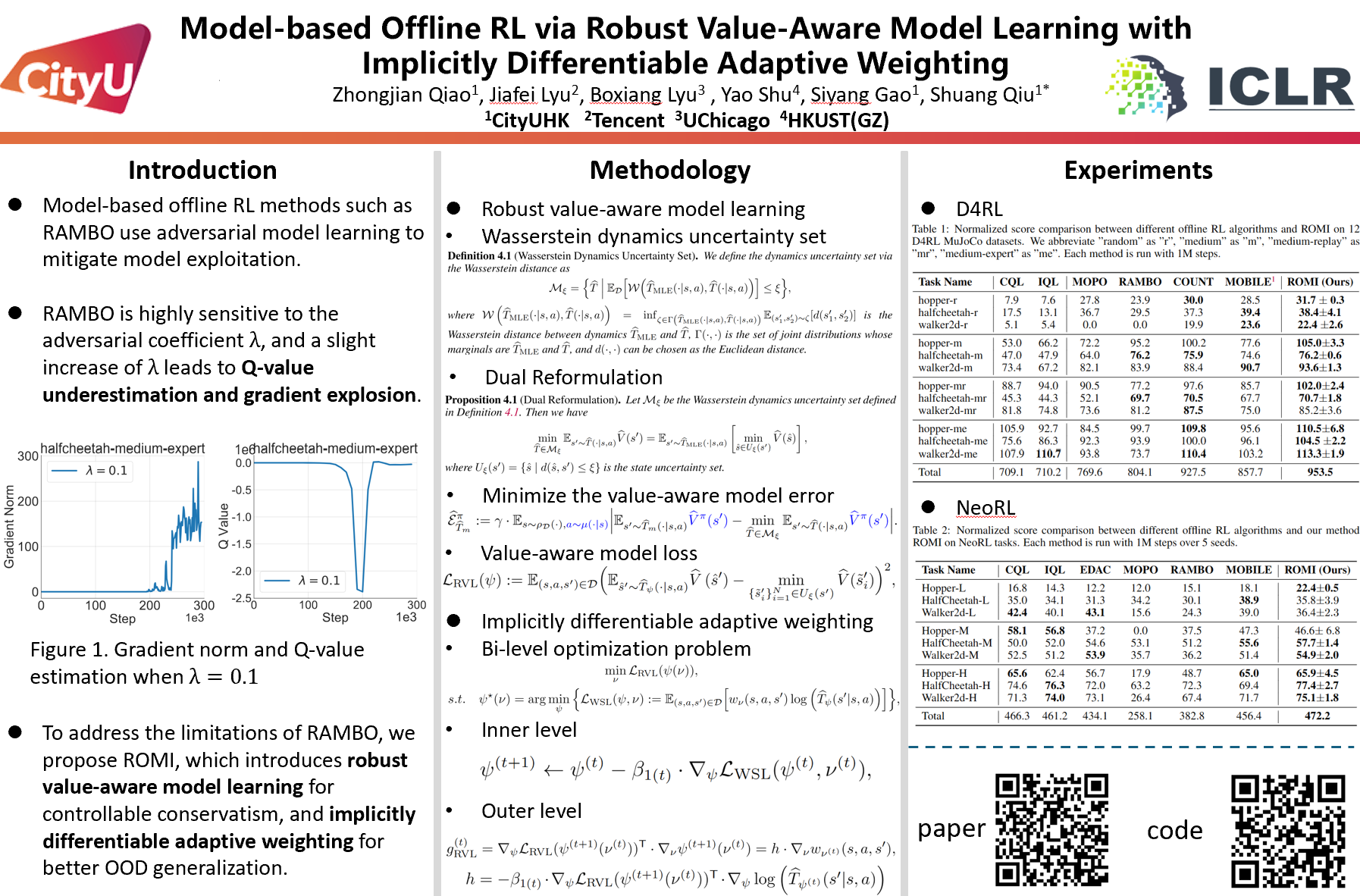
Model-based offline reinforcement learning (RL) aims to enhance offline RL with a dynamics model that facilitates policy exploration. However, model exploitation could occur due to inevitable model errors, which degrades algorithm performance. Adversarial model learning offers a theoretical framework to mitigate model exploitation by solving a maximin formulation, and RAMBO provides a practical implementation with model gradient. However, we empirically observe that severe Q-value underestimation and gradient explosion can occur in RAMBO with only slight hyperparameter tuning, suggesting that it tends to be overly conservative and suffers from unstable model updates. To address these issues, we propose RObust value-aware Model learning via Implicitly differentiable adaptive weighting (ROMI). Instead of updating the dynamics model with model gradient, ROMI introduces a novel robust value-aware model learning approach. This approach requires the dynamics model to predict future states with values close to the minimum Q-value within a scale-adjustable state uncertainty set, enabling controllable conservatism and stable model updates. To further improve out-of-distribution (OOD) generalization during multi-step rollouts, we propose implicitly differentiable adaptive weighting, a bi-level optimization scheme that adaptively achieves dynamics- and value-aware model learning. Empirical results on D4RL and NeoRL datasets show that ROMI significantly outperforms RAMBO and achieves competitive or superior performance compared to state-of-the-art methods on datasets where RAMBO typically underperforms.
Causal-Steer: Disentangled Continuous Style Control without Parallel Corpora
Qingsong Wang ⋅ Chang Yao ⋅ Jingyuan Chen
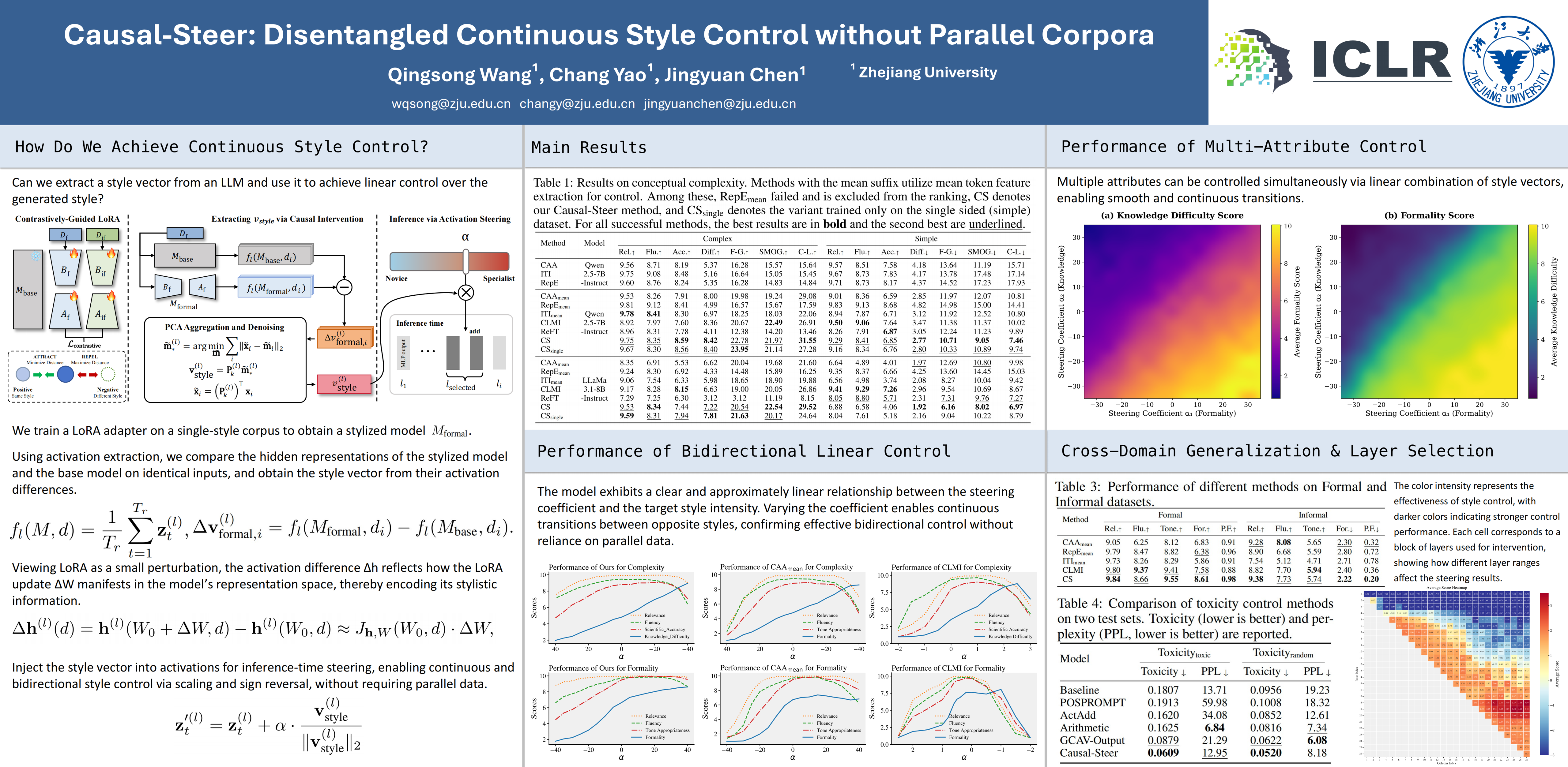
Controlling stylistic attributes of Large Language Models (LLMs), such as formality or conceptual complexity, is crucial for effective human-AI interaction. However, current methods often suffer from discreteness, reliance on expensive parallel corpora, and instability, limiting their practical utility. This paper introduces a novel framework for robust activation steering that eliminates the need for parallel corpora, enabling continuous, fine-grained, and linear control over LLM outputs. Our key insight is to reframe Low-Rank Adaptation (LoRA) as a causal intervention tool. By contrasting activations on identical inputs with and without a LoRA perturbation trained via a contrastive objective, we separate the influence of content. To enhance reliability, we introduce a robust aggregation pipeline that uses Principal Component Analysis (PCA) for denoising and the geometric median for centrality estimation, yielding a stable and disentangled style vector. At inference, this vector allows for precise bidirectional control via activation steering with negligible computational overhead. We demonstrate state-of-the-art performance on controlling conceptual complexity, text detoxification, and formality control. Our method not only provides superior control but also generalizes across different models and tasks, and enables simultaneous multi-attribute control.
GPTailor: Large Language Model Pruning Through Layer Cutting and Stitching
Guinan Su ⋅ Li Shen ⋅ Lu Yin ⋅ Shiwei Liu ⋅ Yanwu Yang ⋅ Jonas Geiping
Large language models (LLMs) have shown remarkable capabilities in language understanding and generation. However, such impressive capability typically comes with a substantial model size, which presents significant challenges in deployment and inference. While structured pruning of model parameters offers a promising way to reduce computational costs at deployment time, current methods primarily focus on single model pruning. In this work, we develop a novel strategy to compress models by strategically combining or merging layers from finetuned model variants, which preserves the original model's abilities by aggregating capabilities accentuated in different finetunes. We pose the optimal tailoring of these LLMs as a zero-order optimization problem, adopting a search space that supports three different operations: (1) Layer removal, (2) Layer selection from different candidate models, and (3) Layer merging. Our experiments demonstrate that this approach leads to competitive model pruning, for example, for the Llama2-13B model families, our compressed models maintain approximately 97.3\% of the original performance while removing ~25\% of parameters, significantly outperforming previous state-of-the-art methods.
VideoAgentTrek: Computer-Use Pretraining from Unlabeled Videos
Dunjie Lu ⋅ Yiheng Xu ⋅ Junli Wang ⋅ Haoyuan Wu ⋅ Xinyuan Wang ⋅ Zekun Wang ⋅ Junlin Yang ⋅ Hongjin SU ⋅ Jixuan Chen ⋅ Junda Chen ⋅ Yuchen Mao ⋅ Junyang Lin ⋅ Binyuan Hui ⋅ Tao Yu
Training computer-use agents requires massive amounts of GUI interaction data, but manually annotating action trajectories at scale is prohibitively expensive. We present VideoAgentTrek, a scalable pipeline that automatically mines training data from publicly available screen-recorded videos, eliminating the need for manual annotation. Our approach addresses a key challenge: raw videos contain implicit demonstrations but lack explicit action labels. To solve this, we develop Video2Action, an inverse dynamics module (IDM) with two components: (1) a video grounding model that detects and localizes GUI actions with precise temporal boundaries, and (2) an action-content recognizer that extracts structured parameters like click coordinates and typed text. Applied to 39,000 YouTube tutorial videos, our pipeline generates 1.52 million interaction steps. We leverage this data through continued pretraining followed by supervised fine-tuning. On OSWorld-Verified, our approach improves task success rates from 9.3% (SFT-only baseline) to 15.8%, a 70% relative improvement. On AgentNetBench, step accuracy increases from 64.1% to 69.3%. Our results demonstrate that passive internet videos can be transformed into high-quality supervision for computer-use agents, providing a scalable alternative to expensive manual annotation.
Landing with the Score: Riemannian Optimization through Denoising
Andrey Kharitenko ⋅ Zebang Shen ⋅ Riccardo De Santi ⋅ Niao He ⋅ Florian Dorfler
Under the \emph{data manifold hypothesis}, high-dimensional data concentrate near a low-dimensional manifold. We study Riemannian optimization when this manifold is only given implicitly through the data distribution, and standard geometric operations are unavailable. This formulation captures a broad class of data-driven design problems that are central to modern generative AI. Our key idea is a \emph{link function} that ties the data distribution to the geometric quantities needed for optimization: its gradient and Hessian recover the projection onto the manifold and its tangent space in the small-noise regime. This construction is directly connected to the score function in diffusion models, allowing us to leverage well-studied parameterizations, efficient training procedures, and even pretrained score networks from the diffusion model literature to perform optimization. On top of this foundation, we develop two {efficient} inference-time algorithms for optimization over data manifolds: \emph{Denoising Landing Flow} (DLF) and \emph{Denoising Riemannian Gradient Descent} (DRGD). We provide theoretical guarantees for approximate feasibility (manifold adherence) and optimality (small Riemannian gradient norm). We demonstrate the effectiveness of our approach on finite-horizon reference tracking tasks in data-driven control, illustrating their potential for practical generative and design applications.
The Choice of Divergence: A Neglected Key to Mitigating Diversity Collapse in Reinforcement Learning with Verifiable Reward
Long Li ⋅ Zhijian Zhou ⋅ JIARAN HAO ⋅ Jason Liu ⋅ Yanting Miao ⋅ Wei Pang ⋅ Xiaoyu Tan ⋅ Wei Chu ⋅ Zhe Wang ⋅ Shirui Pan ⋅ Chao Qu ⋅ Yuan Qi
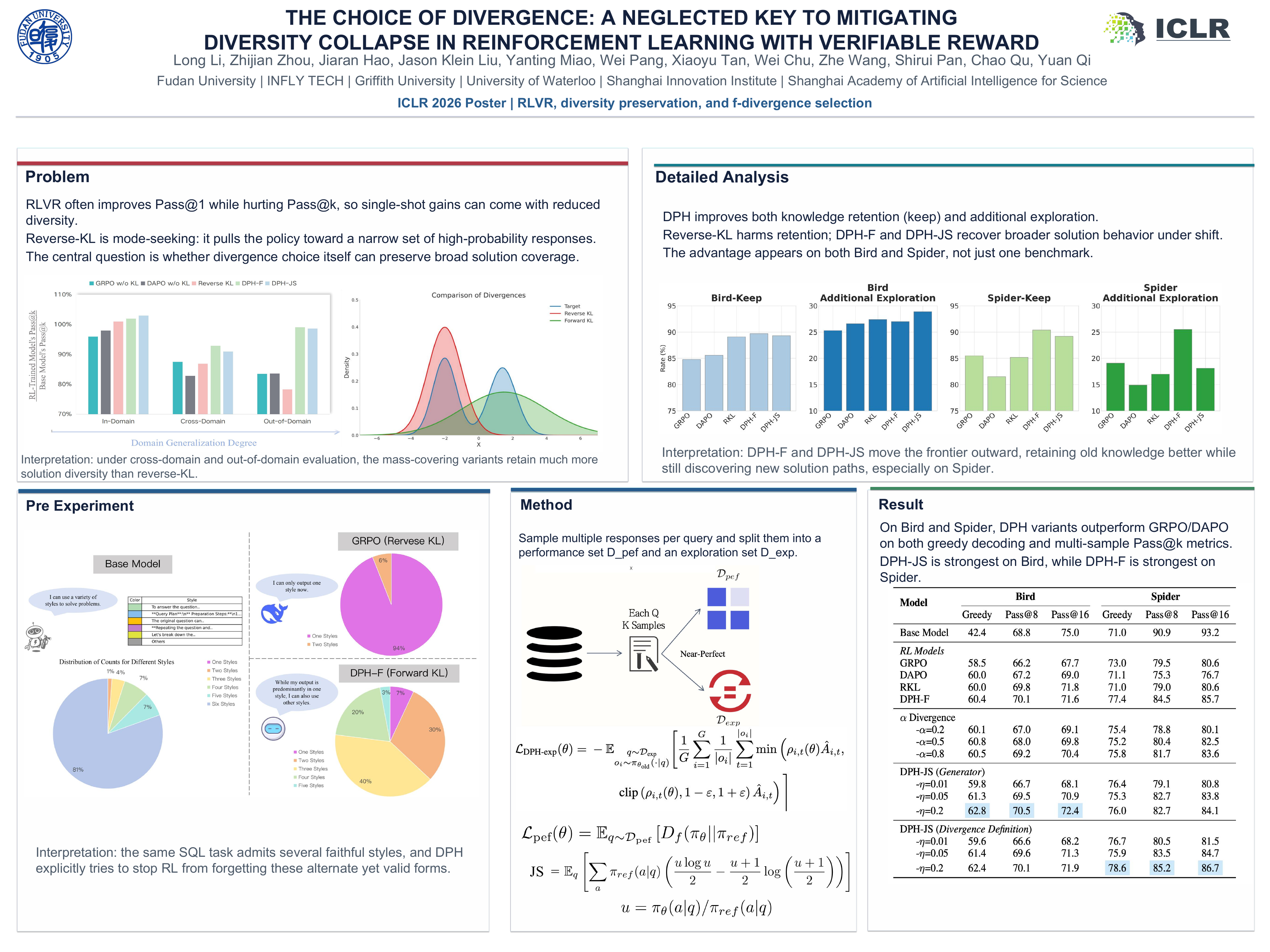
A central paradox in fine-tuning Large Language Models (LLMs) with Reinforcement Learning with Verifiable Reward (RLVR) is the frequent degradation of multi-attempt performance (Pass@k) despite improvements in single-attempt accuracy (Pass@1). This is often accompanied by catastrophic forgetting, where models lose previously acquired skills. Despite numerous proposed methods, the community's focus on the standard reverse KL-divergence has led to a surprising oversight: the potential of alternative f-divergences as a proactive solution has been largely unexamined. We argue that standard RLVR objectives—both those using the mode-seeking reverse KL-divergence and those forgoing a divergence term entirely—lack a crucial mechanism for knowledge retention. The reverse-KL actively accelerates this decay by narrowing the policy, while its absence provides no safeguard against the model drifting from its diverse knowledge base. We propose a fundamental shift in perspective: using the divergence term itself as the solution. Our framework, Diversity-Preserving Hybrid RL (DPH-RL), leverages mass-covering f-divergences (like forward-KL and JS-divergence) to function as a 'rehearsal mechanism'. By continuously referencing the initial policy, this approach forces the model to maintain broad solution coverage. Math and SQL generation experiments show that DPH-RL both improves in-domain Pass@1 and Pass@k scores and effectively prevents catastrophic forgetting on out-of-domain tasks. Additionally, DPH-RL is more training-efficient because it computes f-divergence using generator functions, requiring only sampling from the initial policy and no online reference model. Our work highlights a crucial, overlooked axis for improving RLVR, demonstrating that the proper selection of a divergence measure is a powerful tool for building more general and diverse reasoning models.
Attack-Resistant Watermarking for AIGC Image Forensics via Diffusion-based Semantic Deflection
Qingyu Liu ⋅ Yitao Zhang ⋅ Zhongjie Ba ⋅ Chao Shuai ⋅ Peng Cheng ⋅ Tianhang Zheng ⋅ Zhibo Wang

Protecting the copyright of user-generated AI images is an emerging challenge as AIGC becomes pervasive in creative workflows. Existing watermarking methods (1) remain vulnerable to real-world adversarial threats, often forced to trade off between defenses against spoofing and removal attacks; and (2) cannot support semantic-level tamper localization. We introduce PAI, a training-free inherent watermarking framework for AIGC copyright protection, plug-and-play with diffusion-based AIGC services. PAI simultaneously provides three key functionalities: robust ownership verification, attack detection, and semantic-level tampering localization. Unlike existing inherent watermark methods that only embed watermarks at noise initialization of diffusion models, we design a novel key-conditioned deflection mechanism that subtly steers the denoising trajectory according to the user key. Such trajectory-level coupling further strengthens the semantic entanglement of identity and content, thereby further enhancing robustness against real-world threats. Moreover, we also provide a theoretical analysis proving that only the valid key can pass verification. Experiments across 12 attack methods show that PAI achieves 98.43\% verification accuracy, improving over SOTA methods by 37.25\% on average, and retains strong tampering localization performance even against advanced AIGC edits. Our code is available at \url{https://github.com/QingyuLiu/PAI}.
Neologism Learning for Controllability and Self-Verbalization
John Hewitt ⋅ Oyvind Tafjord ⋅ Robert Geirhos ⋅ Been Kim
Humans invent new words when there is a rising demand for a new useful concept (e.g., doomscrolling). We explore and validate a similar idea in our communication with LLMs: introducing new words to better understand and control the models, expanding on the recently introduced neologism learning. This method introduces a new word by adding a new word embedding and training with examples that exhibit the concept with no other changes in model parameters. We show that adding a new word allows for control of concepts such as flattery, incorrect answers, text length, as well as more complex concepts in AxBench. We discover that neologisms can also further our understanding of the model via self-verbalization: models can describe what each new word means to them in natural language, like explaining that a word that represents a concept of incorrect answers means “a lack of complete, coherent, or meaningful answers. . . ” To validate self-verbalizations, we introduce plug-in evaluation: we insert the verbalization into the context of a model and measure whether it controls the target concept. In some self-verbalizations, we find machine-only synonyms: words that seem unrelated to humans but cause similar behavior in machines. Finally, we show how neologism learning can jointly learn multiple concepts in multiple words.
Cascadia: An Efficient Cascade Serving System for Large Language Models
YOUHE JIANG ⋅ Fangcheng Fu ⋅ Wanru Zhao ⋅ Stephan Rabanser ⋅ Jintao Zhang ⋅ Nic Lane ⋅ Binhang Yuan
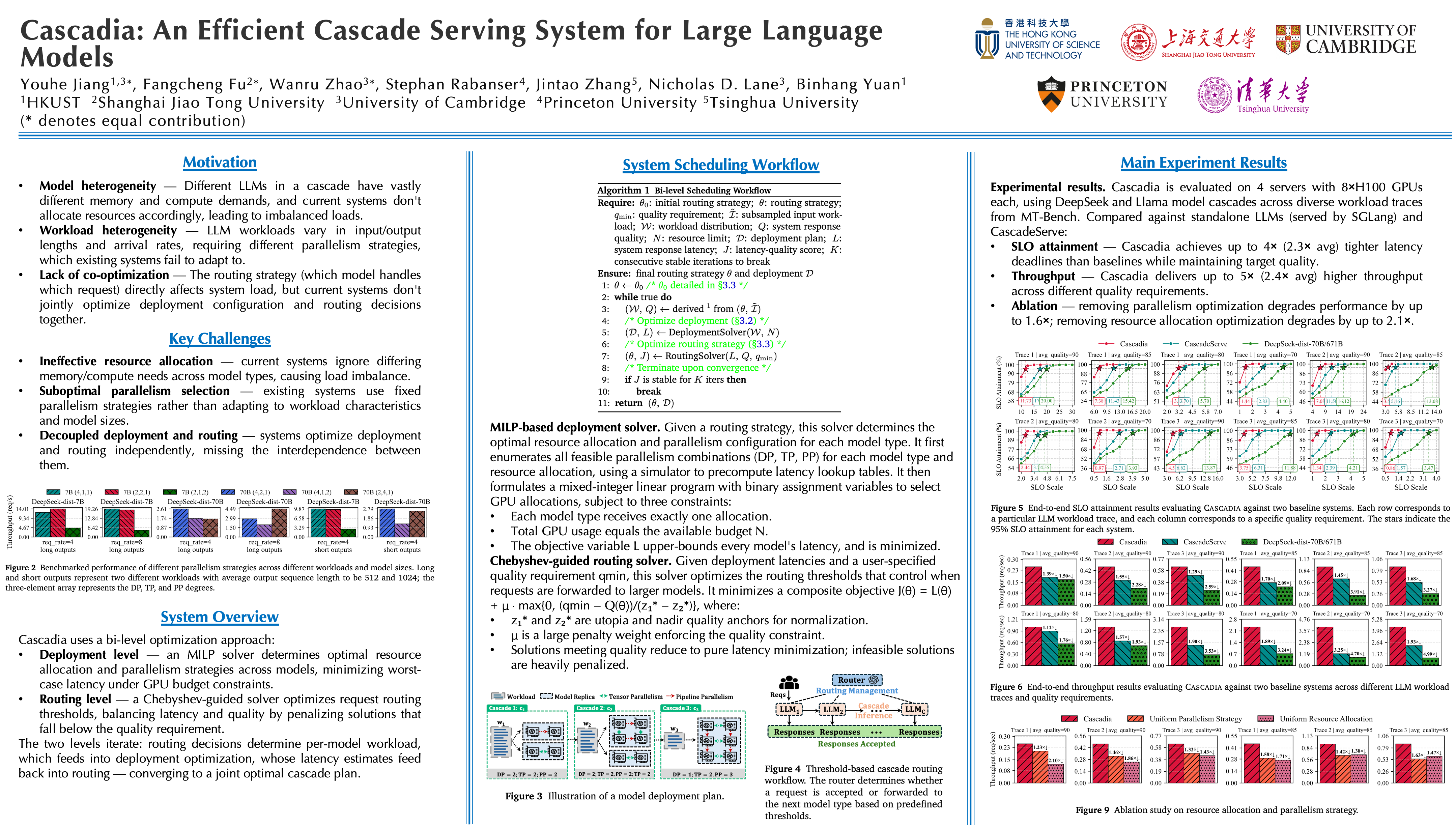
Recent advances in large language models (LLMs) have intensified the need to deliver both rapid responses and high-quality outputs. More powerful models yield better results but incur higher inference latency, whereas smaller models are faster yet less capable. Recent work proposes balancing this latency–quality trade-off using model cascades, which route simpler queries to smaller models and more complex ones to larger models. However, enabling efficient cascade serving remains challenging. Current frameworks lack effective mechanisms for handling (i) the huge and varying resource demands of different LLMs, (ii) the inherent heterogeneity of LLM workloads, and (iii) the co-optimization of system deployment and routing strategy. Motivated by these observations, we introduce Cascadia, a novel cascade serving framework designed explicitly to schedule request routing and deploy model cascades for fast, quality-preserving LLM serving. Cascadia employs a bi-level optimization method: at the deployment level, it uses a mixed-integer linear program to select resource allocations and parallelism strategies based on LLM information and workload characteristics; at the routing level, it applies a Chebyshev-guided method to iteratively co-optimize the routing strategy and the system deployment produced by the deployment level. Our extensive evaluation on diverse workload traces and different model cascades (DeepSeek and the Llama series) demonstrates that Cascadia significantly outperforms both single-model deployments and the state-of-the-art cascade serving baseline, achieving up to 4$\times$ (2.3$\times$ on average) tighter latency SLOs and up to 5$\times$ (2.4$\times$ on average) higher throughput while maintaining target answer quality.
Echoes as Anchors: Probabilistic Costs and Attention Refocusing in LLM Reasoning
Zhuoyuan Hao ⋅ Zhuo Li ⋅ Wu Li ⋅ Fangming Liu ⋅ Min Zhang ⋅ Jing Li
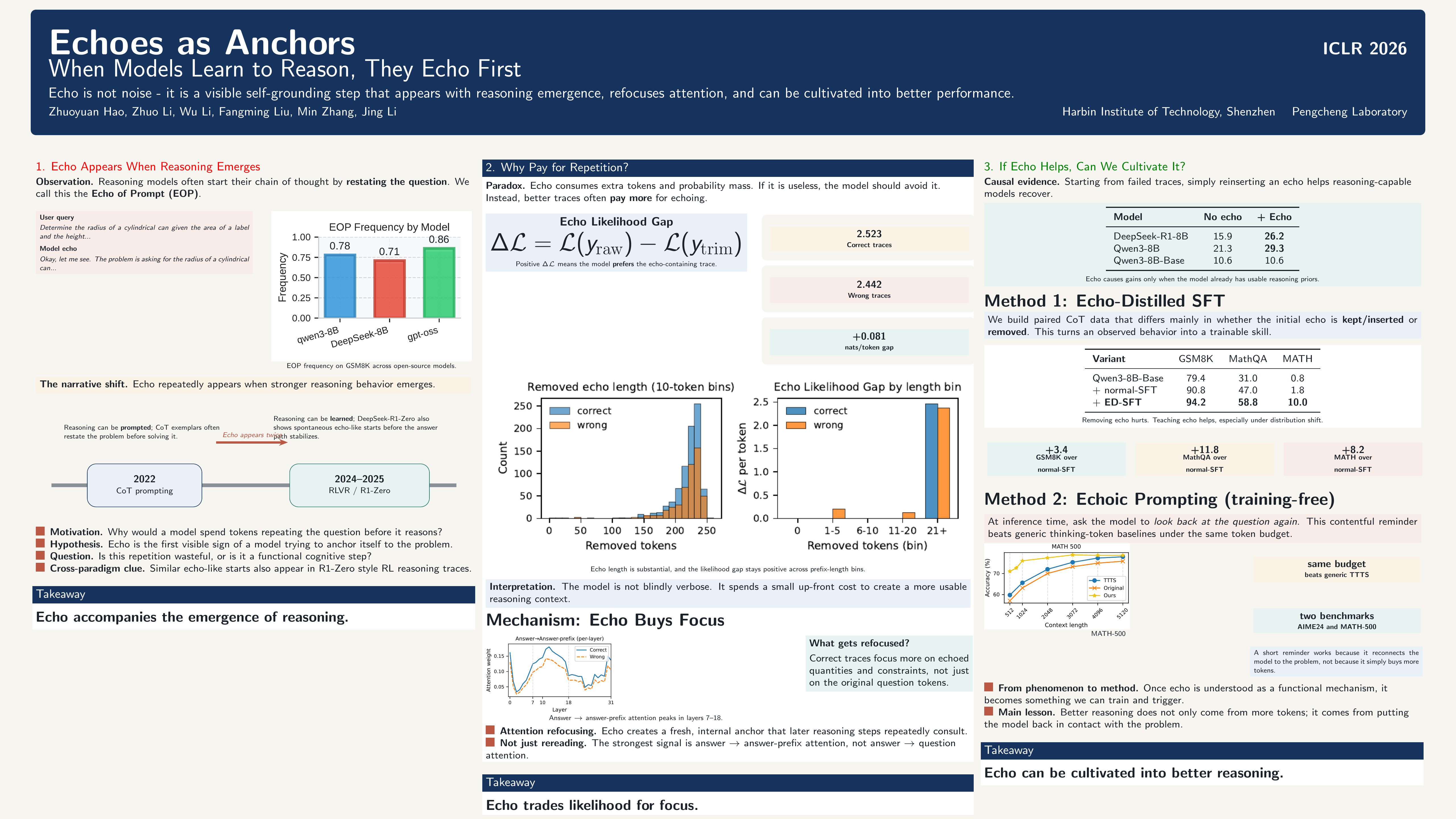
Test-time compute allocation in large reasoning models (LRMs) is widely used and has applications in mathematical problem solving, code synthesis, and planning. Recent work has addressed this problem by scaling self-consistency and parallel thinking, adding generic thinking tokens and prompting models to re-read the question before answering. Unfortunately, these approaches either inject task-agnostic tokens or mandate heuristics that do not explain---and often ignore---the \emph{spontaneous} repetition that many LRMs exhibit at the head of their internal chains. In contrast, we analyze and harness the model's tendency to restate the question, which we term the \emph{Echo of Prompt (EOP)}, as a front-loaded, compute-shaping mechanism. We formalize its probabilistic cost by casting echo removal as rejection-based conditioning and defining the \emph{Echo Likelihood Gap} $\Delta\mathcal{L}$ as a computable proxy. This provides the missing theoretical link that links early repetition to likelihood gains and downstream accuracy. However, it does not by itself specify how to exploit EOP. Consequently, we develop \emph{Echo-Distilled SFT (ED-SFT)} to instill an ``echo-then-reason'' pattern through supervised finetuning, and \emph{Echoic Prompting (EP)} to re-ground the model mid-trace without training. While promising, quantifying benefits beyond verbosity is non-trivial. Therefore, we conduct length and suffix-controlled likelihood analyses together with layer-wise attention studies, showing that EOP increases answer to answer-prefix attention in middle layers, consistent with an \emph{attention refocusing} mechanism. We evaluate under identical decoding settings and compute budgets on GSM8K, MathQA, Hendrycks-MATH, AIME24, and MATH-500 under identical decoding settings and budgets, and find consistent gains over baselines.
ScalingCache: Extreme Acceleration of DiTs through Difference Scaling and Dynamic Interval Caching
Lihui Gu ⋅ Jingbin He ⋅ Lianghao Su ⋅ Kang He ⋅ Wenxiao Wang ⋅ Yuliang Liu
Diffusion Transformers (DiTs) have emerged as powerful generative models, but their iterative denoising structure and deep transformer blocks incur substantial computational overhead, limiting the accessibility and practical deployment of high-quality video generation. To address this bottleneck, we propose ScalingCache, a training-free acceleration framework specifically designed for DiTs. ScalingCache exploits the inherent redundancy in model representations by performing lightweight offline analysis on a small number of samples and dynamically reusing previously computed activations during inference, thereby avoiding full computation at certain denoising steps. Experimental results demonstrate that ScalingCache achieves significant acceleration in both image and video generation tasks while maintaining near-lossless generation quality. On widely used video generation models including Wan2.1 and HunyuanVideo, it achieves approximately 2.5$\times$ acceleration with only 0.5$\%$ drop in VBench scores; on FLUX, it achieves 3.1$\times$ near-lossless acceleration, with human preference tests showing comparable quality to original outputs. Moreover, under similar acceleration ratios, ScalingCache outperforms prior state-of-the-art caching strategies, achieving a 45$\%$ reduction in LPIPS for text-to-image generation and 20$-$30$\%$ reduction for text-to-video generation, highlighting its superior fidelity preservation.
VLM4VLA: Revisiting Vision-Language-Models in Vision-Language-Action Models
Jianke Zhang ⋅ Xiaoyu Chen ⋅ Yanjiang Guo ⋅ Yucheng Hu ⋅ Jianyu Chen
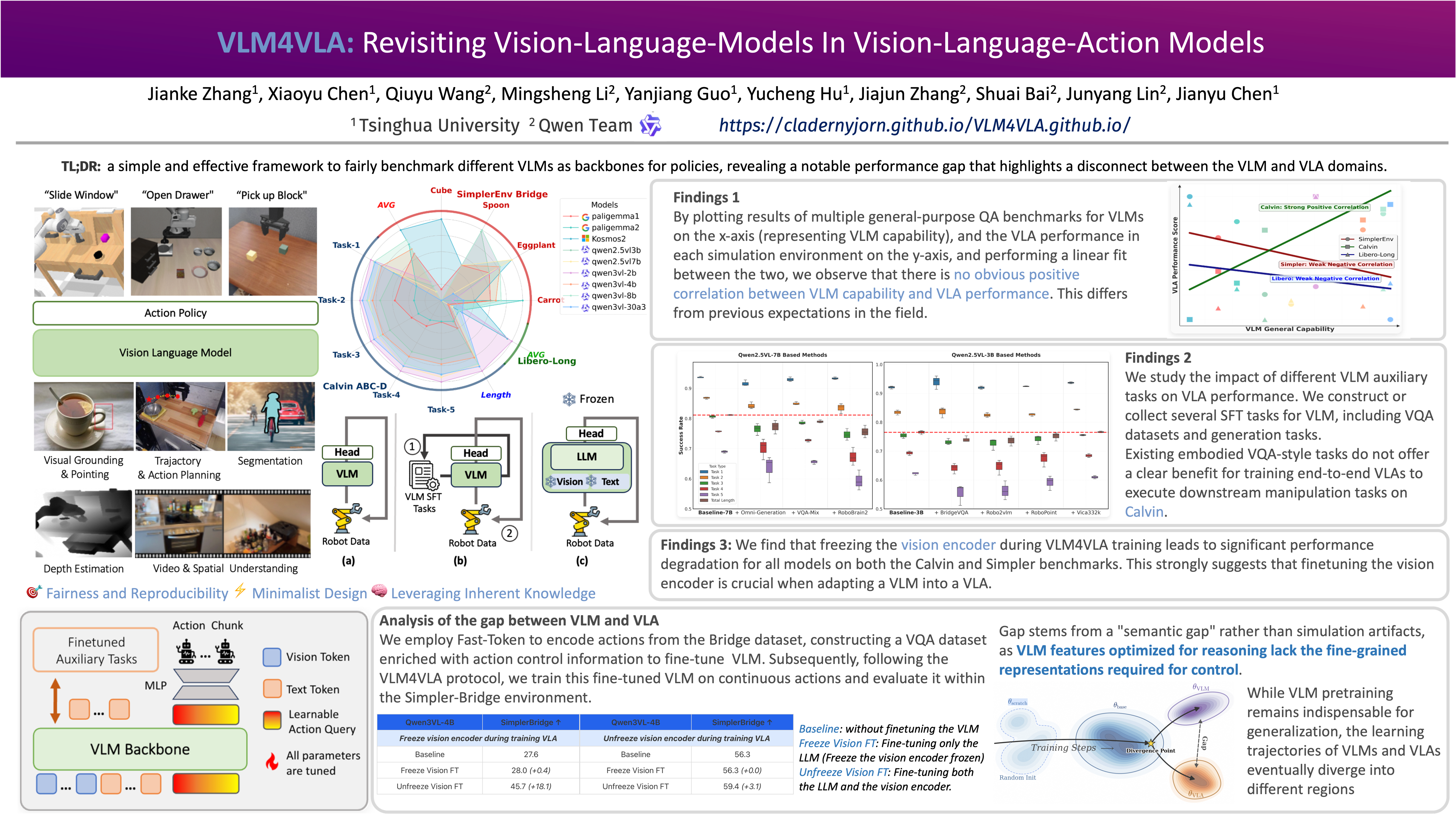
Vision-Language-Action (VLA) models, which integrate pretrained large Vision-Language Models (VLMs) into their policy backbone, are gaining significant attention for their promising generalization capabilities. This paper revisits a fundamental yet seldom systematically studied question: how VLM choice and competence translate to downstream VLA policies performance? We introduce \textbf{VLM4VLA}, a minimal adaptation pipeline that converts general-purpose VLMs into VLA policies using only a small set of new learnable parameters for fair and efficient comparison. Despite its simplicity, VLM4VLA proves surprisingly competitive with more sophisticated network designs. Through extensive empirical studies on various downstream tasks across three benchmarks, we find that while VLM initialization offers a consistent benefit over training from scratch, a VLM's general capabilities are poor predictors of its downstream task performance. This challenges common assumptions, indicating that standard VLM competence is necessary but insufficient for effective embodied control. We further investigate the impact of specific embodied capabilities by fine-tuning VLMs on seven auxiliary embodied tasks (e.g., embodied QA, visual pointing, depth estimation). Contrary to intuition, improving a VLM's performance on specific embodied skills does not guarantee better downstream control performance. Finally, modality-level ablations identify the visual module in VLM, rather than the language component, as the primary performance bottleneck. We demonstrate that injecting control-relevant supervision into the vision encoder of the VLM yields consistent gains, even when the encoder remains frozen during downstream fine-tuning. This isolates a persistent domain gap between current VLM pretraining objectives and the requirements of embodied action-planning. Project Page: \href{https://cladernyjorn.github.io/VLM4VLA.github.io/}{https://cladernyjorn.github.io/VLM4VLA.github.io}.
Tactic: Adaptive Sparse Attention with Clustering and Distribution Fitting for Long-Context LLMs
Kan Zhu ⋅ Tian Tang ⋅ Qinyu Xu ⋅ Zhan Jin ⋅ Yile Gu ⋅ Zhichen Zeng ⋅ Rohan Kadekodi ⋅ Liangyu Zhao ⋅ Ang Li ⋅ Arvind Krishnamurthy ⋅ Baris Kasikci
Long-context models are essential for many applications but face inefficiencies in loading large KV caches during decoding. Prior methods enforce fixed token budgets for sparse attention, assuming a set number of tokens can approximate full attention. However, these methods overlook variations in the importance of attention across heads, layers, and contexts. To address these limitations, we propose Tactic, a sparsity-adaptive and calibration-free sparse attention mechanism that dynamically selects tokens based on their cumulative attention scores rather than a fixed token budget. By setting a target fraction of total attention scores, Tactic ensures that token selection naturally adapts to variations in attention sparsity. To efficiently approximate this selection, Tactic leverages clustering-based sorting and distribution fitting, allowing it to accurately estimate token importance with minimal computational overhead. We show that Tactic outperforms existing sparse attention algorithms, achieving superior accuracy and up to 5.14x decode attention speedup. This improvement translates to an overall 1.51x end-to-end inference speedup, making Tactic a practical and effective solution for long-context LLM inference in accuracy-sensitive applications.
Person-Centric Annotations of LAION-400M: Auditing Bias and Its Transfer to Models
Leander Girrbach ⋅ Stephan Alaniz ⋅ Genevieve Smith ⋅ trevor darrell ⋅ Zeynep Akata
Vision-language models trained on large-scale multimodal datasets show strong demographic biases, but the role of training data in producing these biases remains unclear. A major barrier has been the lack of demographic annotations in web-scale datasets such as LAION-400M. We address this gap by creating person-centric annotations for the full dataset, including over 276 million bounding boxes, perceived gender and race/ethnicity labels, and automatically generated captions. These annotations are produced through validated automatic labeling pipelines combining object detection, multimodal captioning, and finetuned classifiers. Using them, we uncover demographic imbalances and harmful associations, such as the disproportionate linking of men and individuals perceived as Black or Middle Eastern with crime-related and negative content. We also show that 60-70\% of gender bias in CLIP and Stable Diffusion can be linearly explained by direct co-occurrences in the data. Our resources establish the first large-scale empirical link between dataset composition and downstream model bias.
The Forecast After the Forecast: A Post-Processing Shift in Time Series
Daojun Liang ⋅ Qi Li ⋅ Yinglong Wang ⋅ Jing Chen ⋅ Hu Zhang ⋅ Xiaoxiao Cui ⋅ Qizheng Wang ⋅ Shuo Li
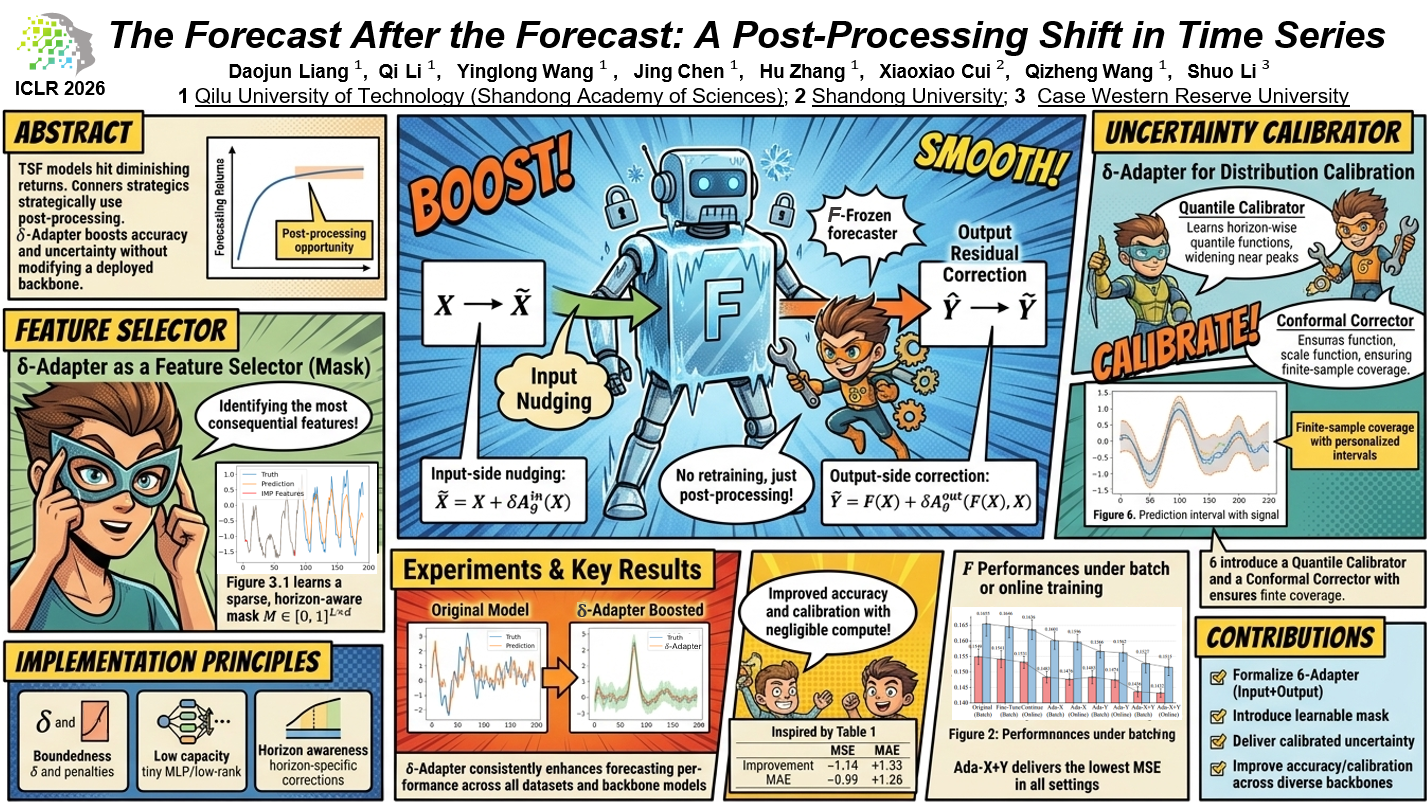
Time series forecasting has long been dominated by advances in model architecture, with recent progress driven by deep learning and hybrid statistical techniques. However, as forecasting models approach diminishing returns in accuracy, a critical yet underexplored opportunity emerges: the strategic use of post-processing. In this paper, we address the last-mile gap in time-series forecasting, which is to improve accuracy and uncertainty without retraining or modifying a deployed backbone. We propose $\delta$-Adapter, a lightweight, architecture-agnostic way to boost deployed time series forecasters without retraining. $\delta$-Adapter learns tiny, bounded modules at two interfaces: input nudging (soft edits to covariates) and output residual correction. We provide local descent guarantees, $O(\delta)$ drift bounds, and compositional stability for combined adapters. Meanwhile, it can act as a feature selector by learning a sparse, horizon-aware mask over inputs to select important features, thereby improving interpretability. In addition, it can also be used as a distribution calibrator to measure uncertainty. Thus, we introduce a Quantile Calibrator and a Conformal Corrector that together deliver calibrated, personalized intervals with finite-sample coverage. Our experiments across diverse backbones and datasets show that $\delta$-Adapter improves accuracy and calibration with negligible compute and no interface changes.
Mango-GS: Enhancing Spatio-Temporal Consistency in Dynamic Scenes Reconstruction using Multi-Frame Node-Guided 4D Gaussian Splatting
Tingxuan Huang ⋅ Haowei Zhu ⋅ Jun-Hai Yong ⋅ Hao Pan ⋅ Bin Wang
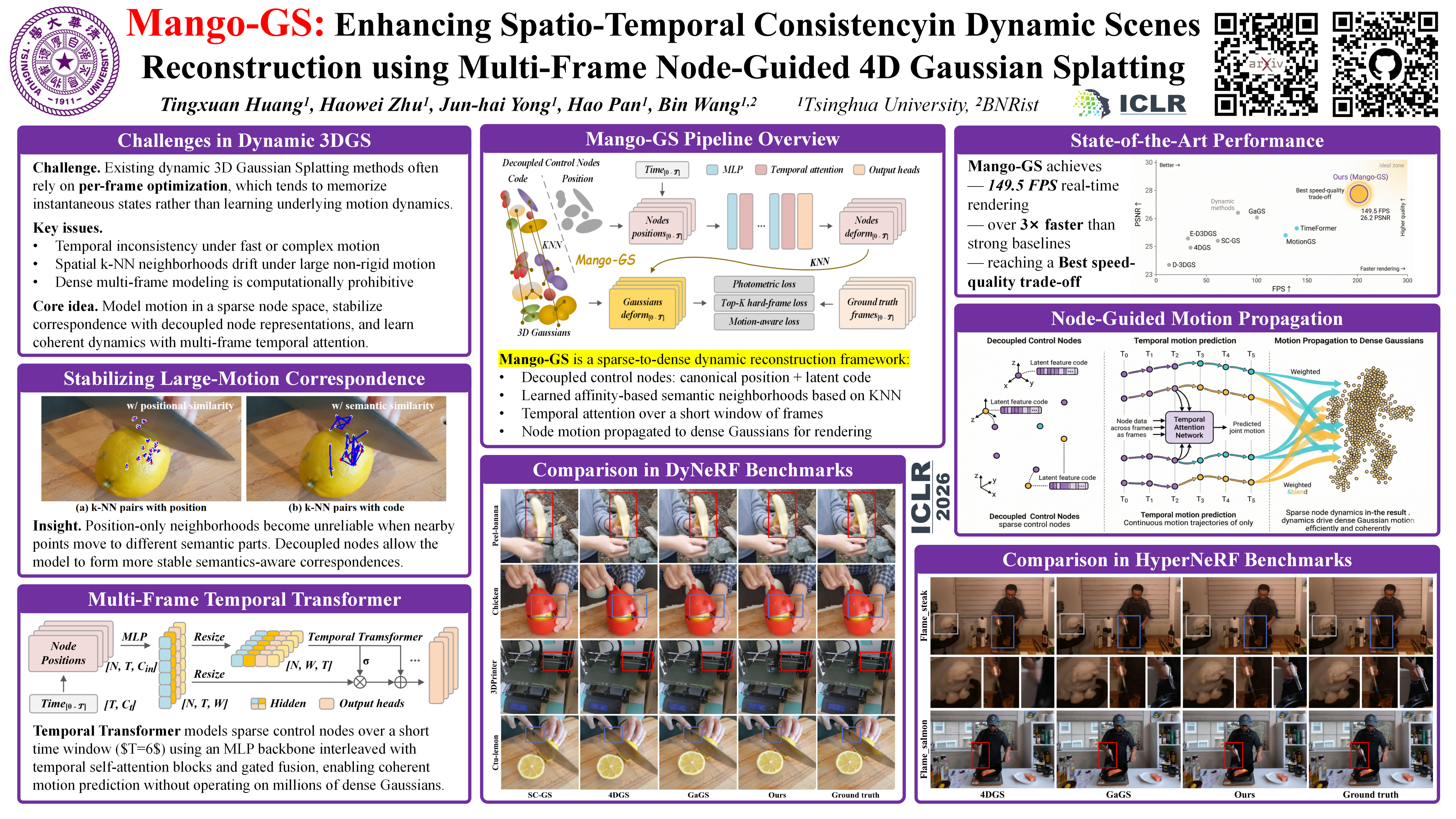
Reconstructing dynamic 3D scenes with photorealistic detail and temporal coherence remains a significant challenge. Existing Gaussian splatting approaches modeling scenes rely on per-frame optimization, causing them to overfit to instantaneous states rather than learning true motion dynamics. To address this, we present Mango-GS, a multi-frame, node-guided framework for high-fidelity 4D reconstruction. Our approach leverages a temporal Transformer to learn complex motion dependencies across a window of frames, ensuring the generation of plausible trajectories. For efficiency, this temporal modeling is confined to a sparse set of control nodes. These nodes are uniquely designed with decoupled position and latent codes, which provide a stable semantic anchor for motion influence and prevents correspondence errors for large movements. Our framework is trained end-to-end, enhanced by a input masking strategy and two multi-frame loss to ensure robustness. Extensive experiments demonstrate that Mango-GS achieves state-of-the-art quality and fast rendering speed, enabling high-fidelity reconstruction and real-time rendering of dynamic scenes.
One Patch Doesn’t Fit All: Adaptive Patching for Native-Resolution Multimodal Large Language Models
Wenzhuo Liu ⋅ Weijie Yin ⋅ Fei Zhu ⋅ Shijie Ma ⋅ Haiyang Guo ⋅ Yi Chen ⋅ Xiao-Hui Li ⋅ Xiao Liang ⋅ Chao Feng ⋅ Cheng-lin Liu
Real-world visual signals are inherently variable in resolution, and it is natural to endow multimodal large language models (MLLMs) with such native-resolution perception capabilities. In principle, for general and straightforward multimodal understanding, low-resolution images are sufficient. While for images with nuanced details like documents and charts, it is crucial to preserve fine-grained details using high-resolution inputs, as naive resizing inevitably results in information loss. Recent advances employ sequence packing to process images of any resolution and aspect ratios. Despite these efforts, model performance degrades at both low and high resolutions, and high-resolution inputs incur substantial computational costs. We argue that the rigid use of a single patch size is the primary cause: when image resolution or information density varies, fixing patch size is intrinsically suboptimal. To address this issue, we introduce Adaptive Patching (AdaPatch), a simple yet effective strategy that adjusts patch size according to image resolution and information density and could be seamlessly plugged into pre-trained fixed-patch MLLMs without any training efforts. Extensive evaluations demonstrate consistent improvements in native resolution performance without additional training. Besides, we provide a training-based method to further adapt MLLMs with dynamic patch sizes and enhance the performance.
To Sink or Not to Sink: Visual Information Pathways in Large Vision-Language Models
Jiayun Luo ⋅ Wan-Cyuan (Chris) Fan ⋅ Lyuyang Wang ⋅ Xiangteng He ⋅ Tanzila Rahman ⋅ Purang Abolmaesumi ⋅ Leonid Sigal
Large Vision Language Models (LVLMs) have recently emerged as powerful architectures capable of understanding and reasoning over both visual and textual information. These models typically rely on two key components: a Vision Transformer (ViT) and a Large Language Model (LLM). ViT encodes visual content into a sequence of image tokens and serves as the perceptual front-end -- the eyes of the model. In contrast, the LLM interprets these tokens to perform high-level reasoning, generates responses, and functions as the cognitive core -- the brain of the model. However, it remains unclear which visual tokens contribute most significantly to understanding and reasoning, and how effectively these signals are propagated from ViT to the LLM. While most existing works have focused on identifying attention sinks, low-semantic tokens receiving disproportionately high attention, within the LLM, we shift the focus to the vision encoder by identifying a class of high-norm visual tokens from ViT, referred to as ViT attention sinks -- a problem that has been rarely studied but is indeed very important for LVLMs. Our findings show that these ViT sinks encapsulate high-level semantic concepts from images, allowing the LLM to perform more effective understanding and reasoning. Despite their importance, these sink tokens are often overlooked in existing LVLM architectures. To explore their contribution, we present both qualitative and quantitative analyses of the information embedded in these sink tokens. We also propose both training-free and training-based approaches to better leverage how this information is interpreted by the LLM, and to what extent. By explicitly utilizing these tokens, we demonstrate substantial improvements across a range of LVLMs and visual reasoning tasks, including but not limited to mathematical problem solving, logical inference, and geometric understanding, highlighting the untapped potential of ViT attention sinks in enhancing visual reasoning.
Estimating Worst-Case Frontier Risks of Open-Weight LLMs
Eric Wallace ⋅ Olivia Watkins ⋅ Miles Wang ⋅ Kai Chen ⋅ Chris Koch
In this paper, we study the worst-case frontier risks of the OpenAI gpt-oss model. We introduce malicious fine-tuning (MFT), where we attempt to elicit maximum capabilities by fine-tuning gpt-oss to be as capable as possible in two domains: biology and cybersecurity. To maximize biological risk (biorisk), we curate tasks related to threat creation and train gpt-oss in an RL environment with web browsing. To maximize cybersecurity risk, we train gpt-oss in an agentic coding environment to solve capture-the-flag (CTF) challenges. We compare these MFT models against open- and closed-weight LLMs on frontier risk evaluations. Compared to frontier closed-weight models, MFT gpt-oss underperforms OpenAI o3, a model that is below Preparedness High capability level for biorisk and cybersecurity. Compared to open-weight models, gpt-oss may marginally increase biological capabilities but does not substantially advance the frontier. Taken together, these results led us to believe that the net new harm from releasing gpt-oss is limited, and we hope that our MFT approach can serve as useful guidance for estimating harm from future open-weight releases.
Are we measuring oversmoothing in graph neural networks correctly?
Kaicheng Zhang ⋅ Piero Deidda ⋅ Desmond Higham ⋅ Francesco Tudisco
Oversmoothing is a fundamental challenge in graph neural networks (GNNs): as the number of layers increases, node embeddings become increasingly similar, and model performance drops sharply. Traditionally, oversmoothing has been quantified using metrics that measure the similarity of neighbouring node features, such as the Dirichlet energy. We argue that these metrics have critical limitations and fail to reliably capture oversmoothing in realistic scenarios. For instance, they provide meaningful insights only for very deep networks, while typical GNNs show a performance drop already with as few as 10 layers. As an alternative, we propose measuring oversmoothing by examining the numerical or effective rank of the feature representations. We provide extensive numerical evaluation across diverse graph architectures and datasets to show that rank-based metrics consistently capture oversmoothing, whereas energy-based metrics often fail. Notably, we reveal that drops in the rank align closely with performance degradation, even in scenarios where energy metrics remain unchanged. Along with the experimental evaluation, we provide theoretical support for this approach, clarifying why Dirichlet-like measures may fail to capture performance drop and proving that the numerical rank of feature representations collapses to one for a broad family of GNN architectures.
Test-Time Optimization of 3D Point Cloud LLM via Manifold-Aware In-Context Guidance and Refinement
Tiankai Chen ⋅ Nanqing Liu ⋅ Li Yang ⋅ xulei yang ⋅ Tianrui Li ⋅ Xun Xu
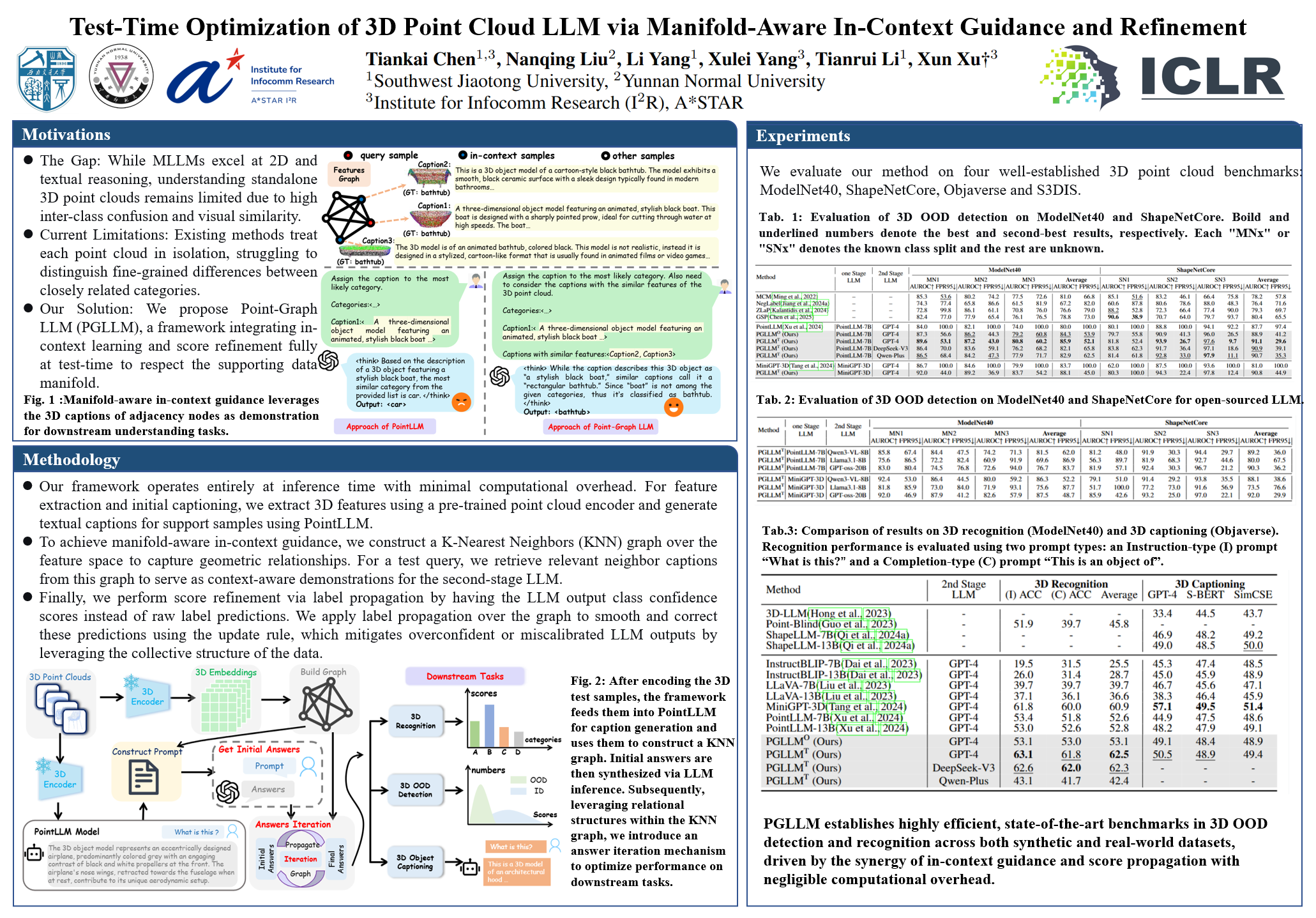
Multimodal Large Language Models (MLLMs) have demonstrated impressive capabilities in textual and 2D visual reasoning, yet their ability to understand and reason over 3D data remains limited. The issues become more challenging for understanding standalone 3D point cloud due to the high interclass confusion. In this work, we propose Point-Graph LLM (PGLLM), a framework that enables more effective 3D point cloud understanding by integrating in-context prompting and score refinement at test-time, respecting supporting data manifold. Our method first employs a pre-trained point cloud encoder which are used to construct a graph where edges encode visual similarity. Each support point cloud sample is converted to a textual caption via pre-trained PointLLM. For a test query, the graph is used to retrieve relevant neighbors whose captions serve as contextual demonstrations for a second stage LLM for final reasoning, a process we term in-context guidance. Furthermore, we introduce a confidence score refinement mechanism based on label propagation to enhance the reliability of LLM predictions for classification and out-of-distribution (OOD) detection tasks. All the above optimizations are carried out fully at test-time. Extensive experiments across diverse 3D datasets and tasks demonstrate that PGLLM consistently improves accuracy and robustness over prior baselines with very almost no additional computation cost, showcasing a promising direction toward native 3D reasoning with MLLMs.
A High Quality Dataset and Reliable Evaluation for Interleaved Image-Text Generation
Yukang Feng ⋅ Jianwen Sun ⋅ Chuanhao Li ⋅ Zizhen Li ⋅ Jiaxin Ai ⋅ Fanrui Zhang ⋅ Sizhuo Zhou ⋅ Yifan Chang ⋅ Shenglin Zhang ⋅ Yu Dai ⋅ Kaipeng Zhang
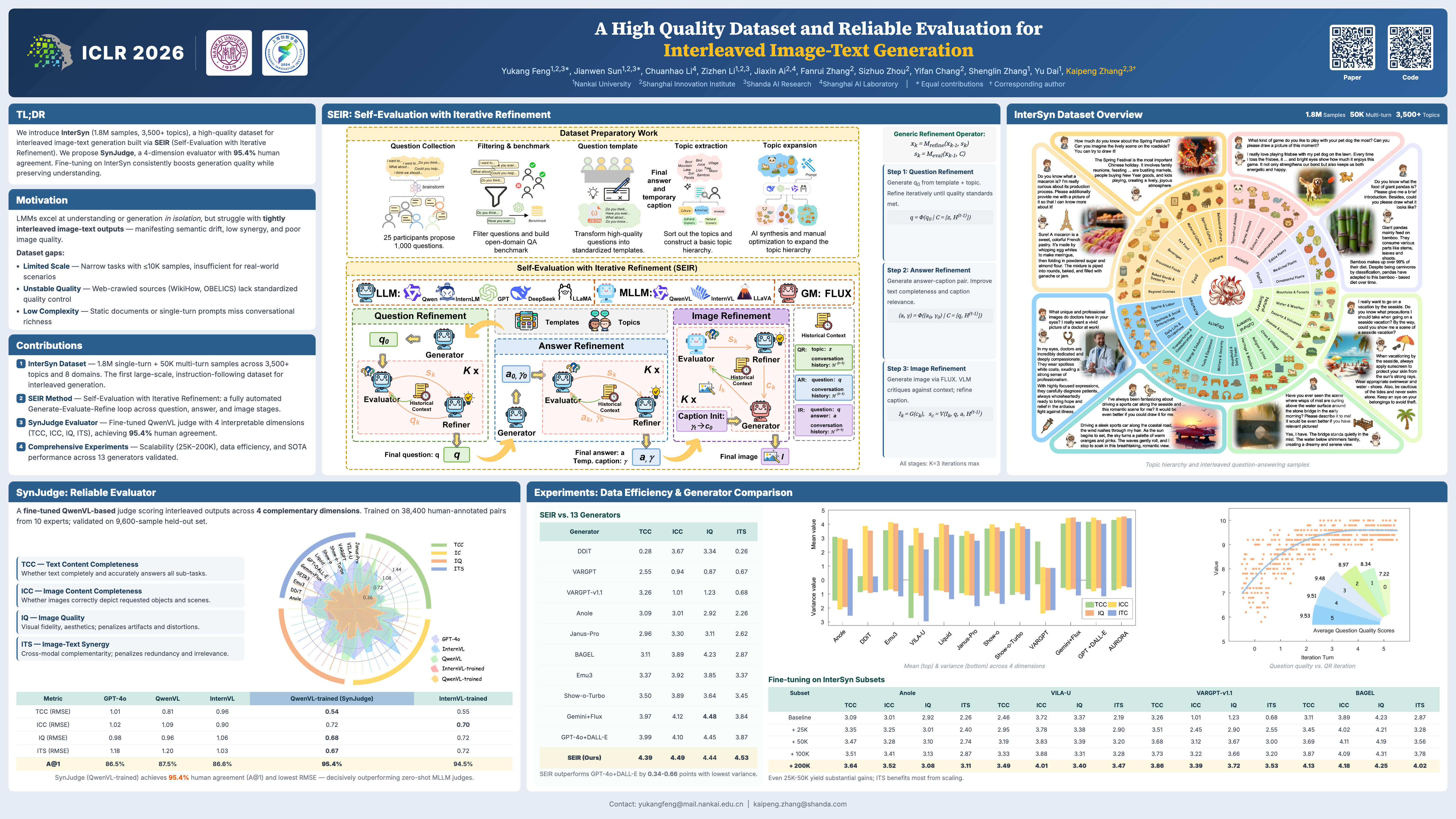
Recent advancements in Large Multimodal Models (LMMs) have significantly improved multimodal understanding and generation. However, these models still struggle to generate tightly interleaved image-text outputs, primarily due to the limited scale, quality and instructional richness of current training datasets. To address this, we introduce \textbf{InterSyn}, a dataset that features: (1) large scale, comprising 1.8M multimodal samples; (2) high quality, supported by our proposed \textbf{Self-Evaluation with Iterative Refinement (SEIR)} method for rigorous automated quality refinement; (3) rich instructional diversity, ensured through diverse well-designed question templates, based on human preferences and covering a 3500-topic hierarchy. These characteristics make InterSyn particularly well-suited for training LMMs in interactive image–text generation capabilities. To evaluate the capabilities, we propose \textbf{SynJudge}, a reliable automatic evaluator that aligns closely with human judge and outputs four interpretable scores: Text Content Completeness (TCC), Image Content Completeness (ICC), Image Quality (IQ), and Image–Text Synergy (ITS). These scores are complementary, covering both content and quality as well as cross-modal interaction, thereby forming a comprehensive evaluation framework. Experimental results on InterSyn subsets of up to 200K samples show that 25K–50K already yield substantial improvements, while scaling to 100K/200K brings further gains in TCC, ICC, and especially ITS, highlighting InterSyn’s: (1) scalability, as performance consistently improves with more data; (2) efficiency, as significant gains are achievable even with smaller subsets, making it accessible to researchers with varying computational resources.
The Natural Geometry of Code: Hyperbolic Representation Learning for Program Reasoning
Weilin Zhou
State-of-the-art models for code representation, such as GraphCodeBERT, embed the hierarchical structure of source code into Euclidean space. This approach can lead to significant representation distortion, especially when embedding deep or highly branched hierarchies,limiting the models' ability to capture deep program semantics. We argue that the natural geometry for code is hyperbolic, as its exponential volume growth perfectly matches the tree-like structure of a code's Abstract Syntax Tree (AST), enabling low-distortion hierarchical embeddings. We introduce {HypeCodeNet}, a geometric deep learning framework that operates natively in hyperbolic space. Formulated in the numerically stable Lorentz model, its manifold-aware components include a hyperbolic embedding layer, a tangent space message-passing mechanism, and a geodesic-based attention module. On code clone detection, code completion, and link prediction, HypeCodeNet significantly outperforms existing Euclidean models, especially on tasks requiring deep structural understanding. Our work suggests that hyperbolic geometry offers a geometrically sound foundation for code representation, establishing hyperbolic geometry as a key to unlocking the structured semantics of code.
DefensiveKV: Taming the Fragility of KV Cache Eviction in LLM Inference
yuan feng ⋅ Haoyu Guo ⋅ Junlin Lv ⋅ S Kevin Zhou ⋅ Xike Xie
Large language models have revolutionized natural language processing, yet their deployment remains hampered by the substantial memory and runtime overhead of the transformer’s Key-Value cache. To mitigate this, recent methods employ a scoring-aggregation framework to evict unimportant cache entries, based on the "stability assumption"—that a fixed subset of entries remains consistently important during generation. However, prior work has largely focused on refining importance indicators for scoring, while defaulting to mean aggregation due to a faithful trust in the stability assumption. In this work, we argue that this underlying assumption is inherently fragile, making mean aggregation highly vulnerable in extreme cases. To counter this, we propose a simple yet elegant defensive aggregation strategy: a two-step, linear-time approach that controls worst-case risk, thereby defending against extreme cases with negligible computational overhead. Embodying this strategy, we propose a novel cache eviction method, DefensiveKV and its extension, Layer-DefensiveKV, which incorporates layer-wise budget allocation. Across seven task domains (18 datasets), our methods reduce generation quality loss by 2.3× and 4.3× respectively, versus the strongest baseline under a 20\% cache size. These results set new performance benchmarks and pioneer a promising direction for optimizing cache eviction against underlying fragility through worst-case risk management.Our code is available at https://github.com/FFY0/DefensiveKV .
SpaceControl: Introducing Test-Time Spatial Control to 3D Generative Modeling
Elisabetta Fedele ⋅ Francis Engelmann ⋅ Ian Huang ⋅ Or Litany ⋅ Marc Pollefeys ⋅ Leonidas Guibas
Generative methods for 3D assets have recently achieved remarkable progress, yet providing intuitive and precise control over the object geometry remains a key challenge.Existing approaches predominantly rely on text or image prompts, which often fall short in geometric specificity: language can be ambiguous, and images are difficult to manipulate. In this work, we introduce SpaceControl, a training-free test-time method for explicit spatial control of 3D asset generation. Our approach accepts a wide range of geometric inputs, from coarse primitives to detailed meshes, and integrates seamlessly with modern generative models without requiring any additional training. A control parameter lets users trade off between geometric fidelity and output realism. Extensive quantitative evaluation and user studies demonstrate that SpaceControl outperforms both training-based and optimization-based baselines in geometric faithfulness while preserving high visual quality. Finally, we present an interactive interface for real-time superquadric editing and direct 3D asset generation, enabling seamless use in creative workflows. Project page: https://spacecontrol3d.github.io/
An Improved Model-free Decision-estimation Coefficient with Applications in Adversarial MDPs
Haolin Liu ⋅ Chen-Yu Wei ⋅ Julian Zimmert
We study decision making with structured observation (DMSO). The complexity for DMSO has been characterized by a series of work [ FKQR21 , CMB22 , FGH23 ]. Still, there is a gap between known regret upper and lower bounds: current upper bounds incur a model estimation error that scales with the size of the model class. The work of [FGQ+23 ] made an initial attempt to reduce the estimation error to only scale with the size of the value function set, resulting in the complexity called optimistic decision-estimation coefficient (optimistic DEC). Yet, their approach relies on the optimism principle to drive exploration, which deviates from the general idea of DEC that drives exploration only through information gain. In this work, we introduce an improved model-free DEC, called Dig-DEC, that removes the optimism mechanism in [FGQ+23 ], making it more aligned with existing model-based DEC. Dig-DEC is always upper bounded by optimistic DEC, and could be significantly smaller in special cases. Importantly, the removal of optimism allows it to seamlessly handle adversarial environments, while it was unclear how to achieve it within the optimistic DEC framework. By applying Dig-DEC to hybrid MDPs where the transition is stochastic but the reward is adversarial, we provide the first model-free regret bounds in hybrid MDPs with bandit feedback in multiple settings: bilinear classes, Bellman-complete MDPs with bounded Bellman-eluder dimension or coverability, resolving the main open problem left by [LWZ25]. We also improve online function-estimation procedure used in model-free learning: For average estimation error minimization, we improve the estimator to achieve better concentration. This improves the $T^{\frac{3}{4}}$ and $T^{\frac{5}{6}}$ regret of [FGQ+23 ] to $T^{\frac{2}{3}}$and $T^{\frac{7}{9}}$ in the cases with on-policy and off-policy exploration. For squared estimation error minimization in Bellman-complete MDPs, we redesign the two-timescale procedure in [ AZ22 , FGQ+23], achieving $\sqrt{T}$ regret that improves over the $T^{\frac{2}{3}}$ regret by [ FGQ+23 ]. This is the first time the performance of a DEC-based approach for Bellman-complete MDPs matches that of optimism-based approaches [JLM21, XFB+23].
jqBench: a benchmark for reading and editing JSON from natural language and/or examples
Gust Verbruggen ⋅ Chris Parnin ⋅ Vu Le ⋅ Sumit Gulwani
We introduce jqBench, a new benchmark for evaluating language models on JSON querying and transformation tasks, where the intent can be given specified using natural language and/or examples. Whereas jqBench is mainly aimed at using the jq tool, it can be used to evaluate other programming languages that query and/or transform JSON. Benchmarks are automatically created from two rich sources of data: Stack Overflow discussions (1496 instances with instructions and examples, called jqStack) and the Spider dataset for SQL generation from natural language (859 instances with instructions and JSON Schema, called jqSpider). We describe and analyze the automated pipeline for benchmark creation, and perform extensive baseline experiments on different models to analyze the complexity and failure modes. Using implicit feedback, the best model (Opus 4.1) scores 76% on the jqStack benchmarks and 81% on the jqSpider benchmarks. Additionally, we show (1) that access to the documentation surprisingly does not help, (2) jq lags behind Python, and (3) that automatic feedback (and therefore examples) is crucial. Besides the challenging benchmarks, we release 13K converted but filtered cases for training purposes.
Interleaving Reasoning for Better Text-to-Image Generation
Wenxuan Huang ⋅ Shuang Chen ⋅ Zheyong Xie ⋅ Shaosheng Cao ⋅ SHIXIANG TANG ⋅ Yufan Shen ⋅ Qingyu Yin ⋅ Wenbo Hu ⋅ Xiaoman Wang ⋅ Yuntian Tang ⋅ Junbo Qiao ⋅ Hangyu Guo ⋅ Yao Hu ⋅ Zhenfei Yin ⋅ Philip Torr ⋅ Yu Cheng ⋅ Wanli Ouyang ⋅ Shaohui Lin
Unified multimodal understanding and generation models recently have achieve significant improvement in image generation capability, yet a large gap remains in instruction following and detail preservation compared to systems that tightly couple comprehension with generation such as GPT-4o. Motivated by recent advances in interleaving reasoning, we explore whether such reasoning can further improve text-to-image (T2I) generation. We introduce Interleaving Reasoning Generation (IRG), a framework that alternates between text-based thinking and image synthesis: the model first produces a text-based thinking to guide an initial image, then reflects on the result to refine fine-grained details, visual quality, and aesthetics while preserving semantics. To train IRG effectively, we propose Interleaving Reasoning Generation Learning (IRGL), which targets two sub-goals: (1) strengthening the initial think-and-generate stage to establish core content and base quality, and (2) enabling high-quality textual reflection and faithful implementation of those refinements in a subsequent image. We curate IRGL-300K, a 300K-scale dataset organized into six decomposed learning modes that jointly cover learning text-based thinking, and full thinking–image trajectories. Starting from a unified foundation model that natively emits interleaved text–image outputs, our two-stage training first builds robust thinking and reflection, then efficiently tunes the IRG pipeline in the full thinking–image trajectory data. Extensive experiments show SoTA performance, yielding absolute gains of 5–10 points on GenEval, WISE, TIIF, GenAI-Bench, and OneIG-EN, alongside substantial improvements in visual quality and fine-grained fidelity. As an early exploration, our results demonstrate that interleaving reasoning is a powerful paradigm for advancing T2I. The code, model weights and datasets will be released in: https://github.com/Osilly/Interleaving-Reasoning-Generation.
CoAct-1: Computer-using Multi-agent System with Coding Actions
Linxin Song ⋅ Yutong Dai ⋅ Viraj Prabhu ⋅ Jieyu Zhang ⋅ Taiwei Shi ⋅ Li Li ⋅ Junnan Li ⋅ silvio savarese ⋅ Zeyuan Chen ⋅ Jieyu Zhao ⋅ Ran Xu ⋅ Caiming Xiong
Autonomous agents that operate computers via Graphical User Interfaces (GUIs) often struggle with efficiency and reliability on complex, long-horizon tasks. While augmenting these agents with planners can improve task decomposition, they remain constrained by the inherent limitations of performing all actions through GUI manipulation, leading to brittleness and inefficiency. In this work, we introduce a more robust and flexible paradigm: enabling agents to use coding as an enhanced action. We present CoAct-1, a novel multi-agent system that synergistically combines GUI-based control with direct programmatic execution. CoAct-1 features an Orchestrator that dynamically delegates subtasks to either a conventional GUI Operator or a specialized Programmer agent, which can write and execute Python or Bash scripts. This hybrid approach allows the agent to bypass inefficient GUI action sequences for tasks like file management and data processing, while still utilizing visual interaction when necessary. We evaluate our system on the challenging OSWorld and WindowsAgentArena benchmark, where CoAct-1 achieves a new state-of-the-art success rate of 60.8% on OSWorld and 52.5% on WindowsAgentArena, significantly outperforming prior methods. Furthermore, our approach dramatically improves efficiency, reducing the average number of steps required to complete a task to just 10.15 on OSWorld, compared to 15 for leading GUI agents. Our results demonstrate that integrating coding as a core action provides a more powerful, efficient, and scalable path toward generalized computer automation.
Recurrent Action Transformer with Memory
Egor Cherepanov ⋅ Aleksei Staroverov ⋅ Alexey Kovalev ⋅ Aleksandr Panov
Transformers have become increasingly popular in offline reinforcement learning (RL) due to their ability to treat agent trajectories as sequences, reframing policy learning as a sequence modeling task. However, in partially observable environments (POMDPs), effective decision-making depends on retaining information about past events - something that standard transformers struggle with due to the quadratic complexity of self-attention, which limits their context length. One solution to this problem is to extend transformers with memory mechanisms. We propose the Recurrent Action Transformer with Memory (RATE), a novel transformer-based architecture for offline RL that incorporates a recurrent memory mechanism designed to regulate information retention. We evaluate RATE across a diverse set of environments: memory-intensive tasks (ViZDoom-Two-Colors, T-Maze, Memory Maze, Minigrid-Memory, and POPGym), as well as standard Atari and MuJoCo benchmarks. Our comprehensive experiments demonstrate that RATE significantly improves performance in memory-dependent settings while remaining competitive on standard tasks across a broad range of baselines. These findings underscore the pivotal role of integrated memory mechanisms in offline RL and establish RATE as a unified, high-capacity architecture for effective decision-making over extended horizons.
From f(x) and g(x) to f(g(x)): LLMs Learn New Skills in RL by Composing Old Ones
Lifan Yuan ⋅ Weize Chen ⋅ Yuchen Zhang ⋅ Ganqu Cui ⋅ Hanbin Wang ⋅ Ziming You ⋅ Ning Ding ⋅ Zhiyuan Liu ⋅ Maosong Sun ⋅ Hao Peng
Does reinforcement learning (RL) teach large language models (LLMs) genuinely new skills, or does it merely activate existing ones? This question lies at the core of ongoing debates about the role of RL in LLM post-training. On one side, strong empirical results can be achieved with RL alone even without preceding supervised finetuning; on the other, critics argue that RL contributes little beyond reweighting existing reasoning strategies. This work provides concrete evidence that LLMs can acquire genuinely new skills during RL by composing existing ones, mirroring one of the central mechanisms by which humans acquire new cognitive skills \citep{Anderson1982Acquisition}. To mitigate data contamination and other confounding factors and to allow precise control over task complexity, we develop a synthetic framework for our investigation. Specifically, we define a skill as the ability to infer the output of a string transformation function $f(x)$ given $x$. Once an LLM has already learned $f$ and $g$ prior to RL, our experiments reveal that RL enables it to learn unseen compositions of them $h(x)=g(f(x))$. Further, this compositional ability generalizes to more difficult problems such as compositions of $>2$ functions unseen during training. Our experiments provide surprising evidence that this compositional ability, acquired on the source task, transfers to a different target task. This transfer occurs even though the model has never trained with RL on any compositional problems in the target task, as long as it has acquired the target task's atomic skills prior to RL on the source task. Our qualitative analysis shows that RL fundamentally changes the reasoning behaviors of the models. In contrast, neither of the findings is observed in next-token prediction training with the same data. Our systematic experiments provide fresh insights into the learning behaviors of widely-used post-training approaches for LLMs. They suggest the value of building base models with the necessary basic skills, followed by RL with appropriate incentivization to acquire more advanced skills that generalize better to complex and out-of-domain problems.
Overtone: Cyclic Patch Modulation for Clean, Efficient, and Flexible Physics Emulators
Payel Mukhopadhyay ⋅ Michael McCabe ⋅ Ruben Ohana ⋅ Miles Cranmer
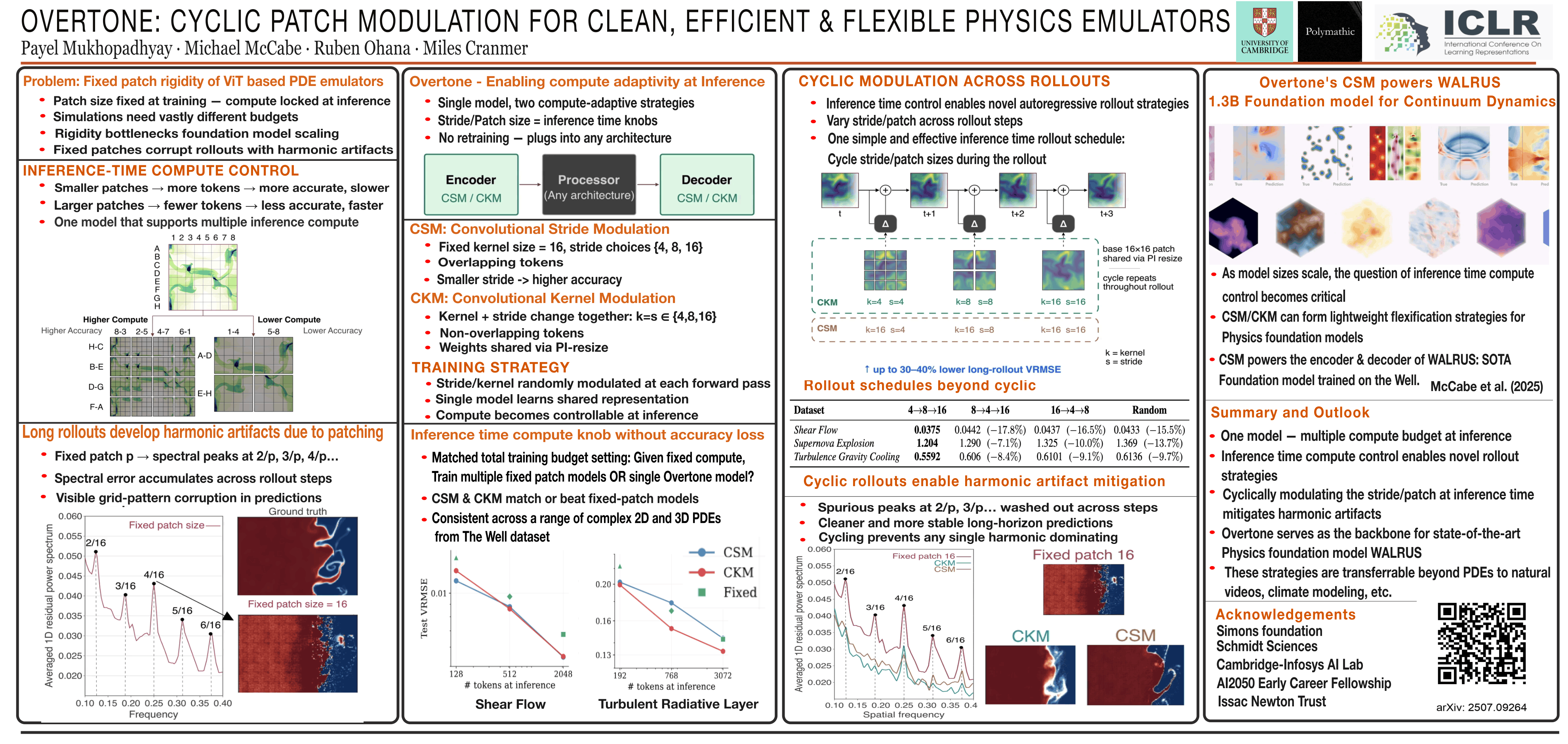
Transformer-based PDE surrogates achieve remarkable performance but face two key challenges: fixed patch sizes cause systematic error accumulation at harmonic frequencies, and computational costs remain inflexible regardless of problem complexity or available resources. We introduce Overtone, a unified solution through dynamic patch size control at inference. Overtone's key insight is that cyclically modulating patch sizes during autoregressive rollouts distributes errors across the frequency spectrum, mitigating the systematic harmonic artifact accumulation that plague fixed-patch models. We implement this through two architecture-agnostic modules—CSM (Convolutional Stride Modulation, using dynamic stride modulation) and CKM (Convolutional Kernel Modulation, using dynamic kernel resizing)—that together provide both harmonic mitigation and compute-adaptive deployment. This flexible tokenization lets users trade accuracy for speed dynamically based on computational constraints, and the cyclic rollout strategy yields up to 40% lower long rollout error in variance-normalised RMSE (VRMSE) compared to conventional, static-patch surrogates. Across challenging 2D and 3D PDE benchmarks, one Overtone model matches or exceeds fixed-patch baselines across inference compute budgets, when trained under a fixed total training budget setting.
Modeling the Density of Pixel-level Self-supervised Embeddings for Unsupervised Pathology Segmentation in Medical CT
Mikhail Goncharov ⋅ Eugenia Soboleva ⋅ Daniil Ignatyev ⋅ Mariia Donskova ⋅ Mikhail Belyaev ⋅ Ivan Oseledets ⋅ Marina Munkhoeva ⋅ Maxim Panov
Accurate detection of all pathological findings in 3D medical images remains a significant challenge, as supervised models are limited to detecting only the few pathology classes annotated in existing datasets. To address this, we frame pathology detection as an unsupervised visual anomaly segmentation (UVAS) problem, leveraging the inherent rarity of pathological patterns compared to healthy ones. We enhance the existing density-based UVAS framework with two key innovations: (1) dense self-supervised learning for feature extraction, eliminating the need for supervised pretraining, and (2) learned, masking-invariant dense features as conditioning variables, replacing hand-crafted positional encodings. Trained on over 30,000 unlabeled 3D CT volumes, our fully self-supervised model, Screener, outperforms existing UVAS methods on four large-scale test datasets comprising 1,820 scans with diverse pathologies. Furthermore, in a low-shot supervised fine-tuning setting, Screener surpasses existing self-supervised pretraining methods, establishing it as a state-of-the-art foundation for pathology segmentation. The code and pretrained models are available at https://github.com/mishgon/screener.
It's All Connected: A Journey Through Test-Time Memorization, Attentional Bias, Retention, and Online Optimization
Ali Behrouz ⋅ Meisam Razaviyayn ⋅ Peilin Zhong ⋅ Vahab Mirrokni
Designing efficient and effective architectural backbones has been in the core of research efforts to enhance the capability of foundation models. Inspired by the human cognitive phenomenon of attentional bias—the natural tendency to prioritize certain events or stimuli—we reconceptualize neural architectures, including Transformers, Titans, and modern linear recurrent neural networks as associative memory modules with attentional bias. We define and formalize the concept of attentional bias as the internal memory objective deep learning architectures. We show that existing deep learning architectures leverage the same attentional bias based on $L_2$ loss function. Going beyond $L_2$ loss function, we present a set of alternative attentional bias configurations along with their effective approximations. We then reinterpret forgetting mechanisms in modern deep learning architectures as a form of retention regularization. Building upon these insights, we present Miras, a general framework to design deep learning architectures based on the choice of attentional bias objective, retention gate, associative memory architecture, and memory learning algorithm. Our experiments show different designs yield models with varying strengths. Furthermore, our special instances of Miras achieve exceptional performance in language modeling, commonsense reasoning, recall intensive, and time series tasks, outperforming Transformers and other modern linear recurrent models.
EVLP: Learning Unified Embodied Vision-Language Planner with Reinforced Supervised Fine-Tuning
xinyan cai ⋅ Qiang Guan ⋅ Shiguang Wu ⋅ DaFeng Chi ⋅ Yuzheng Zhuang ⋅ Xingyue Quan ⋅ Jianye Hao
In complex embodied long-horizon manipulation tasks, effective task decomposition and execution require synergistic integration of textual logical reasoning and visual-spatial imagination to ensure efficient and accurate operation. Current methods fail to adopt a unified generation framework for multimodal planning, leading to inconsistencies in multimodal planning. To address this challenge, we present EVLP (Embodied Vision-Language Planner), an innovative multimodal unified generation framework that jointly models linguistic reasoning and visual generation. Our approach achieves multimodal planning for long-horizon tasks through a novel training pipeline incorporating dynamic pretraining and reinforced alignment. Our core innovations consist of three key components: 1. Unified Multimodal Generation Framework: For understanding, we integrate semantic information with spatial features to provide comprehensive visual perception. For generation, we directly learn the joint distribution of discrete images for one-step visual synthesis, enabling coordinated language-visual modeling through learnable cross-modal attention mechanisms. 2. Dynamic Perception Pretraining: We propose a bidirectional dynamic alignment strategy employing inverse dynamics tasks and forward dynamics tasks, effectively strengthening multimodal correlations within a unified feature space. 3. Reinforced Supervised Fine-Tuning: While conducting instruction-based fine-tuning in the unified generation space, we construct a reinforce loss to align the spatial logic between textual actions and generated images, enabling the model to acquire spatio-aware multimodal planning capabilities.Comprehensive evaluations on multiple complex tasks demonstrate that EVLP significantly outperforms competitive baselines in both instruction execution accuracy and task success rate, benefiting from its unified multimodal architecture and well-designed training pipeline. Extensive ablation studies further validate the rationality of our framework design.
A Two-Phase Deep Learning Framework for Adaptive Time-Stepping in High-Speed Flow Modeling
Jacob Helwig ⋅ Sai Adavi ⋅ Xuan Zhang ⋅ Yuchao Lin ⋅ Felix S Chim ⋅ Luke Vizzini ⋅ Haiyang Yu ⋅ Muhammad Hasnain ⋅ Saykat Biswas ⋅ John Holloway ⋅ Narendra Singh ⋅ N. Anand ⋅ Swagnik Guhathakurta ⋅ Shuiwang Ji
We consider the problem of modeling high-speed flows using machine learning methods. While most prior studies focus on low-speed fluid flows in which uniform time-stepping is practical, flows approaching and exceeding the speed of sound exhibit sudden changes such as shock waves. In such cases, it is essential to use adaptive time-stepping methods to allow a temporal resolution sufficient to resolve these phenomena while simultaneously balancing computational costs. Here, we propose a two-phase machine learning method, known as ShockCast, to model high-speed flows with adaptive time-stepping. In the first phase, we propose to employ a machine learning model to predict the timestep size. In the second phase, the predicted timestep is used as an input along with the current fluid fields to advance the system state by the predicted timestep. We explore several physically-motivated components for timestep prediction and introduce timestep conditioning strategies inspired by neural ODE and Mixture of Experts. We evaluate our methods by generating three supersonic flow datasets, available at https://huggingface.co/divelab. Our code is publicly available as part of the AIRS library (https://github.com/divelab/AIRS).
THE END OF MANUAL DECODING: TOWARDS TRULY END-TO-END LANGUAGE MODELS
Zhichao Wang ⋅ Dongyang Ma ⋅ Xinting Huang ⋅ Deng Cai ⋅ Tian Lan ⋅ Jiahao Xu ⋅ Haitao Mi ⋅ Xiaoying Tang ⋅ Yan Wang
The "end-to-end" label for LLMs is a misnomer. In practice, they depend on a non-differentiable decoding process that requires laborious, hand-tuning of hyperparameters like temperature and top-p. This paper introduces AutoDeco, a novel architecture that enables truly "end-to-end'' generation by learning to control its own decoding strategy. We augment the standard transformer with lightweight heads that, at each step, dynamically predict context-specific temperature and top-p values alongside the next-token logits. This approach transforms decoding into a parametric, token-level process, allowing the model to self-regulate its sampling strategy within a single forward pass. Through extensive experiments on eight benchmarks, we demonstrate that AutoDeco not only significantly outperforms common decoding strategies but also achieves performance comparable to an oracle-tuned baseline derived from "hacking the test set"—a practical upper bound for any static method. Besides, we demonstrate an emergent capability for instruction-based decoding control: the model learns to interpret natural language commands (e.g., ''generate with low randomness'') and adjusts its predicted temperature and top-p on a token-by-token basis, which may open a new paradigm for steerable and interactive LLM decoding.
Inference-time scaling of diffusion models through classical search
XiangCheng Zhang ⋅ Haowei Lin ⋅ Haotian Ye ⋅ James Y Zou ⋅ Jianzhu Ma ⋅ Yitao Liang ⋅ Yilun Du
Classical search algorithms have long underpinned modern artificial intelligence. In this work, we tackle the challenge of inference-time control in diffusion models—adapting generated outputs to meet diverse test-time objectives—using principles from classical search. We propose a general framework that orchestrates local and global search to efficiently navigate the generative space. It performs compute-efficient global exploration using breadth-first and depth-first tree search and employs a theoretically grounded, scalable local search via annealed Langevin MCMC. We evaluate our approach on a range of challenging domains, including planning, offline reinforcement learning, and image generation, and observe significant gains in both performance and efficiency over baseline methods. These results demonstrate that classical search offers a principled and practical foundation for inference-time scaling in diffusion models. By jointly scaling local and global search for the first time, our framework establishes a new Pareto frontier across challenging decision-making domains.
Tree Search for LLM Agent Reinforcement Learning
Yuxiang Ji ⋅ Ziyu Ma ⋅ Yong Wang ⋅ Guanhua Chen ⋅ Xiangxiang Chu ⋅ Liaoni Wu
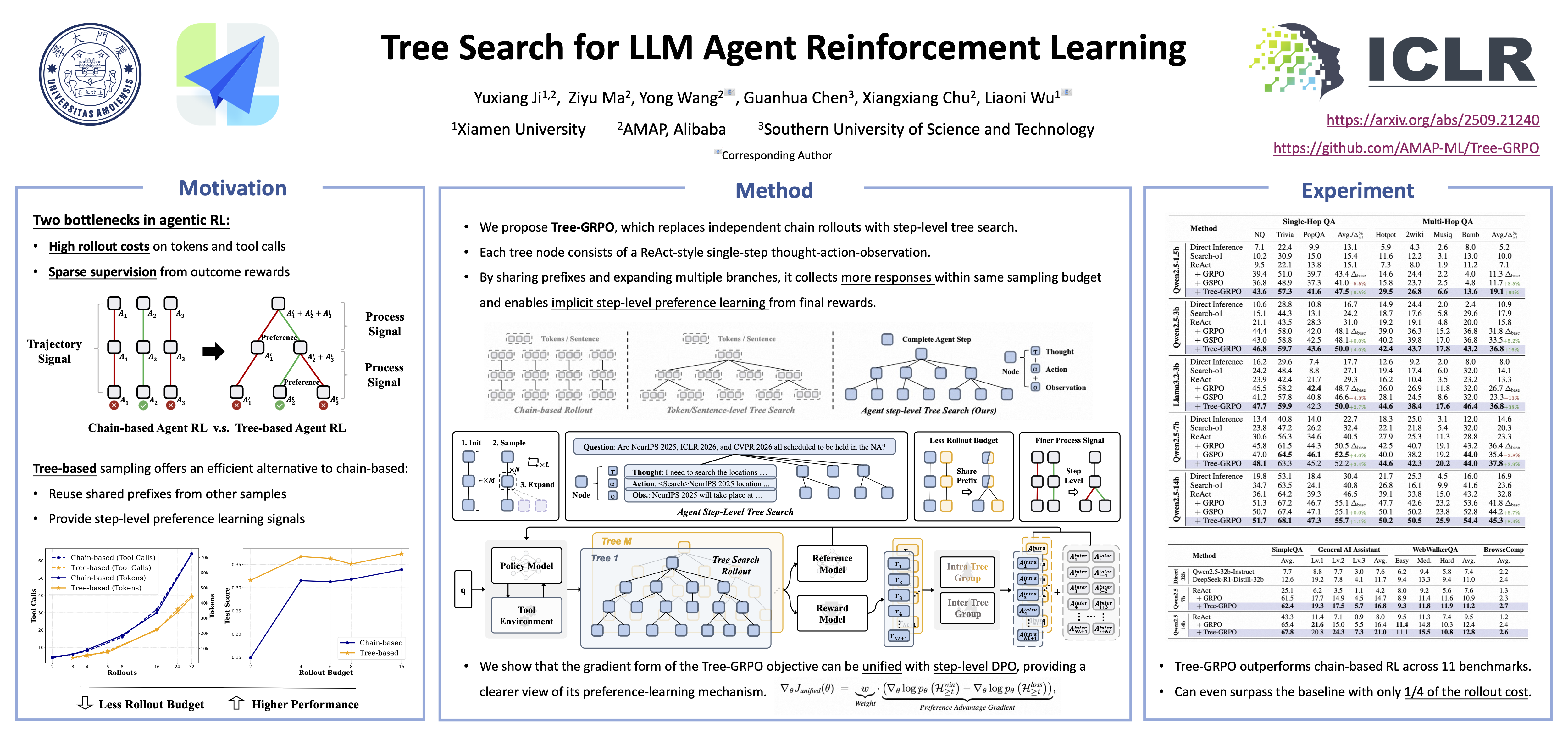
Recent advances in reinforcement learning (RL) have significantly enhanced the agentic capabilities of large language models (LLMs). In long-term and multi-turn agent tasks, existing approaches driven solely by outcome rewards often suffer from the problem of sparse supervision. To address the challenge, we propose Tree-based Group Relative Policy Optimization (Tree-GRPO), a grouped agent RL method based on tree search, where each tree node represents the complete agent interaction step. By sharing common prefixes, the tree search sampling increases the number of rollouts achievable within a fixed budget of tokens or tool calls. Moreover, we find that the tree-structured trajectory naturally allows the construction of step-wise process supervised signals even using only the outcome reward. Based on this, Tree-GRPO estimates the grouped relative advantages both on intra-tree and inter-tree levels. Through theoretical analysis, we demonstrate that the objective of intra-tree level group relative policy optimization is equivalent to that of step-level direct preference learning. Experiments across 11 datasets and 3 types of QA tasks demonstrate the superiority of the proposed tree-based RL over the chain-based RL method.
MedGMAE: Gaussian Masked Autoencoders for Medical Volumetric Representation Learning
Xueming Fu ⋅ Fenghe Tang ⋅ Rongsheng Wang ⋅ Yingtai Li ⋅ Lixia Han ⋅ Jian Lu ⋅ Zihang Jiang ⋅ S Kevin Zhou
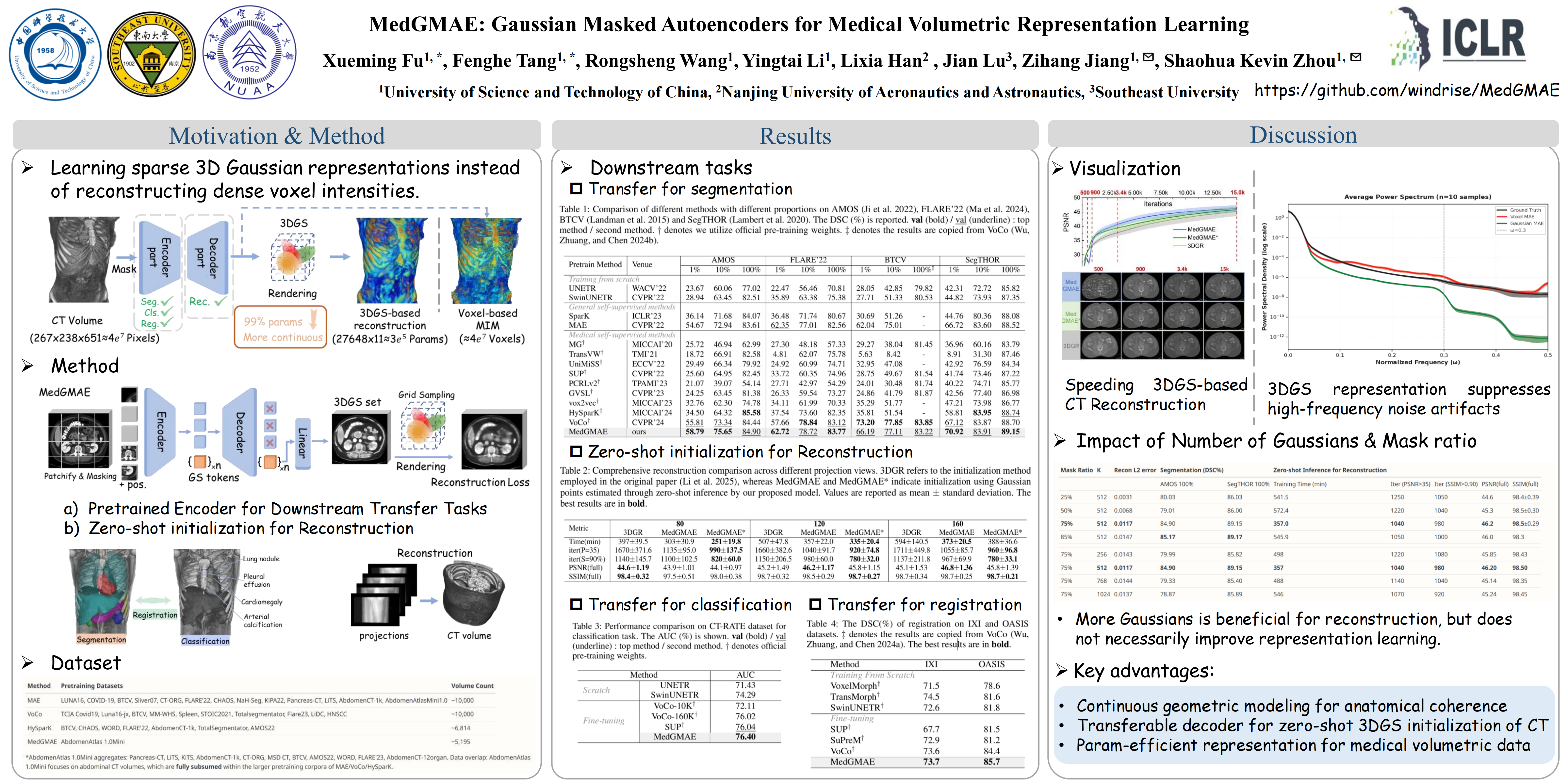
Self-supervised pre-training has emerged as a critical paradigm for learning transferable representations from unlabeled medical volumetric data. Masked autoencoder based methods have garnered significant attention, yet their application to volumetric medical image faces fundamental limitations from the discrete voxel-level reconstruction objective, which neglects comprehensive anatomical structure continuity. To address this challenge, We propose MedGMAE, a novel framework that replaces traditional voxel reconstruction with 3D Gaussian primitives reconstruction as new perspectives on representation learning. Our approach learns to predict complete sets of 3D Gaussian parameters as semantic abstractions to represent the entire 3D volume, from sparse visible image patches. MedGMAE demonstrates dual utility across medical imaging applications. For representation learning, sparse Gaussian prediction produces superior encoder representations that outperform traditional MAE baselines on downstream segmentation, classification, and registration tasks. For volumetric reconstruction, the Gaussian decoder leverages pretrained anatomical priors to accelerate 3D CT volume reconstruction convergence. Extensive experiments across multiple medical imaging datasets demonstrate that our approach achieves superior performance, establishing a new paradigm for medical image pre-training. The code will be available in https://github.com/windrise/MedGMAE.
ATTS: Asynchronous Test-Time Scaling via Conformal Prediction
Jing Xiong ⋅ Qiujiang Chen ⋅ Fanghua Ye ⋅ Zhongwei Wan ⋅ Chuanyang Zheng ⋅ Chenyang Zhao ⋅ Hui Shen ⋅ Alexander Hanbo Li ⋅ Chaofan Tao ⋅ Haochen Tan ⋅ Haoli Bai ⋅ Lifeng Shang ⋅ Lingpeng Kong ⋅ Ngai Wong
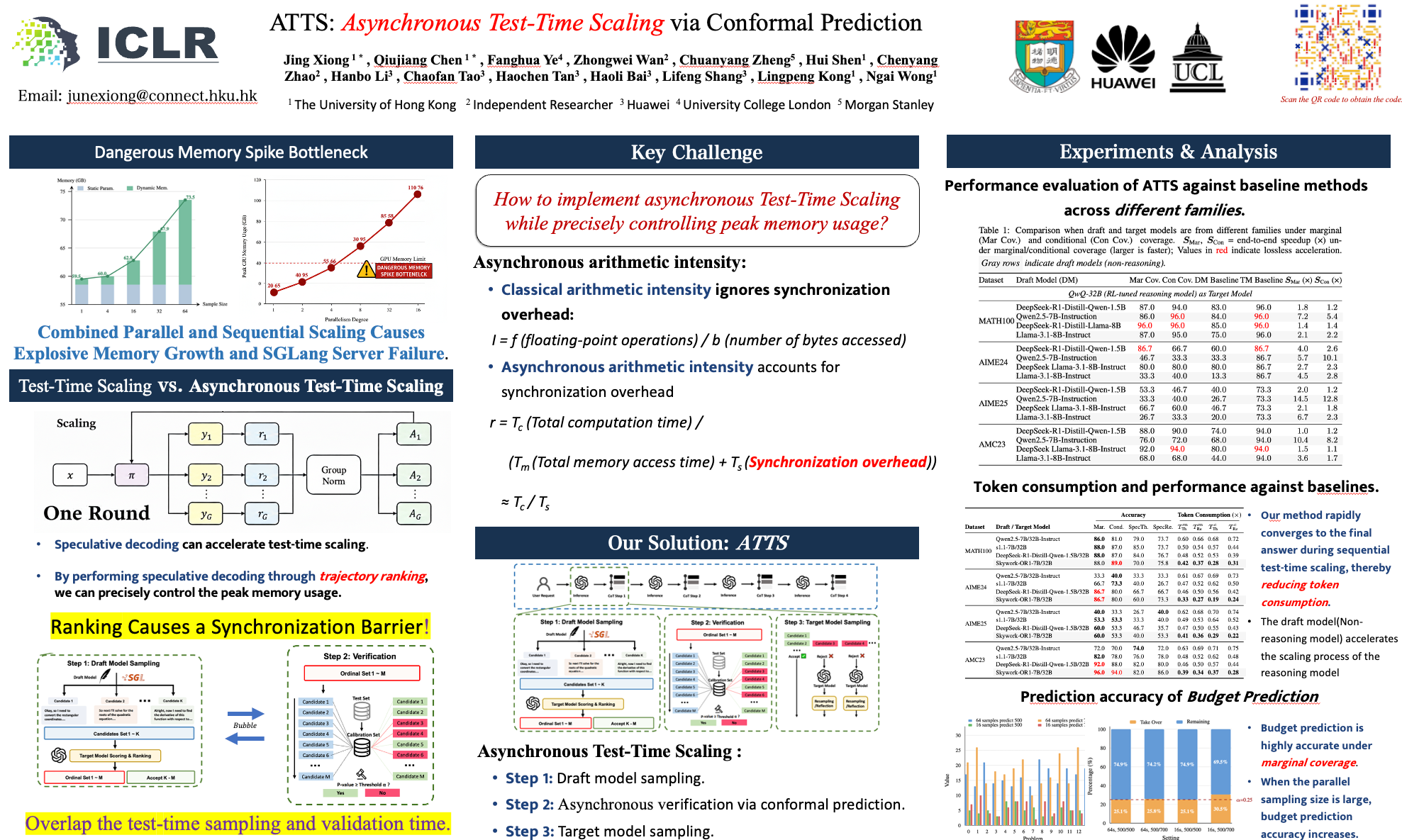
Large language models (LLMs) benefit from test-time scaling but are often hampered by high inference latency. Speculative decoding is a natural way to accelerate the scaling process; however, scaling along both the parallel and sequential dimensions poses significant challenges, including substantial memory-bound execution and synchronization overhead. We introduce ATTS (Asynchronous Test-Time Scaling), a statistically guaranteed adaptive scaling framework that follows the hypothesis testing process to address these challenges. By revisiting arithmetic intensity, ATTS identifies synchronization as the primary bottleneck. It enables asynchronous inference through online calibration and proposes an ordinal classification algorithm that supports a three-stage rejection sampling pipeline, scaling along both the sequential and parallel axes. Across experiments on the MATH, AMC23, AIME24, and AIME25 datasets and across multiple draft–target model families, we show that ATTS delivers up to 56.7x speedup in test-time scaling and a 4.14x throughput improvement, while maintaining accurate control of the rejection rate, reducing latency and memory overhead, and incurring no accuracy loss. By scaling both in parallel and sequential dimensions, we enable the 1.5B/70B draft/target model combination to achieve the performance of the state-of-the-art reasoning model o3-mini (high) on the AIME dataset.
Temporal Geometry of Deep Networks: Hyperbolic Representations of Training Dynamics for Intrinsic Explainability
Ambarish Moharil
This paper investigates how multilayer perceptrons (MLPs) can be represented in non-Euclidean spaces, with emphasis on the Poincaré model of hyperbolic geometry. We aim to capture the geometric evolution of their weighted topology and self-organization over time. Instead of restricting analysis to single checkpoints, we construct temporal parameter-graphs across $T$ snapshots of the optimization process. This reflects the view that neural networks encode information not only in their weights but also in the trajectory traced during training. Drawing on the idea that many complex networks admit embeddings in hidden metric spaces where distances correspond to connection likelihood, we present a geometric and temporal graph-based meta learning framework for obtaining dynamic hyperbolic representations of the underlying neural parameter graphs. Our model embeds temporal parameter-graphs in the Poincaré ball and learns from them while maintaining equivariance to within-snapshot neuron permutations and invariance to permutations of past snapshots. In doing so, it preserves functional equivalence across time and recovers the network’s latent geometry. Experiments on regression and classification tasks with trained MLPs show that hyperbolic temporal representations expose how structure emerges during training, offering intrinsic explanations of self-organisation in a given model training environment.
Post-Training Quantization for Video Matting
Tianrui Zhu ⋅ Houyuan Chen ⋅ Ruihao Gong ⋅ Michele Magno ⋅ Haotong Qin ⋅ Kai Zhang
Video matting is crucial for applications such as film production and virtual reality, yet deploying its computationally intensive models on resource-constrained devices presents challenges. Quantization is a key technique for model compression and acceleration. As an efficient approach, Post-Training Quantization (PTQ) is still in its nascent stages for video matting, facing significant hurdles in maintaining accuracy and temporal coherence. To address these challenges, this paper proposes a novel and general PTQ framework specifically designed for video matting models, marking, to the best of our knowledge, the first systematic attempt in this domain. Our contributions include: (1) A two-stage PTQ strategy that combines block reconstruction-based optimization for fast, stable initial quantization and local dependency capture, followed by a global calibration of quantization parameters to minimize accuracy loss. (2) A Statistically-Driven Global Affine Calibration (GAC) method that enables the network to compensate for cumulative statistical distortions arising from factors such as neglected BN layer effects, even reducing the error of existing PTQ methods on video matting tasks up to 20%. (3) An Optical Flow Assistance (OFA) component that leverages temporal and semantic priors from frames to guide the PTQ process, enhancing the model’s ability to distinguish moving foregrounds in complex scenes and ultimately achieving near full-precision performance even under ultra-low-bit quantization. Comprehensive quantitative and visual results show that our PTQ4VM achieves the state-of-the-art accuracy performance across different bit-widths compared to the existing quantization methods. We highlight that the 4-bit PTQ4VM even achieves performance close to the full-precision counterpart while enjoying 8× FLOP savings.
DP-Fusion: Token-Level Differentially Private Inference for Large Language Models
Rushil Thareja ⋅ Preslav Nakov ⋅ Praneeth Vepakomma ⋅ Nils Lukas
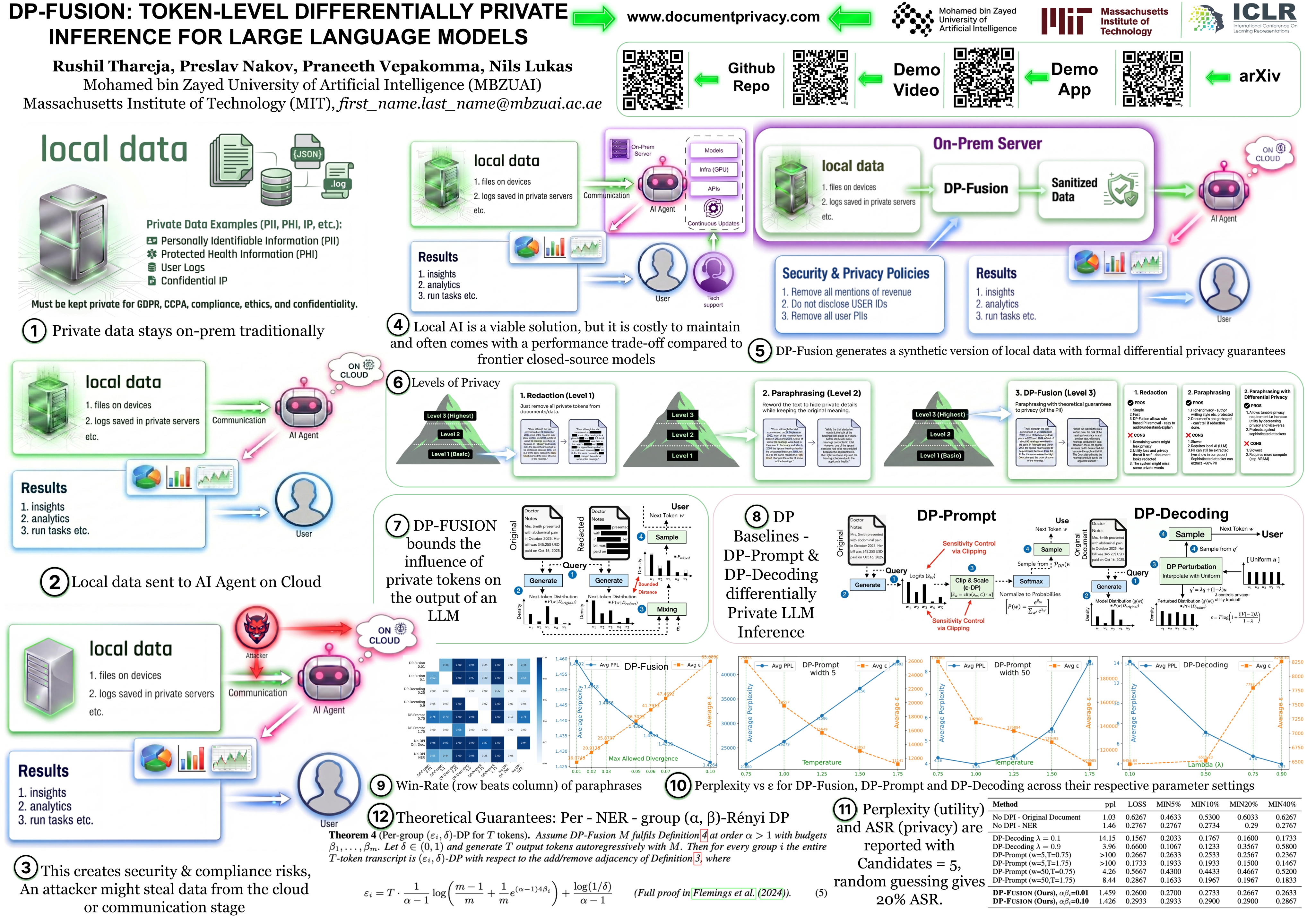
Large language models (LLMs) do not preserve privacy at inference-time. The LLM's outputs can inadvertently reveal information about the model's context, which presents a privacy challenge when the LLM is augmented via tools or databases containing sensitive information. Existing privacy-preserving methods at inference-time have significant limitations since they (i) lack provable guarantees or (ii) have a poor utility/privacy trade-off. We propose DP-Fusion, a Differentially Private Inference (DPI) mechanism for LLMs that provably bounds the influence a set of tokens in the context can have on the LLM's output. DP-Fusion works as follows: (1) label a subset of sensitive tokens, (2) infer the LLM without any sensitive tokens to obtain a baseline, (3) infer the LLM with the sensitive tokens, and (4) blend distributions so that the final output remains within a bounded distance of the baseline distribution. While this per-token influence bound also mitigates jailbreak-style prompt injection, we focus on document privatization, where the goal is to paraphrase a document containing sensitive tokens, e.g., personally identifiable information, so that no attacker can reliably infer them from the paraphrased document while preserving high text quality. The privacy/utility trade-off is controlled by $\epsilon$, where $\epsilon=0$ hides sensitive tokens entirely, while higher values trade off privacy for improved text quality. We show that our method creates token-level provably privatized documents with substantially improved theoretical and empirical privacy, achieving $6\times$ lower perplexity than related DPI methods.
Discrete Adjoint Matching
Oswin So ⋅ Brian Karrer ⋅ Chuchu Fan ⋅ Ricky T. Q. Chen ⋅ Guan-Horng Liu
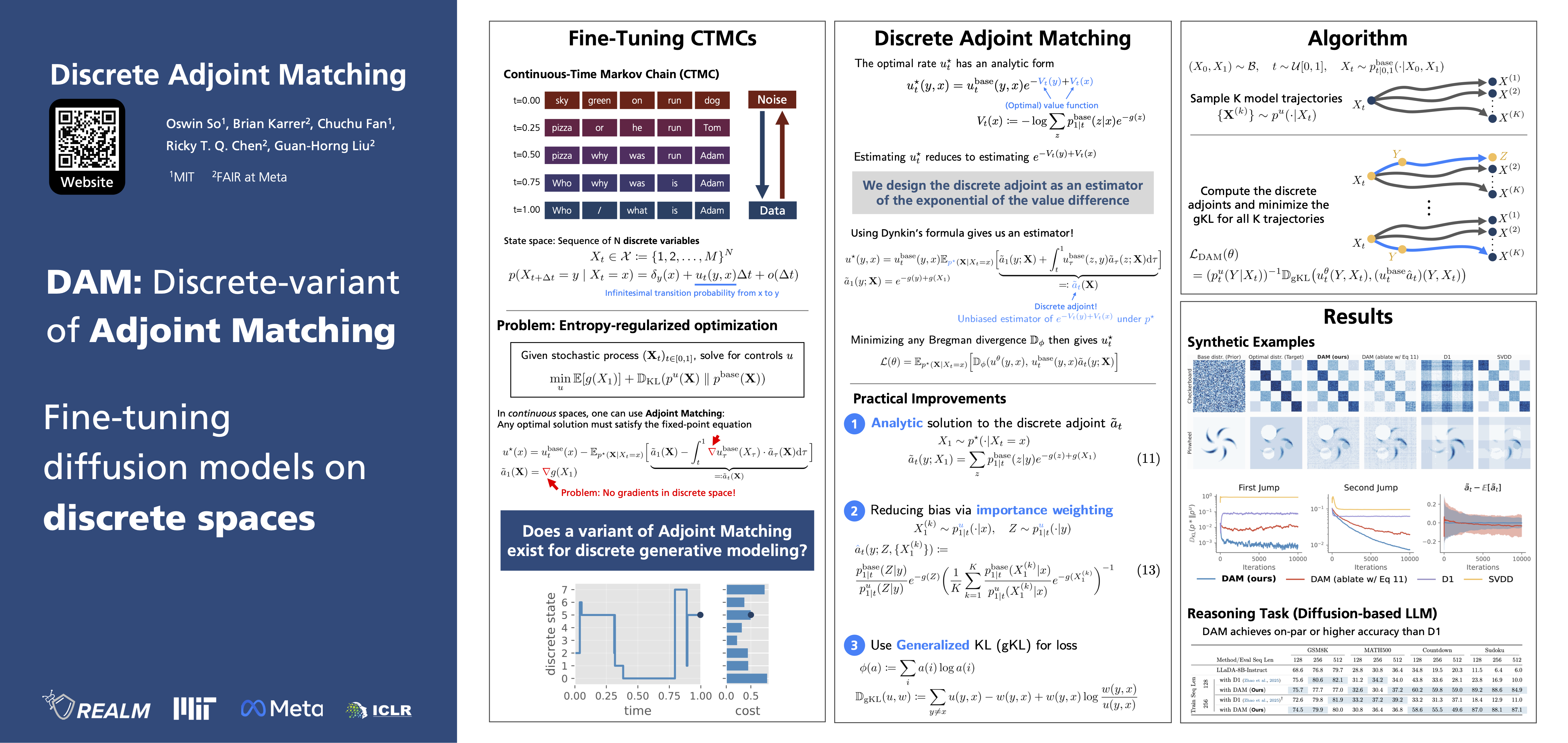
Computation methods for solving entropy-regularized reward optimization—a class of problems widely used for fine-tuning generative models—have advanced rapidly. Among those, Adjoint Matching (AM, Domingo-Enrich et al., 2025) has proven highly effective in continuous state spaces with differentiable rewards. Transferring these practical successes to discrete generative modeling, however, remains particularly challenging and largely unexplored, mainly due to the drastic shift in generative model classes to discrete state spaces, which are nowhere differentiable. In this work, we propose Discrete Adjoint Matching (DAM)—a discrete variant of AM for fine-tuning discrete generative models characterized by Continuous-Time Markov Chains, such as diffusion-based large language models. The core of DAM is the introduction of discrete adjoint—an estimator of the optimal solution to the original problem but formulated on discrete domains—from which standard matching frameworks can be applied. This is derived via a purely statistical standpoint, in contrast to the control-theoretic viewpoint in AM, thereby opening up new algorithmic opportunities for general adjoint-based estimators. We showcase DAM’s effectiveness on synthetic and mathematical reasoning tasks.
Feature compression is the root cause of adversarial fragility in neural networks
Jingchao Gao ⋅ Ziqing Lu ⋅ Raghu Mudumbai ⋅ Xiaodong Wu ⋅ Jirong Yi ⋅ Myung Cho ⋅ Catherine Xu ⋅ Hui Xie ⋅ Weiyu Xu
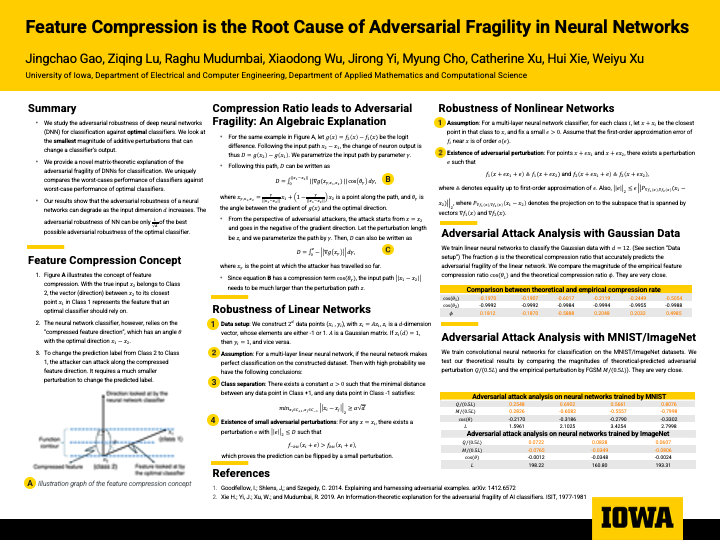
In this paper, we uniquely study the adversarial robustness of deep neural networks (NN) for classification tasks against that of optimal classifiers. We look at the smallest magnitude of possible additive perturbations that can change a classifier's output. We provide a matrix-theoretic explanation of the adversarial fragility of deep neural networks for classification. In particular, our theoretical results show that a neural network's adversarial robustness can degrade as the input dimension $d$ increases. Analytically, we show that neural networks' adversarial robustness can be only $1/\sqrt{d}$ of the best possible adversarial robustness of optimal classifiers. Our theories match remarkably well with numerical experiments of practically trained NN, including NN for ImageNet images. The matrix-theoretic explanation is consistent with an earlier information-theoretic feature-compression-based explanation for the adversarial fragility of neural networks.
Fresh in memory: Training-order recency is linearly encoded in language model activations
Dmitrii Krasheninnikov ⋅ Richard E Turner ⋅ David Krueger
We show that language models' activations linearly encode when information was learned during training. Our setup involves creating a model with a known training order by sequentially fine-tuning Llama-3.2-1B on six disjoint but otherwise similar datasets about named entities. We find that the average activations of test samples corresponding to the six training datasets encode the training order: when projected into a 2D subspace, these centroids are arranged exactly in the order of training and lie on a straight line. Further, we show that linear probes can accurately (approx. 90%) distinguish "early" vs. "late" entities, generalizing to entities unseen during the probes' own training. The model can also be fine-tuned to explicitly report an unseen entity's training stage (approx. 80% accuracy). Notably, the training-order encoding does not seem attributable to simple differences in activation magnitudes, losses, or model confidence. Our paper shows that models can differentiate information by its acquisition time, and carries significant implications for how they might manage conflicting data and respond to knowledge modifications.
VARestorer: One-Step VAR Distillation for Real-World Image Super-Resolution
Yixuan Zhu ⋅ Shilin Ma ⋅ Haolin Wang ⋅ Ao Li ⋅ Yanzhe Jing ⋅ Yansong Tang ⋅ Lei Chen ⋅ Jiwen Lu ⋅ Jie Zhou
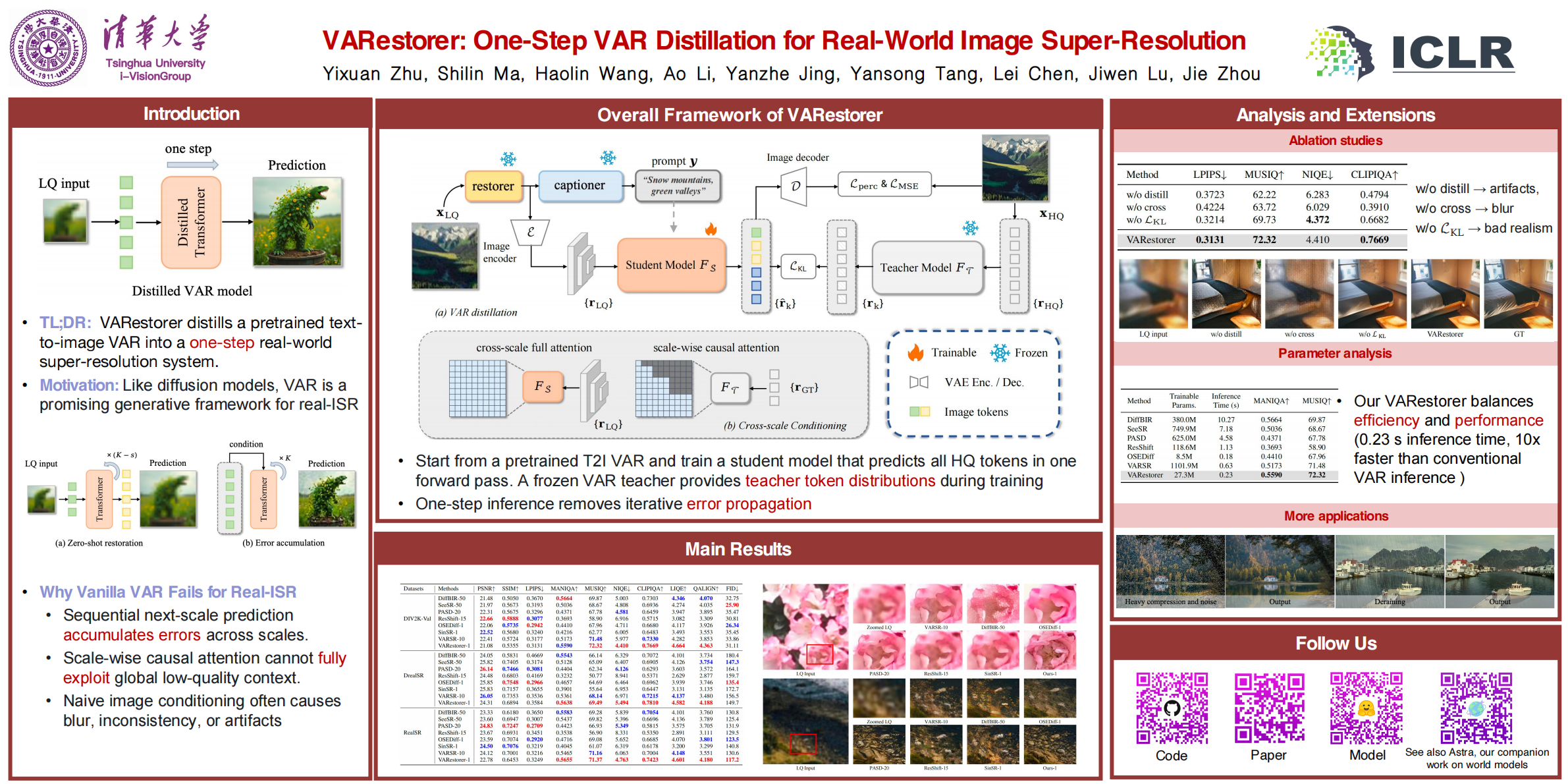
Recent advancements in visual autoregressive models (VAR) have demonstrated their effectiveness in image generation, highlighting their potential for real-world image super-resolution (Real-ISR). However, adapting VAR for ISR presents critical challenges. The next-scale prediction mechanism, constrained by casual attention, fails to fully exploit global low-quality (LQ) context, resulting in blurry and inconsistent high-quality (HQ) outputs. Additionally, error accumulation in the iterative prediction severely degrades coherence in ISR task. To address these issues, we propose VARestorer, a simple yet effective distillation framework that transforms a pre-trained text-to-image VAR model into a one-step ISR model. By leveraging distribution matching, our method eliminates the need for iterative refinement, significantly reducing error propagation and inference time. Furthermore, we introduce pyramid image conditioning with cross-scale attention, which enables bidirectional scale-wise interactions and fully utilizes the input image information while adapting to the autoregressive mechanism. This prevents later LQ tokens from being overlooked in the transformer. By fine-tuning only 1.2\% of the model parameters through parameter-efficient adapters, our method maintains the expressive power of the original VAR model while significantly enhancing efficiency. Extensive experiments show that VARestorer achieves state-of-the-art performance with 72.32 MUSIQ and 0.7669 CLIPIQA on DIV2K dataset, while accelerating inference by 10 times compared to conventional VAR inference.
SP-VLA: A Joint Model Scheduling and Token Pruning Approach for VLA Model Acceleration
Ye Li ⋅ Yuan Meng ⋅ Zewen Sun ⋅ Kangye Ji ⋅ Chen Tang ⋅ Jiajun Fan ⋅ Xinzhu Ma ⋅ Shu-Tao Xia ⋅ Zhi Wang ⋅ Wenwu Zhu
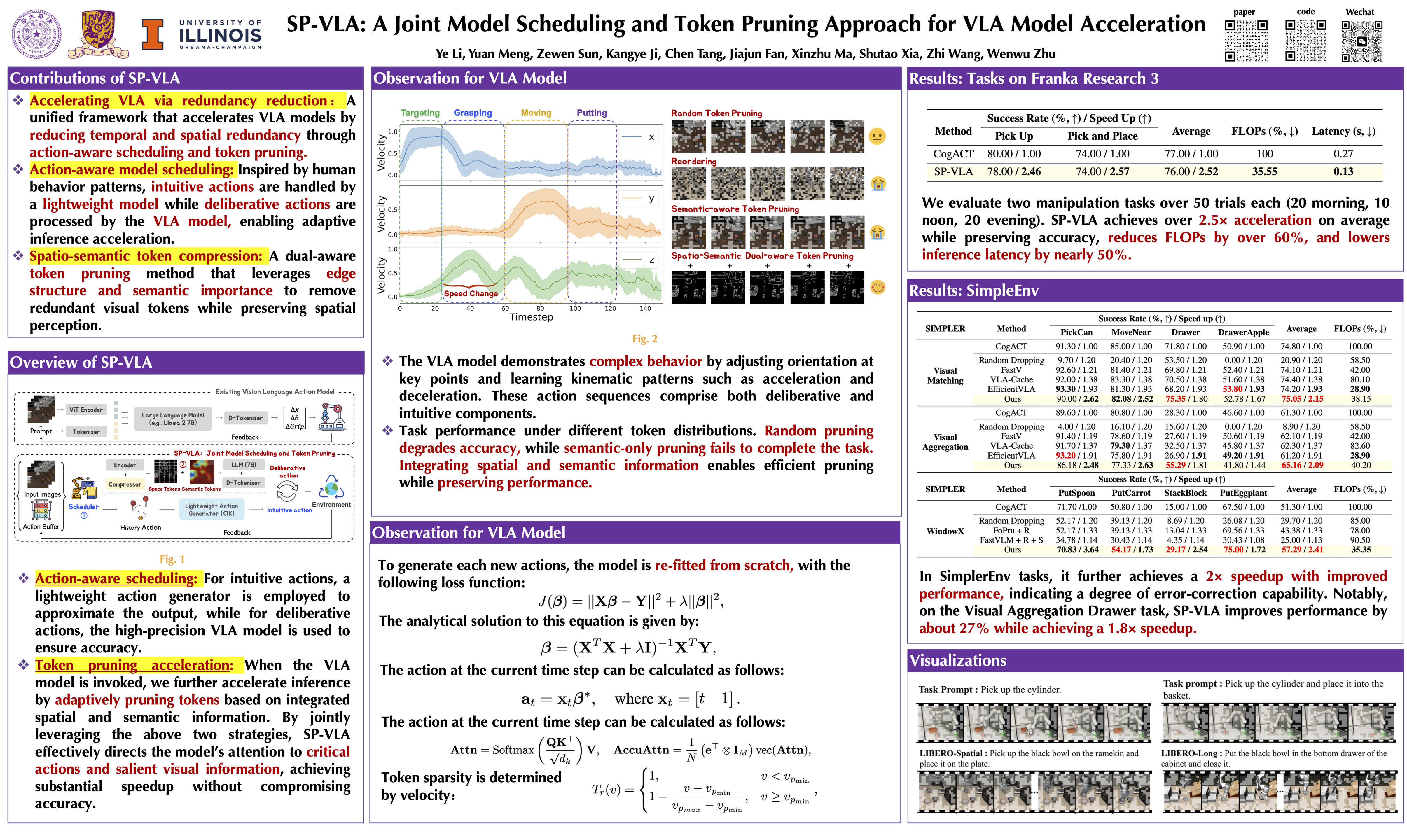
Vision-Language-Action (VLA) models have attracted increasing attention for their strong control capabilities. However, their high computational cost and low execution frequency hinder their suitability for real-time tasks such as robotic manipulation and autonomous navigation. Existing VLA acceleration methods primarily focus on structural optimization, overlooking the fact that these models operate in sequential decision-making environments. As a result, temporal redundancy in sequential action generation and spatial redundancy in visual input remain unaddressed. To this end, we propose SP-VLA, a unified framework that accelerates VLA models by jointly scheduling models and pruning tokens. Specifically, we design an action-aware model scheduling mechanism that reduces temporal redundancy by dynamically switching between VLA model and a lightweight generator. Inspired by the human motion pattern of focusing on key decision points while relying on intuition for other actions, we categorize VLA actions into deliberative and intuitive, assigning the former to the VLA model and the latter to the lightweight generator, enabling frequency-adaptive execution through collaborative model scheduling. To address spatial redundancy, we further develop a spatio-semantic dual-aware token pruning method. Tokens are classified into spatial and semantic types and pruned based on their dual-aware importance to accelerate VLA inference. These two mechanisms work jointly to guide the VLA in focusing on critical actions and salient visual information, achieving effective acceleration while maintaining high accuracy. Extensive experiments show that our method achieves 1.5$\times$ lossless acceleration in LIBERO and 2.4$\times$ in SimplerEnv, with up to 6\% average performance gain. Inference frequency and latency improve by 2.2$\times$ in SimplerEnv and 1.4$\times$ in LIBERO.
Can Vision–Language Models Assess Graphic Design Aesthetics? A Benchmark, Evaluation, and Dataset Perspective.
Ruichuan An ⋅ Shizhao Sun ⋅ Danqing Huang ⋅ Mingxi Cheng ⋅ Yan Gao ⋅ Ji Li ⋅ YU QIAO ⋅ Jiang Bian
Assessing the aesthetic quality of graphic design is central to visual communication, yet remains underexplored in vision–language models (VLMs). We investigate whether VLMs can evaluate design aesthetics in ways comparable to humans. Prior work faces three key limitations: benchmarks restricted to narrow principles and coarse evaluation protocols, a lack of systematic VLM comparisons, and limited training data for model improvement. In this work, we introduce AesEval-Bench, a comprehensive benchmark spanning four dimensions, twelve indicators, and three fully quantifiable tasks: aesthetic judgment, region selection, and precise localization. Then, we systematically evaluate proprietary, open-source, and reasoning-augmented VLMs, revealing clear performance gaps against the nuanced demands of aesthetic assessment. Moreover, we construct a training dataset to fine-tune VLMs for this domain, leveraging human-guided VLM labeling to produce task labels at scale and indicator-grounded reasoning to tie abstract indicators to concrete design regions.Together, our work establishes the first systematic framework for aesthetic quality assessment in graphic design.
Neural Sum-of-Squares: Certifying the Nonnegativity of Polynomials with Transformers
Nico Pelleriti ⋅ Christoph Spiegel ⋅ Shiwei Liu ⋅ David Martinez-Rubio ⋅ Max Zimmer ⋅ Sebastian Pokutta
Certifying nonnegativity of polynomials is a well-known NP-hard problem with direct applications spanning non-convex optimization, control, robotics, and beyond. A sufficient condition for nonnegativity is the Sum-of-Squares property, i.e., it can be written as a sum of squares of other polynomials. In practice, however, certifying the SOS criterion remains computationally expensive and often involves solving a Semidefinite Program (SDP), whose dimensionality grows quadratically in the size of the monomial basis of the SOS expression; hence, various methods to reduce the size of the monomial basis have been proposed. In this work, we introduce the first learning-augmented algorithm to certify the SOS criterion. To this end, we train a Transformer model that predicts an almost-minimal monomial basis for a given polynomial, thereby drastically reducing the size of the corresponding SDP. Our overall methodology comprises three key components: efficient training dataset generation of over 100 million SOS polynomials, design and training of the corresponding Transformer architecture, and a systematic fallback mechanism to ensure correct termination, which we analyze theoretically. We validate our approach on over 200 benchmark datasets, achieving speedups of over $100\times$ compared to state-of-the-art solvers and enabling the solution of instances where competing approaches fail. Our findings provide novel insights towards transforming the practical scalability of SOS programming. Code is available at https://github.com/ZIB-IOL/Neural-Sum-of-Squares.
Learning to Reason without External Rewards
Xuandong Zhao ⋅ Zhewei Kang ⋅ Aosong Feng ⋅ Sergey Levine ⋅ Dawn Song
Training large language models (LLMs) for complex reasoning via Reinforcement Learning with Verifiable Rewards (RLVR) is effective but limited by reliance on costly, domain-specific supervision. We explore Reinforcement Learning from Internal Feedback (RLIF), a framework that enables LLMs to learn from intrinsic signals without external rewards or labeled data. We propose Intuitor, an RLIF method that uses a model's own confidence—termed self-certainty—as its sole reward signal. Intuitor replaces external rewards in Group Relative Policy Optimization (GRPO) with self-certainty scores, enabling fully unsupervised learning. Experiments demonstrate that Intuitor matches GRPO's performance on mathematical benchmarks while achieving better generalization to out-of-domain tasks like code generation, without requiring gold solutions or test cases. Our findings show that intrinsic model signals can drive effective learning across domains, offering a scalable alternative to RLVR for autonomous AI systems where verifiable rewards are unavailable. Code is available at https://github.com/sunblaze-ucb/Intuitor
Enhancing Geometric Perception in VLMs via Translator-Guided Reinforcement Learning
Hao Yu ⋅ Shuning Jia ⋅ Guanghao Li ⋅ Wenhao Jiang ⋅ Chun Yuan
Vision-language models (VLMs) often struggle with geometric reasoning due to their limited perception of fundamental diagram elements. To tackle this challenge, we introduce GeoPerceive, a benchmark comprising diagram instances paired with domain-specific language (DSL) representations, along with an efficient automatic data generation pipeline. This design enables the isolated evaluation of geometric perception independently from reasoning. To exploit the data provided by GeoPerceive for enhancing the geometric perception capabilities of VLMs, we propose GeoDPO, a translator-guided reinforcement learning framework. GeoDPO employs an NL-to-DSL translator, which is trained on synthetic pairs generated by the data engine of GeoPerceive, to bridge natural language and DSL. This translator facilitates the computation of fine-grained, DSL-level scores, which serve as reward signals in reinforcement learning. We assess GeoDPO on both in-domain and out-of-domain datasets, spanning tasks in geometric perception as well as downstream reasoning. Experimental results demonstrate that, while supervised fine-tuning (SFT) offers only marginal improvements and may even impair performance in out-of-domain scenarios, GeoDPO achieves substantial gains: $+26.5\\%$ on in-domain data, $+8.0\\%$ on out-of-domain data, and $+39.0\\%$ on downstream reasoning tasks. These findings underscore the superior performance and generalization ability of GeoDPO over SFT. All codes are released at https://github.com/Longin-Yu/GeoPerceive to ensure reproducibility.
CryoNet.Refine: A One-step Diffusion Model for Rapid Refinement of Structural Models with Cryo-EM Density Map Restraints
Fuyao Huang ⋅ Xiaozhu Yu ⋅ Kui Xu ⋅ Qiangfeng Zhang
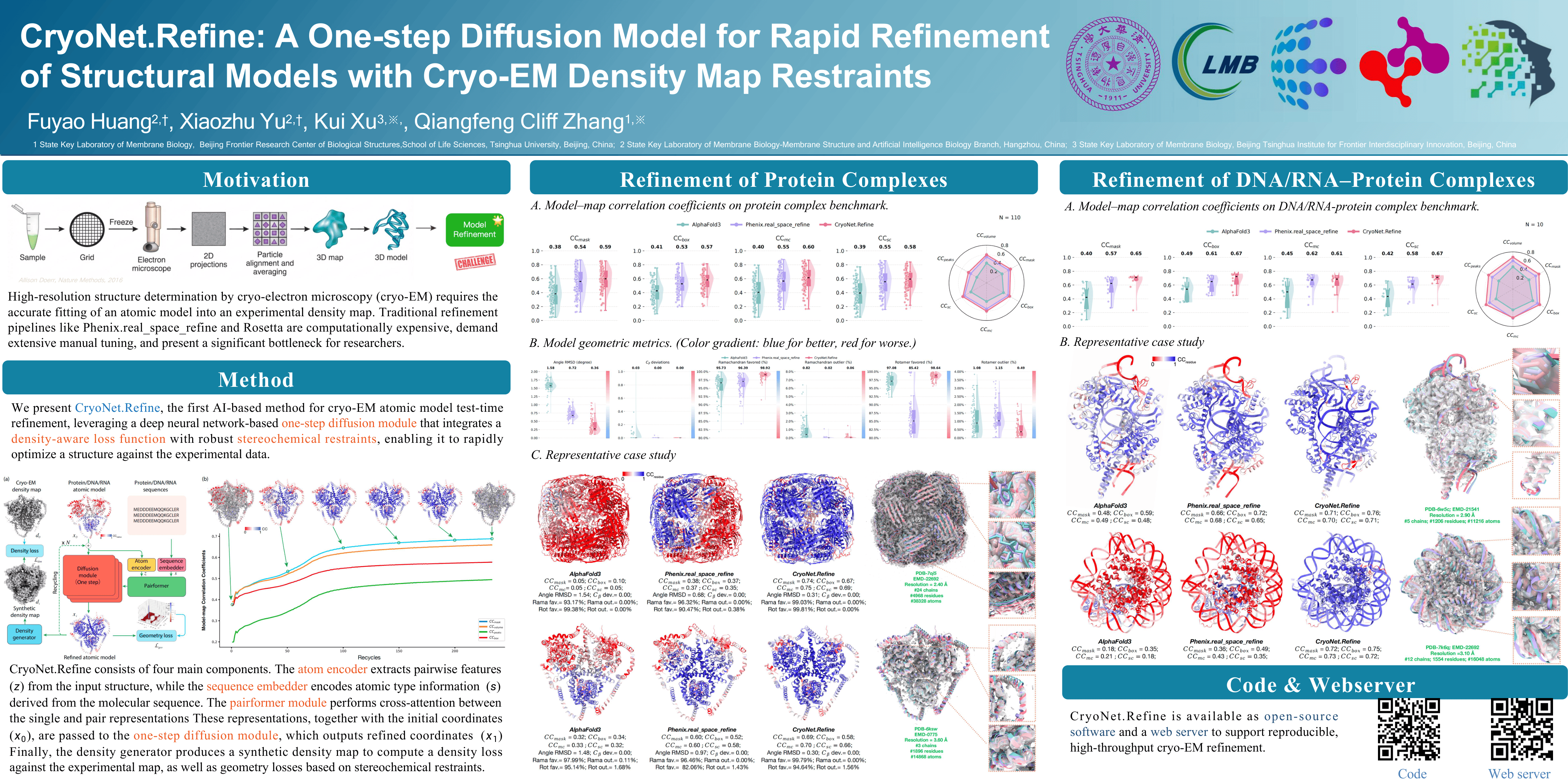
High-resolution structure determination by cryo-electron microscopy (cryo-EM) requires the accurate fitting of an atomic model into an experimental density map. Traditional refinement pipelines like Phenix.realspacerefine and Rosetta are computationally expensive, demand extensive manual tuning, and present a significant bottleneck for researchers. We present CryoNet.Refine, an end-to-end, deep learning framework that automates and accelerates molecular structure refinement. Our approach utilizes a one-step diffusion model that integrates a density-aware loss function with robust stereochemical restraints, enabling it to rapidly optimize a structure against the experimental data. CryoNet.Refine stands as a unified and versatile solution capable of refining not only protein complexes but also nucleic acids (DNA/RNA) and their assemblies. In benchmarks against Phenix.realspacerefine, CryoNet.Refine consistently yields substantial improvements in both model–map correlation and overall model geometric quality. By offering a scalable, automated, and powerful alternative, CryoNet.Refine is poised to become an essential tool for next-generation cryo-EM structure refinement. Web server: https://cryonet.ai/refine; Source code: https://github.com/kuixu/cryonet.refine.
JanusCoder: Towards a Foundational Visual-Programmatic Interface for Code Intelligence
Qiushi Sun ⋅ Jingyang Gong ⋅ Yang Liu ⋅ Qiaosheng Chen ⋅ Lei Li ⋅ Kai Chen ⋅ Qipeng Guo ⋅ Ben Kao ⋅ Fei Yuan
The scope of neural code intelligence is rapidly expanding beyond text-based source code to encompass the rich visual outputs that programs generate. This visual dimension is critical for advanced applications like flexible content generation and precise, program-driven editing of visualizations. However, progress has been impeded by the scarcity of high-quality multimodal code data, a bottleneck stemming from challenges in synthesis and quality assessment. To address these challenges, we make contributions from both a data and modeling perspective. We first introduce a complete synthesis toolkit that leverages reciprocal synergies between data modalities to efficiently produce a large-scale, high-quality corpus spanning from standard charts to complex interactive web UIs and code-driven animations. Leveraging this toolkit, we construct JanusCode-800K, the largest multimodal code corpus to date. This powers the training of our models, JanusCoder and JanusCoderV, which establish a visual-programmatic interface for generating code from textual instructions, visual inputs, or a combination of both. Our unified model is a departure from existing approaches that build specialized models for isolated tasks. Extensive experiments on both text-centric and vision-centric coding tasks demonstrate the superior performance of the JanusCoder series, with our 7B to 14B scale models approaching or even exceeding the performance of commercial models. Furthermore, extensive analysis provides key insights into harmonizing programmatic logic with its visual expression. Our code and checkpoints are available at \url{https://github.com/InternLM/JanusCoder}.
Building a Foundational Guardrail for General Agentic Systems via Synthetic Data
Yue Huang ⋅ Hang Hua ⋅ Yujun Zhou ⋅ Pengcheng Jing ⋅ Manish Nagireddy ⋅ Inkit Padhi ⋅ Greta Dolcetti ⋅ Zhangchen Xu ⋅ Subhajit Chaudhury ⋅ Ambrish Rawat ⋅ Liubov Nedoshivina ⋅ Pin-Yu Chen ⋅ Prasanna Sattigeri ⋅ Xiangliang Zhang
While LLM agents can plan multi-step tasks, intervening at the planning stage—before any action is executed—is often the safest way to prevent harm, since certain risks can lead to severe consequences once carried out. However, existing guardrails mostly operate post-execution, which is difficult to scale and leaves little room for controllable supervision at the plan level. To address this challenge, we highlight three critical gaps in current research: data gap, model gap, and evaluation gap. To close the data gap, we introduce AuraGen, a controllable engine that (i) synthesizes benign trajectories, (ii) injects category-labeled risks with calibrated difficulty, and (iii) filters outputs via an automated reward model, producing large and reliable corpora for pre-execution safety. To close the guardian model gap, we propose a foundational guardrail Safiron, combining a cross-planner adapter with a compact guardian model. The adapter unifies different input formats, while Safiron flags risky cases, assigns risk types, and generates rationales; trained in two stages with a broadly explored data recipe, Safiron achieves robust transfer across settings. To close the evaluation gap, we release \texttt{Pre-Exec Bench}, a realistic benchmark covering diverse tools and branching trajectories, which measures detection, fine-grained categorization, explanation, and cross-planner generalization in human-verified scenarios. Extensive experiments demonstrate consistent gains over strong baselines on Pre-Exec Bench, and ablations further distill actionable practices, providing a practical template for safer agentic systems.
FACT: a first-principles alternative to the Neural Feature Ansatz for how networks learn representations
Enric Adserà ⋅ Neil Mallinar ⋅ James Simon ⋅ Misha Belkin
It is a central challenge in deep learning to understand how neural networks learn representations. A leading approach is the Neural Feature Ansatz (NFA) (Radhakrishnan et al., 2024), a conjectured mechanism for how feature learning occurs. Although the NFA is empirically validated, it is an educated guess and lacks a theoretical basis, and thus it is unclear when it might fail, and how to improve it. In this paper, we take a first-principles approach to understanding why this observation holds, and when it does not. We use first-order optimality conditions to derive the Features at Convergence Theorem (FACT), an alternative to the NFA that (a) obtains greater agreement with learned features at convergence, (b) explains why the NFA holds in most settings, and (c) captures essential feature learning phenomena in neural networks such as grokking behavior in modular arithmetic and phase transitions in learning sparse parities, similarly to the NFA. Thus, our results unify theoretical first-order optimality analyses of neural networks with the empirically-driven NFA literature, and provide a principled alternative that provably and empirically holds at convergence.
UrbanGS: Efficient and Scalable Architecture for Geometrically Accurate Large-Scene Reconstruction
Changbai Li ⋅ Haodong Zhu ⋅ Hanlin Chen ⋅ Xiuping Liang ⋅ Tongfei Chen ⋅ Shuwei Shao ⋅ Linlin Yang ⋅ Huobin Tan ⋅ Baochang Zhang
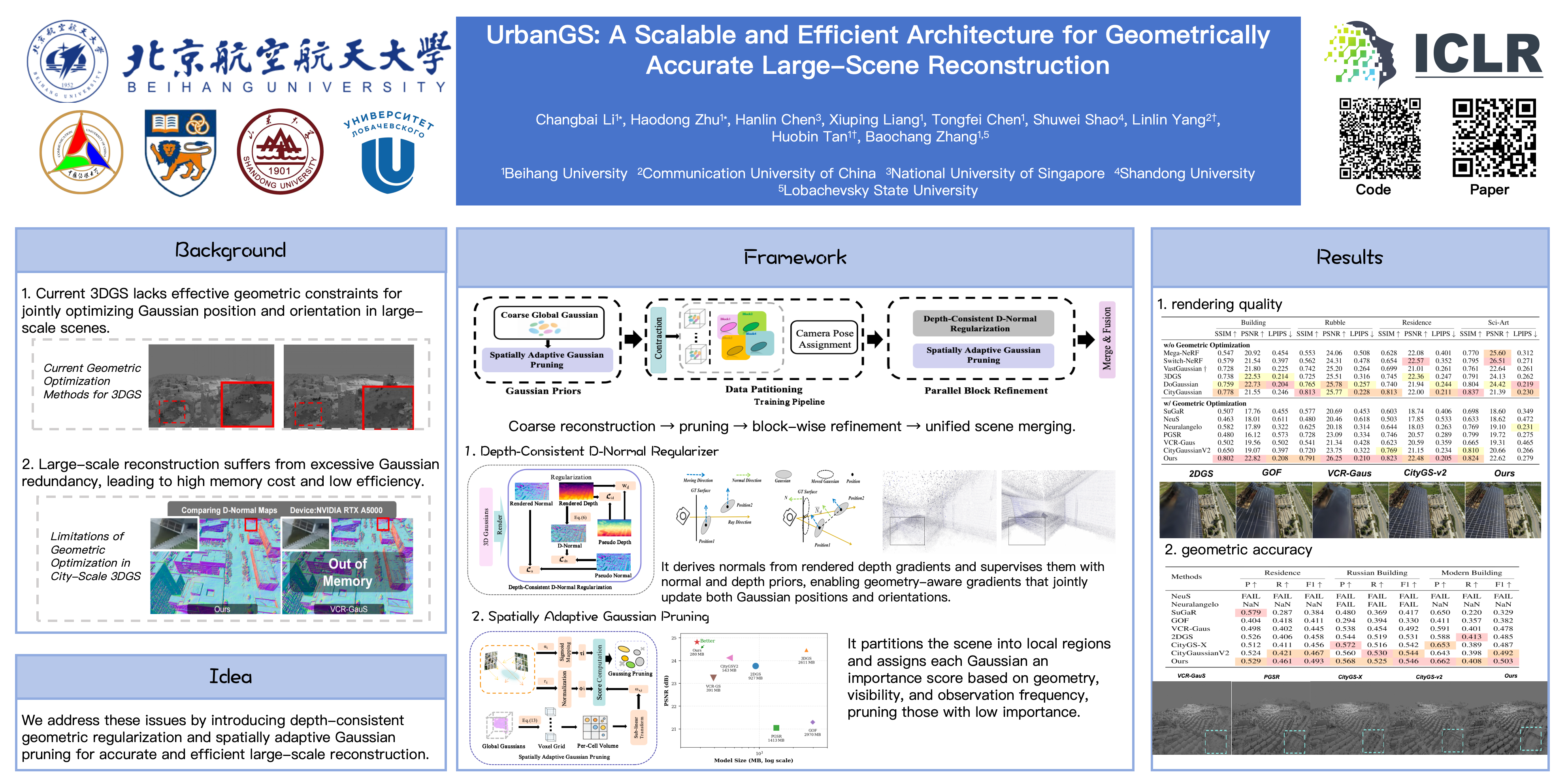
While 3D Gaussian Splatting (3DGS) delivers high-quality, real-time rendering for bounded scenes, its extension to large-scale urban environments introduces critical challenges in geometric consistency, memory efficiency, and computational scalability. We present UrbanGS, a scalable reconstruction framework that effectively addresses these challenges for city-scale applications. We propose a Depth-Consistent D-Normal Regularization module. In contrast to existing approaches that rely solely on monocular normal estimators—which effectively update rotation parameters but poorly optimize other geometric attributes—our method integrates D-Normal constraints with external depth supervision. This enables comprehensive updates of all geometric parameters. By further incorporating an adaptive confidence weighting mechanism based on gradient consistency and inverse depth deviation, our approach significantly enhances multi-view depth alignment and geometric coherence. To improve scalability, we introduce a Spatially Adaptive Gaussian Pruning (SAGP) strategy, which dynamically adjusts Gaussian density based on local geometric complexity and visibility to reduce redundancy. Additionally, a unified partitioning and view assignment scheme is designed to eliminate boundary artifacts and optimize computational load. Extensive experiments on multiple urban datasets demonstrate that UrbanGS achieves superior performance in rendering quality, geometric accuracy, and memory efficiency, offering a systematic solution for high-fidelity large-scale scene reconstruction.
OmniVideoBench: Towards Audio-Visual Understanding Evaluation for Omni MLLMs
Caorui Li ⋅ Yu Chen ⋅ Yiyan Ji ⋅ Jin Xu ⋅ Zhenyu Cui ⋅ Shihao Li ⋅ Yuanxing Zhang ⋅ Zhenghao Song ⋅ Dingling Zhang ⋅ Ying He ⋅ Haoxiang Liu ⋅ Yuxuan Wang ⋅ Qiufeng Wang ⋅ Jiafu Tang ⋅ Zhenhe Wu ⋅ Jiehui Luo ⋅ Zhiyu Pan ⋅ Weihao Xie ⋅ Chenchen Zhang ⋅ Zhaohui Wang ⋅ Jiayi Tian ⋅ Yanghai Wang ⋅ Zhe Cao ⋅ Minxin Dai ⋅ Ke Wang ⋅ Runzhe Wen ⋅ Yinghao MA ⋅ Yaning Pan ⋅ Sungkyun Chang ⋅ Termeh Taheri ⋅ Haiwen Xia ⋅ Christos Plachouras ⋅ Emmanouil Benetos ⋅ Yizhi Li ⋅ Ge Zhang ⋅ Jian Yang ⋅ Tianhao Peng ⋅ zili wang ⋅ Minghao Liu ⋅ Junran Peng ⋅ Zhaoxiang Zhang ⋅ JIAHENG LIU
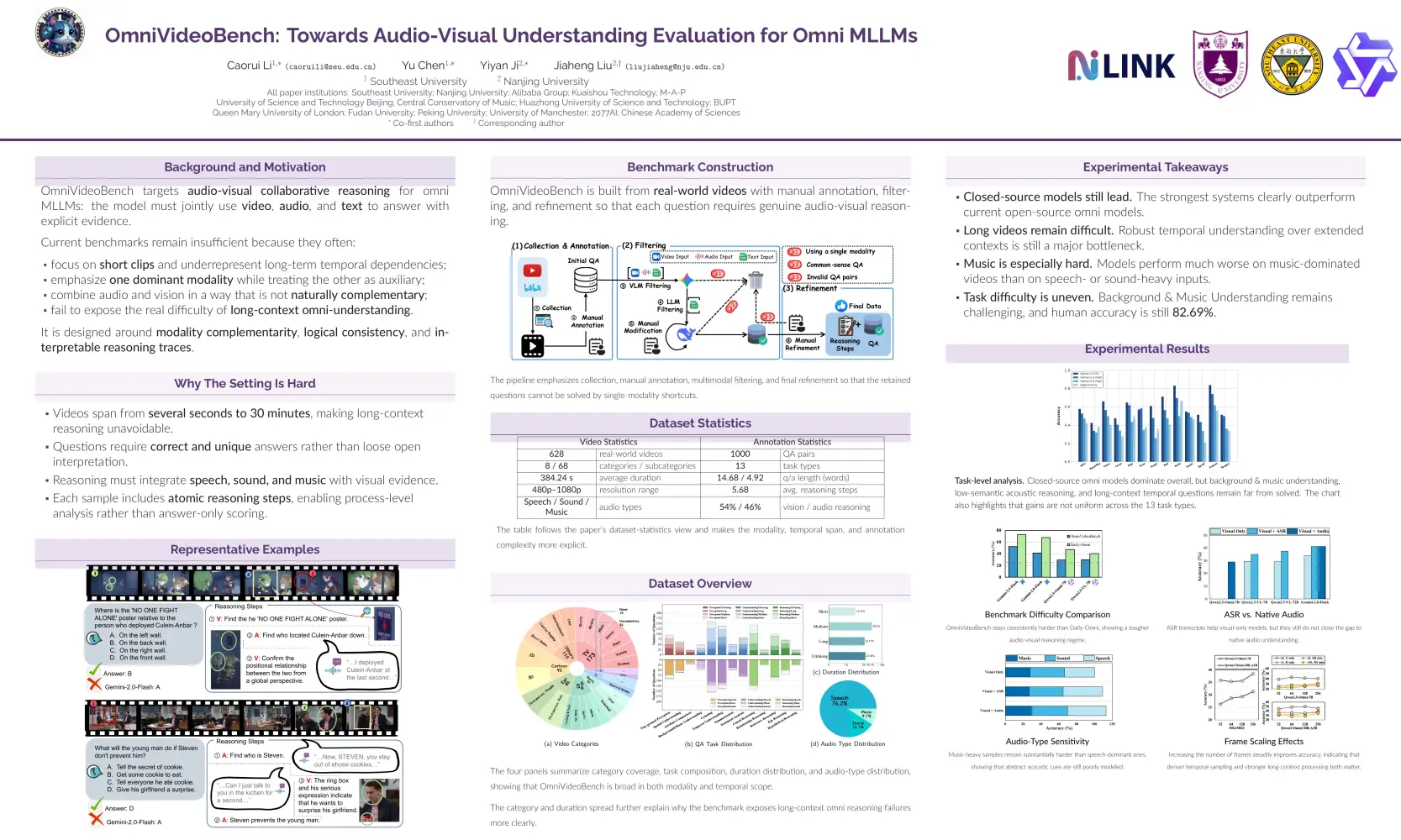
Recent advances in multimodal large language models (MLLMs) have demonstrated substantial potential in video understanding. However, existing benchmarks fail to comprehensively evaluate synergistic reasoning capabilities across audio and visual modalities, often neglecting either one of the modalities or integrating them in a logically inconsistent manner. To bridge this gap, we introduce OmniVideoBench, a large-scale and rigorously designed benchmark dedicated to assessing synergistic audio-visual understanding, with a strong emphasis on modality complementarity and logical consistency. Specifically, OmniVideoBench comprises 1000 high-quality question-answer(QA) pairs, each annotated with step-by-step reasoning traces, derived from 628 diverse videos ranging from several seconds to 30 minutes, and manually verified to guarantee complete correctness and uniqueness. Moreover, OmniVideoBench encompasses 13 carefully designed question types, covering temporal reasoning, spatial localization, counting, causal inference, summarization, and beyond, thereby capturing the essential challenges of video understanding. Evaluation of multiple MLLMs on OmniVideoBench reveals a pronounced gap between model performance and human reasoning, with open-source models lagging significantly behind their closed-source counterparts, underscoring the inherent difficulty of genuine audio-visual reasoning. We will release OmniVideoBench to foster the development of MLLMs with stronger and more generalizable reasoning capabilities.
Adaptive Hopfield Network: Rethinking Similarities in Associative Memory
Shurong Wang ⋅ Yuqi Pan ⋅ Zhuoyang Shen ⋅ Meng Zhang ⋅ Hongwei Wang ⋅ Guoqi Li
Associative memory models are content-addressable memory systems fundamental to biological intelligence and are notable for their high interpretability. However, existing models evaluate the quality of retrieval based on proximity, which cannot guarantee that the retrieved pattern has the strongest association with the query, failing correctness. We reframe this problem by proposing that a query is a generative variant of a stored memory pattern, and define a variant distribution to model this subtle context-dependent generative process. Consequently, correct retrieval should return the memory pattern with the maximum a posteriori probability of being the query's origin. This perspective reveals that an ideal similarity measure should approximate the likelihood of each stored pattern generating the query in accordance with variant distribution, which is impossible for fixed and pre-defined similarities used by existing associative memories. To this end, we develop adaptive similarity, a novel mechanism that learns to approximate this insightful but unknown likelihood from samples drawn from context, aiming for correct retrieval. We theoretically prove that our proposed adaptive similarity achieves optimal correct retrieval under three canonical and widely applicable types of variants: noisy, masked, and biased. We integrate this mechanism into a novel adaptive Hopfield network (A-Hop), and empirical results show that it achieves state-of-the-art performance across diverse tasks, including memory retrieval, tabular classification, image classification, and multiple instance learning. Our code is publicly available at https://github.com/shurongwang/Adaptive-Hopfield-Network.
Sim2Real VLA: Zero-Shot Generalization of Synthesized Skills to Realistic Manipulation
Runyi Zhao ⋅ Sheng Xu ⋅ Ruixing Jin ⋅ Yueci Deng ⋅ Yunxin Tai ⋅ Kui Jia ⋅ Guiliang Liu
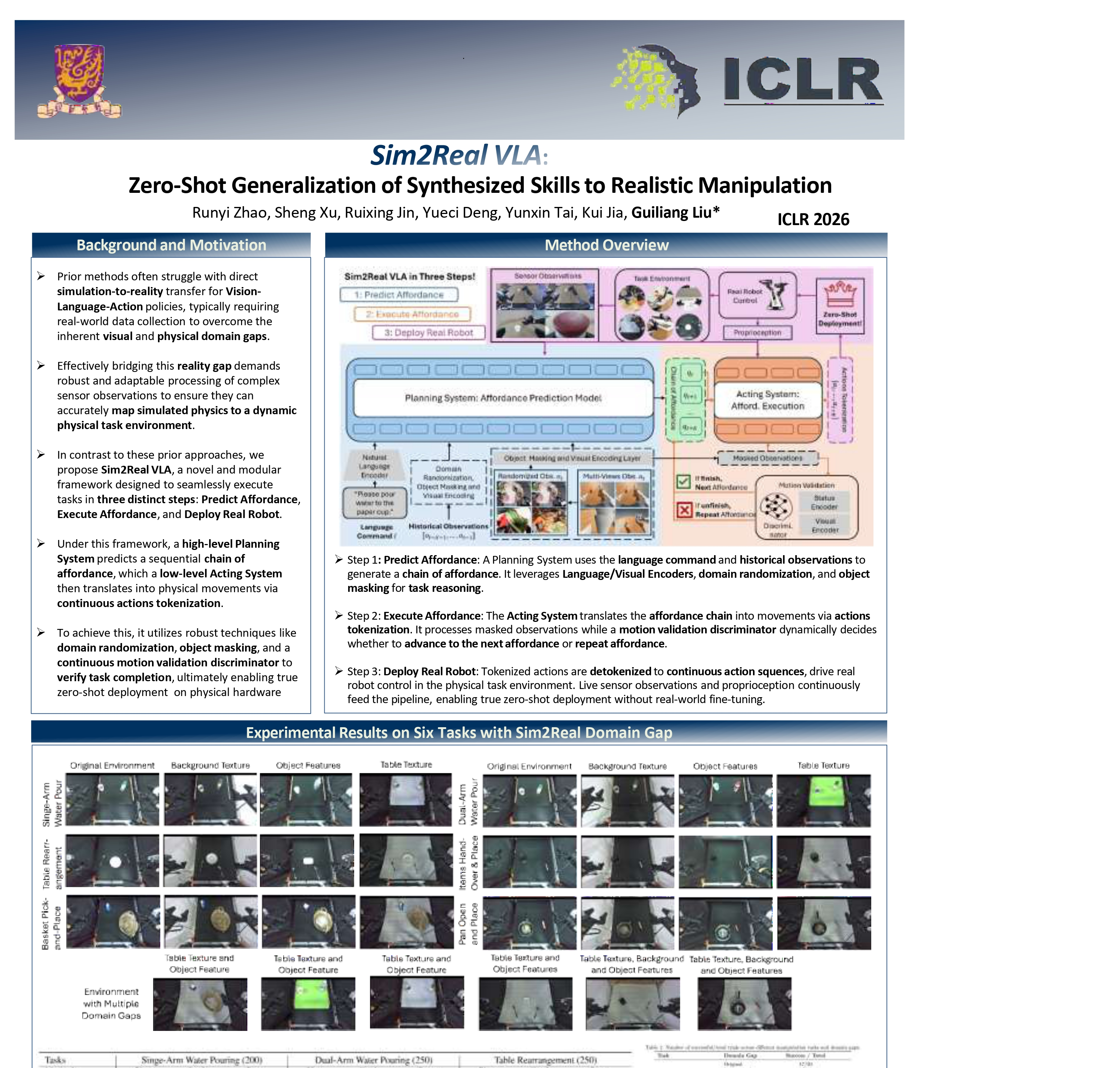
Vision-Language-Action (VLA) models represent a critical milestone toward embodied intelligence in robotic manipulation. To support their training, recent research has developed high-performance simulation engines for data synthesis. However, their effectiveness is still significantly limited by the simulation-to-reality (Sim2Real) gap, as policies trained on synthetic data often fail to generalize reliably to the real world. To address this challenge, we present Sim2Real-VLA, a generalist robot control model trained exclusively on synthetic data, yet capable of transferring seamlessly to real-world manipulation tasks. Sim2Real-VLA features a dual-system architecture: a high-level planner that infers object-centered chains-of-affordances, and a low-level actor that executes and validates these plans in real time via a tokenized action space. This design filters out manipulation-irrelevant features and prioritizes motion-critical dynamics, thereby enhancing Sim2Real domain transfer. Besides, a notable advantage of Sim2Real-VLA lies in its tight integration with automated data generation for manipulation skills, eliminating the need for manual fine-tuning and enabling scalable, hands-free training. Empirical evaluations across bimanual, dexterous, and long-horizon tasks show that Sim2Real-VLA consistently outperforms previous VLA baselines under diverse real-world environments and domain shifts.
TrustGen: A Platform of Dynamic Benchmarking on the Trustworthiness of Generative Foundation Models
Yue Huang ⋅ Chujie Gao ⋅ Siyuan Wu ⋅ Haoran Wang ⋅ Xiangqi Wang ⋅ Jiayi Ye ⋅ Yujun Zhou ⋅ Yanbo Wang ⋅ Jiawen Shi ⋅ Qihui Zhang ⋅ Han Bao ⋅ Zhaoyi Liu ⋅ Yuan Li ⋅ Tianrui Guan ⋅ Peiran Wang ⋅ Haomin Zhuang ⋅ Dongping Chen ⋅ Kehan Guo ⋅ Andy Zou ⋅ Bryan Hooi ⋅ Caiming Xiong ⋅ Elias Stengel-Eskin ⋅ Hongyang Zhang ⋅ Hongzhi Yin ⋅ Huan Zhang ⋅ Huaxiu Yao ⋅ Jieyu Zhang ⋅ Jaehong Yoon ⋅ Kai Shu ⋅ Ranjay Krishna ⋅ Swabha Swayamdipta ⋅ Weijia Shi ⋅ Xiang Li ⋅ Yuexing Hao ⋅ Zhihao Jia ⋅ Zhize Li ⋅ Xiuying Chen ⋅ Zhengzhong Tu ⋅ Xiyang Hu ⋅ Tianyi Zhou ⋅ Jieyu Zhao ⋅ Lichao Sun ⋅ Furong Huang ⋅ Or Cohen-Sasson ⋅ Prasanna Sattigeri ⋅ Anka Reuel ⋅ Max Lamparth ⋅ Yue Zhao ⋅ Nouha Dziri ⋅ Yu Su ⋅ Huan Sun ⋅ Heng Ji ⋅ Chaowei Xiao ⋅ Mohit Bansal ⋅ Nitesh Chawla ⋅ Jian Pei ⋅ Jianfeng Gao ⋅ Michael Backes ⋅ Philip Yu ⋅ Neil Gong ⋅ Pin-Yu Chen ⋅ Bo Li ⋅ Dawn Song ⋅ Xiangliang Zhang
Generative foundation models (GenFMs), such as large language models and text-to-image systems, have demonstrated remarkable capabilities in various downstream applications. As they are increasingly deployed in high-stakes applications, assessing their trustworthiness has become both a critical necessity and a substantial challenge. Existing evaluation efforts are fragmented, rapidly outdated, and often lack extensibility across modalities. This raises a fundamental question: how can we systematically, reliably, and continuously assess the trustworthiness of rapidly advancing GenFMs across diverse modalities and use cases? To address these gaps, we introduce TrustGen, a dynamic and modular benchmarking system designed to systematically evaluate the trustworthiness of GenFMs across text-to-image, large language, and vision-language modalities. TrustGen standardizes trust evaluation through a unified taxonomy of over 25 fine-grained dimensions—including truthfulness, safety, fairness, robustness, privacy, and machine ethics—while supporting dynamic data generation and adaptive evaluation through three core modules: Metadata Curator, Test Case Builder, and Contextual Variator. Taking TrustGen into action to evaluate the trustworthiness of 39 models reveals four key insights. (1) State-of-the-art GenFMs achieve promising overall trust performance, yet significant limitations remain in specific dimensions such as hallucination resistance, fairness, and privacy preservation. (2) Contrary to prevailing assumptions, open-source models now rival and occasionally surpass proprietary systems in trustworthiness metrics. (3) The trust gap among top-performing models is narrowing, likely due to increased industry convergence on best practices. (4) Trustworthiness is not an isolated property; it interacts complexly with other behaviors, such as helpfulness and ethical decision-making. TrustGen is a transformative step toward standardized, scalable, and actionable trustworthiness evaluation, supporting dynamic assessments across diverse modalities and trust dimensions that evolve alongside the generative AI landscape.
Deconstructing Positional Information: From Attention Logits to Training Biases
Zihan Gu ⋅ Ruoyu Chen ⋅ Han Zhang ⋅ Hua Zhang ⋅ Yue Hu
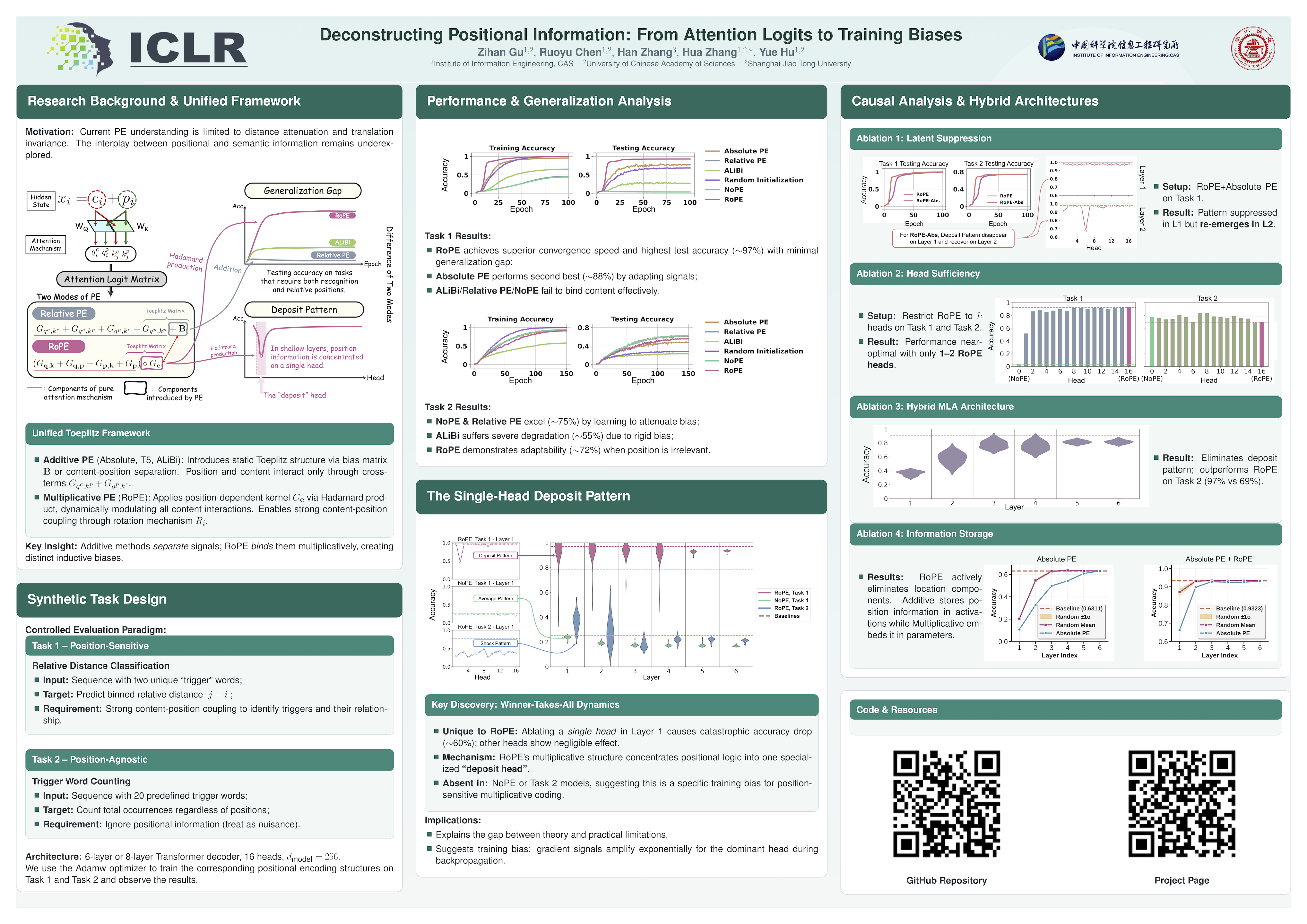
Positional encodings, a mechanism for incorporating sequential information into the Transformer model, are central to contemporary research on neural architectures. Previous work has largely focused on understanding their function through the principle of distance attenuation, where proximity dictates influence. However, the interaction between positional and semantic information remains insufficiently explored, and the complexity of mainstream corpora hinders systematic, comparative studies of these methods. This paper addresses these challenges through a deconstruction of the attention-logit computation and a structured analysis of all mainstream positional encodings. A key focus is placed on Rotary Positional Embedding (RoPE), whose product-based structure uniquely facilitates a direct interaction between position and content. To probe this characteristic, we designed a novel synthetic task that explicitly demands a strong synthesis of positional and semantic information. As theoretically predicted, RoPE demonstrates a significant performance advantage over other encodings on this specialized task. Concurrently, this targeted evaluation uncovers an implicit training issue: a hidden bias manifesting as a distinct information aggregation phenomenon in the model's shallow layers, which we term the "single-head deposit pattern." Through subsequent ablation studies, we analyze this pattern and identify a method for its mitigation. These findings highlight the need for a deeper investigation into the training dynamics of positional encodings to bridge the gap between their theoretical design and practical implementation.
Tractability via Low Dimensionality: The Parameterized Complexity of Training Quantized Neural Networks
Robert Ganian ⋅ Frank Sommer ⋅ Manuel Sorge
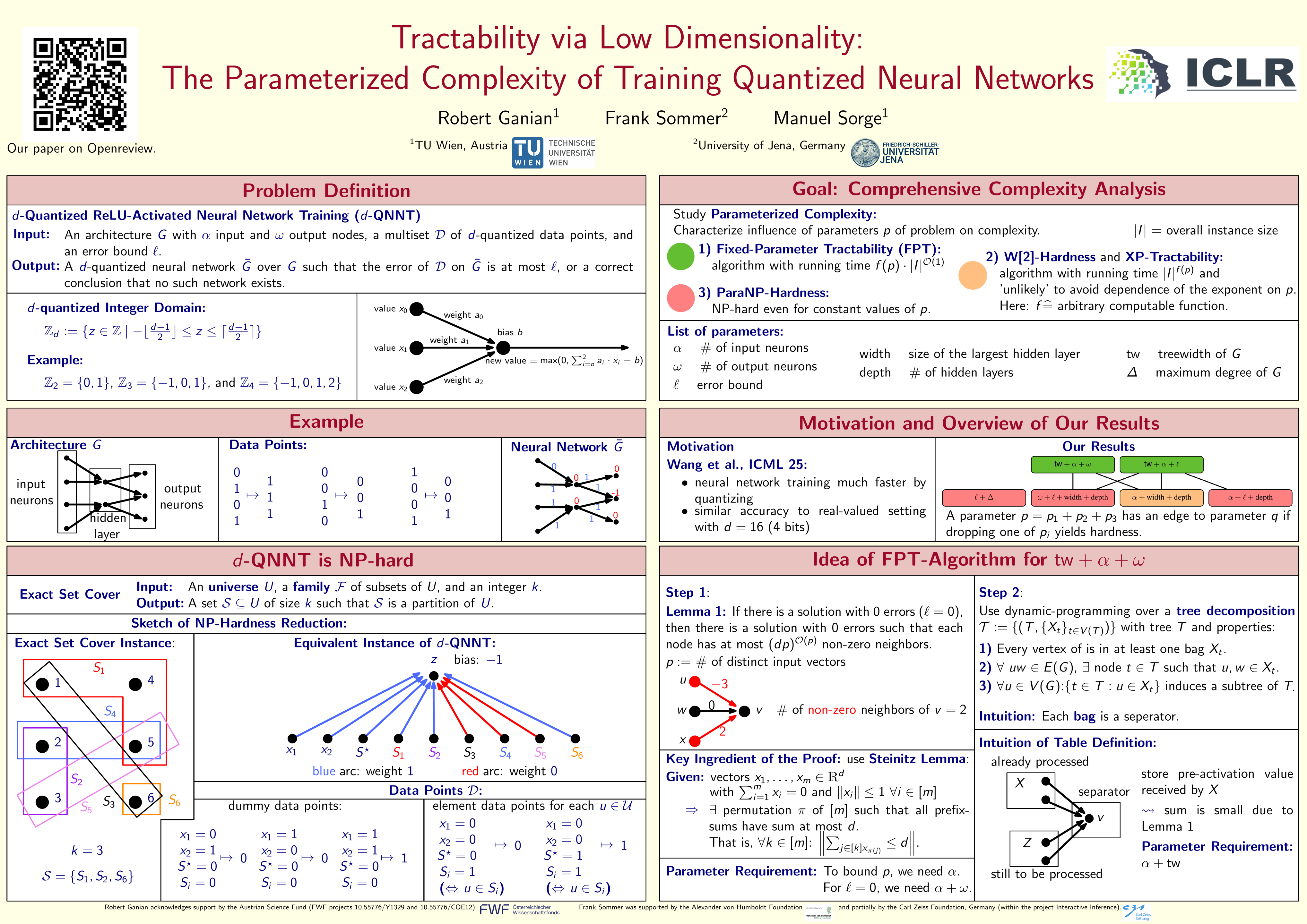
The training of neural networks has been extensively studied from both algorithmic and complexity-theoretic perspectives, yet recent results in this direction almost exclusively concern real-valued networks. In contrast, advances in machine learning practice highlight the benefits of quantization, where network parameters and data are restricted to finite integer domains, yielding significant improvements in speed and energy efficiency. Motivated by this gap, we initiate a systematic complexity-theoretic study of ReLU Neural Network Training in the full quantization mode. We establish strong lower bounds by showing that hardness already arises in the binary setting and under highly restrictive structural assumptions on the architecture, thereby excluding parameterized tractability for natural measures such as depth and width. On the positive side, we identify nontrivial fixed-parameter tractable cases when parameterizing by input dimensionality in combination with width and either output dimensionality or error bound, and further strengthen these results by replacing width with the more general treewidth.
Referring Layer Decomposition
Fangyi Chen ⋅ Yaojie Shen ⋅ Lu Xu ⋅ Ye Yuan ⋅ Shu Zhang ⋅ Yulei Niu ⋅ Longyin Wen
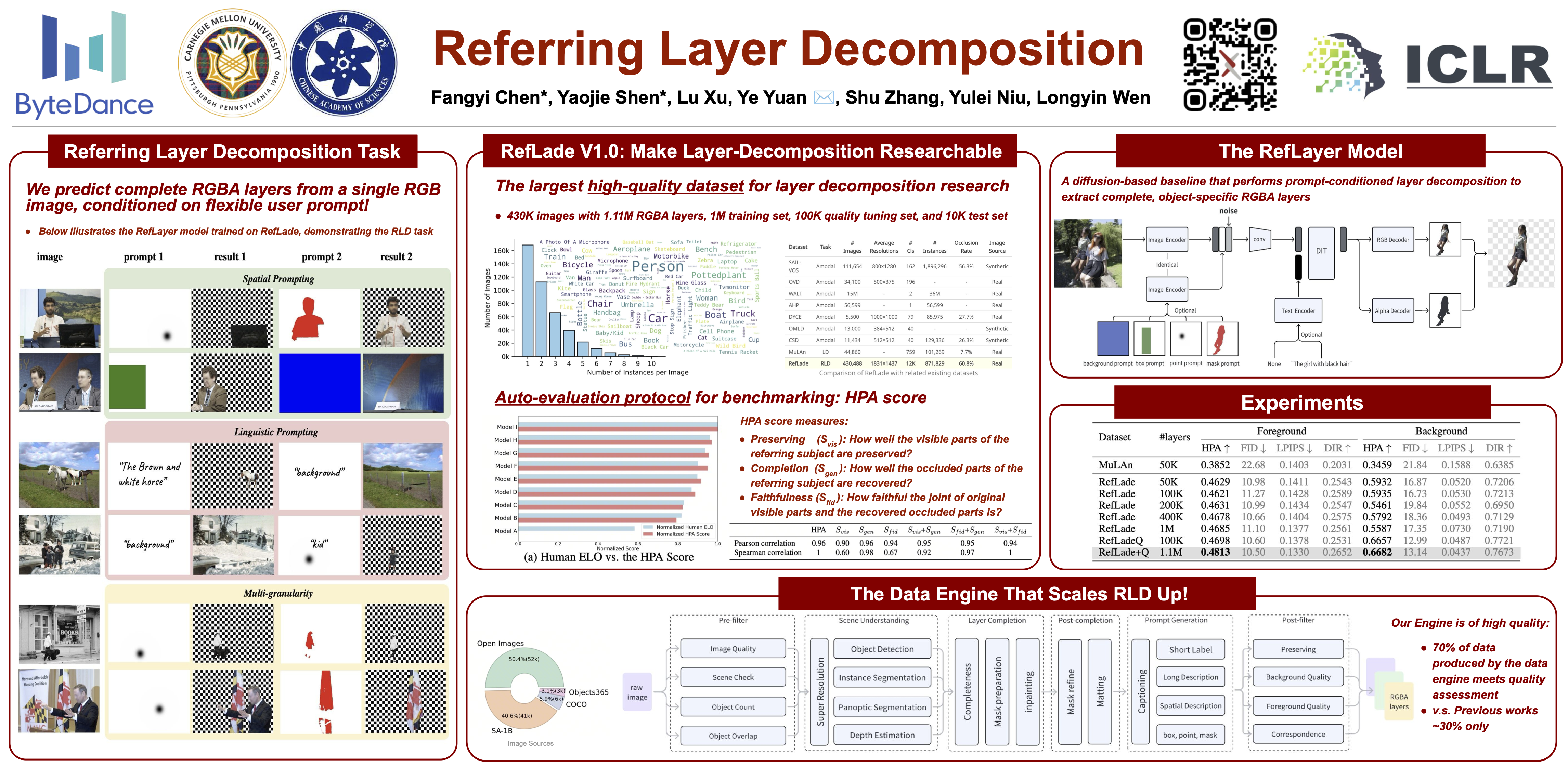
Precise, object-aware control over visual content is essential for advanced image editing and compositional generation. Yet, most existing approaches operate on entire images holistically, limiting the ability to isolate and manipulate individual scene elements. In contrast, layered representations, where scenes are explicitly separated into objects, environmental context, and visual effects, provide a more intuitive and structured framework for interpreting and editing visual content. To bridge this gap and enable both compositional understanding and controllable editing, we introduce the Referring Layer Decomposition (RLD) task, which predicts complete RGBA layers from a single RGB image, conditioned on flexible user prompts, such as spatial inputs (e.g., points, boxes, masks), natural language descriptions, or combinations thereof. At the core is the RefLade, a large-scale dataset comprising 1.11M image–layer–prompt triplets produced by our scalable data engine, along with 100K manually curated, high-fidelity layers. Coupled with a perceptually grounded, human-preference-aligned automatic evaluation protocol, RefLade establishes RLD as a well-defined and benchmarkable research task. Building on this foundation, we present RefLayer, a simple baseline designed for prompt-conditioned layer decomposition, achieving high visual fidelity and semantic alignment. Extensive experiments show our approach enables effective training, reliable evaluation, and high-quality image decomposition, while exhibiting strong zero-shot generalization capabilities. The project will be released at https://yaojie-shen.github.io/project/RLD/
Micro-Macro Retrieval: Reducing Long-Form Hallucination in Large Language Models
Yujie Feng ⋅ Jian Li ⋅ Zhihan Zhou ⋅ Pengfei Xu ⋅ Yujia Zhang ⋅ xiaoyu li ⋅ Xiaohui Zhou ⋅ Alan Zhao ⋅ Xi Chen ⋅ Xiao-Ming Wu
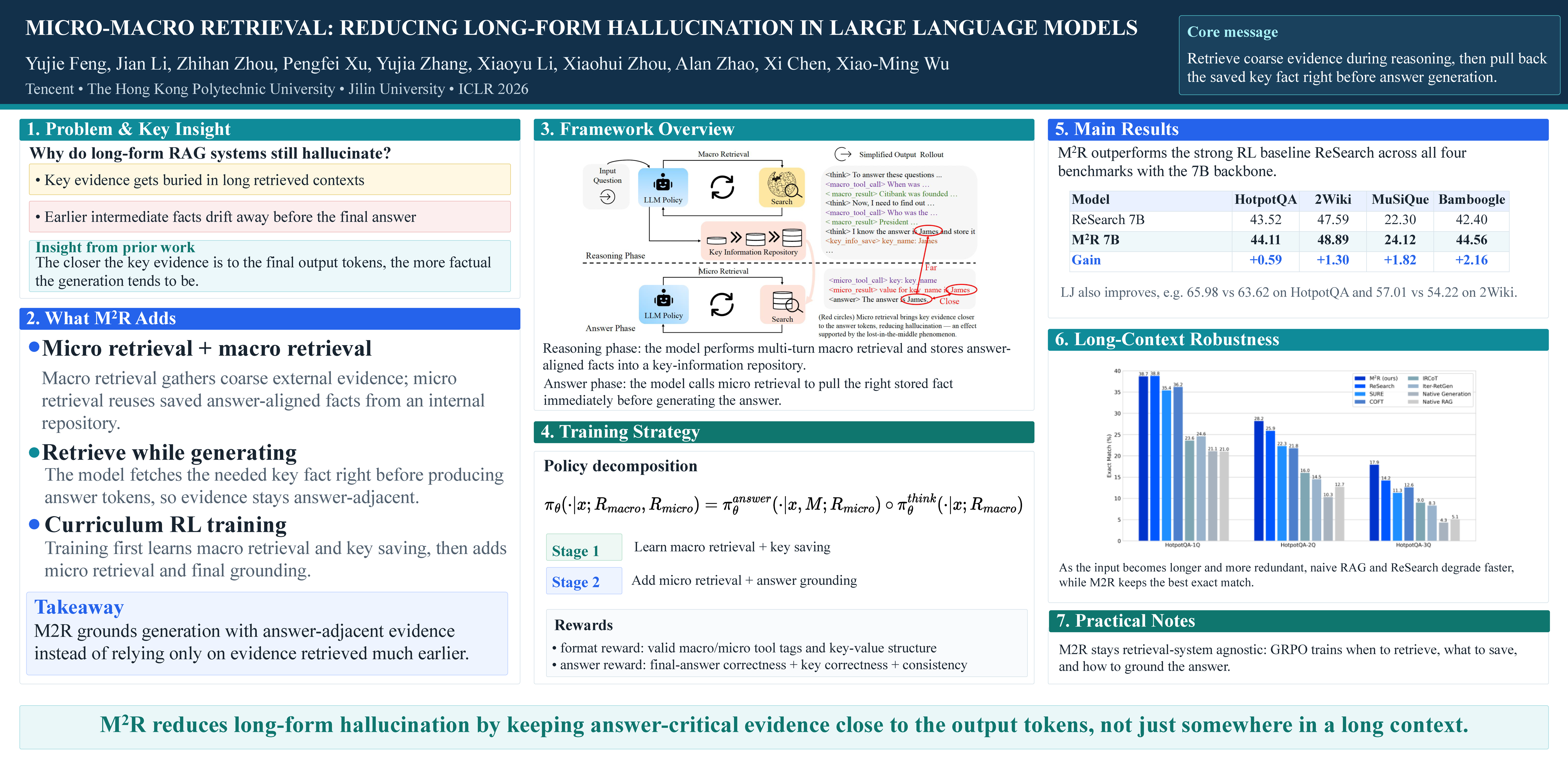
Large Language Models (LLMs) achieve impressive performance across many tasks but remain prone to hallucination, especially in long-form generation where redundant retrieved contexts and lengthy reasoning chains amplify factual errors. Recent studies highlight a critical phenomenon: the closer key information appears to the model outputs, the higher the factual accuracy. However, existing retrieval-augmented language models (RALMs) lack effective mechanisms to ensure this proximity — external evidence is injected into reasoning via multi-turn retrieval, but this cannot ensure key information stays close to the outputs. We propose Micro–Macro Retrieval ($M^2R$), a novel retrieve-while-generate framework to fill this gap. At the macro level, $M^2R$ retrieves coarse-grained evidence from external sources; at the micro level, it extracts essential results from a key information repository built during reasoning and reuses them while generating answers. This design directly addresses the key-information–to-output proximity bottleneck, effectively reducing hallucination in long-form tasks. $M^2R$ is trained with a curriculum learning–based reinforcement learning strategy using customized rule-based rewards, enabling stable acquisition of retrieval and grounding skills. Extensive experiments across different benchmarks demonstrate the effectiveness of $M^2R$, especially in lengthy-context settings.
Why Less is More (Sometimes): A Theory of Data Curation
Elvis Dohmatob ⋅ Mohammad Pezeshki ⋅ Reyhane Askari Hemmat
This paper introduces a theoretical framework to resolve a central paradox in modern machine learning: When is it better to use less data? This question has become critical as classical scaling laws suggesting more is more'' (Sun et al., 2025) are challenged by methods like LIMO (less is more'') and s1 (Ye et al., 2025; Muenighoff et al., 2025), which achieve superior performance with small, aggressively curated datasets. Here, we study data curation strategies where an imperfect oracle selects the training examples according to their difficulty and correctness. Our results provide exact scaling law curves for test error under both label-agnostic and label-aware curation rules, revealing when and why keeping only a subset of data can improve generalization. In contrast to classical scaling laws, we show that under certain conditions, small curated datasets can outperform full datasets, and we provide analytical conditions for this by deriving precise phase transition curves tied to data size and quality. We validate these theoretical claims with empirical results on ImageNet, confirming our predictions about when curation improves accuracy and can even mitigate model collapse. Furthermore, our framework provides a principled explanation for the contradictory curation strategies recently observed in LLM mathematical reasoning.
DreamPhase: Offline Imagination and Uncertainty-Guided Planning for Large-Language-Model Agents
Shayan Mohajer Hamidi ⋅ Linfeng Ye ⋅ Konstantinos Plataniotis
Autonomous agents capable of perceiving complex environments, understanding instructions, and performing multi-step tasks hold transformative potential across domains such as robotics, scientific discovery, and web automation. While large language models (LLMs) provide a powerful foundation, they struggle with closed-loop decision-making due to static pretraining and limited temporal grounding. Prior approaches either rely on expensive, real-time environment interactions or brittle imitation policies, both with safety and efficiency trade-offs. We introduce DreamPhase, a modular framework that plans through offline imagination. A learned latent world model simulates multi-step futures in latent space; imagined branches are scored with an uncertainty-aware value and filtered by a safety gate. The best branch is distilled into a short natural-language reflection that conditions the next policy query, improving behavior without modifying the LLM. Crucially, DreamPhase attains its performance with substantially fewer real interactions: on WebShop, average API calls per episode drop from $\sim$40 with ARMAP-M (token-level search) to $<10$ with DreamPhase, a $4\times$ reduction that lowers latency and reduces executed irreversible actions by $\sim 5\times$ on WebShop (4.9$\times$ on ALFWorld) per incident logs. Across web, science, and embodied tasks, DreamPhase improves sample efficiency, safety, and cost over search-based and reward-based baselines. This offers a scalable path toward safe, high-performance autonomous agents via imagination-driven planning. Code: \url{https://anonymous.4open.science/r/DreamPhase-A8AD/README.md}.
RL's Razor: Why Online Reinforcement Learning Forgets Less
Idan Shenfeld ⋅ Jyothish Pari ⋅ Pulkit Agrawal
Comparison of fine-tuning models with reinforcement learning (RL) and supervised fine-tuning (SFT) reveals that, despite similar performance at a new task, RL preserves prior knowledge and capabilities significantly better. We find that the degree of forgetting is determined by the distributional shift, measured as the KL-divergence between the fine-tuned and base policy evaluated on the new task. Our analysis reveals that on-policy RL is implicitly biased towards KL-minimal solutions among the many that solve the new task, whereas SFT can converge to distributions arbitrarily far from the base model. We validate these findings through experiments with large language models and robotic foundation models and further provide theoretical justification for why on-policy RL updates lead to a smaller KL change. We term this principle $\textit{RL’s Razor}$: among all ways to solve a new task, RL prefers those closest in KL to the original model.
Neural Message-Passing on Attention Graphs for Hallucination Detection
Fabrizio Frasca ⋅ Guy Bar-Shalom ⋅ Yftah Ziser ⋅ Haggai Maron
Large Language Models (LLMs) often generate incorrect or unsupported content, known as hallucinations. Existing detection methods rely on heuristics or simple models over isolated computational traces such as activations, or attention maps. We unify these signals by representing them as attributed graphs, where tokens are nodes, edges follow attentional flows, and both carry features from attention scores and activations. Our approach, CHARM, casts hallucination detection as a graph learning task and tackles it by applying GNNs over the above attributed graphs. We show that CHARM provably subsumes prior attention-based heuristics and, experimentally, it consistently outperforms other leading approaches across diverse benchmarks. Our results shed light on the relevant role played by the graph structure and on the benefits of combining computational traces, whilst showing CHARM exhibits promising zero-shot performance on cross-dataset transfer.
Implicit Regularisation in Diffusion Models: An Algorithm-Dependent Generalisation Analysis
Tyler Farghly ⋅ Patrick Rebeschini ⋅ George Deligiannidis ⋅ Arnaud Doucet
The success of denoising diffusion models raises important questions regarding their generalisation behaviour, particularly in high-dimensional settings. Notably, it has been shown that when training and sampling are performed perfectly, these models memorise training data—implying that some form of regularisation is essential for generalisation. Existing theoretical analyses primarily rely on algorithm-independent techniques such as uniform convergence, heavily utilising model structure to obtain generalisation bounds. In this work, we instead leverage the algorithmic aspects that promote generalisation in diffusion models, developing a general theory of algorithm-dependent generalisation for this setting. Borrowing from the framework of algorithmic stability, we introduce the notion of score stability, which quantifies the sensitivity of score-matching algorithms to dataset perturbations. We derive generalisation bounds in terms of score stability, and apply our framework to several fundamental learning settings, identifying sources of regularisation. In particular, we consider denoising score matching with early stopping (denoising regularisation), sampler-wide coarse discretisation (sampler regularisation), and optimising with SGD (optimisation regularisation). By grounding our analysis in algorithmic properties rather than model structure, we identify multiple sources of implicit regularisation unique to diffusion models that have so far been overlooked in the literature.
Step-Aware Residual-Guided Diffusion for EEG Spatial Super-Resolution
Hongjun Liu ⋅ Leyu Zhou ⋅ Zijianghao Yang ⋅ Chao Yao
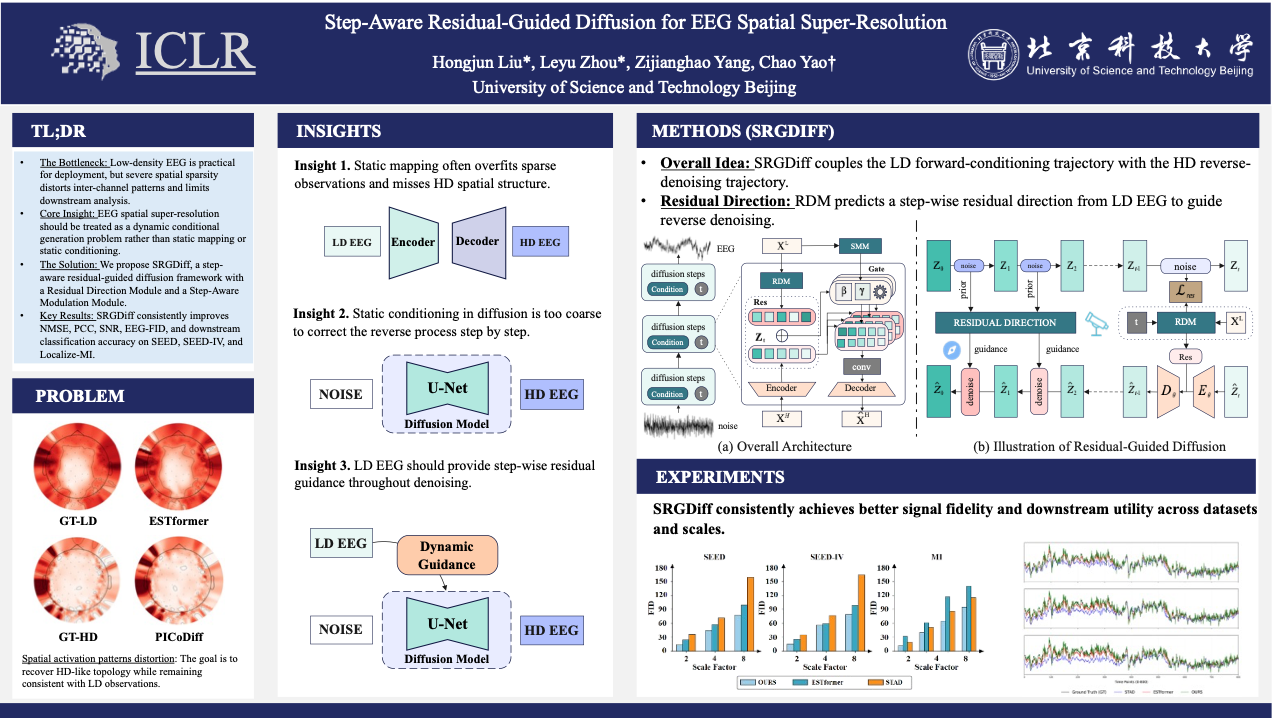
For real-world BCI applications, lightweight Electroencephalography (EEG) systems offer the best cost–deployment balance. However, such spatial sparsity of EEG limits spatial fidelity, hurting learning and introducing bias. EEG spatial super-resolution methods aim to recover high-density EEG signals from sparse measurements, yet is often hindered by distribution shift and signal distortion and thus reducing fidelity and usability for EEG analysis and visualization. To overcome these challenges, we introduce SRGDiff, a step-aware residual-guided diffusion model that formulates EEG spatial super-resolution as dynamic conditional generation. Our key idea is to learn a dynamic residual condition from the low-density input that predicts the step-wise temporal and spatial details to add and uses the evolving cue to steer the denoising process toward high density reconstructions. At each denoising step, the proposed residual condition is additively fused with the previous denoiser feature maps, then a step-dependent affine modulation scales and shifts the activation to produce the current features. This iterative procedure dynamically extracts step-wise temporal rhythms and spatial-topographic cues to steer high-density recovery and maintain a fidelity–consistency balance. We adopt a comprehensive evaluation protocol spanning signal-, feature-, and downstream-level metrics across SEED, SEED-IV, and Localize-MI and multiple upsampling scales. SRGDiff achieves consistent gains of up to 40\% over strong baselines, proving its superiority in the task of EEG spatial super-resolution. Moreover, topographic visualizations comparison and substantial EEG-FID gains jointly indicate that our SR EEG mitigates the spatial–spectral shift between low- and high-density recordings. Our code is available at https://github.com/DhrLhj/ICLR2026SRGDiff.
From Gradient Volume to Shapley Fairness: Towards Fair Multi-Task Learning
Xiao Wang ⋅ Yuying Han ⋅ Dazi Li ⋅ Fei Zhang ⋅ Min Tang
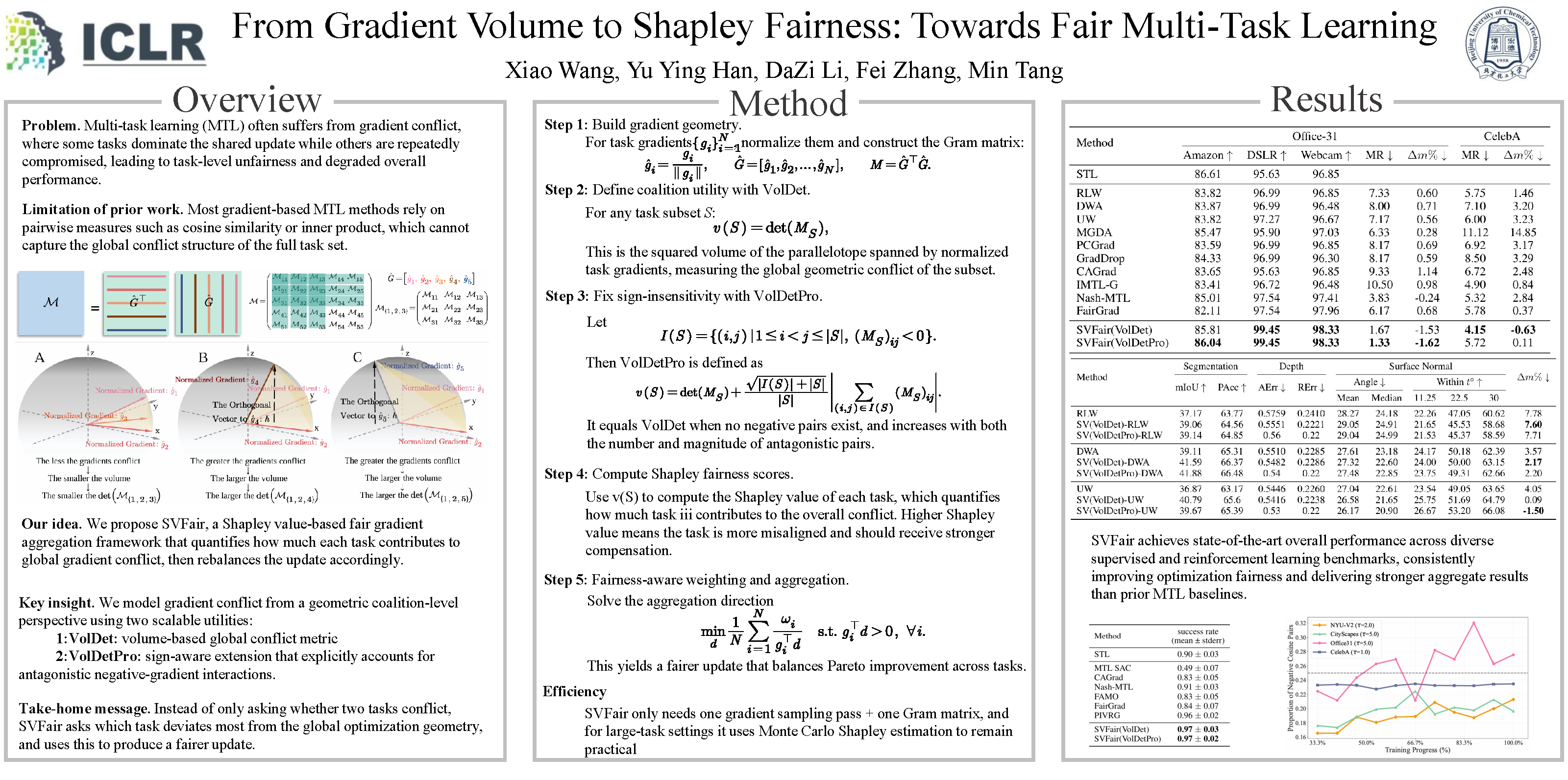
Multi-task learning often suffers from gradient conflicts, leading to unfair optimization and degraded overall performance. To address this, we present SVFair, a Shapley value-based framework for fair gradient aggregation. We propose two scalable geometric conflict metrics: VolDet, a gram determinant volume metric, and VolDetPro, its sign-aware extension distinguishing antagonistic gradients. By integrating these metrics into Shapley value computation, SVFair quantifies each task’s deviation from the overall gradient and rebalances updates toward fairness. In parallel, our Shapley value computation admits controllable complexity. Extensive experiments show that SVFair achieves state-of-the-art results across diverse supervised and reinforcement learning benchmarks, and further improves existing methods when integrated as a fairness-enhancing module.
Dual-Objective Reinforcement Learning with Novel Hamilton-Jacobi-Bellman Formulations
William Sharpless ⋅ Dylan Hirsch ⋅ Sander Tonkens ⋅ Nikhil Shinde ⋅ Sylvia Herbert
Hard constraints in reinforcement learning (RL) often degrade policy performance. Lagrangian methods offer a way to blend objectives with constraints, but require intricate reward engineering and parameter tuning. In this work, we extend recent advances that connect Hamilton-Jacobi (HJ) equations with RL to propose two novel value functions for dual-objective satisfaction. Namely, we address: 1) the Reach-Always-Avoid (RAA) problem – of achieving distinct reward and penalty thresholds – and 2) the Reach-Reach (RR) problem – of achieving thresholds of two distinct rewards. In contrast with temporal logic approaches, which typically involve representing an automaton, we derive explicit, tractable Bellman forms in this context via decomposition. Specifically, we prove that the RAA and RR problems may be rewritten as compositions of previously studied HJ-RL problems. We leverage our analysis to propose a variation of Proximal Policy Optimization (DO-HJ-PPO), and demonstrate that it produces distinct behaviors from previous approaches, out-competing a number of baselines in success, safety and speed across a range of tasks for safe-arrival and multi-target achievement.
StreamingThinker: Large Language Models Can Think While Reading
Junlong Tong ⋅ Yingqi Fan ⋅ Anhao Zhao ⋅ Yunpu Ma ⋅ Xiaoyu Shen
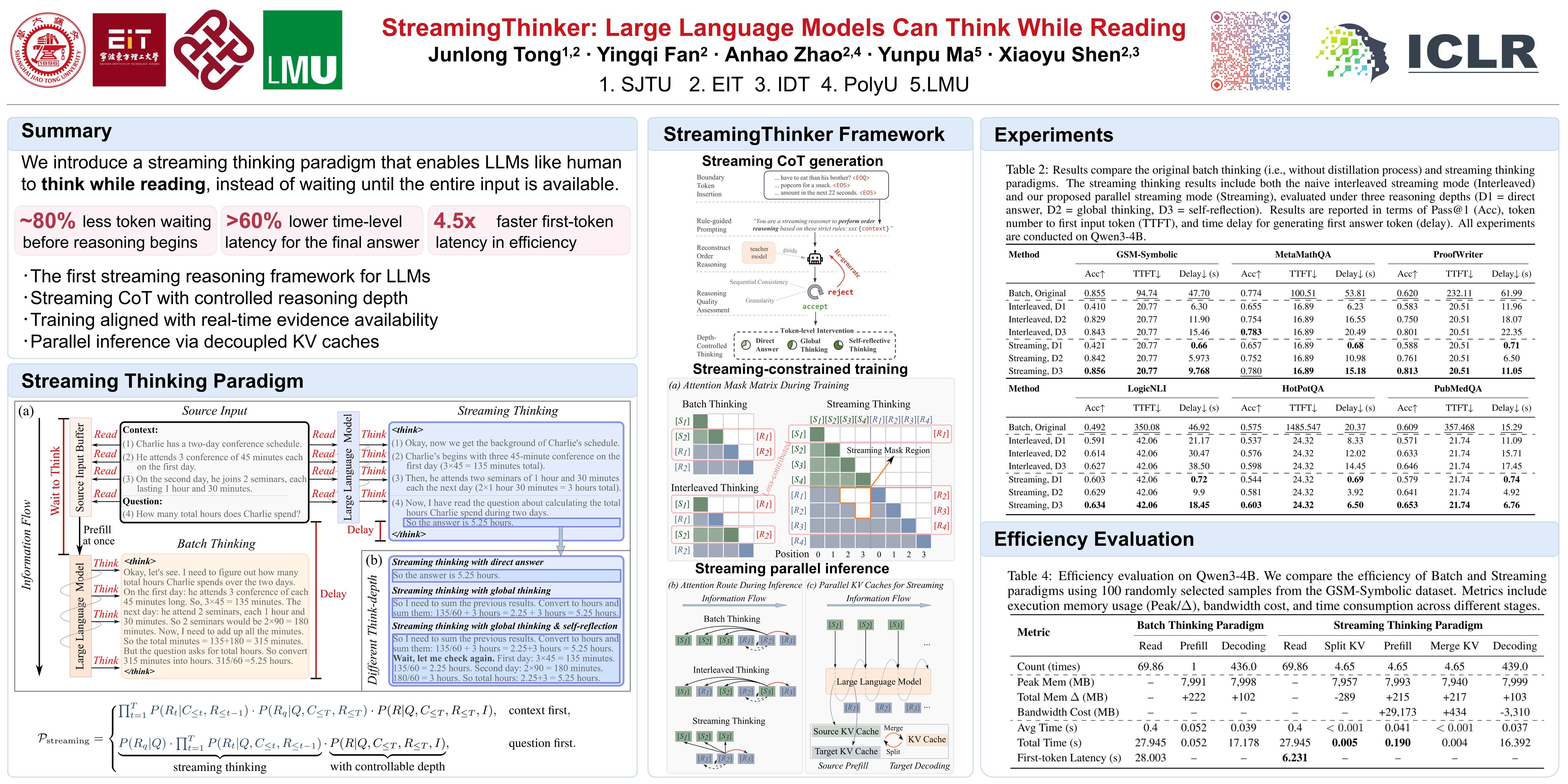
Large language models (LLMs) have demonstrated remarkable capabilities in chain of thought (CoT) reasoning. However, the current LLM reasoning paradigm initiates thinking only after the entire input is available, which introduces unnecessary latency and weakens attention to earlier information in dynamic scenarios. Inspired by human cognition of thinking while reading, we first design a streaming thinking paradigm for LLMs, where reasoning unfolds in the order of input and further adjusts its depth once reading is complete. We instantiate this paradigm with StreamingThinker, a framework that enables LLMs to think while reading through the integration of streaming CoT generation, streaming-constraint training, and streaming parallel inference. Specifically, StreamingThinker employs streaming reasoning units with quality control for CoT generation, enforces order-preserving reasoning through streaming attention masks and position encoding, and leverages parallel KV caches that decouple input encoding from reasoning generation, thereby ensuring alignment and enabling true concurrency. We evaluate StreamingThinker on the Qwen3 model family across math reasoning, logical reasoning, and context-based QA reasoning tasks. Experimental results show that the StreamingThinker preserves performance comparable to batch thinking, while yielding an 80\% reduction in token waiting before the onset of reasoning and a more than 60\% reduction in time-level latency for producing the final answer, demonstrating the effectiveness of the streaming paradigm for LLM reasoning. Code is publicly available at this repository.
A Stitch in Time Saves Nine: Proactive Self-Refinement for Language Models
Jinyi Han ⋅ Xinyi Wang ⋅ Haiquan Zhao ⋅ tingyun li ⋅ Zishang Jiang ⋅ Sihang Jiang ⋅ Jiaqing Liang ⋅ Xin Lin ⋅ Weikang Zhou ⋅ Zeye Sun ⋅ Fei Yu ⋅ Yanghua Xiao
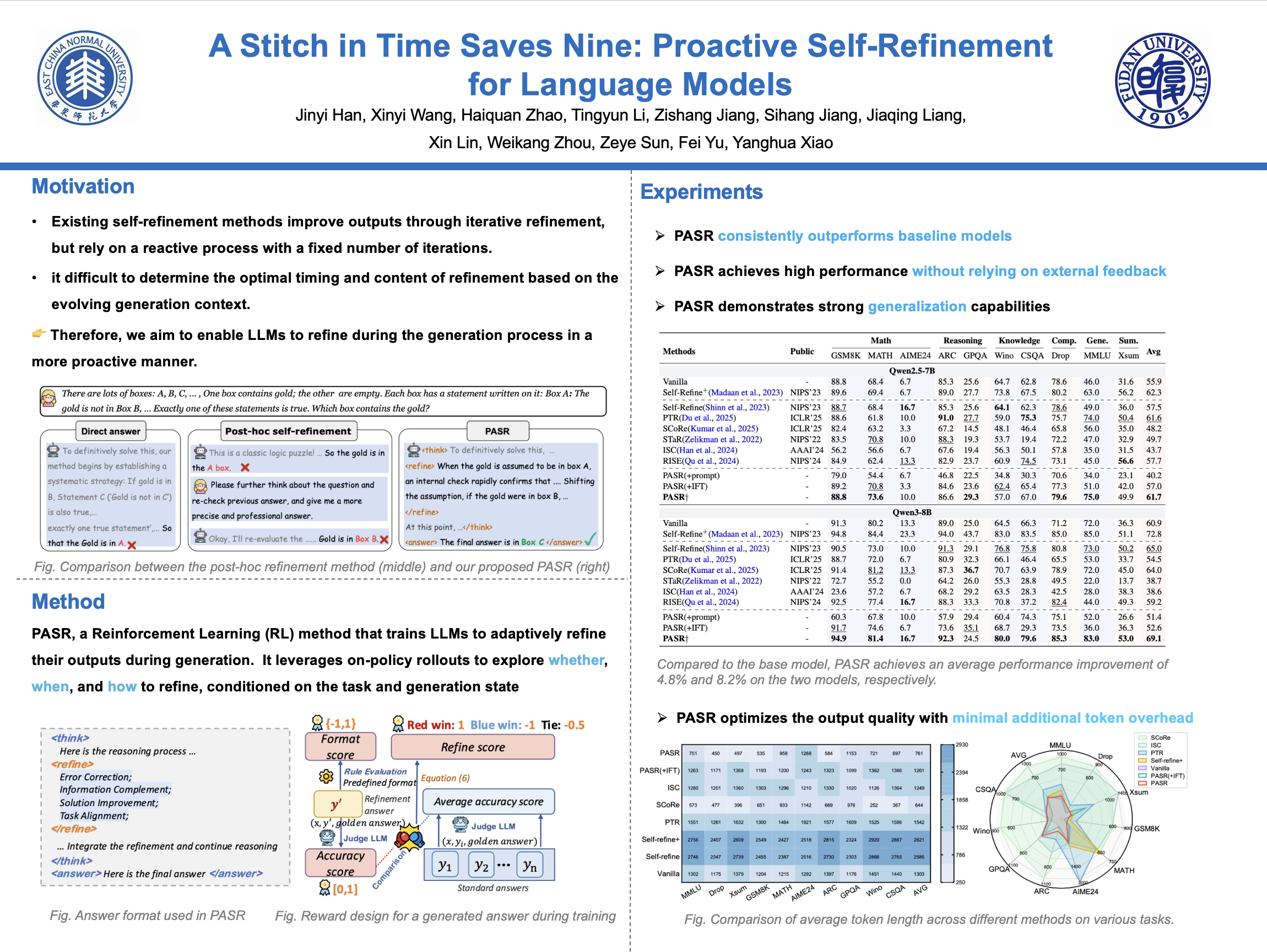
Recent advances in self-refinement have demonstrated significant potential for improving the outputs of large language models (LLMs) through iterative refinement. However, most existing self-refinement methods rely on a reactive process with a fixed number of iterations, making it difficult to determine the optimal timing and content of refinement based on the evolving generation context. Inspired by the way humans dynamically refine their thoughts during execution, we propose ProActive Self-Refinement (PASR), a novel method that enables LLMs to refine their outputs during the generation process. Unlike methods that regenerate entire responses, PASR proactively decides whether, when, and how to refine based on the model’s internal state and evolving context. We conduct extensive experiments on a diverse set of 10 tasks to evaluate the effectiveness of PASR. Experimental results show that PASR significantly enhances problem-solving performance. In particular, on Qwen3-8B, PASR reduces average token consumption by 41.6% compared to standard generation, while also achieving an 8.2% improvement in accuracy. Our code and baselines used in the paper are available in the GitHub.
Misalignments and RL Failure Modes in the Early Stage of Superintelligence
Shu Yang ⋅ Hanqi Yan ⋅ Di Wang
With the rapid ability grokking of frontier Large Models (LMs), there is growing attention and research focus on aligning them with human values and intent via large scale reinforcement learning and other techniques. However, as LMs are getting stronger and more agentic, their misalignment and deceptive behaviors are also emerging and becoming increasingly difficult for humans to pre-detect and keep track of. This blog post discusses current misalignment patterns, deceptive behaviors, RL failure modes, and emergent traits in modern large models to further AI safety discussions and advance the development of mitigation strategies for LM misbehaviors.
Computer Use Survey - A Visual Survey of Computer Use Agents
Kenneth Marino ⋅ Farhan Ishmam ⋅ Ana Marasovic
In recent years, AI systems operating on the web and in computer environments have become a major topic of interest for both academia and industry. The goal of this blog is to provide an interesting and interactive survey of historical and recent works on computer use agents. We define key terms used in the literature, catalogue the expansive list of environments and datasets, discuss the evolution of the methodologies, and assess both today’s landscape and possible paths forward.
Model Tensor Planning
Model Tensor Planning Download PDF An Thai Le · Khai Nguyen · Minh Nhat VU · Joao Carvalho · Jan Peters
Sampling-based model predictive control (MPC) offers strong performance in nonlinear and contact-rich robotic tasks, yet often suffers from poor exploration due to locally greedy sampling schemes. We propose \emph{Model Tensor Planning} (MTP), a novel sampling-based MPC framework that introduces high-entropy control trajectory generation through structured tensor sampling. By sampling over randomized multipartite graphs and interpolating control trajectories with B-splines and Akima splines, MTP ensures smooth and globally diverse control candidates. We further propose a simple $\beta$-mixing strategy that blends local exploitative and global exploratory samples within the modified Cross-Entropy Method (CEM) update, balancing control refinement and exploration. Theoretically, we show that MTP achieves asymptotic path coverage and maximum entropy in the control trajectory space in the limit of infinite tensor depth and width. Our implementation is fully vectorized using JAX and compatible with MuJoCo XLA, supporting \emph{Just-in-time} (JIT) compilation and batched rollouts for real-time control with online domain randomization. Through experiments on various challenging robotic tasks, ranging from dexterous in-hand manipulation to humanoid locomotion, we demonstrate that MTP outperforms standard MPC and evolutionary strategy baselines in task success and control robustness. Design and sensitivity ablations confirm the effectiveness of MTP’s tensor sampling structure, spline interpolation choices, and mixing strategy. Altogether, MTP offers a scalable framework for robust exploration in model-based planning and control.
PCNN: Probable-Class Nearest-Neighbor Explanations Improve Fine-Grained Image Classification Accuracy for AIs and Humans
Giang Nguyen · Valerie Chen · Mohammad Reza Taesiri · Anh Totti Nguyen
Nearest neighbors (NN) are traditionally used to compute final decisions, e.g., in Support Vector Machines or k-NN classifiers, and to provide users with explanations for the model's decision. In this paper, we show a novel utility of nearest neighbors: To improve predictions of a frozen, pretrained image classifier C. We leverage an image comparator S that (1) compares the input image with NN images from the top-K most probable classes given by C; and (2) uses scores from S to weight the confidence scores of C to refine predictions. Our method consistently improves fine-grained image classification accuracy on CUB-200, Cars-196, and Dogs-120. Also, a human study finds that showing users our probable-class nearest neighbors (PCNN) reduces over-reliance on AI, thus improving their decision accuracy over prior work which only shows only the most-probable (top-1) class examples.